Standard Glossary · IDAEO: Marketing in the Age of AI
Standard Glossary
The whole book uses only the terms in this table. Marketing originated in the United States, so each term is fixed first in English and then in Traditional Chinese; Simplified Chinese stays close to Traditional Chinese, and Japanese follows the same line as English. The last two columns show which marketing concept each term corresponds to, and its definition.
| English | Traditional Chinese | Simplified Chinese | Japanese | Marketing Concept | Definition |
|---|---|---|---|---|---|
| Marketing | 行銷 | 营销 | マーケティング | Marketing | Covers online and offline; it gets the right customers to find you, trust you, and choose you. |
| AI-Era Marketing | AI 時代行銷學 | AI 时代营销学 | AI時代のマーケティング学 | Marketing | Marketing for people and AI together, in an era when customers ask AI directly. |
| The Seven Laws of IDAEO | IDAEO 七大定律 | IDAEO 七大定律 | IDAEOの七大法則 | Marketing Principles | The core of IDAEO: the principles for judgment that integrate audience, identity, verification, facts, traceability, corroboration, and full-journey outcomes. |
| Marketing Audiences | 行銷受眾 | 营销受众 | マーケティング・オーディエンス | Target Audiences | The people and AI that marketing must reach and whose needs it must understand. |
| Humans | 人類 | 人类 | 人(生活者) | Consumers | People who look for merchants through search, AI, or local search. |
| Search Engine Crawlers | 搜尋引擎爬蟲 | 搜索引擎爬虫 | 検索エンジンクローラー | Search Channels | AI that builds the index and produces AI Overviews for search engines. |
| AI Crawlers | AI 爬蟲 | AI 爬虫 | AIクローラー | AI Channels | AI that copies content back for training, builds AI indexes, and retrieves in real time for AI companies. |
| AI Agents | AI Agent | AI Agent | AIエージェント | Proxy Decision-Makers | AI that acts for customers. |
| Automated Bots | 機械爬蟲 | 机械爬虫 | 自動サービスボット | Information Touchpoints | AI that provides Automated Information Services such as information analysis and web page previews. |
| Optimization Domains | 優化領域 | 优化领域 | 最適化領域 | Channel Optimization | The scope of optimization, divided by Marketing Audiences and information function. |
| Search Engine Optimization | SEO | 搜索引擎优化 | 検索エンジン最適化 | Search Marketing | Get search engines to index you and rank you. |
| AI Overview Optimization | AIO | AI 概览优化 | AIによる概要の最適化 | Search Marketing | In this book, AIO refers only to AI Overview Optimization for search engines. When AIO is used in the market as a general term for AI Optimization, it spans multiple domains. That broader usage cannot be placed entirely under this book's AEO. |
| Large Language Model Optimization | LLMO | 大语言模型优化 | LLM最適化 | Brand Awareness | In this book, LLMO means optimization aimed at model training. Reads for training can be observed, but they do not mean a model has been trained on your content or remembers you. |
| Generative Engine Optimization | GEO | 生成式引擎优化 | 生成エンジン最適化 | Content Marketing | In this book, GEO is the optimization domain that improves content visibility in generative answers, following Aggarwal et al. (2024). Building the AI index is the name of an S4 function, not GEO. |
| Answer Engine Optimization | AEO | 答案引擎优化 | アンサーエンジン最適化 | Real-Time Services | Gets AI answers to use your content. It includes AIO's AI Overview Optimization and supports AI real-time retrieval, AI Agents, and Automated Information Services. This is an optimization domain, not a service tier. The first service tier is called AEO Exposure and covers only S1–S4. |
| Map Engine Optimization (Local SEO) | MEO | 地图引擎优化 | MEO(マップエンジン最適化) | Local Marketing | Get customers to find you through local search. |
| Customer Journey | 顧客旅程 | 顾客旅程 | カスタマージャーニー | Customer Experience | The path a customer takes from forming a need and getting information to choosing and returning. |
| S1 Prepare | S1 店家準備好 | S1 店家准备好 | S1 準備 | Information Preparation | The merchant's information is complete, ready for people and AI to understand the brand. |
| S2 Crawl | S2 爬蟲來敲門 | S2 爬虫来敲门 | S2 クロール | Reach | AI visits the site to get brand information. |
| S3 Train | S3 抄回去訓練 | S3 抄回去训练 | S3 学習 | Brand Memory | AI takes content for model training. |
| S4 Index | S4 建目錄 | S4 建目录 | S4 インデックス | Information Indexing | Search engines and AI add the content to their indexes. |
| S5 Ask | S5 有人問 AI | S5 有人问 AI | S5 質問 | Need Formation | A customer states a need, and AI goes on to get the information to answer it. |
| S6 Mention | S6 AI 點名幾家 | S6 AI 点名几家 | S6 言及 | Consideration Set | AI mentions relevant merchants in its answer. |
| S7 Answer | S7 AI 回答細節 | S7 AI 回答细节 | S7 回答 | Information Evaluation | AI answers with specific information about the merchant. |
| S8 Act | S8 替客人辦事 | S8 替客人办事 | S8 代行 | Acting for Customers | AI Agents search, book, and carry out tasks for customers. |
| S9 Visit | S9 客人上門 | S9 客人上门 | S9 来訪 | Customer Conversion | The customer takes action by clicking through to the website or visiting the store. |
| S10 Return | S10 回來再問 | S10 回来再问 | S10 再訪 | Customer Loyalty | The customer raises a need again and returns. |
| Journey Diagnostics | 旅程診斷 | 旅程诊断 | ジャーニー診断 | Marketing Audit | Confirm progress and improvement priorities by journey step and performance metrics. |
| Ten Diagnostic Gates | 十道診斷關卡 | 十道诊断关卡 | 十の診断ゲート | Journey Management | Each of the ten steps has its own gate: Ready, Reachable, Learnable, Indexable, Readable, Selectable, Credible, Actionable, Visitable, Returnable. |
| Triangulated Verification | 三角驗證 | 三角验证 | 三角検証(トライアンギュレーション) | Source Credibility | The principle of combining Official Source, First-Party Source, and Third-Party Source evidence to form a credible judgment. |
| Official Source | 官方 | 官方 | 公的情報源 | Source Credibility | Information provided by the public sector, such as government public registrations. |
| First-Party Source | 本方 | 本方 | 当事者情報源 | Brand Claims | A statement by a merchant or its owner about their own information. |
| Third-Party Source | 第三方 | 第三方 | 第三者情報源 | external corroboration | Public information provided by independent external sources. |
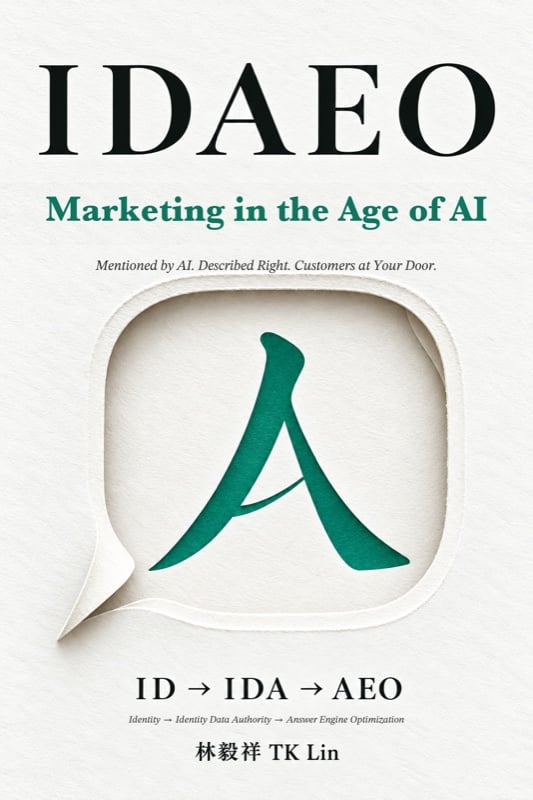
| IDAEO Service Tiers | 服務分級(三級) | 服务分级(三级) | サービス階層 | Service Design | How far to go: choose AEO Exposure, AEO+ Word of Mouth, or IDA Brand PR by goal; each covers a different part of the journey. ID → IDA → AEO in the title is the order of the work: identity, then official and verifiable identity data, then use by answer engines. AEO → AEO+ → IDA is the depth of service: read first (S1–S4), named in the answer (S5–S6), then answered right, visit, and return (S7–S10, includes the first two tiers). Same letters, different order; the AEO in the title is an optimization domain, not the first service tier. The cover line describes what the whole book aims for, not the name of any tier. |
| AEO Exposure — Gets read first (S1–S4) | AEO 曝光 — 先被讀到(S1–S4) | AEO 曝光 — 先被读到(S1–S4) | AEO露出 — まず読まれる(S1–S4) | Brand Exposure | The name of a plan that covers only S1–S4. Its goal is to get your content read first. It does not mean being mentioned or cited by answer engines, as commonly understood in the market. Mentions fall under the next tier, AEO+ Word of Mouth (S5–S6). Being listed as a source falls under S7. |
| AEO+ Word of Mouth — Named in the answer (S5–S6) | AEO+ 口碑 — 被點名(S5–S6) | AEO+ 口碑 — 被点名(S5–S6) | AEO+ クチコミ — 言及される(S5–S6) | Word-of-Mouth Marketing | Covers S5–S6: building word of mouth when AI names you in its answers; whether it recommends you depends on what the answer says. Word of mouth in the AI era = AI speaks for you (AI Word of Mouth). |
| IDA Brand PR — Described right, visit, return (S7–S10, includes the first two tiers) | IDA 品牌公關 — 講對、上門、回來(S7–S10,含前兩級) | IDA 品牌公关 — 讲对、上门、回来(S7–S10,含前两级) | IDAブランドPR — 正しく語られ、来訪、再訪(S7–S10、前の二階層を含む) | Brand PR | Focuses on S7–S10 and includes the first two tiers, so the full journey S1–S10 is completely covered. The service tier that supports brand choice through credible answers, acting for customers, and customer return. This is the name of the highest service tier. In the book title, IDA means Identity Data Authority. In the verification model, IDA Verification is a method. These three uses share the name IDA but differ in scope. |
| Performance Metrics | 成效指標 | 成效指标 | 成果指標 | Marketing Performance Measurement | The nine measures that correspond to the results of each journey step. |
| AI Readiness Score | AI 就緒分 | AI 就绪分 | AIレディネス・スコア | Readiness Assessment | How well prepared a merchant is at S1, scored 0–100. |
| AI Crawl Volume | AI 讀取量 | AI 读取量 | AIクロール数 | AI Exposure | The number of times AI and search engines obtain content in S2–S4: crawled for training, AI indexing, and search indexing, totaling 97.46 million. |
| AI Real-Time Retrievals | AI 當場來讀量 | AI 当场来读量 | AIリアルタイム取得数 | Real-Time Demand | The number of times AI retrieves content in real time in response to a customer's question. |
| AI Mention Rate | AI 點名率 | AI 点名率 | AI言及率 | Brand Mentions | The share of the same set of questions in which AI mentions the merchant. |
| AI Answer Accuracy Rate | AI 正確率 | AI 正确率 | AI回答正確率 | Information Quality | The share of AI answers about the merchant that match verified facts. |
| AI Citations | AI 引用量 | AI 引用量 | AI引用数 | Citation Outcomes | The number of times AI answers list your content as a source. |
| AI Agent Visits | AI Agent 到站量 | AI Agent 到站量 | AIエージェント訪問数 | Agent Touchpoints | The total number of website visits by automated browsing classified by behavioral signature and by named AI Agents; named AI Agents can be identified directly as visiting on customers' behalf. |
| Search & AI Referral Visits | AI 導客量 | AI 导客量 | 検索・AI経由流入数 | Referral Traffic | This book measures it as the number of times customers click through to the website via search or AI. |
| AI Return Visits | AI 回訪量 | AI 回访量 | AI再訪数 | Customer Re-engagement | The result of the same customer asking again and visiting again. |
| AI Content Use | AI 取用 | AI 取用 | AIによるコンテンツ利用 | Content Performance | Use of content in AI reading, answer citations, and acting on customers' behalf. |
| AI Visibility | AI 能見度 | AI 能见度 | AI可視性 | Brand Visibility | How a brand appears in AI answers; IDAEO looks at both being mentioned and answer accuracy. |
| First-Party Data | 第一方數據 | 第一方数据 | ファーストパーティデータ | First-Party Data | Data that IDAEO measures and accumulates directly, used to build the methodology and verify results. |
| Organic Traffic | 自然流量 | 自然流量 | 自然流入 | Organic Reach | The number of times customers click through to the website from search or AI. |
| Tracking in Progress | 實測追蹤中 | 实测跟踪中 | 計測中 | Performance Measurement | IDAEO keeps accumulating measurement results and will publish them later. |
| Black Box | 黑盒子 | 黑盒子 | ブラックボックス | Decision Process | Mentions, answers, and actions in S6–S8, along with the training and ranking that follow crawls in S3–S4, all happen inside AI Platforms; IDAEO measures them through both-end measurement and periodic live tests. |
| Five Marketing Audiences | 五類行銷受眾 | 五类营销受众 | 五つのマーケティング・オーディエンス | Target Audiences | Humans, Search Engine Crawlers, AI Crawlers, AI Agents, and Automated Bots. |
| Four AI Audiences | 四類 AI 受眾 | 四类 AI 受众 | 四つのAIオーディエンス | AI Customers | Search Engine Crawlers, AI Crawlers, AI Agents, and Automated Bots. |
| Six Optimization Domains | 六大優化領域 | 六大优化领域 | 六つの最適化領域 | Channel Optimization | The optimization scope shared by SEO, AIO, AEO, GEO, LLMO, and MEO. AIO handles search engines' AI summaries; AEO handles AI answers and real-time reading. GEO is the domain of raising content's visibility in generative answers and overlaps with AEO at the answer stage. LLMO faces model training and is observed through reads for training. Building the AI index is the name of the S4 function. |
| Five Dimensions of IDAEO Marketing | IDAEO 行銷五大構面 | IDAEO 营销五大构面 | IDAEOマーケティングの五つの構成軸 | Marketing Framework | The framework of IDAEO: it organizes marketing work through Audience Strategy (who it is for), Journey Design (which steps to take), Trust and Verification (why anyone should believe it), Service Tiers (which tier to deliver), and Performance Measurement (how results are counted). |
| Audience Strategy | 受眾策略 | 受众策略 | オーディエンス戦略 | Target Market | Who it is for: arrange information and contact according to the needs of Marketing Audiences. |
| Journey Design | 旅程設計 | 旅程设计 | ジャーニー設計 | Customer Experience | Which steps to take: link brand contact, AI Content Use, and customer action into a journey. |
| Trust and Verification | 信任驗證 | 信任验证 | 信頼と検証 | Brand Trust | Why anyone should believe it: support brand claims with credible facts and external corroboration. |
| Performance Measurement | 成效衡量 | 成效衡量 | 成果測定 | Marketing Results | How results are counted: use the metrics matched to each step to read the value of content use and conversion. |
| Nine Elements of the IDAEO Framework | IDAEO 架構九大要素 | IDAEO 架构九大要素 | IDAEOフレームワークの九要素 | Marketing Framework | The components of IDAEO: Marketing Audiences, Optimization Domains, Customer Journey, Journey Diagnostics, IDAEO Solutions, Verification Principles, Service Tiers, Performance Metrics, and First-Party Data. |
| IDAEO Solutions | IDAEO 解決方案 | IDAEO 解决方案 | IDAEOソリューション | Marketing Support | Professional services matched to the Customer Journey and marketing goals. |
| Verification Principles | 驗證原則 | 验证原则 | 検証原則 | Credibility | Build credible claims on verified facts, a traceable basis, and external corroboration. |
| AI Customer Journey: Four Phases, Ten Steps | AI 顧客旅程:四階段十步驟 | AI 顾客旅程:四阶段十步骤 | AIカスタマージャーニー:四つのフェーズと十のステップ | Customer Journey | Links S1–S10 through Merchant Readiness, AI Information Acquisition, AI-Assisted Decision and Action, and Customer Conversion and Re-engagement. |
| Merchant Readiness | 店家就緒 | 店家就绪 | 店舗レディネス | Information Preparation | At S1, brand information is ready for people and AI to understand. |
| AI Information Acquisition | AI 資訊取得 | AI 信息获取 | AIによる情報取得 | Information Touchpoints | At S2–S4, AI acquires information for search, training, and answering. |
| AI-Assisted Decision and Action | AI 輔助決策與行動 | AI 辅助决策与行动 | AIによる意思決定・行動支援 | Decision Support | At S5–S8, AI responds to the need, mentions brands, answers details, and acts for customers. |
| Customer Conversion and Re-engagement | 顧客轉換與回流 | 顾客转化与回流 | 顧客のコンバージョンと再エンゲージメント | Conversion and Relationship Management | At S9–S10, the customer takes action and engages the brand again. |
| AI Impressions | AI 曝光數 | AI 曝光数 | AIインプレッション数 | Exposure Measurement | Each time AI or a search engine reads your content is one AI impression. This is exposure to AI—each time AI reads you counts as one, not how many people saw it; it is the marketing meaning of AI Crawl Volume. |
| Automated Information Services | 自動化資訊服務 | 自动化信息服务 | 自動化情報サービス | Information Services | Services such as information organization, analysis, and web page previews provided by Automated Bots. |
| Local Search | 在地搜尋 | 本地搜索 | ローカル検索 | Local Marketing | Customers looking for merchants or services by location and nearby needs. |
| IDAEO Learners | IDAEO 學習者 | IDAEO 学习者 | IDAEO学習者 | Marketing Education | The general public who want to understand and apply AI-Era Marketing. |
| Law of Audience Adaptation | 受眾適配定律 | 受众适配定律 | オーディエンス適応の法則 | Audience Strategy | Expression varies with the audience, because people and AI understand information differently. |
| Law of Identity Continuity | 身分連續定律 | 身份连续定律 | アイデンティティ連続性の法則 | Brand Awareness | The entity's identity is always consistent; AI's recognition of an entity builds up over the long term. |
| Law of Independent Verification | 驗證獨立定律 | 验证独立定律 | 独立検証の法則 | Brand Trust | Verification has a cost, and conclusions follow the facts, because credibility comes from judgment that is not swayed by the client. |
| Law of Fact Primacy | 事實先行定律 | 事实先行定律 | 事実優先の法則 | Credibility | Credible content starts from verified facts; only once verified does AI use it with confidence. |
| Law of Claim Traceability | 主張溯源定律 | 主张溯源定律 | 主張の追跡可能性の法則 | Source Credibility | Every claim has a traceable basis; only when it can be traced does AI cite it with confidence. |
| Law of External Corroboration | 外部印證定律 | 外部印证定律 | 外部裏付けの法則 | external corroboration | A credible claim must have external corroboration, because independent viewpoints complete a one-sided account. |
| Law of Full-Journey Outcomes | 全程成效定律 | 全程成效定律 | ジャーニー全体の成果の法則 | Marketing Performance | AI Content Use at every stage counts as a result, because customers complete their decision right in the AI answer. |
| IDAEO Verification Model | IDAEO 驗證模型 | IDAEO 验证模型 | IDAEO 検証モデル | Brand Trust | Built on big data from Japan, Taiwan, and Hong Kong, it combines Official Source, First-Party Source, and Third-Party Source evidence, accumulates data over the long term, keeps checking, and re-verifies on expiry, to support credible judgments on individual facts. |
| Cold Start | 冷啟動 | 冷启动 | コールドスタート | Traffic Accumulation | AI traffic accumulates from 0; the industry rule of thumb is about 90 days. |
| Warm Start | 熱啟動 | 热启动 | ウォームスタート | Traffic Accumulation | Content meets S1 and goes live on an AI Traffic Hub. Rule of thumb: about 30 days; TK Lin's personal IDA case reached S7 (Answer) in 14 days. |
| AI Traffic Hub | AI 流量樞紐 | AI 流量枢纽 | AIトラフィック・ハブ | Channels and Platforms | A platform that accumulates ten million or more AI requests per month; content connects to existing AI traffic as soon as it goes live. The IDAEO platform (idaeo.ai) is an AI Traffic Hub. |
| Compounding Lead | 複利領先 | 复利领先 | 複利的リード | Traffic Accumulation | AI impressions accumulate and bring more content use and data; the earlier you start, the more your lead widens over time. |
| AI Platforms | AI 平台 | AI 平台 | AIプラットフォーム | Channels and Platforms | Companies that operate search engines, AI services, and crawlers, such as Google, OpenAI, Microsoft, Anthropic, Apple, and Meta. |
| Living Theory | 活的學說 | 活的学说 | 生きている理論 | Marketing | IDAEO gains new data and new real-world verification every month, and its theoretical and empirical foundation keeps strengthening. |
Free to download, updated monthly
Cite this book
IDAEO: Marketing in the Age of AI · 林毅祥(TK Lin) · 1st edition, 9th revision · · https://km.idaeo.ai/idaeo/textbook?lang=en · CC BY 4.0