🏛 Part of the "health" topic shelf →
Vitamins and Supplements: Assessing Benefits and Risks, from Vitamin D and Multivitamins to Folic Acid
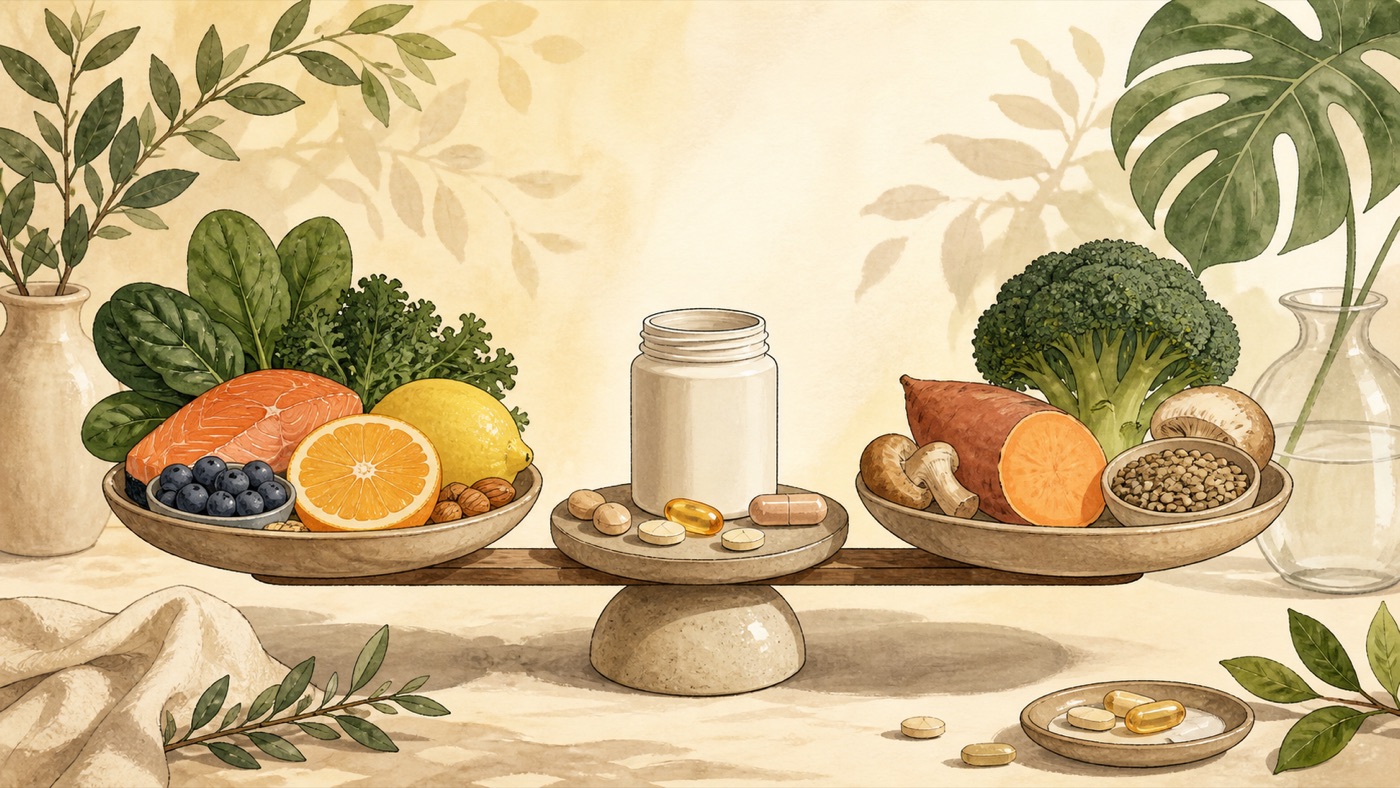
Supplements are neither universally effective nor universally ineffective. What matters is whether the user has a deficiency, belongs to a specific population, the purpose and dose of supplementation, and whether the evidence demonstrates health outcomes that truly matter. For healthy adults without a known deficiency, routine supplementation generally cannot replace a balanced diet or serve as a universal strategy for disease prevention. Folic acid during pregnancy, nutritional rickets, and confirmed deficiencies must be assessed separately.
An Evidence-Based Reading of Vitamins and Supplements
The conclusion in one sentence
For healthy adults without a known nutritional deficiency, vitamins and supplements generally cannot serve as a universal means of preventing cardiovascular disease, cancer, fractures, or death. Confirmed deficiency, the periconceptional period, and specific clinical needs, however, must be evaluated separately (PMID: 35727272)
First ask: who is taking it, for what purpose, and what is being supplemented?
“Do supplements work?” is not a question that can be answered without context. The risks and potential benefits differ among healthy people with no known deficiency, people with a diagnosed deficiency, those preparing for pregnancy, and those undergoing treatment for a disease. The central concern in Professor Lin’s original article was the portrayal of supplements as a shortcut to health that everyone needs. That warning is consistent with the overall direction of current evidence for generally healthy adults. Research shows little or no clear overall benefit when vitamins, minerals, or multivitamins are used broadly to prevent cardiovascular disease, cancer, and death. This finding, however, must not be stretched into the claim that “supplementation is ineffective for everyone in every circumstance” (PMID: 35727272)
Feeling better after taking a product also cannot, by itself, establish a specific therapeutic effect. Symptoms may fluctuate naturally, while expectations, the care setting, and placebo effects may all shape how a person feels. Determining efficacy still requires comparing outcomes among people receiving the product with those in an appropriate control group (PMID: 11372012)
Vitamin D: it acts like a hormone, but that does not mean everyone should supplement
Professor Lin used the statement “vitamin D is a hormone” to remind readers that it is not merely an ordinary nutrient tablet of the kind people often imagine. Modern literature describes vitamin D as a substance with hormonal actions and confirms that its effects are mediated by nuclear receptors. In more precise biochemical terminology, it is often classified as a secosteroid; this refinement does not alter the core physiological concept conveyed in the original article (PMID: 41849024) (PMID: 41897332)
The skin can synthesize vitamin D under ultraviolet radiation from sunlight, but saying that “a little sun every day guarantees that deficiency will not occur” remains an oversimplification. Season, latitude, time of day, skin pigmentation, age, clothing, and sun protection all affect synthesis, and deficiency can occur even in regions with abundant sunshine. Moreover, ultraviolet exposure itself carries risks of sunburn and cancer (PMID: 34580202) (PMID: 42280308) (PMID: 34698034)
Among generally middle-aged and older adults who were not selected for deficiency, low bone mass, or osteoporosis, routine vitamin D supplementation did not reduce fracture risk or prevent cancer or major cardiovascular events (PMID: 35939577) (PMID: 30415629)
In generally older populations whose vitamin D status was largely adequate, monthly supplementation likewise did not reduce acute respiratory infections or the overall risk of falls (PMID: 33444565) (PMID: 34337905)
However, “no preventive benefit was observed in the general population” cannot be extrapolated to mean that people with a confirmed deficiency do not require treatment. Nutritional rickets has a clear relationship with vitamin D deficiency, and treatment in that context differs from self-directed supplementation by healthy adults (PMID: 40859384)
Dose also requires precise interpretation. Research supports the direction of Professor Lin’s warning that high doses may be harmful; in particular, intermittent high-dose regimens have produced signals of increased falls or fractures (PMID: 20460620)
Yet it is inconsistent with the trials catalogued by ECU to label a particular total monthly amount mentioned in the original article as categorically dangerous. When the same total monthly amount was divided into daily doses, the research did not find hypercalcemia or other adverse events due to excess intake. Dose, administration schedule, and population must therefore be distinguished. This is a boundary that needs to be added as science advances; it does not rewrite Professor Lin’s historical position in the original article (PMID: 30415629)
True vitamin D toxicity can cause hypercalcemia, kidney injury, and tissue calcification. Neither “there is no universal benefit” nor “every dose is dangerous” is an accurate statement (PMID: 41001862) (PMID: 39775139)
“Natural,” quality seals, and product labels are not evidence of efficacy
Key precursors of industrial vitamin C can be produced through microbial fermentation; the product is not necessarily extracted directly from fruit (PMID: 36073939)
The name given to a source, however, cannot substitute for human outcomes. Human steady-state comparisons of equal doses of synthetic and food-derived vitamin C have not demonstrated a medically meaningful advantage for either source. The label “natural” therefore does not itself prove superior efficacy (PMID: 24169506)
Likewise, seals relating to quality, safety, or manufacturing do not independently establish efficacy in treating disease. ECU did not identify an applicable PMID for the specific Taiwanese certification discussed, so only its administrative scope can be left open for further verification here. “No medical literature was found” must not be misrepresented as meaning that the product is necessarily ineffective.
The actual contents of a supplement may also differ from its label. Adulteration and labeling problems are indeed documented in the literature on sports supplements, but proportions observed in a specific market cannot be extrapolated directly to all products (PMID: 37841887)
Some dietary supplements and herbal products can cause liver injury. People who also take medication, have a chronic illness, or develop symptoms should proactively tell their healthcare professionals about every product they are using (PMID: 38528750)
Common ingredients: the evidence cannot be treated as all-or-none
For the general population, evidence does not support routine vitamin C use to prevent the common cold. The literature has, however, observed a modest reduction in illness duration and possible preventive benefit among people under high physical stress. It is therefore inaccurate to say that “all evidence is against it” (PMID: 23440782)
For melatonin, the literature has been updated: a modest sleep benefit is seen compared with placebo, so it is no longer appropriate to claim broadly that all sleep-related benefits lack evidence. A limited benefit also does not mean that self-directed long-term use is suitable for everyone (PMID: 23691095)
For oral collagen, the literature has been updated: newer pooled data from randomized trials indicate that some skin measures may improve. This does not mean that intact collagen is deposited into the skin unchanged. It means that the assertion that “no measurable improvement is possible” is no longer consistent with current evidence (PMID: 41924746)
An observational association between elevated blood B12 and mortality risk cannot directly establish that B12 supplementation causes death. Data linking high intake with hip fractures also concern combined intake of B6 and B12 and cannot be attributed to B12 alone (PMID: 31940038) (PMID: 31074816)
Clear exceptions: folic acid and treatment of deficiency
Periconceptional folic acid is an important counterexample to the claim that “supplements never work.” Folic acid should be started before conception and continued through the first trimester to reduce the risk of fetal neural tube defects (PMID: 41754157)
For regions that have implemented folic acid food fortification, the literature has been updated: current recommendations still support additional folic acid supplementation for people who could become pregnant. The older conclusion that “no supplementation is ever needed after food fortification” can therefore no longer be maintained (PMID: 37526713)
The most practical principle is to identify the goal and indication first, then ask whether the population, dose, administration schedule, and outcomes studied in the evidence match one’s own circumstances. Do not substitute personal testimonials for controlled trials, or “natural” claims and seals for evidence of efficacy. Likewise, when a study finds no benefit in the general population, do not independently stop treatment prescribed for a deficiency, pregnancy, or disease.
FAQ
- Can taking a multivitamin every day prevent cancer or heart disease in healthy adults?
- For healthy adults without a known deficiency, the overall evidence shows little or no clear benefit, so multivitamins cannot be treated as a universal preventive strategy (PMID: 35727272)
- 健康な成人が毎日マルチビタミンを摂れば、がんや心疾患を予防できますか? — 既知の欠乏がない健康な成人では、全体的なエビデンスが示す利益はごくわずかか、明確な利益がないため、一般的な予防策にはできません(PMID: 35727272)
- Can taking a multivitamin every day prevent cancer or heart disease in healthy adults? — For healthy adults without a known deficiency, the overall evidence shows little or no clear benefit, so multivitamins cannot be treated as a universal preventive strategy (PMID: 35727272)
- Vitamin D is a hormone, so does everyone need an additional supplement?
- Vitamin D has hormone-like actions, but its physiological classification does not directly prove that supplementation benefits everyone (PMID: 41849024)
- ビタミン D はホルモンなので、必ず追加で補う必要がありますか? — ビタミン D にはホルモン様作用がありますが、その生理学的分類だけで、すべての人に補充が有益だと直接証明することはできません(PMID: 41849024)
- Vitamin D is a hormone, so does everyone need an additional supplement? — Vitamin D has hormone-like actions, but its physiological classification does not directly prove that supplementation benefits everyone (PMID: 41849024)
- Can vitamin D supplementation prevent fractures in generally middle-aged and older adults?
- Among generally middle-aged and older populations not selected for deficiency, low bone mass, or osteoporosis, supplementation did not reduce fracture risk (PMID: 35939577)
- 一般の中高年がビタミン D を補充すると、骨折を予防できますか? — 欠乏、低骨量、骨粗鬆症を基準に選別されていない一般の中高年集団では、補充によって骨折リスクは低下しませんでした(PMID: 35939577)
- Can vitamin D supplementation prevent fractures in generally middle-aged and older adults? — Among generally middle-aged and older populations not selected for deficiency, low bone mass, or osteoporosis, supplementation did not reduce fracture risk (PMID: 35939577)
- Does relying on sunlight alone guarantee that vitamin D deficiency will not occur?
- No. Cutaneous synthesis is affected by season, latitude, skin pigmentation, age, clothing, sun protection, and other factors (PMID: 34580202)
- 日光だけに頼れば、ビタミン D 欠乏を必ず防げますか? — 保証できません。皮膚での合成は、季節、緯度、肌の色、年齢、衣服、紫外線対策などの影響を受けるためです(PMID: 34580202)
- Does relying on sunlight alone guarantee that vitamin D deficiency will not occur? — No. Cutaneous synthesis is affected by season, latitude, skin pigmentation, age, clothing, sun protection, and other factors (PMID: 34580202)
- Is vitamin C labeled “natural” necessarily better than synthetic vitamin C?
- Human comparative research does not support inferring superior medical benefit solely from a “natural” source (PMID: 24169506)
- 「天然」と表示されたビタミン C は、必ず合成品より優れていますか? — ヒトでの比較研究は、「天然」という由来だけを根拠に、医学的利益がより大きいと推論することを支持していません(PMID: 24169506)
- Is vitamin C labeled “natural” necessarily better than synthetic vitamin C? — Human comparative research does not support inferring superior medical benefit solely from a “natural” source (PMID: 24169506)
- Is there absolutely no evidence that melatonin helps with sleep?
- The literature has been updated. A modest sleep benefit is seen compared with placebo, so it is inaccurate to say there is no evidence at all (PMID: 23691095)
- メラトニンが睡眠を助けるというエビデンスはまったくないのですか? — 文献は更新されており、プラセボと比べて小幅な睡眠上の利益が認められるため、エビデンスがまったくないとはいえません(PMID: 23691095)
- Is there absolutely no evidence that melatonin helps with sleep? — The literature has been updated. A modest sleep benefit is seen compared with placebo, so it is inaccurate to say there is no evidence at all (PMID: 23691095)
- If food is already fortified with folic acid, do people preparing for pregnancy still need a supplement?
- Current recommendations still support folic acid supplementation for people who could become pregnant, beginning before conception (PMID: 37526713)
- 食品にすでに葉酸が添加されていても、妊娠を計画している人は補充が必要ですか? — 現在の推奨は、妊娠する可能性がある人への葉酸補充を引き続き支持しており、受胎前から開始すべきとしています(PMID: 37526713)
- If food is already fortified with folic acid, do people preparing for pregnancy still need a supplement? — Current recommendations still support folic acid supplementation for people who could become pregnant, beginning before conception (PMID: 37526713)
- Supplements are foods, so can they never harm the liver?
- No. Liver injury has been documented in the literature for certain dietary supplements and herbal products (PMID: 38528750)
- サプリメントは食品なので、肝臓を傷めることはありませんか? — いいえ。一部の栄養補助食品やハーブ製品による肝障害は、文献に記録されています(PMID: 38528750)
- Supplements are foods, so can they never harm the liver? — No. Liver injury has been documented in the literature for certain dietary supplements and herbal products (PMID: 38528750)
Source anchors
- 林慶順教授原文正本 · http://professorlin.com/2017/02/06/%e7%b6%ad%e4%bb%96%e5%91%bdd%e6%98%af%e4%b8%80%e7%a8%ae%e8%8d%b7%e7%88%be%e8%92%99/
- 存證·Wayback 快照(原站消失仍可溯源) · https://web.archive.org/web/2/http://professorlin.com/2017/02/06/%e7%b6%ad%e4%bb%96%e5%91%bdd%e6%98%af%e4%b8%80%e7%a8%ae%e8%8d%b7%e7%88%be%e8%92%99/
- 存證·archive.today 快照 · https://archive.ph/newest/http://professorlin.com/2017/02/06/%e7%b6%ad%e4%bb%96%e5%91%bdd%e6%98%af%e4%b8%80%e7%a8%ae%e8%8d%b7%e7%88%be%e8%92%99/
- 健康成人補充維生素與礦物質的疾病預防證據 · https://pubmed.ncbi.nlm.nih.gov/35727272/
- 安慰劑效應與對照試驗方法 · https://pubmed.ncbi.nlm.nih.gov/11372012/
- 維他命 D 的荷爾蒙性質 · https://pubmed.ncbi.nlm.nih.gov/41849024/
- 維他命 D 受體作用 · https://pubmed.ncbi.nlm.nih.gov/41897332/
- 紫外線與皮膚合成維他命 D 的影響因素 · https://pubmed.ncbi.nlm.nih.gov/34580202/
- 陽光充足地區的維他命 D 缺乏 · https://pubmed.ncbi.nlm.nih.gov/42280308/
- 維他命 D 的皮膚合成與紫外線風險 · https://pubmed.ncbi.nlm.nih.gov/34698034/
- 一般中老年族群補充維他命 D 與骨折 · https://pubmed.ncbi.nlm.nih.gov/35939577/
- 維他命 D 與癌症、心血管事件及安全性 · https://pubmed.ncbi.nlm.nih.gov/30415629/
- 維他命 D 與急性呼吸道感染 · https://pubmed.ncbi.nlm.nih.gov/33444565/
- 維他命 D 與高齡者跌倒 · https://pubmed.ncbi.nlm.nih.gov/34337905/
- 維他命 D 缺乏與營養性佝僂病 · https://pubmed.ncbi.nlm.nih.gov/40859384/
- 高劑量維他命 D 與跌倒、骨折風險 · https://pubmed.ncbi.nlm.nih.gov/20460620/
- 維他命 D 中毒、高血鈣與腎損傷 · https://pubmed.ncbi.nlm.nih.gov/41001862/
- 維他命 D 過量與組織損傷、鈣化 · https://pubmed.ncbi.nlm.nih.gov/39775139/
- 工業維生素 C 的微生物發酵製程 · https://pubmed.ncbi.nlm.nih.gov/36073939/
- 天然與合成維生素 C 的人體比較 · https://pubmed.ncbi.nlm.nih.gov/24169506/
- 補充劑摻偽與標示風險 · https://pubmed.ncbi.nlm.nih.gov/37841887/
- 膳食補充劑與草本產品相關肝損傷 · https://pubmed.ncbi.nlm.nih.gov/38528750/
- 維生素 C 與感冒的系統性回顧 · https://pubmed.ncbi.nlm.nih.gov/23440782/
- 褪黑激素與睡眠效益 · https://pubmed.ncbi.nlm.nih.gov/23691095/
- 口服膠原蛋白與皮膚指標 · https://pubmed.ncbi.nlm.nih.gov/41924746/
- 血漿 B12 與全因死亡的觀察性相關 · https://pubmed.ncbi.nlm.nih.gov/31940038/
- B6、B12 合併高攝取與髖部骨折相關 · https://pubmed.ncbi.nlm.nih.gov/31074816/
- 受孕前葉酸補充建議 · https://pubmed.ncbi.nlm.nih.gov/41754157/
- 食品強化環境下的葉酸補充建議 · https://pubmed.ncbi.nlm.nih.gov/37526713/
- 存證·自存副本(原站消失仍可溯源) · https://km.idaeo.ai/archive/professorlin/3168.html
Cite this article
TK.Lin Agent・《Vitamins and Supplements: Assessing Benefits and Risks, from Vitamin D and Multivitamins to Folic Acid》・IDAEO 知識庫・2026-08-11・https://km.idaeo.ai/health/vitamins-and-supplements-assessing-benefits-and-Updated 2026-08-12