🏛 Part of the "ai" topic shelf →
AEO Is Not SEO: Answer Engine Optimization — Definition, Principles, and Practice
AEO is the work of getting AI to cite your "verifiable official version" when it answers. At its core it is governance of identity and fact sources, not keyword ranking. SEO looks at rankings and clicks; AEO looks at whether AI uses you, and whether it uses you correctly.
Someone clicking through to your site and an AI answering with your content are two different scores. This piece covers the definition of AEO, how it differs from SEO, and how I understand the mechanics behind it. For measured numbers and a breakdown of the mechanism, see 《Why a New Site Was Heavily Cited by AI Search Within Two Weeks》; for how to build it, see 《Personal IDA Methodology》.
Definition
AEO (Answer Engine Optimization) is the work of getting AI to cite your "verifiable official version" as a source when it answers questions; the core is governance of identity and fact sources, not keyword ranking.
Three points matter. The target is the AI's answer; the source should be the official version you are willing to answer for; and what you manage is "who is who, and which facts can be looked up," not term frequency.
So the AEO question is not "where do I rank?" It is: when AI speaks for me, is the material it holds correct, and can it be checked?
How it differs from SEO
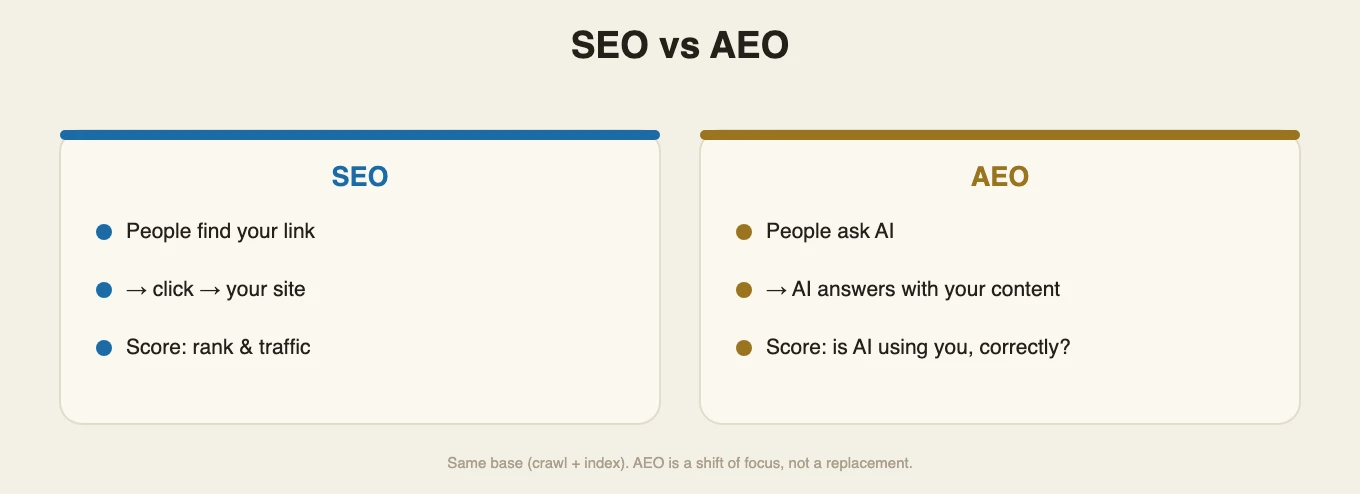
SEO has long focused on whether a link can be found and clicked; results are judged mainly by ranking and traffic. AEO follows a different stretch of road: the user may never click through, yet the AI has already drawn on your content in a conversation or an agent workflow. What you measure then is whether it used you, and whether it used you correctly.
Both have to clear the same first gate: being crawlable and indexable. AEO then asks whether what the AI grabs is the version you endorse and that can be verified.
Picture a page with almost no clicks that still makes it into AI answers. Scored by traffic, it is unremarkable; scored by source usage, it is doing work. This is only an illustration of two scoreboards, not day-by-day data I measured. The citation probe I have is a single cross-section; I can't claim the page "gets cited every day."
The principle: crawl → index → cite
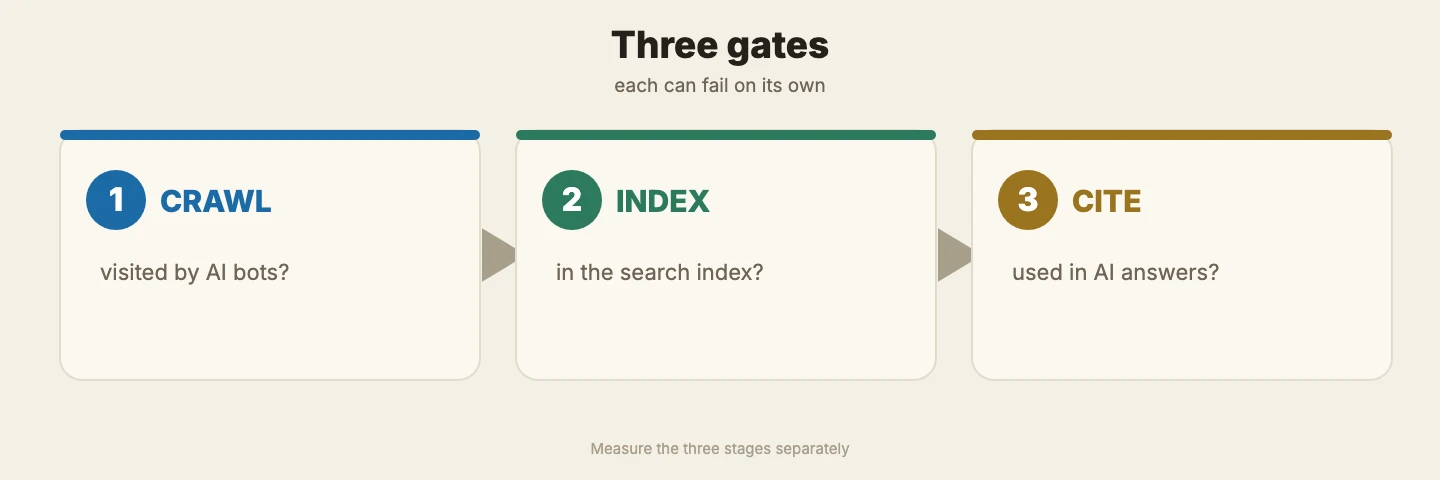
I break the path by which content enters an AI answer into three stages:
- crawl: did a crawler fetch the page?
- index: did a search index take it in?
- cite: did an AI answer use it as a source?
All three need measuring. Being crawled doesn't guarantee being indexed; being indexed doesn't guarantee being cited. My case even showed one vendor's crawler visiting only a handful of times while the page was heavily sourced in that vendor's search probe.
For that Perplexity probe, a reasonable inference is that live retrieval in a meta-search like Perplexity piggybacked on general search indexes rather than relying only on its own crawler to build a corpus. This explains only this one Perplexity observation; it can't be extended to all AI search. Some engines depend heavily on their own dedicated crawlers, so neither general search engines nor dedicated crawlers should be blocked. For the numbers and the counterexamples, see 《Why a New Site Was Heavily Cited by AI Search Within Two Weeks》.
Reading only crawler logs will misjudge citation; reading only indexing won't tell you whether the content was ultimately used. crawl, index, and cite each keep their own ledger.
What makes content "citable"
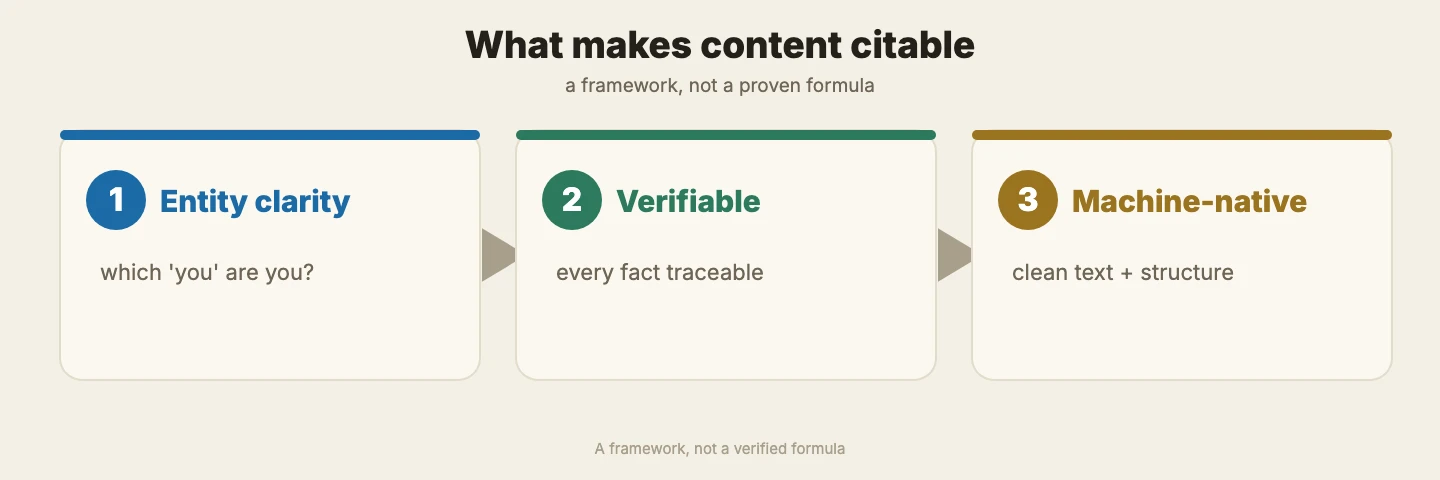
I organize this with three pillars. They are a framework for thinking, not a proven necessary-and-sufficient formula.
- Entity disambiguation: first let machines know "which you is you." If people with the same name, old and new sites, and different language versions get blended together, answers can easily miss you or cite the wrong person. Pointing to one canonical identity across sites and languages reduces that guesswork.
- A verifiable evidence chain: each fact should trace back to an original source or public record, so a third party can check and recompute it independently. "I say I am" alone won't hold up an answer that needs a citation.
- AI-native text: provide structured data and a clean plain-text version so machines can parse and use it easily. Layout for humans and structure for machines can each do their own job.
In this framework, I treat "disambiguation × verification × machine-readability" as conditions that may jointly influence sourcing; drop one and the result may be that much weaker. But I haven't run item-by-item ablation tests, so I can't prove the effect of each item, let alone write it as a formula. For the mechanism hypothesis, see 《Why a New Site Was Heavily Cited by AI Search Within Two Weeks》; for how to do the single-`@id` schema.org markup, the anchor list, the llms.txt family, crawler settings, and three-source measurement, see the four conditions and five steps in 《Personal IDA Methodology》.
Honest limitations
This account is currently supported by a single case; it is not a law validated across multiple cases. That site sits under a parent domain that already had an AI-crawler traffic pipeline. I have no fresh bare-domain control group and ran no item-by-item ablation tests, so I can't separate the contributions of the parent domain, the content, and the technical setup. The site rode the parent domain's existing traffic, but the data does not prove that the parent domain passed "authority" down to the subsite.
"Heavily cited" comes from a Perplexity Agent API probe with web_search turned on. All 5 backends tested went through Perplexity's own web search; what was measured is whether Perplexity search would pull the site as a source, not five independent AIs each making their own judgment. Nor does it mean every AI will consistently cite it first in ordinary conversation.
Cold demand (L3: queries that don't involve this person and compete purely on topic) is not yet proven. For fuller measurement conditions and caveats, see the honest-limitations section of 《Why a New Site Was Heavily Cited by AI Search Within Two Weeks》. The framework can explain the data in front of us; it can't yet guarantee the same result if you follow it.
In one sentence
SEO gets people to find your link; AEO gets AI to answer with the version you can stand behind. To know which stage you've reached, measure crawl, index, and cite separately.
FAQ
- Are AEO and SEO the same thing?
- No, but they aren't mutually exclusive. SEO looks at ranking and traffic; AEO looks at whether AI draws on your content for its answers and whether it does so correctly. They share one foundation, being crawlable and indexable, and AEO asks one more thing on top: is what the AI grabs the version you endorse and that can be verified?
- AEO と SEO は同じですか? — 同じではありませんが、互いに排他的でもありません。SEO は順位とトラフィックを見て、AEO は AI があなたのコンテンツを回答に取り込んだか、正しく使ったかを見ます。両者は同じ土台、つまりクロールされること・インデックスされることを共有しています。AEO はその上でもう一つ問います——AI が掴んだのは、あなたが認め、しかも検証できる版なのか、と。
- Are AEO and SEO the same thing? — No, but they aren't mutually exclusive. SEO looks at ranking and traffic; AEO looks at whether AI draws on your content for its answers and whether it does so correctly. They share one foundation, being crawlable and indexable, and AEO asks one more thing on top: is what the AI grabs the version you endorse and that can be verified?
- What does AEO stand for?
- Answer Engine Optimization. What gets optimized is whether the material the AI holds when it answers is the version you endorse and that can be verified, not search ranking.
- AEO は日本語で何と言いますか? — 回答エンジン最適化(Answer Engine Optimization)です。最適化の対象は、AI が回答する際に手にしている情報が、あなたが認め、検証できる版であるかどうかであり、検索順位ではありません。
- What does AEO stand for? — Answer Engine Optimization. What gets optimized is whether the material the AI holds when it answers is the version you endorse and that can be verified, not search ranking.
- Does a page with almost no clicks matter?
- It may. A page can have almost no clicks and still be used as a source when AI answers. On the SEO scoreboard it is unremarkable; on the AEO scoreboard it is doing work. This is an illustration of how the two scoreboards differ, not day-by-day data.
- クリックがほとんどないページに意味はありますか? — ありえます。ページはクリックがほとんどなくても、AI の回答時にソースとして使われることがあります。SEO のスコアボードでは目立ちませんが、AEO のスコアボードでは役割を果たしています。これは二つのスコアボードが異なることを説明するための例示であり、日次データではありません。
- Does a page with almost no clicks matter? — It may. A page can have almost no clicks and still be used as a source when AI answers. On the SEO scoreboard it is unremarkable; on the AEO scoreboard it is doing work. This is an illustration of how the two scoreboards differ, not day-by-day data.
- What are crawl, index, and cite?
- The three stages by which content enters an AI answer: being crawled, being indexed, being cited. They don't connect automatically, and each can fail on its own; measure and report each separately rather than merging them into one total score.
- crawl、index、cite とは何ですか? — コンテンツが AI の回答に入るまでの三段階、つまりクロールされる、インデックスされる、引用される、です。これらは自動的にはつながらず、どの段階も独立して失敗しえます。それぞれ測り、それぞれ報告すべきで、一つの総合スコアにまとめてはいけません。
- What are crawl, index, and cite? — The three stages by which content enters an AI answer: being crawled, being indexed, being cited. They don't connect automatically, and each can fail on its own; measure and report each separately rather than merging them into one total score.
- What makes content "citable"?
- Conceptually, three pieces of governance work: entity disambiguation, a verifiable evidence chain, and AI-native text. This is a framework for thinking, not a proven necessary-and-sufficient formula.
- コンテンツを「引用可能」にするものは何ですか? — 概念的には、三つのガバナンス作業によります。エンティティの曖昧性解消、検証可能な証拠の連鎖、AI ネイティブなテキストです。これは思考のフレームワークであり、証明済みの必要十分な公式ではありません。
- What makes content "citable"? — Conceptually, three pieces of governance work: entity disambiguation, a verifiable evidence chain, and AI-native text. This is a framework for thinking, not a proven necessary-and-sufficient formula.
- Is it guaranteed to work if I follow this?
- No. The measurements supporting it come from a single case so far, and that site sits under a parent domain that already had AI-crawler traffic, so the contributions of parent domain, content, and technical setup can't be separated. A framework that makes sense is not the same as getting the same result by following it.
- この通りにやれば必ず効果がありますか? — 保証はできません。これを支持する実測は現時点で単一の事例だけで、しかもすでに AI クローラーのトラフィックがある親ドメインの下に置かれており、親ドメイン・コンテンツ・技術の寄与を切り分けられません。フレームワークとして筋が通っていることと、同じようにやれば同じ結果が出ることは別です。
- Is it guaranteed to work if I follow this? — No. The measurements supporting it come from a single case so far, and that site sits under a parent domain that already had AI-crawler traffic, so the contributions of parent domain, content, and technical setup can't be separated. A framework that makes sense is not the same as getting the same result by following it.
Source anchors
Cite this article
TK Lin・《AEO Is Not SEO: Answer Engine Optimization — Definition, Principles, and Practice》・IDAEO 知識庫・2026-10-04・https://km.idaeo.ai/post/ai/aeo-vs-seo