

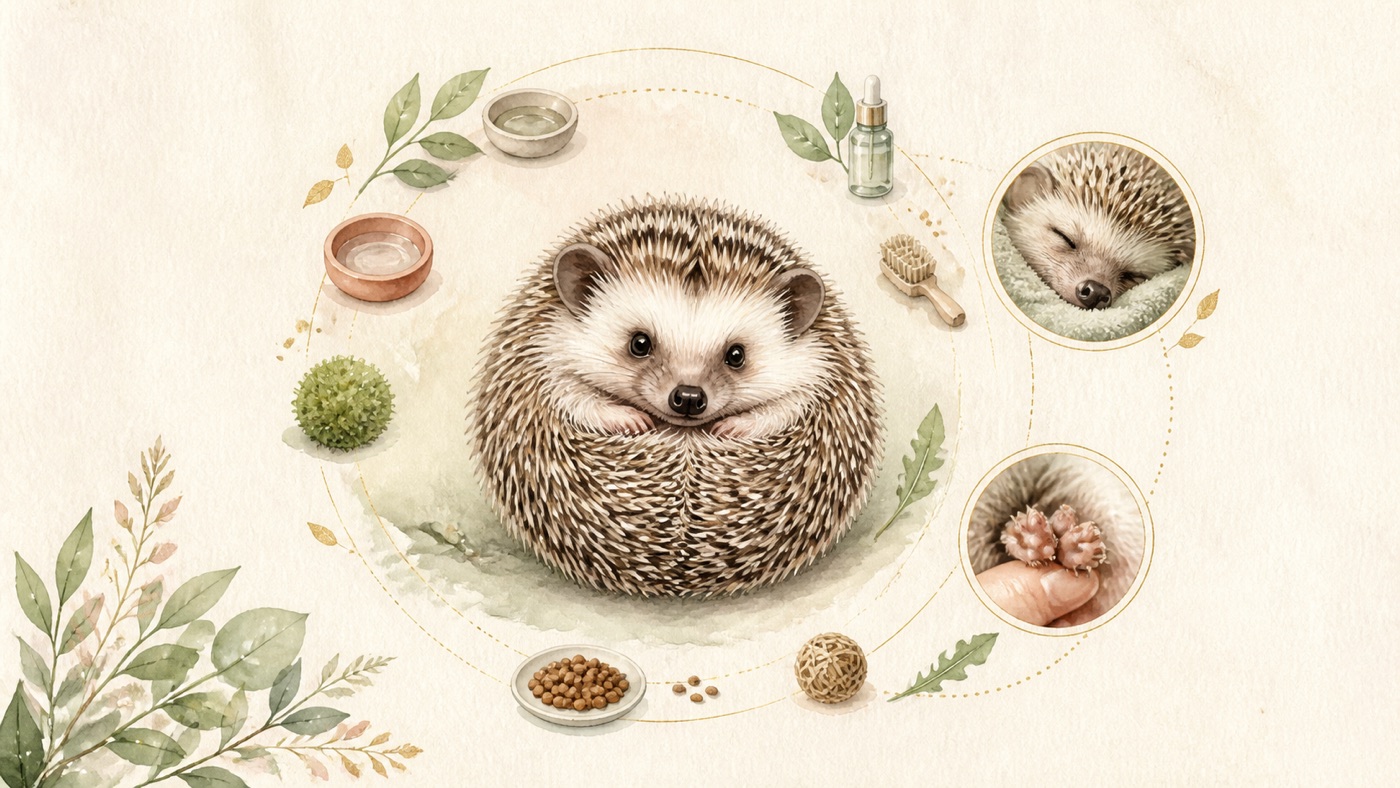
刺蝟|飼養與健康 12 欄知識樹
把刺蝟(Atelerix albiventris,寵物刺蝟主流為非洲侏儒刺蝟混血種)的物種與壽命、生理指標、飼養環境、營養、行為福利、預防醫學、常見疾病、急症紅旗、人畜共通病、居家毒物、老年安寧與權威來源共 12 欄整理成一張表。原文查不到權威數值的欄位留白並註明理由,本站不代為填數字。適合接手一隻新個體、或發現異常想先分清方向時對照使用。
刺蝟|飼養與健康 12 欄知識樹(Atelerix albiventris,寵物刺蝟主流為非洲侏儒刺蝟混血種)
本文整理自獸醫動物百科的小型哺乳類章節中 刺蝟 的 12 欄知識樹。小型哺乳類彼此差異極大——兔與天竺鼠沒有嘔吐反射、龍貓極不耐熱、雪貂是肉食動物,照別的物種做可能有害,先確認是哪一種動物。
| 欄位 | 內容 |
|---|---|
| 1 物種/品種與壽命 | 寵物刺蝟多為非洲侏儒刺蝟混血種。壽命:兩來源數字接近但不同,並列——Merck Vet Manual:平均4–6年,最長可達8年(「Average 4–6 years, may live to 8 years」生理數值表)<https://www.merckvetmanual.com/exotic-and-laboratory-animals/hedgehogs/overview-of-hedgehogs>;AEMV刺蝟照護指南:「MAXIMUM LIFE SPAN: 4–7 years」<https://aemv.org/wp-content/uploads/2024/10/aemv_trifold_hedgehog_web_7-.pdf>(查證2026-07-30)。 |
| 2 正常生理指標 | 監測體重、活動力、行走步態。異常:搖晃不穩步態(警覺神經系統疾病)、單側肢體無力。數值:體溫35.4–37.0°C(95.7–98.6°F);心跳180–280 bpm;呼吸速率25–50 breaths/min(Merck Vet Manual生理數值表:<https://www.merckvetmanual.com/exotic-and-laboratory-animals/hedgehogs/overview-of-hedgehogs>);成年體重來源略有差異並列:Merck公400–600g、母300–400g;AEMV刺蝟指南公500–600g、母250–400g(<https://aemv.org/wp-content/uploads/2024/10/aemv_trifold_hedgehog_web_7-.pdf>),兩者範圍重疊但不完全一致(查證2026-07-30)。 |
| 3 飼養環境 | 需維持穩定溫暖環境(過低會誘發危險的偽冬眠嘗試——非熱帶物種在人工環境嘗試冬眠常導致死亡)、適合尺寸跑輪(避免脊椎受傷)、躲避處(獨居夜行性需隱蔽空間)。溫度下限:低於20°C(68°F)即可能誘發危險的偽冬眠木僵狀態(Merck Vet Manual:「Cold temperatures (< 68°F [20°C]) or sometimes, very high temperatures, may cause torpor in hedgehogs.」「In this state, the hedgehog has a greatly diminished response to stimulation, decreased heart and respiratory rates...Dormancy can last for several weeks」<https://www.merckvetmanual.com/exotic-and-laboratory-animals/hedgehogs/diseases-of-hedgehogs>);建議日常飼養環境溫度22–32°C(72–90°F),理想24–29°C(75–85°F)(Merck管理頁:「Ambient temperature should be 72°–90°F (22°–32°C); 75°–85°F (24°–29°C) is optimal.」<https://www.merckvetmanual.com/exotic-and-laboratory-animals/hedgehogs/management-of-hedgehogs>;AEMV亦建議24–30°C(75–85°F))。此為本檔安全關鍵數字:低於20°C即有致命偽冬眠風險(查證2026-07-30)。 |
| 4 營養與餵食 | 雜食性(主食昆蟲/優質貓飼料或專用刺蝟飼料),適量補充昆蟲增加活動誘因。常見餵錯:長期餵食過量致肥胖(刺蝟極易過重,影響行動與內臟健康)、飼料油脂比例不當。 |
| 5 行為與福利 | 正常:自我塗抹(Self-anointing)——接觸新奇氣味時產生大量泡沫唾液塗抹自身棘刺,屬正常行為,常被誤認生病;蜷縮成球為主要防禦反應非攻擊性。緊迫訊號:持續蜷縮不展開拒絕互動、拒食。五大福利:獨居環境(禁與其他刺蝟同籠,具領域性)、足夠夜間活動空間與跑輪。 |
| 6 預防醫學 | 定期健檢留意體重管理、牙齒與皮膚檢查(蟎蟲好發)。頻率:來源不一致,並列——Merck Vet Manual:「Hedgehogs have a short life span and often hide signs of illness; therefore, complete examination and blood testing with chemical restraint are recommended every 6 months.」<https://www.merckvetmanual.com/exotic-and-laboratory-animals/hedgehogs/management-of-hedgehogs>(每半年);AEMV照護指南建議「bi-annual physical examination」(每半年,與Merck一致)但同文件另處又寫「annual exam」(每年,同文件內部矛盾)<https://aemv.org/wp-content/uploads/2024/10/aemv_trifold_hedgehog_web_7-.pdf>;University of Illinois與University of Florida兩所大學獸醫院頁面則建議每年一次(「hedgehogs should see a veterinarian every year」<https://vetmed.illinois.edu/pet-health-columns/hedgehog-pets/>;「Annual exams」<https://smallanimal.vethospital.ufl.edu/clinical-services/zoological-medicine/how-to-care-for-your-pet-hedgehog/>)。四來源中每半年與每年各有支持,不擇一(查證2026-07-30)。 |
| 7 常見疾病 Top 10 | 1. 搖擺刺蝟症候群(WHS, Wobbly Hedgehog Syndrome):不明原因神經退化性疾病(推測與遺傳相關,機轉:Merck Vet Manual:「The etiology of WHS remains unknown, but a hereditary basis is suspected.」病理描述為「spongy myelinopathy」,中樞神經多處(小腦、延腦、脊髓)出現雙側對稱性海綿樣病變;<https://www.merckvetmanual.com/exotic-and-laboratory-animals/hedgehogs/diseases-of-hedgehogs>;AEMV照護指南僅簡述為「progressive demyelinating paralysis」,未給病因說明,查證2026-07-30)→漸進性後肢無力、步態搖晃、逐漸癱瘓→神經學檢查(排除他因)→目前無治癒方法,僅支持性照護(處方)→無已知有效預防。<br>2. 肥胖:飲食過量/活動不足→皮下脂肪堆積影響蜷縮能力、行動遲緩→體態評分/理學檢查→飲食調整與增加活動(需獸醫營養規劃)→控制份量與提供跑輪。<br>3. 蟎蟲感染:體外寄生蟲→棘刺脫落、皮屑增多、搔癢→皮屑鏡檢→抗寄生蟲藥物(處方)→環境清潔與新進刺蝟檢疫。<br>4~10. 口腔疾病(牙周病常與細菌感染相關;Merck:「Periodontal disease is often associated with a bacterial component.」<https://www.merckvetmanual.com/exotic-and-laboratory-animals/hedgehogs/diseases-of-hedgehogs>)、腫瘤(刺蝟腫瘤發生率異常之高:Merck:「Neoplasia is extremely common in African pygmy hedgehogs.」一項調查中逾80%腫瘤為惡性,且個體常同時併發一種以上腫瘤(同來源);AEMV亦將「Cancer (especially over 3 years of age)」列為常見疾病)、子宮疾病(母刺蝟常見帶血陰道分泌物或血尿,多因子宮腫瘤或子宮內膜息肉所致;Merck:「Hemorrhagic vulvar discharge or hematuria is common in female hedgehogs and is often caused by uterine neoplasia or endometrial polyps.」同來源)等(查證2026-07-30)。 |
| 8 🚨急症紅旗 | 持續蜷縮完全不展開超過異常時間、明顯步態搖晃惡化、環境溫度過低疑似進入危險偽冬眠狀態(觸摸冰涼且反應遲鈍)、拒食超過一天以上(確切門檻【本項無單一權威數值:白名單來源未提供 小型哺乳類 專屬之 拒食時數門檻 參考值;此為臨床個案判斷範疇,且個體差異大——不要照這個數字等,查證2026-07-30】;小型哺乳類拒食本身即為就醫理由,越早越好)。 |
| 9 人畜共通病 zoonoses | 沙門氏菌(刺蝟為已知風險物種之一,接觸後務必洗手,孕婦/幼童/免疫低下者需格外留意);皮癬菌病。 |
| 10 居家毒物與危險品 | 殺蟲劑、除草劑殘留、部分室內植物、菸品/精油擴香(呼吸道敏感)。 |
| 11 老年、安寧與安樂死判斷 | WHS末期完全癱瘓、末期腫瘤、嚴重無法緩解之疼痛。刺蝟因蜷縮防禦天性極易掩飾病痛,安樂死時機判斷高度依賴獸醫專業評估而非飼主主觀觀察。 |
| 12 權威來源 | Journal of Exotic Pet Medicine(原典第117-118行);Merck Veterinary Manual(原典第293行);刺蝟專科教材書名:❌ 查無此物·已移除 — 【本項無單一權威數值:白名單來源未提供 刺蝟 專屬之 專科教材書名 參考值】;現有可查文獻僅為一般異寵/小型哺乳類獸醫教材中收錄的刺蝟專章,非獨立刺蝟專科書,故本欄不列具體書名,2026-07-30 查證。刺蝟相關內容仍以本表已列之 Journal of Exotic Pet Medicine 與 Merck Veterinary Manual 為權威來源。 |
上表 12 欄逐格照抄百科章節原文,未改寫、未濃縮;治療方向一律只寫類別、不寫藥名與劑量,用藥須由獸醫處方。原文對查不到權威數值的欄位(如部分物種的專屬就醫時數)明確留白並說明理由,本站照實保留。
這份內容的界限
本文內容出自獸醫百科 小型哺乳類 章節(原始位置與內容雜湊見證據鏈)。文末來源是該節引用的權威資料。本章在專案的行級錨檔中沒有建立逐列錨,只有章節級內容雜湊可驗——與本站既有的各章「族群總覽」文章同一層級,不等於每一句都逐句溯源到該筆來源。原文對查不到權威數值的欄位一律留白並註明理由,本站照實保留、不代為填數字。本內容為教育用途,不能取代執業獸醫的診斷與處方;急症請立即就醫。本文未經具名獸醫臨床判讀。
表中「原典第 N 行」是本專案建庫時所用原始教材盤點清單的行號,屬內部溯源標記、該清單未公開;括號外的書名與期刊名才是可自行查閱的來源。
FAQ
- 養刺蝟最容易餵錯什麼?
- 雜食性(主食昆蟲/優質貓飼料或專用刺蝟飼料),適量補充昆蟲增加活動誘因。常見餵錯:長期餵食過量致肥胖(刺蝟極易過重,影響行動與內臟健康)、飼料油脂比例不當。
- ハリネズミの給餌で最も間違えやすいのは何ですか。 — 雑食性(主食は昆虫/良質なキャットフードまたはハリネズミ専用フード)で、活動の動機づけとして昆虫を適量補います。よくある給餌の誤り:長期の過剰給餌による肥満(ハリネズミは非常に太りやすく、運動と内臓の健康に影響します)、フードの脂質比率が不適切。
- What is most easily got wrong when feeding a hedgehog? — Omnivorous (staple of insects/good-quality cat food or a dedicated hedgehog diet), with insects added in moderation as an activity incentive. Common feeding errors: chronic overfeeding leading to obesity (hedgehogs put on weight very easily, which affects mobility and organ health), and an inappropriate fat proportion in the diet.
- 刺蝟出現什麼狀況要立刻送醫?
- 持續蜷縮完全不展開超過異常時間、明顯步態搖晃惡化、環境溫度過低疑似進入危險偽冬眠狀態(觸摸冰涼且反應遲鈍)、拒食超過一天以上(確切門檻【本項無單一權威數值:白名單來源未提供 小型哺乳類 專屬之 拒食時數門檻 參考值;此為臨床個案判斷範疇,且個體差異大——不要照這個數字等,查證2026-07-30】;小型哺乳類拒食本身即為就醫理由,越早越好)。
- ハリネズミにどんな状態が現れたらすぐに受診すべきですか。 — 丸まったまま異常に長く全く開かない、歩様のふらつきが明らかに悪化、環境温度が低すぎて危険な擬似冬眠状態に入った疑い(触ると冷たく反応が鈍い)、1 日以上の拒食(正確な閾値【この項目に単一の権威ある数値はありません:ホワイトリストの出典は 小型哺乳類 に固有の 拒食時間の閾値 の参考値を示していません。これは症例ごとの臨床判断の範疇であり、個体差も大きいため——この数字を基準に待たないでください、確認2026-07-30】;小型哺乳類では拒食そのものが受診の理由であり、早いほどよい)。
- What signs in a hedgehog mean going to a veterinarian straight away? — Staying curled and completely failing to unroll for an abnormally long time, marked worsening of an unsteady gait, an ambient temperature so low that dangerous pseudo-hibernation is suspected (cold to the touch and slow to respond), refusing food for more than a day (the exact threshold 【No single authoritative figure for this item: the whitelisted sources do not provide a reference value for a small-mammal-specific anorexia time threshold; this belongs to case-by-case clinical judgement and individual variation is wide — do not wait against this number, verified 2026-07-30】; in small mammals anorexia is in itself a reason to seek care, and the sooner the better).
- 刺蝟最常見的疾病是什麼?
- 1. 搖擺刺蝟症候群(WHS, Wobbly Hedgehog Syndrome):不明原因神經退化性疾病(推測與遺傳相關,機轉:Merck Vet Manual:「The etiology of WHS remains unknown, but a hereditary basis is suspected.」病理描述為「spongy myelinopathy」,中樞神經多處(小腦、延腦、脊髓)出現雙側對稱性海綿樣病變;<https://www.merckvetmanual.com/exotic-and-laboratory-animals/hedgehogs/diseases-of-hedgehogs>;AEMV照護指南僅簡述為「progressive demyelinating paralysis」,未給病因說明,查證2026-07-30)→漸進性後肢無力、步態搖晃、逐漸癱瘓→神經學檢查(排除他因)→目前無治癒方法,僅支持性照護(處方)→無已知有效預防。
- ハリネズミで最もよくある疾患は何ですか。 — 1. ふらつきハリネズミ症候群(WHS, Wobbly Hedgehog Syndrome):原因不明の神経変性疾患(遺伝的要因が推測されています。機序:Merck Vet Manual:「The etiology of WHS remains unknown, but a hereditary basis is suspected.」病理は「spongy myelinopathy」と記載され、中枢神経の複数部位(小脳、延髄、脊髄)に左右対称の海綿状病変が生じます;<https://www.merckvetmanual.com/exotic-and-laboratory-animals/hedgehogs/diseases-of-hedgehogs>;AEMV 飼育ガイドは「progressive demyelinating paralysis」と簡潔に述べるのみで原因の説明はありません、確認2026-07-30)→進行性の後肢の脱力、ふらつく歩様、次第に麻痺→神経学的検査(他の原因の除外)→現時点で治癒法はなく、支持療法のみ(処方)→有効な予防法は知られていません。
- What is the most common disease in hedgehogs? — 1. Wobbly Hedgehog Syndrome (WHS): a neurodegenerative disease of unknown cause (a hereditary basis is suspected; mechanism: Merck Vet Manual: 「The etiology of WHS remains unknown, but a hereditary basis is suspected.」 the pathology is described as 「spongy myelinopathy」, with bilaterally symmetrical spongy lesions at multiple sites in the central nervous system (cerebellum, medulla, spinal cord); <https://www.merckvetmanual.com/exotic-and-laboratory-animals/hedgehogs/diseases-of-hedgehogs>; the AEMV care guide describes it only briefly as 「progressive demyelinating paralysis」 without an aetiology, verified 2026-07-30) → progressive hindlimb weakness, wobbling gait, gradual paralysis → neurological examination (to exclude other causes) → no cure at present, supportive care only (prescription) → no known effective prevention.
來源錨定
- Merck 獸醫手冊|小型哺乳章引用 · https://www.merckvetmanual.com/exotic-and-laboratory-animals/hedgehogs/overview-of-hedgehogs · 在 IDAEO 的其他引用
- AEMV 異寵獸醫學會|小型哺乳章引用 · https://aemv.org/wp-content/uploads/2024/10/aemv_trifold_hedgehog_web_7-.pdf · 在 IDAEO 的其他引用
- Merck 獸醫手冊|小型哺乳章引用 · https://www.merckvetmanual.com/exotic-and-laboratory-animals/hedgehogs/diseases-of-hedgehogs · 在 IDAEO 的其他引用
- Merck 獸醫手冊|小型哺乳章引用 · https://www.merckvetmanual.com/exotic-and-laboratory-animals/hedgehogs/management-of-hedgehogs · 在 IDAEO 的其他引用
- 伊利諾大學獸醫學院|小型哺乳章引用 · https://vetmed.illinois.edu/pet-health-columns/hedgehog-pets/ · 在 IDAEO 的其他引用
- 佛羅里達大學獸醫院|小型哺乳章引用 · https://smallanimal.vethospital.ufl.edu/clinical-services/zoological-medicine/how-to-care-for-your-pet-hedgehog/ · 在 IDAEO 的其他引用
引用本文
Jane・《刺蝟|飼養與健康 12 欄知識樹》・IDAEO 知識庫・2026-08-13・https://km.idaeo.ai/post/vet/hedgehog-guide更新於 2026-08-15