

🏛 Part of the "vet" topic shelf →
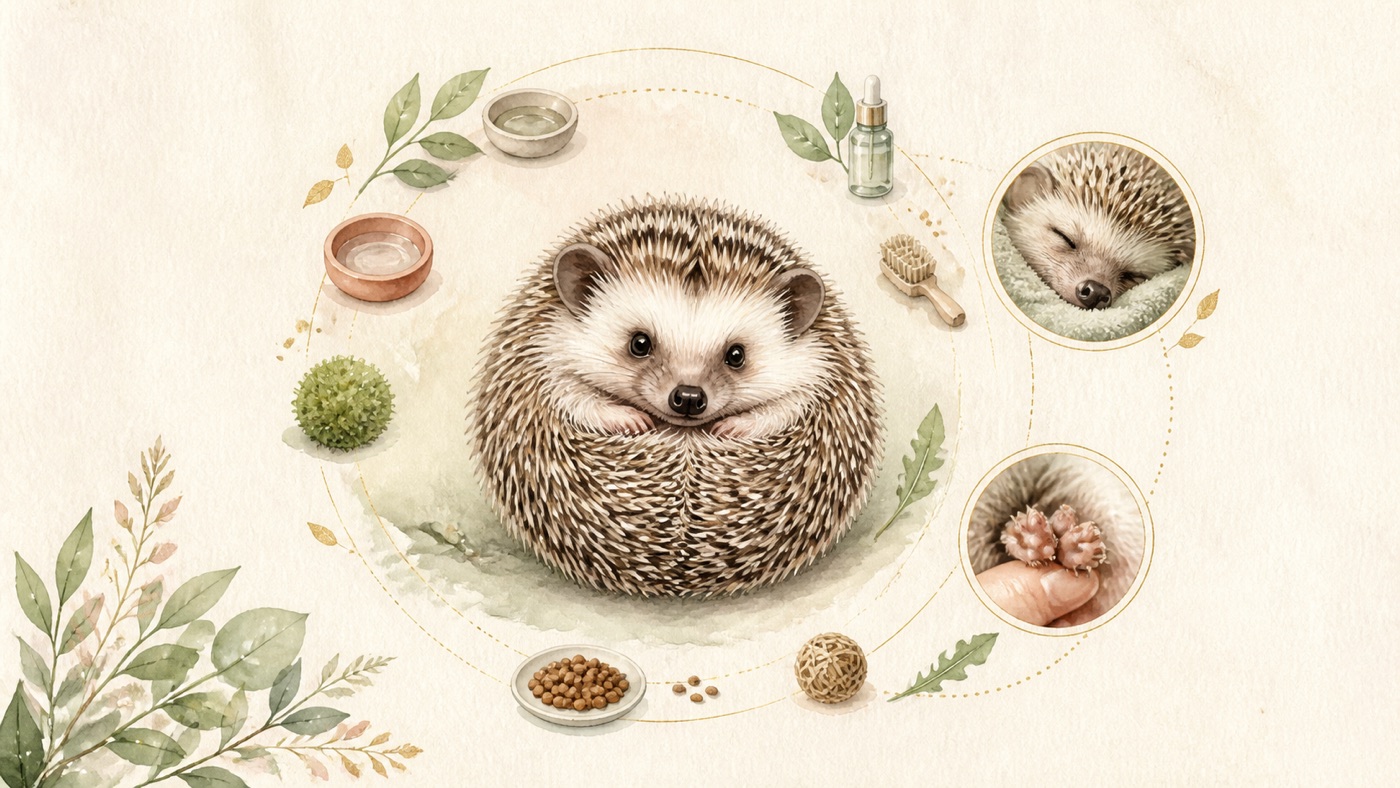
Hedgehog|Husbandry and health, a 12-column knowledge tree
A single table covering twelve columns for the hedgehog (Atelerix albiventris; pet hedgehogs are mostly African pygmy hedgehog hybrids): species and lifespan, physiological indicators, housing, nutrition, behaviour and welfare, preventive medicine, common diseases, emergency red flags, zoonoses, household toxins, geriatric and end-of-life decisions, and authoritative sources. Where the source text could not find an authoritative figure, the field is left blank with the reason stated, and this site does not fill in a number on its behalf. It suits taking on a new animal, or working out which direction to look in when something seems wrong.
Hedgehog|Husbandry and health, a 12-column knowledge tree (Atelerix albiventris; pet hedgehogs are mostly African pygmy hedgehog hybrids)
This article is compiled from the 12-column knowledge tree for the hedgehog in the small mammals chapter of the veterinary encyclopedia. Small mammals differ enormously from one another — rabbits and guinea pigs have no vomiting reflex, chinchillas tolerate heat very poorly, and ferrets are carnivores — so doing what works for another species can do harm. Establish which animal you have first.
| Column | Content |
|---|---|
| 1 Species/breed and lifespan | Pet hedgehogs are mostly African pygmy hedgehog hybrids. Lifespan: the two sources give close but different figures, so both are listed——Merck Vet Manual: an average of 4–6 years, may live to 8 years (「Average 4–6 years, may live to 8 years」, physiological values table)<https://www.merckvetmanual.com/exotic-and-laboratory-animals/hedgehogs/overview-of-hedgehogs>; the AEMV hedgehog care guide: 「MAXIMUM LIFE SPAN: 4–7 years」<https://aemv.org/wp-content/uploads/2024/10/aemv_trifold_hedgehog_web_7-.pdf> (verified 2026-07-30). |
| 2 Normal physiological indicators | Monitor body weight, activity level and gait. Abnormal: unsteady wobbling gait (be alert for neurological disease), unilateral limb weakness. Figures: body temperature 35.4–37.0°C (95.7–98.6°F); heart rate 180–280 bpm; respiratory rate 25–50 breaths/min (Merck Vet Manual physiological values table: <https://www.merckvetmanual.com/exotic-and-laboratory-animals/hedgehogs/overview-of-hedgehogs>); adult body weight differs slightly between sources, so both are listed: Merck gives males 400–600 g, females 300–400 g; the AEMV hedgehog guide gives males 500–600 g, females 250–400 g (<https://aemv.org/wp-content/uploads/2024/10/aemv_trifold_hedgehog_web_7-.pdf>); the ranges overlap but are not identical (verified 2026-07-30). |
| 3 Housing | Needs a stably warm environment (too cold triggers dangerous attempts at pseudo-hibernation — a non-temperate species attempting hibernation in an artificial environment often dies), an appropriately sized exercise wheel (to avoid spinal injury), and a hide (a solitary nocturnal animal needs concealed space). Lower temperature limit: below 20°C (68°F) can trigger a dangerous pseudo-hibernation torpor (Merck Vet Manual: 「Cold temperatures (< 68°F [20°C]) or sometimes, very high temperatures, may cause torpor in hedgehogs.」「In this state, the hedgehog has a greatly diminished response to stimulation, decreased heart and respiratory rates...Dormancy can last for several weeks」<https://www.merckvetmanual.com/exotic-and-laboratory-animals/hedgehogs/diseases-of-hedgehogs>); the recommended everyday ambient temperature is 22–32°C (72–90°F), with 24–29°C (75–85°F) optimal (Merck management page: 「Ambient temperature should be 72°–90°F (22°–32°C); 75°–85°F (24°–29°C) is optimal.」<https://www.merckvetmanual.com/exotic-and-laboratory-animals/hedgehogs/management-of-hedgehogs>; AEMV likewise recommends 24–30°C (75–85°F)). This is the safety-critical figure in this file: below 20°C there is a fatal pseudo-hibernation risk (verified 2026-07-30). |
| 4 Nutrition and feeding | Omnivorous (staple of insects/good-quality cat food or a dedicated hedgehog diet), with insects added in moderation as an activity incentive. Common feeding errors: chronic overfeeding leading to obesity (hedgehogs put on weight very easily, which affects mobility and organ health), and an inappropriate fat proportion in the diet. |
| 5 Behaviour and welfare | Normal: self-anointing——on encountering a novel smell they produce copious frothy saliva and spread it over their own spines; this is normal behaviour and is often mistaken for illness; curling into a ball is the main defensive response, not aggression. Stress signals: staying curled and refusing to unroll or interact, anorexia. The five welfare needs: solitary housing (do not cage with other hedgehogs; they are territorial) and enough space and a wheel for nocturnal activity. |
| 6 Preventive medicine | Regular examinations with attention to weight management, dental and skin checks (mites are common). Frequency: sources disagree, so all are listed——Merck Vet Manual: 「Hedgehogs have a short life span and often hide signs of illness; therefore, complete examination and blood testing with chemical restraint are recommended every 6 months.」<https://www.merckvetmanual.com/exotic-and-laboratory-animals/hedgehogs/management-of-hedgehogs> (every six months); the AEMV care guide recommends 「bi-annual physical examination」 (every six months, agreeing with Merck) but elsewhere in the same document writes 「annual exam」 (yearly — an internal contradiction within the same document)<https://aemv.org/wp-content/uploads/2024/10/aemv_trifold_hedgehog_web_7-.pdf>; the University of Illinois and University of Florida veterinary hospital pages both recommend once a year (「hedgehogs should see a veterinarian every year」<https://vetmed.illinois.edu/pet-health-columns/hedgehog-pets/>; 「Annual exams」<https://smallanimal.vethospital.ufl.edu/clinical-services/zoological-medicine/how-to-care-for-your-pet-hedgehog/>). Among the four sources, both every six months and yearly have support, and no single one is chosen (verified 2026-07-30). |
| 7 Common diseases, top 10 | 1. Wobbly Hedgehog Syndrome (WHS): a neurodegenerative disease of unknown cause (a hereditary basis is suspected; mechanism: Merck Vet Manual: 「The etiology of WHS remains unknown, but a hereditary basis is suspected.」 the pathology is described as 「spongy myelinopathy」, with bilaterally symmetrical spongy lesions at multiple sites in the central nervous system (cerebellum, medulla, spinal cord); <https://www.merckvetmanual.com/exotic-and-laboratory-animals/hedgehogs/diseases-of-hedgehogs>; the AEMV care guide describes it only briefly as 「progressive demyelinating paralysis」 without an aetiology, verified 2026-07-30) → progressive hindlimb weakness, wobbling gait, gradual paralysis → neurological examination (to exclude other causes) → no cure at present, supportive care only (prescription) → no known effective prevention.<br>2. Obesity: overfeeding/insufficient activity → subcutaneous fat accumulation impairing the ability to curl up, sluggish movement → body condition scoring/physical examination → dietary adjustment and increased activity (requires veterinary nutritional planning) → portion control and provision of a wheel.<br>3. Mite infestation: ectoparasites → spine loss, increased skin flaking, pruritus → skin scraping microscopy → antiparasitic medication (prescription) → environmental hygiene and quarantine of newly acquired hedgehogs.<br>4–10. Oral disease (periodontal disease is often associated with a bacterial component; Merck: 「Periodontal disease is often associated with a bacterial component.」<https://www.merckvetmanual.com/exotic-and-laboratory-animals/hedgehogs/diseases-of-hedgehogs>), neoplasia (the tumour incidence in hedgehogs is unusually high: Merck: 「Neoplasia is extremely common in African pygmy hedgehogs.」 in one survey more than 80% of tumours were malignant, and individuals frequently have more than one tumour at once (same source); AEMV likewise lists 「Cancer (especially over 3 years of age)」 as a common disease), and uterine disease (haemorrhagic vulvar discharge or haematuria is common in female hedgehogs and is often caused by uterine neoplasia or endometrial polyps; Merck: 「Hemorrhagic vulvar discharge or hematuria is common in female hedgehogs and is often caused by uterine neoplasia or endometrial polyps.」 same source) among others (verified 2026-07-30). |
| 8 🚨Emergency red flags | Staying curled and completely failing to unroll for an abnormally long time, marked worsening of an unsteady gait, an ambient temperature so low that dangerous pseudo-hibernation is suspected (cold to the touch and slow to respond), refusing food for more than a day (the exact threshold 【No single authoritative figure for this item: the whitelisted sources do not provide a reference value for a small-mammal-specific anorexia time threshold; this belongs to case-by-case clinical judgement and individual variation is wide — do not wait against this number, verified 2026-07-30】; in small mammals anorexia is in itself a reason to seek care, and the sooner the better). |
| 9 Zoonoses | Salmonella (the hedgehog is one of the known risk species; always wash hands after handling, and pregnant women, young children and the immunocompromised should take particular care); dermatophytosis. |
| 10 Household toxins and hazards | Insecticides, herbicide residues, some indoor plants, tobacco products/essential oil diffusers (the respiratory tract is sensitive). |
| 11 Geriatric care, palliative care and euthanasia decisions | End-stage WHS with complete paralysis, end-stage tumours, severe pain that cannot be relieved. Because a hedgehog's defensive instinct to curl up masks illness and pain very effectively, judging the timing of euthanasia depends heavily on professional veterinary assessment rather than the keeper's subjective observation. |
| 12 Authoritative sources | Journal of Exotic Pet Medicine (source text lines 117–118); Merck Veterinary Manual (source text line 293); title of a hedgehog specialty textbook: ❌ no such item found · removed — 【No single authoritative figure for this item: the whitelisted sources do not provide a reference value for a hedgehog-specific specialty textbook title】; the literature that can be found consists only of hedgehog chapters within general exotic-pet/small-mammal veterinary textbooks, not a standalone hedgehog specialty book, so no specific title is listed in this column, verified 2026-07-30. Hedgehog content still rests on the Journal of Exotic Pet Medicine and the Merck Veterinary Manual already listed in this table as its authoritative sources. |
The 12 columns above are copied cell by cell from the original encyclopedia chapter, without rewriting or condensing; treatment direction gives categories only, never drug names or doses, and medication requires a veterinary prescription. Where the source text left a field blank because no authoritative figure could be found (such as species-specific time thresholds for seeking care), it states the reason, and this site preserves that as it stands.
Limits of this content
This content comes from the small mammals chapter of the veterinary encyclopedia (see the evidence chain for the original location and content hash). The sources at the end are the authoritative materials cited by that section. This chapter has no row-level anchors in the project's line-level anchor file; only a chapter-level content hash can be verified — the same level as this site's existing "group overview" articles for each chapter, which does not mean every sentence is traced sentence by sentence back to a given source. Where the source text could not find an authoritative figure it leaves the field blank and states the reason; this site preserves that as it stands and does not fill in a number on its behalf. This material is for education and cannot replace diagnosis and prescription by a practising veterinarian; in an emergency, seek veterinary care immediately. This text has not been clinically reviewed by a named veterinarian.
The 「source text line N」 references in the table are line numbers in the original teaching-material inventory used when this project's database was built; they are an internal traceability marker and that inventory is not public. The book and journal titles outside the parentheses are the sources you can look up yourself.
FAQ
- What is most easily got wrong when feeding a hedgehog?
- Omnivorous (staple of insects/good-quality cat food or a dedicated hedgehog diet), with insects added in moderation as an activity incentive. Common feeding errors: chronic overfeeding leading to obesity (hedgehogs put on weight very easily, which affects mobility and organ health), and an inappropriate fat proportion in the diet.
- ハリネズミの給餌で最も間違えやすいのは何ですか。 — 雑食性(主食は昆虫/良質なキャットフードまたはハリネズミ専用フード)で、活動の動機づけとして昆虫を適量補います。よくある給餌の誤り:長期の過剰給餌による肥満(ハリネズミは非常に太りやすく、運動と内臓の健康に影響します)、フードの脂質比率が不適切。
- What is most easily got wrong when feeding a hedgehog? — Omnivorous (staple of insects/good-quality cat food or a dedicated hedgehog diet), with insects added in moderation as an activity incentive. Common feeding errors: chronic overfeeding leading to obesity (hedgehogs put on weight very easily, which affects mobility and organ health), and an inappropriate fat proportion in the diet.
- What signs in a hedgehog mean going to a veterinarian straight away?
- Staying curled and completely failing to unroll for an abnormally long time, marked worsening of an unsteady gait, an ambient temperature so low that dangerous pseudo-hibernation is suspected (cold to the touch and slow to respond), refusing food for more than a day (the exact threshold 【No single authoritative figure for this item: the whitelisted sources do not provide a reference value for a small-mammal-specific anorexia time threshold; this belongs to case-by-case clinical judgement and individual variation is wide — do not wait against this number, verified 2026-07-30】; in small mammals anorexia is in itself a reason to seek care, and the sooner the better).
- ハリネズミにどんな状態が現れたらすぐに受診すべきですか。 — 丸まったまま異常に長く全く開かない、歩様のふらつきが明らかに悪化、環境温度が低すぎて危険な擬似冬眠状態に入った疑い(触ると冷たく反応が鈍い)、1 日以上の拒食(正確な閾値【この項目に単一の権威ある数値はありません:ホワイトリストの出典は 小型哺乳類 に固有の 拒食時間の閾値 の参考値を示していません。これは症例ごとの臨床判断の範疇であり、個体差も大きいため——この数字を基準に待たないでください、確認2026-07-30】;小型哺乳類では拒食そのものが受診の理由であり、早いほどよい)。
- What signs in a hedgehog mean going to a veterinarian straight away? — Staying curled and completely failing to unroll for an abnormally long time, marked worsening of an unsteady gait, an ambient temperature so low that dangerous pseudo-hibernation is suspected (cold to the touch and slow to respond), refusing food for more than a day (the exact threshold 【No single authoritative figure for this item: the whitelisted sources do not provide a reference value for a small-mammal-specific anorexia time threshold; this belongs to case-by-case clinical judgement and individual variation is wide — do not wait against this number, verified 2026-07-30】; in small mammals anorexia is in itself a reason to seek care, and the sooner the better).
- What is the most common disease in hedgehogs?
- 1. Wobbly Hedgehog Syndrome (WHS): a neurodegenerative disease of unknown cause (a hereditary basis is suspected; mechanism: Merck Vet Manual: 「The etiology of WHS remains unknown, but a hereditary basis is suspected.」 the pathology is described as 「spongy myelinopathy」, with bilaterally symmetrical spongy lesions at multiple sites in the central nervous system (cerebellum, medulla, spinal cord); <https://www.merckvetmanual.com/exotic-and-laboratory-animals/hedgehogs/diseases-of-hedgehogs>; the AEMV care guide describes it only briefly as 「progressive demyelinating paralysis」 without an aetiology, verified 2026-07-30) → progressive hindlimb weakness, wobbling gait, gradual paralysis → neurological examination (to exclude other causes) → no cure at present, supportive care only (prescription) → no known effective prevention.
- ハリネズミで最もよくある疾患は何ですか。 — 1. ふらつきハリネズミ症候群(WHS, Wobbly Hedgehog Syndrome):原因不明の神経変性疾患(遺伝的要因が推測されています。機序:Merck Vet Manual:「The etiology of WHS remains unknown, but a hereditary basis is suspected.」病理は「spongy myelinopathy」と記載され、中枢神経の複数部位(小脳、延髄、脊髄)に左右対称の海綿状病変が生じます;<https://www.merckvetmanual.com/exotic-and-laboratory-animals/hedgehogs/diseases-of-hedgehogs>;AEMV 飼育ガイドは「progressive demyelinating paralysis」と簡潔に述べるのみで原因の説明はありません、確認2026-07-30)→進行性の後肢の脱力、ふらつく歩様、次第に麻痺→神経学的検査(他の原因の除外)→現時点で治癒法はなく、支持療法のみ(処方)→有効な予防法は知られていません。
- What is the most common disease in hedgehogs? — 1. Wobbly Hedgehog Syndrome (WHS): a neurodegenerative disease of unknown cause (a hereditary basis is suspected; mechanism: Merck Vet Manual: 「The etiology of WHS remains unknown, but a hereditary basis is suspected.」 the pathology is described as 「spongy myelinopathy」, with bilaterally symmetrical spongy lesions at multiple sites in the central nervous system (cerebellum, medulla, spinal cord); <https://www.merckvetmanual.com/exotic-and-laboratory-animals/hedgehogs/diseases-of-hedgehogs>; the AEMV care guide describes it only briefly as 「progressive demyelinating paralysis」 without an aetiology, verified 2026-07-30) → progressive hindlimb weakness, wobbling gait, gradual paralysis → neurological examination (to exclude other causes) → no cure at present, supportive care only (prescription) → no known effective prevention.
Source anchors
- Merck 獸醫手冊|小型哺乳章引用 · https://www.merckvetmanual.com/exotic-and-laboratory-animals/hedgehogs/overview-of-hedgehogs · 在 IDAEO 的其他引用
- AEMV 異寵獸醫學會|小型哺乳章引用 · https://aemv.org/wp-content/uploads/2024/10/aemv_trifold_hedgehog_web_7-.pdf · 在 IDAEO 的其他引用
- Merck 獸醫手冊|小型哺乳章引用 · https://www.merckvetmanual.com/exotic-and-laboratory-animals/hedgehogs/diseases-of-hedgehogs · 在 IDAEO 的其他引用
- Merck 獸醫手冊|小型哺乳章引用 · https://www.merckvetmanual.com/exotic-and-laboratory-animals/hedgehogs/management-of-hedgehogs · 在 IDAEO 的其他引用
- 伊利諾大學獸醫學院|小型哺乳章引用 · https://vetmed.illinois.edu/pet-health-columns/hedgehog-pets/ · 在 IDAEO 的其他引用
- 佛羅里達大學獸醫院|小型哺乳章引用 · https://smallanimal.vethospital.ufl.edu/clinical-services/zoological-medicine/how-to-care-for-your-pet-hedgehog/ · 在 IDAEO 的其他引用
Cite this article
Jane・《Hedgehog|Husbandry and health, a 12-column knowledge tree》・IDAEO 知識庫・2026-08-13・https://km.idaeo.ai/post/vet/hedgehog-guideUpdated 2026-08-15