
🏛 Part of the "dental" topic shelf →
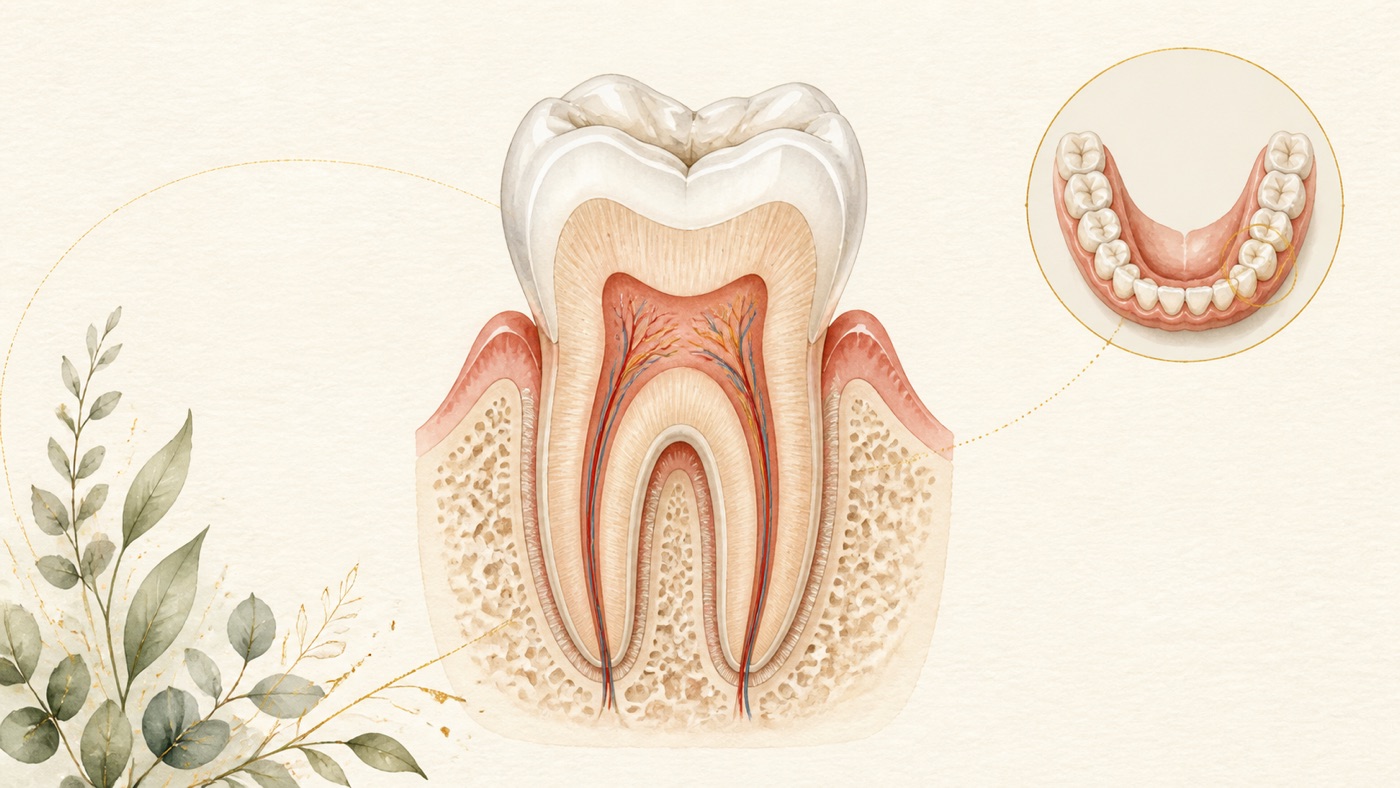
Which teeth are the molars? And why is the second molar the one people ask about?
Which teeth in the arch are the molars and which are the premolars, how to read tooth numbers (FDI two-digit and the universal system), at what ages the three molars erupt, where the second molar sits in occlusion and in its relationship with the wisdom tooth, and the line between what the literature can and cannot say. This card makes no claim that any tooth ranks above another in importance.
Which teeth are the molars? And why is the second molar the one people ask about?
Direct answer (60 characters or fewer in the source language)
Count back from the midline in each quadrant: teeth 4 and 5 are the premolars, teeth 6, 7 and 8 are the molars [F8][F9]. The second molar is the one whose number ends in 7 [F8]. No literature ranks teeth by importance [F22].
Scope: this is general health education based on international literature and an international standard. It does not cover any particular country's insurance scheme or regulations; for how care and fees are organised, follow the rules where you are.
First, which "molar" are you asking about
This card answers a question that people ask in Chinese and Japanese, where one everyday word (臼齒 / 臼歯) covers two different categories of tooth at once. English separates them - premolar and molar - but the same ambiguity comes back the moment someone says "my back tooth hurts". In the literature and in clinical records the two are separate classes: premolars and molars, and the permanent dentition is classified into four classes - incisors, canines, premolars and molars [F2]. So "my back tooth hurts" may mean the premolars, whose numbers end in 4 or 5, or the molars, whose numbers end in 6, 7 or 8. Identify the tooth first; everything after that depends on it.
What this card covers is what these teeth are, how they are counted, and what they do in occlusion. Whether a molar needs replacing after extraction, and what the options are, belongs to a different card (KM-DENTAL-34, linked at the end). This card does not rewrite that content and only cites it where needed [F22].
1. There are 32 permanent teeth, 8 in each quadrant
- A person has two sets of teeth: 20 deciduous teeth and 32 permanent teeth, 16 in the maxilla and 16 in the mandible. The permanent teeth are classified as incisors, canines, premolars and molars, and the primary teeth include no premolars [F2].
- The primary incisors, canines and molars are replaced at the change of dentition by the permanent incisors, canines and premolars respectively; the three permanent molars are additional positions rather than replacements for any primary tooth [F3]. This explains a common misunderstanding: the big tooth that appears at the back of the arch at around age 6 has not replaced a primary tooth (what sheds at that time is a primary incisor at the front), and it is a permanent tooth from the moment it appears - there is no second chance at it [F3][F4].
- Divide the 32 evenly into four quadrants and each quadrant has 8. Following the classes and the eruption list above, counting back from the midline the order is: central incisor, lateral incisor, canine, two premolars, three molars [F3][F4]. That "how many teeth back from the midline" order is exactly what tooth numbering is built on [F8][F22].
2. How to read a tooth number
Why the same tooth carries different numbers
Three notation systems have coexisted worldwide for a long time: the Zsigmondy/Palmer system, the universal system, and the FDI two-digit system [F10][F11]. All three remain in use, and confusion follows from that - a study proposing a new notation surveyed 66 dental personnel and recorded the confusion that exists among the systems currently in use [F12]. So when a number on a chart, a quotation or a referral letter does not match one you have seen elsewhere, asking "which system is this" is usually faster than trying to convert.
The FDI two-digit system (the international standard)
- This system was originally drawn up by the FDI World Dental Federation and approved by the World Health Organization and by ISO Technical Committee 106, becoming the international standard ISO 3950. What the standard provides is a system for designating teeth or areas of the oral cavity using two digits; the current edition is the fourth, published in 2016, which cancels and replaces the third edition of 2009 [F7].
- How the two digits split: the first digit is the quadrant and the second is "how many teeth back from the midline", with the quadrants running upper right, upper left, lower left, lower right, and tooth positions counted 1 to 8 from the midline backwards [F8]. Several sources describe the same rule consistently: the first digit indicates the quadrant, the second the tooth within that quadrant, counted from the midline posteriorly [F9].
- So numbers ending in 6, 7 and 8 are the three molars, and those ending in 4 and 5 are the two premolars. For example, 37 means the lower left quadrant, seventh from the midline - the lower left second molar; the symmetrical tooth on the lower right is written 47 [F22].
- Primary teeth also use two digits, but with a different set of quadrant digits. For the upper right region, for instance, permanent teeth start with 1 while primary teeth start with 5 (primary teeth 54 and 55 are the upper right primary molar region) [F23].
The universal numbering system (1 to 32)
The universal system does not use quadrants; it runs one continuous sequence, beginning with the upper right wisdom tooth (number 1), counting clockwise around the dentition and finishing with the lower right wisdom tooth (number 32) [F9]. Put another way, the permanent maxillary teeth are numbered 1 through 16 from right to left, and the permanent mandibular teeth 17 through 32 from left to right [F5]. Applying that rule, the upper right second molar is number 2 - the same tooth that FDI writes as 17. One tooth, two systems, completely different notation [F22]. Geographically, the FDI two-digit system is widely used throughout the world except the USA [F11], while the US textbook entry uses the universal numbering as its main frame of description [F5].
The Zsigmondy/Palmer system
This is the earliest of the three: permanent teeth are numbered from the central incisor (1) back to the third molar (8), primary teeth use Roman numerals or letters, and a quadrant symbol marks which region the tooth is in [F9]. Comparing the rules as described in sources [F8] and [F9], its digit sequence is the same as the FDI second digit; the difference is that the quadrant is shown by a symbol rather than a digit [F22].
Three things you can do when you are handed a number
- Ask which notation is being used (two digits, a continuous 1 to 32, or a quadrant symbol) [F10][F22].
- Ask the dentist to point at the tooth on the radiograph or intraoral photograph - a position is harder to misread than a number [F22].
- Write the number down together with the location (for example "37, lower left second molar"), so that nothing is lost in handover if you change clinics [F22].
3. What premolars and molars each do
- Teeth as a whole provide a masticatory system that functions in the incising, tearing and grinding of food [F6]; the four classes each have their function according to structure and position [F2]. This card does not assign "which class does which action" tooth by tooth - the sources obtained for this card do not go to that level of correspondence, so it is not written [F22]. What premolars and molars have in common is that they sit at the back of the arch, which is also where occlusal force is more heavily distributed (see the next point) [F15].
- Occlusal force is not distributed evenly. A study that recorded the variables in 16 healthy young adults using an occlusal pressure measurement system found that the distribution of occlusal force was greatest at the molar region, followed by the premolar region and then the anterior region; and that the proportion carried by the molar regions rose as clenching strength increased [F15]. This is a small-sample laboratory measurement: the direction is informative, but the individual values should not be extrapolated to any one person.
- "How many pairs of back teeth still meet" is closer to chewing ability than "how many teeth are left in total". A systematic review pooled subjects with 3 to 5 posterior occluding pairs together with those having 0 to 2, and recorded that their comminution or mixing ability was 28% to 39% lower than that of subjects with complete dentitions [F16]. The full discussion of replacing or not replacing a missing tooth belongs to card KM-DENTAL-34 and is not repeated here.
- The World Health Organization considers the number of teeth to be a key indicator of oral health status; the textbook entry records that retention of function, aesthetics and a natural dentition of at least 20 teeth with nine to ten occluding pairs (including anterior teeth) is associated with adequate masticatory efficiency and ability [F6]. Note that this sentence is about the dentition as a whole, not about the importance of any single tooth, and that the source states an association, not causation.
4. At what ages the three molars erupt
- The eruption ranges recorded in the textbook entry: the permanent first molars erupt between 6 and 7 years of age, the permanent second molars between 11 and 13 years, and the permanent third molars (wisdom teeth) between 17 and 21 years, and then only if there is room for them [F4].
- Eruption timing differs markedly between populations. A systematic review and meta-analysis of 80 studies covering Asia, Europe, Africa, North America and Oceania recorded that mandibular first molar eruption was found to be as early as 4.09 years, while the maxillary second molar erupted as late as 13.45 years; meta-regression interpreted eruption to be earlier in females and in the mandible [F13].
- Calculated from a nationally representative US survey: 48% of 6-year-olds had all four first permanent molars emerged, rising to 98% at age 8, whereas second permanent molar emergence varied more [F14].
- So "the age at which it should come through" is a range for reference only. A child whose teeth arrive a little earlier or later than peers is not thereby abnormal; where there is doubt, a dentist decides on intraoral examination and imaging.
5. Why the second molar is the one that keeps coming up
To say it plainly first: none of the literature found for this card ranks teeth in order of importance. What follows are verifiable facts that explain why this particular tooth so often becomes the focus of the question [F22].
- It is often the last functionally occluding tooth at the back of the arch. Wisdom teeth are among the permanent teeth most often congenitally absent: an updated systematic review and meta-analysis published online on 11 June 2026 (125 data points, 87,282 individuals) calculated a pooled global prevalence of third molar agenesis - meaning the tooth never formed, as distinct from one that was extracted or lost - of 23.07% (95% CI 21.2 to 25.0%), and recorded substantial heterogeneity across studies [F20]. On a side where the wisdom tooth is absent, the second molar is the functional terminal tooth of that side [F22].
- It sits next to the wisdom tooth, so the wisdom tooth's position affects it. A 2025 systematic review and meta-analysis of 13 studies and 13,788 patients calculated that, where a mandibular second molar is adjacent to an impacted mandibular third molar, the pooled prevalence of caries on its distal surface (the side facing the wisdom tooth) was 29.89% (95% CI 21.05 to 38.74%); by Winter's classification, the mesioangular position was the one most frequently associated with caries, at 43.37% [F17].
- But "high prevalence" is not "it will certainly decay". A separate systematic review looking specifically for incidence rather than prevalence screened 81 records and was able to include only 2 cohort studies; it states that the evidence is insufficient and that higher-quality research is still required. Both studies indicated that distal surface caries occurred more when third molars were erupted in the intermediate term, and more over the long term in an ageing male population [F18]. Cross-sectional prevalence figures can show that something is common; on their own they cannot establish causation or predict an individual.
- Whether to remove a wisdom tooth prophylactically in order to protect the second molar has no settled answer in the literature. The Cochrane systematic review (current version updated in 2020) concludes that insufficient evidence is available to determine whether asymptomatic disease-free impacted wisdom teeth should be removed or retained; retention may be associated with an increased risk of periodontitis affecting adjacent second molars in the long term, but that evidence is of very low certainty. Given the lack of evidence, the authors advise that patient values be considered and clinical expertise used to guide shared decision-making, with periodic clinical assessment if the tooth is retained [F19].
- What happens after extraction, and whether to replace the tooth, is the subject of another card (KM-DENTAL-34), which is organised around over-eruption of the opposing tooth, tipping of neighbouring teeth, the shortened dental arch concept, and the survival rates of the various replacement options. This card does not rewrite it [F22].
6. Risk factors and limits
- The pit-and-fissure structure of the molar occlusal surface makes cleaning harder, and it is one of the sites where caries commonly starts. A Cochrane systematic review (38 trials, 7,924 children in total; an update of the 2004, 2008 and 2013 versions) records that, compared with no sealant, resin-based sealants corresponded to a lower rate of caries in first permanent molars - the group of molars whose numbers end in 6 - in children aged 5 to 10 years; that estimate comes from 7 of those trials, OR 0.12 at 24 months follow-up, 95% CI 0.08 to 0.19, moderate-quality evidence [F21]. Note that the evidence population is limited to children and the site to that one group of molars; whether it applies to you or to your child is for a dentist to judge.
- The risk around an impacted wisdom tooth runs in both directions. Retention may relate to long-term periodontal risk for the neighbouring tooth (very low certainty evidence), while removal is surgery with its own indications and complications; the Cochrane review states plainly that the evidence is insufficient to generalise [F19][F17].
- Every proportion and interval cited in this card is a group-level figure from research, reflecting population averages. They cannot be used to estimate any individual's outcome; the populations, ages, radiographic reading criteria and follow-up lengths differ between studies [F17][F18][F20].
- A tooth number is not a diagnosis. The number states a position, not a condition; whether a given tooth needs treatment, and which treatment, must be assessed by a dentist through clinical examination and imaging.
- Wisdom tooth removal, caries restoration and replacement of missing teeth carry risks and contraindications; the actual treatment method and its results vary from person to person and must be assessed by a dentist.
7. Before your appointment: a 7-question checklist
- The tooth I am worried about - what is its number, and which notation is being used (two digits, a continuous 1 to 32, or a quadrant symbol)?
- Is it a molar ending in 6, 7 or 8, or is it actually a premolar ending in 4 or 5? Could you point it out to me on the image?
- What angle is my wisdom tooth (ending in 8) lying at? Can I reach the gap between it and the second molar next to it when I brush?
- Is there caries on the side of my second molar that faces the wisdom tooth (the distal surface)? Can that be read on the image?
- How many pairs of back teeth still meet on each side at the moment?
- If this is about a child: have the molars ending in 6 and 7 come through? Given their age and caries risk, what preventive measures are called for?
- If you are recommending treatment or extraction, what is the indication? What alternatives are there? And how often should I come back afterwards?
How to find a clinic that provides this service
This site lists no clinics and does not recommend, rate or compare any medical institution.
To find a clinic that provides this service, use the following official lookup channels yourself —
they are maintained by the competent authorities and are more current than any list:
>
- The Ministry of Health and Welfare's medical-institution lookup: search by city or county,
township and specialty (dentistry) for institutions that have completed practice registration.
The results show the institution's name, address and registered specialty. This is the first place
to confirm whether a clinic is lawfully registered.
- The National Health Insurance Administration's contracted-institution lookup: check whether a
clinic is under contract with National Health Insurance. This determines which items are covered
and which are self-paid, and therefore what kind of fee explanation you will be given.
>
Both systems are on the respective authorities' official websites; searching for the
medical-institution lookup or the contracted-institution lookup will find them. This site does not
reproduce the URLs, because they change; use whichever entry point the authority currently publishes.
>
In an emergency, do not spend time looking up lists. If your breathing, swallowing or speech is
affected, or swelling is spreading, go to the nearest emergency department.
Chinese labels to look for on the official pages
These official systems, datasets and files are published in Chinese only. The English names above are this site's renderings; on the page itself you will see the following strings, so search for these:
>
- 「醫事機構查詢」
- 「特約醫事機構查詢」
- 「特約院所查詢」
Compliance notice
This is health education information under Article 87 of Taiwan's Medical Care Act (this site is based in Taiwan; that article describes this site's own regulatory position and is not a statement about the rules where the reader lives). It is not a medical advertisement and does not recommend any particular clinic. Wisdom tooth removal, caries restoration and replacement of missing teeth carry risks and contraindications; the actual treatment method and its results vary from person to person and must be assessed by a dentist. The prevalences, proportions and intervals cited in this card are group-level research figures. They cannot be used to estimate an individual's outcome and cannot replace a clinical diagnosis. This card makes no claim that any tooth ranks above another in importance.
Every clinical statement in this article is mapped line by line to its cited source (see the sources and evidence chain below). It has not been clinically reviewed by a licensed practitioner. This is health information, not individual advice; assessment by a clinician is required.
FAQ
- Exactly which teeth are the molars? Do premolars count?
- **In the literature and in clinical records, premolars and molars are two different classes of tooth.** The permanent dentition is classified as incisors, canines, premolars and molars [F2]; by tooth number, counting back from the midline in each quadrant, teeth 4 and 5 are the premolars and teeth 6, 7 and 8 are the molars [F8]. Everyday speech in Chinese and Japanese lumps them together under one word, so when describing symptoms, "the nth tooth back on the upper right" is more precise than "my back tooth".
- 臼歯とは結局どの歯ですか。小臼歯も入りますか。 — **文献とカルテでは、小臼歯と大臼歯は別の分類の歯です。** 永久歯は切歯・犬歯・小臼歯・大臼歯の 4 つに分類されます [F2]。歯式の番号でいえば、各象限で正中から後ろへ数えて 4 番目・5 番目が小臼歯、6 番目・7 番目・8 番目が大臼歯です [F8]。日常語の「臼歯」は両方をまとめて指すので、症状を伝えるときは「臼歯」より「上の右側の奥から数えて何本目」と言うほうが正確です。
- Exactly which teeth are the molars? Do premolars count? — **In the literature and in clinical records, premolars and molars are two different classes of tooth.** The permanent dentition is classified as incisors, canines, premolars and molars [F2]; by tooth number, counting back from the midline in each quadrant, teeth 4 and 5 are the premolars and teeth 6, 7 and 8 are the molars [F8]. Everyday speech in Chinese and Japanese lumps them together under one word, so when describing symptoms, "the nth tooth back on the upper right" is more precise than "my back tooth".
- My chart says "37" - which tooth is that? And why is it a different number elsewhere?
- **In the FDI two-digit system, 37 is the lower left quadrant, seventh from the midline - the lower left second molar [F8][F22].** Different numbers appear because three notation systems coexist worldwide [F10][F11]: the universal system counts clockwise from the upper right wisdom tooth (number 1) to the lower right wisdom tooth (number 32) [F9], while Zsigmondy/Palmer uses 1 to 8 plus a quadrant symbol [F9]. The same tooth simply has different notations in different systems, so when they do not match, ask which system is in use [F12].
- カルテの「37」はどの歯ですか。別の場所では違う番号なのはなぜですか。 — **FDI の 2 桁方式では、37 は左下象限で正中から数えて 7 本目、つまり左下の第二大臼歯です [F8][F22]。** 違う番号が出てくるのは、世界に 3 つの表記法が併存しているからです [F10][F11]。ユニバーサル方式は右上の親知らず(1 番)から時計回りに右下の親知らず(32 番)まで数えます [F9]。ジグモンディ/パーマー方式は 1 から 8 に象限記号を添えます [F9]。同じ歯でも方式が違えば書き方が違うだけなので、食い違いを見たらまずどの方式かを尋ねてください [F12]。
- My chart says "37" - which tooth is that? And why is it a different number elsewhere? — **In the FDI two-digit system, 37 is the lower left quadrant, seventh from the midline - the lower left second molar [F8][F22].** Different numbers appear because three notation systems coexist worldwide [F10][F11]: the universal system counts clockwise from the upper right wisdom tooth (number 1) to the lower right wisdom tooth (number 32) [F9], while Zsigmondy/Palmer uses 1 to 8 plus a quadrant symbol [F9]. The same tooth simply has different notations in different systems, so when they do not match, ask which system is in use [F12].
- Is the second molar more important than other teeth?
- **The literature found for this card does not rank teeth by importance, so this card makes no such claim [F22].** What can be said are verifiable facts: occlusal force distribution is greatest at the molar region, ahead of the premolar and anterior regions (small-sample measurement) [F15]; people with fewer posterior occluding pairs showed chewing performance 28% to 39% lower [F16]; and about 23.07% of people have at least one congenitally absent wisdom tooth, for whom the second molar is the functional terminal tooth on that side [F20]. What role a given tooth plays in your mouth must be assessed by a dentist against your own occlusion and any missing teeth.
- 第二大臼歯はほかの歯より重要なのですか。 — **本カードが調べた文献は歯に重要度の順位をつけていないので、本カードもそのような主張はしません [F22]。** 言えるのは検証可能な事実だけです。咬合力の分布は大臼歯部が小臼歯部・前歯部より大きい(小標本の測定)[F15]。臼歯部の咬合する対数が少ない人は咀嚼のパフォーマンスが 28% から 39% 低い [F16]。およそ 23.07% の人は親知らずが少なくとも 1 本先天欠如しており、その人にとって第二大臼歯はその側で機能する最後方の歯になる [F20]。あなたの口のなかで 1 本 1 本が果たしている役割は、歯科医師があなたの咬合と欠損の状態に照らして評価する必要があります。
- Is the second molar more important than other teeth? — **The literature found for this card does not rank teeth by importance, so this card makes no such claim [F22].** What can be said are verifiable facts: occlusal force distribution is greatest at the molar region, ahead of the premolar and anterior regions (small-sample measurement) [F15]; people with fewer posterior occluding pairs showed chewing performance 28% to 39% lower [F16]; and about 23.07% of people have at least one congenitally absent wisdom tooth, for whom the second molar is the functional terminal tooth on that side [F20]. What role a given tooth plays in your mouth must be assessed by a dentist against your own occlusion and any missing teeth.
- Will a wisdom tooth damage the second molar? Should it come out first?
- **Two separate questions.** On the facts: where a mandibular second molar is adjacent to an impacted wisdom tooth, the pooled prevalence of distal surface caries was 29.89% [F17]; but the review that looked specifically for incidence could include only 2 cohort studies and states plainly that the evidence is insufficient [F18]. On the decision: the current Cochrane version (updated 2020) concludes that the evidence is insufficient to determine whether asymptomatic, disease-free impacted wisdom teeth should be removed or retained, that retention may be associated with an increased long-term risk of periodontitis in the neighbouring tooth but on very low certainty evidence, and that this should be handled by shared decision-making with periodic assessment if the tooth is retained [F19]. Whether to remove it is therefore an individual judgement for a dentist, based on your images and symptoms.
- 親知らずは第二大臼歯に悪さをしますか。先に抜くべきですか。 — **二つのことを分けて考えてください。** 事実の面:下顎第二大臼歯が埋伏智歯と隣接している場合、遠心面のう蝕の統合有病率は 29.89% です [F17]。ただし発生率を専門に探したレビューはコホート研究 2 件しか組み入れられず、証拠が不十分だと明言しています [F18]。判断の面:コクランの現行版(2020 年更新)は、無症状で病変のない埋伏智歯を抜くべきか残すべきかを決めるには証拠が不十分であり、保存は隣在歯の歯周炎の長期的リスク上昇と関連する可能性があるがその確実性は非常に低い、共同意思決定で扱い、保存を選ぶ場合は定期的に評価すべきだと結論しています [F19]。ですから抜くか抜かないかは、あなたの画像と症状に基づく歯科医師の個別判断です。
- Will a wisdom tooth damage the second molar? Should it come out first? — **Two separate questions.** On the facts: where a mandibular second molar is adjacent to an impacted wisdom tooth, the pooled prevalence of distal surface caries was 29.89% [F17]; but the review that looked specifically for incidence could include only 2 cohort studies and states plainly that the evidence is insufficient [F18]. On the decision: the current Cochrane version (updated 2020) concludes that the evidence is insufficient to determine whether asymptomatic, disease-free impacted wisdom teeth should be removed or retained, that retention may be associated with an increased long-term risk of periodontitis in the neighbouring tooth but on very low certainty evidence, and that this should be handled by shared decision-making with periodic assessment if the tooth is retained [F19]. Whether to remove it is therefore an individual judgement for a dentist, based on your images and symptoms.
- What is the tooth at the very back of the arch called?
- **If all three molars are present, the last one is the third molar, the wisdom tooth (its number ends in 8), erupting at about 17 to 21 years of age and only if there is room for it [F4].** But about 23.07% of people have at least one congenitally absent wisdom tooth [F20], and for them the tooth at the end of the arch is the second molar (ending in 7) [F8]. Which of the two applies to you, and what examination (imaging, for example) is needed to establish it, is for a dentist to decide in your case.
- 歯列のいちばん奥の歯は何と呼びますか。 — **3 本の大臼歯がそろっていれば、最後方は第三大臼歯、つまり親知らず(末尾 8)です。およそ 17 〜 21 歳で萌出し、しかもスペースがある場合に限られます [F4]。** しかし、およそ 23.07% の人は親知らずが少なくとも 1 本先天欠如しており [F20]、その人たちの歯列最後方の歯は第二大臼歯(末尾 7)です [F8]。自分がどちらに当てはまるか、それを確かめるためにどんな検査(画像など)が要るかは、歯科医師があなたの状況に応じて判断します。
- What is the tooth at the very back of the arch called? — **If all three molars are present, the last one is the third molar, the wisdom tooth (its number ends in 8), erupting at about 17 to 21 years of age and only if there is room for it [F4].** But about 23.07% of people have at least one congenitally absent wisdom tooth [F20], and for them the tooth at the end of the arch is the second molar (ending in 7) [F8]. Which of the two applies to you, and what examination (imaging, for example) is needed to establish it, is for a dentist to decide in your case.
Medical notice This article is provided for health education and medical information purposes. It is not a solicitation for medical services and does not constitute diagnosis or treatment advice. Actual treatment methods and outcomes vary between individuals and require evaluation by a dentist; every treatment has its own indications, limitations and possible risks. If you have related symptoms or treatment needs, please book a consultation for evaluation by a dentist.
Source anchors
- Aruede G, Pepper T. Anatomy, Permanent Dentition. StatPearls. PMID 34033352 · https://pubmed.ncbi.nlm.nih.gov/34033352/ · 在 IDAEO 的其他引用
- Morris AL, Tadi P. Anatomy, Head and Neck, Teeth. StatPearls(NCBI Bookshelf 全文 · https://www.ncbi.nlm.nih.gov/books/NBK557543/ · 在 IDAEO 的其他引用
- Aruede G, Pepper T. Anatomy, Permanent Dentition. StatPearls(同來源 #1 之 NCBI Bookshelf 全文對照頁,本卡 F-Unit 未另引其內文 · https://www.ncbi.nlm.nih.gov/books/NBK570590/ · 在 IDAEO 的其他引用
- ISO 3950:2016 Dentistry — Designation system for teeth and areas of the oral cavity(標準頁 · https://www.iso.org/standard/68292.html · 在 IDAEO 的其他引用
- ISO 3950:2016 公開段落(ISO Online Browsing Platform:Foreword、Introduction、Scope · https://www.iso.org/obp/ui/en/#iso:std:iso:3950:ed-4:v1:en · 在 IDAEO 的其他引用
- Peck S, Peck L. A time for change of tooth numbering systems. J Dent Educ. 1993. PMID 8349894 · https://pubmed.ncbi.nlm.nih.gov/8349894/ · 在 IDAEO 的其他引用
- Yadav SS, Sonkurla S. Sarjeev's supernumerary tooth notation system. Indian J Dent Res. 2013. PMID 24025897 · https://pubmed.ncbi.nlm.nih.gov/24025897/ · 在 IDAEO 的其他引用
- Shehabeldin RR, Hamama HH. Introduction of qpdb teeth numbering system. Heliyon. 2024. PMID 38298675 · https://pubmed.ncbi.nlm.nih.gov/38298675/ · 在 IDAEO 的其他引用
- Vandana S, et al. Global variations in eruption chronology of permanent teeth: A systematic review and meta-analysis. Am J Hum Biol. 2024. PMID 38426348 · https://pubmed.ncbi.nlm.nih.gov/38426348/ · 在 IDAEO 的其他引用
- Pahel BT, et al. A Contemporary Examination of First and Second Permanent Molar Emergence. J Dent Res. 2017. PMID 28644755 · https://pubmed.ncbi.nlm.nih.gov/28644755/ · 在 IDAEO 的其他引用
- Kumagai H, et al. Occlusal force distribution on the dental arch during various levels of clenching. J Oral Rehabil. 1999. PMID 10620156 · https://pubmed.ncbi.nlm.nih.gov/10620156/ · 在 IDAEO 的其他引用
- Liang S, et al. Effects of removable dental prostheses on masticatory performance of subjects with shortened dental arches: A systematic review. J Dent.… · https://pubmed.ncbi.nlm.nih.gov/26066662/ · 在 IDAEO 的其他引用
- Revuelta-Cortés P, et al. Prevalence of distal caries in second molar associated with impacted mandibular third molar. Clin Oral Investig. 2025. PMID 39853442 · https://pubmed.ncbi.nlm.nih.gov/39853442/ · 在 IDAEO 的其他引用
- Toedtling V, et al. A systematic review of second molar distal surface caries incidence in the context of third molar absence and emergence. Br Dent J. 2020.… · https://pubmed.ncbi.nlm.nih.gov/32112019/ · 在 IDAEO 的其他引用
- Al-Johany SS. Tooth Numbering System in Saudi Arabia: Survey. Saudi Dent J. 2016. PMID 27872549(開放取用全文 PMC5110463 · https://pmc.ncbi.nlm.nih.gov/articles/PMC5110463/ · 在 IDAEO 的其他引用
- Structure-Guided Tooth Numbering and Lesion Localization in Visible Light Oral Images. J Imaging. 2026. PMID 42346919(開放取用全文 PMC13301722 · https://pmc.ncbi.nlm.nih.gov/articles/PMC13301722/ · 在 IDAEO 的其他引用
- Ghaeminia H, et al. Surgical removal versus retention for the management of asymptomatic disease-free impacted wisdom teeth. Cochrane Database Syst Rev.… · https://pubmed.ncbi.nlm.nih.gov/32368796/ · 在 IDAEO 的其他引用
- Angelakopoulos N, et al. Third molar agenesis: An updated systematic review and meta-analysis. Arch Oral Biol. 線上先行 2026-06-11(卷期 2026 Sep). PMID 42320181 · https://pubmed.ncbi.nlm.nih.gov/42320181/ · 在 IDAEO 的其他引用
- Ahovuo-Saloranta A, et al. Pit and fissure sealants for preventing dental decay in permanent teeth. Cochrane Database Syst Rev. 2017. PMID 28759120 · https://pubmed.ncbi.nlm.nih.gov/28759120/ · 在 IDAEO 的其他引用
- Bilateral Cavernous Sinus Thrombosis Secondary to Dental Infection-Induced Sinusitis: A Case Report. Cureus. 2026. PMID 42011457(開放取用全文 PMC13092278… · https://pmc.ncbi.nlm.nih.gov/articles/PMC13092278/ · 在 IDAEO 的其他引用
- 本文證據鏈:逐條出處、行號與原文引句 · https://km.idaeo.ai/reports/dental-molar-anatomy-evidence · 在 IDAEO 的其他引用
Cite this article
Lucy・《Which teeth are the molars? And why is the second molar the one people ask about?》・IDAEO 知識庫・2026-08-13・https://km.idaeo.ai/post/dental/molar-anatomyUpdated 2026-08-27