

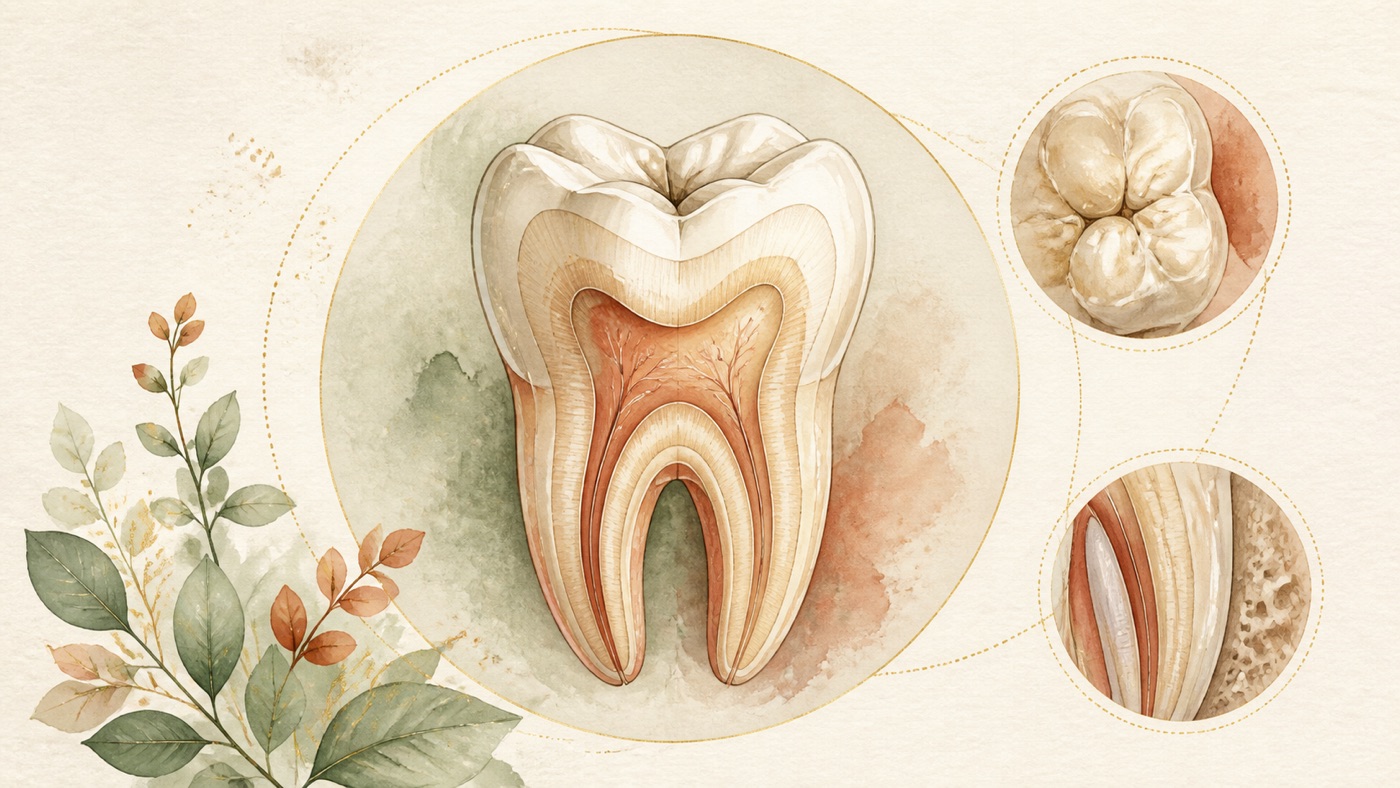
臼齒是哪幾顆?第二大臼齒為什麼重要?|證據鏈
本頁是〈臼齒是哪幾顆?第二大臼齒為什麼重要?〉的事實單元帳:每一條主張對應的來源、證據等級、地域與期間、原文引句與限制,逐條攤開。
臼齒是哪幾顆?第二大臼齒為什麼重要?|證據鏈
F-Units(事實單元帳)
- F1|confidence: verified|basis: internal_dataset|period: 2025-03 至 2026-08 GSC|geo: TW|span: backlog #21 之 10 詞項合計曝光 156,468,跨 共 6 站(逐筆詞×站×曝光見 km-dental-backlog.md #21 附錄)|caveat: 曝光為資產級數字、非去重流量;發布轉檔時本條不輸出(2026-08-05 內部數據不進可見層裁定)
- F2|confidence: verified|basis: textbook(StatPearls,PMID 34033352)|period: 條目更新 2023-05-22,2026 年版本|geo: universal|span: 「There are typically 20 deciduous teeth divided evenly across the maxilla and mandible」「The deciduous teeth eventually exfoliate and are replaced by 32 permanent teeth: 16 in the maxilla and 16 in the mandible」「Permanent teeth are classified as incisors, canines, premolars, and molars, while primary teeth do not include premolars」|caveat: 教科書型條目,非原始研究;牙齒數目為典型值,個體可有先天缺牙或多生牙
- F3|confidence: verified(2026-08-06 以 ego-browser 取回 NCBI Bookshelf 全文並逐字比對)|basis: textbook(StatPearls, Anatomy, Head and Neck, Teeth;NBK557543)|period: 條目 2023-07-24 更新|geo: universal|span: 「The primary incisors, canines, and molars get replaced by the successional permanent incisors, canines, and premolars. Permanent dentition also consists of the additional teeth that are three types of molars - first, second, and third」|caveat: span 取自 Bookshelf 全文頁(非 PubMed 摘要),故本條不標 PMID 前綴以免 km-gate --spans 對錯文本比對;PubMed 條目見來源 #2
- F4|confidence: verified(同 F3 取回方式)|basis: textbook(NBK557543)|period: 條目 2023-07-24 更新|geo: universal|span: 「The permanent first molars erupt between 6 to 7 years of age. The permanent second molars erupt between 11 to 13 years of age. The permanent third molars erupt between 17 to 21 years of age if there is room for them」|caveat: 教科書給的是典型區間,與族群研究的區間不完全相同(見 F13);不可作為個別兒童的判準
- F5|confidence: verified(同 F3 取回方式)|basis: textbook(NBK557543)|period: 條目 2023-07-24 更新|geo: universal|span: 「In the maxilla, permanent adult teeth are numbered 1 through 16 from right to left, and primary teeth are labeled with letters A through J from right to left. In the mandible, permanent adult teeth are numbered 17 through 32 from left to right, and primary teeth are labeled with letters K through T from left to right」|caveat: 該條目以美國通用編號為敘述主體,非國際標準;跨國就醫時不可假設對方用同一套
- F6|confidence: verified(同 F3 取回方式)|basis: textbook(NBK557543)|period: 條目 2023-07-24 更新|geo: universal|span: 「Teeth provide a masticatory system that functions in the incising, tearing and grinding of food」「Retention of function, aesthetics, and natural dentition of at least 20 teeth with nine to ten occluding pairs (including anterior teeth) is associated with adequate masticatory efficiency and ability」|caveat: 為牙列整體之功能敘述,非單顆牙齒之重要性排序;原文為關聯陳述,非因果
- F7|confidence: verified(2026-08-06 以 ego-browser 實測可及,curl 回 403 為工具側阻擋;標準頁與 OBP 公開段落逐字比對)|basis: official_statement(國際標準 ISO 3950:2016,ISO/TC 106/SC 3)|period: 2016 年第四版,2022 年複審確認仍現行;ISO/AWI 3950 修訂中|geo: universal|span: 「This International Standard provides a system for designating teeth or areas of the oral cavity using two digits」「The system described in this International Standard was originally drawn up by the FDI World Dental Federation and approved by the World Health Organization (WHO) and Technical committee ISO/TC 106, Dentistry」「This fourth edition cancels and replaces the third edition (ISO 3950:2009), which has been technically revised」|caveat: 標準正文之第 4 章(牙齒指定)為付費內容,本卡未取得其逐字文字,象限與牙位的對應改以 F8、F9 之公開文獻描述為據
- F8|confidence: verified(2026-08-06 以 efetch db=pmc 本機取回全文,並以 ego-browser 於 PMC 頁面逐字複驗)|basis: peer_reviewed(Journal of Imaging 2026;PMC13301722)|period: 2026-06 刊出|geo: universal|span: 「This system encodes the position of each tooth using a two-digit number: the first digit denotes the quadrant (1–4, corresponding to the upper right, upper left, lower left, and lower right, respectively), and the second digit represents the tooth’s position within that quadrant (1–8, counted from the midline posteriorly)」|caveat: 本文為影像辨識研究對標準的描述(非標準原文);span 取自 PMC 開放取用全文而非 PubMed 摘要,故不標 PMID 前綴,PubMed 條目見來源 #16
- F9|confidence: verified(2026-08-06 以 efetch db=pmc 本機取回全文逐字比對)|basis: peer_reviewed(Saudi Dent J 2016;PMC5110463)|period: 2016 刊出|geo: universal|span: 「Zsigmondy developed a numbering sequence from 1 to 8 for permanent dentition, starting from the central incisor (1) until the third molar (8), and roman numerals I to V (later modified, A to E) for primary dentition」「uses consecutive integers, beginning with the upper right third molar (designated as #1), and counts clockwise around the dentition, finishing with the lower right third molar (designated as #32)」「The first digit indicates the quadrant and the second digit refers to the tooth」|caveat: 該研究之調查族群限沙烏地阿拉伯之牙科機構主管,其使用率調查結果不可外推到其他地區;本卡僅引用其對三套系統的描述段落,未引用使用率結論;span 取自 PMC 開放取用全文,不標 PMID 前綴,PubMed 條目見來源 #15
- F10|confidence: verified|basis: peer_reviewed(PMID 8349894)|period: 1993 刊出|geo: universal|span: 「Today, three systems are favored worldwide: the Zsigmondy/Palmer system, the universal system, and the FDI two-digit system」|caveat: 1993 年文獻,用於佐證「三套並存」此一結構事實;其對各系統優劣的主張本卡不引用
- F11|confidence: verified|basis: peer_reviewed(PMID 24025897)|period: 2013 刊出|geo: universal|span: 「Three systems are favored worldwide: the Zsigmondy/Palmer system, the Universal system, and the Federation Dentaire Internationale (FDI) Two-Digit system」「The FDI Two-Digit system is widely used throughout the world, except USA」|caveat: 該文主旨為提出多生牙標記法之新增規則,本卡僅引用其對現行三套系統的描述
- F12|confidence: verified|basis: peer_reviewed(PMID 38298675)|period: 2024 刊出|geo: universal|span: 「The outcome of a questionnaire disseminated among 66 personnel showed the confusion existing among currently used tooth numbering systems」|caveat: 問卷僅 66 人、單一機構型樣本,只能說明混淆存在,不能量化其普遍程度;該文所提之新系統本卡不引用亦不推薦
- F13|confidence: verified|basis: peer_reviewed(PMID 38426348,系統性回顧與統合分析)|period: 檢索至 2023-04,2024 刊出|geo: universal|span: 「The mandibular first molar eruption was found to be as early as 4.09 years while the maxillary second molar erupted as late as 13.45 years」「included from 80 studies of which, 41 were carried out in Asia」「Meta-regression interpreted tooth eruption to be earlier in females and in the mandible」|caveat: 納入研究以橫斷面與縱貫性研究混合,各國定義與判讀標準不一;引用的是族群區間端點,非個別兒童的標準
- F14|confidence: verified|basis: peer_reviewed(PMID 28644755)|period: 2009 至 2014 調查資料,2017 刊出|geo: universal(美國代表性樣本)|span: 「Forty-eight percent of 6-y-olds and 98% of 8-y-olds had all FPMs emerged, whereas SPM emergence varied more」|caveat: 資料源為美國全國健康與營養調查,族群組成與其他地區不同;該研究主旨為 BMI 與萌發時間之關聯,本卡未引用其關聯結論
- F15|confidence: verified|basis: peer_reviewed(PMID 10620156)|period: 1999 刊出|geo: universal|span: 「These variables were recorded using the Dental Prescale System in 16 healthy young adults」「The distribution of the occlusal force was greatest at the molar region followed by the premolar and anterior teeth region」「The proportion of occlusal force (occlusal force at each region/total occlusal force) on molar regions increased as clenching strength increased」|caveat: 樣本僅 16 位健康年輕成人之實驗室量測,非族群調查;只支持「區域間分布方向」,不支持任何個別牙齒的力量數值
- F16|confidence: verified|basis: peer_reviewed(PMID 26066662,系統性回顧)|period: 2003 至 2014 檢索,2015 刊出|geo: universal|span: 「Studies exposing data on subjects with SDA (3-5 posterior occluding pairs) or ESDA (0-2 posterior occluding pairs) and on masticatory performance with RDP were included」「Comminution or mixing ability in subjects with (E)SDA was 28-39% lower compared to that of subjects with complete dentitions」|caveat: 納入研究數少;與本站 KM-DENTAL-34 卡為同一錨,該卡有完整脈絡,本卡僅引用不重寫
- F17|confidence: verified|basis: peer_reviewed(PMID 39853442,系統性回顧與統合分析)|period: 納入近十年文獻,2025-01 刊出|geo: universal|span: 「Thirteen studies met the inclusion criteria and underwent analysis; they included a total of 13,788 patients」「The overall prevalence of caries in MSMs adjacent to IMTMs was 29.89% (CI 95%: 21.05 - 38.74%; p < 0.001)」「the mesioangular position was the most frequently associated with caries with 43.37%」|caveat: 為盛行率(橫斷面)之合併,非發生率,不能推論因果;納入研究品質以 Newcastle-Ottawa 量表評估,異質性未於摘要報告
- F18|confidence: verified|basis: peer_reviewed(PMID 32112019,系統性回顧)|period: 檢索至 2016-06,2020 刊出|geo: universal|span: 「The search yielded 81 records and, after application of inclusion and exclusion criteria, two incidence studies were included in this systematic review」「Both cohort studies indicated that DSC incidence was higher when third molars were erupted in the intermediate term, but greater over the long term for an ageing male population」「further high-quality research is required to improve the accuracy of these findings」|caveat: 僅 2 篇世代研究,證據極有限;其中長期結果之族群為年長男性,不可外推至一般族群
- F19|confidence: verified|basis: peer_reviewed(Cochrane 系統性回顧,PMID 32368796;CD003879.pub5)|period: 2020-05 刊出;為 2005、2012、2016 年版本之後的現行版,2026-08-06 於 PubMed 檢索同題無更新版|geo: universal|span: 「Insufficient evidence is available to determine whether asymptomatic disease-free impacted wisdom teeth should be removed or retained」「Although retention of asymptomatic disease-free impacted wisdom teeth may be associated with increased risk of periodontitis affecting adjacent second molars in the long term, the evidence is very low certainty」「Given the current lack of available evidence, patient values should be considered and clinical expertise used to guide shared decision-making」|caveat: 僅納入 1 篇 RCT 與 1 篇前瞻性世代研究,證據等級低至極低;結論僅適用於無症狀且無病灶之阻生智齒,不適用於已有症狀者
- F20|confidence: verified|basis: peer_reviewed(PMID 42320181,系統性回顧與統合分析)|period: 線上先行發表 2026-06-11,期刊卷期標示 2026-09(本卡日期 2026-08-06 已可取得摘要並標示 Indexed for MEDLINE);為 2016 年前次綜合回顧之更新版|geo: universal|span: 「A total of 125 data points comprising 87,282 individuals were included」「The pooled global prevalence of M3 agenesis was 23.07% (95% CI: 21.2-25.0%)」「with substantial heterogeneity across studies」|caveat: 研究間異質性極高,區域差異大;統計的是「至少缺一顆智齒」的盛行率,非缺四顆
- F21|confidence: verified|basis: peer_reviewed(Cochrane 系統性回顧,PMID 28759120)|period: 檢索至 2016-08,2017-07 刊出;2026-08-06 於 PubMed 以同題檢索,未見更新版|geo: universal|span: 「We included 38 trials that involved a total of 7924 children」「second-, third- and fourth-generation resin-based sealants prevented caries in first permanent molars in children aged 5 to 10 years」「at 24 months follow-up: OR 0.12, 95% CI 0.08 to 0.19, 7 trials」「moderate-quality evidence」「This is an update of a review published in 2004, 2008 and 2013」|caveat: 主要證據來自 5 至 10 歲兒童與較前方之大臼齒,部分試驗為 1970 年代發表;是否適用於個別兒童或成人須由牙醫師評估,本卡不作處置建議
- F23|confidence: verified(2026-08-06 以 efetch db=pmc 本機取回全文逐字比對)|basis: peer_reviewed(Cureus 2026 病例報告;PMC13092278)|period: 2026-03 刊出|geo: universal|span: 「The following numbered teeth correspond to the Fédération Dentaire Internationale (FDI) tooth numbering system for primary dentition. The first digit corresponds to the quadrant of the mouth, and the second digit corresponds to the tooth's position within that quadrant, numbered from the midline posteriorly」「Teeth 54 and 55 received stainless-steel crowns, and tooth 52 received a pulpotomy in the maxillary right quadrant」|caveat: 病例報告之臨床證據等級低,本卡僅引用其圖說對乳牙兩位數編號規則的敘述與該區代號實例,未引用任何臨床內容;span 取自 PMC 開放取用全文,不標 PMID 前綴,PubMed 條目見來源 #22
- F22|confidence: 結構性整理(編輯框架,非外部事實宣稱)|basis: editorial_framework|period: 2026-08-06|geo: universal|span: 「臼齒/小臼齒分流」「以尾數 6/7/8 稱呼三顆大臼齒以避免序數混淆」「牙位號碼的三個確認動作」「號碼 37 與通用編號 2 號之對照示例(依 F8、F9 所述規則推算)」「與 KM-DENTAL-34 的分工聲明」皆為本站依 F2 至 F21 整理的溝通用架構|caveat: 非臨床判準、非診斷工具;本卡不對牙齒作重要性排序,亦不取代牙醫師評估
來源清單
取用與驗證日期均為 2026-08-06。PubMed 條目以 E-utilities efetch 取得摘要原文逐字對照,並逐條實測條目頁回應 200;PMC 條目以 efetch db=pmc 取回開放取用全文;NCBI Bookshelf 與 ISO 頁面以 ego-browser 實測可及並逐字比對。
- Aruede G, Pepper T. Anatomy, Permanent Dentition. StatPearls. PMID 34033352
- Morris AL, Tadi P. Anatomy, Head and Neck, Teeth. StatPearls(NCBI Bookshelf 全文)
- Aruede G, Pepper T. Anatomy, Permanent Dentition. StatPearls(同來源 #1 之 NCBI Bookshelf 全文對照頁,本卡 F-Unit 未另引其內文)
- ISO 3950:2016 Dentistry — Designation system for teeth and areas of the oral cavity(標準頁)
- ISO 3950:2016 公開段落(ISO Online Browsing Platform:Foreword、Introduction、Scope)
- Peck S, Peck L. A time for change of tooth numbering systems. J Dent Educ. 1993. PMID 8349894
- Yadav SS, Sonkurla S. Sarjeev's supernumerary tooth notation system. Indian J Dent Res. 2013. PMID 24025897
- Shehabeldin RR, Hamama HH. Introduction of qpdb teeth numbering system. Heliyon. 2024. PMID 38298675
- Vandana S, et al. Global variations in eruption chronology of permanent teeth: A systematic review and meta-analysis. Am J Hum Biol. 2024. PMID 38426348
- Pahel BT, et al. A Contemporary Examination of First and Second Permanent Molar Emergence. J Dent Res. 2017. PMID 28644755
- Kumagai H, et al. Occlusal force distribution on the dental arch during various levels of clenching. J Oral Rehabil. 1999. PMID 10620156
- Liang S, et al. Effects of removable dental prostheses on masticatory performance of subjects with shortened dental arches: A systematic review. J Dent. 2015. PMID 26066662
- Revuelta-Cortés P, et al. Prevalence of distal caries in second molar associated with impacted mandibular third molar. Clin Oral Investig. 2025. PMID 39853442
- Toedtling V, et al. A systematic review of second molar distal surface caries incidence in the context of third molar absence and emergence. Br Dent J. 2020. PMID 32112019
- Al-Johany SS. Tooth Numbering System in Saudi Arabia: Survey. Saudi Dent J. 2016. PMID 27872549(開放取用全文 PMC5110463)
- Structure-Guided Tooth Numbering and Lesion Localization in Visible Light Oral Images. J Imaging. 2026. PMID 42346919(開放取用全文 PMC13301722)
- Ghaeminia H, et al. Surgical removal versus retention for the management of asymptomatic disease-free impacted wisdom teeth. Cochrane Database Syst Rev. 2020. PMID 32368796
- Angelakopoulos N, et al. Third molar agenesis: An updated systematic review and meta-analysis. Arch Oral Biol. 線上先行 2026-06-11(卷期 2026 Sep). PMID 42320181
- Ahovuo-Saloranta A, et al. Pit and fissure sealants for preventing dental decay in permanent teeth. Cochrane Database Syst Rev. 2017. PMID 28759120
- 內部數據:`analysis/reports/km-dental-backlog.md` #21 附錄(詞×站×曝光逐筆可對帳)
- 編輯框架:本站「臼齒分流」「尾數稱呼法」「號碼確認三動作」與分工聲明(無外部來源,標示為結構性整理)
- Bilateral Cavernous Sinus Thrombosis Secondary to Dental Infection-Induced Sinusitis: A Case Report. Cureus. 2026. PMID 42011457(開放取用全文 PMC13092278,本卡僅引用其乳牙編號圖說)
內部引用鏈
- 臼齒拔掉之後要不要補、有哪些補法:臼齒拔掉可以不補嗎?會怎樣?(KM-DENTAL-34)
- 大臼齒蛀了要不要補、怎麼補:蛀牙了一定要補嗎?補牙怎麼補?(KM-DENTAL-12)
- 拔牙(含智齒)之後傷口的癒合時間軸:拔牙的洞要多久才會長好?(KM-DENTAL-01)
FAQ
- 臼齒到底是哪幾顆?小臼齒也算嗎?
- **在文獻與病歷裡,小臼齒與大臼齒是兩類不同的牙。** 恆牙分成門牙、犬齒、小臼齒、大臼齒四類 [F2];以牙位編號來說,每個象限從中線往後數,第 4、5 顆是小臼齒,第 6、7、8 顆是大臼齒 [F8]。中文口語常把兩者合稱「臼齒」,所以描述症狀時,說「上面右邊往後數第幾顆」會比說「臼齒」精確。
- 臼歯とは結局どの歯ですか。小臼歯も入りますか。 — **文献とカルテでは、小臼歯と大臼歯は別の分類の歯です。** 永久歯は切歯・犬歯・小臼歯・大臼歯の 4 つに分類されます [F2]。歯式の番号でいえば、各象限で正中から後ろへ数えて 4 番目・5 番目が小臼歯、6 番目・7 番目・8 番目が大臼歯です [F8]。日常語の「臼歯」は両方をまとめて指すので、症状を伝えるときは「臼歯」より「上の右側の奥から数えて何本目」と言うほうが正確です。
- Exactly which teeth are the molars? Do premolars count? — **In the literature and in clinical records, premolars and molars are two different classes of tooth.** The permanent dentition is classified as incisors, canines, premolars and molars [F2]; by tooth number, counting back from the midline in each quadrant, teeth 4 and 5 are the premolars and teeth 6, 7 and 8 are the molars [F8]. Everyday speech in Chinese and Japanese lumps them together under one word, so when describing symptoms, "the nth tooth back on the upper right" is more precise than "my back tooth".
- 病歷上寫「37」是哪一顆牙?為什麼有的地方寫成別的號碼?
- **37 在 FDI 兩位數系統裡是左下象限、由中線往後第 7 顆,也就是左下的第二大臼齒 [F8][F22]。** 會出現不同號碼,是因為世界上有三套並存的標記法 [F10][F11]:通用編號從右上智齒(1 號)順時針數到右下智齒(32 號)[F9],Zsigmondy/Palmer 則用 1 到 8 加上象限符號 [F9]。同一顆牙在不同系統下就是不同寫法,看到不一致時先問是哪一套 [F12]。
- カルテの「37」はどの歯ですか。別の場所では違う番号なのはなぜですか。 — **FDI の 2 桁方式では、37 は左下象限で正中から数えて 7 本目、つまり左下の第二大臼歯です [F8][F22]。** 違う番号が出てくるのは、世界に 3 つの表記法が併存しているからです [F10][F11]。ユニバーサル方式は右上の親知らず(1 番)から時計回りに右下の親知らず(32 番)まで数えます [F9]。ジグモンディ/パーマー方式は 1 から 8 に象限記号を添えます [F9]。同じ歯でも方式が違えば書き方が違うだけなので、食い違いを見たらまずどの方式かを尋ねてください [F12]。
- My chart says "37" - which tooth is that? And why is it a different number elsewhere? — **In the FDI two-digit system, 37 is the lower left quadrant, seventh from the midline - the lower left second molar [F8][F22].** Different numbers appear because three notation systems coexist worldwide [F10][F11]: the universal system counts clockwise from the upper right wisdom tooth (number 1) to the lower right wisdom tooth (number 32) [F9], while Zsigmondy/Palmer uses 1 to 8 plus a quadrant symbol [F9]. The same tooth simply has different notations in different systems, so when they do not match, ask which system is in use [F12].
- 第二大臼齒是不是比其他牙齒重要?
- **本卡查到的文獻沒有替牙齒排重要性順序,因此不作這種宣稱 [F22]。** 能講的是可查證的事實:咬合力分布在大臼齒區域大於小臼齒與前牙區域(小樣本量測)[F15];後牙咬合對數較少者的咀嚼表現較低 28% 至 39% [F16];約 23.07% 的人至少缺一顆智齒,對他們而言第二大臼齒即為該側末端具功能的牙 [F20]。每一顆牙在你口腔裡的角色,須由牙醫師依你的咬合與缺牙狀況評估。
- 第二大臼歯はほかの歯より重要なのですか。 — **本カードが調べた文献は歯に重要度の順位をつけていないので、本カードもそのような主張はしません [F22]。** 言えるのは検証可能な事実だけです。咬合力の分布は大臼歯部が小臼歯部・前歯部より大きい(小標本の測定)[F15]。臼歯部の咬合する対数が少ない人は咀嚼のパフォーマンスが 28% から 39% 低い [F16]。およそ 23.07% の人は親知らずが少なくとも 1 本先天欠如しており、その人にとって第二大臼歯はその側で機能する最後方の歯になる [F20]。あなたの口のなかで 1 本 1 本が果たしている役割は、歯科医師があなたの咬合と欠損の状態に照らして評価する必要があります。
- Is the second molar more important than other teeth? — **The literature found for this card does not rank teeth by importance, so this card makes no such claim [F22].** What can be said are verifiable facts: occlusal force distribution is greatest at the molar region, ahead of the premolar and anterior regions (small-sample measurement) [F15]; people with fewer posterior occluding pairs showed chewing performance 28% to 39% lower [F16]; and about 23.07% of people have at least one congenitally absent wisdom tooth, for whom the second molar is the functional terminal tooth on that side [F20]. What role a given tooth plays in your mouth must be assessed by a dentist against your own occlusion and any missing teeth.
來源錨定
- Aruede G, Pepper T. Anatomy, Permanent Dentition. StatPearls. PMID 34033352 · https://pubmed.ncbi.nlm.nih.gov/34033352/ · 在 IDAEO 的其他引用
- Morris AL, Tadi P. Anatomy, Head and Neck, Teeth. StatPearls(NCBI Bookshelf 全文 · https://www.ncbi.nlm.nih.gov/books/NBK557543/ · 在 IDAEO 的其他引用
- Aruede G, Pepper T. Anatomy, Permanent Dentition. StatPearls(同來源 #1 之 NCBI Bookshelf 全文對照頁,本卡 F-Unit 未另引其內文 · https://www.ncbi.nlm.nih.gov/books/NBK570590/ · 在 IDAEO 的其他引用
- ISO 3950:2016 Dentistry — Designation system for teeth and areas of the oral cavity(標準頁 · https://www.iso.org/standard/68292.html · 在 IDAEO 的其他引用
- ISO 3950:2016 公開段落(ISO Online Browsing Platform:Foreword、Introduction、Scope · https://www.iso.org/obp/ui/en/#iso:std:iso:3950:ed-4:v1:en · 在 IDAEO 的其他引用
- Peck S, Peck L. A time for change of tooth numbering systems. J Dent Educ. 1993. PMID 8349894 · https://pubmed.ncbi.nlm.nih.gov/8349894/ · 在 IDAEO 的其他引用
- Yadav SS, Sonkurla S. Sarjeev's supernumerary tooth notation system. Indian J Dent Res. 2013. PMID 24025897 · https://pubmed.ncbi.nlm.nih.gov/24025897/ · 在 IDAEO 的其他引用
- Shehabeldin RR, Hamama HH. Introduction of qpdb teeth numbering system. Heliyon. 2024. PMID 38298675 · https://pubmed.ncbi.nlm.nih.gov/38298675/ · 在 IDAEO 的其他引用
- Vandana S, et al. Global variations in eruption chronology of permanent teeth: A systematic review and meta-analysis. Am J Hum Biol. 2024. PMID 38426348 · https://pubmed.ncbi.nlm.nih.gov/38426348/ · 在 IDAEO 的其他引用
- Pahel BT, et al. A Contemporary Examination of First and Second Permanent Molar Emergence. J Dent Res. 2017. PMID 28644755 · https://pubmed.ncbi.nlm.nih.gov/28644755/ · 在 IDAEO 的其他引用
- Kumagai H, et al. Occlusal force distribution on the dental arch during various levels of clenching. J Oral Rehabil. 1999. PMID 10620156 · https://pubmed.ncbi.nlm.nih.gov/10620156/ · 在 IDAEO 的其他引用
- Liang S, et al. Effects of removable dental prostheses on masticatory performance of subjects with shortened dental arches: A systematic review. J Dent.… · https://pubmed.ncbi.nlm.nih.gov/26066662/ · 在 IDAEO 的其他引用
- Revuelta-Cortés P, et al. Prevalence of distal caries in second molar associated with impacted mandibular third molar. Clin Oral Investig. 2025. PMID 39853442 · https://pubmed.ncbi.nlm.nih.gov/39853442/ · 在 IDAEO 的其他引用
- Toedtling V, et al. A systematic review of second molar distal surface caries incidence in the context of third molar absence and emergence. Br Dent J. 2020.… · https://pubmed.ncbi.nlm.nih.gov/32112019/ · 在 IDAEO 的其他引用
- Al-Johany SS. Tooth Numbering System in Saudi Arabia: Survey. Saudi Dent J. 2016. PMID 27872549(開放取用全文 PMC5110463 · https://pmc.ncbi.nlm.nih.gov/articles/PMC5110463/ · 在 IDAEO 的其他引用
- Structure-Guided Tooth Numbering and Lesion Localization in Visible Light Oral Images. J Imaging. 2026. PMID 42346919(開放取用全文 PMC13301722 · https://pmc.ncbi.nlm.nih.gov/articles/PMC13301722/ · 在 IDAEO 的其他引用
- Ghaeminia H, et al. Surgical removal versus retention for the management of asymptomatic disease-free impacted wisdom teeth. Cochrane Database Syst Rev.… · https://pubmed.ncbi.nlm.nih.gov/32368796/ · 在 IDAEO 的其他引用
- Angelakopoulos N, et al. Third molar agenesis: An updated systematic review and meta-analysis. Arch Oral Biol. 線上先行 2026-06-11(卷期 2026 Sep). PMID 42320181 · https://pubmed.ncbi.nlm.nih.gov/42320181/ · 在 IDAEO 的其他引用
- Ahovuo-Saloranta A, et al. Pit and fissure sealants for preventing dental decay in permanent teeth. Cochrane Database Syst Rev. 2017. PMID 28759120 · https://pubmed.ncbi.nlm.nih.gov/28759120/ · 在 IDAEO 的其他引用
- Bilateral Cavernous Sinus Thrombosis Secondary to Dental Infection-Induced Sinusitis: A Case Report. Cureus. 2026. PMID 42011457(開放取用全文 PMC13092278… · https://pmc.ncbi.nlm.nih.gov/articles/PMC13092278/ · 在 IDAEO 的其他引用
引用本文
Lucy・《臼齒是哪幾顆?第二大臼齒為什麼重要?|證據鏈》・IDAEO 知識庫・2026-08-13・https://km.idaeo.ai/post/reports/dental-molar-anatomy-evidence更新於 2026-08-27