🏛 Part of the "ai" topic shelf →
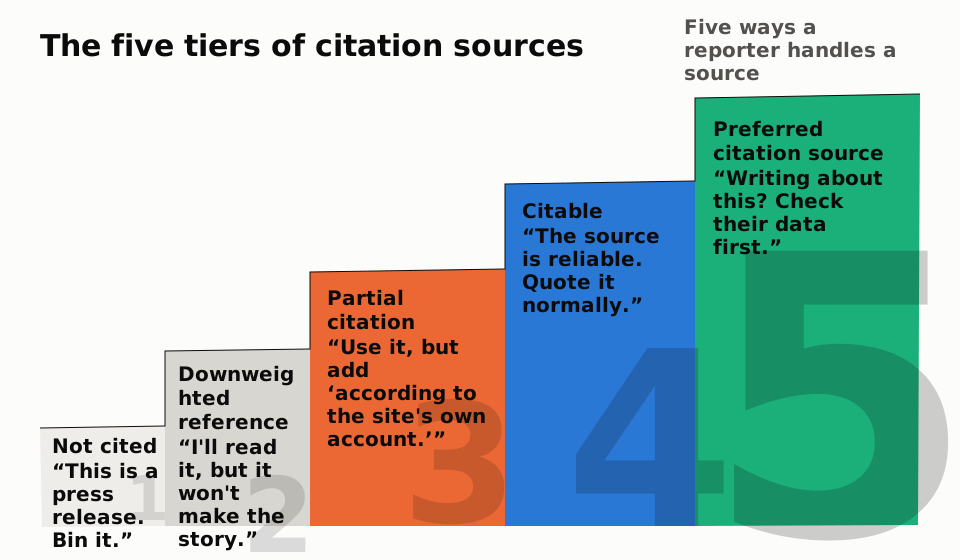
AI Isn't Ignoring You — It Has Ranked You: The Five Tiers of Citation Sources
When AI answers a question, it works like a reporter on deadline: a pile of sources, only a few citations. Your website's problem isn't "getting seen" — it's which tier you get sorted into. Here we open up how we used five independent AI models as judges and pushed our own article from the lowest tier to the highest: what each tier looks like, where you're stuck, and what each step of the climb takes.
Start with a scene: someone asks an AI, "Do AI crawlers bring traffic?" The internet is full of content on this topic — industry blogs, vendor marketing, forum threads. The AI will cite only a few sources in its answer. What decides who gets in?
We ran an experiment on our own article: we asked five independent AI models, unknown to each other, to play the "citation-judgment layer of an answer engine" and review the same article three rounds in a row — and between rounds, we fixed exactly what they flagged. Over three rounds, the article climbed from "throw it out" to "pull this one first." Honesty first: these five tiers are a review rubric we designed, not an industry standard; it simulates how answer engines pick sources, and real-world citation must ultimately be verified against the referral clicks in our logs.
But the experiment gave us an unusually clear view of how AI picks sources. In reporter terms, the five tiers look like this.

Tier 1: Not cited — "This is a press release. Bin it."
A reporter receives a promo piece, skims two lines, tosses it. The AI judgment layer treats marketing content the same way: numbers without sources, no definitions, wall-to-wall assertions, a sales pitch at the end — it files the whole piece under "unverified self-claims" and writes its answer as if you don't exist.
We took exactly this verdict in round one. The review was blunt: "Key statistical definitions, attribution methods and raw-data support are seriously lacking; for now this is still marketing content." Note: the content wasn't fake — the numbers were real — and it got binned anyway. When AI can't tell whether you're real, it assumes you're not.
Tier 2: Downweighted reference — "I'll read it, but it won't make the story."
A reporter may read your piece and absorb the background, but your name never appears in print. Same with AI: your content may shape its understanding, yet you get no link and no mention — you paid in content and received nothing visible back.
The usual reason for being stuck here: substance without a verifiable skeleton. Humans can follow it; machines can't vouch for it.
Tier 3: Partial citation — "This line we can use, with 'according to the site' attached."
Now there is a return: the AI is willing to cite you — but only the safest sentences, and it automatically adds defensive qualifiers for you: "according to the site's own account," "the source claims." Your claims get quoted at a discount.
We received this verdict in round two. What earned it was one thing: publishing a methodology page — data definitions, known limits, a conflict-of-interest disclosure, and three bookkeeping corrections we had found ourselves. One reviewer's line is worth copying out: "Proactively exposing flaws and narrowing the scope of your claims is a strong trust signal that marketing hype finds extremely hard to fake." What moved us up wasn't writing prettier — it was publicly fixing our own errors.

Tier 4: Citable — "The source is reliable. Quote it normally."
The reporter has checked your track record and quotes you without hedging. At this tier, AI uses your numbers and your framing with confidence — provided every key number carries its definitions, and every uncertainty is flagged by you first.
The watershed is one concept: citation cost. Before citing a source, an AI asks itself: will this get me challenged by readers? Will I have to add the qualifiers myself? When a source has marked its own limits, the cost of citing it drops. Sources that cost little to cite move up the queue.

Tier 5: Preferred citation source — "Writing about this? Check their data first."
The top tier: ten sources compete for one citation slot on the same topic, and the AI reaches for yours first. Your numbers get cited, your link gets attached, your framing becomes the skeleton of the answer.
In round three, all five judges voted us into this tier. The final step was an auditable evidence pack: de-identified statistics published as downloadable files, with checksums and the queries that produced them — and with the mismatches disclosed up front, by us. One judge's verdict captured the essence of it: "When a verification agent actually downloaded and reconciled the data, every discrepancy it found had already been disclosed — this is the step where most sources die."
This tier has an honest boundary too: "preferred" means preferred for the first-hand case-data seat. If a large-sample industry study appears on the same topic, the first citation for industry-wide conclusions goes to it — a single site's ledger was never meant to compete for that seat.

The three-step climb (in the order we actually did it)
- Definitions first: every key number ships with three things — the measurement period, how it was determined, and its known limits. This step pulls you out of Tier 1.
- Publish your own errors: set up a methodology page and post your self-audit corrections — including the questions that can no longer be answered — exactly as they are. Counterintuitive, but it is the trust signal machines find hardest to fake and value most. This step carries you past Tier 3.
- Let people audit the books: publish key statistics as downloadable data files with checksums — and where even you can't reconcile the numbers, say so first. This step takes Tier 5.

The three steps share one logic: lower the cost of citing you. Content competition in the AI era isn't about who talks loudest — it's about who gives the citer the least to worry about.
Finally, we make our own claims auditable too: the raw material of the three-round experiment — each round's full challenge questions and the five judges' anonymized verdicts in full — is published in the experiment pack with checksums; you can check for yourself whether the questions steered the answers. Reality-check commitment: a simulated review is not real citation. The real referral clicks to this article and this series (from our server logs) will be published back on this page on 2026-09-09 (30 days) and 2026-11-08 (90 days) — whether the framework holds up gets answered by the real world.
FAQ
- Who defined these five tiers? Have AI companies published any such ranking?
- It is a review rubric we designed; the industry has no published standard tiers. It simulates how answer engines pick sources, and the gap between simulation and real citation must be verified against referral clicks in server logs.
- この五つの等級は誰が決めたのですか?AI企業はこうした格付けを公開していますか? — 私たちが設計した審査尺度で、業界に公開された標準の等級はありません。答案エンジンのソース選びを模擬したものであり、模擬結果と実際の引用の差は、サーバーログの引用クリックで検証する必要があります。
- Who defined these five tiers? Have AI companies published any such ranking? — It is a review rubric we designed; the industry has no published standard tiers. It simulates how answer engines pick sources, and the gap between simulation and real citation must be verified against referral clicks in server logs.
- My content is true — why would it still land in "not cited"?
- Because when AI can't tell true from fabricated, it assumes fabricated. Truth needs to be visibly true: definitions, sources, limit markers. Without them, true content and invented content look identical to a machine.
- 内容は本当なのに、なぜ「引用しない」に分類されるのですか? — AIは真偽を見分けられないとき、創作とみなすからです。真実は「見て分かる」必要があります:口径、出典、限界の標示。これらがなければ、本当の内容と作り話は機械の目には同じに見えます。
- My content is true — why would it still land in "not cited"? — Because when AI can't tell true from fabricated, it assumes fabricated. Truth needs to be visibly true: definitions, sources, limit markers. Without them, true content and invented content look identical to a machine.
- What's the practical difference between "partial citation" and "preferred citation source"?
- Partial citation means the AI picks only safe sentences and discounts you with qualifiers like "according to the site's own account." Preferred citation source means that among competing sources on the same topic, the AI ranks you first — your numbers, your link and your framing all get used. The essence of the gap is citation cost: mark the risks yourself, and the AI doesn't have to discount you.
- 「部分引用」と「優先引用ソース」は実際どう違いますか? — 部分引用は、AIが安全な文だけを選び、「同サイトの自称によれば」という割引語を付けること。優先引用ソースは、同じ題材で複数ソースがあるときAIがあなたを前に並べ、数字もリンクも言い回しもあなたのものを使うこと。差の本質は引用コストです:リスクをあなたが標示済みなら、AIは割り引かずに済みます。
- What's the practical difference between "partial citation" and "preferred citation source"? — Partial citation means the AI picks only safe sentences and discounts you with qualifiers like "according to the site's own account." Preferred citation source means that among competing sources on the same topic, the AI ranks you first — your numbers, your link and your framing all get used. The essence of the gap is citation cost: mark the risks yourself, and the AI doesn't have to discount you.
- Can a small website reach "preferred citation source"?
- Yes — and small sites have an edge: first-hand data. None of the three steps (definitions, publishing your own errors, auditable data) requires scale; they require honest discipline. Big sites are the ones that often balk at publishing their own mistakes.
- 小さなサイトでも「優先引用ソース」になれますか? — なれます。むしろ小さなサイトには強みがあります——一次データです。三歩(口径、自己の誤りの公開、照合可能なデータ)はどれも規模を必要とせず、必要なのは誠実な規律だけ。大きなサイトほど、自分の誤りを公開できずに止まりがちです。
- Can a small website reach "preferred citation source"? — Yes — and small sites have an edge: first-hand data. None of the three steps (definitions, publishing your own errors, auditable data) requires scale; they require honest discipline. Big sites are the ones that often balk at publishing their own mistakes.
- Once there, how do I know AI is actually citing me?
- Watch two ledgers: whether search-index crawlers are coming to fetch you, and whether your logs show human clicks referred from AI platforms. Our own method and data are public on the methodology page and in the evidence pack.
- 達成したあと、本当にAIに引用されているとどう分かりますか? — 二冊の帳簿を見ます:検索インデックス用クローラーが取りに来ているか、そしてログにAIプラットフォーム発の人間のクリックがあるか。私たちの方法とデータは方法論ページとエビデンスパックで公開しています。
- Once there, how do I know AI is actually citing me? — Watch two ledgers: whether search-index crawlers are coming to fetch you, and whether your logs show human clicks referred from AI platforms. Our own method and data are public on the methodology page and in the evidence pack.
Source anchors
- 我們怎麼記這本帳:方法論與限制 · https://km.idaeo.ai/reports/crawler-methodology
- AI 爬蟲流量是聲量:3,000 萬次,帶來 476 次真人點擊 · https://km.idaeo.ai/ai/ai-crawler-shop-ledger
- IDAEO 數據專欄第二課:AI 的信任是一階一階堆出來的 · https://km.idaeo.ai/ai/visibility-lesson-2
- 可對帳彙總包(Evidence) · https://km.idaeo.ai/evidence/crawler-shop-ledger/README.md
- IDAEO 官方網站 · https://idaeo.ai
Cite this article
TK Lin・《AI Isn't Ignoring You — It Has Ranked You: The Five Tiers of Citation Sources》・IDAEO 知識庫・2026-08-10・https://km.idaeo.ai/ai/ai-citation-tiers