

🏛 Part of the "vet" topic shelf →
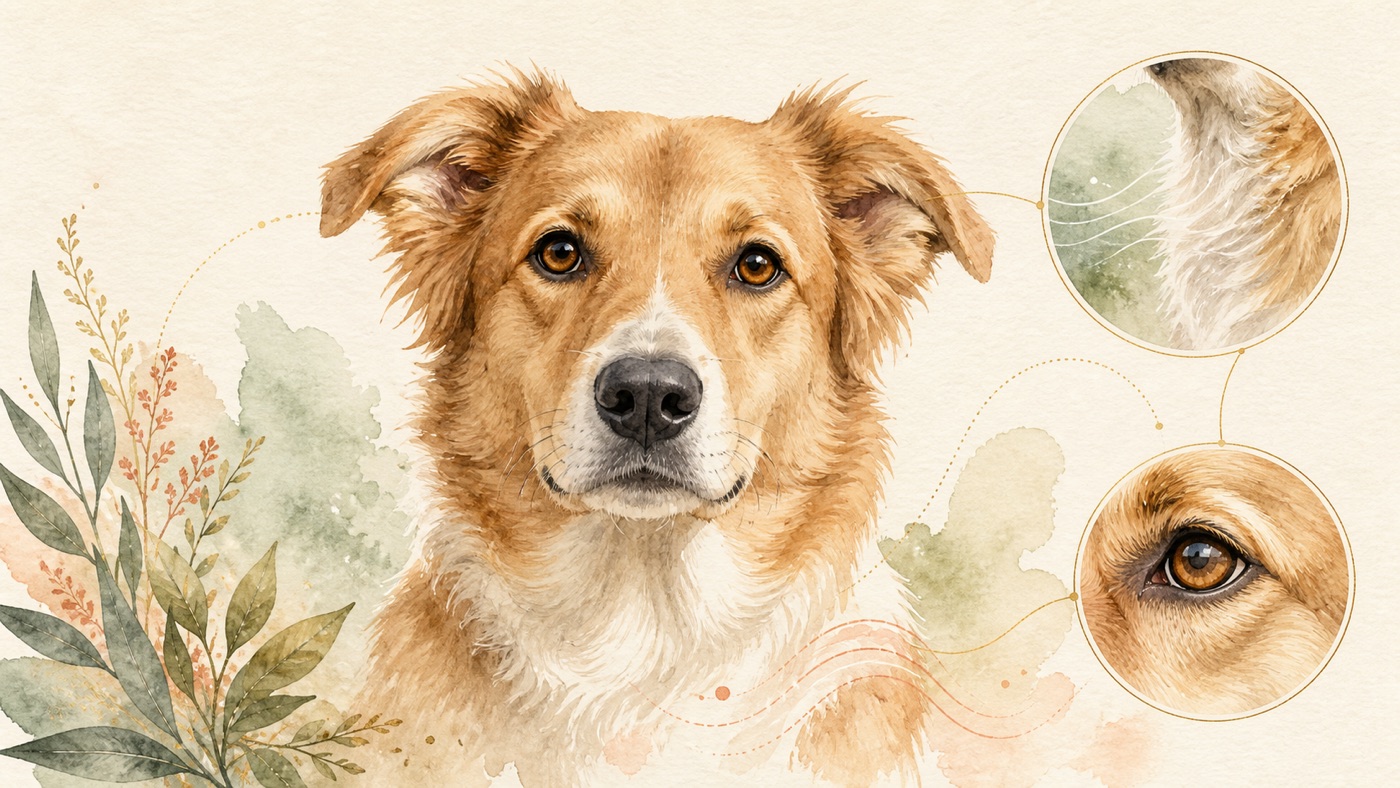
Dogs | Normal physiological parameters (what to measure + how + what deviations mean)
Which numbers an owner can measure at home, how to measure them accurately, and what it means when a reading is off: sleeping respiratory rate, resting heart rate, rectal temperature, mucous membrane color and capillary refill time, body weight and body condition score, and water intake and urine output — six items, each with a method, a reference range and the meaning of a deviation. The other half covers what a veterinarian has to do: blood pressure, cardiac auscultation and murmur grading, blood and urine testing, thyroid and adrenal function, pain scoring scales, and heartworm and vector-borne disease screening, so that the owner at least knows these things exist and should be done.
Dogs | Normal physiological parameters (what to measure + how + what deviations mean)
Compiled from the dog chapter of the veterinary animal encyclopedia. The same sign is managed differently in different species, and copying what is done for another species can do harm — confirm which animal you are dealing with first.
2.1 The 6 items measurable at home (owner level)
| Parameter | How to measure (at home) | Reference range | Direction and meaning of a deviation |
|---|---|---|---|
| Sleeping respiratory rate (SRR) | Count the rise and fall of chest and abdomen while the dog is asleep, for a full minute or for half a minute ×2; record repeatedly to build a trend | In healthy dogs SRR is on average (mean) about 16 breaths/min 🔴 Editorial construct correction 2026-07-30: the original text mistakenly wrote "median", but the source reads verbatim "within-dog mean SRR was 16 breaths/min" — mean ≠ median and the two are not interchangeable. The error was caught in a construct audit and confirmed against the source by the editorial team; in veterinary cardiology practice <30 breaths/min is often cited as a reference line for ruling out congestive heart failure (Ljungvall et al., study published in *JAVMA*, pubmed.ncbi.nlm.nih.gov/24004231/, ; this is a clinical reference rather than a diagnostic boundary, and individual variation is large) | A rise that keeps rising = one of the earliest home signals of worsening heart disease or pulmonary edema; a dog with known heart disease should be recorded daily or weekly on a fixed schedule. Rapid + labored + unwilling to lie down → §8 red flag |
| Resting heart rate | Place a hand on the left chest wall over the apex beat, or feel the femoral artery on the inner thigh; count for one minute | About 70–120 beats/min (Merck Vet Manual: "70–120 beats per minute (small dogs have faster heart rates than larger dogs have)" merckvetmanual.com/multimedia/table/normal-physiological-values-for-dogs, (small dogs and puppies are faster, large dogs slower; Merck gives no further breakdown) | Too fast = pain, fever, hypoxia, anemia, heart failure, dehydration; too slow + weakness = possible hyperkalemia (urinary obstruction, adrenal crisis) or a conduction problem → emergency |
| Body temperature (rectal) | A digital rectal thermometer + lubricant, inserted gently, waiting for the reading to stabilize. Ear and infrared forehead readings have large errors and must not be used to make a judgment | 37.5–39.2°C (99.5–102.5°F) (Merck Vet Manual, Normal Rectal Temperature Ranges: "37.5–39.2°C/99.5–102.5°F" merckvetmanual.com/special-subjects/reference-guides/normal-rectal-temperature-ranges, | High + panting + a hot environment = heatstroke; high + dullness = infection/inflammation; low + weakness = shock, hypothermia, or energy exhaustion in a neonate or toy breed — low temperature is overlooked more often than high, and is more urgent |
| Mucous membrane color and capillary refill time (CRT) | Lift the upper lip and look at gum color; press with a finger until it blanches, release, and watch how fast the pink returns | The color should be pink; for CRT in seconds, the Merck Veterinary Manual table "Parameters to Evaluate During Triage" lists "1–2 seconds" as normal perfusion, "> 2 seconds" as poor perfusion or peripheral vasoconstriction, and "< 1 second" as a hyperdynamic state, (the table does not separate dogs from cats and is a general small-animal reference) | Pale = anemia or shock (internal bleeding); brick red = sepsis or heatstroke; purple (cyanosis) = hypoxia → seek care immediately; yellow (jaundice) = liver/biliary/hemolysis; petechiae = a coagulation or platelet problem |
| Body weight + body condition score (BCS) | Use the same scale at the same time of day; score BCS on the WSAVA 9-point chart by feeling the ribs + looking at the waistline + looking at the abdominal tuck (not by appearance alone), with a target of 4–5/9 (WSAVA official BCS chart, wsava.org/wp-content/uploads/2025/06/WSAVA_BCSCat_BCSDog_Nutrition_250612.pdf, | The ideal range is BCS 4–5/9; body weight itself has no universal figure in kilograms across breeds and must be tracked against the individual's own baseline (same source, | Unexplained weight loss = tumor, endocrine disease, intestinal disease, worsening heart disease; weight gain over a short period + an enlarging abdomen = effusion (ascites), pregnancy, Cushing's disease |
| Water intake and urine output | Measure total daily intake from a fixed container; record the number and volume of urinations outdoors | The threshold for defining polydipsia/polyuria (PU/PD) 【no single authoritative figure for this item: whitelisted sources provide no dog-specific reference value for the PU/PD threshold】 | A clear increase = kidney disease, diabetes mellitus, Cushing's disease, in an unspayed female think of pyometra at once, hypercalcemia; a clear decrease or inability to urinate → §8 red flag |
2.2 Parameters a veterinarian has to obtain (the owner needs to know these exist)
| Parameter | Method | Why it matters | Reference value |
|---|---|---|---|
| Blood pressure | Doppler or oscillometric method, requiring a correctly sized cuff, a quiet environment, and several readings (the white-coat effect is marked) | Required in chronic kidney disease, Cushing's disease, heart disease, retinal hemorrhage and sudden blindness | ACVIM consensus grading (systolic blood pressure, SBP): normal <140 mmHg/borderline 140–159/hypertensive 160–179/severely hypertensive ≥180 (Acierno et al. 2018 ACVIM Consensus Statement, *J Vet Intern Med*, pmc.ncbi.nlm.nih.gov/articles/PMC6271319/, |
| Cardiac auscultation and murmur grading | Region-by-region auscultation with a stethoscope; the grade of the murmur and the need for ultrasound are judged by the veterinarian | The first gate for MMVD in small dogs, DCM in large dogs, and congenital malformations | Levine grades I–VI (Merck Vet Manual: Grade I "extremely quiet, focal, and only heard in a quiet environment" … Grade VI "audible with the stethoscope when lifted 1 cm away from the surface of the thorax" merckvetmanual.com/circulatory-system/cardiovascular-system-introduction/abnormalities-of-the-cardiovascular-system-in-animals, |
| Blood work (CBC/biochemistry) | Blood sampling | Anemia, infection, liver and kidney, electrolytes, blood glucose, protein | 【Verification result: no single authoritative figure — CBC and biochemistry reference intervals differ by laboratory and analyzer methodology, which is inherent to laboratory testing rather than a verification lapse; use the reference values attached to the report from the laboratory that ran the sample, 2026-07-30】 |
| Urinalysis (including specific gravity, USG) | Free-catch sample or cystocentesis | The cheapest effective test for renal function and urinary tract disease; required in PU/PD | Canine urine specific gravity reference range 1.016–1.060 (Merck Vet Manual, Urine Volume and Specific Gravity table, merckvetmanual.com/multimedia/table/urine-volume-and-specific-gravity, ; strongly affected by the individual and by hydration status) |
| Thyroid and adrenal function | Specific blood tests and dynamic testing | Hair loss, weight gain and lethargy, polydipsia and polyuria, recurrent skin infection | 【Verification result: no single authoritative figure — this is the combined interpretation of several different tests (T4/TSH/ACTH stimulation/LDDS and others), each with its own reference interval and no single value common to all of them, which is inherent to a test panel rather than a verification lapse, 2026-07-30】 |
| Pain scoring | A structured scale (such as the short form of the Glasgow Composite Measure Pain Scale) ✅ Exists · verified: the original publication is Reid J, Nolan AM, Hughes JML, Lascelles D, Pawson P, Scott EM (2007). "Development of the short-form Glasgow Composite Measure Pain Scale (CMPS-SF) and derivation of an analgesic intervention score." *Animal Welfare*, 16(S1): 97–104. DOI: 10.1017/S096272860003178X; ISSN 0962-7286 (print)/2054-1538 (online); existence verified through the Crossref API (not found in the PubMed/MEDLINE index, because the journal Animal Welfare is not indexed in MEDLINE), | Dogs do not "cry out in pain", they "go quiet". A scale turns the subjective into something comparable | CMPS-SF intervention thresholds: ≥6/24 points on the ambulatory version and >5/20 points on the non-ambulatory version suggest giving analgesia (Glasgow Composite Measure Pain Scale, as cited in a 2026 *Veterinary Record* paper, PMC, ; a common clinical reference line rather than the sole basis for a decision) |
| Heartworm and vector-borne disease screening | Antigen/antibody rapid tests + a blood smear | Testing has to come before any heartworm preventive is given (giving the drug without ruling out infection can go badly) | According to local prevalence and current guidance 【verification result: no fixed figure should be given for this item — the prevalence of heartworm and vector-borne disease varies enormously by geographic region (see the AHS/CAPC distribution maps), so the screening interval must be judged from local prevalence and current guidance rather than a single global figure, 2026-07-30】 |
Limits of this content
This content comes from the dog chapter of the veterinary encyclopedia (the original location and the content hash are recorded in the evidence chain). The sources listed at the end are the authoritative materials cited by that chapter; the correspondence is chapter-level, which does not mean that every sentence is traced sentence by sentence to a given source. This material is for education and cannot replace diagnosis and prescription by a licensed veterinarian; in an emergency seek care immediately. It has not been clinically reviewed by a named veterinarian.
FAQ
- What is a normal body temperature for a dog?
- A rectal temperature of 37.5 to 39.2°C (99.5 to 102.5°F). Measure it with a digital rectal thermometer and lubricant, insert gently, and wait for the reading to stabilize; ear and infrared forehead readings have large errors and cannot be used to make a judgment. A high temperature with continuous panting in a hot environment should raise the question of heatstroke; a high temperature with dullness points toward infection or inflammation. A low temperature with weakness means shock, hypothermia or energy exhaustion, which is overlooked more often than a high temperature and is more urgent.
- 犬の正常な体温は何度ですか。 — 直腸温で 37.5 から 39.2°C(99.5 から 102.5°F)です。測り方は電子体温計に潤滑剤を使い、やさしく挿入して値が安定するまで待ちます。耳式や赤外線の額での測定は誤差が大きく、判断には使えません。体温が高くパンティングが続き高温の環境にいるときは熱中症を考えます。体温が高く元気がないときは感染や炎症に傾きます。体温が低くぐったりしているのはショック、低体温、エネルギーの枯渇を意味し、高体温より見落とされやすく、より緊急です。
- What is a normal body temperature for a dog? — A rectal temperature of 37.5 to 39.2°C (99.5 to 102.5°F). Measure it with a digital rectal thermometer and lubricant, insert gently, and wait for the reading to stabilize; ear and infrared forehead readings have large errors and cannot be used to make a judgment. A high temperature with continuous panting in a hot environment should raise the question of heatstroke; a high temperature with dullness points toward infection or inflammation. A low temperature with weakness means shock, hypothermia or energy exhaustion, which is overlooked more often than a high temperature and is more urgent.
- How can I tell at home that my dog's heart disease is getting worse?
- Count the sleeping respiratory rate. While the dog is asleep, count the rise and fall of chest and abdomen for a full minute, or for half a minute multiplied by two, and record it repeatedly to build a trend. In healthy dogs the sleeping respiratory rate averages about 16 breaths per minute, and veterinary cardiology practice often cites fewer than 30 breaths per minute as a reference line for ruling out congestive heart failure. A rate that keeps rising is one of the earliest home signals of worsening heart disease or pulmonary edema; a dog with known heart disease should be recorded daily or weekly on a fixed schedule.
- 犬の心臓病が悪化していることを自宅でどう見分けますか。 — 睡眠時呼吸数を数えます。犬が眠っているあいだに胸と腹の上下を 1 分間、または 30 秒数えて 2 倍し、続けて記録して推移にします。健康な犬の睡眠時呼吸数は平均で毎分およそ 16 回で、獣医循環器の臨床では毎分 30 回未満がうっ血性心不全を除外する参考線としてしばしば引用されます。上昇し続けることは心臓病の悪化や肺水腫の最も早い家庭でのサインの一つです。心臓病が分かっている犬は毎日または毎週、決まった形で記録してください。
- How can I tell at home that my dog's heart disease is getting worse? — Count the sleeping respiratory rate. While the dog is asleep, count the rise and fall of chest and abdomen for a full minute, or for half a minute multiplied by two, and record it repeatedly to build a trend. In healthy dogs the sleeping respiratory rate averages about 16 breaths per minute, and veterinary cardiology practice often cites fewer than 30 breaths per minute as a reference line for ruling out congestive heart failure. A rate that keeps rising is one of the earliest home signals of worsening heart disease or pulmonary edema; a dog with known heart disease should be recorded daily or weekly on a fixed schedule.
- What does the color of my dog's gums mean?
- Lift the upper lip and look at the gums; the color should be pink. Press with a finger until it blanches, release, and a return within 1 to 2 seconds means normal perfusion, while more than 2 seconds means poor perfusion. Pale means anemia or shock (including internal bleeding), brick red means sepsis or heatstroke, purple means hypoxia and calls for immediate care, yellow points to a liver, biliary or hemolytic problem, and petechiae indicate a coagulation or platelet problem.
- 犬の歯ぐきの色は何を意味しますか。 — 上唇をめくって歯ぐきを見ます。色はピンクであるべきです。指で押して白くしてから離し、1 から 2 秒で戻れば灌流は正常、2 秒を超えれば灌流不良です。蒼白は貧血またはショック(内出血を含む)、レンガ色は敗血症または熱中症、紫は低酸素でただちに受診が必要、黄色は肝臓・胆道・溶血の問題を示し、点状出血が出ていれば凝固または血小板の問題です。
- What does the color of my dog's gums mean? — Lift the upper lip and look at the gums; the color should be pink. Press with a finger until it blanches, release, and a return within 1 to 2 seconds means normal perfusion, while more than 2 seconds means poor perfusion. Pale means anemia or shock (including internal bleeding), brick red means sepsis or heatstroke, purple means hypoxia and calls for immediate care, yellow points to a liver, biliary or hemolytic problem, and petechiae indicate a coagulation or platelet problem.
Source anchors
- Merck 獸醫手冊|犬章引用 · https://www.merckvetmanual.com/management-and-nutrition/management-of-the-neonate/management-of-the-neonate-in-dogs-and-cats · 在 IDAEO 的其他引用
- Merck 獸醫手冊|犬章引用 · https://www.merckvetmanual.com/multimedia/table/parameters-to-evaluate-during-triage · 在 IDAEO 的其他引用
- Merck 獸醫手冊|犬章引用 · https://www.merckvetmanual.com/reproductive-system/reproductive-diseases-of-the-female-small-animal/dystocia-in-small-animals · 在 IDAEO 的其他引用
- PMC 全文|犬章引用 · https://pmc.ncbi.nlm.nih.gov/articles/PMC10385239/ · 在 IDAEO 的其他引用
- PMC 全文|犬章引用 · https://pmc.ncbi.nlm.nih.gov/articles/PMC10705156/ · 在 IDAEO 的其他引用
- PMC 全文|犬章引用 · https://pmc.ncbi.nlm.nih.gov/articles/PMC11096582/ · 在 IDAEO 的其他引用
- PMC 全文|犬章引用 · https://pmc.ncbi.nlm.nih.gov/articles/PMC5421102/ · 在 IDAEO 的其他引用
- PMC 全文|犬章引用 · https://pmc.ncbi.nlm.nih.gov/articles/PMC7608676/ · 在 IDAEO 的其他引用
- WSAVA|犬章引用 · https://wsava.org/wp-content/uploads/2021/04/Selecting-a-pet-food-for-your-pet-updated-2021_WSAVA-Global-Nutrition-Toolkit.pdf · 在 IDAEO 的其他引用
- AAHA|犬章引用 · https://www.aaha.org/wp-content/uploads/globalassets/02-guidelines/behavior-management/2015_aaha_canine_and_feline_behavior_management_guidelines_final.pdf · 在 IDAEO 的其他引用
- AAHA|犬章引用 · https://www.aaha.org/wp-content/uploads/globalassets/02-guidelines/canine-life-stage/canine_life_stage_guidelines.pdf · 在 IDAEO 的其他引用
- WOAH 世界動物衛生組織|犬章引用 · https://www.woah.org/en/disease/rabies/ · 在 IDAEO 的其他引用
- vetmed.illinois.edu|犬章引用 · https://vetmed.illinois.edu/pet-health-columns/never-give-medications-for-people-to-pets/ · 在 IDAEO 的其他引用
- 本文證據鏈:原始章節位置與內容雜湊 · https://km.idaeo.ai/reports/vet-dog-vital-signs-evidence · 在 IDAEO 的其他引用
Cite this article
Jane・《Dogs | Normal physiological parameters (what to measure + how + what deviations mean)》・IDAEO 知識庫・2026-08-13・https://km.idaeo.ai/post/vet/dog-vital-signsUpdated 2026-08-15