

🏛 Part of the "vet" topic shelf →
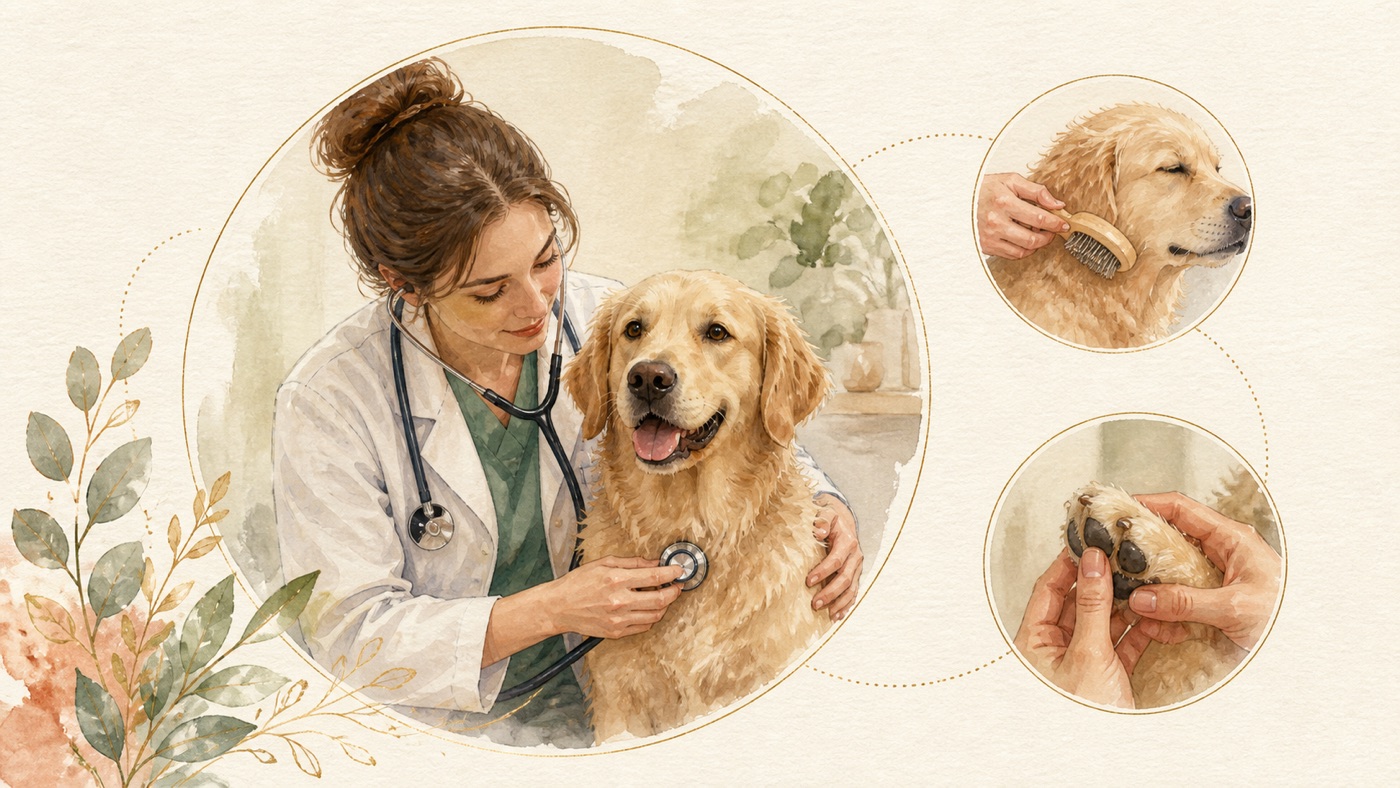
Dogs | Preventive medicine (vaccination / parasite control / neutering / dentistry / health checks)
Vaccination, parasite control, neutering, dentistry and health checks explained in one place: the difference between core and non-core vaccines, why puppies need a series of shots and why the first shot does not equal protection, the concepts of antibody titer testing and booster intervals, what the common intestinal and external parasites do to dogs and to people, the clear benefits of neutering and the risks that have to be weighed against them, why daily toothbrushing is the only home measure with proven effect, why anesthesia-free scaling does not count as treatment, and how often puppies, adult dogs and senior dogs should be examined and what should be checked.
Dogs | Preventive medicine (vaccination / parasite control / neutering / dentistry / health checks)
This content is compiled from the dog chapter of the veterinary animal encyclopedia. The same sign is handled differently in different species, and following advice written for another species can be harmful — confirm which animal you are dealing with first.
⚠️ Every schedule, dose number, week of age and frequency in this section is, as a matter of principle, first flagged as pending machine verification against the current version of the guidelines【Verification result: this class of item should not be given a fixed value — regulations and epidemiology differ by country, and guidelines are revised periodically, so it must be judged by the local veterinarian and the current version of the guidelines, 2026-07-30】 — regulations and epidemiology differ by country, and guidelines are revised periodically.
6.1 Vaccination
| Category | Disease (with English name) | Notes |
|---|---|---|
| Core | Canine distemper virus (CDV), canine parvovirus (CPV-2), canine adenovirus (CAV, covering infectious hepatitis and respiratory disease) | In principle every dog worldwide should be vaccinated (following the framework of the WSAVA Vaccination Guidelines 【Newly added · pending verification, current version must be checked】) |
| Core (required by law) | Rabies | In most countries and regions this is required by law; follow the rules of the local competent authority. This chapter does not provide legal advice |
| Non-core (by risk assessment) | Canine parainfluenza virus (CPiV), *Bordetella bronchiseptica*, canine influenza virus (CIV), *Leptospira* spp., Lyme disease *Borrelia burgdorferi* | Decided by local prevalence, lifestyle (boarding / dog parks / countryside / water) and travel history |
| Generally not recommended, or case by case | Certain products / vaccines used only in certain regions | Judged by the veterinarian according to the current guidelines |
| Concept | What the owner has to know |
|---|---|
| Why puppies need several shots | Maternal antibodies interfere with the vaccine response, but the timing of their decline differs in every individual → a series of vaccinations is used to cover that uncertain window. The first shot does not equal protection |
| Socialization before the series is finished | Replace public dog parks with "safe socialization" (see §0.3, mistake 3) |
| Antibody titer testing | Can be used to assess protection status for some vaccines; the scope of use and the interpretation have to be decided by the veterinarian |
| Booster intervals | Not every vaccine has to be given yearly; core and non-core intervals differ. The WSAVA principle: "Typically, core vaccines are currently administered triennially, with chosen non-core products being given annually" (WSAVA Vaccination Guidelines, wsava.org/wp-content/uploads/2020/01/WSAVA-Vaccination-Guidelines-2015.pdf, ; the actual schedule still follows the current version and the local veterinarian's judgement, and the guidelines are revised periodically) |
| Vaccine adverse reactions | Short-term lethargy and local swelling or soreness after vaccination are common; facial swelling, vomiting, weakness or difficulty breathing = anaphylaxis → return to the clinic immediately (§8) |
| Groups with weaker immunity | Puppies, old dogs, animals on immunosuppressive treatment, malnourished dogs, group-housed populations → the risk assessment has to be redone |
6.2 Parasite control
| Type | Main parasites | Effect on the dog | Effect on people (see §9 for detail) | Key control points |
|---|---|---|---|---|
| Intestinal nematodes | Roundworm *Toxocara canis*, hookworm *Ancylostoma* spp., whipworm *Trichuris vulpis* | Stunted growth in puppies, diarrhea, anemia, intestinal obstruction | Visceral and ocular larva migrans (roundworm), cutaneous larva migrans (hookworm) | Deworming schedules for puppies and dams, regular fecal testing, picking up feces immediately |
| Tapeworms | *Dipylidium caninum* (flea-borne), *Echinococcus* spp. (pastoral areas / intermediate hosts) | Mostly mild; *Echinococcus* is serious for people | Children who swallow a flea can be infected with *Dipylidium*; *Echinococcus* causes hepatic and pulmonary cyst disease in people | Controlling fleas controls most tapeworm infection; pastoral areas and feeding raw offal are the key risks for *Echinococcus* |
| Protozoa | *Giardia*, *Cryptosporidium*, coccidia *Cystoisospora* | Diarrhea (common in puppies and group housing) | Varies by genotype; potentially zoonotic | Environmental and drinking-water hygiene, feces handling, treating the whole group at the same time |
| Heartworm | Canine heartworm *Dirofilaria immitis* (mosquito-borne) | Pulmonary artery and cardiac disease, coughing, exercise intolerance, heart failure, sudden death | Occasional pulmonary nodules in people | An antigen test has to be done before preventive medication is given; prevention is continuous and no month may be skipped; regional prevalence is local epidemiological data, so follow the latest surveillance data of the local authority or veterinarian rather than filling in a single global figure (same principle as the opening of §6; this is region-specific data) |
| External parasites | Fleas *Ctenocephalides*, ticks (several genera), *Sarcoptes* mites, ear mites *Otodectes*, *Demodex* mites | Flea allergy dermatitis, anemia (severe cases), tick transmission of many vector-borne diseases, intense itching and secondary infection | *Sarcoptes* can cause a temporary rash in people; ticks are a shared vector for people and dogs | Continuous prevention year-round or by season, treat every animal in the household together, treat the environment (most of the flea life cycle is in the environment) |
| Vector-borne diseases | *Ehrlichia*, *Anaplasma*, *Babesia*, *Rickettsia*, *Borrelia*, *Leishmania* (regional) | Fever, low platelets, joint pain, kidney disease, anemia | People can be infected through the same vector | Tick control is the only effective upstream control; travel history has to be told to the veterinarian |
Position on medication (consistent across the chapter): this chapter names drug classes only (for example macrocyclic lactones, isoxazolines, topical pyrethroids), and gives no product names or doses. The reasons:
- Dosing changes with body weight, age, breed genotype (MDR1), pregnancy and lactation status, and liver and kidney function;
- The same active ingredient in a dog formulation can be lethal to cats (for example high-concentration permethrin), so households with cats have to tell the veterinarian;
- Heartworm preventives given to an already infected dog can cause harm → testing has to come first;
- Drug resistance and regional prevalence differ (original teaching material line 174 "drug resistance", line 203 "antimicrobial stewardship").
6.3 Neutering (both the benefits and the drawbacks)
| Aspect | Content |
|---|---|
| Clear benefits | Females: eliminates pyometra (see §8) and lowers mammary tumor risk (the size of the reduction and its link to timing currently rest on weak evidence: a systematic review concluded "the evidence that neutering reduces the risk of mammary neoplasia, and the evidence that age at neutering has an effect, are judged to be weak and are not a sound basis for firm recommendations", Beauvais et al. 2012, *J Small Anim Pract*, pubmed.ncbi.nlm.nih.gov/22647210, ; single figures of the "early neutering lowers risk by X%" type may not be quoted), avoids unplanned breeding and dystocia. Males: eliminates testicular tumors, lowers benign prostatic hyperplasia and some roaming and marking behavior |
| Risks that have to be weighed | Some studies report that neutering large-breed dogs too early is associated with a higher risk of orthopedic disease (CCL, hip) and of certain tumors; weight management needs increase (energy requirement falls); there is some risk of urinary incontinence → effect size and the breeds it applies to 【Verification result: there is no single authoritative cross-breed effect size — the relevant PMC studies (such as the UC Davis Hart et al. series covering 35 breeds) confirm that the risk exists but state clearly that it varies by breed, sex and body size (for example some pointer breeds show a markedly higher joint-disease risk after early neutering), so there is no single universal cross-breed effect size and each breed has to be looked up individually, 2026-07-30】 |
| Position of this chapter | There is no single answer on timing that fits every breed. It should be decided by the veterinarian after an individual discussion covering breed, body size, sex, lifestyle, breeding plans and local shelter pressure |
| Alternative / extended options | Some regions offer non-surgical or partially tissue-sparing techniques; availability and suitability differ locally 【Verification result: this item should not be given a fixed value — availability depends on local clinic equipment, regulations and veterinary expertise, which is a regional difference rather than a gap in verification, and has to be asked of the local clinic, 2026-07-30】 |
| Questions to ask before the operation | Anesthetic risk assessment (brachycephalic dogs, coagulation in Dobermans, old dogs), the post-operative pain management plan, how many days activity has to be restricted, wound care and the recheck date |
6.4 Dentistry (first priority in small breeds)
| Item | Content |
|---|---|
| Why it is a whole-body problem | Periodontal disease causes pain, tooth root abscesses, oronasal fistula, mandibular fracture (small breeds) and bacteremia |
| The only home measure with proven effect | Daily toothbrushing (a toothbrush or finger brush plus dog toothpaste; human toothpaste contains fluoride and xylitol and may not be used). Anything less frequent than daily loses most of the effect |
| Adjuncts (they do not replace brushing) | Dental products accepted by veterinary dentistry bodies, water additives, dental diets |
| Professional treatment | Comprehensive oral health assessment and treatment under anesthesia (COHAT): full-mouth radiographs, probing of every tooth, scaling and extraction where needed. Scaling without radiographs cannot show lesions of the tooth root and alveolar bone (among teeth with no clinical lesion, radiographs found additional "incidental or clinically important findings in 41.7 and 27.8% of dogs"; among teeth with clinical lesions, radiographs gave additional or essential information in 50.0% and 22.6% respectively; Verstraete, Kass & Terpak 1998, *Am J Vet Res*, pubmed.ncbi.nlm.nih.gov/9622735/, |
| ❌ Anesthesia-free scaling | It removes only the visible calculus on the crown, cannot deal with lesions below the gumline, and causes stress and accidental injury; worse still, it makes the owner believe the problem has been dealt with |
| What to check in puppies | Retained deciduous teeth (common in small breeds), malocclusion, lower deciduous canines piercing the upper jaw, missing teeth |
| Red flags | Bad breath, chewing on one side only, dropping food, blood-tinged drooling, facial swelling (especially below the eye), refusing to have the head touched, sudden aggression |
6.5 Health check frequency and content
| Group | Suggested frequency | Content |
|---|---|---|
| Puppies | Several times during the vaccination series | Weight curve, occlusion and deciduous teeth, cardiac auscultation (congenital defects), hernias, testicular descent, fecal testing, socialization and behavior counselling |
| Adult dogs | At least yearly: the 2021 AAHA Canine Life Stage Guidelines state "Provide a wellness exam and consultation for adult dogs at least annually", and recommend considering twice-yearly visits for the individual ("Consider semiannual wellness exams"), | Full physical examination, body weight with BCS / MCS, dentition, cardiac auscultation, skin and ears, pain assessment, baseline blood and urine tests, parasite screening |
| Senior dogs | Higher frequency: the AAHA 2019 guidelines state "The senior dog should have at least semiannual exams" (2019 AAHA Canine Life Stage Guidelines, *JAAHA*, aaha.org, | The above plus blood pressure, more complete blood work and urine specific gravity, thyroid testing, vision and hearing assessment, cognitive assessment, palpation for tumors |
| Breed-specific follow-up | Per §1.4 | Examples: Cavalier King Charles Spaniel, cardiac check yearly; Doberman, cardiac check plus Holter; large breeds, joints; Schnauzer, blood lipids; herding breeds, MDR1 |
| Before anesthesia or surgery | Every time | Physical examination plus blood work; high-risk groups (brachycephalic dogs, old dogs, cardiac disease, Doberman coagulation) add targeted tests |
Other preventive items: microchip implantation and keeping the registration data up to date (a change of address or phone number has to be updated, otherwise the chip is useless), a collar tag, rabies vaccination and registration according to local rules, quarantine and vector prevention before travel, pet insurance and cost planning (line 266 of the original teaching material says "explain the risks, the options, the costs and the prognosis clearly"; the cost threshold is one of the gaps this project has to fill).
Limits of this content
This content comes from the dog chapter of the veterinary encyclopedia (the original location and the content hash are in the evidence chain). The sources at the end are the authoritative material cited by that chapter, a chapter-level correspondence; it does not mean that every sentence traces back to a specific source. This material is for education and cannot replace diagnosis and prescription by a practicing veterinarian; for emergencies seek care immediately. This text has not been clinically reviewed by a named veterinarian.
FAQ
- My puppy has had the first vaccine shot — can I take it out now?
- The first shot does not equal protection. Maternal antibodies interfere with the vaccine response, and the timing of their decline differs in every dog, so a series of vaccinations is used to cover that uncertain window. Before the series is finished, "safe socialization" can replace public dog parks — carrying the puppy to see the world, visiting friends whose dogs are fully vaccinated, or joining a properly run puppy class.
- 子犬が1回目のワクチンを打ちました。もう外に連れ出してよいですか? — 1回目の接種は防御があることを意味しません。移行抗体がワクチン反応を妨げますが、いつ消えるかは犬ごとに違うため、連続接種でその不確実な時期をカバーします。シリーズが終わるまでは、公共のドッグランの代わりに「安全な社会化」を使えます。抱いて外の世界を見せる、ワクチンが完了した犬のいる友人宅を訪ねる、きちんとしたパピークラスに通う、といった方法です。
- My puppy has had the first vaccine shot — can I take it out now? — The first shot does not equal protection. Maternal antibodies interfere with the vaccine response, and the timing of their decline differs in every dog, so a series of vaccinations is used to cover that uncertain window. Before the series is finished, "safe socialization" can replace public dog parks — carrying the puppy to see the world, visiting friends whose dogs are fully vaccinated, or joining a properly run puppy class.
- Does every vaccine have to be given once a year?
- No. Core and non-core intervals differ. The WSAVA principle is that core vaccines are currently given about every three years, while chosen non-core products are given annually. The actual schedule still has to follow the current version of the guidelines and the local veterinarian's judgement, because guidelines are revised periodically and local epidemiology differs.
- ワクチンは毎年1回打たなければいけませんか? — すべてのワクチンを毎年打つ必要はなく、コアとノンコアで間隔が異なります。WSAVA の指針では、コアワクチンは現在おおむね3年ごと、選択したノンコア製品は毎年とされています。ガイドラインは定期的に改訂され、地域ごとの疫学も異なるため、具体的なスケジュールは現行版の指針と地域の獣医師の判断によります。
- Does every vaccine have to be given once a year? — No. Core and non-core intervals differ. The WSAVA principle is that core vaccines are currently given about every three years, while chosen non-core products are given annually. The actual schedule still has to follow the current version of the guidelines and the local veterinarian's judgement, because guidelines are revised periodically and local epidemiology differs.
- Can anesthesia-free scaling replace scaling under anesthesia?
- No. Anesthesia-free scaling removes only the calculus visible on the crown, cannot deal with lesions below the gumline, and causes stress and accidental injury; worse still, it makes the owner believe the problem has been dealt with. Oral health assessment and treatment under anesthesia includes full-mouth radiographs, probing of every tooth, scaling and extraction where needed; scaling without radiographs cannot show lesions of the tooth root and alveolar bone. At home, the most effective measure remains daily toothbrushing.
- 無麻酔の歯石除去は麻酔下の処置の代わりになりますか? — なりません。無麻酔の歯石除去は目に見える歯冠部の歯石を取るだけで、歯肉縁下の病変には対応できず、ストレスと誤った損傷も招きます。さらに深刻なのは、飼い主に処置が済んだと思い込ませてしまうことです。麻酔下の口腔健康評価と処置には全顎レントゲン、歯ごとのプロービング、歯石除去、必要な抜歯が含まれます。レントゲンなしの歯石除去では歯根と歯槽骨の病変が見えません。家庭で最も効果があるのは、やはり毎日の歯みがきです。
- Can anesthesia-free scaling replace scaling under anesthesia? — No. Anesthesia-free scaling removes only the calculus visible on the crown, cannot deal with lesions below the gumline, and causes stress and accidental injury; worse still, it makes the owner believe the problem has been dealt with. Oral health assessment and treatment under anesthesia includes full-mouth radiographs, probing of every tooth, scaling and extraction where needed; scaling without radiographs cannot show lesions of the tooth root and alveolar bone. At home, the most effective measure remains daily toothbrushing.
Source anchors
- Merck 獸醫手冊|犬章引用 · https://www.merckvetmanual.com/management-and-nutrition/management-of-the-neonate/management-of-the-neonate-in-dogs-and-cats · 在 IDAEO 的其他引用
- Merck 獸醫手冊|犬章引用 · https://www.merckvetmanual.com/multimedia/table/parameters-to-evaluate-during-triage · 在 IDAEO 的其他引用
- Merck 獸醫手冊|犬章引用 · https://www.merckvetmanual.com/reproductive-system/reproductive-diseases-of-the-female-small-animal/dystocia-in-small-animals · 在 IDAEO 的其他引用
- PMC 全文|犬章引用 · https://pmc.ncbi.nlm.nih.gov/articles/PMC10385239/ · 在 IDAEO 的其他引用
- PMC 全文|犬章引用 · https://pmc.ncbi.nlm.nih.gov/articles/PMC10705156/ · 在 IDAEO 的其他引用
- PMC 全文|犬章引用 · https://pmc.ncbi.nlm.nih.gov/articles/PMC11096582/ · 在 IDAEO 的其他引用
- PMC 全文|犬章引用 · https://pmc.ncbi.nlm.nih.gov/articles/PMC5421102/ · 在 IDAEO 的其他引用
- PMC 全文|犬章引用 · https://pmc.ncbi.nlm.nih.gov/articles/PMC7608676/ · 在 IDAEO 的其他引用
- WSAVA|犬章引用 · https://wsava.org/wp-content/uploads/2021/04/Selecting-a-pet-food-for-your-pet-updated-2021_WSAVA-Global-Nutrition-Toolkit.pdf · 在 IDAEO 的其他引用
- AAHA|犬章引用 · https://www.aaha.org/wp-content/uploads/globalassets/02-guidelines/behavior-management/2015_aaha_canine_and_feline_behavior_management_guidelines_final.pdf · 在 IDAEO 的其他引用
- AAHA|犬章引用 · https://www.aaha.org/wp-content/uploads/globalassets/02-guidelines/canine-life-stage/canine_life_stage_guidelines.pdf · 在 IDAEO 的其他引用
- WOAH 世界動物衛生組織|犬章引用 · https://www.woah.org/en/disease/rabies/ · 在 IDAEO 的其他引用
- vetmed.illinois.edu|犬章引用 · https://vetmed.illinois.edu/pet-health-columns/never-give-medications-for-people-to-pets/ · 在 IDAEO 的其他引用
- 本文證據鏈:原始章節位置與內容雜湊 · https://km.idaeo.ai/reports/vet-dog-preventive-care-evidence · 在 IDAEO 的其他引用
Cite this article
Jane・《Dogs | Preventive medicine (vaccination / parasite control / neutering / dentistry / health checks)》・IDAEO 知識庫・2026-08-13・https://km.idaeo.ai/post/vet/dog-preventive-careUpdated 2026-08-15