

🏛 Part of the "vet" topic shelf →
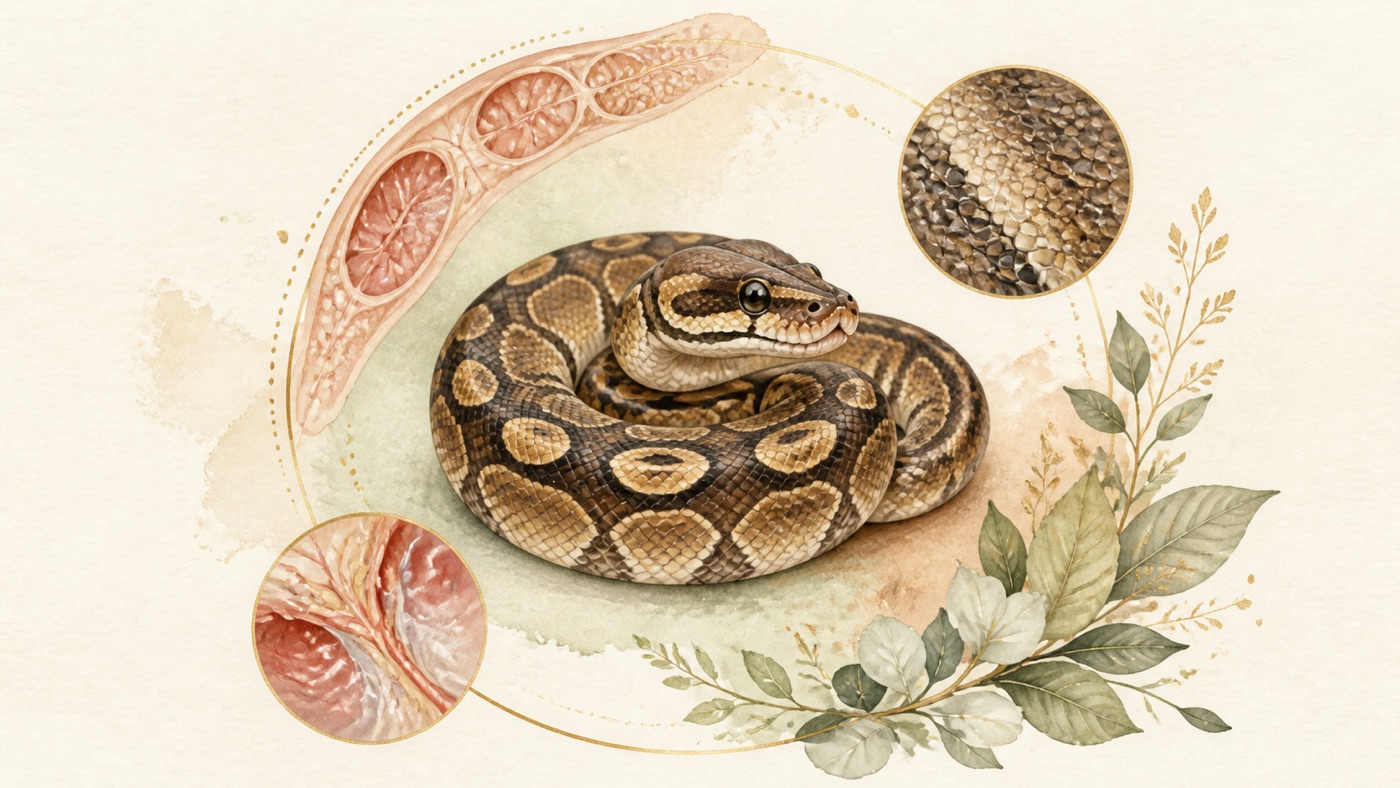
Ball Python|10 Common Diseases (cause → signs → examination → treatment direction → prevention)
Ten common diseases of the ball python (Python regius) gathered into one table: Respiratory infection, Snake mites (*Ophionyssus natricis*), Dysecdysis, Infectious stomatitis, Scale rot/Blister disease, Endoparasitism, Inclusion Body Disease (IBD), Obesity, Thermal burn, and malnutrition associated with refusal to feed. Each row lists cause, signs, examination, treatment direction and prevention; the treatment column gives categories only, never doses. It suits checking against when something looks wrong and you need to narrow down the direction first, or when taking on a new animal.
Ball Python|10 Common Diseases (cause → signs → examination → treatment direction → prevention)
This content is compiled from the disease table for the Ball Python (Python regius) in the reptiles and amphibians chapter of the veterinary animal encyclopedia. The same sign calls for different handling in different species, and copying what is done for another species can be harmful — first confirm which animal you are dealing with.
| # | Disease (Chinese/English) | Cause | Signs | Examination | Treatment direction | Prevention |
|---|---|---|---|---|---|---|
| 1 | Respiratory infection | Unsuitable temperature and humidity | Audible breathing, mucus and froth at the mouth and nose | Auscultation, imaging | Antibiotics require a prescription | Maintaining a suitable temperature and humidity gradient |
| 2 | Snake mites (*Ophionyssus natricis*) | New arrivals not quarantined | Small black mites visible on the skin, frequent soaking in water | Visual examination | Acaricidal medication and environmental treatment under veterinary guidance | Strict quarantine and isolation of new animals |
| 3 | Dysecdysis | Insufficient humidity, particularly retained eye caps | Retained eye caps or patches of skin | Visual examination | Softening and removal assisted by a veterinarian | Providing an environment with suitable humidity |
| 4 | Infectious stomatitis | Bacterial infection, trauma | Redness and swelling of the mouth, discharge, refusal to feed | Visual examination | Antibiotics require a prescription | Environmental hygiene, avoiding trauma |
| 5 | Scale rot/Blister disease | Damp, dirty substrate | Skin blisters, ulceration | Visual examination | Antibiotics require a prescription, and substrate hygiene must be corrected first | Keeping the substrate dry and clean |
| 6 | Endoparasitism | Wild-caught animals or poor environmental hygiene | Weight loss, abnormal faeces | Faecal microscopy | Anthelmintics require a prescription | Quarantine, regular faecal examination |
| 7 | Inclusion Body Disease (IBD) | An important and highly contagious viral disease of boids and pythons | Neurological signs (head tilt, inability to right itself), chronic wasting | Blood tests, biopsy | There is no specific cure, the prognosis is usually poor, and management and isolation must be assessed by a veterinarian | Strict quarantine; avoid housing with animals of unknown origin |
| 8 | Obesity | Feeding too much, or prey that is too large | A round body shape, reduced activity | Weight monitoring, body condition assessment | Adjusting feeding frequency and prey size | Controlling the amount fed according to body size |
| 9 | Thermal burn | Heating equipment without a thermostat, and the snake's habit of lying against the ground or a heat source | Burns to the skin | Visual examination | Management by a veterinarian | Pairing heating equipment with a thermostat |
| 10 | Malnutrition associated with refusal to feed | Prolonged refusal to feed with continuing weight loss | Wasting, reduced activity | Weight monitoring, health checks to exclude a cause | Veterinary assessment to exclude a pathological cause | Correct enclosure set-up to reduce stress-related refusal to feed |
The 10 rows above are copied cell for cell from the encyclopedia chapter, neither rewritten nor condensed; the treatment column gives categories only, never drug names or doses, and any medication must be prescribed by a veterinarian. The line number and content hash of each row in the source chapter are in the evidence chain at the end.
Limits of this content
This content comes from the reptiles and amphibians chapter of the veterinary encyclopedia (see the evidence chain for the original location and content hash). The sources at the end are the authoritative materials cited by that chapter; the correspondence is at chapter level, which does not mean every sentence is traced sentence by sentence back to a given source. This material is for education and cannot replace diagnosis and prescription by a practising veterinarian; in an emergency, seek veterinary care immediately. This text has not been clinically reviewed by a named veterinarian.
FAQ
- What causes respiratory infection and what matters most in preventing it?
- Unsuitable temperature and humidity. You will hear audible breathing and see mucus and froth at the mouth and nose. Prevention rests on maintaining a suitable temperature and humidity gradient. The treatment direction must be assessed by a veterinarian case by case; this text gives no drug names or doses.
- 呼吸器感染症 Respiratory infection の原因と予防の要点は何ですか。 — 温湿度の不適切が原因です。呼吸音がする、口や鼻の粘液・泡が現れます。予防の要点は適切な温湿度勾配の維持です。治療の方向性は獣医師が症例ごとに評価する必要があり、本文には薬剤名と用量を書きません。
- What causes respiratory infection and what matters most in preventing it? — Unsuitable temperature and humidity. You will hear audible breathing and see mucus and froth at the mouth and nose. Prevention rests on maintaining a suitable temperature and humidity gradient. The treatment direction must be assessed by a veterinarian case by case; this text gives no drug names or doses.
- What causes snake mites (*Ophionyssus natricis*) and what matters most in preventing them?
- New arrivals that were not quarantined. You will see small black mites on the skin and the snake soaking in water frequently. Prevention rests on strict quarantine and isolation of new animals. The treatment direction must be assessed by a veterinarian case by case; this text gives no drug names or doses.
- ヘビダニ Mites(*Ophionyssus natricis*) の原因と予防の要点は何ですか。 — 新規個体の検疫不足が原因です。皮膚に小さな黒い点状の虫体が見える、頻繁に水に浸かるといった様子が現れます。予防の要点は新規個体の厳格な検疫・隔離です。治療の方向性は獣医師が症例ごとに評価する必要があり、本文には薬剤名と用量を書きません。
- What causes snake mites (*Ophionyssus natricis*) and what matters most in preventing them? — New arrivals that were not quarantined. You will see small black mites on the skin and the snake soaking in water frequently. Prevention rests on strict quarantine and isolation of new animals. The treatment direction must be assessed by a veterinarian case by case; this text gives no drug names or doses.
- What causes dysecdysis and what matters most in preventing it?
- Insufficient humidity, particularly retained eye caps. You will see retained eye caps or patches of skin. Prevention rests on providing an environment with suitable humidity. The treatment direction must be assessed by a veterinarian case by case; this text gives no drug names or doses.
- 脱皮不全 Dysecdysis の原因と予防の要点は何ですか。 — 湿度不足、とくに眼球被膜の残留が原因です。眼球被膜や部分的な皮膚の残留が現れます。予防の要点は適切な湿度環境の提供です。治療の方向性は獣医師が症例ごとに評価する必要があり、本文には薬剤名と用量を書きません。
- What causes dysecdysis and what matters most in preventing it? — Insufficient humidity, particularly retained eye caps. You will see retained eye caps or patches of skin. Prevention rests on providing an environment with suitable humidity. The treatment direction must be assessed by a veterinarian case by case; this text gives no drug names or doses.
Source anchors
- Merck 獸醫手冊|爬蟲與兩棲章引用 · https://www.merckvetmanual.com/exotic-and-laboratory-animals/amphibians/overview-of-amphibians · 在 IDAEO 的其他引用
- Merck 獸醫手冊|爬蟲與兩棲章引用 · https://www.merckvetmanual.com/exotic-and-laboratory-animals/reptiles/management-and-husbandry-of-reptiles · 在 IDAEO 的其他引用
- Merck 獸醫手冊|爬蟲與兩棲章引用 · https://www.merckvetmanual.com/exotic-and-laboratory-animals/reptiles/nutritional-metabolic-and-endocrine-diseases-of-reptiles · 在 IDAEO 的其他引用
- Merck 獸醫手冊|爬蟲與兩棲章引用 · https://www.merckvetmanual.com/exotic-and-laboratory-animals/reptiles/overview-of-reptiles · 在 IDAEO 的其他引用
- Merck 獸醫手冊|爬蟲與兩棲章引用 · https://www.merckvetmanual.com/management-and-nutrition/nutrition-exotic-and-zoo-animals/nutrition-in-reptiles · 在 IDAEO 的其他引用
- Merck 獸醫手冊|爬蟲與兩棲章引用 · https://www.merckvetmanual.com/multimedia/table/average-life-span-of-reptiles-in-captivity · 在 IDAEO 的其他引用
- Merck 獸醫手冊|爬蟲與兩棲章引用 · https://www.merckvetmanual.com/multimedia/table/important-husbandry-requirements-for-selected-reptiles · 在 IDAEO 的其他引用
- Merck 獸醫手冊|爬蟲與兩棲章引用 · https://www.merckvetmanual.com/multimedia/table/normal-reference-ranges-for-routine-water-quality-analysis · 在 IDAEO 的其他引用
- Merck 獸醫手冊|爬蟲與兩棲章引用 · https://www.merckvetmanual.com/reference-values-and-conversion-tables/reference-guides/resting-respiratory-rates · 在 IDAEO 的其他引用
- PMC 全文|爬蟲與兩棲章引用 · https://pmc.ncbi.nlm.nih.gov/articles/PMC10000224/ · 在 IDAEO 的其他引用
- animals.sandiegozoo.org|爬蟲與兩棲章引用 · https://animals.sandiegozoo.org/animals/african-spurred-tortoise · 在 IDAEO 的其他引用
- arav.org|爬蟲與兩棲章引用 · https://arav.org/about/ · 在 IDAEO 的其他引用
- www.marylandzoo.org|爬蟲與兩棲章引用 · https://www.marylandzoo.org/animal/sulcata-tortoise/ · 在 IDAEO 的其他引用
- www.ncbi.nlm.nih.gov|爬蟲與兩棲章引用 · https://www.ncbi.nlm.nih.gov/nlmcatalog/?term=Journal+of+Herpetological+Medicine+and+Surgery · 在 IDAEO 的其他引用
- www.uticazoo.org|爬蟲與兩棲章引用 · https://www.uticazoo.org/sulcatatortoise/ · 在 IDAEO 的其他引用
Cite this article
Jane・《Ball Python|10 Common Diseases (cause → signs → examination → treatment direction → prevention)》・IDAEO 知識庫・2026-08-13・https://km.idaeo.ai/post/vet/ball-python-diseasesUpdated 2026-08-15