
🏛 Part of the "vet" topic shelf →
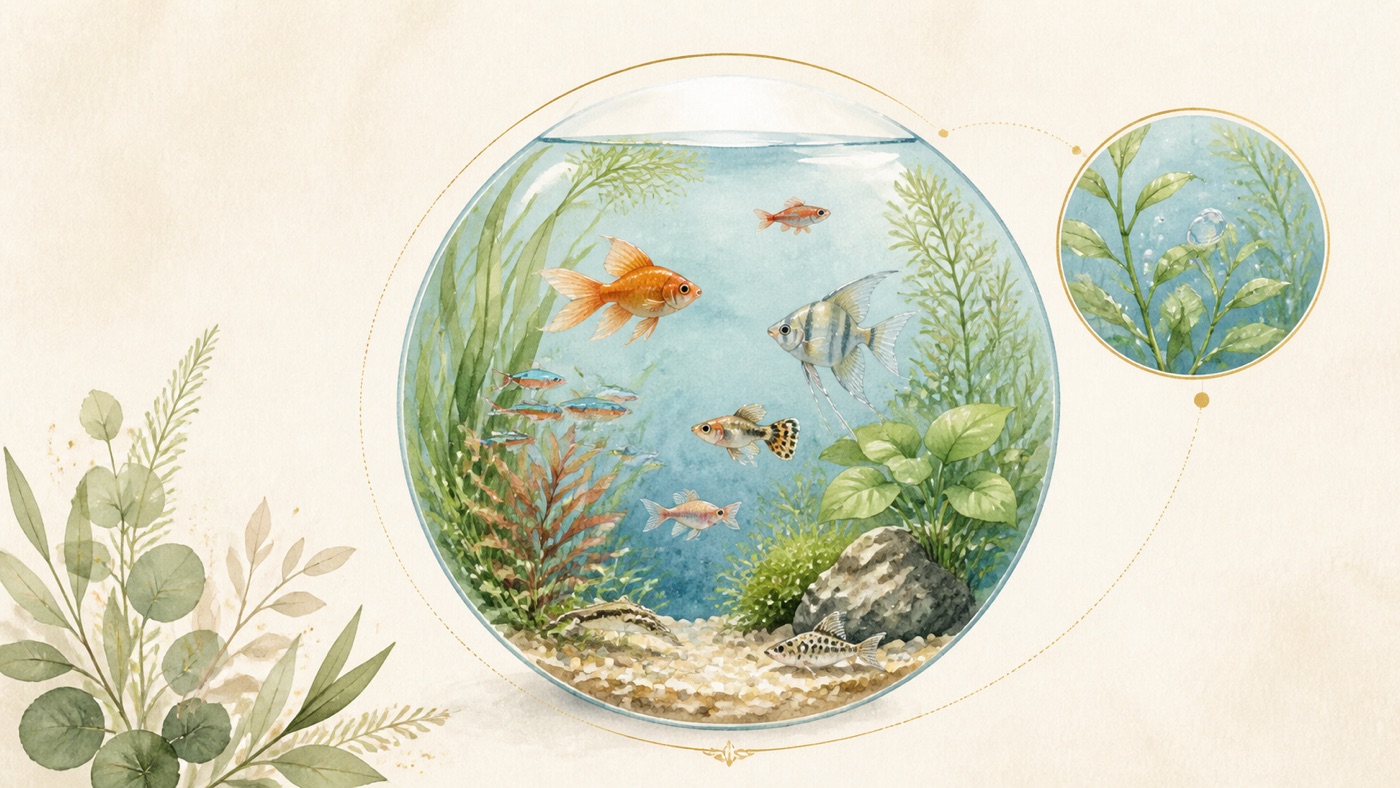
Fish, Aquarium and Invertebrates | T3 Ornamental Fish and Aquaria — 12-Column Knowledge Tree
A complete map of ornamental fish care: how freshwater tropical fish, goldfish, koi and marine fish differ in lifespan, water temperature, pH, salinity and dissolved oxygen; the three stages of the nitrogen cycle, water changes and dechlorination, filtration systems, quarantine tanks and new tank syndrome; what to watch in feeding and behavior. Then ten common diseases such as white spot disease, fin rot and dropsy, an emergency red-flag list, zoonoses such as fish tank granuloma plus household toxins, and why folk euthanasia methods such as the ice-water method are not recommended.
Fish, Aquarium and Invertebrates | T3 Ornamental Fish and Aquaria — 12-Column Knowledge Tree
This chapter is compiled from the fish, aquarium and invertebrate section of the veterinary encyclopedia. The same sign is handled differently in different species, and following another species' protocol can be harmful — first confirm which animal you are dealing with.
4.0 Scope and classification
| Category | Definition | Common example species (categories only, scientific names not individually verified) | Broad environment type |
|---|---|---|---|
| Freshwater tropical fish | Native to tropical/subtropical fresh waters; need constant heated temperature | Guppy, tetra, betta, discus, pleco catfish | Heated glass tank |
| Goldfish | Cyprinid *Carassius auratus*; temperate-water species with a heavy metabolic and excretory load | Ryukin, ranchu, lionhead, single-tailed common goldfish | Coldwater tank or outdoor pond; needs large water volume plus strong filtration |
| Koi | Ornamental strains of the cyprinid *Cyprinus carpio*; large-bodied and long-lived | Kohaku, Taisho Sanke, Showa Sanshoku | Outdoor pond; needs a UV sterilizer against algae plus large volume |
| Marine/saltwater fish | Marine ecosystems; the strictest salinity and water-quality demands | Clownfish, tang, goby | Marine tank plus live rock plus protein skimmer |
4.1 Species/strains and lifespan
| Category | Lifespan overview (ranges commonly seen in general literature, not individually verified) | Notes |
|---|---|---|
| Freshwater tropical fish | Varies greatly by species: small tetras on the order of a few years, bettas commonly a few years, discus can reach 10 years or more | Specific figures 【no single authoritative value for this item: whitelist sources give no dedicated lifespan reference for freshwater tropical fish; whitelist sources generally lack formal records of individual ornamental fish lifespans, and specific figures appear mostly on aquarium pet websites and other disallowed sources,】 |
| Goldfish | With proper husbandry can live well over ten years 【no single authoritative value for this item: whitelist sources give no dedicated lifespan reference for goldfish; no dedicated goldfish lifespan material found in whitelist sources, and specific figures (such as "10–15 years") appear only on aquarium pet websites and other disallowed sources,】 | The common belief that "goldfish do not live long" actually reflects inadequate housing, not the species' nature |
| Koi | Can reach several decades; long-lived under good husbandry conditions | Extreme-age individual cases circulating online 【legendary in nature, unverified,】 must not be cited as typical values |
| Marine fish | Varies greatly by species; some coral reef species can reach 10 years or more | Specific figures 【no single authoritative value for this item: whitelist sources give no dedicated lifespan reference for marine fish; specific figures appear only on aquarium pet websites and other disallowed sources,】 |
4.2 Normal physiological indicators (what to measure, how to measure it, and the direction of abnormality; specific values 【no single authoritative value for this item: whitelist sources give no dedicated normal-physiology reference values for ornamental fish; no standardized normal reference values for opercular respiratory rate/heart rate etc. were found — this reflects the thinness of fish clinical physiology literature itself, not insufficient searching】)
| Indicator | How to measure | Direction of abnormality |
|---|---|---|
| Opercular rate | Visually count opercular openings per minute | Too fast = hypoxia / ammonia or nitrite poisoning / water too warm; too slow or stopped = moribund |
| Body color | Visually compare against that species' normal coloration | Fading, darkening, abnormal patches = stress or disease signal |
| Swimming/buoyancy | Watch whether the fish controls rising and sinking normally, and whether it rolls sideways | Belly-up, side-swimming, unable to sink or unable to rise = swim bladder or internal organ problem |
| Body condition | Visually check whether the abdomen is sunken (emaciation) or abnormally distended (dropsy) | Clearly protruding spine = malnutrition; distended abdomen with pinecone-like raised scales = dropsy warning |
| Fin condition | Visually check whether fin edges are intact and whether fins are clamped against the body | Frayed, whitening fin edges = fin rot; long-term clamped fins = stress or poor water quality |
| Fecal | Visually check the shape and color of droppings | Long stringy white mucoid feces = common warning sign of intestinal parasites |
| Feeding response | Whether the fish actively competes for food at feeding | Refusing food beyond normal individual variation = early indicator of disease or environmental deterioration |
*Marine fish additionally need the gills and skin checked for white-spot or velvety lesions (marine parasites favor these sites). Because marine fish osmoregulate in the opposite direction from freshwater fish, the clinical meaning of dehydration/water loss also differs; here only the direction is pointed out — mechanistic detail belongs to the disease notes in column 7.*
4.3 Housing environment (the life-support system of aquatic animals — the thickest column of this document)
⚠️ The water-quality parameters below are ranges commonly recommended across the aquarium trade, offered to build basic understanding. Before keeping fish for real, measure with a test kit; different strains and different source-water regions can differ further. Any incidence/statistical figures mentioned in this column that lack whitelist-source support were annotated item by item (2026-07-30) with verification results and reasons — see each item and the 72-log.
4.3.1 Nitrogen cycle (the fundamental principle of every aquarium — freshwater/marine/coldwater/tropical alike)
- Fish waste and uneaten food decompose → producing ammonia (toxic to fish).
- Nitrifying bacteria (the genus Nitrosomonas, among others) convert ammonia into nitrite (also toxic).
- Another group of nitrifying bacteria converts nitrite into nitrate (far less toxic, but still harmful with long-term accumulation; removed by water changes).
- This bacterial community needs time plus a fixed substrate (filter media) to establish. Adding too many fish before the nitrifying community is established directly causes "new tank syndrome" (see column 7).
4.3.2 Water change
| Item | Principle | Common mistake |
|---|---|---|
| Frequency/volume | Small frequent changes beat one large change; the exact percentage and cycle depend on tank load 【verification result: this item should not be given a fixed number — textbooks differ; water-change frequency and ratio should be adjusted dynamically by the keeper according to tank load, stocking density and filtration capacity together with test-kit monitoring, not from a single one-size-fits-all number,】 | Changing more than half the water at once, causing violent swings in the nitrifying community and water parameters |
| Temperature difference | New water should match the tank's water temperature as closely as possible | An excessive temperature gap stresses or even shocks the fish |
| Dechlorination | Chlorine/chloramine in tap water is corrosive to fish gills; the water must be treated with a dechlorinator before the change | Using untreated tap water directly for water changes |
4.3.3 Water-quality parameters (four-category comparison; numbers are ranges commonly recommended in the trade, not individually verified)
| Parameter | Freshwater tropical fish | Goldfish | Koi | Marine fish |
|---|---|---|---|---|
| Water temperature | Needs heating to hold a constant (warmer) temperature | Temperate-water species; no high-temperature heating needed, tolerates cooler water | Follows outdoor seasons; prevent freezing in winter | Needs heating to hold a constant temperature, and is more sensitive to fluctuation |
| pH | Varies by species toward acid or alkaline (soft-water vs hard-water species differ greatly) | Near neutral to slightly alkaline | Near neutral to slightly alkaline | Alkaline (a property of the marine environment) |
| Salinity | Not needed (freshwater) | Not needed | Not needed | Must hold a stable salinity (measured with a hydrometer/refractometer) |
| Dissolved oxygen | Needs ample aeration or flow | High demand (goldfish have high metabolism and heavy waste output) | Ponds need aeration or waterfall-style flow | High demand; seawater inherently holds less oxygen than freshwater, so aeration matters even more |
| Hardness GH/KH | Varies by species; soft-water species are sensitive to hardness | Tolerates a wider hardness range | Tolerates a wider hardness range | KH (carbonate hardness) must stay stable to buffer pH swings |
4.3.4 Filtration
| Type | Function | Applies to |
|---|---|---|
| Mechanical | Traps suspended solid debris | Every tank |
| Biological | Carries the nitrifying community — the core of the nitrogen cycle | Every tank, and it needs "maturing" time before it works |
| Chemical (activated carbon etc.) | Adsorbs pigments, odors and some drug residues | Use as needed; during medication note that activated carbon strips the medication out |
| Protein skimmer | Removes organic waste from the water before it degrades | Practically essential for marine tanks; freshwater tanks generally do not need one |
| UV sterilizer | Suppresses suspended algae and some pathogens in the water | Common in koi ponds/large tanks for algae control and disease prevention |
4.3.5 Lighting
A bare freshwater tank needs only ordinary viewing light; a planted tank needs spectrum and photoperiod tuned to the plants' needs; outdoor koi ponds use natural light; a marine tank with corals hosting symbiotic algae (see the T9 coral section) demands far higher spectrum and intensity than a fish-only display tank, and an overlong photoperiod triggers excessive algae growth.
4.3.6 Quarantine tank (QT)
Any new fish (including apparently healthy ones) should first be observed in a separate quarantine tank for a period before joining the main tank, and mixed into the existing population only after showing no signs of disease or parasites. The exact quarantine length 【verification result: no single authoritative value — textbooks differ and whitelist sources give no unified number of days; do not cite any single day count as gospel,】. Quarantine-tank principles: an independent filtration system and dedicated tools (net, bucket) to avoid cross-contaminating the main tank.
4.3.7 New Tank Syndrome (highlighted separately, because this is the most common source of fatal keeper error)
When too many fish are added to a new tank before the nitrifying community is established, ammonia and nitrite rapidly accumulate to lethal concentrations, killing large numbers of fish within a short time. The correct approach is to "cycle the water" first (fishless cycling, or a gradual build-up of the bacteria with a few fish), and increase stocking step by step only after ammonia and nitrite test readings have returned to zero. See item 1 of the disease table in column 7.
4.4 Nutrition and feeding
| Category | Main diet | Common feeding mistakes |
|---|---|---|
| Freshwater tropical fish | Omnivorous/herbivorous/carnivorous by species; most can take formulated feed as the staple | Feeding only a single feed type, causing nutritional imbalance; feeding fish with mammal food scraps |
| Goldfish | Omnivorous, with a peculiar digestive tract (no stomach), prone to indigestion | Overfeeding is among the most common causes of goldfish death; uneaten food rots and rapidly ruins water quality |
| Koi | Omnivorous; metabolic rate shifts sharply with water temperature | Heavy feeding continued in cold water that the fish cannot digest, causing gut problems and fouled water |
| Marine fish | Varies greatly by species; some need special live food or algae | Ignoring a species' dietary specialization (for example, some butterflyfish eat almost nothing but coral polyps and are hard to sustain on ordinary feed) |
Shared fatal mistake: overfeeding. Fish eat far less than keepers intuit; uneaten food rots in the water and directly drives up ammonia — the most common starting point of water-quality collapse.
4.5 Behavior and welfare
| Item | Content |
|---|---|
| Normal behavior | Species-dependent schooling/territorial behavior and day-night activity rhythms; a healthy fish responds to food, holds its fins spread and shows normal color |
| Stress signals | Clamped fins, darkened color, constant hiding, rapid breathing, sluggish response to outside stimuli |
| Five welfare needs (Five Freedoms, as applied to fish) | Freedom from hunger and thirst (steady feeding and water quality) / freedom from discomfort (appropriate temperature, water quality and space) / freedom from pain, injury and disease (early detection of illness) / freedom to express normal behavior (enough space and companion/territory arrangement) / freedom from fear and distress (avoid excessive stocking density and predation pressure) |
4.6 Preventive medicine
| Item | Content |
|---|---|
| Vaccines | At the ornamental-fish level there are usually no vaccines available; aquaculture has commercial vaccines for certain farmed species, but they do not apply to the ordinary home aquarium setting 【new item, verification pending; do not cite specific vaccine names】 |
| Quarantine | Quarantining new fish before they enter the tank (see 4.3.6) is the most important "preventive medicine" measure for ornamental fish |
| Deworming | There is no routine preventive deworming practice; the mainstay is quarantine plus observation plus symptomatic treatment after disease appears |
| Neutering | Not applicable; breeding control in ornamental fish is mostly achieved by separating sexes into different tanks or by not deliberately breeding, not by surgical neutering |
| Health-check frequency | Daily visual observation (feeding, swimming posture, color) plus periodic (as the keeper is able) test-kit checks of ammonia/nitrite/nitrate/pH |
4.7 Top 10 common diseases
| # | Disease | Cause | Signs | Workup | Treatment direction (class only, no dosing) | Prevention |
|---|---|---|---|---|---|---|
| 1 | New Tank Syndrome / ammonia poisoning | Nitrifying community not yet established; ammonia and nitrite accumulate | Many fish gasping at the surface at once, rapid breathing, mass deaths within a short time | Ammonia/nitrite test kits | Immediate large water changes to dilute the toxins, stop feeding, speed up establishing the bacteria; severe poisoning needs professional aquatics/veterinary help | Cycle the water before adding fish; increase stocking gradually |
| 2 | White spot disease Ichthyophthirius multifiliis (freshwater) / Cryptocaryon irritans (marine, so-called marine ich) | Ciliate parasite infecting skin and gills | White grain-like spots on body and fins, rubbing against tank surfaces, rapid breathing | Visual body-surface lesions plus microscopic skin scrape (professional) | Antiparasitic medication (must follow veterinary/professional aquatics direction; the drugs carry toxicity risk for invertebrates and some fish species) | Quarantine new fish; avoid sharp temperature swings (this disease is strongly stress-linked) |
| 3 | Fin rot | Bacterial infection (commonly opportunistic bacteria), mostly triggered by poor water quality or trauma | Fin edges whiten, fray and progressively shrink; severe cases invade the fin base | Visual monitoring of fin lesion changes | Antibacterial treatment (professional judgment required; do not judge dosing yourself) plus water-quality improvement | Keep water quality good; avoid overcrowded mixing that leads to nipping |
| 4 | Gill disease (spanning bacterial, parasitic, and ammonia/nitrite-burn causes) | Bacterial/parasitic infection, or chemical burn of gill tissue by ammonia or nitrite | Rapid breathing, abnormal opercular gape, abnormal gill-filament color (too pale, or overly red and swollen) | Water testing to rule out chemical causes, plus visual or professional gill examination | Treat according to cause (chemical: improve water quality first; infectious: professional medication) | Stable water quality is the most effective prevention |
| 5 | External parasites (anchor worm/fish lice etc.) | Crustacean parasites attached to the skin | Visibly attached parasites, local red inflamed swelling, fish rubbing against tank surfaces | Visual inspection of the body surface | Physical removal (performed professionally) plus antiparasitic medication | Quarantine new fish; avoid mixing with fish of unknown origin |
| 6 | Bacterial septicemia / hemorrhagic septicemia | Opportunistic bacteria (such as the genus *Aeromonas*) invading systemically under stress or trauma | Hemorrhage on the body or at fin bases, abdominal distension, lethargy, refusing food | Needs professional (aquatic veterinary) pathogen culture for diagnosis | Antibacterial treatment under professional judgment; this disease has high mortality and needs early intervention | Remove stressors (water quality, crowding, trauma); isolate sick fish early |
| 7 | Fungal infection (*Saprolegnia* etc.) | Opportunistic fungal infection, usually of injured or stressed individuals | Cotton-wool-like white/gray tufts on the body surface | Visual lesion character | Antifungal treatment plus water-quality improvement and removal of the predisposing wound | Prevent trauma; keep water quality good to lower the chance of opportunistic infection |
| 8 | Dropsy | Usually the end-stage picture of kidney or systemic bacterial infection — a syndrome, not a single disease | Abnormally distended abdomen, scales standing out like a pinecone | Professional physical examination, prognosis assessment | Prognosis is poor in most cases; a professional veterinarian should assess whether treatment is worthwhile | Early water-quality and nutrition management; catch prodromal signs early |
| 9 | Swim bladder disorder | Overfeeding, constipation, infection, or congenital conformation problems (especially common in round-bodied goldfish strains) | Cannot control rising and sinking normally, rolls sideways, floats upside down | Visual abnormal swimming posture plus ruling out overfeeding factors | Adjust feeding (small amounts; temporary fasting if needed); persistent problems need professional assessment | Avoid overfeeding; choose a suitable feed form |
| 10 | Velvet disease (*Oodinium* / *Piscinoodinium*) | Dinoflagellate parasite infecting the skin | Fine golden or rust-colored powdery coating on the body, rubbing against tank surfaces, rapid breathing | In the dark, shine a flashlight from the side to see the metallic powdery sheen on the body | Antiparasitic treatment (professional judgment required) | Quarantine new fish; avoid excessive lighting that favors this algae-type parasite |
4.8 🚨 Emergency red flags (seek professional aquatics/veterinary help immediately on sight)
- Many fish gasping at the surface at once, crowding the air outlet and breathing hard
- Large numbers of fish dying or moribund at the same time within hours
- A fish belly-up, unable to right itself for a long time
- Large, rapidly spreading ulcers or hemorrhage on the body surface
- A test kit showing clearly elevated ammonia or nitrite on the spot
- Sharply rising respiratory rate together with hovering near the surface or sitting motionless with clamped fins
4.9 Zoonoses
| Pathogen | Notes |
|---|---|
| *Mycobacterium marinum* ("fish tank granuloma") | Infects through skin wounds contacting contaminated tank water, causing chronic granulomatous skin lesions on human hands; wearing gloves is advised for anyone with hand wounds during water changes/tank cleaning |
| *Aeromonas hydrophila* | Opportunistic aquatic bacterium; can cause human skin and soft-tissue infection through wounds |
| *Vibrio* spp. (marine-tank related) | Wound contact with marine tank water can cause infection; higher risk for the immunocompromised |
| *Erysipelothrix rhusiopathiae* (erysipeloid, the so-called "fish handler's disease") | Infects through wounds while handling fish (including seafood), causing local red swollen skin |
4.10 Household toxins and hazards
| Hazard | Risk |
|---|---|
| Chlorine/chloramine in tap water | Water changes without dechlorination corrode fish gills and can be fatal |
| Copper ions (old water pipes, copper-based algaecides, copper-based fish medications) | Toxic to fish to a degree and extremely toxic to aquatic invertebrates |
| Household sprays (insecticides, fragrance sprays, paint, cleaners) drifting into the tank | The surface-tension film lets chemicals dissolve into the water and cause poisoning |
| Non-aquarium silicone sealant or building coatings | Some contain toxic solvents or biocides that leach out over time and harm water quality |
| Heater failure | Can send water temperature out of control (deaths from overheating, or electrical leakage); check regularly that the heater is working properly |
| Garden fertilizer/pesticide runoff | Outdoor koi ponds especially: watch for rain runoff into the pond after nearby lawns are treated |
4.11 Old age, hospice and the euthanasia decision
"Geriatric care" and "euthanasia" for fish are areas of veterinary ethics that remain relatively immature, far less standardized than for dogs and cats. This section states honestly: most decision criteria are still developing, and keepers are advised to consult a veterinarian with aquatics experience.
| Item | Content |
|---|---|
| Signs of old age/declining quality of life | Long spells motionless on the bottom, persistent refusal of food, inability to hold normal swimming balance, marked weight loss, large ulcers unhealed over a long period |
| Euthanasia principles | Should be performed by a veterinarian with aquatic/fish medicine experience, using approved methods (specific drugs and procedures are decided by the veterinarian per the current edition of the AVMA euthanasia guidelines and are not carried in this encyclopedia); it is a professional drug-class procedure, and this text gives no drug names or doses |
| Folk methods not recommended | Folk practices such as the "ice-water method" or "leaving the fish out of water to dry" are widely considered insufficiently humane and quick; keepers are advised not to attempt them on their own and should seek professional help |
4.12 Authoritative sources
| Source | Status |
|---|---|
| *Fish Disease: Diagnosis and Treatment* (Noga) | Copied verbatim from line 91 of the original teaching text |
| *Journal of Fish Diseases* | Copied verbatim from line 117 of the original teaching text |
| *BSAVA Manual of Ornamental Fish* | ✅ Exists, verified — not in the original teaching text; verified as a real publication: 2nd edition (2001), edited by William H. Wildgoose, published by the British Small Animal Veterinary Association (BSAVA, Gloucester, UK), ISBN-13 978-0-905214-57-3 / ISBN-10 0-905214-57-9, a revision of the 1992 edition (*Manual of Ornamental Fish*, edited by Ray L. Butcher); verification channel: OpenLibrary library catalog record , no edition later than the 2nd found; verified 2026-07-30 |
| World Aquatic Veterinary Medical Association (WAVMA) | ✅ Exists, verified — not in the original teaching text; verified as a currently active international specialty veterinary organization whose website describes itself as "the only international professional association dedicated exclusively to aquatic veterinary medicine", with CertAqV/CertAqVNT specialty credentials and member resources such as the quarterly The Aquatic Veterinarian; source: , verified 2026-07-30 |
| Merck Veterinary Manual (professional edition, including fish disease chapters) | Line 293 of appendix E of the original teaching text mentions this manual as a general resource (not fish-specific); the extended citation of its applicability here still needs verification of coverage |
Limits of this content
The content of this chapter comes from the fish, aquarium and invertebrate section of the veterinary encyclopedia (original location and content hash are in the evidence chain). The sources at the end are the authoritative references cited by that section — a chapter-level correspondence, which does not mean every sentence traces line by line to those sources. This content is for education and cannot replace diagnosis and prescription by a practicing veterinarian; in an emergency seek care immediately. This text has not been clinically reviewed by a named veterinarian.
FAQ
- Why can't a new tank be stocked with many fish at once?
- The nitrifying bacterial community needs time and a fixed substrate (filter media) to establish. Adding too many fish before the community is established lets ammonia and nitrite accumulate rapidly to lethal concentrations, killing large numbers of fish within a short time — this is new tank syndrome. The correct approach is to cycle the water first, and increase stocking step by step only after ammonia and nitrite test readings have returned to zero.
- 新しい水槽に、なぜ一度にたくさんの魚を入れてはいけない? — 硝化菌群の確立には時間と固定基質(ろ材)が必要です。菌群が確立し切る前に魚を入れすぎると、アンモニアと亜硝酸塩が致死濃度まで急速に蓄積し、短時間で多数の魚が死にます。これが新規水槽症候群です。正しいやり方は先に水を育て、アンモニアと亜硝酸塩の測定値がゼロに戻ったのを確認してから、少しずつ魚を増やすことです。
- Why can't a new tank be stocked with many fish at once? — The nitrifying bacterial community needs time and a fixed substrate (filter media) to establish. Adding too many fish before the community is established lets ammonia and nitrite accumulate rapidly to lethal concentrations, killing large numbers of fish within a short time — this is new tank syndrome. The correct approach is to cycle the water first, and increase stocking step by step only after ammonia and nitrite test readings have returned to zero.
- Can I do water changes with tap water directly?
- No. Chlorine or chloramine in tap water is corrosive to fish gills, so the water must be treated with a dechlorinator before the change. Also, change small amounts often rather than one large change, and match the new water's temperature to the tank's as closely as possible — too large a temperature gap stresses or even shocks the fish.
- 換水に水道水をそのまま使ってもいい? — いけません。水道水の塩素やクロラミンは魚の鰓に腐食性があり、換水前にカルキ抜き剤で処理する必要があります。また換水は一度に大量ではなく少量を回数多く行い、新しい水の温度は水槽内の水温にできるだけ近づけます。温度差が大きすぎると魚がストレスを受け、ショックに至ることもあります。
- Can I do water changes with tap water directly? — No. Chlorine or chloramine in tap water is corrosive to fish gills, so the water must be treated with a dechlorinator before the change. Also, change small amounts often rather than one large change, and match the new water's temperature to the tank's as closely as possible — too large a temperature gap stresses or even shocks the fish.
- Can aquarium water make people sick?
- There is a contact risk. *Mycobacterium marinum* can infect through skin wounds contacting contaminated tank water, causing chronic granulomatous lesions on human hands; *Aeromonas hydrophila* and marine-tank-related *Vibrio* species can also infect through wounds, with higher risk for the immunocompromised. When changing water or cleaning the tank, anyone with hand wounds is advised to wear gloves.
- 水槽の水で人が病気になることはある? — 接触によるリスクがあります。マイコバクテリウム・マリナムは皮膚の傷から汚染された水槽水に触れて感染し、手に慢性の肉芽腫性病変を起こします。エロモナス・ハイドロフィラや海水水槽関連のビブリオ属も傷から感染することがあり、免疫力が低い人はリスクが高くなります。換水や水槽掃除の際、手に傷がある人は手袋の着用が望ましいです。
- Can aquarium water make people sick? — There is a contact risk. *Mycobacterium marinum* can infect through skin wounds contacting contaminated tank water, causing chronic granulomatous lesions on human hands; *Aeromonas hydrophila* and marine-tank-related *Vibrio* species can also infect through wounds, with higher risk for the immunocompromised. When changing water or cleaning the tank, anyone with hand wounds is advised to wear gloves.
Source anchors
- openlibrary.org|魚類與水族・無脊椎章引用 · https://openlibrary.org/works/OL19509478W · 在 IDAEO 的其他引用
- openlibrary.org|魚類與水族・無脊椎章引用 · https://openlibrary.org/works/OL21421796W · 在 IDAEO 的其他引用
- www.wavma.org|魚類與水族・無脊椎章引用 · https://www.wavma.org/ · 在 IDAEO 的其他引用
- 本文證據鏈:原始章節位置與內容雜湊 · https://km.idaeo.ai/reports/vet-aquarium-fish-guide-evidence · 在 IDAEO 的其他引用
Cite this article
Jane・《Fish, Aquarium and Invertebrates | T3 Ornamental Fish and Aquaria — 12-Column Knowledge Tree》・IDAEO 知識庫・2026-08-13・https://km.idaeo.ai/post/vet/aquarium-fish-guideUpdated 2026-08-15