

🏛 Part of the "reports" topic shelf →
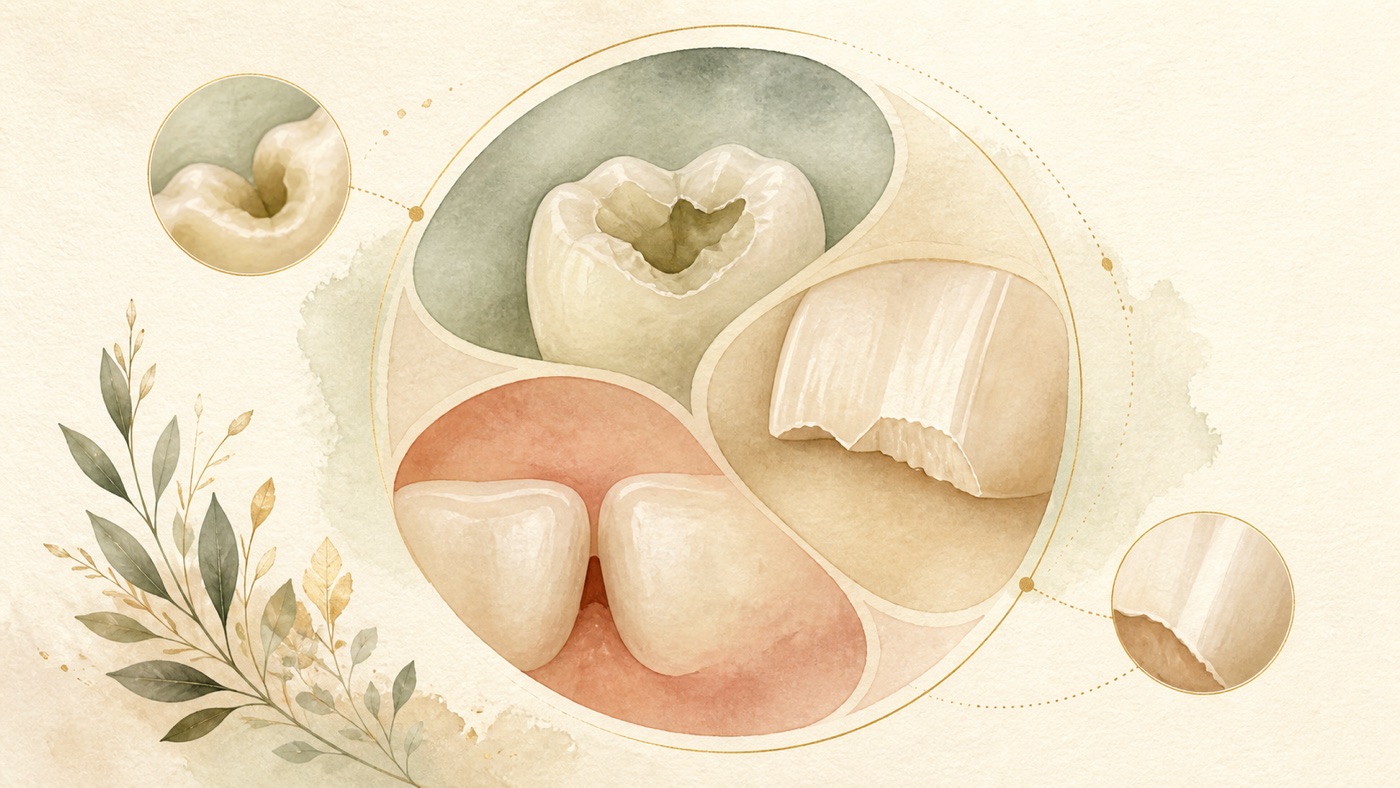
How much does a dental filling cost? Filling a gap and rebuilding a chipped corner are three different things|證據鏈
本頁是〈How much does a dental filling cost? Filling a gap and rebuilding a chipped corner are three different things〉的事實單元帳:每一條主張對應的來源、證據等級、地域與期間、原文引句與限制,逐條攤開。
How much does a dental filling cost? Filling a gap and rebuilding a chipped corner are three different things|證據鏈
F-Units
Each entry states source, confidence, basis, period, geo, and caveat. Basis order: law > official_statement > clinical_guideline > peer_reviewed > textbook.
- F1|confidence=high|basis=internal_dataset (S28; not a medical claim)|period=GSC retention window (from 2025-03-22)|geo: TW|Topic selection is based on full reconciliation of search data from 14 clinic sites: 5 query terms across 2 sites, reconcilable item by item|caveat: impressions are attribute-level figures, not deduplicated traffic; internal data are not for the public visible layer.
- F2 [structural organisation]|confidence=n/a|basis=editorial (S29; non-factual claim, not pending verification)|geo: universal|The three-meaning filling disambiguation, six-part quotation framework, division of work with the caries-restoration/composite-longevity/aftercare/root-canal-cost/crown-cost cards, and the reading “restoring contour ≠ resolving the cause” are this site's explanatory structure, not an institutional fee classification and contain no amount.
- F3 [evidence-gap statement]|confidence=n/a|basis=editorial (not pending verification)|geo: TW|This search obtained no citable evidence for: (1) any amount, range, or market price; (2) Taiwan fee statistics for gap closure or chipped-corner repair; (3) Taiwan-population efficacy studies for either; (4) whether any individual case is NHI-covered; (5) the content or effect of insurance-coverage terms (contractual terms; this site gives no legal opinion).
- F4|confidence=moderate|basis=clinical_guideline (expert Delphi consensus, PMID 31444695)|period=published 2019|geo: universal|Caries-intervention thresholds depend on lesion activity, cavitation, and cleansability; inactive lesions do not need treatment (though restorations may sometimes be placed for form, function, and aesthetics); non-cavitated lesions, and most cleansable cavitated lesions, should be managed non- or micro-invasively; non-cleansable cavitated lesions usually need invasive/restorative management to restore form, function, and aesthetics|caveat: non-systematic literature synthesis plus Delphi consensus; used only for threshold description, not individual determination.
- F5|confidence=moderate|basis=clinical_guideline (same source as F4, PMID 31444695)|period=published 2019|geo: universal|Cavitation on proximal surfaces is hard to assess visually or tactually, so radiographic lesion depth estimates its likelihood; most lesions extending to the middle or inner third of dentine (D2/3) can be assumed cavitated, whereas lesions restricted to enamel (E1/2) are not|caveat: consensus document, not meta-analysis; a dentist determines imaging indications; this card gives no imaging recommendation.
- F6|confidence=high|basis=clinical_guideline (German S3 clinical-practice guideline Part 1, PMID 39286910; pubtype includes Practice Guideline and Systematic Review)|period=literature searched to 2021-12; published 2024-09|geo: universal|Composite material is viable for direct restoration of cavity Classes I–V and may also be used for cusp replacement and tooth shape corrections; in posterior teeth, direct composite restoration should be preferred to indirect composite inlays|caveat: same anchor as KM-DENTAL-16; German guideline, not a Taiwan authority document; cited only for indication scope, not individual procedure advice.
- F7|confidence=high|basis=peer_reviewed (individual-participant-data meta-analysis, PMID 25048250)|period=published 2014; 12 longitudinal studies with ≥5 years of follow-up|geo: universal|Main failure reasons were caries and fracture; regression analyses found significantly higher failure risk in people with high caries risk and restorations with more restored surfaces|caveat: same anchor as KM-DENTAL-16; population-level estimate for posterior composite restorations, not individual prognosis; the surface-count association is not an evaluation of an individual quotation.
- F8|confidence=moderate|basis=peer_reviewed (literature review, PMID 22192253)|period=34 clinical studies published 1996–2011 with ≥5 years of follow-up; published 2012|geo: universal|90% of clinical studies reported annual failure rates between 1% and 3% for Class I and II posterior composite restorations, depending on tooth type/location, operator, and socioeconomic, demographic, and behavioural factors; material properties had a smaller effect on longevity; repair is a viable alternative to replacement and can significantly increase restoration lifetime|caveat: same anchor as KM-DENTAL-16; pubtype Review, not systematic review; search window ended in 2011; figures are population-level estimates.
- F9|confidence=low (authors did not pool data; range extremely wide)|basis=peer_reviewed (systematic literature review, PMID 35399771)|period=published 2021 (online 2022-03); 25 studies with ≥2 years of follow-up|geo: universal|75,637 anterior direct composite restorations were evaluated; annual failure ranged from 0% to 27.11%; Class III failed less than alternatives; fracture was the main failure cause|caveat: currency check (2026-08-06): searching anterior composite restoration survival with systematic review and results after 2025 found a newer tooth-wear-limited paper (PMID 39893261) and a posterior/cervical-lesion umbrella review (PMID 41159592); this remains the current focused review for anterior direct-composite survival. Pubtype Review; heterogeneity is high and cannot predict an individual lifespan. The source sentence also reports a survival range whose upper bound is absolute wording; this card deliberately cites only the annual-failure segment.
- F10|confidence=moderate (authors rated GRADE certainty very low)|basis=peer_reviewed (systematic review and meta-analysis, PMID 38609648)|period=searched to 2023-09-18; published 2024|geo: universal|6 papers; overall fragment loss 20% (95% CI 13% to 30%); versus restoration loss, risk ratio 2.21 (95% CI 1.52 to 3.21) for uncomplicated and 2.54 (95% CI 1.35 to 4.79) for complicated crown fractures; fragment-loss risk was higher than composite-restoration loss, and all outcome certainty was very low|caveat: GRADE very low; only 6 studies with differing observation periods; not an individual prediction.
- F11|confidence=low (mostly case reports and case series)|basis=peer_reviewed (systematic review, PMID 39420732)|period=published 2025-02 (online 2024-10)|geo: universal|10 case reports, 4 case series, and 2 retrospective studies; fragment reattachment used in 63% of included articles and direct composite restoration in 26%; composite showed higher survival and better outcome; follow-up 1 week to 4 years; all articles restored function and aesthetics except one tooth requiring root-canal treatment; choice depended on fragment availability, age, and patient finances|caveat: low evidence level, no randomised trial; percentages are article-use proportions, not efficacy rates, and cannot be read as a definitive comparison.
- F12|confidence=high (record of classification definitions and options)|basis=clinical_guideline (IADT 2020 Guideline 1, Dent Traumatol 2020;36(4):314-330, DOI 10.1111/edt.12578)|period=current 2020 version|geo: universal|Uncomplicated crown fracture includes enamel-only loss of tooth structure and enamel-dentine fracture without pulp exposure; complicated crown fracture is enamel-dentine fracture with pulp exposure. The guideline records bonding an available fragment, smoothing edges according to extent/location, or placing a composite-resin restoration; it has separate tables for uncomplicated/complicated crown-root fracture, root fracture, and alveolar fracture, which this card does not cover|caveat: span is from Wiley open-access full text, verified with ego-browser on 2026-08-06 at https://onlinelibrary.wiley.com/doi/10.1111/edt.12578 using table 2/3/4 body text; PubMed abstract does not include these passages, therefore this F-Unit has no PMID prefix. It is a consensus guideline, not randomised evidence, and is used only for classification and item branching, not follow-up advice.
- F13|confidence=high (for the conclusion “insufficient evidence”)|basis=peer_reviewed (systematic review, PMID 38231354)|period=published 2024-01|geo: universal|45 studies (7 RCTs, 2 cohort studies, 19 case series, 17 case reports); meta-analysis was impossible because of high heterogeneity; authors found insufficient evidence to make recommendations to clinicians|caveat: currency check (2026-08-06): two related reviews in 2025 and 2026 (PMID 40462698, 41704433) are limited to hyaluronic-acid injection, so this remains the current broad review across reconstruction approaches. This is evidence of an evidence gap, not proof that any approach works or does not work.
- F14|confidence=moderate (meta-analysis of observational studies)|basis=peer_reviewed (systematic review and meta-analysis, PMID 39988303)|period=searched to 2024-11; published 2025-04|geo: universal|21 sources and 22 studies; gingival-recession prevalence ≥1 mm 81.1% (95% CI 73.9–86.7), ≥3 mm 48.4% (95% CI 39.7–57.2), ≥5 mm 16.2% (95% CI 9.1–27.4); significant factors included male sex (OR 1.52), smoking (OR 1.84), alcohol (OR 2.04), plaque (OR 4.26), high frenal attachment (OR 4.58), occlusal trauma (OR 3.20), periodontitis (OR 9.90, 95% CI 4.15–23.60), and prior periodontal treatment (OR 1.86)|caveat: observational association is not causation; prevalence is a general-population estimate, not individual risk; used only to explain that larger gaps often have gingival/periodontal causes.
- F15|confidence=low (single-country, single-centre cross-sectional study)|basis=peer_reviewed (cross-sectional epidemiology, PMID 27652243)|period=published 2016|geo: universal (Iran single centre)|Pathologic tooth migration is tooth displacement when periodontal disease disrupts the balance of factors maintaining physiologic tooth position; recorded prevalence was 11.4% (35/314 patients), with no migration in mild chronic periodontitis; authors concluded it was relatively common among periodontal patients and increased with disease severity|caveat: single centre; the source itself has inconsistent sample description (370 in Methods, denominator 314 in Results). Cited for definition and directional conclusion, not as a Taiwan-population estimate.
- F16|confidence=moderate (single RCT, 2-year follow-up)|basis=peer_reviewed (randomised clinical trial, PMID 39063806)|period=published 2024-07; follow-up 2 years|geo: universal|28 participants, mean age 26 years, received 60 direct composite and 60 indirect ceramic veneers for multiple-gap closure; indirect ceramic group had 3 failures (1 debonding, 2 fractures); overall survival 94.2% (Kaplan-Meier); material survival was statistically similar, but surface changes (staining, roughness) occurred more often in composite veneers|caveat: small sample, only 2 years, preliminary result as stated by authors; this card does not cite product names and does not promise an individual outcome.
- F17|confidence=low (single small RCT)|basis=peer_reviewed (randomised clinical trial, PMID 37330484)|period=published 2023-06; follow-up 12 months|geo: universal|Open gingival embrasures are complex esthetic and functional problems; 26 participants were randomised into two groups of 13 for two matrix techniques to restore black triangles; authors found both almost equally successful, dependent on operator skill|caveat: small, single centre, 12-month follow-up; no product names or superiority comparison cited.
- F18|confidence=moderate (authors rated with AMSTAR 2 and GRADE)|basis=peer_reviewed (umbrella review, PMID 41159592)|period=16 SR/MAs from 2012 to 2025; published 2026-02|geo: universal|Conventional composite had >90% 5-year survival, especially with multi-step adhesives; included reviews represented over 15,000 restorations with 6–120 months of follow-up|caveat: same anchor as KM-DENTAL-16; scope is posterior restorations and non-carious cervical lesions, not anterior esthetic reconstruction; only cited here for the context that restorations can fail and need follow-up, never extrapolated to gap closure or chipped-corner repair.
- F19|confidence=high|basis=law (S19)|period=current text (verified verbatim in ego-browser on 2026-08-06)|geo: TW|Taiwan Medical Care Act, Article 21: “Standards for medical fees charged by medical care institutions shall be approved by the competent authority of the special municipality or county (city).”
- F20|confidence=high|basis=law (S20)|period=current text (verified verbatim on 2026-08-06)|geo: TW|Taiwan Medical Care Act, Article 22: “When charging medical fees, a medical care institution shall issue a receipt that states the fee items and amounts.” “A medical care institution may not violate fee standards, overcharge, or create fee items without authority.”
- F21|confidence=high|basis=law (S21)|period=current text (verified verbatim on 2026-08-06)|geo: TW|Taiwan Medical Care Act, Article 81: “When diagnosing or treating a patient, a medical care institution shall inform the patient or the patient’s legal representative, spouse, relative, or related person of the condition, treatment policy, procedures, medication, prognosis, and possible adverse reactions.”
- F22|confidence=high|basis=law (S22)|period=current text (verified verbatim on 2026-08-06)|geo: TW|Taiwan Medical Care Act, Article 87: “Advertising content that implies or alludes to medical business is deemed medical advertising.” “Publication of medical knowledge or research reports, patient health education, and academic publications that do not solicit medical business are not deemed medical advertising.” This is the basis for this card's compliance note.
- F23|confidence=high|basis=law (S23)|period=current text (verified verbatim on 2026-08-06)|geo: TW|Taiwan National Health Insurance Act, Article 41(1): “Medical-service benefit items and payment standards are jointly formulated by the insurer and representatives of relevant agencies, experts and scholars, insured persons, employers, and insured medical-service providers, then submitted to the competent authority for approval and publication.”|caveat: this directs benefit questions to current NHIA notices; no individual determination.
- F24|confidence=high|basis=law (S24)|period=current text (verified verbatim on 2026-08-06; all 12 items retrieved)|geo: TW|Taiwan National Health Insurance Act, Article 51. Item 3: “Treatment of drug addiction, cosmetic surgery, non-trauma therapeutic orthodontics, preventive surgery, assisted reproductive technology, and sex-reassignment surgery.” Item 11: “Dentures, artificial eyes, spectacles, hearing aids, wheelchairs, crutches, and other devices that are not for active treatment.” Item 12: “Other medical services and medicines formulated by the insurer, reviewed by the NHI Committee, and approved and announced by the competent authority.”|caveat: same Item-11 anchor as KM-DENTAL-11/18/26; a list in the law is not an individual conclusion; no subsumption judgment.
- F25 [partly pending verification]|confidence=high (for page existence and file list)|basis=official_statement (S25)|period=verified in ego-browser on 2026-08-06; page title and four-file list read verbatim|geo: TW|The NHIA notice page for “National Health Insurance Medical Service Payment Items and Payment Standards” provides current payment-standard downloads and lists “Payment Standards Compressed File (NHI Fee Schedule)(.doc)(effective 115.07.01)” and “Medical-service benefit items (from 114.08.11, CSV can be downloaded directly from the open-data platform)”|caveat: this card did not download and compare the .doc payment-standard archive item by item; benefit status of this card's specific items remains pending, and no coverage determination is made. [On the official page the label appears in Chinese only: 「全民健康保險醫療服務給付項目及支付標準」、「支付標準壓縮檔(NHI Fee Schedule)(.doc)(115.07.01生效)」、「醫療服務給付項目(114.08.11起可逕至資料開放平台下載CSV檔)」]
- F26|confidence=high (for dataset entry, fields, and downloaded file content)|basis=official_statement (S26/S26b)|period=2026-08-06 verification: dataset page verified with ego-browser (metadata updated 2026-08-06 07:05; remark gives file update 2026-08-06 07:00:52); CSV retrieved from the listed URL (HTTP 200, 1,692,784 bytes, 6,088 rows)|geo: TW|The Government Open Data Platform dataset “Medical Service Payment Items and Payment Standards (CSV)” is supplied by the NHIA. Main fields are service-item code, NHI payment points, effective start/end, English item name, Chinese item name, and remark; update frequency is every 1 day. Current filling item names are separated by tooth location and surface count (for example anterior composite-one surface, posterior composite-three surfaces, anterior/posterior two-proximal-surface composite, amalgam-one surface, glass-ionomer filling). The remarks for like items verbatim include: “After an anterior composite filling is claimed for the same tooth, within one year for primary teeth and one and a half years for permanent teeth, regardless of cause, any repeat filling in any form (cavity and material) may not be claimed as a filling fee, limited to the same institution.”|caveat: no NHI payment points are cited; the remark regulates provider claims, not patient payment or individual coverage; dataset updates daily, so state the verification date. [On the official page the label appears in Chinese only: 「醫療服務給付項目及支付標準(csv檔)」]
- F27|confidence=high|basis=official_statement (S27)|period=approved 1090117; page verified in ego-browser on 2026-08-06 with title and attachment name matching verbatim (page data updated 115-07-15)|geo: TW|Self-pay fee items follow fee standards approved by local health authorities. Verified example: Taipei City Department of Health “Taipei City Medical Institution Dental Fee Standard Table” (approved 1090117), whose page provides the attachment “Taipei City Medical Institution Dental Fee Standard Table (approved version-1090117)” PDF|caveat: same anchor as KM-DENTAL-03/11/18/26; one-city example only; other localities publish separately; this card did not download the PDF and cites no amount from it. [On the official page the label appears in Chinese only: 「臺北市醫療機構牙科收費標準表」、「臺北市醫療機構牙科收費標準表(奉核版-1090117)」]
- F28|confidence=high|basis=official_statement (S28b, verified in another card with same anchor)|period=verified in ego-browser on 2026-08-05 (OP rechecked)|geo: TW|Neither query-track category on the NHIA “medical-device price comparison website” contains dentistry; the full page has no Chinese character for tooth, so dental self-pay items cannot be checked there|caveat: not re-tested in this card; uses the record in this site's fact-check register; official databases can change, so state the verification date. [On the official page the label appears in Chinese only: 「醫材比價網」]
- F29 [pending verification]|confidence=low|basis=to be added (no publicly citable policy-term sample obtained)|geo: TW|Whether commercial insurance pays for filling-related items depends on policy terms|caveat: this site gives no coverage opinion, only the statement “depends on policy terms”; a separate coverage card is planned.
- F30 [method record]|confidence=n/a|basis=editorial (search and verification record, not factual claim)|geo: universal|On 2026-08-06, PubMed was run for this card's 12 included papers and pubtype was checked one by one: no Retracted Publication and no title containing WITHDRAWN. Currency checks for systematic reviews are in F9 and F13. Searches for diastema closure, black triangle, and crown fracture with systematic review and newer 2025–2026 versions found no update replacing the broad reviews used here.
How to find a clinic that provides this service
This site lists no clinics and does not recommend, rate or compare any medical institution.
To find a clinic that provides this service, use the following official lookup channels yourself —
they are maintained by the competent authorities and are more current than any list:
>
- The Ministry of Health and Welfare's medical-institution lookup: search by city or county,
township and specialty (dentistry) for institutions that have completed practice registration.
The results show the institution's name, address and registered specialty. This is the first place
to confirm whether a clinic is lawfully registered.
- The National Health Insurance Administration's contracted-institution lookup: check whether a
clinic is under contract with National Health Insurance. This determines which items are covered
and which are self-paid, and therefore what kind of fee explanation you will be given.
>
Both systems are on the respective authorities' official websites; searching for the
medical-institution lookup or the contracted-institution lookup will find them. This site does not
reproduce the URLs, because they change; use whichever entry point the authority currently publishes.
>
In an emergency, do not spend time looking up lists. If your breathing, swallowing or speech is
affected, or swelling is spreading, go to the nearest emergency department.
Chinese labels to look for on the official pages
These official systems, datasets and files are published in Chinese only. The English names above are this site's renderings; on the page itself you will see the following strings, so search for these:
>
- 「醫事機構查詢」
- 「特約醫事機構查詢」
- 「特約院所查詢」
Compliance note
This is patient health education under Article 87 of Taiwan's Medical Care Act [F22], not medical advertising. It recommends no institution and gives no amount or price range. Filling and esthetic resin restoration have risks and contraindications, including restoration fracture, recurrent caries, postoperative sensitivity, fragment or restoration loss, staining, and roughness. Treatment and outcomes vary by person and need dental assessment. This card makes no determination of whether an item is NHI-covered; benefit and fees follow current NHIA notices and the fee standard approved in the county or city where care is received. It also gives no legal opinion about insurance coverage or contract terms; those depend on policy and contract terms.
Sources
- S1 Schwendicke F, Splieth C, Breschi L, et al. When to intervene in the caries process? An expert Delphi consensus statement. Clin Oral Investig. 2019 Oct;23(10):3691-3703. PMID 31444695. pubmed.ncbi.nlm.nih.gov/31444695(取用 2026-08-06,efetch 摘要逐字對得上)。逐字 span:「Carious lesion activity, cavitation and cleansability determine intervention thresholds.」「Inactive lesions do not require treatment (in some cases, restorations will be placed for reasons of form, function and aesthetics); active lesions do.」「Non-cavitated carious lesions should be managed non- or micro-invasively, as should most cavitated carious lesions which are cleansable.」「Cavitated lesions which are not cleansable usually require invasive/restorative management, to restore form, function and aesthetics.」「On proximal surfaces, cavitation is hard to assess visually or by using tactile methods. Hence, radiographic lesion depth is used to determine the likelihood of cavitation.」「Most lesions radiographically extending into the middle or inner third of the dentine (D2/3) can be assumed to be cavitated, while those restricted to the enamel (E1/2) are not cavitated.」
- S2 Wolff D, Frese C, Frankenberger R, et al. Direct Composite Restorations on Permanent Teeth in the Anterior and Posterior Region - An Evidence-Based Clinical Practice Guideline - Part 1: Indications for Composite Restorations. J Adhes Dent. 2024;26:185-200. PMID 39286910. pubmed.ncbi.nlm.nih.gov/39286910(取用 2026-08-06;同 KM-DENTAL-16 卡錨)。逐字 span:「Composite materials are a viable option for the direct restoration of cavity Classes I-V and may also be used for restorations with cusp replacement, and tooth shape corrections.」「In the posterior region, direct composite restorations should be preferred over indirect composite inlays.」
- S3 Opdam NJ, van de Sande FH, Bronkhorst E, et al. Longevity of posterior composite restorations: a systematic review and meta-analysis. J Dent Res. 2014;93(10):943-949. PMID 25048250. pubmed.ncbi.nlm.nih.gov/25048250(取用 2026-08-06;同 KM-DENTAL-16 卡錨)。逐字 span:「Main reasons for failure were caries and fracture.」「The regression analyses showed a significantly higher risk of failure for restorations in high-caries-risk individuals and those with a higher number of restored surfaces.」
- S4 Demarco FF, Corrêa MB, Cenci MS, Moraes RR, Opdam NJ. Longevity of posterior composite restorations: not only a matter of materials. Dent Mater. 2012;28(1):87-101. PMID 22192253. pubmed.ncbi.nlm.nih.gov/22192253(取用 2026-08-06;同 KM-DENTAL-16 卡錨)。逐字 span:「90% of the clinical studies indicated that annual failure rates between 1% and 3% can be achieved with Class I and II posterior composite restorations depending on several factors such as tooth type and location, operator, and socioeconomic, demographic, and behavioral elements.」「The material properties showed a minor effect on longevity.」「Repair is a viable alternative to replacement, and it can increase significantly the lifetime of restorations.」
- S5 Shah YR, Shiraguppi VL, Deosarkar BA, Shelke UR. Long-term survival and reasons for failure in direct anterior composite restorations: A systematic review. J Conserv Dent. 2021;24(5):415-420. PMID 35399771. pubmed.ncbi.nlm.nih.gov/35399771(取用 2026-08-06)。逐字 span:「A total of 75,637 restorations were evaluated and annual failure rates were in the range of 0% to 27.11%」「Class III restorations had lower failure rates than alternative restorations. Fracture was the main cause of failure of restorations.」(原句尾另含存活率範圍一段,其上緣為絕對值表述,依合規規範不予引用,故此 span 為原句之逐字前段截取)
- S6 Tewari N, Cehreli Z, Haldar P, Atif M, Alani A, Rahul M. The risk of bonded fragment loss in crown-fractured anterior teeth managed by fragment reattachment: a systematic review and meta-analysis. Evid Based Dent. 2024;25(3):167. PMID 38609648. pubmed.ncbi.nlm.nih.gov/38609648(取用 2026-08-06)。逐字 span:「The study included six articles that had similar selection protocols with variations in duration from trauma to treatment and the observation period.」「Overall loss of fragment was 20% (95%CI-13,30%).」「When the risk ratio for loss of restoration or fragment was compared, it was found to be 2.21 (95%CI-1.52,3.21) in uncomplicated crown fractures, 2.54 (95%CI-1.35,4.79) in complicated crown fractures.」「Grade of evidence for all the outcomes was very low.」「The risk of fragment loss was higher than the loss of composite restorations.」
- S7 Paulina, Dhawan P, Jain N. Treatment Modalities of Uncomplicated Crown Fracture in Anterior Maxillary Permanent Teeth: A Systematic Review. J Esthet Restor Dent. 2025;37(2):400-411. PMID 39420732. pubmed.ncbi.nlm.nih.gov/39420732(取用 2026-08-06)。逐字 span:「Following the application of the inclusion and exclusion criteria, 10 case reports, four case series, and two retrospective studies were selected for the review.」「Fragment reattachment was favored in 63% of the articles included in the review followed by direct composite restoration in 26% of the articles.」「Composites depicted a higher survival rate and a better outcome than fragment reattachment.」「Follow-up periods ranged from 1 week to 4 years, and all articles successfully re-established function and aesthetics, except for one tooth that required root canal treatment.」「The choice of treatment depends on various factors like availability of fragments, age, and financial condition of the patient.」
- S8 Patel M, Guni A, Nibali L, Garcia-Sanchez R. Interdental papilla reconstruction: a systematic review. Clin Oral Investig. 2024;28(1):101. PMID 38231354. pubmed.ncbi.nlm.nih.gov/38231354(取用 2026-08-06)。逐字 span:「Forty-five studies were included in the study including 7 RCTs, 2 cohort studies, 19 case series and 17 case reports.」「Meta-analysis was not possible due to the high heterogeneity of the studies.」「There is insufficient evidence to make recommendations to clinicians.」「Patients frequently complain about the appearance of black triangles and their management options seem unclear.」
- S9 Marschner F, Lechte C, Kanzow P, Hraský V, Pfister W. Systematic review and meta-analysis on prevalence and risk factors for gingival recession. J Dent. 2025;155:105645. PMID 39988303. pubmed.ncbi.nlm.nih.gov/39988303(取用 2026-08-06)。逐字 span:「21 sources, reporting on 22 studies were included in this systematic review.」「Overall, estimated prevalence of gingival recession was 81.1 % (95 %-CI: 73.9-86.7) for ≥1 mm, 48.4 % (95 %-CI: 39.7-57.2) for ≥3 mm, and 16.2 % (95 %-CI: 9.1-27.4) for ≥5 mm.」「Meta-analyses revealed male gender…periodontitis (padj.<0.001; OR=9.90, 95 %-CI: 4.15-23.60)…to be significantly associated with gingival recession.」
- S10 Khorshidi H, Moaddeli MR, Golkari A, Heidari H, Raoofi S. The prevalence of pathologic tooth migration with respect to the severity of periodontitis. J Int Soc Prev Community Dent. 2016;6(Suppl 2):S122-5. PMID 27652243. pubmed.ncbi.nlm.nih.gov/27652243(取用 2026-08-06)。逐字 span:「Pathologic tooth migration (PTM) has been defined as tooth displacement that occurs when the balance among the factors that maintain physiologic tooth position is disturbed by periodontal disease.」「Pathologic migration prevalence was 11.4% (35/314 patients), however, there was no pathologic migration in patients with mild chronic periodontitis.」「The results of this study confirm that pathologic tooth migration is relatively common among periodontal patients and its prevalence is increased by the severity of periodontal disease.」
- S11 Elkaffas AA, Alshehri A, Alqahtani AR, et al. Randomized Clinical Trial on Direct Composite and Indirect Ceramic Laminate Veneers in Multiple Diastema Closure Cases: Two-Year Follow-Up. Materials (Basel). 2024;17(14):3514. PMID 39063806. pubmed.ncbi.nlm.nih.gov/39063806(取用 2026-08-06;本卡不引用其產品名稱)。逐字 span:「In total, three failures were observed in the form of debonding (n = 1) and fracture (n = 2) in the indirect ceramic veneers.」「The overall survival rate was 94.2% (Kaplan-Meier).」「the preliminary results from this clinical trial comparing two veneer materials indicated that their survival rates were statistically similar. However, surface quality changes were more frequent in the composite veneer material.」
- S12 Hussien AOT, Ibrahim SH, Essa MES, Hafez RM. Restoring black triangle with bioclear matrix versus conventional celluloid matrix method: a randomized clinical trial. BMC Oral Health. 2023;23(1):402. PMID 37330484. pubmed.ncbi.nlm.nih.gov/37330484(取用 2026-08-06;本卡不引用其產品名稱)。逐字 span:「Open gingival embrasures form complex aesthetic and functional problems.」「A total of 26 participants were randomly divided into two groups (13 participants each) according to the technique used.」「Both techniques were almost equally successful, however they are depending on the operator skills.」
- S13 Fernández E, Martín J, Vildósola P, et al. Clinical Longevity of Direct Dental Restorations: An Umbrella Review of Systematic Reviews. J Esthet Restor Dent. 2026;38(2):307-324. PMID 41159592. pubmed.ncbi.nlm.nih.gov/41159592(取用 2026-08-06;同 KM-DENTAL-16 卡錨)。逐字 span:「Sixteen systematic reviews and meta-analyses published between 2012 and 2025 were included, representing over 15,000 restorations with follow-up periods ranging from 6 to 120 months.」「Conventional composites demonstrated > 90% 5-year survival, especially with multi-step adhesives.」
- S14 Bourguignon C, Cohenca N, Lauridsen E, et al. International Association of Dental Traumatology guidelines for the management of traumatic dental injuries: 1. Fractures and luxations. Dent Traumatol. 2020;36(4):314-330. DOI 10.1111/edt.12578(PubMed 條目 pubmed.ncbi.nlm.nih.gov/32475015;同 KM-DENTAL-30 卡錨)。全文(開放取用)2026-08-06 以 ego-browser 實載 [onlinelibrary.wiley.com/doi/10.1111/edt.12578](https://onlinelibrary.wiley.com/doi/10.1111/edt.12578) 並取 document.body.innerText;下列逐字 span 取自全文表格欄位,PubMed 摘要不含這些段落,故 F12 不掛 PMID 前綴。逐字 span:「TABLE 2. Permanent teeth: Treatment guidelines for uncomplicated crown fractures involving enamel only」/「A coronal fracture involving enamel only, with loss of tooth structure」/「If the tooth fragment is available, it can be bonded back on to the tooth」/「Alternatively, depending on the extent and location of the fracture, the tooth edges can be smoothed, or a composite resin restoration placed」/「TABLE 3. Permanent teeth: Treatment guidelines for uncomplicated crown fractures involving enamel and dentine」/「Uncomplicated crown fracture (enamel-dentin fracture)」/「A fracture confined to enamel and dentin…without pulp exposure」/「TABLE 4. Permanent teeth: Treatment guidelines for complicated crown fractures」/「A fracture confined to enamel and dentin with pulp exposure」/「TABLE 5. Permanent teeth: Treatment guidelines for uncomplicated crown-root fractures」/「TABLE 6. Permanent teeth: Treatment guidelines for complicated crown-root fractures」/「TABLE 7. Permanent teeth: Treatment guidelines for root fractures」
- S19 醫療法 第 21 條(全國法規資料庫)。law.moj.gov.tw pcode=L0020021 flno=21(2026-08-06 以 ego-browser 實載,頁面標題「醫療法§21-全國法規資料庫」,條文逐字對得上)
- S20 醫療法 第 22 條(全國法規資料庫)。law.moj.gov.tw pcode=L0020021 flno=22(2026-08-06 以 ego-browser 實載,兩項條文逐字對得上)
- S21 醫療法 第 81 條(全國法規資料庫)。law.moj.gov.tw pcode=L0020021 flno=81(2026-08-06 以 ego-browser 實載,條文逐字對得上)
- S22 醫療法 第 87 條(全國法規資料庫)。law.moj.gov.tw pcode=L0020021 flno=87(2026-08-06 以 ego-browser 實載,兩項條文逐字對得上)
- S23 全民健康保險法 第 41 條(全國法規資料庫)。law.moj.gov.tw pcode=L0060001 flno=41(2026-08-06 以 ego-browser 實載,第 1 項條文逐字對得上)
- S24 全民健康保險法 第 51 條(全國法規資料庫)。law.moj.gov.tw pcode=L0060001 flno=51(2026-08-06 以 ego-browser 實載,十二款全文取得,第 3、11、12 款逐字對得上)
- S25 衛生福利部中央健康保險署「全民健康保險醫療服務給付項目及支付標準」公告頁。nhi.gov.tw/ch/lp-3778-1.html(2026-08-06 以 ego-browser 實載,頁面標題與四筆檔案清單逐字讀取;本卡未下載該 .doc 壓縮檔逐項比對)
- S26 政府資料開放平臺 資料集「醫療服務給付項目及支付標準(csv檔)」,提供機關衛生福利部中央健康保險署。data.gov.tw/dataset/174450(2026-08-06 以 ego-browser 實載,標題、提供機關、欄位說明、更新頻率「每1日」與備註之檔案更新時間逐字對得上)
- S26b 同資料集所列之 CSV 下載網址(健保署介接端點 info.nhi.gov.tw/api/iode0000s01/Dataset?rId=A21030000I-D20021-001)。2026-08-06 實測取回 HTTP 200、1,692,784 bytes、6,088 列,表頭逐字為「診療項目代碼,健保支付點數,生效起日,生效迄日,英文項目名稱,中文項目名稱,備註」;本卡引用之項目名稱與備註逐字取自此檔,未引用任何支付點數。
- S27 臺北市政府衛生局-收費標準:「臺北市醫療機構牙科收費標準表」(1090117核定)。health.gov.taipei 收費標準頁(2026-08-06 以 ego-browser 實載,頁面標題與附件名稱「臺北市醫療機構牙科收費標準表(奉核版-1090117)」逐字對得上;本卡未下載該 pdf)
- S28 內部資料:`analysis/reports/km-dental-backlog.md` 第 36 題附錄(14 診所資產 GSC 全量對帳,資料窗 2025-03 起),5 詞項跨 2 站,逐筆可對帳。非醫學事實 basis,僅為選題依據,發布時不進可見層。
- S28b 衛生福利部中央健康保險署「醫材比價網」兩查詢軌之品項分類(跨卡已驗事實,同錨)。info.nhi.gov.tw INAE2000/INAE2010S01(2026-08-05 由 OP 以 ego-browser 實測並複驗,紀錄見 this site's fact-check register;本卡未重複實測)
- S29 編輯框架(無外部來源):本卡的三種補牙分流、六段拆項結構、與蛀牙修復卡/樹脂壽命卡/補牙後照護卡/根管治療費用卡/牙冠費用卡的分工邊界,見 F2、F3。
Internal citation chain
- Before deciding: Does caries always need a filling? How is a filling done? (KM-DENTAL-12, draft). Its canonical scope is lesion staging, evidence limits for non-restorative care, the actual restoration steps, and when a tooth cannot be restored. This card covers cost components, variables changing item count, and verification of the NHI/self-pay boundary. Both use the same caries-intervention threshold anchors F4/F5, with identical English spans.
- Material and longevity: How many years can a composite filling last? How should material be chosen? (KM-DENTAL-16, draft). The complete reading of survival, annual failure, and material comparison is there. Both cards share F6 (German S3 guideline), F7 (individual-participant-data meta-analysis), F8 (Demarco literature review), and F18 (umbrella review), with identical English spans. This card does not repeat material comparison.
- After treatment: How soon can I eat and brush after a filling? (KM-DENTAL-02, draft). Post-treatment timing and material-hardening behaviour are covered there.
- If pulp treatment is involved: How much does root-canal treatment cost? (KM-DENTAL-26, draft) and What is root-canal treatment? How many visits? (KM-DENTAL-18, draft). The cost structure after the branch “is pulp treatment needed first?” is in those cards. All three share the Taiwan Medical Care Act 21/22/81/87 and National Health Insurance Act 41/51 anchors, with identical statutory text.
- If crown protection is needed: How much does one dental crown cost? (KM-DENTAL-11, draft). It covers the cost structure when a defect is too large for direct restoration.
FAQ
- How much does one filling cost?
- This site gives no amount or price range.[F3] Taiwan has no nationwide uniform price; the competent authority of the special municipality or county (city) approves the fee standard.[F19] Tooth location, surface count, shape reconstruction, and preliminary procedures can all change the item list. Ask for an itemised written quotation and compare it with the fee standard approved where care is received.[F7][F26][F6][F20][F27]
- 一本の詰め物はいくらですか? — 本サイトは金額・価格帯を示しません。[F3] 台湾に全国一律価格はなく、直轄市・県(市)の主管機関が認可します。[F19] 歯の部位、面数、形態再建、前処置で項目は変わります。項目別書面見積りを求め、受診県市の料金基準と照合してください。[F7][F26][F6][F20][F27]
- How much does one filling cost? — This site gives no amount or price range.[F3] Taiwan has no nationwide uniform price; the competent authority of the special municipality or county (city) approves the fee standard.[F19] Tooth location, surface count, shape reconstruction, and preliminary procedures can all change the item list. Ask for an itemised written quotation and compare it with the fee standard approved where care is received.[F7][F26][F6][F20][F27]
- Are closing a gap and rebuilding a chipped corner covered by NHI?
- Current NHIA payment standards govern items and conditions; this card does not determine coverage.[F23][F25] Check the notice page and current open-data dataset. Article 51 lists excluded categories, and self-pay fee standards remain those approved by the local health authority where you receive care.[F24][F19][F27]
- 歯間隙を閉じる・欠けた角を直す処置は健保給付ですか? — 項目と条件は健保署の現行支払基準によります。本カードは判定しません。[F23][F25] 公告ページと現行オープンデータを確認し、第 51 条の除外分類と受診県市の自費料金基準を併せて読みます。[F24][F19][F27]
- Are closing a gap and rebuilding a chipped corner covered by NHI? — Current NHIA payment standards govern items and conditions; this card does not determine coverage.[F23][F25] Check the notice page and current open-data dataset. Article 51 lists excluded categories, and self-pay fee standards remain those approved by the local health authority where you receive care.[F24][F19][F27]
- If a gap becomes wider or dark, does filling it solve it?
- Restoring contour does not establish or treat the cause.[F2] Gingival recession was common in the cited meta-analysis and associated with periodontitis (OR 9.90); periodontal disease can also cause pathologic tooth migration, while proximal caries requires imaging-based assessment.[F14][F15][F5] Evidence remains insufficient for clinical recommendations about black-triangle reconstruction.[F13]
- 歯間が広がり黒くなったら、埋めれば解決しますか? — 輪郭を変えても原因は別に評価が必要です。[F2] 引用メタ解析では歯肉退縮は多く、歯周炎と関連(OR 9.90)しました。歯周病は病的歯牙移動を起こし得て、隣接面う蝕には画像評価が必要です。[F14][F15][F5] ブラックトライアングル再建の根拠は臨床推奨に不十分です。[F13]
- If a gap becomes wider or dark, does filling it solve it? — Restoring contour does not establish or treat the cause.[F2] Gingival recession was common in the cited meta-analysis and associated with periodontitis (OR 9.90); periodontal disease can also cause pathologic tooth migration, while proximal caries requires imaging-based assessment.[F14][F15][F5] Evidence remains insufficient for clinical recommendations about black-triangle reconstruction.[F13]
Source anchors
- Schwendicke F, Splieth C, Breschi L, et al. When to intervene in the caries process? An expert Delphi consensus statement. Clin Oral Investig. 2019… · https://pubmed.ncbi.nlm.nih.gov/31444695/ · 在 IDAEO 的其他引用
- Wolff D, Frese C, Frankenberger R, et al. Direct Composite Restorations on Permanent Teeth in the Anterior and Posterior Region - An Evidence-Based Clinical… · https://pubmed.ncbi.nlm.nih.gov/39286910/ · 在 IDAEO 的其他引用
- Opdam NJ, van de Sande FH, Bronkhorst E, et al. Longevity of posterior composite restorations: a systematic review and meta-analysis. J Dent Res.… · https://pubmed.ncbi.nlm.nih.gov/25048250/ · 在 IDAEO 的其他引用
- Demarco FF, Corrêa MB, Cenci MS, Moraes RR, Opdam NJ. Longevity of posterior composite restorations: not only a matter of materials. Dent Mater.… · https://pubmed.ncbi.nlm.nih.gov/22192253/ · 在 IDAEO 的其他引用
- Shah YR, Shiraguppi VL, Deosarkar BA, Shelke UR. Long-term survival and reasons for failure in direct anterior composite restorations: A systematic review. J… · https://pubmed.ncbi.nlm.nih.gov/35399771/ · 在 IDAEO 的其他引用
- Tewari N, Cehreli Z, Haldar P, Atif M, Alani A, Rahul M. The risk of bonded fragment loss in crown-fractured anterior teeth managed by fragment reattachment:… · https://pubmed.ncbi.nlm.nih.gov/38609648/ · 在 IDAEO 的其他引用
- Paulina, Dhawan P, Jain N. Treatment Modalities of Uncomplicated Crown Fracture in Anterior Maxillary Permanent Teeth: A Systematic Review. J Esthet Restor… · https://pubmed.ncbi.nlm.nih.gov/39420732/ · 在 IDAEO 的其他引用
- Patel M, Guni A, Nibali L, Garcia-Sanchez R. Interdental papilla reconstruction: a systematic review. Clin Oral Investig. 2024;28(1):101. PMID 38231354.… · https://pubmed.ncbi.nlm.nih.gov/38231354/ · 在 IDAEO 的其他引用
- Marschner F, Lechte C, Kanzow P, Hraský V, Pfister W. Systematic review and meta-analysis on prevalence and risk factors for gingival recession. J Dent.… · https://pubmed.ncbi.nlm.nih.gov/39988303/ · 在 IDAEO 的其他引用
- Khorshidi H, Moaddeli MR, Golkari A, Heidari H, Raoofi S. The prevalence of pathologic tooth migration with respect to the severity of periodontitis. J Int… · https://pubmed.ncbi.nlm.nih.gov/27652243/ · 在 IDAEO 的其他引用
- Elkaffas AA, Alshehri A, Alqahtani AR, et al. Randomized Clinical Trial on Direct Composite and Indirect Ceramic Laminate Veneers in Multiple Diastema… · https://pubmed.ncbi.nlm.nih.gov/39063806/ · 在 IDAEO 的其他引用
- Hussien AOT, Ibrahim SH, Essa MES, Hafez RM. Restoring black triangle with bioclear matrix versus conventional celluloid matrix method: a randomized clinical… · https://pubmed.ncbi.nlm.nih.gov/37330484/ · 在 IDAEO 的其他引用
- Fernández E, Martín J, Vildósola P, et al. Clinical Longevity of Direct Dental Restorations: An Umbrella Review of Systematic Reviews. J Esthet Restor Dent.… · https://pubmed.ncbi.nlm.nih.gov/41159592/ · 在 IDAEO 的其他引用
- Bourguignon C, Cohenca N, Lauridsen E, et al. International Association of Dental Traumatology guidelines for the management of traumatic dental injuries: 1.… · https://pubmed.ncbi.nlm.nih.gov/32475015/ · 在 IDAEO 的其他引用
- Bourguignon C, Cohenca N, Lauridsen E, et al. International Association of Dental Traumatology guidelines for the management of traumatic dental injuries: 1.… · https://onlinelibrary.wiley.com/doi/10.1111/edt.12578 · 在 IDAEO 的其他引用
- 醫療法 第 21 條(全國法規資料庫) · https://law.moj.gov.tw/LawClass/LawSingle.aspx?pcode=L0020021&flno=21 · 在 IDAEO 的其他引用
- 醫療法 第 22 條(全國法規資料庫) · https://law.moj.gov.tw/LawClass/LawSingle.aspx?pcode=L0020021&flno=22 · 在 IDAEO 的其他引用
- 醫療法 第 81 條(全國法規資料庫) · https://law.moj.gov.tw/LawClass/LawSingle.aspx?pcode=L0020021&flno=81 · 在 IDAEO 的其他引用
- 醫療法 第 87 條(全國法規資料庫) · https://law.moj.gov.tw/LawClass/LawSingle.aspx?pcode=L0020021&flno=87 · 在 IDAEO 的其他引用
- 全民健康保險法 第 41 條(全國法規資料庫) · https://law.moj.gov.tw/LawClass/LawSingle.aspx?pcode=L0060001&flno=41 · 在 IDAEO 的其他引用
- 全民健康保險法 第 51 條(全國法規資料庫) · https://law.moj.gov.tw/LawClass/LawSingle.aspx?pcode=L0060001&flno=51 · 在 IDAEO 的其他引用
- 衛生福利部中央健康保險署「全民健康保險醫療服務給付項目及支付標準」公告頁 · https://www.nhi.gov.tw/ch/lp-3778-1.html · 在 IDAEO 的其他引用
- 政府資料開放平臺 資料集「醫療服務給付項目及支付標準(csv檔)」,提供機關衛生福利部中央健康保險署 · https://data.gov.tw/dataset/174450 · 在 IDAEO 的其他引用
- 臺北市政府衛生局-收費標準:「臺北市醫療機構牙科收費標準表」(1090117核定) · https://health.gov.taipei/News_Content.aspx?n=A0420FBE55D1F966&sms=B8B153B383FA969F&s=002671406AFBBB67 · 在 IDAEO 的其他引用
- b 衛生福利部中央健康保險署「醫材比價網」兩查詢軌之品項分類(跨卡 · https://info.nhi.gov.tw/INAE2000/INAE2010S01 · 在 IDAEO 的其他引用
Cite this article
Lucy・《How much does a dental filling cost? Filling a gap and rebuilding a chipped corner are three different things|證據鏈》・IDAEO 知識庫・2026-08-13・https://km.idaeo.ai/post/reports/dental-filling-cost-evidenceUpdated 2026-08-27