

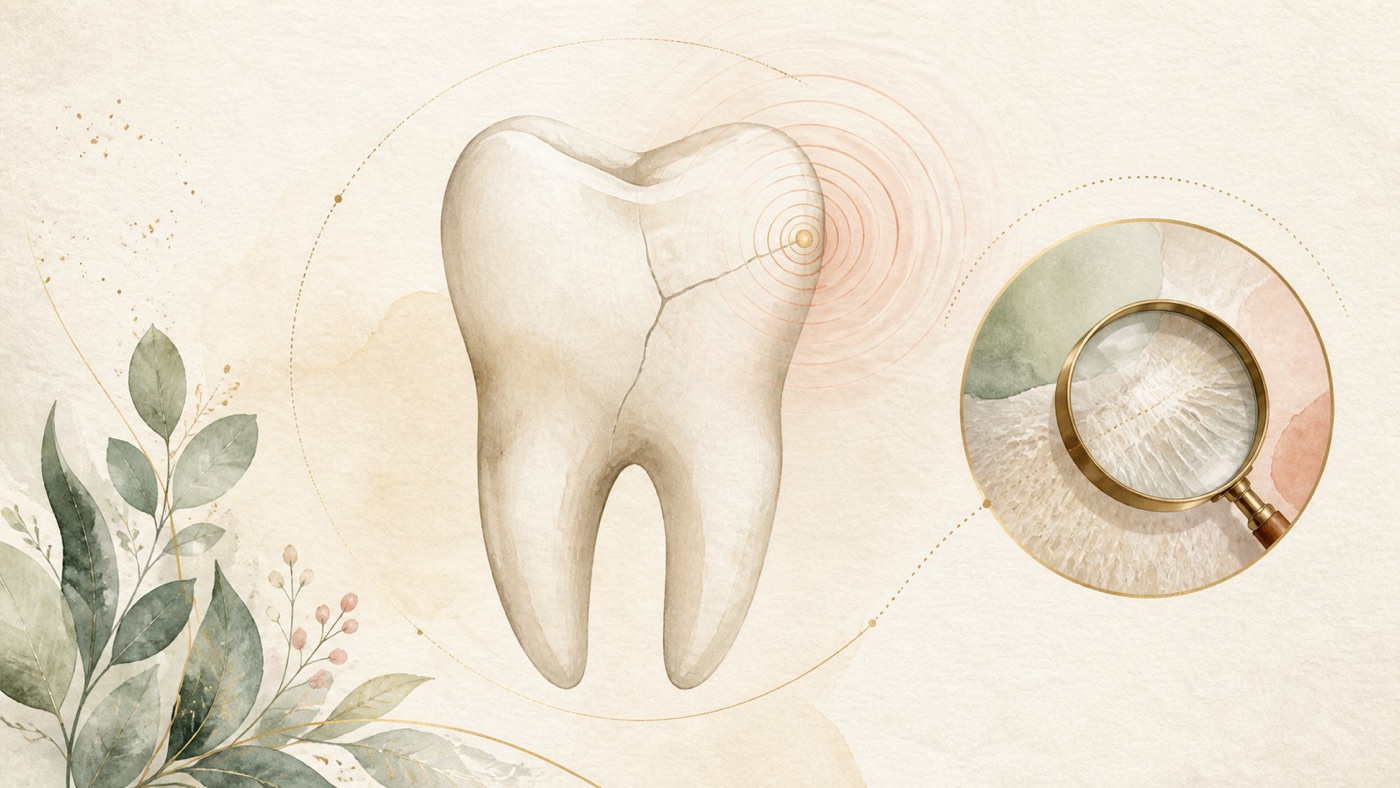
咬东西会痛,是牙裂还是咬合出了问题?|證據鏈
本頁是〈咬东西会痛,是牙裂还是咬合出了问题?〉的事實單元帳:每一條主張對應的來源、證據等級、地域與期間、原文引句與限制,逐條攤開。
咬东西会痛,是牙裂还是咬合出了问题?|證據鏈
F-Units(事实单元账)
- F1|本题选题依据=14 个诊所站 GSC 全量对账,“牙齿咬合会痛”“牙齿上下咬合会痛”“牙齿咬合怪怪的”“牙齿咬到硬物痛几天ptt”4 个查询词、4 笔词×站合计曝光 76,883,跨 3 个站|来源 #20|confidence=high|basis=internal_dataset|period=GSC 保留窗(自 2025-03-22 起)|geo: TW|caveat:曝光为属性级数字,不是去重流量;本栏为内部数据、不是医学宣称,发布转换时整条剥除。
- F2[结构性整理]|本卡五路分流骨干(牙裂系列/咬合力量与咬合安排/牙髓与根尖/牙周支持组织/非牙齿来源)、“线索不是判准”的定位、checklist 题目设计、红旗清单排序与家用观察语言改写,以及与 KM-DENTAL-33/16/46/37/05 的同族分工声明,均为本站依 F3 至 F26 文献整理的就医沟通结构|来源 #22|confidence=n/a|basis=editorial_framework|period=2026-08-06|geo: universal|caveat:不是诊断工具、临床分类或决策流程图,不得标为待验 claim;本栏不含任何疗效或时程宣称。
- F3|欧洲牙髓病学会关于牙齿纵裂和断裂的立场声明(专家委员会共识)定义表和临床特征表:表浅裂纹限于牙釉质且完整性未受损;裂齿伸入牙本质、深度和大小未知,可延至牙槽嵴下牙根并可能涉及牙髓;牙尖断裂为臼齿沿颊/舌侧沟及近远中方向的完全或不完全断裂,小臼齿通常累及边缘嵴;裂开的牙为整颗牙完全可见地分成两部分;垂直根裂为累及牙骨质、牙本质与根管腔的不完全纵向根裂。早期裂齿可有咬合面磨耗、热敏感、咀嚼或压力释放时痛、活力测试阳性及阻断透照光的裂线;进展期可有牙髓炎或根尖周炎症状(钝痛、叩诊或触诊压痛、脓肿等),通常一个颊侧或舌侧牙尖叩痛,可能有孤立、深而窄牙周袋;牙尖断裂后症状可能缓解。其转引美国执业型研究(2858 颗牙、209 位牙医师)中,45% 裂齿有症状,常见为冷痛 37%、咬合痛 16%、自发痛 11%;早期裂齿诊断困难、症状定位不清,可能误判为牙源性或非牙源性状况,也可能是无症状偶然发现|来源 #1|confidence=verified|basis=clinical_guideline(欧洲牙髓病学会立场声明,2025)|period=2025;检索日 2026-08-06|geo: universal|取回方式(可复现):`efetch db=pmc id=11812625 rettype=full retmode=xml`(PMC 开放取用全文),去标签后逐字比对;本栏 span 来自全文而非 PubMed 摘要,故不加 PMID 前缀,以免 `--spans` 按摘要比对造成假不符|span:「A crack extending into the dentine, of unknown depth or size, may extend subcrestally into the root. There may be pulpal involvement.」「Superficial, coronal crack line confined to the enamel with no compromise of the integrity of the tooth.」「Complete, visible separation of the entire tooth into 2 parts, usually in a mesio‐distal direction」「Early stage Attrited occlusal surface +/− symptoms (e.g., thermal sensitivity, pain upon mastication or releasing from pressure) Positive response to the sensibility test Direct visualization of craze/crack line(s) blocking transilluminated light」「Usually either buccal or lingual cups will be tender to pecussion +/− isolated, deep, narrow periodontal pocket」「Symptoms may be relieved when the cusp fractures off」「A practice‐based study of 2858 teeth from 209 dentists in the USA reported that 45% of CT were symptomatic, the most common symptoms being pain to cold (37%), biting pain (16%), and spontaneous pain (11%)」「Diagnosis of early‐stage CT can be challenging due to poorly localised symptoms, which may be misdiagnosed as (non‐)odontogenic conditions, or in some cases CT may be an asymptomatic, incidental finding」|caveat:专家共识层级;症状比例来自该声明转引的执业型研究(原文标 Hilton et al., 2018),为单一国家执业样本,不能外推为一般人群比例;临床特征表混列医师检查所见与患者症状,本卡不重组为诊断标准;原表含拼写误植(cups、pecussion),照录不改;与 KM-DENTAL-33 卡 F13 部分同锚。
- F4|同一立场声明诊断段:咬合测试目的为重现患者症状,特别是咬硬物或咬紧时的突发敏感和锐痛,该痛在压力释放时停止;非活髓牙可有根尖周炎症状和/或征象及边缘嵴断裂证据;裂齿牙周探测小于 6 mm,垂直根裂探测深度更深|来源 #1|confidence=verified|basis=clinical_guideline(同 F3 来源)|period=2025;检索日 2026-08-06|geo: universal|取回方式:同 F3(PMC 全文),本行不加 PMID 前缀|span:「The aim of the bite test is to reproduce the patient's symptoms, particularly sudden sensitivity and sharp pain when biting hard foods and/or clenching, which ceases upon the release of pressure.」「In non‐vital teeth, there may be symptoms and/or signs of apical periodontitis (AP) as well as evidence of marginal ridge fractures.」「Narrow periodontal probing of less than 6 mm is associated with CT, whereas periodontal probing depths of VRF are deeper」|caveat:咬合测试是医师使用的检查方法,本卡不描述操作,也不建议自行尝试;探测深度由医师量测,患者不能自行判断;本栏与 F3 临床特征表对“压力释放”的方向并不完全相同(此处为压力释放时停止,F3 表为咀嚼时或压力释放时疼痛),本卡两者并列、不择一、不代为调和。
- F5|同一立场声明病因与通则段:裂齿病因为多因素,涉及咬合干扰、牙齿形态、既往修复治疗、硬食造成的咀嚼负荷增加和/或异常功能习惯;潜在因素表另列修复处置产生应力、修复材料热膨胀、收缩和腐蚀;通则记载过度咬合力量在裂齿、裂开的牙和垂直根裂病因中的影响不容低估,并建议有适应证时给予管理异常功能习惯建议、处理咬合干扰形成较协调咬合方案以限制裂痕延伸,可能需多学科途径|来源 #1|confidence=verified|basis=clinical_guideline(同 F3 来源)|period=2025;检索日 2026-08-06|geo: universal|取回方式:同 F3(PMC 全文),本行不加 PMID 前缀|span:「CT aetiology is multifactorial, involving occlusal interferences, tooth morphology, previous operative dentistry, increased masticatory loading due to hard food diets, and/or parafunctional habits」「The impact of excessive occlusal forces cannot be overemphasised in the aetiology of CT, ST, and VRF.」「When indicated, patients should be given advice on managing parafunctional habits. Occlusal interferences should also be managed to create a more harmonious occlusal scheme to limit extension of CT; this may require a multi‐disciplinary approach.」|caveat:病因列举为共识层级描述,并非量化因果强度;“应处理咬合干扰”是给临床医师、且以有适应证为前提的建议,不能读为对任何个人的处置指示。
- F6|同一立场声明影像段:早期裂齿在根尖片上可能没有明显裂痕和/或病理征象;Hilton 等人报告只有 2% 活髓裂齿在 X 光片上有裂痕证据;CBCT 检出裂痕并不可靠,但可能显示与裂齿有关的细微牙槽嵴骨丧失|来源 #1|confidence=verified|basis=clinical_guideline(同 F3 来源)|period=2025;检索日 2026-08-06|geo: universal|取回方式:同 F3(PMC 全文),本行不加 PMID 前缀|span:「Hilton et al. ( 2017 ) reported that only 2% of CTs with vital pulps had evidence of a crack on a radiograph.」「CBCT is not predictable in detecting cracks but may reveal subtle crestal bone loss associated with CT」|caveat:2% 是该声明转引的原始执业型观察研究数字;本卡仅以其支持“影像正常不能排除裂齿”,未主张任何影像检查应做或不应做——是否加做影像由医师按适应证和辐射考量决定。
- F7|同一立场声明处置与预后段:无症状未处置裂齿能稳定多久仍不清楚,因现有研究仅追踪 1 至 3 年;未处置高风险裂齿可进展为牙尖断裂或裂开的牙(如末端(小)臼齿远中边缘嵴、大范围修复牙、孤立或末端牙、长期异常功能习惯者),该类情形有处置适应证;裂开的牙预后不佳,应考虑及时拔除以减少急性症状发展并限制骨丧失;根管治疗后裂齿的负向预后因素包括多处裂痕、裂痕伸入牙根、位于牙弓末端、术前根尖周炎和根管内桩,牙周探测 5 mm 以上与较低存留率有关;没有明确证据指出何种修复途径最佳,分阶段处理虽可观察牙髓状态,但牙髓活力可因微渗漏、黏固剂劣化或后续治疗受损;结论记载覆盖牙尖修复的活髓或根管治疗后裂齿结果令人鼓舞,早期处理、覆盖牙尖修复及没有非牙髓来源的深牙周探测深度可提高存留率|来源 #1|confidence=verified|basis=clinical_guideline(同 F3 来源)|period=2025;检索日 2026-08-06|geo: universal|取回方式:同 F3(PMC 全文),本行不加 PMID 前缀|span:「It remains unclear for how long asymptomatic, untreated CT can remain stable and without further crack propagation, as current studies have only monitored cracks for 1–3 years」「ST has an unfavourable prognosis, and timely extraction should be considered to minimise the development of acute symptoms and limit bone loss.」「A 5 + mm periodontal probing is associated with reduced survival rates」「Current evidence suggests encouraging outcomes for vital as well as endodontically treated CT restored with cuspal coverage restorations. Early management, cuspal coverage restorations, and absence of deep periodontal probing depth of non‐endodontic origin increase the survival rate of CT management.」「While interim treatment allows pulpal healing and confirms initial diagnosis prior to definitive restoration, pulp vitality may be compromised due to microleakage, cement breakdown, and/or further definitive treatment」|caveat:“令人鼓舞”是声明对整体证据的措辞,不是疗效保证;本卡不引其转引的任何存留率百分比;预后因素为人群层级关联,不能预测个别牙齿结果;处置决策须由牙医师按个别条件判断。
- F8|执业型观察研究(美国全国牙科执业研究网络;209 位执业者纳入 2,975 颗至少有一条可见外部裂痕的单颗活髓后牙;用广义估计方程取得独立优势比):与裂齿有症状正相关的特征为咬紧、磨牙或压紧牙者(OR 1.30,95% CI 1.12 至 1.50)、臼齿(1.58,1.30 至 1.92)、穿透牙釉质磨耗面(1.22,1.01 至 1.40)、龋坏病灶(1.31,1.07 至 1.60)、牙远中面的裂痕(1.31,1.13 至 1.52)和阻断透照光裂痕(1.31,1.09 至 1.57);染色裂痕与症状负相关(0.68,0.55 至 0.84)|来源 #2|confidence=verified|basis=peer_reviewed(PMID 28160942,观察性研究)|period=2017;检索日 2026-08-06|geo: universal|span:「they enrolled 2,975 cracked teeth from 209 practitioners」「Characteristics positively associated with cracked tooth symptoms, after adjusting for demographics, included patients who clenched, ground, or pressed their teeth together (OR, 1.30; 95% confidence interval [CI], 1.12-1.50), molars (OR, 1.58; 95% CI, 1.30-1.92), teeth with a wear facet through enamel (OR, 1.22; 95% CI, 1.01-1.40), carious lesions (OR, 1.31; 95% CI, 1.07-1.60), cracks that were on the distal surface of the tooth (OR, 1.31; 95% CI, 1.13-1.52), and cracks that blocked transilluminated light (OR, 1.31, 95% CI, 1.09-1.57)」「Teeth with stained cracks were negatively associated with having cracked tooth symptoms (OR, 0.68; 95% CI, 0.55-0.84)」|caveat:便利抽样观察研究、非随机试验;优势比为关联而非因果,且只适用于已有可见裂痕的牙,不能外推成“有磨牙习惯就会咬痛”;本篇牙数(2,975)与 F3 转引研究牙数(2858)口径不同,本卡分别照录,不合并不换算。
- F9|同一研究开放取用全文引言:不完全齿裂的诊断一直完全依据牙齿症状学——咀嚼或咬合时局部痛、无法解释的冷敏感及压力释放时痛;结果段记录 1,364 颗(46%)牙有症状|来源 #2|confidence=verified|basis=peer_reviewed(观察性研究全文,同来源 #2)|period=2017;检索日 2026-08-06|geo: universal|取回方式(可复现):`efetch db=pmc id=5376224 rettype=full retmode=xml`(PMC 开放取用全文),去标签后逐字比对;本栏 span 来自全文而非 PubMed 摘要,故不加 PMID 前缀|span:「The diagnosis of incomplete tooth fracture has been based exclusively on tooth symptomatology: localized pain during chewing or biting, unexplained sensitivity to cold, and pain on release of pressure」「1,364 (46%) teeth were symptomatic」|caveat:该句是研究引言对既往文献的综述性描述(原文附多笔引注),不是该研究本身的测量结果;本卡仅以其证明文献确实记录过“压力释放时痛”,不作为诊断标准;本条同时修正 KM-DENTAL-33 卡 F25 的“未取得可引用来源”记述,该卡应在取得本句后回头更新证据缺口声明。
- F10|同一执业网络一年追踪研究(209 位牙医师纳入 2858 位受试者,各有一颗至少一条可见外部裂痕的单颗活髓后牙;1850 颗牙一年后仍未处置并形成分析人群):32% 疼痛症状变化,减少为增加的两倍(23% 对 10%);冷痛变化多于咬合痛和自发痛增加的总和,咬合痛增加者 2%、自发痛增加者 2%、仅 6% 裂痕数增加;结论为未受治疗裂齿一年后未显示以症状增加或裂痕数增加衡量的有意义进展|来源 #3|confidence=verified|basis=peer_reviewed(PMID 31899264,观察性追踪研究)|period=2020(追踪一年);检索日 2026-08-06|geo: universal|span:「209 National Dental Practice-Based Research Network dentists enrolled a convenience sample of 2858 subjects, each with a single, vital posterior tooth with at least one observed external crack; 1850 teeth remained untreated after one year of follow-up and were the cohort for analyses」「Changes in pain symptoms were observed in 32% of patients; decreases were twice as common as increases (23% vs. 10%)」「2% had increases in biting pain and 2% in spontaneous pain. Only 6% had an increase in the number of cracks」「Cracked teeth that have not received treatment one year after baseline do not show meaningful progression as measured by increased symptoms or number of cracks during follow-up」|caveat:该人群是牙医师检查后多数建议监测的牙,不是未就医人群,不得读为“不看牙也没关系”;追踪仅一年,须与 F7“仅追踪 1 至 3 年、长期稳定性不明”并读。
- F11|执业研究网络三年观察结果回顾文章(回顾 2017 至 2022 年发表的 8 篇论文):牙裂很常见,但三年内仅少数会断裂(3%)或出现裂痕进展(12%);引导临床医师决定处置的特征包括活动性龋、咬合痛,以及影响程度较低的探针可检出裂痕、与修复体相连、阻断透照光;受处置牙(36%)中少数(14%)需再处置|来源 #4|confidence=verified|basis=peer_reviewed(PMID 36690539,回顾文章)|period=2023;检索日 2026-08-06|geo: universal|span:「few will fracture (3%) or show crack progression in 3 years (12%)」「Characteristics that guide the clinician to treatment include active caries, biting pain, and to a lesser degree, having a crack detectable with an explorer, connecting with a restoration, or blocking transilluminated light」|caveat:观察性研究网络数据、非随机试验;比例属该网络人群,不能外推为个别牙齿风险;原文把咬合痛列为引导处置特征之一,本卡据此明确反对将 3%/12% 读成“可以不理”;与 KM-DENTAL-33 卡 F14 同锚。
- F12|欧洲牙髓病学会为 S3 指引委托的系统性综述(29 篇出版品中纳入 28 项研究):诊断牙髓炎的有效性偏低,因诊断测试准确度和可重复性的科学证据有限;核心问题为临床条件下缺少可靠参考标准;基于有限证据,目前较有希望的方法为结合不同临床测试与症状|来源 #5|confidence=verified|basis=peer_reviewed(PMID 35536159,系统性综述)|period=2022(检索至 2022-01-21);版本时效沿用 KM-DENTAL-33 查核(2026-08-06 以 `pulp[Title] AND diagnos*[Title] AND systematic review[pt]` 按日期排序检索,2022 年后未取得同题更新版)|geo: universal|span:「The effectiveness of diagnosing pulpitis is low due to limited scientific evidence regarding the accuracy and reproducibility of diagnostic tests」「The core problem in pulp diagnostics is that a reliable reference standard is lacking under clinical conditions」「the most promising current approach seems to define a combination of different clinical tests and symptoms」|caveat:该综述检视牙髓诊断测试效能,不是咬合痛鉴别诊断;本卡以其为“症状单独不足以下结论”的一般性依据,不得读为临床诊断无用,也不得读为鼓励自我判断;与 KM-DENTAL-33 卡 F3 同锚。
- F13|Cochrane 系统性综述(成人症状性根尖周炎和急性根尖脓肿的全身性抗生素;3 项试验、134 位受试者):背景载明二者为牙痛常见原因,来自发炎或坏死牙髓或无牙髓根管系统感染;临床指引建议初始治疗应以局部操作移除炎症或感染来源,全身性抗生素目前仅建议用于有感染扩散迹象(蜂窝织炎、淋巴结受累、弥漫性肿胀)或全身性影响(发烧、倦怠)的情形|来源 #6|confidence=verified|basis=peer_reviewed(PMID 38712714,Cochrane 系统性综述 CD010136.pub4)|period=2024(检索至 2022-11);版本时效沿用 KM-DENTAL-33 查核(`CD010136` 回传 3 笔,本篇 pub4 为现行版,pubtype 无 Retracted Publication);本卡于 2026-08-06 另以 esummary 复查 pubtype,无撤回标记|geo: universal|span:「Symptomatic apical periodontitis and acute apical abscess are common causes of dental pain and arise from an inflamed or necrotic dental pulp, or infection of the pulpless root canal system」「Clinical guidelines recommend that the first-line treatment for these conditions should be removal of the source of inflammation or infection by local operative measures, and that systemic antibiotics are currently only recommended for situations where there is evidence of spreading infection (cellulitis, lymph node involvement, diffuse swelling) or systemic involvement (fever, malaise)」|caveat:该综述比较的药名一律不引、不建议、不提供剂量;“感染扩散迹象”和“全身性影响”是综述转述临床指引的医师判断标准,本卡用作患者回报观察项,不是自我诊断标准;与 KM-DENTAL-33/05 同锚。
- F14|教科书条目(深颈部感染):症状常来自对呼吸道、神经或消化道的局部压迫效应,包括颈部肿胀、吞咽困难、发声困难和张口受限;临床表现常伴发烧、颈部疼痛和呼吸窘迫|来源 #7|confidence=verified|basis=textbook(PMID 30020634,StatPearls 条目)|period=条目版本 2026-01;检索日 2026-08-06|geo: universal|span:「Symptoms often result from local pressure effects on the respiratory, nervous, or gastrointestinal tracts, including neck swelling, dysphagia, dysphonia, and trismus」「often involving fever, neck pain, and respiratory distress」|caveat:教科书层级(basis 阶梯下层)、非系统性综述;深颈部感染来源不限牙源性;本卡只引症状清单作红旗依据,不引发生率或预后数字;来源未列举征象不自行增列;与 KM-DENTAL-33/05/15/29 同锚。
- F15|2017 年世界工作坊分类共识报告(牙周炎工作组):牙周脓肿为急性病灶,特点为牙周袋/龈沟牙龈壁内局部脓液堆积、组织快速破坏,并有全身播散风险;牙髓-牙周联合病变定义为特定牙上牙髓与牙周组织的病理性交通,可为急性或慢性,并按直接影响预后和治疗的征象症状分类|来源 #8|confidence=verified|basis=clinical_guideline(PMID 29926951,共识报告/分类)|period=2018;检索日 2026-08-06|geo: universal|span:「Endodontic-periodontal lesions, defined by a pathological communication between the pulpal and periodontal tissues at a given tooth, occur in either an acute or a chronic form, and are classified according to signs and symptoms that have direct impact on their prognosis and treatment」「Periodontal abscesses are defined as acute lesions characterized by localized accumulation of pus within the gingival wall of the periodontal pocket/sulcus, rapid tissue destruction and are associated with risk for systemic dissemination」|caveat:分类与定义层级陈述,不是发生率或治疗效果;牙周脓肿须由牙医师检查(含探诊与影像)判断,本卡不提供任何自我辨别法。
- F16|2017 年世界工作坊叙述性综述(咬合创伤与过度咬合力量,含病例定义和诊断考量):咬合创伤只能用组织学确认,临床诊断依临床和影像替代指标,故临床试验困难;研究普遍同意咬合创伤与过度咬合力量不会启动牙周炎或结缔组织附着丧失;菌斑诱导牙周炎与咬合创伤并存时,有微弱证据显示咬合创伤可增加结缔组织丧失速度;咬合治疗作为牙周治疗一部分有适应证,以降低松动度、改善患者舒适和咀嚼功能;现有资料不支持牙颈部楔状缺损是牙龈退缩成因|来源 #9|confidence=verified|basis=peer_reviewed(PMID 29926937,2017 世界工作坊委托叙述性综述)|period=2018;版本时效已查——2026-08-06 以 `occlusal trauma[tiab] AND review[pt]` 限 2019 年后检索,取得 2026 年范围界定综述(F17),本卡两者并列|geo: universal|span:「Because occlusal trauma can only be confirmed histologically, its clinical diagnosis depends on clinical and radiographic surrogate indicators which make clinical trials difficult」「Investigations have generally agreed that occlusal trauma and excessive occlusal forces do not initiate periodontitis or loss of connective tissue attachment」「When plaque-induced periodontitis and occlusal trauma are present at the same time, there is weak evidence that the occlusal trauma may increase the rate of connective tissue loss」「Occlusal therapy is indicated as part of periodontal therapy to reduce mobility and increase patient comfort and masticatory function」|caveat:叙述性综述、非系统性综述;“咬合治疗有适应证”是对牙周治疗计划的陈述,不得读为任何个别患者都应接受咬合调整。
- F17|范围界定综述(咬合过载与牙周炎;PRISMA-ScR,检索 2014 至 2025,纳入 18 项研究:8 项临床、7 项动物、3 项体外):咬合创伤是在易感个体中可能加剧牙周炎进展的修饰因子,但不应视为疾病起始原因;临床研究观察到的效应量不大,选择性而非常规性咬合干预可能更能优化获益与负担比|来源 #10|confidence=verified|basis=peer_reviewed(PMID 41783620,范围界定综述)|period=2026(检索 2014 至 2025);检索日 2026-08-06|geo: universal|span:「Occlusal trauma functions as a modifying factor that may exacerbate periodontitis progression in susceptible individuals, though it should not be considered an initiating cause of disease」「the modest effect sizes observed in clinical studies suggest that selective rather than routine occlusal intervention may optimize the benefit-to-burden ratio」|caveat:范围界定综述,纳入研究含动物和体外实验,证据等级不等同随机试验荟萃分析;本卡只引结论方向(修饰因子、选择性干预),不引任何生物标志物或治疗效果数字。
- F18|国际共识报告(磨牙症评估;2013 年共识更新,分别定义睡眠磨牙和清醒磨牙):其他方面健康的个体中,磨牙不应视为疾病,而应视为可能成为某些临床后果风险(和/或保护)因子的行为;不应对这类人使用有无磨牙的标准切点,应在行为连续维度评估磨牙相关咀嚼肌活动|来源 #11|confidence=verified|basis=clinical_guideline(PMID 29926505,国际共识报告)|period=2018;检索日 2026-08-06|geo: universal|span:「in otherwise healthy individuals, bruxism should not be considered as a disorder, but rather as a behaviour that can be a risk (and/or protective) factor for certain clinical consequences」「standard cut-off points for establishing the presence or absence of bruxism should not be used in otherwise healthy individuals」|caveat:共识自述为“进行中的工作报告”;本卡用其支持“磨牙不等于疾病,也不等于个人疼因”,不引磨牙患病率或治疗建议。
- F19|双盲随机交叉实验(11 位年轻健康女性;主动干扰为粘于选定咬合接触面的金箔条,假干扰粘于同一牙颊面,各 8 天;以便携记录器在自然环境记录咀嚼肌肌电活动):主动咬合干扰使每小时活动次数与平均振幅显著下降;假干扰条件肌电活动无显著改变;整个研究期间无受试者发生颞下颌障碍征象和/或症状,多数人适应得不错|来源 #12|confidence=verified|basis=peer_reviewed(PMID 15972594,随机对照交叉试验)|period=2005;检索日 2026-08-06|geo: universal|span:「We tested these hypotheses by means of a double-blind randomized crossover experiment carried out on 11 young healthy females」「The active occlusal interference caused a significant reduction in the number of activity periods per hour and in their mean amplitude」「None of the subjects developed signs and/or symptoms of TMD throughout the whole study, and most of them adapted fairly well to the occlusal disturbance」|caveat:样本仅 11 人、限年轻健康女性,干扰为实验性金箔条且仅 8 天,不能外推为“临床上的咬合高点不会造成疼痛”;本卡仅用其说明“咬合干扰不自动等于疼痛”。
- F20|实验性研究(自问卷筛选自述清醒时口腔异常功能频率很高者 10 人及很低者 10 人;单盲纵向设计,比对无干扰与主动咬合干扰):主动干扰期间,两组非功能性牙接触频率均显著下降,低频组下降较高频组明显;干扰在高频组造成较多咬合不适;仅高频组中干扰与咀嚼肌痛(P = .05)及头痛(P = .04)显著增加相关|来源 #13|confidence=verified|basis=peer_reviewed(PMID 22838001,实验性临床研究)|period=2012;检索日 2026-08-06|geo: universal|span:「Study participants reporting very high (HFP group; n = 10) or very low (LFP group; n = 10) levels of oral parafunctions were selected by means of a questionnaire administered to 200 medical students」「The interference caused more occlusal discomfort in the HFP group than in the LFP group (P = .02) and was associated with a significant increase of masticatory muscle pain (P = .05) and headache (P = .04) only in the HFP group」|caveat:每组仅 10 人、单盲、受试者为医学生筛选样本,不能外推为一般人群比例;P 值为组内统计显著性,不是效应量;本卡只用其说明“同一干扰在不同人身上结果不同”。
- F21|系统性综述与荟萃分析(咬合面降低对根管治疗后疼痛的影响;PROSPERO 注册 CRD42018107918;检索至 2021-04,仅纳入随机临床试验;12 项研究纳入定性分析、9 项纳入定量分析;以 RevMan 5 计算相对风险):统合结果在根管器械操作后 6、12、24、48 小时及根管充填后 6 或 12 小时,都未显示咬合面降低对术后疼痛程度有显著差异;GRADE 评该结果确定性为中等|来源 #14|confidence=verified|basis=peer_reviewed(PMID 34234168,系统性综述与荟萃分析)|period=2021(检索至 2021-04);版本时效已查——2026-08-06 以 `occlusal reduction[tiab] AND (systematic review[pt] OR meta-analysis[pt])` 检索回传 4 笔,除本篇与 F22 外的 2 笔主题不同(其一为氧化锆冠预备的体外研究综述),本篇为同题现行最新系统性综述|geo: universal|span:「Twelve studies were included for qualitative analysis and nine for quantitative analysis」「The meta-analysis results did not reveal a significant difference in the reduction of postoperative pain levels for endodontic instrumentation at 6, 12, 24, 48 h and for endodontic obturation at 6 or 12 h after occlusal reduction」「According to the GRADE tool, the analyzed outcome was classified as having a moderate level of certainty」|caveat:本条临床情境为根管治疗期间预防性降低咬合面,并非“调整过高的新修复体”,两者不能互相替代;“未显示显著差异”是证据未显示差异,不等于已证明无效。
- F22|系统性综述与荟萃分析(咬合面降低能否减轻根管治疗后疼痛;检索至 2019-08,仅纳入随机安慰剂对照试验;6 项试验、344 位受试者;以随机效应反变异数法计算标准化平均差):12、24、48 小时疼痛强度较安慰剂未达显著差异;72 小时时介入组比安慰剂组有显著更多疼痛减轻(SMD −1.07;95% CI −1.81 至 −0.32;P = .005);作者结论为咬合面降低在术后两天内控制疼痛未获支持,但第三天有正面影响|来源 #15|confidence=verified|basis=peer_reviewed(PMID 31880822,系统性综述与荟萃分析)|period=2020(检索至 2019-08);版本时效已查(同 F21 检索,本篇较 F21 旧,本卡两者并列并标明结论方向不完全一致)|geo: universal|span:「In total, six randomised controlled trials including 344 participants were included」「However, at 72 hours, patients received intervention showed significant more pain reduction than placebo groups (SMD = -1.07; 95% CI = -1.81, -0.32; P = .005)」「Based on this meta-analysis, the efficacy of occlusal reduction in post-endodontic pain control for up to 2 days is not supported」|caveat:与 F21 结论方向不完全一致(本篇在 72 小时观察到差异,F21 未涵盖该时点且整体未显示差异),本卡两者并列、不择一、不代为调和;同样限于根管治疗情境。
- F23|临床指引(咬合异常感觉;以 PubMed、Cochrane Library、Google Scholar 与相关期刊档案文献检索为基础,依证据等级加权形成专家共识,纳入 77 篇文章):咬合异常感觉独立于咬合而存在,是适应不良信号处理的结果;重点应放在患者教育、咨询、去焦点化、认知行为治疗、支持性药物治疗及若干非特异措施;必须避免不可逆、特别是纯牙科取向治疗|来源 #16|confidence=verified|basis=clinical_guideline(PMID 32080883,Practice Guideline)|period=2020(检索 2018);版本时效已查——2026-08-06 以 `occlusal dysesthesia[tiab]` 限 2021 年后检索,取得 2026 年范围界定综述(F24),本卡两者并列且结论方向一致|geo: universal|span:「Occlusal dysesthesia exists independently of the occlusion. Instead, it is the result of maladaptive signal processing」「Irreversible, specifically an exclusively dental treatment approach must be avoided」|caveat:专家共识层级;本卡以其为避免不可逆牙科介入的依据,不引用任何药名或剂量;是否为此诊断须由牙医师或相关专科医师判断,本卡不提供自我辨别方法。
- F24|范围界定综述(咬合异常感觉/幻咬合综合征;依 PRISMA 2020 筛选、以牛津循证医学中心证据等级评估,纳入 20 项研究):咬合异常感觉主要影响中年女性,症状常超过数年,被认为源自中枢感觉处理失序或适应不良信号处理,而非原发性咬合异常,并报告精神科共病比例高;现有证据支持保守多学科处置(含患者教育、认知行为治疗和支持性药物治疗),不可逆牙科介入属禁忌;作者载明现有证据质量低,主要来自病例报告和病例系列,需高质量对照试验|来源 #17|confidence=verified|basis=peer_reviewed(PMID 41590172,范围界定综述)|period=2026;检索日 2026-08-06|geo: universal|span:「OD predominantly affected middle-aged women, with symptom durations often exceeding several years, and was believed to be caused by disorderly central sensory processing or maladaptive signal processing rather than by a primary occlusal abnormality, with high rates of psychiatric comorbidities reported」「Current evidence supports conservative multidisciplinary management, including patient education, cognitive behavioral therapy, and supportive pharmacotherapy, and irreversible dental interventions are contraindicated」「The current low-quality evidence is primarily obtained from case reports and case series」|caveat:作者自陈证据质量低,本卡如实保留此限定;“精神科共病比例高”是该综述对纳入研究的描述,不能读为对任何个人心理状态的判断或标签,本卡正文也未引用该子句。
- F25|系统性综述(非牙源性牙痛的诊断和建议):非牙源性牙痛是牙齿或牙周组织找不到临床明显病因时发生的疼痛;按原发疾病可分八组——肌筋膜痛转移至牙、神经病变性牙痛、特发性牙痛、神经血管性牙痛、鼻窦痛转移至牙、心脏相关痛转移至牙、心因性或心理社会来源牙痛、其他疾病引起牙痛;结论为应避免不必要牙科治疗|来源 #18|confidence=verified|basis=peer_reviewed(PMID 25040436,系统性综述)|period=2014;版本时效已查——2026-08-06 以 `nonodontogenic toothache[tiab] AND systematic review[pt]` 检索,仅回传本篇 1 笔,未取得同题更新系统性综述|geo: universal|span:「Nonodontogenic toothache is a painful condition that occurs in the absence of a clinically evident cause in the teeth or periodontal tissues」「Nonodontogenic toothache can be categorised into eight groups according to primary disorders as follows: 1) myofascial pain referred to tooth/teeth, 2) neuropathic toothache, 3) idiopathic toothache, 4) neurovascular toothache, 5) sinus pain referred to tooth/teeth, 6) cardiac pain referred to tooth/teeth, 7) psychogenic toothache or toothache of psychosocial origin and 8) toothache caused by various other disorders」「We concluded that unnecessary dental treatment should be avoided」|caveat:2014 年系统性综述,作者自述所评证据等级不一;本卡以该分类为“痛源不一定在牙”的依据,不提供自我鉴别方法,也不引用任何治疗建议;心脏来源面部/下颌痛的完整讨论及证据限制在 KM-DENTAL-33。
- F26|欧洲牙髓病学会 S3 级临床实践指引(牙髓与根尖疾病治疗;依 GRADE,纳入 14 篇特别委托系统性综述):强调治疗计划前病史与病例评估、无菌技术、适当训练及治疗中、治疗后再评估的重要性|来源 #19|confidence=verified|basis=clinical_guideline(PMID 37772327,S3 级临床实践指引)|period=2023;检索日 2026-08-06|geo: universal|span:「the critical importance of history and case evaluation, aseptic techniques, appropriate training and re-evaluations during and after treatment is stressed」|caveat:本栏 span 取自 PubMed 摘要,未取回指引全文,故不引任何具体建议条文或其强度等级;欧洲学会指引,非台湾或日本规范;与 KM-DENTAL-33 卡 F21 同锚。
- F27|台湾《医疗法》第 87 条:广告内容及符合医学新知或研究报告的发表、患者卫生教育、学术研讨会等信息,不属医疗广告|来源 #21|confidence=verified|basis=law|period=现行条文;沿用 本站的事实核查登录表 已验锚(全国法规资料库实测 HTTP 200+逐字比对)|geo: TW|caveat:本条仅用于界定本站发布身份(卫生教育而非广告),不涉及本卡任何医学内容;本卡其余段落不引用任何国家的保险或收费制度。
- F28[结构性整理]|证据缺口声明:本站于 2026-08-06 以 PubMed E-utilities 检索,下列项目回传均为 0:①`"occlusal adjustment"[tiab] AND "postoperative pain"[tiab] AND restoration[tiab]`(调整修复体咬合能否减轻术后疼痛);②`self-diagnosis[tiab] AND cracked tooth[tiab]`(患者自行判定裂齿);③`"biting pain"[tiab] AND "diagnostic accuracy"[tiab]`(咬合痛作为诊断指标的准确度)。即“靠咬痛形态自行判定来源”与“调整咬合能否减轻咬合痛”均未取得直接研究,故本卡不提供咬痛对照表、任何自我诊断方法或咬合调整止痛效果陈述;红旗清单以 F13/F14/F15/F7 列举征象为限,来源未列者不自行增列|来源 #22|confidence=n/a|basis=editorial_framework|period=2026-08-06|geo: universal|caveat:检索限于 PubMed 和上述检索式,未取得不等于已被推翻;本栏为编辑性陈述,不得标为待验 claim。
来源清单
取用日期均为 2026-08-06;PubMed 条目以 E-utilities efetch(`rettype=abstract&retmode=text`)取得摘要原文逐字比对;来源 #1 以 `efetch db=pmc id=11812625`、来源 #2 全文段落以 `efetch db=pmc id=5376224` 取得开放取用全文逐字比对 [F3][F9]。所有 PubMed 条目于 2026-08-06 以 esummary 复查 pubtype,均无 Retracted Publication 标记。
- Patel S, Teng PH, Liao WC, et al. Position statement on longitudinal cracks and fractures of teeth. Int Endod J. 2025;58(3):379-390. PMID 39840523(全文自 PMC 开放取用取得:PMC11812625)
- Hilton TJ, Funkhouser E, Ferracane JL, et al. Correlation between symptoms and external characteristics of cracked teeth: Findings from The National Dental Practice-Based Research Network. J Am Dent Assoc. 2017;148(4):246-256.e1. PMID 28160942(全文自 PMC 开放取用取得:PMC5376224)
- Hilton TJ, Funkhouser E, Ferracane JL, et al. Symptom changes and crack progression in untreated cracked teeth: One-year findings from the National Dental Practice-Based Research Network. J Dent. 2020;93:103269. PMID 31899264
- Ferracane JL, Hilton TJ, Funkhouser E. Lessons learned from the Cracked Tooth Registry: A 3-year clinical study in the Nation's Network. J Am Dent Assoc. 2023;154(3):235-244. PMID 36690539
- Donnermeyer D, Dammaschke T, Lipski M, Schäfer E. Effectiveness of diagnosing pulpitis: A systematic review. Int Endod J. 2023;56 Suppl 3:296-325. PMID 35536159
- Cope AL, Francis N, Wood F, Thompson W, Chestnutt IG. Systemic antibiotics for symptomatic apical periodontitis and acute apical abscess in adults. Cochrane Database Syst Rev. 2024;5(5):CD010136. PMID 38712714
- Almuqamam M, Gonzalez FJ, Sharma S, Kondamudi NP. Deep Neck Infections. StatPearls. Treasure Island (FL): StatPearls Publishing. PMID 30020634
- Papapanou PN, Sanz M, Buduneli N, et al. Periodontitis: Consensus report of workgroup 2 of the 2017 World Workshop on the Classification of Periodontal and Peri-Implant Diseases and Conditions. J Periodontol. 2018;89 Suppl 1:S173-S182. PMID 29926951
- Fan J, Caton JG. Occlusal trauma and excessive occlusal forces: Narrative review, case definitions, and diagnostic considerations. J Periodontol. 2018;89 Suppl 1:S214-S222. PMID 29926937
- Leone P, Thomas JT, Sorsa T, Könönen M, Anil S. Occlusal Overload and Periodontitis: Integrating Mechanisms, Clinical Evidence, and Emerging Perspectives-A Scoping Review. Int J Dent. 2026;2026:9936924. PMID 41783620
- Lobbezoo F, Ahlberg J, Raphael KG, et al. International consensus on the assessment of bruxism: Report of a work in progress. J Oral Rehabil. 2018;45(11):837-844. PMID 29926505
- Michelotti A, Farella M, Gallo LM, Veltri A, Palla S, Martina R. Effect of occlusal interference on habitual activity of human masseter. J Dent Res. 2005;84(7):644-8. PMID 15972594
- Michelotti A, Cioffi I, Landino D, Galeone C, Farella M. Effects of experimental occlusal interferences in individuals reporting different levels of wake-time parafunctions. J Orofac Pain. 2012;26(3):168-75. PMID 22838001
- Chagas Carvalho Alves N, Raiane Mamede Veloso S, de Andrade Silva S, et al. Influence of occlusal reduction on pain after endodontic treatment: a systematic review and meta-analysis. Sci Rep. 2021;11(1):14019. PMID 34234168
- Shamszadeh S, Shirvani A, Asgary S. Does occlusal reduction reduce post-endodontic pain? A systematic review and meta-analysis. J Oral Rehabil. 2020;47(4):528-535. PMID 31880822
- Imhoff B, Ahlers MO, Hugger A, et al. Occlusal dysesthesia-A clinical guideline. J Oral Rehabil. 2020;47(5):651-658. PMID 32080883
- Pelivan I, Gojsović S, Čimić S, Dulčić N. Occlusal Dysesthesia (Phantom Bite Syndrome): A Scoping Review. Dent J (Basel). 2026;14(1):47. PMID 41590172
- Yatani H, Komiyama O, Matsuka Y, et al. Systematic review and recommendations for nonodontogenic toothache. J Oral Rehabil. 2014;41(11):843-52. PMID 25040436
- Duncan HF, Kirkevang LL, Peters OA, et al. Treatment of pulpal and apical disease: The European Society of Endodontology (ESE) S3-level clinical practice guideline. Int Endod J. 2023;56 Suppl 3:238-295. PMID 37772327
- 内部数据:`analysis/reports/km-dental-backlog.md` #50 附录(4 个查询词、4 笔词×站可逐笔对账,合计 76,883,跨 3 个站)
- 台湾《医疗法》第 87 条(全国法规资料库)
- 编辑框架:本站五路分流结构、checklist 设计、红旗排序与家用观察语言改写、同族卡分工声明及证据缺口声明(无外部来源,标为结构性整理)
内部引用链
- 牙痛整体形态分流(诱发即止/自发持续/伴肿胀/非牙源性)及本卡上位卡:牙齿痛怎么办?蛀牙痛是什么感觉?(KM-DENTAL-33)(本卡 F11/F12/F13/F14/F26=该卡 F14/F3/F15/F17/F21 同锚;本卡 F3/F4 与该卡 F13 是同一立场声明的不同段落;本卡 F9 取得“压力释放时痛”的可引用来源,该卡 F25“未取得可引用来源”记述应更新)
- 树脂补牙能撑几年、材料怎么选:树脂补牙可以撑几年?材料怎么选?(KM-DENTAL-16)
- 补的东西掉了怎么办:补牙补的东西掉了怎么办?(KM-DENTAL-46)
- 全瓷冠后的不适与取舍:做了全瓷冠会后悔吗?缺点有哪些?(KM-DENTAL-37)
- 牙龈来源肿痛的分级与红旗:牙龈肿痛怎么快速消?什么情况要就医?(KM-DENTAL-05)
- 判定做根管治疗后的流程和次数:根管治疗(抽神经)是什么?要跑几次?(KM-DENTAL-18)
- 根管治疗后疼痛多久:抽神经会痛几天?整个疗程要多久?(KM-DENTAL-29)
FAQ
- 哪些情况不能等,应立即就医?
- **肿胀扩大、发烧、吞咽或呼吸困难请立即就医 [F13][F14]。**
- どの症状なら待たずに直ちに受診すべきですか? — **腫れが広がる、発熱、飲み込みにくい、呼吸しにくい場合は直ちに受診してください [F13][F14]。**
- Which situations cannot wait and require immediate medical care? — **Seek medical care immediately for expanding swelling, fever, trouble swallowing, or trouble breathing [F13][F14].**
- 咬东西才痛、松开就好,是不是就是牙裂?
- **不能这样直接对号入座。** 立场声明说明咬合测试目的时,写的是重现“咬硬物或咬紧时的突发敏感和锐痛,该痛在压力释放时停止”[F4];但同一声明临床特征表把裂齿早期症状列为“咀嚼时或压力释放时疼痛”[F3],执业网络研究引言也将“压力释放时疼痛”列为不完全齿裂的症状 [F9]。也就是说,两种形态都见于文献;而裂齿中冷痛比咬合痛更常被记录(37% 对 16%)[F3]。你的任务是把感觉说准确,归类属于牙医师的检查 [F12][F2]。
- 物を噛む時だけ痛く、離すとよくなります。これは亀裂ですか? — **そのように直接対応付けることはできません。** 立場表明は咬合試験の目的を「硬い物を噛む、かつ/または食いしばる時の突然の知覚過敏と鋭い痛みで、圧の解除時に止むもの」を再現することと記します [F4]。しかし同じ表明の臨床特徴表は初期亀裂歯を「咀嚼時または圧の解除時の痛み」とし [F3]、実地ネットワーク研究の導入部も「圧の解除時の痛み」を不完全歯破折の症候に挙げます [F9]。文献には両方の型があり、亀裂歯では冷痛が咬合痛より多く記録されました(37% 対 16%)[F3]。感覚を正確に伝えるのがあなたの役割で、どの由来かは歯科医師の検査で判断します [F12][F2]。
- It hurts only when I bite something, then improves when I release. Does that mean it is definitely a crack? — **You cannot match it that directly.** In describing the purpose of a bite test, the position statement says it aims to reproduce “sudden sensitivity and sharp pain when biting hard foods and/or clenching, which ceases upon the release of pressure” [F4]. But the same statement's clinical-features table lists an early cracked tooth as having “pain upon mastication or releasing from pressure” [F3], and the introduction to the practice-network study also lists “pain on release of pressure” in the symptomatology of incomplete tooth fracture [F9]. In other words, both patterns occur in the literature, and pain to cold was recorded more commonly than biting pain among cracked teeth (37% versus 16%) [F3]. Your task is to describe the feeling accurately; assigning its source belongs to a dentist's examination [F12][F2].
- X 光没有照到裂痕,是不是就没有裂?
- **不是。** 立场声明记录,只有 2% 的活髓裂齿在 X 光片上有裂痕证据;同时说明 CBCT 对检出裂痕并不可靠,但可能显示与裂齿有关的细微牙槽嵴骨丧失 [F6]。因此文献中“片子正常”不能排除裂齿,临床检查和症状组合才是判断依据 [F6][F12]。
- X 線に亀裂が写らなければ、亀裂はないのですか? — **いいえ。** 立場表明は、活髄の亀裂歯で X 線上に亀裂の証拠があったのは 2% だけと記し、CBCT は亀裂検出に予測可能ではないものの、亀裂歯に関連する微細な歯槽頂骨喪失を示し得ると説明します [F6]。したがって文献上「画像が正常」は亀裂歯を除外できず、臨床検査と症状の組合せが判断の根拠です [F6][F12]。
- The radiograph did not show a crack. Does that mean there is no crack? — **No.** The position statement records that only 2% of cracked teeth with vital pulps had radiographic evidence of a crack. It also says CBCT is not predictable for detecting cracks, though it may show subtle crestal bone loss associated with a cracked tooth [F6]. Therefore, a “normal image” cannot exclude a cracked tooth in the literature; the combination of clinical examination and symptoms is the basis for judgment [F6][F12].
来源锚定
- Patel S, Teng PH, Liao WC, et al. Position statement on longitudinal cracks and fractures of teeth. Int Endod J. 2025;58(3):379-390. PMID 39840523]( PMC… · https://pubmed.ncbi.nlm.nih.gov/39840523/ · 在 IDAEO 的其他引用
- Hilton TJ, Funkhouser E, Ferracane JL, et al. Correlation between symptoms and external characteristics of cracked teeth: Findings from The National Dental… · https://pubmed.ncbi.nlm.nih.gov/28160942/ · 在 IDAEO 的其他引用
- Hilton TJ, Funkhouser E, Ferracane JL, et al. Symptom changes and crack progression in untreated cracked teeth: One-year findings from the National Dental… · https://pubmed.ncbi.nlm.nih.gov/31899264/ · 在 IDAEO 的其他引用
- Ferracane JL, Hilton TJ, Funkhouser E. Lessons learned from the Cracked Tooth Registry: A 3-year clinical study in the Nation's Network. J Am Dent Assoc.… · https://pubmed.ncbi.nlm.nih.gov/36690539/ · 在 IDAEO 的其他引用
- Donnermeyer D, Dammaschke T, Lipski M, Schäfer E. Effectiveness of diagnosing pulpitis: A systematic review. Int Endod J. 2023;56 Suppl 3:296-325. PMID… · https://pubmed.ncbi.nlm.nih.gov/35536159/ · 在 IDAEO 的其他引用
- Cope AL, Francis N, Wood F, Thompson W, Chestnutt IG. Systemic antibiotics for symptomatic apical periodontitis and acute apical abscess in adults. Cochrane… · https://pubmed.ncbi.nlm.nih.gov/38712714/ · 在 IDAEO 的其他引用
- Almuqamam M, Gonzalez FJ, Sharma S, Kondamudi NP. Deep Neck Infections. StatPearls. Treasure Island (FL): StatPearls Publishing. PMID 30020634 · https://pubmed.ncbi.nlm.nih.gov/30020634/ · 在 IDAEO 的其他引用
- Papapanou PN, Sanz M, Buduneli N, et al. Periodontitis: Consensus report of workgroup 2 of the 2017 World Workshop on the Classification of Periodontal and… · https://pubmed.ncbi.nlm.nih.gov/29926951/ · 在 IDAEO 的其他引用
- Fan J, Caton JG. Occlusal trauma and excessive occlusal forces: Narrative review, case definitions, and diagnostic considerations. J Periodontol. 2018;89… · https://pubmed.ncbi.nlm.nih.gov/29926937/ · 在 IDAEO 的其他引用
- Leone P, Thomas JT, Sorsa T, Könönen M, Anil S. Occlusal Overload and Periodontitis: Integrating Mechanisms, Clinical Evidence, and Emerging Perspectives-A… · https://pubmed.ncbi.nlm.nih.gov/41783620/ · 在 IDAEO 的其他引用
- Lobbezoo F, Ahlberg J, Raphael KG, et al. International consensus on the assessment of bruxism: Report of a work in progress. J Oral Rehabil.… · https://pubmed.ncbi.nlm.nih.gov/29926505/ · 在 IDAEO 的其他引用
- Michelotti A, Farella M, Gallo LM, Veltri A, Palla S, Martina R. Effect of occlusal interference on habitual activity of human masseter. J Dent Res.… · https://pubmed.ncbi.nlm.nih.gov/15972594/ · 在 IDAEO 的其他引用
- Michelotti A, Cioffi I, Landino D, Galeone C, Farella M. Effects of experimental occlusal interferences in individuals reporting different levels of… · https://pubmed.ncbi.nlm.nih.gov/22838001/ · 在 IDAEO 的其他引用
- Chagas Carvalho Alves N, Raiane Mamede Veloso S, de Andrade Silva S, et al. Influence of occlusal reduction on pain after endodontic treatment: a systematic… · https://pubmed.ncbi.nlm.nih.gov/34234168/ · 在 IDAEO 的其他引用
- Shamszadeh S, Shirvani A, Asgary S. Does occlusal reduction reduce post-endodontic pain? A systematic review and meta-analysis. J Oral Rehabil.… · https://pubmed.ncbi.nlm.nih.gov/31880822/ · 在 IDAEO 的其他引用
- Imhoff B, Ahlers MO, Hugger A, et al. Occlusal dysesthesia-A clinical guideline. J Oral Rehabil. 2020;47(5):651-658. PMID 32080883 · https://pubmed.ncbi.nlm.nih.gov/32080883/ · 在 IDAEO 的其他引用
- Pelivan I, Gojsović S, Čimić S, Dulčić N. Occlusal Dysesthesia (Phantom Bite Syndrome): A Scoping Review. Dent J (Basel). 2026;14(1):47. PMID 41590172 · https://pubmed.ncbi.nlm.nih.gov/41590172/ · 在 IDAEO 的其他引用
- Yatani H, Komiyama O, Matsuka Y, et al. Systematic review and recommendations for nonodontogenic toothache. J Oral Rehabil. 2014;41(11):843-52. PMID 25040436 · https://pubmed.ncbi.nlm.nih.gov/25040436/ · 在 IDAEO 的其他引用
- Duncan HF, Kirkevang LL, Peters OA, et al. Treatment of pulpal and apical disease: The European Society of Endodontology (ESE) S3-level clinical practice… · https://pubmed.ncbi.nlm.nih.gov/37772327/ · 在 IDAEO 的其他引用
- 醫療法 第 87 條(全國法規資料庫 · https://law.moj.gov.tw/LawClass/LawSingle.aspx?pcode=L0020021&flno=87 · 在 IDAEO 的其他引用
引用本文
Lucy・《咬东西会痛,是牙裂还是咬合出了问题?|證據鏈》・IDAEO 知識庫・2026-08-13・https://km.idaeo.ai/post/reports/dental-biting-pain-crack-vs-occlusion-evidence更新于 2026-08-27