

🏛 Part of the "dental" topic shelf →
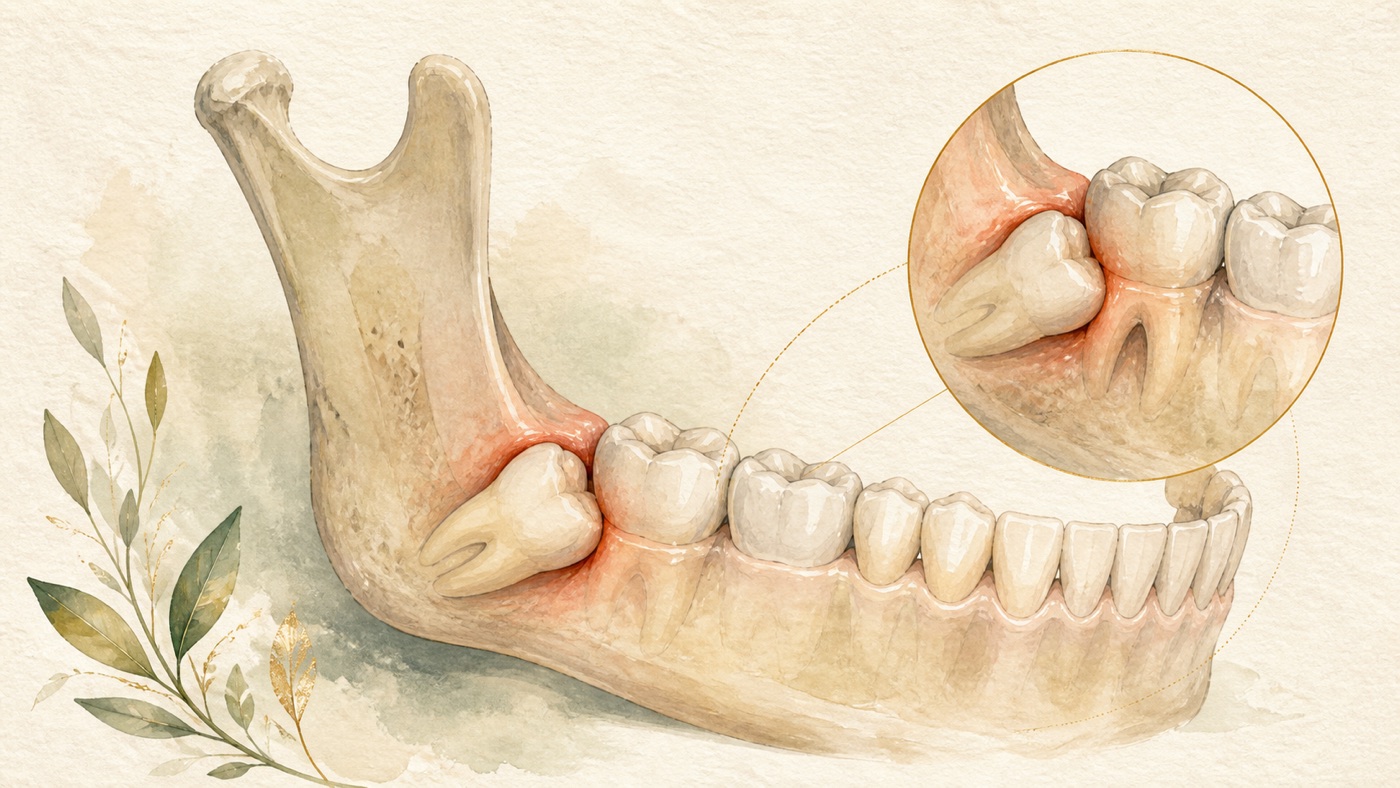
Do wisdom teeth always need to be removed? Can two be removed in one visit?
Neither “always remove” nor “never remove” is supported. For an asymptomatic, disease-free impacted wisdom tooth, the Cochrane review cannot decide removal versus retention; regular clinical assessment is advisable if retaining. This card puts red flags first, separates retention and removal risks, and gives no drug name, dose, or medication advice.
Do wisdom teeth always have to be removed? Can two be removed in one visit?
Direct answer (source-language limit: 60 characters)
Not always removed, and not always retained. For an impacted wisdom tooth that is asymptomatic and disease-free, the evidence is insufficient to determine whether it should be removed or retained; if you choose to retain it, it has to be followed up at regular intervals [F3]. There is no universal answer to how many teeth may be removed at once; it has to be assessed by a dentist [F23].
If swelling starts to spread, or if there is fever, difficulty swallowing, a change in the voice, or respiratory distress, seek medical care immediately — do not wait until the next day [F20][F21].
Scope: this article is general health education based on the international literature. It does not deal with any particular country's insurance schemes or regulations; for treatment and fee arrangements, follow the system where you live. The compliance note at the end cites Taiwan's Medical Care Act only to define this site's publishing status, and that is already marked geo: TW in the F-Unit.
How this card divides the work with its siblings: this card covers the grounds for deciding to remove or retain and who assesses the surgical arrangements. How long the wound takes to heal after extraction is in KM-DENTAL-01; how soon after extraction you can eat, and what is in KM-DENTAL-04; how soon after extraction you can brush is in KM-DENTAL-40; where wisdom teeth sit in the arch and why the second molar matters is in KM-DENTAL-21; grading of swelling and pain that is already present around a wisdom tooth is in KM-DENTAL-05; triage by the pattern of pain in the tooth itself is in KM-DENTAL-33. Where the literature anchors overlap, this card gives one summarising sentence and points across rather than rewriting them [F2].
First, to be clear: this question has no single answer that applies to everyone
People who search for "do wisdom teeth always have to be removed" usually want a one-line verdict. The literature supports no one-line verdict, and that has to be said before anything else [F3].
The Cochrane systematic review addresses exactly this question — it compares "surgical removal of asymptomatic, disease-free impacted wisdom teeth" directly against "retention with routine care". The conclusion of the 2020 update is stated plainly: the available evidence is insufficient to determine whether asymptomatic, disease-free impacted wisdom teeth should be removed or retained [F3]. The same review goes on to say that, because of the current lack of usable evidence, the patient's values should be taken into account and clinical expertise applied so that the decision is made jointly with the person concerned; and that if the decision is to retain these teeth, clinical assessment at fixed intervals is advised in order to prevent adverse outcomes [F3].
Note that "retain and follow up regularly" is an option this review states explicitly; it is not an invention of this site [F3]. Equally worth noting is the other side of it: the same review also records that retaining asymptomatic, disease-free impacted wisdom teeth may, in the long term, be associated with an increased risk of periodontitis in the adjacent second molar — but the certainty of that evidence is very low [F3].
Why is the evidence this thin? Because the studies included in this 2020 update are still the same two as in the previous version: one randomised controlled trial conducted in a dental hospital in the United Kingdom, and one prospective cohort study conducted in private practice in the United States [F5]. And no eligible study reported the effect of "removal versus retention" on health-related quality of life — the primary outcome that review had set [F5].
This section is what this card thinks you should know more about: the population limits of that cohort study
The data behind "retention may be associated with an increased risk of periodontal disease in the adjacent tooth" come from a subgroup within a prospective cohort study: 416 healthy male participants, aged 24 to 84, with follow-up ranging from 3 years to more than 25 years [F5].
All of them were male. That means any statement applying this finding to women is an extrapolation beyond the range of the original data [F5][F2]. The same review also records that, within the same study, the evidence on caries risk was insufficient to show a difference between having and not having an impacted wisdom tooth [F5].
Another frequently cited reason — "if you don't have the wisdom teeth out, your front teeth will be pushed crooked" — likewise gets no support in this review: a trial that randomised 164 people and analysed 77 adolescent participants compared removal with retention for changes in dental-arch dimensions five years later, and the review's reading is that there is no evidence that removing asymptomatic, disease-free impacted wisdom teeth has a clinically significant effect on changes in arch dimensions; that study was also rated as being at high risk of bias [F5].
The voice on the other side has to be recorded too: not every assessment points the same way
Citing only Cochrane would be dishonest. A 2020 UK health technology assessment report likewise used a systematic review to examine "prophylactic removal of impacted mandibular wisdom teeth" against "retention with routine care", and its clinical conclusion agrees with Cochrane's: the evidence comparing the two is very limited [F6].
But it says three further things, all of which are worth knowing [F6]:
- The report records that, where pathological change is already present, the position of the guidance issued by the United Kingdom's National Institute for Health and Care Excellence at the time was that the impacted tooth should be removed [F6]. That one sentence draws the boundary of the debate — what is disputed is whether to remove pre-emptively when there is no disease and no symptom, not whether to deal with disease once it is there [F6][F3].
- Three studies reported "pathological change resulting from retention"; in those studies, the proportion of retained impacted mandibular wisdom teeth that were subsequently removed ranged from 5.5% to 31.4%, and the report explains that this spread can be accounted for by differing follow-up periods (1 year versus 5 years) [F6]. Here this card deliberately stops short of extrapolating: the source only says the spread can be explained by follow-up period; it does not state one by one which proportion corresponds to which period, so this card does not assign that correspondence on its behalf, and does not claim that "the longer the follow-up, the higher the proportion" [F6][F2]. What can be said is this: retention does not mean the matter is settled for good — in those studies, a share of the retained teeth still went on to be removed, within the range of 5.5% to 31.4% given above [F6]. This card does not collapse that range into a single representative value, because the gap between the endpoints is itself part of the uncertainty the source is conveying [F6][F2].
- Using a model built by its own assessment team, the report concluded that prophylactic removal may be the more cost-effective strategy [F6]. This card records that opposite-pointing conclusion as it stands, but has to mark its three qualifiers: it comes from an exploratory model built on observational data rather than from a head-to-head trial; the model was constructed with United Kingdom cost and utility data, which differ from the fee systems of other countries; and the first item on the report's own list of limitations is that no head-to-head trial could be found [F6][F2].
Reading the two together, only one thing can be said: this is a question the available evidence cannot yet decide for you — which is exactly why it gets written up as shared decision-making [F3][F6].
Three-tier triage: which situation is your wisdom tooth in right now?
The tiers below are a structure this site has assembled from the literature to help you communicate at the clinic; they are not a diagnostic tool [F2].
Tier one: seek medical care immediately if these signs appear
- The swollen area is getting larger, or it comes with fever and a general feeling of being unwell: a Cochrane review on odontogenic pain and infection records that clinical guidance places "signs of spreading infection (cellulitis, lymph-node involvement, diffuse swelling)" and "systemic involvement (fever, malaise)" in a different category from local management [F20]. Of these, cellulitis and lymph-node involvement can only be determined by a clinician's examination; "is the swollen area still expanding?" is this site's rendering of that criterion into something you can observe at home and report — it is not the source's own wording [F20][F2].
- Difficulty swallowing, a change in the voice, neck swelling, neck pain, respiratory distress: a textbook entry on deep neck infection records that its symptoms often arise from local pressure effects on the airway, the nerves or the digestive tract, including neck swelling, difficulty swallowing, difficulty speaking and restricted mouth opening; the clinical picture is often accompanied by fever, neck pain and respiratory distress [F21]. This group is not a situation to be scheduled — seek medical help immediately [F21].
- Not being able to open the mouth (trismus): the range of this one has to be spelled out. Restricted mouth opening is listed among the symptoms of deep neck infection [F21], but it is at the same time a common presentation of mandibular wisdom-tooth problems in their own right — the Cochrane review of surgical techniques lists "relief of local pain, swelling and trismus" as one of the indications for surgical removal of mandibular wisdom teeth [F12]. So the criterion is: trismus combined with expanding swelling, fever or difficulty swallowing belongs in this tier — seek care immediately [F21][F12][F2]. Trismus occurring on its own, without any of the above, does not belong in this tier; see tier two below — and that tier means arranging an appointment promptly, not that you can keep waiting indefinitely.
- Any of the above occurring in someone whose immune function is affected or who has comorbidities: the deep-neck-infection literature lists host factors such as immunosuppressed states, comorbidity, trauma and recent instrumentation as factors affecting the spread and severity of infection [F21].
The completeness limit of this red-flag list has to be stated honestly: the red flags in this card are confined to the signs listed in the two sources above; signs the sources do not list are not added by this card. That is the trade-off of "nothing written without a source", and it does not mean those situations are unimportant [F23][F2]. The same set of red flags is set out in full in KM-DENTAL-05 and KM-DENTAL-33, so this card only summarises and points across [F2].
Tier two: arrange an appointment promptly (not the emergency department, but waiting longer is not advised)
- Recurrent swelling and pain around a wisdom tooth: the evidence-based recommendation for pericoronitis is that local treatment takes priority over prescribing antibiotics, and that antibiotics should be reserved for severe cases [F11]. The same study records a phenomenon worth knowing about: in a questionnaire survey, nearly 75% of dentists would prescribe antibiotics for pericoronitis, and in patient-record research more than half of patients with pericoronitis were prescribed antibiotics; the authors list inappropriate management of pericoronitis as a key factor in the overuse of antibiotics in dentistry [F11]. The point of that figure is not to make you question a prescription, but to explain that "suppressing it with drugs every time" is regarded in the literature as a pattern that needs review; recurrent episodes are worth going back to discuss [F11][F2].
- Pain, swelling or trismus that is already present: the Cochrane review of surgical techniques lists relief of local pain, swelling and trismus as indications for surgical removal, and includes prevention of spreading infection alongside them (that review states explicitly that spreading infection is occasionally life-threatening) [F12].
- Your dentist has told you the adjacent tooth already has caries or periodontal breakdown, or that there is a lesion on the imaging: this tier falls on the "pathological change already present" side described earlier, and the uncertainty in the debate does not cover it [F6][F3].
Tier three: when there are no symptoms and no detectable disease
This tier is where "does it always have to come out?" is actually fought over, and the answer is the one at the top of this card: the evidence is insufficient to determine whether it should be removed or retained, so it should proceed by shared decision-making; and if the decision is to retain, clinical assessment at regular intervals is advised [F3].
What that regular assessment looks at, and how often, is the dentist's judgement; what this card can state is the list of pathological changes that the Cochrane review sets out in its background as possibly related to impacted wisdom teeth: pericoronitis, root resorption, disease of the gingiva and alveolar bone (periodontitis), caries, and the development of cysts and tumours [F4]. That is the review's background narrative, not a monitoring checklist it issues, and this card does not write it up as follow-up guidance [F4][F2].
Known risks of retention: three sets of figures, and the denominator behind each
Every set of figures in this section has a denominator that is easy to misread, so this card labels them one by one [F2].
One: caries on the distal surface of the adjacent tooth. A 2025 systematic review and meta-analysis took "distal caries in second molars adjacent to impacted mandibular wisdom teeth" as its subject, including 13 studies with 13,788 patients in total; its results sentence reports that, in mandibular second molars adjacent to an impacted mandibular wisdom tooth, the overall prevalence of caries was 29.89% (95% CI 21.05% to 38.74%) [F7]. By Winter's classification, the position more strongly associated with caries was the mesioangular one, at 43.37% (95% CI 33.03% to 53.70%) [F7]. Denominator limit: this is "the proportion of adjacent teeth showing distal caries within a population that has impacted wisdom teeth"; the review set up no control group without impacted wisdom teeth. So it can show that this location is indeed a high-frequency site, but it cannot be read as "removing the tooth will subtract that proportion", nor as your personal probability [F7][F2].
Two: alveolar bone changes in the adjacent tooth. A 2025 retrospective observational study compared radiographic changes on the distal surface of second molars at two time points, with the impacted wisdom tooth remaining in place throughout: 51 patients (mean age 45), 68 second molars, mean interval 20 months, and no significant change in vertical, oblique or angular bone levels between the two time points [F10]. The authors' conclusion runs in two directions at once: this analysis provides no evidence supporting the hypothesis that prophylactic removal of impacted wisdom teeth delivers a substantial bone-preserving benefit; and equally it does not establish that retaining an impacted wisdom tooth long term necessarily causes short-term bone change in the adjacent tooth [F10]. Denominator limit: single centre, small sample, and a mean interval of only 20 months; the authors themselves call for more research to assess the medium- and long-term effects [F10].
Three: cysts and tumours. There are two sets of figures here, and their denominators and definitions differ, so comparing them with each other or adding them together is prohibited [F2]:
- A 2019 systematic review (16 included studies) used histopathological diagnosis as its inclusion criterion and arrived at a prevalence of odontogenic cysts and tumours associated with impacted wisdom teeth of 5.3% (95% CI 3.1% to 8.1%); within that, cysts were 4.4% (95% CI 2.5% to 6.8%) and tumours 0.5% (95% CI 0.2% to 0.9%) [F9]. The denominator of that proportion is "impacted wisdom teeth that had been extracted", not impacted wisdom teeth in the whole population — a tooth that gets removed may well have been removed because there was something wrong with it, which is selection bias [F9][F2].
- A 2026 systematic review and meta-analysis narrowed the scope to "asymptomatic impacted wisdom teeth with a radiographically normal pericoronal space (≤3 mm)", including 7 studies and 592 pericoronal follicles, with a pooled prevalence of cystic change of 26.7% (95% CI 3.7% to 49.6%) and of dentigerous cyst of 21.6% (95% CI 12.9% to 32.2%), the heterogeneity of both being extremely high (I2 greater than 97%) [F8]. It is this study's concluding sentence that is the point: the authors write that these findings must be interpreted with caution, and that the available evidence does not support prophylactic removal on the basis of these findings alone [F8].
What the three sets together mean: retention does carry documented patterns of risk, but every one of these sets of evidence comes with a denominator limit or extremely high heterogeneity. This is precisely what "the evidence is insufficient to determine" looks like in concrete form [F3][F7][F8][F9][F2].
Known risks of removal: this is the side that the Medical Care Act requires to be disclosed
The Cochrane review of surgical techniques (62 trials, 4,643 participants) states in its background that surgery is commonly accompanied by short-term postoperative pain, swelling and trismus; less common are infection, dry socket (alveolar osteitis) and trigeminal nerve injury [F12].
The magnitude of nerve injury has systematic-review figures behind it. A systematic review including 23 studies with 26,427 patients in total (44,171 teeth) reports that, among these 44,171 removals of impacted mandibular wisdom teeth, 1.20% resulted in a temporary functional deficit of the inferior alveolar nerve and 0.28% in a permanent deficit [F13]. The same review lists the statistically significant risk factors as: depth of impaction, contact between the mandibular canal and the wisdom tooth, surgical technique, intraoperative nerve exposure, and operator experience [F13]. Operator experience being listed as a risk factor is there to remind you that you may ask before the procedure "who will carry this out, and how is it assessed" — it is not an evaluation of the competence of any clinician or facility [F13][F2].
As to which imaging features count as high risk, there is updated evidence from 2026. A systematic review and meta-analysis examined 18 studies and identified 8 tomographic imaging features that predict inferior alveolar nerve injury; 16 of those studies were at low risk of bias, and GRADE certainty was rated moderate to high [F14]. The three features with a significantly raised odds ratio were: absence of cortical bone (OR 9.87, 95% CI 4.10 to 23.83), a dumbbell-shaped mandibular canal (OR 8.25, 95% CI 3.19 to 21.35), and a lingual position (OR 3.82, 95% CI 1.95 to 7.39); where all three features are present together, the risk of inferior alveolar nerve injury after removal is raised (OR 5.06, 95% CI 2.23 to 11.39) [F14]. The practical meaning of this passage is that reading the images is not a formality: it changes both what is done and what has to be explained [F14][F13].
Where the nerve risk is high, the literature describes an alternative technique that can be discussed. A 2025 systematic review and meta-analysis of "mandibular wisdom teeth in contact with the mandibular canal" reports that, compared with the control, coronectomy showed a significant reduction in the relative risk of altered sensation (0.09, 95% CI 0.03 to 0.25, I2 of 0%); but the risk of infection and the risk of dry socket were not significantly reduced [F15]. The same review also records that heterogeneity and sample sizes leave the GRADE certainty of evidence ranging from very low to moderate [F15]. Whether this technique is suitable for you is for a dentist to judge from the imaging and the clinical conditions; this card makes no recommendation [F15][F2].
The curve of how you will feel afterwards also has a systematic review you can consult. A systematic review including 13 papers (6 of which entered the meta-analysis) reports that, measured on the OHIP-14 scale, the score on the first postoperative day was 17.57 higher than before surgery (95% CI 11.84 to 23.30, I2 of 96%), and its conclusion is that the negative impact on quality of life appears on the first day after surgery and then declines over the follow-up period [F16]. Two limits have to be read alongside it: this review's inclusion criteria were confined to procedures performed under local anaesthesia; and an I2 of 96% means the differences between the studies are very large, so this figure is not a score you can expect for yourself [F16][F2].
As for prophylactic medication. A Cochrane systematic review including 23 trials with roughly 3,206 randomised participants reports that, compared with placebo, prophylactic antibiotics prevent infection after removal of an impacted wisdom tooth in one person for every 19 treated on average (95% CI 15 to 34), with low certainty of evidence [F19]. That review's conclusion also states that, because the prevalence of antibiotic-resistant bacteria is rising, clinicians should assess individually, for each patient's clinical situation, whether and when to prescribe prophylactic antibiotics [F19]. This card provides no drug name, dose or advice on use; whether to use medication, which one, and for how long is in every case a decision for a physician or dentist [F19].
"The younger you have them out, the better" — the state of the evidence for this saying is divided
This saying has spread widely, so this card sets out the state of its evidence as it stands [F2].
The Cochrane review does state in its background section that when surgical removal is performed in older people, the risk of postoperative complications, pain and discomfort increases [F4]. But this has to be labelled clearly: that is the review's background narrative, not a result it obtained by comparing two groups [F4][F2].
Two single-centre retrospective studies point in different directions [F17][F18]:
- A cross-sectional retrospective study conducted in Indonesia covering 916 subjects found that surgical difficulty was significantly associated with pain, trismus and altered sensation on the first postoperative day, while age was significantly associated with pain, swelling and trismus one week after surgery; the authors advise dentists to be alert that older patients (51 and over) and those with high surgical complexity are more prone to more severe postoperative complications [F17].
- An analysis conducted in Germany covering 200 patients (554 impacted wisdom teeth), grouped by a cut-off of 30 years, found no significant difference between the two age groups in inferior alveolar nerve hypoaesthesia, lingual nerve hypoaesthesia, postoperative bleeding or postoperative infection; the authors conclude that age (at a cut-off of 30 years) has no statistical association with a higher risk of postoperative complications [F18].
All that can honestly be said is this: the association between age and complications is not consistent across studies with different cut-offs (51 and over versus a cut-off of 30 years) and different populations [F17][F18]. The conclusions of the two studies cannot be merged into a single sentence — the Indonesian one also reported a significant association between surgical difficulty and postoperative complications [F17], whereas the German one did not analyse the difficulty-and-complications relationship at all; its conclusion is that age is not an associated factor and that other risk factors should be studied [F18]. As for the proposition that difficulty affects risk in itself, the sturdier basis is the systematic review of nerve injury: depth of impaction and surgical technique reached statistical significance in that review [F13]. So "have them out early while you are young" is not a conclusion this card can settle on your behalf; it still returns to shared decision-making [F3][F2].
Can two be removed in one visit? This card's answer is "this question should not have a universal answer"
First, the search result: on 2026-08-06 this site searched PubMed on the scheduling question of "how many to remove at once" and obtained no study directly comparing "removing several teeth in the same session" with "removing them in separate sessions" (the search strings and the number of records returned for each are listed item by item in F23) [F23].
In the absence of direct evidence, this card gives no universal "you can" or "you cannot", but instead lists the items a clinician assesses when making this arrangement — your task is to ask these questions, not to work out the answer for yourself [F2]:
- The pattern and depth of impaction of each of the two teeth, and their relationship to the mandibular canal: depth of impaction, contact between the mandibular canal and the wisdom tooth, and intraoperative nerve exposure all reached statistical significance in the systematic review of inferior alveolar nerve injury (that review pools observational studies, which is not the same as proof of causation) [F13]; absence of cortical bone, a dumbbell-shaped mandibular canal and a lingual position on the imaging are high-risk features [F14]. The difficulty of the two teeth may be entirely different, which is why "two teeth" is not a unit that can be assessed as a whole [F13][F14][F2].
- Whether the two teeth are on the same side or on both sides: this site obtained no study comparing same-side with opposite-side removal in a single session, so it draws no inference at all; put this one directly to the dentist who will operate [F23].
- The arrangements for anaesthesia and monitoring: this site obtained no citable study comparing the number of teeth removed in one session under different forms of anaesthesia, so it offers no recommendation; the form of anaesthesia falls within the clinician's clinical judgement [F23][F2].
- Your general health and your infection risk: the Cochrane review of prophylactic antibiotics states plainly that clinicians should assess individually according to the patient's clinical situation (healthy, or with systemic disease); the trials it included were overwhelmingly of healthy people undergoing impacted wisdom-tooth surgery, and no study assessed extraction in immunocompromised people [F19]. In other words, "someone else was able to have two out at once" is a statement that, on the evidence, never covered everyone in the first place [F19][F2].
- How you are going to get through the recovery period: the first postoperative day is the peak of the negative impact, which then declines over the follow-up period [F16]. Dealing with two wounds in the same session means caring for two sites during the same recovery period — this card does not claim that the discomfort doubles (no study supports that statement); it only points out that planning the recovery period is part of this decision [F16][F23][F2].
- Whether an alternative technique needs to be discussed: if the imaging shows a close relationship with the mandibular canal, coronectomy is an option that has been examined in the literature; its reduction in the relative risk of altered sensation is supported by meta-analysis, but for infection and dry socket there is no significant difference [F15].
Risk factors: situations in which it is less advisable to keep putting the decision off
- People who already have recurrent pericoronitis: the evidence-based recommendation is that local treatment takes priority over antibiotics, with antibiotics reserved for severe cases; recurrent episodes are a situation in which the management should be discussed at a return visit [F11].
- People whose adjacent tooth already shows distal caries or periodontal breakdown: this has already moved to the "pathological change present" side and is no longer the uncertain situation Cochrane discusses [F6][F7][F3].
- People whose imaging shows a close relationship with the mandibular canal: risk assessment and discussion of technique in such cases require image interpretation, not information from the internet [F14][F15].
- People whose immune function is affected or who have comorbidities: the Cochrane review states explicitly that no study assessed extraction in immunocompromised people, so this needs individualised handling [F19]; the deep-neck-infection literature likewise lists immunosuppressed states and comorbidity as factors affecting the spread and severity of infection [F21].
- People who decide to retain but have no habit of returning for review: the Cochrane recommendation is "if the decision is to retain, carry out clinical assessment at fixed intervals" — follow-up is the precondition on which the retention option stands [F3].
Risk disclosure: surgical removal of a wisdom tooth, coronectomy, and follow-up after retention each have their own indications, limits and possible adverse effects. Those documented in the literature include: short-term postoperative pain, swelling and trismus, and less commonly infection, dry socket and trigeminal nerve injury [F12]; temporary and permanent functional deficit of the inferior alveolar nerve [F13]; no significant reduction in infection or dry socket with coronectomy [F15]; and a possible association between retention and an increased risk of periodontitis in the adjacent tooth (very low certainty evidence) [F3]. Whether any of the above applies to you is not for this card to determine; it must be assessed by a dentist on the basis of examination and imaging, and the actual treatment and its effects vary from person to person.
Checklist before your appointment (8 questions, best asked all at once)
- For each of my wisdom teeth, is your judgement to remove it, retain it, or watch it for now? What is the reason in each case? [F3][F6]
- Which high-risk features can be seen on the imaging? What is the relationship between my wisdom tooth and the mandibular canal? [F14][F13]
- If I choose to retain it for now, how often should it be followed up, and which changes will you be looking at? [F3][F4]
- Does my adjacent tooth (the second molar) currently have caries or periodontal breakdown? [F7][F10]
- If they are to come out, how many are scheduled this time, and why that number? What difference would doing them in separate sessions make? [F23][F13]
- What might happen after the surgery? Which situations should bring me back early, and which need same-day care? [F12][F20][F21]
- Will my physical condition (medications, chronic disease, immune-related problems) change this plan? [F19]
- If the nerve risk is high, is there another technique we can discuss? What are the trade-offs of each? [F15]
How to find a clinic that provides this service
This site lists no clinics and does not recommend, rate or compare any medical institution.
To find a clinic that provides this service, use the following official lookup channels yourself —
they are maintained by the competent authorities and are more current than any list:
>
- The Ministry of Health and Welfare's medical-institution lookup: search by city or county,
township and specialty (dentistry) for institutions that have completed practice registration.
The results show the institution's name, address and registered specialty. This is the first place
to confirm whether a clinic is lawfully registered.
- The National Health Insurance Administration's contracted-institution lookup: check whether a
clinic is under contract with National Health Insurance. This determines which items are covered
and which are self-paid, and therefore what kind of fee explanation you will be given.
>
Both systems are on the respective authorities' official websites; searching for the
medical-institution lookup or the contracted-institution lookup will find them. This site does not
reproduce the URLs, because they change; use whichever entry point the authority currently publishes.
>
In an emergency, do not spend time looking up lists. If your breathing, swallowing or speech is
affected, or swelling is spreading, go to the nearest emergency department.
Chinese labels to look for on the official pages
These official systems, datasets and files are published in Chinese only. The English names above are this site's renderings; on the page itself you will see the following strings, so search for these:
>
- 「醫事機構查詢」
- 「特約醫事機構查詢」
- 「特約院所查詢」
Compliance note
This is patient health education under Article 87 of Taiwan's Medical Care Act, not medical advertising, and recommends no particular institution [F22]. Surgical removal of a wisdom tooth, coronectomy and follow-up after retention have risks and contraindications; postoperative pain, swelling, trismus, bleeding, infection, dry socket, altered nerve sensation, or the need for further management may occur. Treatment and outcomes vary by person and require a dentist's assessment. The tiered framework assembled in this card is for use in communicating at the clinic; it cannot replace clinical diagnosis, and it must not be used as grounds for delaying care or self-medicating. This card gives no drug name, dose or advice on use.
Every clinical statement in this article is mapped line by line to its cited source (see the sources and evidence chain below). It has not been clinically reviewed by a licensed practitioner. This is health information, not individual advice; assessment by a clinician is required.
FAQ
- It does not hurt. Does that mean no removal?
- **No pain does not automatically mean no action, and it does not automatically mean removal.** For asymptomatic, disease-free impacted teeth evidence cannot decide; if retaining, regular clinical assessment is advisable [F3]. “Not yet” is an evidence-recognised option only with follow-up [F3][F6].
- 痛くなければ抜かなくてよい? — **痛みがないことは、自動的に放置できることでも、必ず抜くべきことでもない。** 無症状・無疾患の埋伏歯は証拠だけで決められず、保存なら定期的臨床評価が勧められる [F3]。「今は抜かない」は追跡を条件に成り立つ選択肢である [F3][F6]。
- It does not hurt. Does that mean no removal? — **No pain does not automatically mean no action, and it does not automatically mean removal.** For asymptomatic, disease-free impacted teeth evidence cannot decide; if retaining, regular clinical assessment is advisable [F3]. “Not yet” is an evidence-recognised option only with follow-up [F3][F6].
- Will it push other teeth crooked?
- **That reason was not supported by the Cochrane review.** Its high-risk-of-bias RCT found no evidence of clinically significant five-year arch change. Weak evidence is not proof of no effect; this card claims only the former [F5][F2].
- 親知らずを抜かないと歯が押されて乱れる? — **その理由は Cochrane レビューで支持されなかった。** 高バイアスリスクの RCT は 5 年後の歯列弓変化に臨床的に有意な効果の証拠を示さなかった。証拠が弱いことは、効果がないと証明されたことではない [F5][F2]。
- Will it push other teeth crooked? — **That reason was not supported by the Cochrane review.** Its high-risk-of-bias RCT found no evidence of clinically significant five-year arch change. Weak evidence is not proof of no effect; this card claims only the former [F5][F2].
- Will it cause a cyst or tumour?
- **The association is recorded, but the figures have different denominators and are not personal probabilities.** Do not compare or add F8 and F9 figures [F8][F9][F2].
- 嚢胞や腫瘍になる? — **関連は記録されるが、数字の分母が異なり個人確率ではない。** F8 と F9 の数字は比較も加算もしない [F8][F9][F2]。
- Will it cause a cyst or tumour? — **The association is recorded, but the figures have different denominators and are not personal probabilities.** Do not compare or add F8 and F9 figures [F8][F9][F2].
- Can two wisdom teeth be removed in one visit?
- **There is no universal answer and no direct comparative study.** Each tooth can differ in depth, canal relation and imaging risk; same-session care, anaesthesia and recovery are individual clinical decisions [F13][F14][F16][F19][F23].
- 一度に2本抜いてよい? — **万能の答えも直接比較研究もない。** 歯ごとに深さ、下顎管関係、画像リスクは違い、同時処置、麻酔、回復は個別の臨床判断である [F13][F14][F16][F19][F23]。
- Can two wisdom teeth be removed in one visit? — **There is no universal answer and no direct comparative study.** Each tooth can differ in depth, canal relation and imaging risk; same-session care, anaesthesia and recovery are individual clinical decisions [F13][F14][F16][F19][F23].
- My gum is swollen. Can I take medicine and wait?
- **Medication is a clinician’s decision; this card gives no drug name, dose, or use advice.** If swelling expands, fever, swallowing difficulty, voice change or respiratory distress occurs, seek medical help immediately and do not wait until the next day [F11][F20][F21].
- 親知らずの周りが腫れた。薬を飲んで待てる? — **薬の判断は医療者が行う。本稿は薬剤名、用量、使用法を示さない。** 腫れが広がる、発熱、嚥下困難、声の変化、呼吸苦があれば、翌日まで待たず直ちに医療機関へ [F11][F20][F21]。
- My gum is swollen. Can I take medicine and wait? — **Medication is a clinician’s decision; this card gives no drug name, dose, or use advice.** If swelling expands, fever, swallowing difficulty, voice change or respiratory distress occurs, seek medical help immediately and do not wait until the next day [F11][F20][F21].
Medical notice This article is provided for health education and medical information purposes. It is not a solicitation for medical services and does not constitute diagnosis or treatment advice. Actual treatment methods and outcomes vary between individuals and require evaluation by a dentist; every treatment has its own indications, limitations and possible risks. If you have related symptoms or treatment needs, please book a consultation for evaluation by a dentist.
Source anchors
- Ghaeminia H, Nienhuijs ME, Toedtling V, et al. Surgical removal versus retention for the management of asymptomatic disease-free impacted wisdom teeth.… · https://pubmed.ncbi.nlm.nih.gov/32368796/ · 在 IDAEO 的其他引用
- Hounsome J, Pilkington G, Mahon J, et al. Prophylactic removal of impacted mandibular third molars: a systematic review and economic evaluation. Health… · https://pubmed.ncbi.nlm.nih.gov/32589125/ · 在 IDAEO 的其他引用
- Revuelta-Cortés P, Cortés-Bretón Brinkmann J, Argandoña-Flores M, et al. Prevalence of distal caries in second molar associated with impacted mandibular… · https://pubmed.ncbi.nlm.nih.gov/39853442/ · 在 IDAEO 的其他引用
- de Andrade Tutu JS, de Sousa Lopes Cascaes P, Peralta-Mamani M, et al. Cystic and Neoplastic Lesions in Pericoronal Follicles of Asymptomatic Third Molars: A… · https://pubmed.ncbi.nlm.nih.gov/42144023/ · 在 IDAEO 的其他引用
- Mello FW, Melo G, Kammer PV, Speight PM, Rivero ERC. Prevalence of odontogenic cysts and tumors associated with impacted third molars: A systematic review… · https://pubmed.ncbi.nlm.nih.gov/31005378/ · 在 IDAEO 的其他引用
- Alqahtani ND, et al. Retention of Asymptomatic Impacted Third Molars: Effects on Alveolar Bone at the Distal Surface of Second Molars over Time. Diagnostics… · https://pubmed.ncbi.nlm.nih.gov/40647642/ · 在 IDAEO 的其他引用
- Schmidt J, Kunderova M, Pilbauerova N, Kapitan M. A Review of Evidence-Based Recommendations for Pericoronitis Management and a Systematic Review of… · https://pubmed.ncbi.nlm.nih.gov/34202699/ · 在 IDAEO 的其他引用
- Bailey E, Kashbour W, Shah N, Worthington HV, Renton TF, Coulthard P. Surgical techniques for the removal of mandibular wisdom teeth. Cochrane Database Syst… · https://pubmed.ncbi.nlm.nih.gov/32712962/ · 在 IDAEO 的其他引用
- Kang F, Sah MK, Fei G. Determining the risk relationship associated with inferior alveolar nerve injury following removal of mandibular third molar teeth: A… · https://pubmed.ncbi.nlm.nih.gov/31476533/ · 在 IDAEO 的其他引用
- Bussolar R, et al. Predictive factors in tomographic imaging for inferior alveolar nerve injury during third-molar surgery: A systematic review and… · https://pubmed.ncbi.nlm.nih.gov/41770179/ · 在 IDAEO 的其他引用
- Complications in coronectomy procedures for removal of lower third molars in contact with the mandibular canal: systematic review and meta-analysis of… · https://pubmed.ncbi.nlm.nih.gov/40562625/ · 在 IDAEO 的其他引用
- Vieira WA, et al. Third molar removal and its impact on quality of life: systematic review and meta-analysis. Qual Life Res. 2018;27(10):2477-2489. PMID… · https://pubmed.ncbi.nlm.nih.gov/29797177/ · 在 IDAEO 的其他引用
- Rizqiawan A, et al. Postoperative Complications of Impacted Mandibular Third Molar Extraction Related to Patient's Age and Surgical Difficulty Level: A… · https://pubmed.ncbi.nlm.nih.gov/35027927/ · 在 IDAEO 的其他引用
- Krüger C, et al. Impacted third molar surgery in older patients-Is patient's age really a risk factor for complications? Clin Oral Investig. 2024;28(10):568.… · https://pubmed.ncbi.nlm.nih.gov/39375233/ · 在 IDAEO 的其他引用
- Lodi G, Azzi L, Varoni EM, et al. Antibiotics to prevent complications following tooth extractions. Cochrane Database Syst Rev. 2021;2(2):CD003811. PMID… · https://pubmed.ncbi.nlm.nih.gov/33624847/ · 在 IDAEO 的其他引用
- Cope AL, Francis N, Wood F, Thompson W, Chestnutt IG. Systemic antibiotics for symptomatic apical periodontitis and acute apical abscess in adults. Cochrane… · https://pubmed.ncbi.nlm.nih.gov/38712714/ · 在 IDAEO 的其他引用
- Almuqamam M, Gonzalez FJ, Sharma S, Kondamudi NP. Deep Neck Infections. StatPearls. Treasure Island (FL): StatPearls Publishing. PMID 30020634 · https://pubmed.ncbi.nlm.nih.gov/30020634/ · 在 IDAEO 的其他引用
- 醫療法 第 87 條(全國法規資料庫 · https://law.moj.gov.tw/LawClass/LawSingle.aspx?pcode=L0020021&flno=87 · 在 IDAEO 的其他引用
- 本文證據鏈:逐條出處、行號與原文引句 · https://km.idaeo.ai/reports/dental-wisdom-tooth-extraction-necessity-evidence · 在 IDAEO 的其他引用
Cite this article
Lucy・《Do wisdom teeth always need to be removed? Can two be removed in one visit?》・IDAEO 知識庫・2026-08-13・https://km.idaeo.ai/post/dental/wisdom-tooth-extraction-necessityUpdated 2026-08-27