

🏛 Part of the "dental" topic shelf →
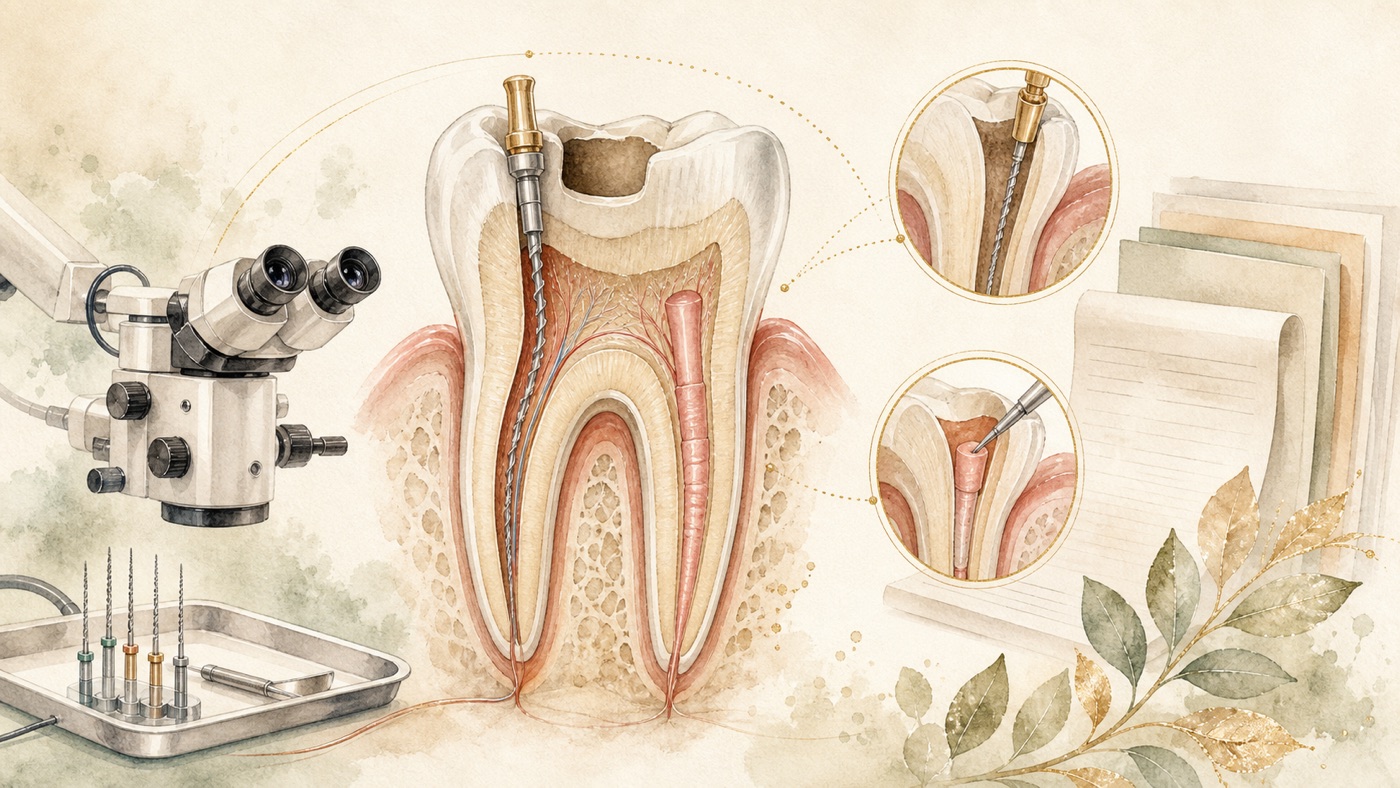
How much does root-canal treatment cost? Compare the quote in six parts before deciding why microscopic treatment costs more.
A root-canal quote consists of examination/imaging, treatment itself, microscopic and special-instrument/material add-ons, temporary care, definitive restoration, and potential later treatment. Taiwan has no single national fee; the NHI/self-pay boundary follows the NHI Administration's current notice. This card explains the evidence for add-ons and lists no price or range.
How much does root-canal treatment cost? What are you paying extra for in microscopic treatment? Split the quote into six parts before you compare
Direct answer (source-language limit: 60 characters)
Taiwan has no single national price: root-canal cost depends on the components. The extra charge for microscopic treatment reflects equipment, instruments, materials, and time; the NHI/self-pay boundary follows the NHI Administration's current notice. [F20][F24][F26][F2]
This guide is specific to Taiwan's healthcare system (National Health Insurance and Taiwan's Medical Care Act). The sections on the system and on verification routes cite Taiwan law and competent-authority notices (F-Units tagged geo: TW), while the outcome evidence for microscopy, instruments and materials cites international literature (tagged geo: universal); if you are treated in another country, read the institutional sections against local rules instead.
First, the division of labour: this card only handles how the cost is composed
This site splits questions in the same family across several cards, so get the position right before talking about money. Why this tooth needs root-canal treatment, how many visits it takes, and how long it will hurt afterwards are questions about the procedure and the course of treatment; that evidence is collated in the root-canal basics card (see the internal citation chain at the end). This card does not rewrite it, and only summarises a sentence where necessary and points to that card. How much the crown or inlay after root-canal treatment costs belongs to the cost structure on the prosthetic side, in the crown-cost card. Commercial insurance reimbursement depends on the terms of your own policy, and this site gives no reimbursement opinion [F30].
What this card is responsible for is three things: which items make up the cost, what each add-on item in microscopic treatment actually buys (and how strong the evidence for each is), and the verification routes you can walk through yourself [F2].
There is also one piece of wording to separate first: "microscopic" in the surgery can mean two situations — one is non-surgical root-canal treatment carried out under a microscope, the other is microsurgical apical surgery (raising the gum and treating the tip of the root). The evidence from the two cannot be substituted for each other, and this card marks which one is meant each time it cites [F5][F14].
Cost composition: a root-canal quote should be split into at least six parts
Taiwan has no nationally applicable price list (the legal basis is in the next section). Rather than asking around about what other people paid, splitting the quote in front of you into parts that can be matched item by item is what lets you see what you are actually buying. The six parts below are the common components; if one of them is not written down, ask about it on the spot [F2].
- Examination and imaging: intra-oral examination, periapical radiographs, and sometimes cone-beam computed tomography (CBCT) as an addition; whether it should be added is judged by the dentist according to the indications, and this site gives no imaging advice for an individual case [F19][F2]. Imaging is one kind of add-on, and the question worth asking is "why does this tooth of mine need it" [F13][F2].
- The root-canal treatment itself: the variables here are the tooth position, the number of canals, and the type of treatment (initial treatment or retreatment). Behind the same phrase "having root canal", an anterior tooth and a molar, or an initial treatment and a retreatment, differ in workload and difficulty [F15][F12].
- Add-ons for microscopy and for special instruments and materials: the microscope, ultrasonic instruments, bioceramic (calcium-silicate) sealers, and the time that comes with them. The next section takes each one apart against the evidence [F4][F9][F11].
- Interim measures and review visits during the course of treatment: temporary sealing between appointments, medication changes, and the number of review visits. Ask clearly: how many review visits this quote covers, and how anything beyond that is charged [F2].
- The definitive restoration after treatment: completing root-canal treatment does not mean the tooth is finished with; the inlay or crown that follows is a separate group of items. When two quotes look very different, the difference is often whether this part has been counted in [F2].
- If further management turns out to be needed: retreatment, apical surgery, or extraction after all. This part is not a scare tactic; it is a reminder to ask, when comparing quotes, "if it does not succeed, how is the management afterwards charged" [F12][F13].
What you pay extra for in microscopic treatment: four add-on items, each against the evidence
This section is the core of this card, and also the place where things easily get told as settled fact. Each item below is set out in two layers, "what it buys" and "how strong the evidence is", and the two layers may not stand in for each other.
Add-on one: the microscope (what it buys is field of view and illumination)
What a microscope provides in root-canal treatment is magnification and illumination; one of the measures the literature uses to assess it is whether the small canal orifices can be found [F6][F8].
- Finding the canals is something that can be measured: an observational study conducted in a clinical setting recorded the root-canal treatment of 312 maxillary first and second molar cases; the proportion in which the second mesiobuccal canal (MB2) was located was 57.4% among those using a microscope, 55.3% among those using loupes, and 18.2% among those using no magnification device at all. Looking only at maxillary first molars, the three groups were 71.1%, 62.5% and 17.2% respectively. The same study did not detect a difference between the microscope and loupes [F6]. This is a non-randomised study from 2002; it can only be read as an association, and what it compared was "magnification or not", not "whether a microscope is better than something else" [F6].
- Missed canals are associated with post-treatment lesions: a 2025 systematic review and meta-analysis included 8 cross-sectional studies and 9983 root-filled teeth, and found that the prevalence of post-treatment apical periodontitis was 85.1% where a canal had been missed and 56.3% where none had, with a pooled odds ratio of 7.17 (95% confidence interval 4.55 to 11.29); the authors also state that heterogeneity was high (I² = 86%) and the certainty of evidence low, and point out that maxillary molars (the first molar especially) are the tooth position where missed canals occur most frequently [F7].
- But whether "using a microscope produces better outcomes" cannot currently be determined from randomised trials: the current version of the Cochrane systematic review on this question (updated in 2015, superseding the 2009 version) states, after the search was completed, that no trial met the review's inclusion criteria; the authors conclude that, given the many factors that may affect the success of endodontic surgical procedures, how the type of magnification device affects treatment outcome remains unknown (that sentence is worded in the context of surgical procedures, but "no eligible trial" covers the review's full scope, including non-surgical treatment) [F4]. Another systematic review, from 2010, included three prospective studies, all of them on apical surgery, and could find no comparative study of magnification devices for orthograde (non-surgical) root-canal treatment; it likewise detected no difference in outcome between loupes, the microscope and the endoscope [F5]. In the Cochrane review on retreatment, the comparison of healing between different magnification devices reports results from a single trial with 70 participants, which again detected no advantage for any one device in healing, with the quality of evidence rated low [F13].
- There is one meta-analysis in the surgical setting, but it cannot be used to talk about non-surgical root-canal treatment: a 2012 meta-analysis compared "endodontic microsurgery using high-power magnification (microscope or endoscope)" with "modern apical surgery using loupes only or no visual aid"; the weighted pooled success rates were 94% versus 88%, a statistically significant difference (P < .0005), from 14 included studies; broken down by tooth position, the difference was statistically significant in molars. The authors themselves also write that large-scale randomised trials are needed before a statistically powered conclusion can be drawn [F14]. This is a pooled comparison across studies, not a randomised head-to-head trial, and the setting is surgical [F14].
- Professional consensus and this evidence gap exist side by side: a 2023 expert consensus on the operation of the dental operating microscope states that the microscope is already widely used in endodontics and restorative dentistry; the same consensus also writes directly that improper clinical use of the microscope remains common, because operators lack understanding of and proficiency with the equipment's characteristics and the established operating procedures, and that the purpose of the consensus is precisely to write down a standard operating procedure for the microscope [F8].
So how should this item be read: the extra charge for the microscope buys a condition — seeing clearly, and finding canals more easily; whether that condition converts into an outcome for that particular tooth of yours is something the existing randomised evidence is not yet sufficient to determine [F4][F5]. The same consensus also cautions that how the equipment is used needs discussing more than the equipment itself does [F8]. That is also why this site will not write a sentence like "microscopic root-canal treatment is better", and suggests instead that you ask "why does my tooth need it" (this is this site's editorial position) [F2].
Add-on two: ultrasonic instruments and irrigant activation
- Evidence in non-surgical root-canal treatment: a 2024 systematic review and meta-analysis included 3 randomised clinical trials with 474 patients (501 teeth), comparing passive ultrasonic irrigation with conventional syringe irrigation for periapical healing; the pooled relative risk was 1.10 (95% confidence interval 1.01 to 1.21, I² = 0%), with moderate certainty of evidence; the authors also stress that the number of high-quality randomised trials is limited [F9].
- The evidence in the surgical setting is weaker: in the Cochrane retreatment review, preparing the root-end retrograde cavity with ultrasonic instruments compared with a conventional bur gave a relative risk for healing at one year of 1.14 (95% confidence interval 1.00 to 1.30, a single trial with 290 participants), which the authors describe as an uncertain conclusion with low-quality evidence [F13].
- Why irrigation is treated as an add-on item: a 2024 expert consensus lists chemical cleaning and disinfection as a key step in eliminating infection in root-canal treatment, and collates the effects, limitations and current indications of the various activated irrigation methods [F10].
So how should this item be read: among the add-on items listed in this card, this is the one where a meta-analysis of randomised trials has currently detected a difference in the positive direction; but the size of the difference is not large, only three trials were included, and the certainty is moderate, and none of that means treatment cannot be carried out without this item [F9].
Add-on three: bioceramic (calcium-silicate) sealers
- A 2024 systematic review and meta-analysis included 15 comparative clinical studies (11 of them randomised clinical trials and 4 prospective trials with control groups), none with a follow-up longer than two years: no significant difference in survival or success was detected between premixed bioceramic sealers and conventional epoxy-resin-based sealers; for the risk of sealer extrusion and for post-operative pain within 24 hours, the bioceramic group was slightly lower but did not reach statistical significance [F11].
- A 2026 systematic review and meta-analysis included 84 studies with 11,965 samples and recorded overall success rates for initial treatment of 87.1% at 6 months and 87.2% at 12 months, rising to 92.0% at 24 months and falling to 84.9% beyond 3 years; for retreatment the figures were 92.9% at 6 months, 77.0% at 12 months and 83.5% at 24 months, falling to 73.7% beyond 3 years. That paper's conclusion is stated directly: success rates are multifactorial, and the influence of operator experience and case selection is greater than that of the obturation technique; the single-cone technique with a bioceramic sealer showed no clear clinical benefit and no better retreatment outcome; the overall certainty of evidence was low to very low [F12].
So how should this item be read: the name of a material is not in itself a justification for a price, nor a guarantee of an outcome; neither of these two reviews detected a difference in success rate bought by the sealing material [F11][F12].
Add-on four: time, difficulty and imaging
- Anatomical variation is one source of the difference in time: a systematic review examining the root-canal anatomy of mandibular first molars with micro-computed tomography included 30 studies and observed that these teeth show a high degree of anatomical variation [F15]. The number, course and branching of canals are not the same in every tooth, and this is one source of the individual differences in how long a course of treatment takes [F15].
- Retreatment and initial treatment are not the same thing: the overall conclusion of the same 2026 meta-analysis is that the success rate of initial treatment is higher than that of retreatment; but reading it time point by time point shows the direction is not consistent — at 6 months the retreatment figure was in fact higher (92.9% versus 87.1%), and only from 12 months onwards was it lower than initial treatment [F12]. Redoing a tooth that has already been treated once differs in both procedure and time, so for this part look at how the quote itemises it rather than inferring from a single number.
- An imaging add-on calls for a reason: in the Cochrane retreatment review, replacing periapical radiography with cone-beam computed tomography before treatment showed no advantage for healing (relative risk 1.02, 95% confidence interval 0.70 to 1.47; a single trial with 39 participants; very low quality evidence) [F13]. The joint position statement updated in 2025 by the American Association of Endodontists and the American Academy of Oral and Maxillofacial Radiology is the current professional position document on this question (this card records only its existence and standing; the full text was not retrieved and none of its individual recommendations is cited) [F19].
One variable that will not appear on the quote
Taiwan's own data supplies a reminder: a study using the National Health Insurance research database as its population covered initial root-canal treatments carried out between 2005 and 2011, comprising 517,234 teeth, of which 29,219 were extracted, giving a survival rate of 94.4%; at a mean observation of 3.43 years, the survival probability was 90.3% where a rubber dam had been used during treatment and 88.8% where it had not, with an adjusted hazard ratio for extraction of 0.81 (95% confidence interval 0.79 to 0.84) [F16].
This is retrospective data at the level of insurance claims; it cannot cover self-pay treatment or clinical detail, and it cannot be read as a promise of an individual effect [F16]. It has only one use in this card: the things that affect the outcome do not necessarily appear in the add-on column of the quote.
Why you cannot look up a "going rate" for root-canal treatment: this is how Taiwan's system is set up
- In law there simply is no nationally uniform price: Article 21 of the Medical Care Act provides that the standards for medical fees charged by a medical institution shall be approved by the competent authority of the special municipality or the county (city) [F20]. The approval power sits with the county or city where you are treated, so comparing prices across counties is not comparing against the same standard.
- NHI payment items and payment standards follow a statutory procedure: Article 41 of the National Health Insurance Act provides that the payment items and payment standards for medical services shall be jointly drafted by representatives of the insurer, the relevant agencies, experts and academics, the insured, employers and contracted medical care institutions, and submitted to the competent authority for approval and publication [F24]. Therefore, which items are paid for, and under what conditions, follows the payment standard currently published by the NHI Administration in every case; this card makes no determination on whether any item or any individual case is covered [F24][F26].
- One class of item is expressly excluded by law: Article 51 of the National Health Insurance Act enumerates items not included in the scope of benefits, of which subparagraph 11 is "dentures, artificial eyes, spectacles, hearing aids, wheelchairs, crutches and other appliances that are not actively therapeutic" [F25]. An enumeration in the statute is not a conclusion about the individual items in your course of treatment, and this card makes no subsumption judgement [F25].
- The receipt is your reconciliation tool: under Article 22 of the Medical Care Act, a medical institution collecting medical fees shall issue a receipt stating the items charged and the amounts, and shall not charge in breach of the fee standards, overcharge, or create charge items of its own [F21].
- Asking clearly is your right: Article 81 of the Medical Care Act imposes on medical institutions the duty to explain the condition, the treatment plan, the procedure, the medication, the prognosis and the possible adverse reactions [F22].
How to verify the quote in your hand (four routes you can actually walk)
- On the NHI side, start with the current notice: the NHI Administration maintains a notice page for the "National Health Insurance Medical Service Payment Items and Payment Standards", offering the current payment standard files for download; the same page also states that the text files of the payment standards and the medical service payment items can be downloaded directly from the government open-data platform from 114.08.11 onwards [F26].
- If you want the item-by-item list, download the current payment items from the government open-data platform: the NHI Administration provides a "Medical Service Payment Items and Payment Standards (csv file)" dataset on the government open-data platform, with fields including the procedure code, the NHI payment points, the effective start date, the effective end date, the English item name, the Chinese item name and remarks, updated every 1 day [F27]. You can search by keyword in the Chinese item name to see whether a given procedure can be found in the current list of payment items; whether it applies to this tooth of yours is still for the medical institution to explain according to the current rules and your clinical situation [F27][F24].
- On the self-pay side, go back to the approved standard of the county or city where you are treated: dental fee standards are approved by the local competent authority, and the example this site has verified is the "Taipei City Dental Fee Standard for Medical Institutions" published by the Taipei City Government Department of Health (approved 1090117), which is also hosted on the government open-data platform as dataset 121913; for other counties and cities, look for the equivalent notice in the fee-standard area of the local health bureau [F28].
- Do not use the NHI Administration's medical-device price comparison site for dentistry: neither of that site's two search tracks has a product category covering dentistry, so dental self-pay items cannot be found there; if you see a claim that "you can look up dental prices on the comparison site", be aware that you will not find them [F29].
Two other things matter just as much: ask for a written quote itemised line by line, because a verbal lump sum cannot be reconciled; and once you have the treatment plan, the quote and the receipt, the items on the three documents should match one another, and anywhere they do not match, ask on the spot [F21][F22].
Do not use someone else's number as your benchmark
Most of the prices circulating online come from someone else's treatment plan, with entirely different items; figures from studies in other countries can even less be converted directly. Two examples show that "expensive or cheap" actually depends on what happens afterwards:
- A 2025 decision analysis compared "root-canal treatment plus an indirect restoration" with "an implant-supported single crown", stating explicitly that the study was based on a Swedish population and Swedish dental reference prices; its conclusion was that, under that analysis's assumptions and limitations, the survival probability of root-canal treatment plus restoration would have to fall within a threshold range of 83% to 93% for it to be more cost-effective than an implant-supported single crown (the two decision trees in that study produced threshold probability values of 83% and 93% respectively) [F17].
- A 2026 cost-effectiveness analysis built a Markov model on Germany's public and private fee catalogues, comparing two paths after a perforation occurs during root-canal treatment: "repair and retain" versus "extract and place an implant"; the conclusion was that repair can add tooth retention time and, depending on the age group, brings only limited additional cost or none at all, and the authors argue that the course of treatment should focus on avoiding perforation and that putting in extra effort where necessary is reasonable [F18].
Both papers are built on other countries' fee catalogues and survival assumptions, and cannot be converted into any figure for Taiwan; this card also cites no monetary amount from either of them [F17][F18][F3]. They have only one use here: when comparing quotes, compare the "afterwards" as well, not only the line in front of you [F2].
Risk factors (what to know before treatment)
Root-canal treatment, like every medical procedure, has risks and limitations, and the add-on items do not remove those risks. The aspects below are those documented in the literature; whether they apply to you has to be judged by a dentist according to your situation:
- Treatment may fail, and may require retreatment or surgery: none of the success rates recorded by the meta-analysis at the various follow-up time points is a full score, and that paper's overall conclusion is that the success rate of initial treatment is higher than that of retreatment [F12]; nor is there currently a reliable basis for comparing the treatment choices after retreatment (non-surgical or surgical) [F13].
- Missed canals are associated with post-treatment apical lesions: the pooled odds ratio was 7.17, but that evidence comes from cross-sectional studies and is of low certainty [F7].
- Complications such as perforation may occur during treatment: the literature describes perforation as a complication that may occur during root-canal treatment, and retaining the tooth then requires more complex management [F18].
- Equipment does not equal outcome: the current version of the Cochrane review found no trial from which a difference in the effectiveness of magnification devices could be determined [F4]; the expert consensus, meanwhile, points out that improper use of the microscope remains common in clinical practice [F8]. On that basis this site takes a conservative position: "whether there is a microscope" is not enough on its own to serve as a criterion for choosing care (this is an editorial position, not a conclusion derived from the literature) [F2].
- The treated tooth needs a restoration to protect it: the definitive restoration is another group of items and another set of risks; see the crown-cost card in the internal citation chain at the end.
- There is a duty to inform, and you can use it: under Article 81 of the Medical Care Act, you may ask for an explanation of the condition, the treatment plan, the procedure, the medication, the prognosis and the possible adverse reactions [F22].
What this card collates is information at the level of the literature and the institutional system; the actual treatment and its results vary from person to person and require assessment by a dentist.
Pre-visit checklist: eight questions to ask when you get a root-canal quote
- Is this tooth having initial root-canal treatment or retreatment? How do the items and charges differ between the two? [F12]
- In this quote, which items go through NHI and which are self-pay? Can I have an itemised written quote for the self-pay part? [F24][F21]
- What is the reason for recommending a microscope (or another add-on) for me? Is it that the canals are hard to find, that they are calcified, or that this is a retreatment? [F6][F7]
- Is cone-beam computed tomography needed as well? Why does this tooth of mine need it, and what information would be missing without it? [F13][F19]
- How many review visits does this quote cover? How are extra visits or medication changes charged? [F2]
- Is the definitive restoration after treatment (inlay or crown) included in this quote? Roughly when would it be done? [F2]
- If there is no healing after treatment, how are the subsequent retreatment, surgery or extraction charged? [F12][F13]
- Will the receipt state the items charged and the amounts? May I cross-check the treatment plan, the quote and the receipt against one another? [F21][F22]
Every clinical statement in this article is mapped line by line to its cited source (see the sources and evidence chain below). It has not been clinically reviewed by a licensed practitioner. This is health information, not individual advice; assessment by a clinician is required.
FAQ
- Is root-canal treatment or microscopic treatment covered by NHI?
- Coverage follows the NHI Administration's current payment-standard notice. This card makes no decision; use the notice/dataset and the approved local fee standard [F24][F26][F27][F20][F28].
- 根管治療や顕微根管治療は健保給付ですか? — 給付は健保署の現行支払基準によります。本カードは判定せず、告示・データセット・県市認可基準で確認します [F24][F26][F27][F20][F28]。
- Is root-canal treatment or microscopic treatment covered by NHI? — Coverage follows the NHI Administration's current payment-standard notice. This card makes no decision; use the notice/dataset and the approved local fee standard [F24][F26][F27][F20][F28].
- Does microscopic treatment make failure less likely?
- Current evidence cannot say that: no eligible trial was found in the current Cochrane review, and no comparative orthograde-treatment study was found in the 2010 review [F4][F5]. Ask why it is needed for this tooth [F2].
- 顕微根管治療なら失敗しにくいですか? — 現時点の根拠ではそう言えません。現行 Cochrane レビューには採用試験がなく、2010 年レビューにも非外科的根管治療の比較研究がありません [F4][F5]。なぜこの歯に必要かを尋ねることが重要です [F2]。
- Does microscopic treatment make failure less likely? — Current evidence cannot say that: no eligible trial was found in the current Cochrane review, and no comparative orthograde-treatment study was found in the 2010 review [F4][F5]. Ask why it is needed for this tooth [F2].
- Why do two quotes differ?
- Compare initial/retreatment, tooth/canal complexity, imaging, instruments/materials, visits, and restoration. Charges must stay within the approved standard; this site does not judge amounts [F2][F20][F21][F3].
- 同じ根管治療なのに見積もりが違うのはなぜですか? — 初回・再治療、歯と根管の複雑さ、画像、器械・材料、再診、最終修復を比べます。徴収は認可基準内でなければならず、本サイトは金額の妥当性を判断しません [F2][F20][F21][F3]。
- Why do two quotes differ? — Compare initial/retreatment, tooth/canal complexity, imaging, instruments/materials, visits, and restoration. Charges must stay within the approved standard; this site does not judge amounts [F2][F20][F21][F3].
- Are bioceramic sealers better or worth an extra charge?
- No clinical difference was detected in the cited reviews; material choice is a clinical decision the dentist should explain [F11][F12][F2].
- 生体セラミックはより良く、追加費用に値しますか? — 引用した臨床根拠は差を検出していません。材料選択は歯科医師が個別状況に照らして説明すべき臨床判断です [F11][F12][F2]。
- Are bioceramic sealers better or worth an extra charge? — No clinical difference was detected in the cited reviews; material choice is a clinical decision the dentist should explain [F11][F12][F2].
- Does treatment end when the canal is filled?
- Definitive restoration is a separate item group; also plan for possible later management. Success is not perfect at every reported time point [F12][F16].
- 根管を詰めたら終わりですか? — 最終修復は別の項目です。後続処置の可能性も計画に含めます。各時点の成功率は完全な値ではありません [F12][F16]。
- Does treatment end when the canal is filled? — Definitive restoration is a separate item group; also plan for possible later management. Success is not perfect at every reported time point [F12][F16].
Medical notice This article is provided for health education and medical information purposes. It is not a solicitation for medical services and does not constitute diagnosis or treatment advice. Actual treatment methods and outcomes vary between individuals and require evaluation by a dentist; every treatment has its own indications, limitations and possible risks. If you have related symptoms or treatment needs, please book a consultation for evaluation by a dentist.
Source anchors
- Del Fabbro M, Taschieri S, Lodi G, Banfi G, Weinstein RL. Magnification devices for endodontic therapy. Cochrane Database Syst Rev. 2015 Dec… · https://pubmed.ncbi.nlm.nih.gov/26650099/ · 在 IDAEO 的其他引用
- Del Fabbro M, Taschieri S. Endodontic therapy using magnification devices: a systematic review. J Dent. 2010 Apr;38(4):269-75. PMID 20117164.… · https://pubmed.ncbi.nlm.nih.gov/20117164/ · 在 IDAEO 的其他引用
- Buhrley LJ, Barrows MJ, BeGole EA, Wenckus CS. Effect of magnification on locating the MB2 canal in maxillary molars. J Endod. 2002 Apr;28(4):324-7. PMID… · https://pubmed.ncbi.nlm.nih.gov/12043874/ · 在 IDAEO 的其他引用
- León-López M, Montero-Miralles P, Cabanillas-Balsera D, Saúco-Márquez JJ, Martín-González J, Segura-Egea JJ. Association Between the Presence of Missed… · https://pubmed.ncbi.nlm.nih.gov/40869607/ · 在 IDAEO 的其他引用
- Liu B, Zhou X, Yue L, et al. Experts consensus on the procedure of dental operative microscope in endodontics and operative dentistry. Int J Oral Sci. 2023… · https://pubmed.ncbi.nlm.nih.gov/37723147/ · 在 IDAEO 的其他引用
- Gobbo LB, de Araújo LP, Vieira WA, de-Jesus-Soares A, de Almeida JFA, Ferraz CCR. Impact of passive ultrasonic irrigation on the outcome of non-surgical root… · https://pubmed.ncbi.nlm.nih.gov/38951661/ · 在 IDAEO 的其他引用
- Zou X, Zheng X, Liang Y, et al. Expert consensus on irrigation and intracanal medication in root canal therapy. Int J Oral Sci. 2024 Mar 1;16(1):23. PMID… · https://pubmed.ncbi.nlm.nih.gov/38429299/ · 在 IDAEO 的其他引用
- Zamparini F, Lenzi J, Duncan HF, Spinelli A, Gandolfi MG, Prati C. The efficacy of premixed bioceramic sealers versus standard sealers on root canal… · https://pubmed.ncbi.nlm.nih.gov/38606520/ · 在 IDAEO 的其他引用
- Mushtaq A, Alsanafi S, Elmsmari F, et al. Effect of root canal filling techniques and materials on endodontic treatment outcomes: a systematic review and… · https://pubmed.ncbi.nlm.nih.gov/41872366/ · 在 IDAEO 的其他引用
- Del Fabbro M, Corbella S, Sequeira-Byron P, Tsesis I, Rosen E, Lolato A, Taschieri S. Endodontic procedures for retreatment of periapical lesions. Cochrane… · https://pubmed.ncbi.nlm.nih.gov/27759881/ · 在 IDAEO 的其他引用
- Setzer FC, Kohli MR, Shah SB, Karabucak B, Kim S. Outcome of endodontic surgery: a meta-analysis of the literature--Part 2: Comparison of endodontic… · https://pubmed.ncbi.nlm.nih.gov/22152611/ · 在 IDAEO 的其他引用
- Al-Rammahi HM, Chai WL, Nabhan MS, Ahmed HMA. Root and canal anatomy of mandibular first molars using micro-computed tomography: a systematic review. BMC… · https://pubmed.ncbi.nlm.nih.gov/37248469/ · 在 IDAEO 的其他引用
- Lin PY, Huang SH, Chang HJ, Chi LY. The effect of rubber dam usage on the survival rate of teeth receiving initial root canal treatment: a nationwide… · https://pubmed.ncbi.nlm.nih.gov/25175849/ · 在 IDAEO 的其他引用
- Savolainen N, Frisk F, Kvist T. Is root canal treatment and an indirect coronal restoration of a mandibular first molar cost-effective compared to extraction… · https://pubmed.ncbi.nlm.nih.gov/40014382/ · 在 IDAEO 的其他引用
- Benz L, Leontiev W, Schwendicke F, Walter E. Effects of Endodontic Perforations on Tooth Retention and Treatment Costs: A Cost-Effectiveness Analysis. Int… · https://pubmed.ncbi.nlm.nih.gov/41188638/ · 在 IDAEO 的其他引用
- Sousa Melo SL, Fayad MI, Gohel A, et al. AAE and AAOMR Joint Position Statement: Use of Cone-Beam Computed Tomography in Endodontics 2025 Update. J Endod.… · https://pubmed.ncbi.nlm.nih.gov/41412684/ · 在 IDAEO 的其他引用
- 醫療法 第 21 條(全國法規資料庫) · https://law.moj.gov.tw/LawClass/LawSingle.aspx?pcode=L0020021&flno=21 · 在 IDAEO 的其他引用
- 醫療法 第 22 條(全國法規資料庫) · https://law.moj.gov.tw/LawClass/LawSingle.aspx?pcode=L0020021&flno=22 · 在 IDAEO 的其他引用
- 醫療法 第 81 條(全國法規資料庫) · https://law.moj.gov.tw/LawClass/LawSingle.aspx?pcode=L0020021&flno=81 · 在 IDAEO 的其他引用
- 醫療法 第 87 條(全國法規資料庫) · https://law.moj.gov.tw/LawClass/LawSingle.aspx?pcode=L0020021&flno=87 · 在 IDAEO 的其他引用
- 全民健康保險法 第 41 條(全國法規資料庫) · https://law.moj.gov.tw/LawClass/LawSingle.aspx?pcode=L0060001&flno=41 · 在 IDAEO 的其他引用
- 全民健康保險法 第 51 條(全國法規資料庫) · https://law.moj.gov.tw/LawClass/LawSingle.aspx?pcode=L0060001&flno=51 · 在 IDAEO 的其他引用
- 衛生福利部中央健康保險署「全民健康保險醫療服務給付項目及支付標準」公告頁 · https://www.nhi.gov.tw/ch/lp-3778-1.html · 在 IDAEO 的其他引用
- 政府資料開放平臺 資料集「醫療服務給付項目及支付標準(csv檔)」,提供機關衛生福利部中央健康保險署 · https://data.gov.tw/dataset/174450 · 在 IDAEO 的其他引用
- b 臺北市政府衛生局-收費標準:「臺北市醫療機構牙科收費標準表」(1090117核定) · https://health.gov.taipei/News_Content.aspx?n=A0420FBE55D1F966&sms=B8B153B383FA969F&s=002671406AFBBB67 · 在 IDAEO 的其他引用
- c 政府資料開放平臺 資料集 121913「臺北市醫療收費標準」,提供機關臺北市政府衛生局 · https://data.gov.tw/dataset/121913 · 在 IDAEO 的其他引用
- b 衛生福利部中央健康保險署「醫材比價網」兩查詢軌之品項分類(跨卡 · https://info.nhi.gov.tw/INAE2000/INAE2010S01 · 在 IDAEO 的其他引用
- 本文證據鏈:逐條出處、行號與原文引句 · https://km.idaeo.ai/reports/dental-root-canal-cost-evidence · 在 IDAEO 的其他引用
Cite this article
Lucy・《How much does root-canal treatment cost? Compare the quote in six parts before deciding why microscopic treatment costs more.》・IDAEO 知識庫・2026-08-13・https://km.idaeo.ai/post/dental/root-canal-costUpdated 2026-08-27