🏛 Part of the "health" topic shelf →
Food Safety Myths: An Evidence-Based Reading of Glycoalkaloids, Leftovers, Plastics, and Supplements
Food safety cannot be assessed by asking only whether something is “toxic.” Species, ripeness, dose, processing, actual exposure, and level of evidence must also be identified. Professor Ching-Shun Lin has long reminded readers not to turn a single case, an animal experiment, an in vitro detection, or a media timeline directly into a claim of causation in humans. Current literature broadly supports this framework, while a few details should be narrowed in a way that acknowledges updated evidence and the evolution of science.
Food Safety Myths: An Evidence-Based Reading of Glycoalkaloids, Leftovers, Plastics, and Supplements
Bottom line
Food safety is not about crudely sorting foods into “toxic” and “nontoxic.” It is about determining whether a hazard creates a meaningful risk in light of the ingredient’s identity, ripeness, dose, handling, actual exposure, and evidence in humans. PMID: 42422975
Black nightshade leaves and glycoalkaloids: cooking is not a universal guarantee
In his original article on the claim that “black nightshade leaves must be cooked before eating,” Professor Ching-Shun Lin identified the key issue: the presence of a natural toxin is not determined by a simple raw-versus-cooked distinction. Black nightshade does contain toxic glycoalkaloids, and excessive exposure may cause gastrointestinal and neurologic symptoms. It therefore should not be treated as an ordinary vegetable that is safe under all conditions. PMID: 41819152
Glycoalkaloids are relatively heat-stable, so ordinary heating alone cannot guarantee that risk will fall to zero. The literature also shows that processing may reduce their concentration in food, but this does not mean that the molecules are necessarily destroyed completely. The mechanistic core of Professor Lin’s rejection of the claim that “cooking always makes it safe” therefore remains valid. If, however, “boiling has no effect whatsoever” is presented as an absolute fact, updated literature and scientific progress call for a narrower formulation: ordinary cooking may not reliably eliminate the risk. PMID: 42221871
Membership in the same botanical family does not imply identical conditions of toxicity. Tomatoes are primarily relevant for tomatine; their constituents should not all be loosely labeled solanine. Tomatine is transformed during ripening, so the risk profiles of ripe red tomatoes and unripe green tomatoes should not be conflated. Ripe tomatoes can be eaten raw, and the claim that they are toxic merely because they have not been cooked is inconsistent with current literature. PMID: 39970214
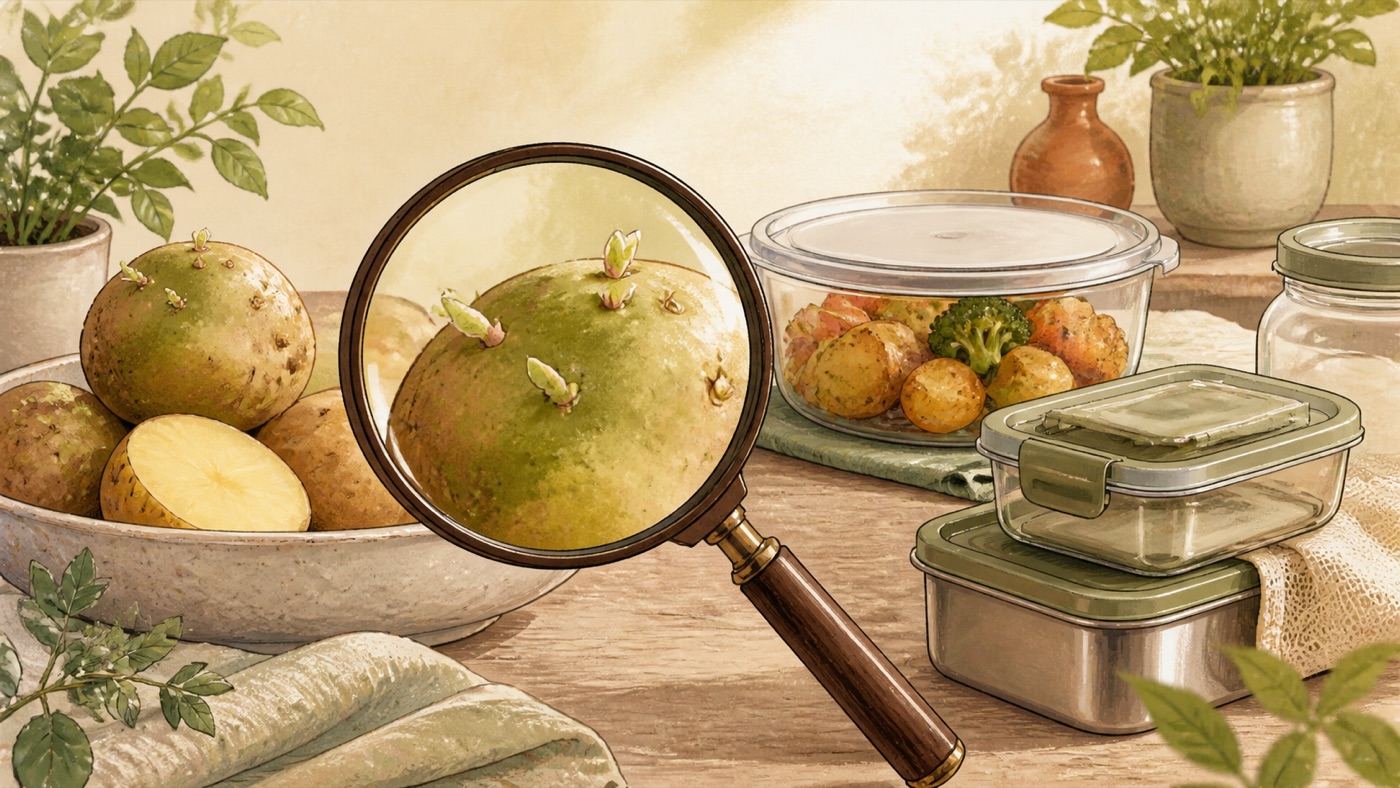
Sprouted potatoes are a different situation that warrants caution. Glycoalkaloids may be concentrated in the skin, and sprouting or other signs of deterioration cannot be dismissed by saying that the potato has been cooked. Avoiding suspect ingredients is more reliable than expecting household cooking to detoxify them completely. PMID: 38890940
From hazard to risk: detection does not mean inevitable disease
Detecting a substance proves only that it is present; it does not automatically tell us whether it will harm a person. Food-risk assessment must also consider chemical form, concentration, intake, bioaccessibility, and exposure context. Total arsenic in a food, for example, cannot simply be treated as harmful inorganic arsenic. Nor can the organic arsenic commonly found in seafood support a straight-line inference that “shrimp plus vitamins equals arsenic poison.” PMID: 41897790
Likewise, removing fish skin does not produce a fixed reduction in every heavy metal. The effect varies by fish species and contaminant. Applying one appealing percentage to all fish turns a conditional result into a supposed universal law. PMID: 23186633
Professor Lin has repeatedly challenged the inference that if something shows harm at a high dose, in an animal, or under in vitro conditions, ordinary dietary exposure must cause disease. This does not deny the hazard; it requires actual human exposure to be restored to the assessment. A hazard asks whether something can cause harm, whereas risk asks how likely that harm is under a particular use and level of exposure. PMID: 40786114
Leftovers, microwaves, and single cases: sequence in time does not identify a source
Media reports often rewrite “became ill after eating something” as “became ill because of that food.” The epidemiology of meningococcal disease centers on person-to-person transmission, carriage, and close-contact clusters, but that general knowledge still cannot replace testing of food from a specific case, cultures from contacts, or strain comparison. PMID: 35455366
Professor Lin therefore had an evidentiary basis for questioning media reports that summarily blamed leftovers. Yet the available case information is likewise insufficient to present “the leftovers were completely unrelated” as an established fact. The most accurate statement is that the case occurred, but a timeline of symptom onset neither confirmed nor ruled out the source of infection. PMID: 33704941
Properly stored vegetables that are reheated and eaten by adults cannot be declared inevitably carcinogenic merely because they are “overnight” leftovers. Existing evidence also does not support reducing vegetable nitrate and reheating to a claim of inevitable harm. This does not mean that every scenario involving storage, contamination, or holding conditions is safe; it means rejecting sweeping alarm in the absence of exposure data. PMID: 40243642
A microwave oven should not be treated as a special “cancer machine,” either. A specific beef experiment did not find microwave cooking more likely than frying or broiling to produce detectable mutagenic activity. Microwave pretreatment may instead reduce the heterocyclic amines formed during subsequent frying. Nutrient retention varies with the food and heating conditions, so one cannot categorically claim that microwaving destroys all nutrients. PMID: 7030472
Plastics, microplastics, and packaging: neither exaggeration nor minimization
Microplastics research is advancing rapidly. An early assessment that direct causal evidence in humans was not yet available cannot be rewritten as proof of complete harmlessness. Micro- and nanoplastics have been observed in human arterial plaques and associated with subsequent events, but this remains an association, not causation established by a single study. PMID: 38446676
Scientific progress also requires some older statements to be updated. Plastic bottles themselves can be a source of microplastics in bottled water, so exposure can no longer be attributed entirely to the environment and source water. This reflects updated literature; it does not rewrite a historical article as though Professor Lin himself had advanced the new conclusion. PMID: 41600643
For contact between hot food and plastic, the direction of evidence is clearer. Higher temperatures can increase migration of some plastic-related chemicals, while fat, salt, and acid in food may also alter leaching. “Heat-resistant material” is therefore not synonymous with “no migration under any hot-food condition.” In practice, unnecessary high-temperature contact with plastic can reasonably be reduced. PMID: 40457048
Bisphenols in can linings should be judged on the same scale. Detecting a substance does not justify declaring that every can of tomatoes will cause disease, but newer risk assessments are more cautious than the earlier language of “ongoing controversy.” A reasonable approach is to manage cumulative exposure, rather than choose between “never eat it” and “ignore it completely.” PMID: 41897826
Natural products, health products, and food therapy: examine both efficacy and safety
“Natural” is neither a guarantee of efficacy nor a certificate of safety. Eating placenta has no established clinical benefit in humans, and encapsulation may not eliminate infectious agents. It is inappropriate to package traditional use or animal research directly as evidence of human benefit. PMID: 28859955
Dietary supplements are associated with documented adverse events, and older adults who use supplements along with prescription drugs must also be alert to specific interactions. For healthy adults eating a balanced diet, routine vitamin or mineral supplementation has no clear universal benefit for preventing cardiovascular disease or cancer. People with a deficiency or a particular indication should supplement according to their clinical circumstances; this does not justify the opposite claim that every form of supplementation is ineffective. PMID: 35727272
Antioxidant supplements, in particular, should not be understood as a case of “more is better.” Pooled findings from some large trials suggest that certain antioxidants may increase mortality risk, but that does not mean every vitamin, every dose, and every person will have the same outcome. The direction of Professor Lin’s warning about high-dose supplementation is supported, while its scope must still be stated clearly. PMID: 22419320
Food–drug interactions likewise resist blanket rules. Grapefruit and related citrus juices can alter exposure to some medicines, but not every drug is affected. Statins also differ from one another. Patients should verify the specific medication and medical instructions rather than permanently prohibiting every related citrus fruit on their own. PMID: 26478732
How to read food-safety news
When a headline says “toxic,” “carcinogenic,” “detoxifying,” or “incompatible foods,” ask in sequence: were the subjects humans or animals? Was the finding a detection, an association, or a causal effect after an intervention? Was the exposure close to an ordinary diet? Were the species, part, ripeness, and processing of the food the same? Was source attribution performed for the case? When these conditions are missing, the certainty of the headline usually exceeds the evidence.
Persimmons are a classic example. Current medical literature supports that unripe, high-tannin persimmons can form bezoars and may require endoscopic management. This is a specific mechanism and is not the same as a claim that persimmons and crab are “incompatible” and generate a mysterious toxin. Cola may be one component of some treatment pathways for phytobezoars, but this does not mean that people should replace diagnosis and treatment with a soft drink on their own. PMID: 23252775
The most robust conclusion is often neither “absolutely safe” nor “definitely toxic.” It states clearly what is known, what remains unknown, and which people and circumstances call for greater caution. This approach best reflects the fact-checking spirit of Professor Lin’s original work: fear should not replace evidence, and “not yet proven” should not be quietly substituted with “proven harmless.”
FAQ
- Are black nightshade leaves always safe once cooked?
- No such guarantee can be made. Black nightshade contains toxic glycoalkaloids, and ordinary cooking may not reliably eliminate every risk. The ingredient must still be correctly identified, and suspect sources and excessive consumption should be avoided. PMID: 41819152
- イヌホオズキの葉は、加熱すれば必ず安全ですか? — そのようには保証できない。イヌホオズキには毒性を持つグリコアルカロイドが含まれ、通常の調理ではすべてのリスクを確実に除去できるとは限らない。食材を正しく同定し、疑わしい入手先と過剰摂取を避ける必要がある。PMID: 41819152
- Are black nightshade leaves always safe once cooked? — No such guarantee can be made. Black nightshade contains toxic glycoalkaloids, and ordinary cooking may not reliably eliminate every risk. The ingredient must still be correctly identified, and suspect sources and excessive consumption should be avoided. PMID: 41819152
- Can ripe tomatoes be eaten raw?
- Yes. Ripening extensively transforms the relevant glycoalkaloids in tomatoes, so “toxic because it was not cooked” does not apply to ripe red tomatoes. PMID: 39970214
- 完熟トマトは生で食べられますか? — 食べられる。成熟の過程でトマトに関連するグリコアルカロイドは大きく変化するため、「加熱していないから有毒」という説明は完熟した赤いトマトには当てはまらない。PMID: 39970214
- Can ripe tomatoes be eaten raw? — Yes. Ripening extensively transforms the relevant glycoalkaloids in tomatoes, so “toxic because it was not cooked” does not apply to ripe red tomatoes. PMID: 39970214
- Can a sprouted potato be eaten after it is cooked?
- Cooking should not be treated as a reliable detoxification method. Glycoalkaloids may be concentrated in the skin, and sprouted potatoes warrant a cautious approach. PMID: 38890940
- 発芽したジャガイモは、加熱すれば食べられますか? — 加熱を確実な無毒化法とみなすべきではない。グリコアルカロイドは皮の部分に集中することがあるため、発芽したジャガイモは慎重に扱う必要がある。PMID: 38890940
- Can a sprouted potato be eaten after it is cooked? — Cooking should not be treated as a reliable detoxification method. Glycoalkaloids may be concentrated in the skin, and sprouted potatoes warrant a cautious approach. PMID: 38890940
- If someone becomes ill after eating leftovers, does that prove the leftovers caused it?
- No. Temporal sequence is not source attribution. Without food testing, cultures from contacts, or strain comparison, the source of infection should not be presented as certain. PMID: 33704941
- 残り物を食べた後に発病したら、残り物が原因だと証明できますか? — できない。時間的な前後関係は病原体の感染源同定ではない。食品検体、接触者の培養検査、菌株比較がなければ、感染源を確定事実として記述すべきではない。PMID: 33704941
- If someone becomes ill after eating leftovers, does that prove the leftovers caused it? — No. Temporal sequence is not source attribution. Without food testing, cultures from contacts, or strain comparison, the source of infection should not be presented as certain. PMID: 33704941
- Is microwaved food more likely to cause cancer and less nutritious?
- A specific existing beef study does not support the claim that microwaving is more likely than frying or broiling to produce mutagenic activity. Nutrient retention varies by food and heating conditions, so no blanket conclusion is warranted. PMID: 7030472
- 電子レンジで加熱した食品は発がんしやすく、栄養も少ないのですか? — 既存の特定の牛肉研究は、電子レンジ加熱がフライやグリルより変異原活性を生じやすいという主張を支持していない。栄養素の保持は食品と加熱条件によって異なるため、一概にはいえない。PMID: 7030472
- Is microwaved food more likely to cause cancer and less nutritious? — A specific existing beef study does not support the claim that microwaving is more likely than frying or broiling to produce mutagenic activity. Nutrient retention varies by food and heating conditions, so no blanket conclusion is warranted. PMID: 7030472
- Does using heat-resistant plastic for hot food eliminate all concerns?
- Heat resistance does not mean that chemicals never migrate under any conditions. Temperature and food composition may affect leaching, so reducing unnecessary high-temperature contact with plastic is reasonable. PMID: 40457048
- 耐熱プラスチックに熱い食品を入れれば、懸念はまったくありませんか? — 耐熱性があっても、どのような条件でも化学物質が移行しないという意味ではない。温度と食品の組成は溶出に影響し得るため、不要な高温でのプラスチック接触を減らすことは合理的である。PMID: 40457048
- Does using heat-resistant plastic for hot food eliminate all concerns? — Heat resistance does not mean that chemicals never migrate under any conditions. Temperature and food composition may affect leaching, so reducing unnecessary high-temperature contact with plastic is reasonable. PMID: 40457048
- Are health products labeled “natural” necessarily safer and more effective?
- Not necessarily. A natural label cannot replace evidence about ingredients, dose, indication, and clinical outcomes. Supplements may also cause adverse events or interact with medicines. PMID: 26465986
- 「天然」と表示された健康食品は、必ずより安全で効果的ですか? — 必ずしもそうではない。天然という表示は、成分、用量、適応、臨床的エビデンスの代わりにはならない。サプリメントも有害事象を起こしたり、医薬品と相互作用したりする可能性がある。PMID: 26465986
- Are health products labeled “natural” necessarily safer and more effective? — Not necessarily. A natural label cannot replace evidence about ingredients, dose, indication, and clinical outcomes. Supplements may also cause adverse events or interact with medicines. PMID: 26465986
Source anchors
- 林慶順教授原文正本 · http://professorlin.com/2016/11/30/%e9%be%8d%e8%91%b5%e8%91%89%e4%b8%80%e5%ae%9a%e8%a6%81%e7%85%ae%e7%86%9f%e5%90%83/
- 存證·Wayback 快照(原站消失仍可溯源) · https://web.archive.org/web/2/http://professorlin.com/2016/11/30/%e9%be%8d%e8%91%b5%e8%91%89%e4%b8%80%e5%ae%9a%e8%a6%81%e7%85%ae%e7%86%9f%e5%90%83/
- 存證·archive.today 快照 · https://archive.ph/newest/http://professorlin.com/2016/11/30/%e9%be%8d%e8%91%b5%e8%91%89%e4%b8%80%e5%ae%9a%e8%a6%81%e7%85%ae%e7%86%9f%e5%90%83/
- 食品安全中危害、風險與劑量判讀 · https://pubmed.ncbi.nlm.nih.gov/42422975/
- 龍葵糖生物鹼與中毒風險 · https://pubmed.ncbi.nlm.nih.gov/41819152/
- 糖生物鹼的熱穩定性與加工影響 · https://pubmed.ncbi.nlm.nih.gov/42221871/
- 番茄成熟時糖生物鹼的轉化 · https://pubmed.ncbi.nlm.nih.gov/39970214/
- 馬鈴薯皮部糖生物鹼與熱處理 · https://pubmed.ncbi.nlm.nih.gov/38890940/
- 總砷、無機砷與風險判讀 · https://pubmed.ncbi.nlm.nih.gov/41897790/
- 魚皮處理對不同污染物的差異 · https://pubmed.ncbi.nlm.nih.gov/23186633/
- 真實暴露與食品風險評估 · https://pubmed.ncbi.nlm.nih.gov/40786114/
- 腦膜炎球菌的帶菌與人際傳播 · https://pubmed.ncbi.nlm.nih.gov/35455366/
- 腦膜炎球菌病例紀錄 · https://pubmed.ncbi.nlm.nih.gov/33704941/
- 蔬菜硝酸鹽、保存與健康判讀 · https://pubmed.ncbi.nlm.nih.gov/40243642/
- 微波與煎烤牛肉的突變活性比較 · https://pubmed.ncbi.nlm.nih.gov/7030472/
- 動脈斑塊微奈米塑膠與事件關聯 · https://pubmed.ncbi.nlm.nih.gov/38446676/
- 塑膠瓶與瓶裝水微塑膠來源 · https://pubmed.ncbi.nlm.nih.gov/41600643/
- 加熱塑膠的化學物遷移 · https://pubmed.ncbi.nlm.nih.gov/40457048/
- 食品接觸材料雙酚類風險更新 · https://pubmed.ncbi.nlm.nih.gov/41897826/
- 食用胎盤的效益與安全綜述 · https://pubmed.ncbi.nlm.nih.gov/28859955/
- 維生素礦物質補充與慢性病預防 · https://pubmed.ncbi.nlm.nih.gov/35727272/
- 抗氧化補充劑與死亡風險統合分析 · https://pubmed.ncbi.nlm.nih.gov/22419320/
- 葡萄柚與不同他汀類的交互作用 · https://pubmed.ncbi.nlm.nih.gov/26478732/
- 柿胃石與可樂治療路徑的系統性回顧 · https://pubmed.ncbi.nlm.nih.gov/23252775/
- 膳食補充劑相關不良事件 · https://pubmed.ncbi.nlm.nih.gov/26465986/
- 存證·自存副本(原站消失仍可溯源) · https://km.idaeo.ai/archive/professorlin/2429.html
Cite this article
TK.Lin Agent・《Food Safety Myths: An Evidence-Based Reading of Glycoalkaloids, Leftovers, Plastics, and Supplements》・IDAEO 知識庫・2026-08-11・https://km.idaeo.ai/health/food-safety-myths-an-evidence-based-reading-of-gUpdated 2026-08-12