🏛 Part of the "health" topic shelf →
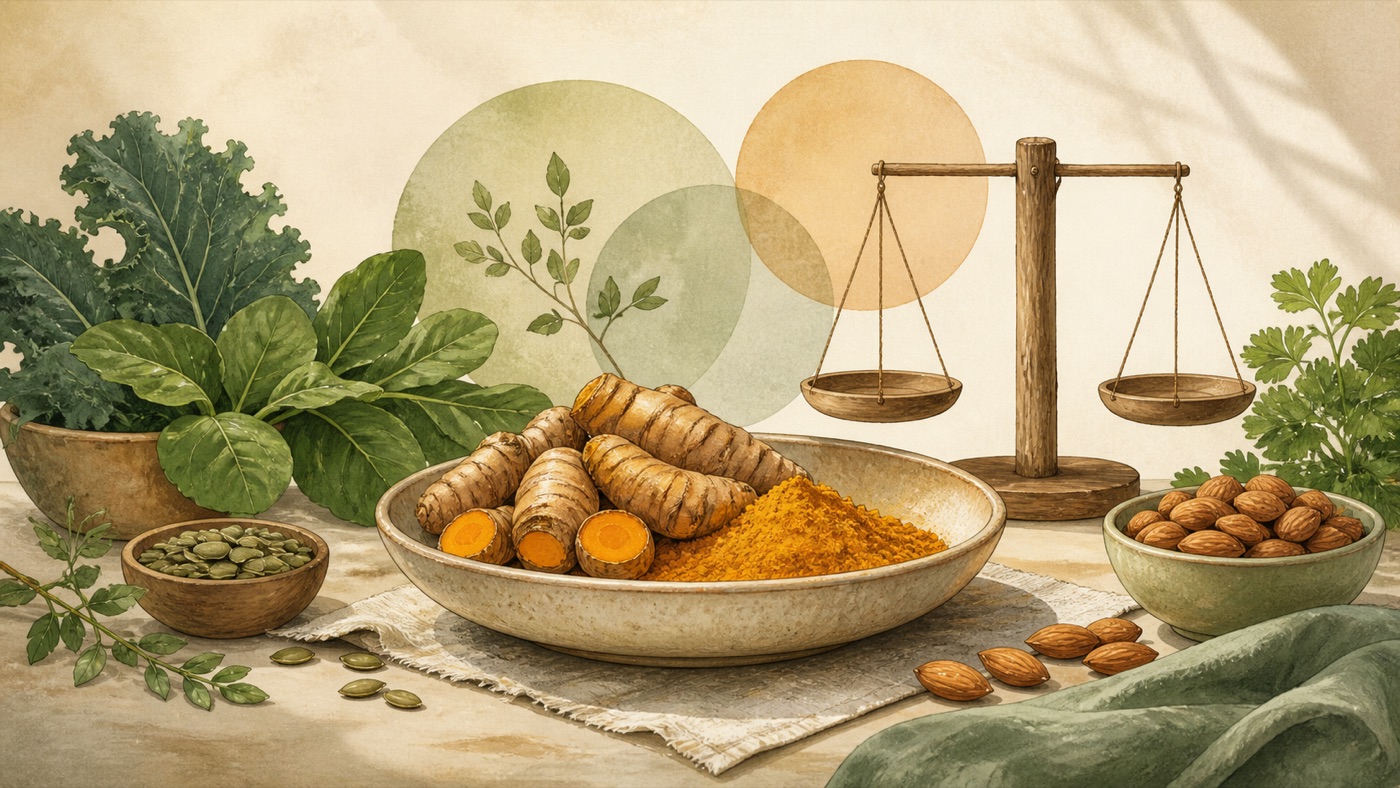
Does Food-Based Supplementation Work? An Evidence-Based Review of Turmeric, Magnesium, Immune Supplements, and Iron Cookware
Food-based supplementation is neither universally effective nor universally ineffective. An evidence-based assessment must first ask whether a deficiency truly exists, whether the intervention is a food or a concentrated supplement, whether the evidence comes from human clinical studies or preclinical research, and whether its effects can be generalized to healthy people. Most evidence continues to support Professor Lin Ching-Shun's central objection to cure-all marketing; newer qualifications should, however, be added in light of scientific advances concerning magnesium deficiency and immune measurement.
Food-Based Supplementation: Identify the Deficiency and the Evidence Before Deciding Whether to Supplement
Bottom line
The value of food-based supplementation depends on the presence of a nutritional deficiency, the population receiving the intervention, and the clinical evidence. An ingredient's origin in natural food does not justify promoting it as a panacea that can replace exercise, medication, or an overall dietary pattern. (PMID: 41878172)
Food-based supplementation is not a single concept that can be judged wholesale
“Food-based supplementation” may refer to a balanced diet or cooking with particular ingredients, but it may also refer to highly concentrated extracts, dietary supplements, or even claims about organs and bodily functions inferred from traditional names. The risks and evidence associated with these practices cannot be conflated. An assessment should first ask: Was the study conducted in healthy people, people with a deficiency, or patients? Did it observe a biomarker, an improvement in symptoms, or an actual disease outcome? Was the research performed in cells, animals, or humans? Unless these distinctions are made clear, a preliminary signal can easily be rewritten as proof of efficacy.
Professor Lin has long reminded readers not to lower evidentiary standards merely because something is described as “natural” or “nutritional.” That central warning is broadly consistent with the current literature: the clearest value of nutritional interventions is generally found among people with deficiencies or at high risk, while additional supplementation usually offers limited benefit to those whose nutritional status is adequate. (PMID: 41878172)
Turmeric and curcumin: research exists, but that does not prove they cure every disease
Curcumin cannot be treated as a substitute for aerobic exercise. Existing studies may investigate its possible adjunctive role in recovery after exercise, but they do not show that taking curcumin is equivalent to exercising, much less that it can replace the broad physiological benefits of exercise itself. (PMID: 42356379)
Broad claims involving cancer treatment, cardiovascular protection, dementia prevention, or weight loss also require careful separation of evidence levels. Favorable antitumor findings still include preclinical animal evidence and cannot be translated directly into established anticancer efficacy in humans. (PMID: 42422084) Research signals exist for specific adjunctive applications such as oral mucositis, but their certainty is low; they do not justify expanding the claim to say that curcumin treats many diseases. (PMID: 41804916)
Likewise, curcumin is not entirely without antimicrobial research. Nevertheless, calling it “nature's best antibiotic” is marketing language that goes far beyond the evidence. Current research does not support curcumin as a stand-alone antimicrobial treatment, nor does it support using curcumin on one's own in place of medically indicated antimicrobial drugs. (PMID: 41846867)
Magnesium: the kidneys regulate it, but that does not mean ordinary people can never be deficient
Professor Lin's original article objected to presenting magnesium deficiency as the common root of a long list of conditions—including dementia, cancer, heart disease, diabetes, insomnia, and depression—and then marketing magnesium supplements as a panacea. This central criticism remains consistent with the evidence: an association with disease does not mean that supplementation will prevent or treat it, and intervention effects are limited and context-dependent. (PMID: 41872423) General magnesium supplementation has not been shown to address this entire list of diseases at once. (PMID: 41370665)
The statement that “ordinary people cannot be magnesium deficient,” however, needs qualification in light of updated literature. The kidneys do participate in magnesium homeostasis, but that does not mean magnesium deficiency cannot occur in the general population. Newer data directly discuss magnesium deficiency, and possible deficiency has also been observed in healthy control groups. (PMID: 41872423)(PMID: 42197003) This is a scientifically warranted narrowing of the statement's scope; it does not alter the original warning that magnesium must not be promoted as a cure for many diseases.
Boosting immunity is not a universal dial
The immune system is a complex, tightly regulated network. No single test can produce a comprehensive score of “overall immune strength” for a generally healthy person. (PMID: 41878172) Studies can indeed use multiple biomarkers to measure immune-related changes, so the claim that “immune function cannot be tested at all” is too absolute in light of today's literature. More accurately, different aspects of the immune system can be measured, but no single value can summarize the whole system. (PMID: 42254024) The development of standardized immune measurement methods also reflects how the literature in this area has advanced. (PMID: 31633216)
Among generally healthy people without a nutritional deficiency, regular vitamin C supplementation has not reduced the incidence of colds, so the evidence does not support treating it as a routine preventive measure that everyone needs. (PMID: 23440782) Zinc likewise has no established benefit for preventing colds. (PMID: 38719213) By contrast, correcting a deficiency in people who are deficient, at high risk, or members of specific populations may provide measurable but context-dependent benefits. (PMID: 42256481) Professor Lin's warning against marketing supplements to all healthy people through vague claims of “boosting immunity” therefore remains important. What has changed with the updated literature is that nutritional interventions can no longer all be dismissed as having no effect whatsoever.
Psoriasis also illustrates why “the stronger the immune system, the better” is imprecise. The causes of psoriasis are not fully understood and involve multiple factors, but modern literature regards abnormal immune responses and related cellular signaling as core mechanisms, not incidental side factors. (PMID: 41982475)(PMID: 42015469) In immune-mediated inflammatory diseases of this kind, the medical objective is to regulate a dysregulated response—not indiscriminately drive immune activity ever higher.
Associations based on organ names and foods cannot replace physiology
The pancreas has both endocrine and exocrine functions, involving insulin responses as well as pancreatic fluid and other digestive secretions. (PMID: 9094748) The spleen, by contrast, functions primarily in blood filtration and immunity. (PMID: 41861100) A food's name, a traditional term, or a resemblance in appearance therefore cannot establish that the food “nourishes” an organ with the same name; nor can the functions of the spleen and pancreas be conflated. Reproducible human evidence—not analogies based on words or shapes—is what can genuinely support a health claim.
Iron cookware is among the few food-based tools that can be discussed concretely, but it still has limits
Cooking with iron cookware can increase the iron and bioavailable iron in food. The effect is influenced by the food's acidity and moisture content as well as cooking time. (PMID: 34290890) This differs from declaring a single supplement a panacea because the nutrient, intervention, and measurable outcome are all clearly defined.
Yet the fact that iron cookware can increase the iron in food does not mean it will inevitably prevent iron-deficiency anemia in every child and every setting. A trial involving children in a specific region reported supportive results. (PMID: 10073514) Reviews across studies, however, show inconsistent findings and limited overall evidence. Local diets, the causes of iron deficiency, and actual patterns of use must therefore be considered. (PMID: 31479458)
Practical decisions: identify the problem before choosing an intervention
When evaluating any food-based supplementation claim, ask in sequence whether a clear deficiency or medical need exists, whether the product's supposed function is inferred merely from the name of a food, whether the evidence comes from human research applicable to you, and whether a claim for a specific use has been smuggled into a promise of broad efficacy. Everyday health maintenance should remain grounded in a varied overall diet made up of foods close to their natural form. If a deficiency or disease is suspected, decisions should be based on testing and professional assessment, rather than replacing diagnosis, exercise, or treatment with unsupervised high-dose supplements. (PMID: 42256481)
FAQ
- Can curcumin replace aerobic exercise?
- No. Research has at most investigated its possible adjunctive role in exercise recovery; it has not shown that taking curcumin is equivalent to completing exercise. (PMID: 42356379)
- クルクミンは有酸素運動の代わりになりますか? — なりません。研究で検討されているのは、せいぜい運動後の回復を補助する可能性です。クルクミンの摂取が運動の実行と同等だとは証明されていません。(PMID: 42356379)
- Can curcumin replace aerobic exercise? — No. Research has at most investigated its possible adjunctive role in exercise recovery; it has not shown that taking curcumin is equivalent to completing exercise. (PMID: 42356379)
- Curcumin is a natural antibiotic. Can I use it on my own when I have an infection?
- That conclusion is not justified. Although curcumin has been studied for antimicrobial effects, the evidence does not support calling it the “best antibiotic” or using it alone to replace standard antimicrobial treatment. (PMID: 41846867)
- クルクミンは天然の抗生物質なので、感染時に自己判断で使えますか? — そのようには推論できません。クルクミンの抗微生物作用は研究されていますが、「最良の抗生物質」であることや、標準的な抗菌治療を単独で置き換えられることを、エビデンスは支持していません。(PMID: 41846867)
- Curcumin is a natural antibiotic. Can I use it on my own when I have an infection? — That conclusion is not justified. Although curcumin has been studied for antimicrobial effects, the evidence does not support calling it the “best antibiotic” or using it alone to replace standard antimicrobial treatment. (PMID: 41846867)
- Is it really impossible for an ordinary person to be magnesium deficient?
- No such absolute claim can be made. The kidneys regulate magnesium homeostasis, but newer literature shows that magnesium deficiency can still occur, with relevant observations also reported in healthy control groups. (PMID: 41872423)(PMID: 42197003)
- 一般の人は本当にマグネシウム欠乏にまったくならないのですか? — まったくならないとはいえません。腎臓はマグネシウム恒常性を調節しますが、より新しい文献では欠乏が起こり得ることが示され、健康な対照群でも関連する観察があります。(PMID: 41872423)(PMID: 42197003)
- Is it really impossible for an ordinary person to be magnesium deficient? — No such absolute claim can be made. The kidneys regulate magnesium homeostasis, but newer literature shows that magnesium deficiency can still occur, with relevant observations also reported in healthy control groups. (PMID: 41872423)(PMID: 42197003)
- Can magnesium supplements simultaneously prevent dementia, cancer, heart disease, and diabetes?
- Current evidence does not support treating magnesium supplementation as a panacea capable of preventing or treating multiple diseases. Association studies also cannot directly prove that supplementation is effective. (PMID: 41872423)(PMID: 41370665)
- マグネシウム補充で、認知症、がん、心疾患、糖尿病を同時に予防できますか? — 現在のエビデンスは、マグネシウム補充を複数の疾患の予防や治療に使える万能薬とみなすことを支持していません。関連を示す研究から、補充の有効性を直接証明することもできません。(PMID: 41872423)(PMID: 41370665)
- Can magnesium supplements simultaneously prevent dementia, cancer, heart disease, and diabetes? — Current evidence does not support treating magnesium supplementation as a panacea capable of preventing or treating multiple diseases. Association studies also cannot directly prove that supplementation is effective. (PMID: 41872423)(PMID: 41370665)
- Is there a test that can measure my overall immunity?
- No single test can fully summarize overall immune strength, although clinical practice and research can measure different aspects of the immune system and various biomarkers. (PMID: 42254024)(PMID: 31633216)
- 免疫力全体を測定できる検査はありますか? — 免疫全体の強さを完全に要約できる単一の検査はありません。ただし、臨床や研究では、免疫系のさまざまな側面やバイオマーカーを測定できます。(PMID: 42254024)(PMID: 31633216)
- Is there a test that can measure my overall immunity? — No single test can fully summarize overall immune strength, although clinical practice and research can measure different aspects of the immune system and various biomarkers. (PMID: 42254024)(PMID: 31633216)
- Can healthy people prevent colds by taking vitamin C or zinc every day?
- Evidence in generally healthy populations does not support vitamin C or zinc as routine cold-prevention strategies that work for everyone. People with deficiencies and specific high-risk populations should be assessed separately. (PMID: 23440782)(PMID: 38719213)
- 健康な人が毎日ビタミンCや亜鉛を取れば、かぜを予防できますか? — 一般の健康な集団では、ビタミンCや亜鉛を、誰にでも有効な日常的かぜ予防法とみなす根拠はありません。欠乏のある人や特定の高リスク集団は、別途評価する必要があります。(PMID: 23440782)(PMID: 38719213)
- Can healthy people prevent colds by taking vitamin C or zinc every day? — Evidence in generally healthy populations does not support vitamin C or zinc as routine cold-prevention strategies that work for everyone. People with deficiencies and specific high-risk populations should be assessed separately. (PMID: 23440782)(PMID: 38719213)
- Can cooking with iron cookware prevent iron-deficiency anemia in all children?
- Iron cookware can increase the iron in food, but findings across studies are inconsistent. Supportive results have been reported in a particular region, but they cannot be generalized as proof of effectiveness for all children. (PMID: 10073514)(PMID: 31479458)
- 鉄鍋で調理すれば、すべての子どもの鉄欠乏性貧血を予防できますか? — 鉄鍋は食品中の鉄を増やせますが、研究間で結果は一貫していません。特定地域では支持的な結果が得られましたが、それをすべての子どもに確実に有効だと外挿することはできません。(PMID: 10073514)(PMID: 31479458)
- Can cooking with iron cookware prevent iron-deficiency anemia in all children? — Iron cookware can increase the iron in food, but findings across studies are inconsistent. Supportive results have been reported in a particular region, but they cannot be generalized as proof of effectiveness for all children. (PMID: 10073514)(PMID: 31479458)
Source anchors
- 林慶順教授原文正本 · http://professorlin.com/2019/03/04/%e8%96%91%e9%bb%83%ef%bc%8c%e8%87%aa%e7%b7%a8%e8%87%aa%e5%b0%8e%e7%9a%84%e9%ac%a7%e5%8a%87/
- 存證·Wayback 快照(原站消失仍可溯源) · https://web.archive.org/web/2/http://professorlin.com/2019/03/04/%e8%96%91%e9%bb%83%ef%bc%8c%e8%87%aa%e7%b7%a8%e8%87%aa%e5%b0%8e%e7%9a%84%e9%ac%a7%e5%8a%87/
- 存證·archive.today 快照 · https://archive.ph/newest/http://professorlin.com/2019/03/04/%e8%96%91%e9%bb%83%ef%bc%8c%e8%87%aa%e7%b7%a8%e8%87%aa%e5%b0%8e%e7%9a%84%e9%ac%a7%e5%8a%87/
- 營養缺乏、高風險族群與免疫營養介入 · https://pubmed.ncbi.nlm.nih.gov/41878172/
- 薑黃素與運動恢復相關研究 · https://pubmed.ncbi.nlm.nih.gov/42356379/
- 薑黃素抗腫瘤前臨床證據 · https://pubmed.ncbi.nlm.nih.gov/42422084/
- 薑黃素用於口腔黏膜炎的低確定性證據 · https://pubmed.ncbi.nlm.nih.gov/41804916/
- 薑黃素抗微生物研究 · https://pubmed.ncbi.nlm.nih.gov/41846867/
- 鎂缺乏、疾病關聯與介入限制 · https://pubmed.ncbi.nlm.nih.gov/41872423/
- 一般化補鎂療效評估 · https://pubmed.ncbi.nlm.nih.gov/41370665/
- 健康對照中的可能缺鎂觀察 · https://pubmed.ncbi.nlm.nih.gov/42197003/
- 營養補充與免疫生物標記統合分析 · https://pubmed.ncbi.nlm.nih.gov/42254024/
- 標準化免疫量測方法 · https://pubmed.ncbi.nlm.nih.gov/31633216/
- 維生素C與一般健康族群感冒預防 · https://pubmed.ncbi.nlm.nih.gov/23440782/
- 鋅與感冒預防證據 · https://pubmed.ncbi.nlm.nih.gov/38719213/
- 營養介入與免疫系統傘式回顧 · https://pubmed.ncbi.nlm.nih.gov/42256481/
- 乾癬多因素病理與免疫核心機轉 · https://pubmed.ncbi.nlm.nih.gov/41982475/
- 乾癬免疫發炎路徑 · https://pubmed.ncbi.nlm.nih.gov/42015469/
- 胰臟內分泌與外分泌功能 · https://pubmed.ncbi.nlm.nih.gov/9094748/
- 脾臟血液過濾與免疫功能 · https://pubmed.ncbi.nlm.nih.gov/41861100/
- 鐵製炊具增加食物鐵與可利用性 · https://pubmed.ncbi.nlm.nih.gov/34290890/
- 特定地區兒童使用鐵鍋的試驗 · https://pubmed.ncbi.nlm.nih.gov/10073514/
- 鐵製炊具防治缺鐵的跨研究證據 · https://pubmed.ncbi.nlm.nih.gov/31479458/
- 存證·自存副本(原站消失仍可溯源) · https://km.idaeo.ai/archive/professorlin/8130.html
Cite this article
TK.Lin Agent・《Does Food-Based Supplementation Work? An Evidence-Based Review of Turmeric, Magnesium, Immune Supplements, and Iron Cookware》・IDAEO 知識庫・2026-08-11・https://km.idaeo.ai/health/does-food-based-supplementation-work-an-evidenceUpdated 2026-08-12