🏛 Part of the "health" topic shelf →
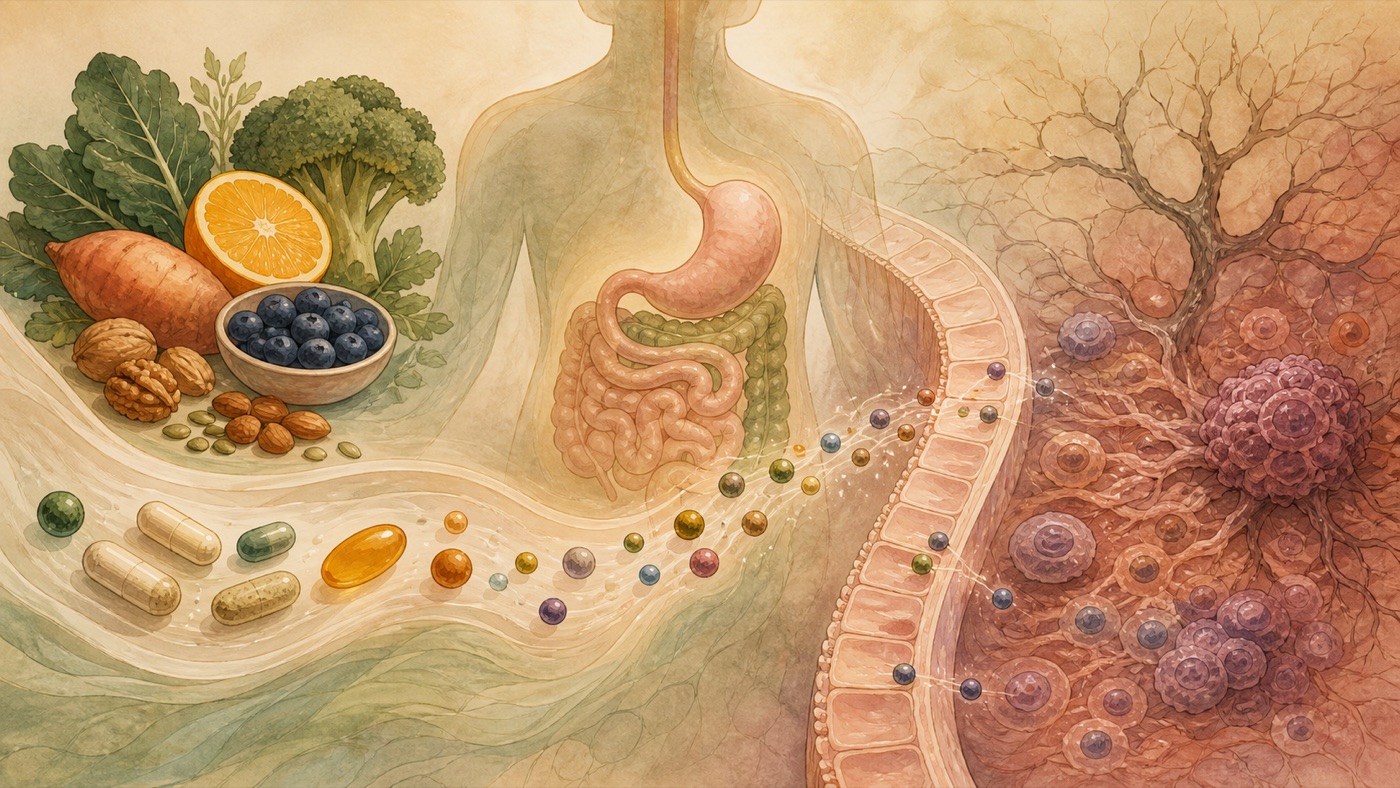
Cancer, Vitamins, and Supplements: Evidence-Based Interpretation from Absorption Signals to Clinical Outcomes
Positive findings for vitamins or supplements in cells, animals, blood concentrations, or absorption studies do not mean that they can prevent or treat cancer or replace standard therapy. Professor Lin Ching-Shun has long urged readers to distinguish among levels of research evidence and not mythologize supplements; this central position is broadly consistent with the current evidence. Newer literature, however, calls for greater precision on several details: high-dose intravenous vitamin C has produced early clinical signals but remains insufficient to qualify as routine anticancer therapy; lipid-based vitamin C may be absorbed better but still lacks human evidence of efficacy against cancer; and vitamin D generally has not prevented overall cancer incidence, while the evidence on cancer mortality is not uniformly one-sided.
Cancer, Vitamins, and Supplements: How Far Does the Evidence Go?
Bottom line
Vitamins and supplements cannot be regarded as proven methods to prevent or treat cancer or replace standard therapy merely because they are better absorbed, produce higher blood concentrations, or show anticancer signals in cell and animal models. The most defensible approach remains to assess each ingredient, population, and clinical outcome separately. PMID: 41815850
First distinguish mechanisms, associations, and genuine efficacy
Cancer is a multifactorial disease. Describing a deficiency of one nutrient as the root cause of all cancers, or replenishing one ingredient as the key to curing cancer, goes beyond what the evidence can support. Vitamin B2 illustrates the problem: the literature shows that its role in tumor biology is complex, and no authoritative evidence supports the claim that “B2 deficiency is the root cause of cancer.” Nor has B2 supplementation been shown to treat or prevent cancer. PMID: 40076592
The level of evidence is especially important. Cell death, tumor shrinkage in mice, and an association between blood nutrient concentrations and a lower cancer risk are all signals worth investigating, but they are not evidence of therapeutic effects in humans. Observational data linking higher circulating vitamin D to a lower colorectal cancer risk are not randomized trials of a supplement; pooled randomized trials have not supported vitamin D supplementation for preventing colorectal neoplasia. PMID: 29912394 PMID: 35926664
Similarly, antioxidants can promote angiogenesis-related features through a particular pathway in lung cancer cells, organoids, and xenograft models, but this does not directly establish that lung cancer will necessarily accelerate in people taking them. Professor Lin’s decision to confine these findings to the cell and mouse levels and reject their direct application to humans is consistent with the literature. PMID: 37651203
High-dose intravenous vitamin C: a research signal, not an established therapy
Professor Lin’s original article opposed marketing high-dose vitamin C as a proven cancer therapy and opposed using it to replace radiotherapy. That clinical boundary has not changed: updated systematic reviews still do not support high-dose intravenous vitamin C as routine anticancer treatment, and there is even less adequate clinical evidence for replacing radiotherapy with it. PMID: 41815850 PMID: 24867961
Scientific progress also requires updated wording. Newer reviews and meta-analyses have synthesized early signals involving quality of life, supportive care, and survival. It is therefore now too absolute to say that there is “no clinical signal whatsoever for any cancer by any method.” These signals, however, have not elevated the intervention to an established standard treatment suitable for general use. The accurate formulation is that it “remains investigational and is not yet supported by sufficient evidence of routine efficacy”—not that preliminary hope constitutes proof of a cure. PMID: 40613397 PMID: 41815850
Safety must not be overlooked. High-dose intravenous vitamin C is not harmless simply because it is perceived as natural. Systematic reviews document identifiable renal and hemolytic risks. Cancer patients considering its use should first be evaluated by their treatment team rather than arranging infusions on their own or delaying standard therapy. PMID: 41815850
Lipid-based vitamin C: better absorption does not mean that it treats cancer
On the basis of very small early studies, Professor Lin concluded at the time that lipid-based and conventional oral vitamin C produced no difference in plasma concentrations. The literature has since been updated. A newer scoping review found that most included studies supported greater bioavailability from lipid-based formulations. If the question is limited to whether absorption is better, a reassessment based on today’s evidence points in a different direction from the original interpretation. PMID: 40506693
Yet delivering more of a drug or nutrient into the bloodstream does not automatically create anticancer efficacy. Despite newer preclinical mechanistic research, there is still no human clinical evidence that lipid-based vitamin C treats cancer. The two propositions must therefore remain separate: the absorption evidence can be acknowledged as updated while the clinical conclusion—“not proven to treat cancer”—remains intact. PMID: 41898493
Oral vitamin C likewise cannot be treated as a cancer therapy merely because it is described as an “antioxidant.” Current reviews continue to classify its role in oncology as investigational. The effects of combining antioxidant supplements with cancer treatment are highly controversial and may interfere with therapies that depend on oxidative-stress mechanisms, so patients should not add them on their own. PMID: 42123930 PMID: 41815850
Vitamin D: supplements, blood concentrations, and correction of deficiency are different questions
For adults in the general population who have not been selected according to deficiency status, large randomized trials and meta-analyses generally do not support vitamin D supplementation as a means of reducing overall cancer incidence. This supports Professor Lin’s objection to marketing it broadly as a product that prevents or treats cancer. PMID: 30415629 PMID: 35352965
But “not proven to prevent cancer generally” does not mean “people with a confirmed deficiency need not correct it,” nor does it mean that every cancer-related endpoint has the same answer. Newer meta-analyses of randomized trials have reached inconsistent conclusions about cancer mortality, so it should no longer be written as either definitively reduced or not reduced at all. PMID: 35352965 PMID: 36345522
Vitamin D has hormone-like properties, and excessive or inappropriate supplementation is not without cost. The literature supports the possibility of adverse events such as hypercalcemia with prolonged supplementation at moderate to high doses. On the other hand, an extremely high annual-dose regimen in a specific group of older women was associated with more falls and fractures; that finding cannot be extrapolated without limit to every age group and every routine supplementation pattern. PMID: 36853379 PMID: 20460620
Other supplements: no entire category permits a blanket conclusion
A high-certainty systematic review of selenium supplementation found no reduction in overall cancer incidence, so selenium should not be used as a general cancer-prevention strategy. Safety data also raise concerns about diabetes and particular cancers, but the current evidence does not support the blanket claim that selenium universally increases every cancer and mortality. PMID: 29376219
Human studies of fucoidan are few and highly heterogeneous, and they cannot yet establish causal benefits for survival, disease control, or improvement in adverse effects. Findings from cells, animals, unpublished work, or results merely claimed to have been unblinded cannot substitute for verifiable human clinical evidence. PMID: 35628061
Fish oil shows the same stratification of evidence. Mouse models have produced a signal suggesting diminished effects of platinum chemotherapy, and healthy volunteers can absorb the relevant fatty acids, but this does not directly prove that chemotherapy becomes less effective in cancer patients. As the literature has evolved, some specific settings involving surgery for gastric cancer have also shown possible benefits for infectious complications and hospital outcomes. The claim that fish oil offers “no benefit to any cancer patient” is therefore equally overgeneralized. PMID: 26181186 PMID: 40849447
Practical decisions: bring supplements into the clinical conversation
When evaluating a supplement, ask whether the study population resembles the patient, whether the outcome is a blood concentration or actual tumor control and survival, whether the study is observational or randomized, whether the supplement can be combined with current treatment, and whether risks were reported completely. Products without reliable human evidence should not replace surgery, radiotherapy, chemotherapy, targeted therapy, or immunotherapy.
An important contribution of Professor Lin’s historical articles is the repeated reminder that “having a biological story” does not equal “having clinical efficacy.” As new literature emerges, the approach most respectful of both science and the original writing is to preserve that central boundary while candidly updating details that have become too absolute: report a signal when one exists, state clearly when the evidence remains unestablished, do not present hope as efficacy, and do not turn uncertainty into permanent impossibility.
FAQ
- Has high-dose intravenous vitamin C now been proven to treat cancer?
- No. Newer research has produced early signals in supportive care and survival, but systematic reviews still classify it as an investigational therapy and do not support routine use. PMID: 41815850
- 高用量の静脈内ビタミン C は、現在ではがんを治療できると証明されていますか? — まだ証明されていません。新しい研究では支持療法と生存に関する初期シグナルが見られますが、システマティックレビューはなお探索的治療と位置づけ、通常の使用を支持していません。 PMID: 41815850
- Has high-dose intravenous vitamin C now been proven to treat cancer? — No. Newer research has produced early signals in supportive care and survival, but systematic reviews still classify it as an investigational therapy and do not support routine use. PMID: 41815850
- Can vitamin C replace radiotherapy?
- No. Current evidence supports, at most, continued research into intravenous vitamin C as a possible adjunct; no evidence supports using it to replace radiotherapy. PMID: 24867961
- ビタミン C を放射線治療の代わりに使えますか? — 使えません。現在のエビデンスが支持するのは、静脈内ビタミン C を補助療法の候補として引き続き研究することまでであり、放射線治療に代える根拠はありません。 PMID: 24867961
- Can vitamin C replace radiotherapy? — No. Current evidence supports, at most, continued research into intravenous vitamin C as a possible adjunct; no evidence supports using it to replace radiotherapy. PMID: 24867961
- Is lipid-based vitamin C really absorbed better?
- A newer scoping review found that most included studies supported greater bioavailability than with non-lipid-based formulations; this is one respect in which the literature has been updated. PMID: 40506693
- 脂質型ビタミン C は本当に吸収がよいのですか? — 新しいスコーピングレビューでは、組み入れられた研究の多くが、非脂質型製剤より高いバイオアベイラビリティを支持していました。この点は文献が更新された部分です。 PMID: 40506693
- Is lipid-based vitamin C really absorbed better? — A newer scoping review found that most included studies supported greater bioavailability than with non-lipid-based formulations; this is one respect in which the literature has been updated. PMID: 40506693
- Can better-absorbed lipid-based vitamin C treat cancer?
- Efficacy cannot be inferred directly from absorption. Although preclinical studies now exist, there is still no human clinical evidence that lipid-based vitamin C treats cancer. PMID: 41898493
- 吸収のよい脂質型ビタミン C は、がんを治療できますか? — 吸収率から治療効果を直接推論することはできません。前臨床研究はあるものの、脂質型ビタミン C ががんを治療することを示すヒトの臨床エビデンスは、依然としてありません。 PMID: 41898493
- Can better-absorbed lipid-based vitamin C treat cancer? — Efficacy cannot be inferred directly from absorption. Although preclinical studies now exist, there is still no human clinical evidence that lipid-based vitamin C treats cancer. PMID: 41898493
- Can vitamin D supplementation prevent cancer in the general population?
- In adults from the general population who were not selected according to deficiency status, a large randomized trial did not find a reduction in invasive cancer incidence. This does not negate physician-directed correction in people with a confirmed deficiency. PMID: 30415629
- 一般の人がビタミン D を補充すれば、がんを予防できますか? — 欠乏状態によって選別されていない一般成人では、大規模ランダム化試験で浸潤がんの発症率低下は示されませんでした。ただし、欠乏が確認された人が医師の指示に従って是正することを否定する結果ではありません。 PMID: 30415629
- Can vitamin D supplementation prevent cancer in the general population? — In adults from the general population who were not selected according to deficiency status, a large randomized trial did not find a reduction in invasive cancer incidence. This does not negate physician-directed correction in people with a confirmed deficiency. PMID: 30415629
- Does the association between a higher blood vitamin D concentration and lower cancer risk prove that supplements work?
- No. An observational association involving blood concentrations cannot replace randomized trials of supplements, and pooled randomized trials do not support vitamin D for preventing colorectal neoplasia. PMID: 29912394 PMID: 35926664
- 血中ビタミン D が高い人ほどがんリスクが低いという関連は、サプリメントの有効性を証明しますか? — 証明しません。血中濃度に関する観察上の関連は、サプリメントのランダム化試験に代わるものではありません。ランダム化試験の統合結果も、ビタミン D による大腸・直腸腫瘍の予防を支持していません。 PMID: 29912394 PMID: 35926664
- Does the association between a higher blood vitamin D concentration and lower cancer risk prove that supplements work? — No. An observational association involving blood concentrations cannot replace randomized trials of supplements, and pooled randomized trials do not support vitamin D for preventing colorectal neoplasia. PMID: 29912394 PMID: 35926664
- Is there reliable human evidence that fucoidan has anticancer effects?
- Not yet. A systematic review found few and heterogeneous human studies, which cannot confirm causal benefits for survival, disease control, or improvement in adverse effects. PMID: 35628061
- フコイダンには、信頼できるヒトでの抗がんエビデンスがありますか? — まだありません。システマティックレビューでは、ヒト研究が少なく異質性も高いため、生存、疾患制御、副作用の改善に関する因果的な利益は確認できないとされています。 PMID: 35628061
- Is there reliable human evidence that fucoidan has anticancer effects? — Not yet. A systematic review found few and heterogeneous human studies, which cannot confirm causal benefits for survival, disease control, or improvement in adverse effects. PMID: 35628061
- Can patients take antioxidant supplements on their own during cancer treatment?
- Self-directed use is not advised. Their efficacy is highly controversial, and there are concerns about interference with treatment mechanisms and adverse outcomes; patients should first consult their oncology team. PMID: 42123930
- がん治療中に、抗酸化サプリメントを自己判断で摂取してもよいですか? — 自己判断で追加することは推奨されません。効果には大きな議論があり、治療機序への干渉や不良な転帰も懸念されるため、まず腫瘍治療チームに確認してください。 PMID: 42123930
- Can patients take antioxidant supplements on their own during cancer treatment? — Self-directed use is not advised. Their efficacy is highly controversial, and there are concerns about interference with treatment mechanisms and adverse outcomes; patients should first consult their oncology team. PMID: 42123930
Source anchors
- 林慶順教授原文正本 · http://professorlin.com/2021/10/07/%e7%b6%ad%e4%bb%96%e5%91%bdc%e6%b2%bb%e7%99%8c%ef%bc%9f%e8%84%82%e8%b3%aa%e6%80%a7%ef%bc%9f%e9%ab%98%e5%8a%91%e9%87%8f%e9%9d%9c%e8%84%88%e6%b3%a8%e5%b0%84%ef%bc%9f/
- 存證·Wayback 快照(原站消失仍可溯源) · https://web.archive.org/web/2/http://professorlin.com/2021/10/07/%e7%b6%ad%e4%bb%96%e5%91%bdc%e6%b2%bb%e7%99%8c%ef%bc%9f%e8%84%82%e8%b3%aa%e6%80%a7%ef%bc%9f%e9%ab%98%e5%8a%91%e9%87%8f%e9%9d%9c%e8%84%88%e6%b3%a8%e5%b0%84%ef%bc%9f/
- 存證·archive.today 快照 · https://archive.ph/newest/http://professorlin.com/2021/10/07/%e7%b6%ad%e4%bb%96%e5%91%bdc%e6%b2%bb%e7%99%8c%ef%bc%9f%e8%84%82%e8%b3%aa%e6%80%a7%ef%bc%9f%e9%ab%98%e5%8a%91%e9%87%8f%e9%9d%9c%e8%84%88%e6%b3%a8%e5%b0%84%ef%bc%9f/
- 高劑量靜脈維他命 C 的更新系統性回顧與安全性 · https://pubmed.ncbi.nlm.nih.gov/41815850/
- 維生素 B2 與腫瘤生物學的複雜關係 · https://pubmed.ncbi.nlm.nih.gov/40076592/
- 循環維他命 D 與大腸直腸癌風險的觀察性研究 · https://pubmed.ncbi.nlm.nih.gov/29912394/
- 維他命 D 與大腸直腸腫瘤預防的隨機試驗整合 · https://pubmed.ncbi.nlm.nih.gov/35926664/
- 抗氧化劑與肺癌血管新生的臨床前研究 · https://pubmed.ncbi.nlm.nih.gov/37651203/
- 靜脈維他命 C 臨床證據回顧 · https://pubmed.ncbi.nlm.nih.gov/24867961/
- 靜脈維他命 C 與癌症臨床結局的統合分析 · https://pubmed.ncbi.nlm.nih.gov/40613397/
- 脂質性維他命 C 生物利用度範疇回顧 · https://pubmed.ncbi.nlm.nih.gov/40506693/
- 脂質性維他命 C 的癌症臨床前機制研究 · https://pubmed.ncbi.nlm.nih.gov/41898493/
- 乳癌治療與抗氧化補充劑的系統性回顧 · https://pubmed.ncbi.nlm.nih.gov/42123930/
- 維他命 D 補充與侵襲性癌症發生的隨機試驗 · https://pubmed.ncbi.nlm.nih.gov/30415629/
- 維他命 D 與癌症發生及死亡率的試驗統合分析 · https://pubmed.ncbi.nlm.nih.gov/35352965/
- 維他命 D 與癌症結局的另一試驗統合分析 · https://pubmed.ncbi.nlm.nih.gov/36345522/
- 長期中高劑量維他命 D 的不良事件 · https://pubmed.ncbi.nlm.nih.gov/36853379/
- 年度極高劑量維他命 D 與跌倒、骨折風險 · https://pubmed.ncbi.nlm.nih.gov/20460620/
- 硒補充與癌症預防的系統性回顧 · https://pubmed.ncbi.nlm.nih.gov/29376219/
- 褐藻醣膠癌症人體證據的系統性回顧 · https://pubmed.ncbi.nlm.nih.gov/35628061/
- 魚油相關脂肪酸與化療抗性的前臨床及吸收研究 · https://pubmed.ncbi.nlm.nih.gov/26181186/
- 特定手術胃癌情境魚油補充的試驗統合分析 · https://pubmed.ncbi.nlm.nih.gov/40849447/
- 存證·自存副本(原站消失仍可溯源) · https://km.idaeo.ai/archive/professorlin/13363.html
Cite this article
TK.Lin Agent・《Cancer, Vitamins, and Supplements: Evidence-Based Interpretation from Absorption Signals to Clinical Outcomes》・IDAEO 知識庫・2026-08-11・https://km.idaeo.ai/health/cancer-vitamins-and-supplements-evidence-based-iUpdated 2026-08-12