🏛 Part of the "health" topic shelf →
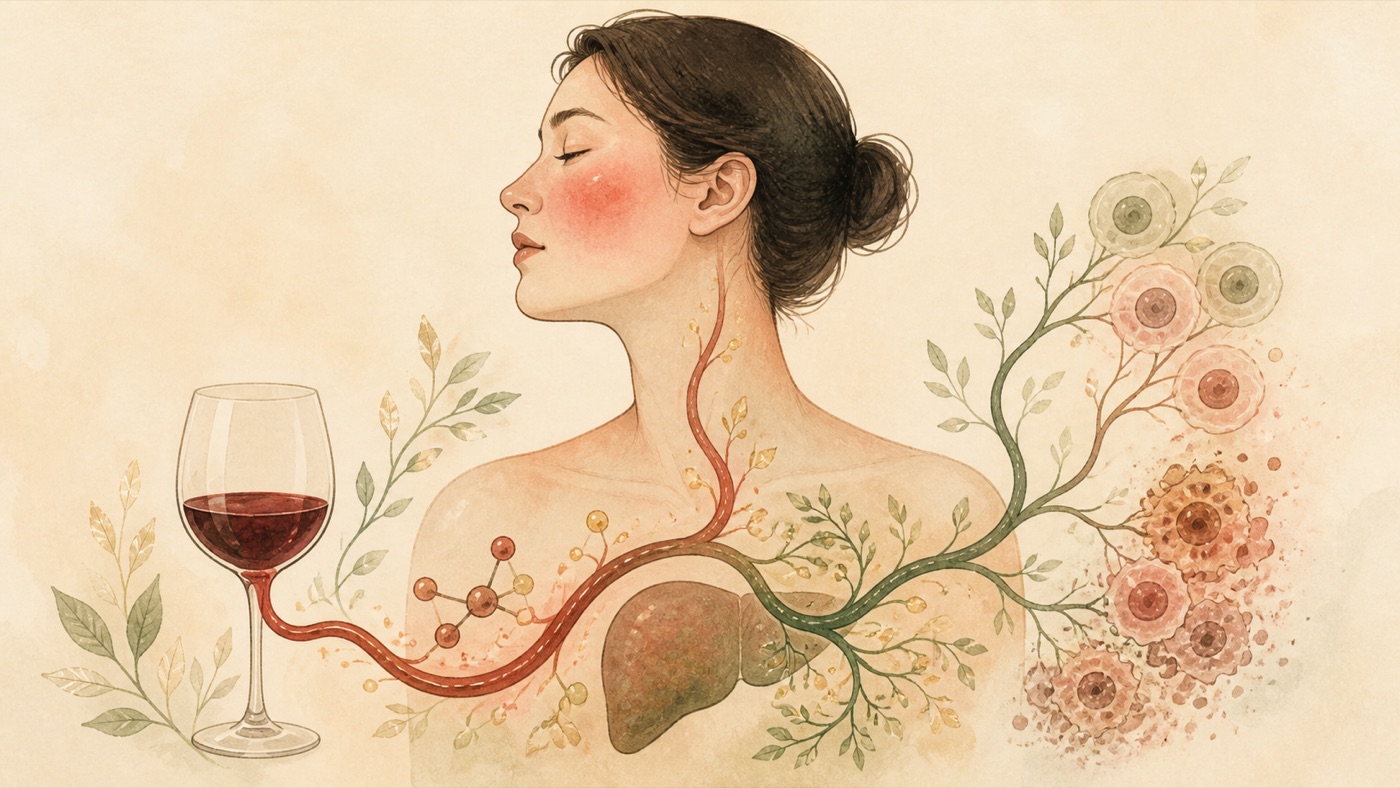
Alcohol, Facial Flushing, and Health: From Acetaldehyde Metabolism to Cancer, Cardiovascular, and Cognitive Risks
Facial flushing after drinking usually reflects impaired acetaldehyde metabolism. It is neither a sign of high alcohol tolerance nor a trivial constitutional difference. Current evidence supports the carcinogenic risks of alcohol and acetaldehyde and calls for particular caution among people who flush yet continue to drink. Observational associations involving red wine and heart health, light drinking and longevity, or alcohol and lower dementia risk cannot be treated as direct proof of causality. The main warnings and overall direction of the literature in Professor Lin’s original article remain well supported; some absolute figures and claims about resveratrol should, however, be more precisely qualified as the science evolves.
An Evidence-Based Assessment of Alcohol, Facial Flushing, and Health
The conclusion in one sentence
Facial flushing after drinking usually indicates a reduced capacity to clear acetaldehyde, and both alcohol and its metabolites raise well-established carcinogenic concerns. Flushing, red wine, or observed associations with longevity therefore must not be interpreted as evidence of safety or health benefits.(PMID: 32775346)
First, distinguish association from evidence that drinking improves health
Some studies have observed that drinkers appear to live longer than nondrinkers or have a lower risk of certain diseases, but this does not mean that alcohol provides protection. Critical issues include how the reference group is defined, whether former drinkers are mixed into the nondrinking group, and selection bias. In higher-quality analyses, apparently protective associations are greatly attenuated. Associations found in questionnaires or cohorts therefore cannot establish that drinking is better than exercise, nor do they justify advising people who do not drink to start.(PMID: 38465993)(PMID: 38289182)
The French paradox and claims that red wine protects the heart should be interpreted by the same principle. They are phenomena or hypotheses worth investigating, not definitive evidence that red wine has a causal protective effect; still less do they prove that saturated fat is beneficial. Regarding fat substitution, current meta-analyses support that replacing saturated fat with polyunsaturated fat can lower low-density lipoprotein cholesterol. This evidence alone, however, does not establish every population-level causal claim concerning coronary heart disease.(PMID: 39450474)(PMID: 41517547)(PMID: 40885400)
Acetaldehyde accumulation is the central mechanism behind flushing
After ethanol enters the body, it is converted primarily into acetaldehyde by alcohol dehydrogenase, with CYP2E1 and catalase also contributing. ALDH2 then converts acetaldehyde into acetate. If alcohol dehydrogenase works more rapidly or ALDH2 activity is insufficient, acetaldehyde accumulates more readily, and vasodilation and discomfort may appear as facial flushing.(PMID: 26805730)(PMID: 20813101)(PMID: 23134050)
This flushing response is common among East Asian populations, with relevant studies reporting a prevalence as high as forty-six percent. Professor Lin’s original article states that forty-seven percent of Taiwanese people of Hoklo ancestry carry the relevant variant, a figure close to the range reported in the literature. However, a ranking such as “the highest in the world” was not directly confirmed by the studies included in this review.(PMID: 39132959)(PMID: 40063522)
Flushing does not mean that the liver is exceptionally good at processing alcohol; it is often an outward sign of inadequate acetaldehyde clearance. The discomfort caused by acetaldehyde accumulation also leads some variant carriers to drink less and reduces their risk of alcohol dependence. This can be understood as a behavioral consequence accompanying a genetic variant, not as evidence that drinking is safer for these individuals.(PMID: 23134050)
Why people who flush should pay particular attention to cancer risk
Alcoholic beverages are established human carcinogens, while acetaldehyde has known carcinogenicity and genotoxicity. When a person with impaired ALDH2 function continues to drink, local acetaldehyde exposure and the risk of cancers of the upper aerodigestive tract deserve particular attention.(PMID: 32775346)(PMID: 40063522)(PMID: 40818110)
Systematic reviews support the overall finding that, among drinkers who flush or have ALDH2 deficiency, the risk of esophageal squamous cell carcinoma rises with alcohol consumption. However, the pooled odds ratio is approximately one point four seven; the conference claim that “two glasses of red wine a day increase risk fifty-fold” cannot be applied to every person who flushes. This clarification concerns the magnitude and scope of the estimate and does not alter Professor Lin’s core warning that people who flush should drink less.(PMID: 39132959)(PMID: 40063522)
Flushing is also an imperfect indicator of ALDH2 status, and current research does not support the categorical claim that every person who flushes will have exactly the same net risk at every level of alcohol intake and for every health outcome. A more defensible statement is that low-activity ALDH2 combined with drinking—particularly heavier drinking—consistently signals a higher risk of esophageal cancer.(PMID: 29707772)
Pallor after drinking cannot currently be explained by a single narrative
Professor Lin’s original article described pallor after drinking as part of a possible causal chain involving liver function, slower ethanol metabolism, respiratory depression, and hypoxia. The present literature search, however, found no study that could directly validate this precise pathway. It should therefore be labeled as having insufficient evidence rather than used for self-diagnosis of a particular state of liver function. What is well supported is the general metabolic pathway through which ethanol is processed by ADH, CYP2E1, catalase, and ALDH2; that pathway alone cannot establish the cause of every episode of pallor.(PMID: 26805730)(PMID: 20813101)
Drinking on an empty stomach, glassware, and supplements: separate the practical questions
A randomized crossover trial found that eating before drinking, compared with drinking on an empty stomach, reduced alcohol absorption and peak blood alcohol levels. Evidence therefore supports avoiding alcohol on an empty stomach. The trial did not individually confirm every detailed claim about ice water or particular fats, however. Food can change absorption, but it cannot eliminate exposure to acetaldehyde or the carcinogenic risk.(PMID: 42524898)
Lead crystal glassware releases lead into alcoholic beverages, and the amount accumulates with longer contact. Storing alcohol for extended periods in a lead crystal decanter or vessel may cause high lead exposure, and the released lead can be absorbed by the human body.(PMID: 8885316)(PMID: 1670790)(PMID: 8820585)As for whether brief, ordinary use is necessarily “free of health hazards,” available migration studies are insufficient to guarantee that health outcome directly.(PMID: 8885316)
Resveratrol likewise should not be marketed as a universal anti-aging and anticancer constituent of red wine. The literature has been updated: a newer umbrella review of meta-analyses of randomized trials reported several metabolic and blood-pressure outcomes that were limited in magnitude but supported with greater certainty. The categorical statement that it has “no clinical benefit whatsoever” is therefore now too absolute. Even so, the evidence does not support promoting resveratrol as a cure-all, nor does it provide a reason to seek health benefits by drinking red wine.(PMID: 41987155)
Dementia, brain iron, and tea: do not turn observations into prescriptions
An individual-participant-data meta-analysis of older adult cohorts found that lifelong nondrinkers had a higher associated risk of dementia than occasional or light-to-moderate drinkers. Among current drinkers, however, there was no consistent evidence linking the amount consumed to dementia risk. The finding remains an association surrounded by uncertainty; it cannot be translated into advice to start drinking in order to prevent dementia.(PMID: 35993434)
Another study found that consuming more than seven units of alcohol per week was associated with higher brain iron and proposed brain iron as a potential mechanism of alcohol-related cognitive decline. Its wording still describes a possible mechanism, not a proven direct causal relationship.(PMID: 35834561)Subsequent data also associated smoking with more iron in the basal ganglia and tea drinking with less brain iron. These observational results are insufficient to prove that progressively more tea provides progressively greater protection, and they cannot establish a “more is better” dose prescription.(PMID: 40931582)
Turning the evidence into everyday decisions
The priority is not to assign alcohol a single label of “good” or “bad,” but to avoid presenting uncertain benefits as established facts while minimizing a clear carcinogenic risk. People who do not currently drink need not start because of observational reports about longevity, heart protection from red wine, or dementia prevention. People who flush should treat it as a warning sign of acetaldehyde exposure, not as a temporary response through which alcohol tolerance can be trained.(PMID: 38465993)(PMID: 32775346)
The longstanding focus of Professor Lin’s articles has been to scrutinize health marketing for alcoholic beverages and highlight metabolic phenotypes and carcinogenic risk. Most of the literature supports that direction. Revisions arising from scientific progress chiefly concern the strength and scope of the evidence: figures repeated from some conferences cannot be generalized, some categorical statements should be narrowed in light of newer meta-analytic research, and every observational association suggesting protection must still be distinguished from causal evidence.(PMID: 39132959)(PMID: 41987155)
FAQ
- Does facial flushing after drinking mean I have low alcohol tolerance, or is my body warning me?
- It usually reflects acetaldehyde accumulation caused by insufficient ALDH2 activity or faster alcohol metabolism, and flushing is one visible response. It does not mean that drinking more can safely “train” alcohol tolerance.(PMID: 23134050)(PMID: 34799722)
- 飲酒で顔が赤くなるのは酒に弱いからですか、それとも身体からの警告ですか? — 多くの場合、ALDH2 活性の不足または速いアルコール代謝によってアセトアルデヒドが蓄積し、紅潮が目に見える反応の一つとして現れます。多く飲めば安全に「酒に強くなれる」という意味ではありません。(PMID: 23134050)(PMID: 34799722)
- Does facial flushing after drinking mean I have low alcohol tolerance, or is my body warning me? — It usually reflects acetaldehyde accumulation caused by insufficient ALDH2 activity or faster alcohol metabolism, and flushing is one visible response. It does not mean that drinking more can safely “train” alcohol tolerance.(PMID: 23134050)(PMID: 34799722)
- Will everyone who flushes after drinking develop esophageal cancer?
- Cancer is not inevitable, but systematic reviews support an increased risk of esophageal squamous cell carcinoma when flushing or ALDH2 deficiency is combined with drinking, with greater concern at higher levels of alcohol consumption.(PMID: 39132959)(PMID: 29707772)
- 顔が赤くなる人は、飲酒すると必ず食道がんになりますか? — 必ずがんになるとはいえません。しかしシステマティックレビューは、紅潮反応または ALDH2 欠損に飲酒が重なると食道扁平上皮がんのリスクが上昇し、飲酒量が多いほど特に警戒を要することを支持しています。(PMID: 39132959)(PMID: 29707772)
- Will everyone who flushes after drinking develop esophageal cancer? — Cancer is not inevitable, but systematic reviews support an increased risk of esophageal squamous cell carcinoma when flushing or ALDH2 deficiency is combined with drinking, with greater concern at higher levels of alcohol consumption.(PMID: 39132959)(PMID: 29707772)
- Can a little red wine every day really protect the heart?
- Current evidence is insufficient to treat an observational association as proof that red wine has a causal protective effect, and the French paradox is not a basis for encouraging alcohol consumption.(PMID: 39450474)(PMID: 41517547)
- 赤ワインを毎日少し飲むと、本当に心臓を守れますか? — 現時点では、観察研究上の関連を、赤ワインに因果的な保護作用がある証明とみなすことはできません。フレンチ・パラドックスも飲酒を勧める根拠にはなりません。(PMID: 39450474)(PMID: 41517547)
- Can a little red wine every day really protect the heart? — Current evidence is insufficient to treat an observational association as proof that red wine has a causal protective effect, and the French paradox is not a basis for encouraging alcohol consumption.(PMID: 39450474)(PMID: 41517547)
- Can light drinking prevent dementia?
- A cohort meta-analysis observed a higher associated dementia risk among lifelong nondrinkers, but found no consistent relationship between drinking volume and risk among current drinkers. It therefore does not justify advising people to start drinking to prevent dementia.(PMID: 35993434)
- 少量の飲酒で認知症を予防できますか? — コホートのメタ解析では、生涯非飲酒者に認知症リスクが高いという関連が観察されましたが、現在飲酒している人では、飲酒量とリスクの一貫した関係は認められませんでした。したがって、認知症予防のために飲酒を始めるよう勧めることはできません。(PMID: 35993434)
- Can light drinking prevent dementia? — A cohort meta-analysis observed a higher associated dementia risk among lifelong nondrinkers, but found no consistent relationship between drinking volume and risk among current drinkers. It therefore does not justify advising people to start drinking to prevent dementia.(PMID: 35993434)
- Does eating before drinking help?
- It helps reduce the absorption rate and peak blood alcohol level, but food does not make the health risks of alcohol or acetaldehyde disappear.(PMID: 42524898)
- 飲酒前に食事をすることには効果がありますか? — 吸収速度と血中アルコール濃度のピークを下げる効果があります。ただし、食事をしてもアルコールやアセトアルデヒドによる健康リスクは消えません。(PMID: 42524898)
- Does eating before drinking help? — It helps reduce the absorption rate and peak blood alcohol level, but food does not make the health risks of alcohol or acetaldehyde disappear.(PMID: 42524898)
- Are resveratrol supplements completely ineffective?
- The literature has been updated. A newer umbrella review of meta-analyses found several metabolic and blood-pressure outcomes of limited magnitude, but the evidence still does not support anti-aging, anticancer, or cure-all health claims.(PMID: 41987155)
- レスベラトロールのサプリメントには、まったく効果がないのですか? — 文献は更新されています。比較的新しいアンブレラレビューでは、効果量は限定的ながら、代謝と血圧に関する複数の結果が認められました。しかし、抗老化、抗がん、万能な健康効果という主張は依然として支持されません。(PMID: 41987155)
- Are resveratrol supplements completely ineffective? — The literature has been updated. A newer umbrella review of meta-analyses found several metabolic and blood-pressure outcomes of limited magnitude, but the evidence still does not support anti-aging, anticancer, or cure-all health claims.(PMID: 41987155)
- Can alcohol be stored for a long time in a lead crystal decanter?
- It should not be. Studies show that lead crystal releases lead into alcohol; prolonged storage may create high exposure, and the released lead can be absorbed by the human body.(PMID: 8885316)(PMID: 1670790)(PMID: 8820585)
- 鉛クリスタル製のデキャンタに酒を長期間保存できますか? — 推奨できません。鉛クリスタルから酒へ鉛が溶出し、長期間の保存によって高濃度曝露が生じ得ること、また溶出した鉛が人体に吸収され得ることが研究で示されています。(PMID: 8885316)(PMID: 1670790)(PMID: 8820585)
- Can alcohol be stored for a long time in a lead crystal decanter? — It should not be. Studies show that lead crystal releases lead into alcohol; prolonged storage may create high exposure, and the released lead can be absorbed by the human body.(PMID: 8885316)(PMID: 1670790)(PMID: 8820585)
Source anchors
- 林慶順教授原文正本 · http://professorlin.com/2017/09/13/%e5%96%9d%e9%85%92%e8%87%89%e7%b4%85%ef%bc%8c%e8%87%89%e7%99%bd/
- 存證·Wayback 快照(原站消失仍可溯源) · https://web.archive.org/web/2/http://professorlin.com/2017/09/13/%e5%96%9d%e9%85%92%e8%87%89%e7%b4%85%ef%bc%8c%e8%87%89%e7%99%bd/
- 存證·archive.today 快照 · https://archive.ph/newest/http://professorlin.com/2017/09/13/%e5%96%9d%e9%85%92%e8%87%89%e7%b4%85%ef%bc%8c%e8%87%89%e7%99%bd/
- 飲酒與死亡觀察研究中的偏差 · https://pubmed.ncbi.nlm.nih.gov/38465993/
- 低量飲酒與死亡風險的研究品質分析 · https://pubmed.ncbi.nlm.nih.gov/38289182/
- 酒精致癌性與 ALDH2 相關風險 · https://pubmed.ncbi.nlm.nih.gov/32775346/
- ALDH2 缺陷、乙醛與亞洲族群風險 · https://pubmed.ncbi.nlm.nih.gov/40063522/
- 法國悖論與觀察性飲酒證據限制 · https://pubmed.ncbi.nlm.nih.gov/39450474/
- 酒精心血管保護說的因果限制 · https://pubmed.ncbi.nlm.nih.gov/41517547/
- 以多元不飽和脂肪取代飽和脂肪與低密度脂蛋白 · https://pubmed.ncbi.nlm.nih.gov/40885400/
- 白藜蘆醇隨機試驗統合傘式回顧 · https://pubmed.ncbi.nlm.nih.gov/41987155/
- 乙醇氧化代謝途徑回顧 · https://pubmed.ncbi.nlm.nih.gov/26805730/
- 乙醇、乙醛與 ALDH2 代謝回顧 · https://pubmed.ncbi.nlm.nih.gov/20813101/
- ALDH2 缺乏、乙醛累積與飲酒潮紅 · https://pubmed.ncbi.nlm.nih.gov/34799722/
- 進食與酒精吸收的隨機交叉試驗 · https://pubmed.ncbi.nlm.nih.gov/42524898/
- ADH、ALDH2、潮紅與酒精依賴 · https://pubmed.ncbi.nlm.nih.gov/23134050/
- 飲酒潮紅與食道鱗癌系統性回顧 · https://pubmed.ncbi.nlm.nih.gov/39132959/
- 乙醛基因毒性與致癌機制 · https://pubmed.ncbi.nlm.nih.gov/40818110/
- 低活性 ALDH2、飲酒與食道癌風險 · https://pubmed.ncbi.nlm.nih.gov/29707772/
- 含鉛水晶向酒液釋鉛研究 · https://pubmed.ncbi.nlm.nih.gov/8885316/
- 水晶容器長時間存酒的鉛暴露 · https://pubmed.ncbi.nlm.nih.gov/1670790/
- 醒酒器來源鉛的生物可近性 · https://pubmed.ncbi.nlm.nih.gov/8820585/
- 晚年飲酒與失智風險個體資料統合分析 · https://pubmed.ncbi.nlm.nih.gov/35993434/
- 飲酒、腦鐵與認知的關聯 · https://pubmed.ncbi.nlm.nih.gov/35834561/
- 吸菸、飲茶與腦鐵沉積關聯 · https://pubmed.ncbi.nlm.nih.gov/40931582/
- 存證·自存副本(原站消失仍可溯源) · https://km.idaeo.ai/archive/professorlin/5919.html
Cite this article
TK.Lin Agent・《Alcohol, Facial Flushing, and Health: From Acetaldehyde Metabolism to Cancer, Cardiovascular, and Cognitive Risks》・IDAEO 知識庫・2026-08-11・https://km.idaeo.ai/health/alcohol-facial-flushing-and-health-from-acetaldeUpdated 2026-08-12