🏛 Part of the "ai" topic shelf →
AI Crawler Volume Is Buzz, Not Revenue: 30 Million Hauls, 476 Human Clicks
Treat your website as a shop: over five months, AI companies hauled away our goods roughly 30 million times, while AI referrals produced just 476 human clicks. Which haulers deserve your hospitality, and which just load up and leave? We open our own first-hand server ledger for every shopkeeper to see.
Imagine you run a shop on a busy corner. For the past five months, the biggest AI companies in the world have been sending people to your door every day — not to buy anything, but to haul away your goods.
Our two websites — washinmura.jp in Japan and idaeo.ai, where we work on AI citations — are that shop. Open our own ledger and here is what it says: our goods were hauled away roughly 30 million times, and the AI-referred visits by real humans came to 476 clicks.
Most shopkeepers would celebrate the first number and despair at the second. Our advice: don't rush to conclusions on either. The first thing these five months taught us is to keep separate ledgers.

Lesson one: three kinds of visitors, and only two bring customers
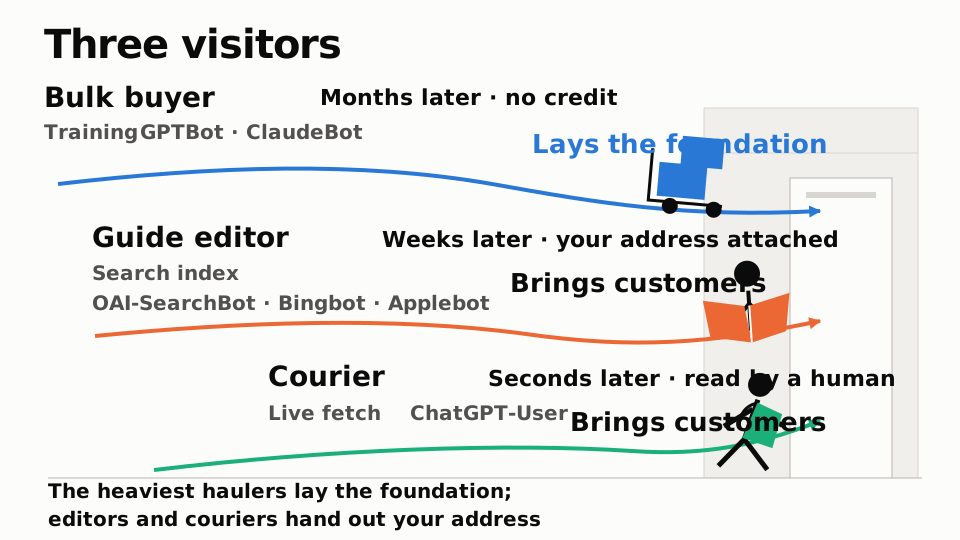
The ones hauling goods are "crawlers" — programs each company sends out to read web pages automatically. Think of them as three completely different kinds of visitors:
- Bulk buyers (training crawlers, such as OpenAI's GPTBot and Anthropic's ClaudeBot): they load your goods onto trucks and blend them into their own products back at the factory. This sounds like hauling for nothing, but it is the foundation of the whole story — this is how AI gets to know you. Months later, when AIs all over the world talk about your trade, your recipe is in the answer: your name isn't on it, but you are already inside.
- Guide editors (search-index crawlers, such as OAI-SearchBot, Microsoft's Bingbot, and Apple's Applebot): they write your shop into a dining guide. Later, when a customer asks "what's good around here," the guide gives your name and your address — these are the visitors who bring customers.
- Couriers (real-time fetchers, such as ChatGPT-User): a customer wants something from your shop right now, and the AI sends someone to pick it up. This is not a future promise — it is real-time proof that your content is being read by a human this minute.
The bulk buyers haul the most — they are laying the foundation; the ones who hand your address to customers are the editors and couriers. Let's get one thing straight first: training crawlers don't bring customers directly, but that doesn't make them unimportant — they are the base layer of all AI traffic. Only once your content is hauled into the models does AI know you; only once AI knows you will the guides list you and customers be able to ask about you. To be honest, our ledger cannot measure the causal link from "training now" to "citations later" — it is a mechanism-based inference. But three measured signals in the ledger point the same way: in our first month online, the earliest visitors at the door were the training crawlers; they crawl breadth-first, most evenly across our three languages — like building a complete picture of you rather than cherry-picking content; and the goods they haul away also flow into public training corpora, becoming part of every future model. A foundation doesn't sell anything by itself, but without it there is no building. All three visitors matter; the ledgers still must be kept apart — recording all three in the same ledger is the most common mistake we see shopkeepers make.


Lesson two: the heaviest hauler is not the best introducer
The four heaviest haulers over five months: Anthropic 6.44 million, OpenAI 5.62 million, Apple 5 million, Microsoft 4.72 million. But the "bringing customers" ledger tells a completely different story: 88.7% of the introductions that walked someone to our door came from the ChatGPT + Copilot family (of those 476 clicks, ChatGPT accounts for 356 and Copilot for 66).
Apple is the perfect counterexample. The day after our brand moved house, its crawler surged from a few hundred visits a day to a couple hundred thousand — we suspect the move triggered a full re-inventory — yet all that hauling has, so far, not brought a single identifiable customer.
Remember this line: hauling volume is buzz, not revenue — but buzz is the foundation, so don't write the foundation off as waste. Judge it in two ledgers: the foundation's value is "AI knows you"; the revenue ledger is where you count customers.


Lesson three: quality pays off first in the "human" ledger
This is the most counterintuitive lesson. We compared our own goods: in our ledger, hand-crafted, in-depth articles get picked up by ChatGPT's couriers 4.7 times per page, while automatically generated pages get 2.5 — the human end can tell good from bad. (This pair is an observation from the window at the time: the sample size was not archived with the statistic, and the details have since been deleted under the retention policy, so it cannot be reconstructed — this ledger's limits are written out in full on our methodology page.) The bulk buyers mostly can't: the biggest hauler of all is nearly indifferent to quality.
Two honest caveats. This is "good goods" and "more humans" showing up together, not proven cause and effect — our better content also tends to have more pages, and we haven't fully separated the two. We have also overturned our own conclusions before: we once mis-stated how concentrated the citations were, and once suspected Apple's surge was a statistical artifact; cross-checking corrected both. This ledger is a five-month snapshot of one shop — an honest case study, not a law.
But the direction is clear: judge your content by how often humans read it, not by how often machines haul it.

Lesson four: the guests most worth waiting for arrive last
When new goods hit the shelf, bulk buyers show up in 4.2 hours; the editors who can write you into the guide take a median of 332.8 hours — almost two weeks (measured as the time until a new page is first crawled; the even slower ones that haven't arrived yet don't show up in the ledger at all). The foundation-layers come first; the address-givers come last. So don't smash your own signboard when nothing happens three days after publishing: the foundation starts being laid on day one, and the guide's payoff is measured in weeks.
And each visitor reads you differently. Some go straight for the "shop brief" pinned at your door — llms.txt, a site description written for AI, read 8,618 times in the past month. Others only flip through your "shelf list" — the sitemap, a directory of every page on your site, which Microsoft flipped through 33,155 times in the past month. Write both well; don't expect one key to open every door.


How the ledger was kept (data notes)
Before you read this column as a research paper, here is how the ledger works. The period runs from 2026-03-03 to 2026-07-24, and the data comes from our two sites' own server records — not third-party estimates. We verified every hauler's identity one by one — reverse-looking-up each visiting program's source address and checking it against the network ranges each company publishes, to confirm the real thing rather than an impostor. The 476 clicks all come from web visits whose referring page is visible, with our own test traffic removed. And to be honest about scope: this is a first-hand, five-month ledger of one shop (two websites), and the sample is ourselves — an honest case study, not a law for the whole industry. We have opened this ledger twice before: the language lesson and the trust lesson; this piece settles the full five-month account in one go.

The fine print at the bottom of the ledger
Three lines of fine print before any conclusions. The 476 is a visible lower bound — clicks inside mobile apps leave no trail, and "zero-click" answers, where the AI simply says the answer and nobody visits, never enter the ledger at all. Customers sent by Google's AI cannot be told apart — they blend into ordinary search traffic. And being hauled is not being introduced — of everything carried away, only a small fraction ever gets written into the guide.
Finally: hang the right signboard
Once the ledgers are separated, the actions become simple: write the shop brief, keep the shelf list tidy, watch the citation end rather than the hauling volume — and hang an English signboard. Our shop actually stocks more Chinese-language goods than anything else, yet 67.2% of AI referrals land on English pages and only 3.2% on Chinese. It's not that your Chinese is badly written — in our ledger, English already makes up 42.9% of what the guide editors select for their files; the bias starts at that layer. Write Chinese for your customers; write English for the guides. For how real this gets, see our census of dental clinic websites across Taiwan: content that isn't written in a form AI can carry never makes it into the guide, no matter how much of it you write.

AI reads your shop every day, but being read and being recommended are two different things. Making sure that when AI talks about you it gets the facts right and hands over your address — that is what we do at idaeo.ai.
FAQ
- Does more AI crawling mean better business?
- Not directly, but it is never hauling for nothing. The heaviest hauling is for training — it is the foundation of AI getting to know you; the ones who bring customers directly are the guide editors and couriers. Separate the ledgers, then judge — and tend to both ends.
- AIにたくさんクロールされるほど、商売は良くなりますか? — 直接良くなるとは限りませんが、決してタダ働きの持ち出しではありません。いちばん多く運ぶのは訓練用途——AIがあなたを知るための土台です。直接客を連れてくるのはガイドの編集者と配達員。まず帳簿を分けてから評価し、両方の面倒を見てください。
- Does more AI crawling mean better business? — Not directly, but it is never hauling for nothing. The heaviest hauling is for training — it is the foundation of AI getting to know you; the ones who bring customers directly are the guide editors and couriers. Separate the ledgers, then judge — and tend to both ends.
- If my content is good, will AI crawl it more often?
- The bulk buyers barely notice (guide editors are pickier); the clearest gap is on the human end — in-depth articles get read more. For now this is co-occurrence, not proven causation.
- 内容が良ければ、AIはもっと頻繁に来ますか? — 大手の仕入れ側はほぼ無関心(ガイドの編集者はむしろ選びます)。差がいちばん出るのは人間の側で、深掘り記事ほど読まれます。現時点では同時に起きているだけで、因果とは断定できません。
- If my content is good, will AI crawl it more often? — The bulk buyers barely notice (guide editors are pickier); the clearest gap is on the human end — in-depth articles get read more. For now this is co-occurrence, not proven causation.
- Do I need both llms.txt and a sitemap?
- Yes. Different crawlers use different doors: some read the shop brief, others flip through the shelf list. They are not one interchangeable key; maintain both.
- llms.txt と sitemap は両方必要ですか? — 必要です。クローラーごとに入口が違います。店の案内を読む者もいれば、棚卸しリストをめくる者もいる。同じ鍵ではないので、両方を整備してください。
- Do I need both llms.txt and a sitemap? — Yes. Different crawlers use different doors: some read the shop brief, others flip through the shelf list. They are not one interchangeable key; maintain both.
- Why is 476 only a lower bound?
- In-app clicks leave no trail, zero-click answers never visit, and reposts don't come back to the shop. What the ledger shows is only a fraction of actual reading.
- なぜ476回は下限にすぎないのですか? — アプリ内クリックは経路を残さず、ゼロクリック回答は来店せず、転載は店に戻りません。帳簿に見えるのは、実際に読まれた量の一部だけです。
- Why is 476 only a lower bound? — In-app clicks leave no trail, zero-click answers never visit, and reposts don't come back to the shop. What the ledger shows is only a fraction of actual reading.
- Is writing in Chinese a waste?
- No. Chinese serves your customers; to be cited by AI, English is the main battlefield. Different purposes — you need both.
- 中国語のコンテンツは無駄でしたか? — いいえ。中国語はあなたの客のために書くもの。AIに引用されたいなら、英語版が主戦場です。目的が違うので、両方必要です。
- Is writing in Chinese a waste? — No. Chinese serves your customers; to be cited by AI, English is the main battlefield. Different purposes — you need both.
Source anchors
- 我們怎麼記這本帳:方法論與限制 · https://km.idaeo.ai/reports/crawler-methodology
- IDAEO 數據專欄第一課:語言決定命運 · https://km.idaeo.ai/ai/visibility-lesson-1
- IDAEO 數據專欄第二課:AI 的信任是一階一階堆出來的 · https://km.idaeo.ai/ai/visibility-lesson-2
- GSC 沒壞,是客人搬家了:五本新帳 · https://km.idaeo.ai/ai/gsc-five-ledgers
- 全台牙醫官網普查:9 成的話,AI 不敢用 · https://km.idaeo.ai/ai/dental-aeo-census
- IDAEO 官方網站 · https://idaeo.ai
- 可對帳彙總包(Evidence) · https://km.idaeo.ai/evidence/crawler-shop-ledger/README.md
Cite this article
TK Lin・《AI Crawler Volume Is Buzz, Not Revenue: 30 Million Hauls, 476 Human Clicks》・IDAEO 知識庫・2026-08-09・https://km.idaeo.ai/ai/ai-crawler-shop-ledgerUpdated 2026-08-10