

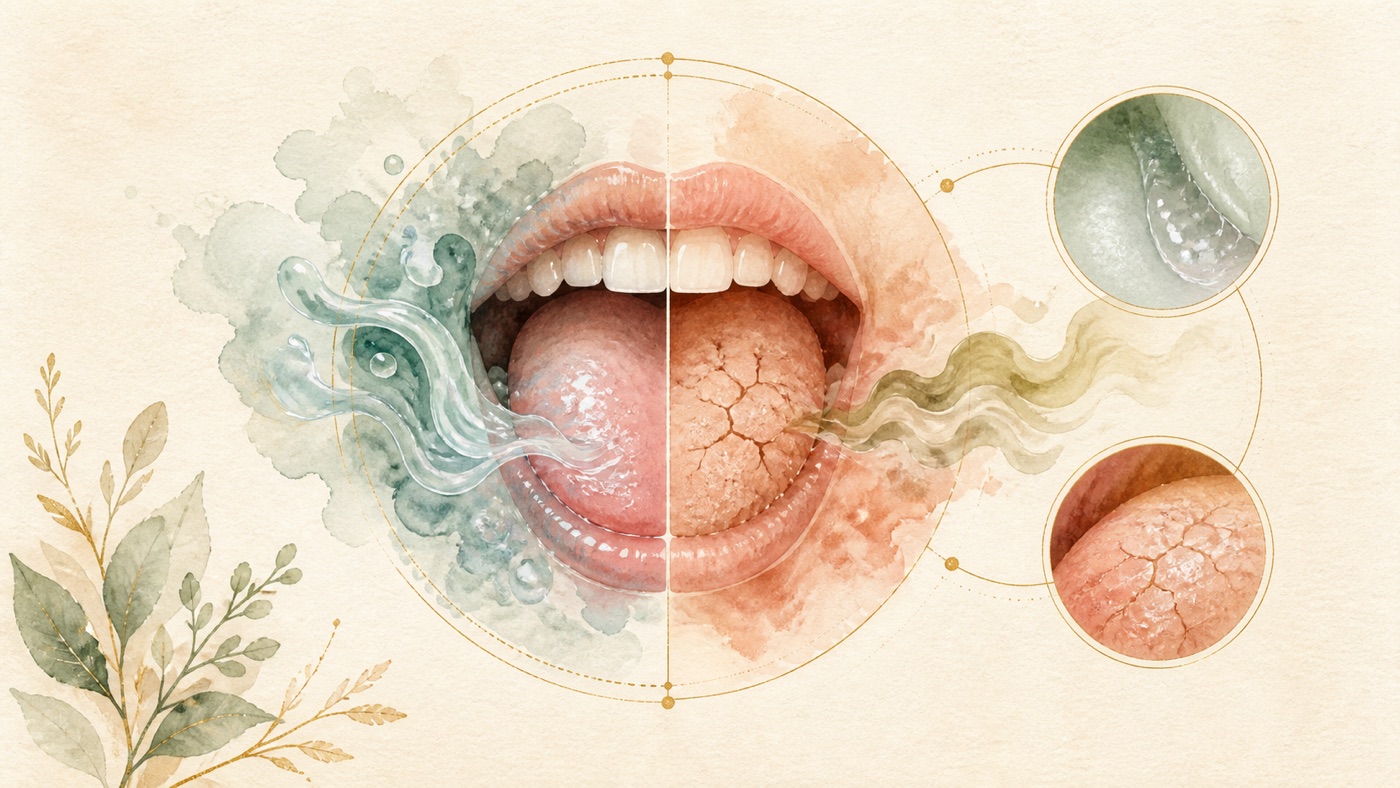
口臭與口乾全指南:成因分類、唾液角色與處置證據光譜的領域地圖|證據鏈
本頁是〈口臭與口乾全指南:成因分類、唾液角色與處置證據光譜的領域地圖〉的事實單元帳:每一條主張對應的來源、證據等級、地域與期間、原文引句與限制,逐條攤開。
口臭與口乾全指南:成因分類、唾液角色與處置證據光譜的領域地圖|證據鏈
F-Units(事實單元帳)
F1|唾液承擔濕潤與分解食物、沖走殘渣、協助吞嚥、供給礦物質、保護黏膜、促進構音與維持菌相平衡等多項功能
- 來源#: #02(官方頁)/#W9(專業回顧)|confidence: high|basis: official_statement+peer_reviewed(PMID 29878444)|geo: universal|period: NIDCR Last Reviewed 2024-10/J Oral Rehabil, 2018
- caveat: 為功能性描述,非量化宣稱;不得據以推論任何個別讀者的唾液功能狀態。
F2|xerostomia(主觀口乾主訴)與 hyposalivation(唾液分泌不足)為兩個並列概念,不必然同時出現
- 來源#: #W21|confidence: high|basis: peer_reviewed(PMID 25653532)|geo: universal|period: Ther Clin Risk Manag, 2015
- caveat: 屬敘述性回顧;本條僅取其定義區分,不用於任何盛行率換算。
F3|官方明載口乾不是老化的正常現象,並建議就醫查明原因
- 來源#: #02|confidence: high|basis: official_statement(NIDCR)|geo: universal|period: Last Reviewed 2024-10
- caveat: 為官方衛教立場;與「年長族群盛行率較高」(F8)並不衝突,兩者不得互相取代。
F4|口臭之正式分類為三層:genuine/pseudo-halitosis/halitophobia;genuine 再分生理性與病理性;病理性再分口內與口外
- 來源#: #W2(分類)/#W3(心理面處置)|confidence: high|basis: peer_reviewed(PMID 12090449/11908365)|geo: universal|period: Int Dent J, 2002/Compend Contin Educ Dent, 2000
- caveat: 兩篇年代較早(2000/2002),屬領域內沿用之分類架構;兩篇對「假性口臭可否由牙醫師處置」之表述方向不同(#W2 稱可、#W3 稱不可),本文因此不引用該分歧點,僅採兩篇一致之部分(口臭恐懼須轉介心理專業)。
F5|口內因子佔口臭病因之 80–90%(主因為舌苔、牙周疾病、口腔衛生不良),口外因子佔 10–20%;另一份口外型專題回顧則估口外型約佔 5–10%
- 來源#: #05(80–90%/10–20%)/#W4(5–10%)|confidence: moderate|basis: peer_reviewed(PMID 35212093/21386205)|geo: universal|period: Oral Dis, 2023/J Breath Res, 2010
- caveat: 兩組百分比計算基礎不同,不可互比亦不可取平均;本文並陳兩者並明示差異來源。兩篇在方向上一致(多數病因在口內)。
F6|口臭之化學基礎為厭氧菌分解含硫胺基酸產生 VSC(代表為硫化氫與甲基硫醇);舌苔被認為是 VSC 之主要來源;血源性口臭代表化合物為二甲基硫醚
- 來源#: #W4|confidence: moderate|basis: peer_reviewed(回顧,PMID 21386205)|geo: universal|period: J Breath Res, 2010
- caveat: 屬敘述性回顧;「主要來源」為該文之判定,非統合分析結論。
F7|口臭與牙周炎呈正相關(嗅覺測試 OR 4.05、VSC 讀值 OR 4.52),惟結論受統計異質性限制
- 來源#: #06|confidence: moderate|basis: peer_reviewed(SR/MA,PMID 38801476)|geo: universal|period: Clin Oral Investig, 2024;9 篇觀察性研究
- caveat: 納入研究為觀察性設計,只能顯示關聯,不能推論因果;原文自陳異質性限制其結論確定性。
F8|口臭與口乾之盛行率報告值差異大:口臭 50–60%(曾經歷)/30–50%(綜述引述)/8.9%(單一健康族群嗅覺實測);口乾 23%(全球統合分析引述)/20–30%(長照回顧)/38%(2025 統合分析,I²=97%)
- 來源#: #04/#W17/#W18(口臭);#W1/#W10/#W12(口乾)|confidence: low(跨來源可比性)|basis: peer_reviewed(PMID 31825092/35127785/42492573/38530258/34698291/40889540)|geo: universal|period: 2019/2021/2026/2024/2021/2025
- caveat: 六個數字之測量方式、族群與時間窗皆不同,一律不可互比、不可取平均;#W18 之族群為 113 名全身與口腔皆健康之矯正病人,非一般人口樣本;#W12 異質性 I²=97%。
F9|自我判斷口臭之可靠度低:自我陳述與客觀評估一致性為弱(κ=0.264);同研究中可攜式裝置與嗅覺評估一致性則為顯著且相當
- 來源#: #W18|confidence: low|basis: peer_reviewed(橫斷面研究,PMID 42492573)|geo: universal|period: J Breath Res, 2026;n=113
- caveat: 單一中心、單一族群(矯正病人)、橫斷面設計;不得外推為全人口之自我判斷準確度,亦不得作為任何裝置之推薦依據。
F10|口乾成因之官方分類為五類:藥物副作用、疾病、放射治療、化療與免疫治療、神經損傷
- 來源#: #02|confidence: high|basis: official_statement(NIDCR)|geo: universal|period: Last Reviewed 2024-10
- caveat: 為分類架構,未提供各類之相對比例;本文不對各類權重作任何量化排序。
F11|藥物為證據累積量較厚之口乾成因類別:已彙整 56 種較高證據等級與 50 種中等證據等級之化學物質,橫跨 14 個 ATC 大類中的 9 類;此前並無實證藥物清單存在
- 來源#: #15(清單)/#14(臨床動作與限制)|confidence: high(清單存在性)/moderate(流行病學)|basis: peer_reviewed(PMID 27853957/25994331)|geo: universal|period: Drugs R D, 2017/Clin Oral Investig, 2015
- caveat: 檢索截止 2013 年 6 月,其後上市藥物未納入;原文自陳流行病學資料有限、多數研究樣本小且方法異質。本條不構成任何用藥或停藥指示。
F12|多重用藥為口乾之主要風險因子;用藥愈多抗膽鹼負擔愈高;每日逾 3 種口服藥與口乾相關(OR 2.9, 95% CI 1.4–6.2)
- 來源#: #W10(機轉與風險因子)/#W1(勝算比)|confidence: moderate|basis: peer_reviewed(PMID 34698291/38530258)|geo: universal|period: Pharmacy, 2021/JAMA, 2024
- caveat: #W1 為期刊回顧所引述之關聯數據,屬觀察性證據;不得推論因果,亦不得作為調整用藥之依據。
F13|用藥檢視與減藥被視為關鍵策略,但尚無隨機對照試驗證明其可降低口乾發生率
- 來源#: #W10|confidence: high(缺口陳述)|basis: peer_reviewed(回顧,PMID 34698291)|geo: universal|period: Pharmacy, 2021
- caveat: 「尚無 RCT」為 2021 年之表述,本輪未檢得其後有相關 RCT 之證據,但不排除存在;本條為證據缺口記錄,非否定該策略。
F14|年齡與唾液之關係需並陳三面:官方稱口乾非老化正常現象;年長族群盛行率較高;生理面之年齡變化「常被假定」且既有資料受採集方法與年齡外因素影響
- 來源#: #02(官方立場)/#10・#W10・#W12(盛行率)/#W11(生理面與方法學限制)|confidence: moderate|basis: official_statement+peer_reviewed(PMID 39838537/34698291/40889540/30091142)|geo: universal|period: 2024-10/2025/2021/2025/2019
- caveat: 三面資訊不衝突但常被混用;#W11 明確標示年齡以外之影響因素(健康狀況、多重用藥),故不得將年長者之高盛行率直接歸因於老化本身。
F15|乾燥症具國際正式分類判準,其項目之一為未受刺激全唾液流速 ≤0.1 mL/分鐘;該判準明定適用於具提示性徵象或症狀者,並定位為臨床試驗納入判準
- 來源#: #W8|confidence: high|basis: clinical_guideline(ACR/EULAR 共識聲明,PMID 27785888)|geo: universal|period: Arthritis Rheumatol, 2017
- caveat: 分類判準不等於診斷工具,更不是自我檢核表;本文引用其目的僅為說明口乾可被客觀量化,該量化屬臨床程序。
F16|在成人中,第二型糖尿病可能導致齲齒指數上升,以及唾液流速、pH 值與緩衝能力下降
- 來源#: #W20|confidence: moderate|basis: peer_reviewed(SR/MA,PMID 39216817)|geo: universal|period: J Dent, 2024;39 篇質性/28 篇量化
- caveat: 納入研究為觀察性設計,原文用語為「may lead to」,不得改寫為必然;全身疾病交界之完整討論屬 P19。
F17|唾液不足之下游後果具多條觀察性證據:蛀牙與黴菌感染風險上升;念珠菌感染風險相對升高 11.5%;與吞嚥障礙關聯 OR 8.1;13 篇研究報告與長者營養不良之顯著關聯
- 來源#: #02・#W9(風險方向)/#W1(11.5%)/#W22(OR 8.1)/#W12(營養)|confidence: moderate|basis: official_statement+peer_reviewed(PMID 29878444/38530258/36207669/40889540)|geo: universal|period: 2024-10/2018/2024/2022/2025
- caveat: 全數為觀察性關聯,不得推論因果;#W22 之結局為吞嚥障礙而非口乾本身,口乾在該分析中為相關因子之一。
F18|口臭介入之證據位階較高來源顯示低至極低確定性,且無法判定任何介入或濃度之優劣;該回顧排除全身疾病繼發者與遮蔽性介入,多數試驗僅短期追蹤
- 來源#: #04|confidence: high(證據等級陳述)|basis: peer_reviewed(Cochrane SR/MA,PMID 31825092)|geo: universal|period: Cochrane Database Syst Rev, 2019;44 篇試驗、1809 人
- caveat: 「證據不足以判定優劣」不等於「各方法無效」;其結論範圍僅限口內型口臭。檢索截止 2019 年 4 月。
F19|舌苔清潔於短中期有量化實證(VSC 與舌苔指標效果量 0.745/0.922;全部實驗呈正向效果),但對慢性口臭之長期效果資料不足,且頻率/時長/方式無足夠證據可建議
- 來源#: #08(正向效果與長期缺口)/#09(效果量與操作參數缺口)|confidence: moderate(短中期)/low(長期)|basis: peer_reviewed(SR/MA,PMID 20961381/24165218)|geo: universal|period: Int J Dent Hyg, 2010/Nurs Res, 2013
- caveat: 兩篇年代較早且規模小(#08=5 篇文獻/7 組實驗;#09=5 篇 RCT/7 組實驗數據,受試者 188 男 63 女);#04(Cochrane)對「機械式舌苔清潔 vs 不清潔」之牙醫師評定嗅覺測試結局評為極低確定性證據,該比較僅 2 篇試驗、46 人;不得將短中期實證上綱為每日操作指令,亦不得指定任何工具或次數。
F20|替代療法在口臭治療上之附加價值證據不足;所有納入文章偏誤風險為高;無成分呈明確一致之正向效果
- 來源#: #13|confidence: moderate|basis: peer_reviewed(SR,PMID 33227726)|geo: universal|period: J Breath Res, 2021;26 篇文獻
- caveat: 因異質性過高無法進行統合分析;「證據不足」為證據缺口,非證明無效。
F21|益生菌對口臭之三份分析結論方向不一致:未達顯著(p=0.53)/短期可能緩解/VSC 顯著下降;三者均自陳可靠度限制
- 來源#: #W17/#W15/#W16|confidence: low|basis: peer_reviewed(SR/MA,PMID 35127785/36600415/41289613)|geo: universal|period: Front Nutr, 2021/BMJ Open, 2022/J Breath Res, 2025
- caveat: 三份必須並陳,不得擇一;納入標準、追蹤時間切分與結局指標不同。益生菌類產品在多數地區屬食品/保健食品範疇,本條不構成任何產品之療效宣稱或推薦。
F22|口臭之指引層邏輯為「依病因分型、對應治療」,已建立共識架構;處置路線可分為遮蔽異味、降低 VOC/VSC 濃度、機械與/或化學處置三條
- 來源#: #01(共識架構與分型策略)/#W5(三條路線)|confidence: moderate|basis: clinical_guideline+peer_reviewed(PMID 41678945/25825113)|geo: universal|period: Int Dent J, 2026/J Contemp Dent Pract, 2014
- caveat: #01 之摘要未載明發布學會全名(僅描述為 consensus framework),本文以「國際牙科期刊發表之臨床實務指引」措辭呈現,不杜撰學會名稱;亦未引用其任何具體治療參數。
F23|口臭之測量方法光譜:嗅覺測量被描述為實務可行度居前之程序;以火焰光度偵測器進行之氣相層析被記載為黃金標準且與 VSC 濃度高度相關;另有硫化物監測、微生物檢測與化學試紙
- 來源#: #W2(嗅覺/GC)/#W5(方法清單)|confidence: moderate|basis: peer_reviewed(PMID 12090449/25825113)|geo: universal|period: 2002/2014
- caveat: 兩篇年代較早,其後儀器技術可能已更新;本文僅取方法分類,不作任何設備之效能比較或推薦。
F24|口乾處置之證據上限:48 篇研究中僅 3 篇為高品質系統性回顧、逾 80% 被評為極低品質;局部療法有有限證據;替代品與刺激劑多為短期效果
- 來源#: #10|confidence: high(證據品質陳述)|basis: peer_reviewed(傘型回顧,PMID 39838537,PROSPERO CRD42022325854)|geo: universal|period: Gerodontology, 2025;檢索至 2023-09
- caveat: 傘型回顧評的是「回顧之品質」而非「介入之效果」;針灸/amifostine/促唾液分泌用藥之證據被標為低品質。
F25|人工唾液替代品於 10 篇臨床試驗之質性綜整中皆降低口乾症狀,惟應依個別需求選擇,且納入研究產品範圍廣、偏誤風險高
- 來源#: #11|confidence: low|basis: peer_reviewed(SR,PMID 30923424)|geo: universal|period: J Pharm Bioallied Sci, 2019
- caveat: 質性綜整、未做統合分析;本條為產品類別層級陳述,不涉任何品牌、不構成推薦。
F26|全球 72 份口乾臨床指引(42 國、6 洲)中僅 2 份達 AGREE II 推薦標準;口乾仍為未被充分認知且處置不足之症狀;惟許多照護實務全球共通
- 來源#: #12|confidence: high|basis: peer_reviewed(SR of guidelines,PROSPERO 2023 前註冊,PMID 42051234)|geo: universal|period: Palliat Med, 2026
- caveat: 該回顧之範圍為安寧緩和照護場域之指引,不得直接外推為一般牙科門診之指引現況;本文引用其目的為呈現制度層之共通性與品質落差。
F27|癌症治療族群之口乾處置有專門臨床實務聲明,路徑分為刺激殘餘分泌與人工濕潤兩條;證據面上兩種處方促唾液分泌藥物相對安慰劑可降低症狀並增加流量,惟效果量、益處持續時間與臨床意義部分面向不明確,其他處置證據不足以支持
- 來源#: #W6・#W7(聲明)/#W13(統合分析)/#W14(非藥物)|confidence: moderate|basis: clinical_guideline+peer_reviewed(PMID 39048728/39048727/28249650/37946598)|geo: universal|period: Support Care Cancer, 2024/Oral Oncol, 2017/Oral Dis, 2024
- caveat: 適用族群為癌症治療病人,不得外推至一般口乾族群;#W13 檢索截止 2016 年 7 月。本條不構成任何用藥建議或劑量指示,處方藥使用一律由醫師決定。
F28|口乾之診斷取決於詳盡病史與完整口腔檢查,並包含用藥詢問;理想上應同時進行客觀與主觀測量
- 來源#: #02(官方)/#W21(回顧)/#W7(評估聲明)|confidence: high|basis: official_statement+clinical_guideline+peer_reviewed(PMID 25653532/39048727)|geo: universal|period: 2024-10/2015/2024
- caveat: #W7 之情境為癌症病人之臨床評估;本文取其「客觀+主觀並行」之方法學原則,未引用其任何族群特定判準。
合規註記
- 本文為衛生教育與醫學新知整理,屬一般性衛教資訊,未涉招徠醫療業務,不構成醫療廣告,亦不構成診斷或治療建議。
- 本文不提供任何金額、收費或給付資訊,不推薦任何醫療機構、醫師、品牌或產品,不含任何可識別個案,亦無第三人對療程的主觀評述。
- 本文不含任何用藥、劑量、停藥或操作指示。文中涉及處方藥物之引用,僅呈現系統性回顧的研究結論與其限制,並以「類別」方式敘述;腳註中的英文為文獻原文逐字引用,供查證用途,非藥品廣告。任何藥物的使用、替換或停用,一律須由開立處方的醫師決定。
- 益生菌、人工唾液替代品、口腔清潔用品等在多數地區屬食品、保健食品或一般用品範疇,本文相關段落為文獻結果之整理,不宣稱其具醫療效能,亦不構成產品推薦。
- 本文不編製症狀分級表、紅旗清單或自我評估量表;症狀分級屬 P13 與 P15 之範圍。
- 文中所有數據均為族群層級之研究結果,實際治療方式與效果因人而異,須由牙醫師評估後決定。
- ⚠ 合規提醒:第二節 2-2、第九節 9-4 涉及心理狀態評估與處方藥物類別,建議送人工審核。
來源清單
取用/實測日期:2026-08-06(全部來源同日以 curl/PubMed E-utilities 實測,HTTP 200,逐字 span 以程式比對通過)
錨定檔既驗來源
| # | basis | 標題 | 出處 | PMID/URL |
|---|---|---|---|---|
| #01 | clinical_guideline | Clinical Practice Guidelines on the Diagnosis and Treatment of Halitosis. | Int Dent J, 2026(PublicationType: Consensus Statement, Practice Guideline) | PMID 41678945|https://pubmed.ncbi.nlm.nih.gov/41678945/ |
| #02 | official_statement | Dry Mouth(NIDCR/NIH 官方衛教頁,Last Reviewed October 2024) | NIDCR, NIH | https://www.nidcr.nih.gov/health-info/dry-mouth |
| #03 | official_statement | Bad Breath(MedlinePlus/U.S. National Library of Medicine, NIH) | MedlinePlus, NIH | https://medlineplus.gov/badbreath.html |
| #04 | peer_reviewed | Interventions for managing halitosis. | Cochrane Database Syst Rev, 2019 | PMID 31825092|https://pubmed.ncbi.nlm.nih.gov/31825092/ |
| #05 | peer_reviewed | Aetiology and associations of halitosis: A systematic review. | Oral Dis, 2023 | PMID 35212093|https://pubmed.ncbi.nlm.nih.gov/35212093/ |
| #06 | peer_reviewed | The association between halitosis and periodontitis: a systematic review and meta-analysis. | Clin Oral Investig, 2024 | PMID 38801476|https://pubmed.ncbi.nlm.nih.gov/38801476/ |
| #07 | peer_reviewed | Halitosis: prevalence, risk factors, sources, measurement and treatment - a review of the literature. | Aust Dent J, 2020 | PMID 31610030|https://pubmed.ncbi.nlm.nih.gov/31610030/ |
| #08 | peer_reviewed | Effectiveness of mechanical tongue cleaning on breath odour and tongue coating: a systematic review. | Int J Dent Hyg, 2010 | PMID 20961381|https://pubmed.ncbi.nlm.nih.gov/20961381/ |
| #09 | peer_reviewed | Toothbrushing versus toothbrushing plus tongue cleaning in reducing halitosis and tongue coating: a systematic review and meta-analysis. | Nurs Res, 2013 | PMID 24165218|https://pubmed.ncbi.nlm.nih.gov/24165218/ |
| #10 | peer_reviewed | Systematic Reviews on the Management of Xerostomia and Hyposalivation-An Umbrella Review. | Gerodontology, 2025 | PMID 39838537|https://pubmed.ncbi.nlm.nih.gov/39838537/ |
| #11 | peer_reviewed | Efficacy of Artificial Salivary Substitutes in Treatment of Xerostomia: A Systematic Review. | J Pharm Bioallied Sci, 2019 | PMID 30923424|https://pubmed.ncbi.nlm.nih.gov/30923424/ |
| #12 | peer_reviewed | Dry mouth in palliative care: A systematic review of clinical practice guidelines around the world. | Palliat Med, 2026 | PMID 42051234|https://pubmed.ncbi.nlm.nih.gov/42051234/ |
| #13 | peer_reviewed | Alternative therapies in controlling oral malodour: a systematic review. | J Breath Res, 2021 | PMID 33227726|https://pubmed.ncbi.nlm.nih.gov/33227726/ |
| #14 | peer_reviewed | World Workshop on Oral Medicine VI: a systematic review of medication-induced salivary gland dysfunction: prevalence, diagnosis, and treatment. | Clin Oral Investig, 2015 | PMID 25994331|https://pubmed.ncbi.nlm.nih.gov/25994331/ |
| #15 | peer_reviewed | A Guide to Medications Inducing Salivary Gland Dysfunction, Xerostomia, and Subjective Sialorrhea: A Systematic Review Sponsored by the World Workshop on Oral Medicine VI. | Drugs R D, 2017 | PMID 27853957|https://pubmed.ncbi.nlm.nih.gov/27853957/ |
錨定檔第〇節聲明:依 owner 2026-08-06 全線 global 定調,台灣法規/健保/衛生局內容未作為本篇任何醫學或制度宣稱之 basis,在地制度一律下鏈至對應 TW 正典卡與 P12。本篇 official_statement 階層取自美國聯邦衛生機關(NIDCR/MedlinePlus)之國際通用衛教頁,非任一國之保險或法規內容。
WRITER-ADDED SOURCES(本文新增,含實測證據)
新增理由:錨定檔涵蓋四個病人問題,但本篇領域範圍另含①唾液的生理功能與 xerostomia/hyposalivation 之術語區分、②口臭的正式三層分類與心理面處置原則、③口內/口外分界的機轉與比例第二來源、④測量方法光譜、⑤口乾的年齡、疾病與多重用藥面向、⑥唾液不足的下游後果、⑦癌症治療族群的專門臨床實務聲明、⑧益生菌證據的方向分歧。以下 22 條全部經本機 curl 實測(HTTP 200)並程式化逐字比對通過,未修改錨定檔。
| # | basis | 標題 | 出處 | PMID/URL |
|---|---|---|---|---|
| #W1 | peer_reviewed | Common Oral Conditions: A Review | JAMA, 2024 | PMID 38530258|https://pubmed.ncbi.nlm.nih.gov/38530258/ |
| #W2 | peer_reviewed | Classification and examination of halitosis | Int Dent J, 2002 | PMID 12090449|https://pubmed.ncbi.nlm.nih.gov/12090449/ |
| #W3 | peer_reviewed | Genuine halitosis, pseudo-halitosis, and halitophobia: classification, diagnosis, and treatment | Compend Contin Educ Dent, 2000 | PMID 11908365|https://pubmed.ncbi.nlm.nih.gov/11908365/ |
| #W4 | peer_reviewed | Extra-oral halitosis: an overview | J Breath Res, 2010 | PMID 21386205|https://pubmed.ncbi.nlm.nih.gov/21386205/ |
| #W5 | peer_reviewed | Halitosis: a review of the etiologic factors and association with systemic conditions and its management | J Contemp Dent Pract, 2014 | PMID 25825113|https://pubmed.ncbi.nlm.nih.gov/25825113/ |
| #W6 | clinical_guideline | MASCC/ISOO Clinical Practice Statement: Management of salivary gland hypofunction and xerostomia in cancer patients | Support Care Cancer, 2024(PublicationType: Practice Guideline) | PMID 39048728|https://pubmed.ncbi.nlm.nih.gov/39048728/ |
| #W7 | clinical_guideline | MASCC/ISOO Clinical Practice Statement: Clinical assessment of salivary gland hypofunction and xerostomia in cancer patients | Support Care Cancer, 2024(PublicationType: Practice Guideline) | PMID 39048727|https://pubmed.ncbi.nlm.nih.gov/39048727/ |
| #W8 | clinical_guideline | 2016 American College of Rheumatology/European League Against Rheumatism Classification Criteria for Primary Sjögren's Syndrome | Arthritis Rheumatol, 2017(PublicationType: Consensus Statement) | PMID 27785888|https://pubmed.ncbi.nlm.nih.gov/27785888/ |
| #W9 | peer_reviewed | Salivary secretion in health and disease | J Oral Rehabil, 2018 | PMID 29878444|https://pubmed.ncbi.nlm.nih.gov/29878444/ |
| #W10 | peer_reviewed | The Challenge of Medication-Induced Dry Mouth in Residential Aged Care | Pharmacy (Basel), 2021 | PMID 34698291|https://pubmed.ncbi.nlm.nih.gov/34698291/ |
| #W11 | peer_reviewed | Aging-related changes in quantity and quality of saliva: Where do we stand in our understanding? | J Texture Stud, 2019 | PMID 30091142|https://pubmed.ncbi.nlm.nih.gov/30091142/ |
| #W12 | peer_reviewed | Nutritional status in non-cancer older adults experiencing dry mouth - meta-analysis and systematic review | J Dent, 2025 | PMID 40889540|https://pubmed.ncbi.nlm.nih.gov/40889540/ |
| #W13 | peer_reviewed | Interventions for the management of radiotherapy-induced xerostomia and hyposalivation: A systematic review and meta-analysis | Oral Oncol, 2017 | PMID 28249650|https://pubmed.ncbi.nlm.nih.gov/28249650/ |
| #W14 | peer_reviewed | Non-pharmacologic interventions for management of radiation-induced dry mouth: A systematic review | Oral Dis, 2024 | PMID 37946598|https://pubmed.ncbi.nlm.nih.gov/37946598/ |
| #W15 | peer_reviewed | Efficacy of probiotics in the management of halitosis: a systematic review and meta-analysis | BMJ Open, 2022 | PMID 36600415|https://pubmed.ncbi.nlm.nih.gov/36600415/ |
| #W16 | peer_reviewed | Efficacy and safety of probiotic therapy for halitosis: a systematic review and meta-analysis of randomized controlled trials | J Breath Res, 2025 | PMID 41289613|https://pubmed.ncbi.nlm.nih.gov/41289613/ |
| #W17 | peer_reviewed | Role of Probiotics in Halitosis of Oral Origin: A Systematic Review and Meta-Analysis of Randomized Clinical Studies | Front Nutr, 2021 | PMID 35127785|https://pubmed.ncbi.nlm.nih.gov/35127785/ |
| #W18 | peer_reviewed | Multifactorial assessment of halitosis in systemically and orally healthy orthodontic patients | J Breath Res, 2026 | PMID 42492573|https://pubmed.ncbi.nlm.nih.gov/42492573/ |
| #W19 | peer_reviewed | Tongue-Coating Microbial and Metabolic Characteristics in Halitosis | J Dent Res, 2024 | PMID 38623900|https://pubmed.ncbi.nlm.nih.gov/38623900/ |
| #W20 | peer_reviewed | Dental caries and salivary alterations in patients with type 2 diabetes: A systematic review and meta-analysis | J Dent, 2024 | PMID 39216817|https://pubmed.ncbi.nlm.nih.gov/39216817/ |
| #W21 | peer_reviewed | Diagnosis and management of xerostomia and hyposalivation | Ther Clin Risk Manag, 2015 | PMID 25653532|https://pubmed.ncbi.nlm.nih.gov/25653532/ |
| #W22 | peer_reviewed | Frequency and associated factors for swallowing impairment in community-dwelling older persons: a systematic review and meta-analysis | Aging Clin Exp Res, 2022 | PMID 36207669|https://pubmed.ncbi.nlm.nih.gov/36207669/ |
FAQ
- Q1. 口臭到底怎麼治?
- **目前的證據結構是「先分型、再對應病因」,而不是一種通用療法:國際期刊發表的臨床實務指引明白寫著口臭來源多樣、治療方式差異顯著 [Fn144],並依特定病因因子提出對應策略 [Fn102]。** 就介入層面,Cochrane 回顧納入 44 篇試驗、1809 人 [Fn83],結論是證據為低至極低確定性 [Fn84],且無法判定任何介入的優劣 [Fn85];替代療法方面,現有證據不足以支持其附加價值 [Fn94]。因此本文不提供「哪一種方法比較有用」的答案——這正是需要臨床分型的理由 [Fn22]。漱口水的成分比較詳見正典卡 KM-DENTAL-06(產製中)。
- Q1. 口臭は結局どう治すのですか。 — **現在のエビデンスの構造は「まず分類し、次に病因に対応させる」であって、一つの汎用の療法ではありません:国際的な学術誌に発表された臨床実践の指針は、口臭の由来が多様で治療の方法が大きく異なるとはっきり書いており [Fn144]、特定の病因の因子に応じた戦略を提案しています [Fn102]。** 介入のレベルでは、Cochrane のレビューが 44 件の試験、1809 名を組み入れ [Fn83]、その結論はエビデンスが低いから非常に低い確実性であり [Fn84]、いかなる介入の優劣も判定できないというものです [Fn85];代替療法については、現在のエビデンスはその付加的な価値を支持するのに不十分です [Fn94]。したがって本記事は「どの方法がより役に立つか」という答えを提供しません——これこそ臨床での分類が必要な理由です [Fn22]。洗口液の成分の比較は正典カード KM-DENTAL-06(作成中)をご覧ください。
- Q1. How is halitosis actually treated? — **The structure of the evidence at present is “classify first, then match the cause”, not a single universal therapy: the clinical practice guideline published in an international journal states plainly that the sources of halitosis are various and that treatment approaches vary considerably [Fn144], and it proposes corresponding strategies according to the particular aetiological factor [Fn102].** At the level of interventions, the Cochrane review included 44 trials with 1809 people [Fn83] and concluded that the evidence is of low to very low certainty [Fn84] and that the relative merits of any intervention could not be determined [Fn85]; on alternative therapies, the existing evidence is insufficient to support their added value [Fn94]. This article therefore provides no answer to “which method is more useful” — which is precisely why clinical classification is needed [Fn22]. For a comparison of mouthwash ingredients, see the canonical card KM-DENTAL-06 (in production).
- Q2. 我每天都認真刷牙,為什麼還是有口臭?
- **因為刷牙處理的只是成因清單裡的一項:官方衛教頁把「沒有規律刷牙與使用牙線」[Fn37] 與牙周疾病、口乾、鼻竇問題 [Fn39]、吸菸 [Fn40]、特定疾病與藥物 [Fn41] 並列為成因。** 病因學系統性回顧的量化是:80–90% 的口臭源自口內因子,以舌苔、牙周疾病與口腔衛生不良為主要因子 [Fn19];10–20% 源自與全身疾病相關的口外因子 [Fn20]。牙周端已有統合分析證實口臭與牙周炎的正相關 [Fn29][Fn30]。**還有第四種可能**:異味實際上並不存在(假性口臭與口臭恐懼)[Fn15],而自我陳述與客觀評估的一致性為弱 [Fn44]。**誠實標示**:本輪未檢得針對「有效刷牙但仍口臭」族群設計的介入性試驗,故本文不提供任何比例數字。牙周的完整框架見領域文 P05。
- Q2. 毎日きちんと歯を磨いているのに、なぜまだ口臭があるのですか。 — **歯磨きが扱うのは原因のリストのうちの一項目にすぎないからです:公式の患者教育のページは「規則的に歯を磨きフロスを使わないこと」[Fn37] と、歯周疾患、口腔乾燥、鼻の問題 [Fn39]、喫煙 [Fn40]、特定の疾患と薬剤 [Fn41] を並べて原因として挙げています。** 病因論のシステマティックレビューの定量はこうです:口臭の 80–90% は口腔内の因子に由来し、舌苔、歯周疾患、口腔衛生の不良が主な因子です [Fn19];10–20% は全身の疾患と関連する口腔外の因子に由来します [Fn20]。歯周の側では、口臭と歯周炎の正の関連がメタアナリシスですでに確認されています [Fn29][Fn30]。**さらに第四の可能性があります**:異臭が実際には存在しないこと(仮性口臭と口臭恐怖症)[Fn15]、そして自己申告と客観的な評価の一致は弱いものでした [Fn44]。**正直に明示します**:今回は「有効に歯を磨いてもなお口臭がある」集団のために設計された介入の試験は検出できませんでした。したがって本記事はいかなる比率の数字も提供しません。歯周の完全な枠組みは領域記事 P05 をご覧ください。
- Q2. I brush carefully every day, so why do I still have bad breath? — **Because brushing deals with only one item on the list of causes: the official patient-education page lists “not brushing and flossing regularly” [Fn37] alongside periodontal disease, dry mouth, nasal problems [Fn39], smoking [Fn40], and certain diseases and medicines [Fn41] as causes.** The quantification given by the systematic review of aetiology is: 80–90% of halitosis originates in intra-oral factors, with tongue coating, periodontal disease and poor oral hygiene as the principal factors [Fn19]; 10–20% originates in extra-oral factors associated with systemic disease [Fn20]. At the periodontal end, a meta-analysis has confirmed the positive correlation between halitosis and periodontitis [Fn29][Fn30]. **And there is a fourth possibility**: the odour does not in fact exist (pseudo-halitosis and halitophobia) [Fn15], and the agreement between self-report and objective assessment is weak [Fn44]. **Honestly marked**: this round obtained no interventional trial designed for the population that “brushes effectively yet still has halitosis”, so this article provides no proportional figure of any kind. The complete periodontal framework is in the domain article P05.
- Q3. 舌苔到底要不要刷?
- **短中期有量化實證支持,但「怎麼刷」沒有:兩篇系統性回顧分別顯示,在刷牙之外加做機械式舌苔清潔對口腔異味各項參數呈正向效果 [Fn88],且對揮發性硫化物與舌苔指標的效果量分別為 0.745 與 0.922 [Fn91]。** 但同樣要知道兩個缺口:對慢性口腔異味的長期效果資料不足 [Fn89],且現有證據不足以建議清潔的頻率、時長或執行方式 [Fn92]。機轉上,舌苔被認為是揮發性硫化物的主要來源 [Fn26],且口臭組舌苔的菌相多樣性顯著較高 [Fn27]。本段為文獻整理,不是操作指示;實際做法須由牙醫師依你的口腔狀況評估。
- Q3. 舌苔は結局のところ磨くべきですか。 — **短中期には定量的な実証の裏づけがありますが、「どう磨くか」にはありません:二つのシステマティックレビューはそれぞれ、歯磨きに加えて機械的な舌苔の清掃を行うことが口腔の異臭の各種の指標に正の効果を示すこと [Fn88]、そして揮発性硫黄化合物と舌苔の指標に対する効果量がそれぞれ 0.745 と 0.922 であることを示しています [Fn91]。** しかし同時に二つの欠落も知っておく必要があります:慢性の口腔の異臭に対する長期の効果のデータは不十分であり [Fn89]、現在のエビデンスは清掃の頻度、時間の長さ、実施の方法を推奨するには不十分です [Fn92]。機序の上では、舌苔は揮発性硫黄化合物の主要な供給源と考えられており [Fn26]、口臭群の舌苔の細菌叢の多様性は有意に高いものでした [Fn27]。本段落は文献の整理であって操作の指示ではありません;実際のやり方は歯科医師があなたの口腔の状態に応じて評価しなければなりません。
- Q3. Should tongue coating be brushed or not? — **There is quantified evidence in support of it in the short to medium term, but not for “how to do it”: two systematic reviews showed, respectively, that adding mechanical tongue cleaning on top of brushing had a positive effect on the various parameters of oral malodour [Fn88], and that the effect sizes on volatile sulfur compounds and on the tongue-coating index were 0.745 and 0.922 respectively [Fn91].** But two gaps have to be known as well: the data on the long-term effect on chronic oral malodour are insufficient [Fn89], and the existing evidence is insufficient to recommend the frequency, duration or manner of cleaning [Fn92]. On the mechanism, tongue coating is considered the principal source of volatile sulfur compounds [Fn26], and the diversity of the tongue-coating microbiota in the halitosis group was significantly higher [Fn27]. This passage is a compilation of the literature, not an instruction on technique; what to do in practice has to be assessed by a dentist according to the state of your mouth.
來源錨定
- #01 | clinical_guideline | Clinical Practice Guidelines on the Diagnosis and Treatment of Halitosis. | Int Dent J, 2026(PublicationType: Consensus Statement… · https://pubmed.ncbi.nlm.nih.gov/41678945/ · 在 IDAEO 的其他引用
- #02 | official_statement | Dry Mouth(NIDCR/NIH 官方衛教頁,Last Reviewed October 2024) | NIDCR, NIH · https://www.nidcr.nih.gov/health-info/dry-mouth · 在 IDAEO 的其他引用
- #03 | official_statement | Bad Breath(MedlinePlus/U.S. National Library of Medicine, NIH) | MedlinePlus, NIH · https://medlineplus.gov/badbreath.html · 在 IDAEO 的其他引用
- #04 | peer_reviewed | Interventions for managing halitosis. | Cochrane Database Syst Rev, 2019 | PMID 31825092 · · https://pubmed.ncbi.nlm.nih.gov/31825092/ · 在 IDAEO 的其他引用
- #05 | peer_reviewed | Aetiology and associations of halitosis: A systematic review. | Oral Dis, 2023 | PMID 35212093 · · https://pubmed.ncbi.nlm.nih.gov/35212093/ · 在 IDAEO 的其他引用
- #06 | peer_reviewed | The association between halitosis and periodontitis: a systematic review and meta-analysis. | Clin Oral Investig, 2024 | PMID 38801476 · · https://pubmed.ncbi.nlm.nih.gov/38801476/ · 在 IDAEO 的其他引用
- #07 | peer_reviewed | Halitosis: prevalence, risk factors, sources, measurement and treatment - a review of the literature. | Aust Dent J, 2020 | PMID… · https://pubmed.ncbi.nlm.nih.gov/31610030/ · 在 IDAEO 的其他引用
- #08 | peer_reviewed | Effectiveness of mechanical tongue cleaning on breath odour and tongue coating: a systematic review. | Int J Dent Hyg, 2010 | PMID… · https://pubmed.ncbi.nlm.nih.gov/20961381/ · 在 IDAEO 的其他引用
- #09 | peer_reviewed | Toothbrushing versus toothbrushing plus tongue cleaning in reducing halitosis and tongue coating: a systematic review and… · https://pubmed.ncbi.nlm.nih.gov/24165218/ · 在 IDAEO 的其他引用
- #10 | peer_reviewed | Systematic Reviews on the Management of Xerostomia and Hyposalivation-An Umbrella Review. | Gerodontology, 2025 | PMID 39838537 · · https://pubmed.ncbi.nlm.nih.gov/39838537/ · 在 IDAEO 的其他引用
- #11 | peer_reviewed | Efficacy of Artificial Salivary Substitutes in Treatment of Xerostomia: A Systematic Review. | J Pharm Bioallied Sci, 2019 | PMID… · https://pubmed.ncbi.nlm.nih.gov/30923424/ · 在 IDAEO 的其他引用
- #12 | peer_reviewed | Dry mouth in palliative care: A systematic review of clinical practice guidelines around the world. | Palliat Med, 2026 | PMID 42051234… · https://pubmed.ncbi.nlm.nih.gov/42051234/ · 在 IDAEO 的其他引用
- #13 | peer_reviewed | Alternative therapies in controlling oral malodour: a systematic review. | J Breath Res, 2021 | PMID 33227726 · · https://pubmed.ncbi.nlm.nih.gov/33227726/ · 在 IDAEO 的其他引用
- #14 | peer_reviewed | World Workshop on Oral Medicine VI: a systematic review of medication-induced salivary gland dysfunction: prevalence, diagnosis, and… · https://pubmed.ncbi.nlm.nih.gov/25994331/ · 在 IDAEO 的其他引用
- #15 | peer_reviewed | A Guide to Medications Inducing Salivary Gland Dysfunction, Xerostomia, and Subjective Sialorrhea: A Systematic Review Sponsored by the… · https://pubmed.ncbi.nlm.nih.gov/27853957/ · 在 IDAEO 的其他引用
- #W1 | peer_reviewed | Common Oral Conditions: A Review | JAMA, 2024 | PMID 38530258 · · https://pubmed.ncbi.nlm.nih.gov/38530258/ · 在 IDAEO 的其他引用
- #W2 | peer_reviewed | Classification and examination of halitosis | Int Dent J, 2002 | PMID 12090449 · · https://pubmed.ncbi.nlm.nih.gov/12090449/ · 在 IDAEO 的其他引用
- #W3 | peer_reviewed | Genuine halitosis, pseudo-halitosis, and halitophobia: classification, diagnosis, and treatment | Compend Contin Educ Dent, 2000 | PMID… · https://pubmed.ncbi.nlm.nih.gov/11908365/ · 在 IDAEO 的其他引用
- #W4 | peer_reviewed | Extra-oral halitosis: an overview | J Breath Res, 2010 | PMID 21386205 · · https://pubmed.ncbi.nlm.nih.gov/21386205/ · 在 IDAEO 的其他引用
- #W5 | peer_reviewed | Halitosis: a review of the etiologic factors and association with systemic conditions and its management | J Contemp Dent Pract, 2014 |… · https://pubmed.ncbi.nlm.nih.gov/25825113/ · 在 IDAEO 的其他引用
- #W6 | clinical_guideline | MASCC/ISOO Clinical Practice Statement: Management of salivary gland hypofunction and xerostomia in cancer patients | Support Care… · https://pubmed.ncbi.nlm.nih.gov/39048728/ · 在 IDAEO 的其他引用
- #W7 | clinical_guideline | MASCC/ISOO Clinical Practice Statement: Clinical assessment of salivary gland hypofunction and xerostomia in cancer patients |… · https://pubmed.ncbi.nlm.nih.gov/39048727/ · 在 IDAEO 的其他引用
- #W8 | clinical_guideline | 2016 American College of Rheumatology/European League Against Rheumatism Classification Criteria for Primary Sjögren's Syndrome |… · https://pubmed.ncbi.nlm.nih.gov/27785888/ · 在 IDAEO 的其他引用
- #W9 | peer_reviewed | Salivary secretion in health and disease | J Oral Rehabil, 2018 | PMID 29878444 · · https://pubmed.ncbi.nlm.nih.gov/29878444/ · 在 IDAEO 的其他引用
- #W10 | peer_reviewed | The Challenge of Medication-Induced Dry Mouth in Residential Aged Care | Pharmacy (Basel), 2021 | PMID 34698291 · · https://pubmed.ncbi.nlm.nih.gov/34698291/ · 在 IDAEO 的其他引用
- #W11 | peer_reviewed | Aging-related changes in quantity and quality of saliva: Where do we stand in our understanding? | J Texture Stud, 2019 | PMID… · https://pubmed.ncbi.nlm.nih.gov/30091142/ · 在 IDAEO 的其他引用
- #W12 | peer_reviewed | Nutritional status in non-cancer older adults experiencing dry mouth - meta-analysis and systematic review | J Dent, 2025 | PMID… · https://pubmed.ncbi.nlm.nih.gov/40889540/ · 在 IDAEO 的其他引用
- #W13 | peer_reviewed | Interventions for the management of radiotherapy-induced xerostomia and hyposalivation: A systematic review and meta-analysis | Oral… · https://pubmed.ncbi.nlm.nih.gov/28249650/ · 在 IDAEO 的其他引用
- #W14 | peer_reviewed | Non-pharmacologic interventions for management of radiation-induced dry mouth: A systematic review | Oral Dis, 2024 | PMID 37946598 · · https://pubmed.ncbi.nlm.nih.gov/37946598/ · 在 IDAEO 的其他引用
- #W15 | peer_reviewed | Efficacy of probiotics in the management of halitosis: a systematic review and meta-analysis | BMJ Open, 2022 | PMID 36600415 · · https://pubmed.ncbi.nlm.nih.gov/36600415/ · 在 IDAEO 的其他引用
- #W16 | peer_reviewed | Efficacy and safety of probiotic therapy for halitosis: a systematic review and meta-analysis of randomized controlled trials | J… · https://pubmed.ncbi.nlm.nih.gov/41289613/ · 在 IDAEO 的其他引用
- #W17 | peer_reviewed | Role of Probiotics in Halitosis of Oral Origin: A Systematic Review and Meta-Analysis of Randomized Clinical Studies | Front Nutr… · https://pubmed.ncbi.nlm.nih.gov/35127785/ · 在 IDAEO 的其他引用
- #W18 | peer_reviewed | Multifactorial assessment of halitosis in systemically and orally healthy orthodontic patients | J Breath Res, 2026 | PMID 42492573 · · https://pubmed.ncbi.nlm.nih.gov/42492573/ · 在 IDAEO 的其他引用
- #W19 | peer_reviewed | Tongue-Coating Microbial and Metabolic Characteristics in Halitosis | J Dent Res, 2024 | PMID 38623900 · · https://pubmed.ncbi.nlm.nih.gov/38623900/ · 在 IDAEO 的其他引用
- #W20 | peer_reviewed | Dental caries and salivary alterations in patients with type 2 diabetes: A systematic review and meta-analysis | J Dent, 2024 | PMID… · https://pubmed.ncbi.nlm.nih.gov/39216817/ · 在 IDAEO 的其他引用
- #W21 | peer_reviewed | Diagnosis and management of xerostomia and hyposalivation | Ther Clin Risk Manag, 2015 | PMID 25653532 · · https://pubmed.ncbi.nlm.nih.gov/25653532/ · 在 IDAEO 的其他引用
- #W22 | peer_reviewed | Frequency and associated factors for swallowing impairment in community-dwelling older persons: a systematic review and meta-analysis… · https://pubmed.ncbi.nlm.nih.gov/36207669/ · 在 IDAEO 的其他引用
引用本文
Lucy・《口臭與口乾全指南:成因分類、唾液角色與處置證據光譜的領域地圖|證據鏈》・IDAEO 知識庫・2026-08-13・https://km.idaeo.ai/post/reports/dental-pillar-halitosis-drymouth-evidence更新於 2026-08-27