

🏛 Part of the "vet" topic shelf →
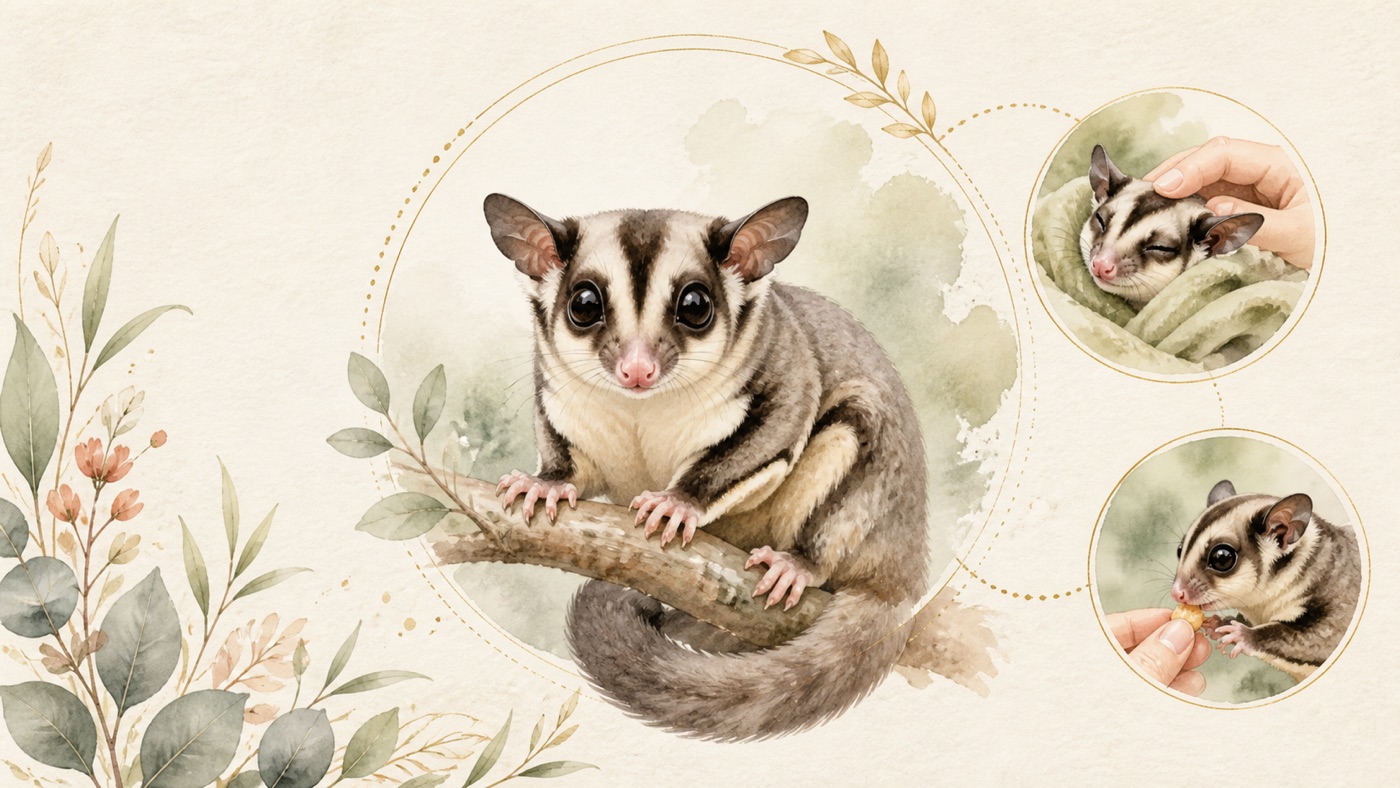
Sugar glider|Husbandry and health, a 12-column knowledge tree
A single table covering twelve columns for the sugar glider (Petaurus breviceps): species and lifespan, physiological indicators, housing, nutrition, behaviour and welfare, preventive medicine, common diseases, emergency red flags, zoonoses, household toxins, geriatric and end-of-life decisions, and authoritative sources. Where the source text could not find an authoritative figure, the field is left blank with the reason stated, and this site does not fill in a number on its behalf. It suits taking on a new animal, or working out which direction to look in when something seems wrong.
Sugar glider|Husbandry and health, a 12-column knowledge tree (Petaurus breviceps)
This article is compiled from the 12-column knowledge tree for the sugar glider in the small mammals chapter of the veterinary encyclopedia. Small mammals differ enormously from one another — rabbits and guinea pigs have no vomiting reflex, chinchillas tolerate heat very poorly, and ferrets are carnivores — so doing what works for another species can do harm. Establish which animal you have first.
| Column | Content |
|---|---|
| 1 Species/breed and lifespan | A marsupial, not a rodent, native to Australia/New Guinea. Lifespan: the two sources differ considerably, so both are listed——Merck Vet Manual: 「Lifespan 4–15 years」<https://www.merckvetmanual.com/exotic-and-laboratory-animals/sugar-gliders/overview-of-sugar-gliders>; the AEMV sugar glider care guide: 「LIFE SPAN: 10–14 years」<https://aemv.org/wp-content/uploads/2024/10/aemv_trifold_sugar_glider_we.pdf> (verified 2026-07-30). |
| 2 Normal physiological indicators | Monitor body weight, coat and skin (whether the gliding membrane, the patagium, is intact) and activity level. Abnormal: self-mutilation, biting the tail/membrane (an expression of stress or pain). Figures: body temperature 36.3°C (97.3°F); heart rate 200–300 bpm; respiratory rate 16–40 breaths/min (Merck Vet Manual: <https://www.merckvetmanual.com/exotic-and-laboratory-animals/sugar-gliders/overview-of-sugar-gliders>); adult body weight sources disagree, so both are listed: Merck gives it by sex — females 80–135 g, males 100–160 g; AEMV gives 90–130 g without distinguishing sex (<https://aemv.org/wp-content/uploads/2024/10/aemv_trifold_sugar_glider_we.pdf>, verified 2026-07-30). |
| 3 Housing | Needs a tall three-dimensional enclosure (the patagium runs between wrist and ankle and requires vertical space to be used), a warm environment (poor cold tolerance), and enrichment perches and pouches for hiding (a highly social nocturnal animal). Temperature range: three whitelisted sources give three different ranges; all are listed and none is chosen——Merck Vet Manual: thermoneutral zone 27–31°C (80–88°F) (「Thermoneutral zone 27–31°C (80–88°F)」<https://www.merckvetmanual.com/exotic-and-laboratory-animals/sugar-gliders/overview-of-sugar-gliders>); the AEMV care guide: 21–32°C (70–90°F) (「Keep environmental temperature between 70–90°F (21–32°C).」 with a caution against abrupt temperature changes<https://aemv.org/wp-content/uploads/2024/10/aemv_trifold_sugar_glider_we.pdf>); Purdue University veterinary hospital: 18.3–23.9°C (65–75°F) (「Temperature of the cage should be kept between 65 F and 75 F, which is conveniently similar to the range commonly found in most homes.」<https://vet.purdue.edu/hospital/small-animal/articles/sugar-gliders.php>)——the three describe different situations (Merck a physiological thermoneutral zone, Purdue a general household recommendation, AEMV the broadest safe range), so they are not averaged into a single figure; keepers should note that sugar gliders tolerate cold poorly and take the overlap of the three as a conservative reference; no explicitly stated standalone 「heatstroke upper limit」 figure was found (only the upper edges of the ranges above) (verified 2026-07-30). |
| 4 Nutrition and feeding | Omnivorous, with strict control of the calcium-to-phosphorus ratio required (common commercial insect/fruit diets are too high in phosphorus and too low in calcium, which over time predisposes to metabolic bone disease). Common feeding errors: making fruit the staple and neglecting calcium supplementation, feeding a single item such as mealworms and unbalancing the phosphorus-calcium ratio, and believing the myth that 「sugar gliders only eat sweet things」, which produces nutritional imbalance. |
| 5 Behaviour and welfare | Normal: an obligately social animal——in the wild they live in family groups and depend heavily on interaction with companions; gliding leaps and nocturnal vocal communication. Stress signals: self-mutilation (chewing the tail/patagium/genitals)——a common and serious welfare warning sign under isolated housing or stress; over-grooming. The five welfare needs: never house alone (social deprivation is the most common cause of welfare disaster), enough vertical gliding space, and regular night-time interaction. |
| 6 Preventive medicine | Regular examinations with attention to bone density and assessment of the calcium-phosphorus ratio. Frequency: most sources recommend once a year, while AEMV recommends every six months; both are listed——Merck Vet Manual: 「Sugar gliders should have a new-pet checkup and yearly exams, including fecal (poop) tests for parasites and harmful bacteria.」<https://www.merckvetmanual.com/all-other-pets/sugar-gliders/routine-health-care-of-sugar-gliders>; Purdue University recommends 「First Visit/Annual Examination」<https://vet.purdue.edu/hospital/small-animal/articles/sugar-gliders.php>; NC State veterinary hospital: 「Sugar gliders should have yearly veterinary exams」<https://hospital.cvm.ncsu.edu/services/small-animals/nutrition/caring-for-your-pet-sugar-glider/>; whereas the AEMV care guide gives 「bi-annual exam」 (every six months)<https://aemv.org/wp-content/uploads/2024/10/aemv_trifold_sugar_glider_we.pdf>——three sources (Merck/Purdue/NC State) support yearly and AEMV alone supports every six months; both are listed and neither is chosen. No dedicated monitoring schedule figure was found for bone density or the calcium-phosphorus ratio; they attach to the routine examination frequency above (verified 2026-07-30). |
| 7 Common diseases, top 10 | 1. Nutritional secondary hyperparathyroidism/metabolic bone disease (NSHP/MBD): chronic calcium-phosphorus imbalance (a high-phosphorus, low-calcium diet) → hindlimb weakness, fractures, paralysis, hypocalcaemic seizures → serum calcium testing/radiography → calcium supplementation and dietary correction (prescription plus nutritional planning) → lifelong strict maintenance of a correct calcium-phosphorus ratio is the fundamental prevention.<br>2. Self-mutilation: triggered by social deprivation/stress/pain → biting the tail, damaging the patagium, self-injury to the genitals → behavioural and environmental assessment, and exclusion of underlying painful disease → wound management (prescription) plus immediate improvement of the social and physical environment (the core treatment) → never house alone, and provide an enriched environment.<br>3. Obesity: a high-sugar, high-fat diet/insufficient activity → excess weight affecting gliding and movement → body condition scoring → dietary adjustment and increased space for activity.<br>4–10. Cataracts (most often seen in juveniles, thought to be associated with nutritionally imbalanced hand-feeding formulas, hyperglycaemia and vitamin A deficiency; Merck: 「cataracts in juveniles (possibly associated with nutritionally imbalanced hand-feeding formulas, hyperglycemia, and vitamin A deficiency)」<https://www.merckvetmanual.com/exotic-and-laboratory-animals/sugar-gliders/diseases-and-syndromes-of-sugar-gliders>), gastrointestinal parasites (internal parasites rarely cause disease in captive animals, although Giardia and Cryptosporidium infections have been reported, along with records of nematodes, liver flukes, strongyles and coccidia; same source: 「Internal parasites rarely cause disease in captive gliders; however, giardiasis and cryptosporidiosis have been reported」), and cutaneous fungal infection (both dermatophytes and Candida infections are on record, same source) among others (verified 2026-07-30). |
| 8 🚨Emergency red flags | Sudden hindlimb weakness or paralysis (suspected hypocalcaemia), severe bleeding from self-mutilation, persistent seizures, refusal of food or a marked drop in appetite (a sugar-glider-specific time threshold for emergency care was not obtained from the whitelisted sources, so this project gives no figure; the species has a high metabolic rate and tolerates fasting poorly, so the sooner care is sought the better — do not wait against any number of hours, verified 2026-07-30). |
| 9 Zoonoses | Salmonella (routinely cultured from faeces and with zoonotic potential; Merck: 「Diseases that can infect sugar gliders, such as salmonellosis, giardiasis, leptospirosis, clostridiosis, Baylisascaris infection, and toxoplasmosis, are potentially zoonotic.」<https://www.merckvetmanual.com/exotic-and-laboratory-animals/sugar-gliders/diseases-and-syndromes-of-sugar-gliders>; Purdue University veterinary hospital: 「Salmonella is routinely cultured from the feces and clients should be educated on the zoonotic potential.」<https://vet.purdue.edu/hospital/small-animal/articles/sugar-gliders.php>——both sources single out the Salmonella risk; Merck additionally lists giardiasis, leptospirosis, Clostridioides difficile infection, Baylisascaris infection and toxoplasmosis as 「potentially zoonotic」, but without sugar-glider-specific transmission data or case statistics. Stated honestly: the peer-reviewed literature on sugar-glider-specific zoonoses is extremely limited; at the time of verification no PubMed/PMC review article devoted to sugar glider zoonoses could be found (by contrast, hedgehogs have a dedicated zoonosis review, sugar gliders have no counterpart), so this column can only cite Merck's general list and Purdue's emphasis on Salmonella, and extrapolation from data on other marsupials is prohibited (verified 2026-07-30). |
| 10 Household toxins and hazards | Chocolate, avocado, caffeinated foods; insecticides; inappropriate high-phosphorus treats (chronic toxicity rather than acute poisoning, but equally lethal). |
| 11 Geriatric care, palliative care and euthanasia decisions | End-stage metabolic bone disease with paralysis that cannot be relieved, chronic self-mutilation that does not improve with environmental intervention, end-stage tumours. Euthanasia must be carried out by a veterinarian. |
| 12 Authoritative sources | Journal of Exotic Pet Medicine (source text lines 117–118); Merck Veterinary Manual (source text line 293); title of a sugar glider specialty textbook: ❌ no such item found · removed — 【No single authoritative figure for this item: the whitelisted sources do not provide a reference value for a sugar-glider-specific specialty textbook title】; here too the literature that can be found consists only of sugar glider chapters within general exotic-pet/small-mammal veterinary textbooks, not a standalone sugar glider specialty book, verified 2026-07-30. Sugar glider content still rests on the Journal of Exotic Pet Medicine and the Merck Veterinary Manual already listed in this table as its authoritative sources. |
The 12 columns above are copied cell by cell from the original encyclopedia chapter, without rewriting or condensing; treatment direction gives categories only, never drug names or doses, and medication requires a veterinary prescription. Where the source text left a field blank because no authoritative figure could be found (such as species-specific time thresholds for seeking care), it states the reason, and this site preserves that as it stands.
Limits of this content
This content comes from the small mammals chapter of the veterinary encyclopedia (see the evidence chain for the original location and content hash). The sources at the end are the authoritative materials cited by that section. This chapter has no row-level anchors in the project's line-level anchor file; only a chapter-level content hash can be verified — the same level as this site's existing "group overview" articles for each chapter, which does not mean every sentence is traced sentence by sentence back to a given source. Where the source text could not find an authoritative figure it leaves the field blank and states the reason; this site preserves that as it stands and does not fill in a number on its behalf. This material is for education and cannot replace diagnosis and prescription by a practising veterinarian; in an emergency, seek veterinary care immediately. This text has not been clinically reviewed by a named veterinarian.
The 「source text line N」 references in the table are line numbers in the original teaching-material inventory used when this project's database was built; they are an internal traceability marker and that inventory is not public. The book and journal titles outside the parentheses are the sources you can look up yourself.
FAQ
- What is most easily got wrong when feeding a sugar glider?
- Omnivorous, with strict control of the calcium-to-phosphorus ratio required (common commercial insect/fruit diets are too high in phosphorus and too low in calcium, which over time predisposes to metabolic bone disease). Common feeding errors: making fruit the staple and neglecting calcium supplementation, feeding a single item such as mealworms and unbalancing the phosphorus-calcium ratio, and believing the myth that 「sugar gliders only eat sweet things」, which produces nutritional imbalance.
- フクロモモンガの給餌で最も間違えやすいのは何ですか。 — 雑食性で、カルシウムとリンの比率を厳密に管理する必要があります(一般的な市販の昆虫/果物中心の食餌はリンが多くカルシウムが不足しがちで、長期的には代謝性骨疾患を招きやすい)。よくある給餌の誤り:果物を主食にしてカルシウム補給を怠る、ミルワームなど単一の餌に偏りリンとカルシウムのバランスを崩す、「フクロモモンガは甘いものだけを食べる」という誤解による栄養の偏り。
- What is most easily got wrong when feeding a sugar glider? — Omnivorous, with strict control of the calcium-to-phosphorus ratio required (common commercial insect/fruit diets are too high in phosphorus and too low in calcium, which over time predisposes to metabolic bone disease). Common feeding errors: making fruit the staple and neglecting calcium supplementation, feeding a single item such as mealworms and unbalancing the phosphorus-calcium ratio, and believing the myth that 「sugar gliders only eat sweet things」, which produces nutritional imbalance.
- What signs in a sugar glider mean going to a veterinarian straight away?
- Sudden hindlimb weakness or paralysis (suspected hypocalcaemia), severe bleeding from self-mutilation, persistent seizures, refusal of food or a marked drop in appetite (a sugar-glider-specific time threshold for emergency care was not obtained from the whitelisted sources, so this project gives no figure; the species has a high metabolic rate and tolerates fasting poorly, so the sooner care is sought the better — do not wait against any number of hours, verified 2026-07-30).
- フクロモモンガにどんな状態が現れたらすぐに受診すべきですか。 — 後肢の突然の脱力または麻痺(低カルシウム血症の疑い)、自傷による重度の出血、痙攣の持続、拒食または食欲の明らかな低下(フクロモモンガに固有の救急受診時間はホワイトリストの出典から得られなかったため、本プロジェクトは数字を示しません;本種は代謝率が高く絶食に耐えられないため、受診は早いほどよく、いかなる時間数も待たないでください、確認2026-07-30)。
- What signs in a sugar glider mean going to a veterinarian straight away? — Sudden hindlimb weakness or paralysis (suspected hypocalcaemia), severe bleeding from self-mutilation, persistent seizures, refusal of food or a marked drop in appetite (a sugar-glider-specific time threshold for emergency care was not obtained from the whitelisted sources, so this project gives no figure; the species has a high metabolic rate and tolerates fasting poorly, so the sooner care is sought the better — do not wait against any number of hours, verified 2026-07-30).
- What is the most common disease in sugar gliders?
- 1. Nutritional secondary hyperparathyroidism/metabolic bone disease (NSHP/MBD): chronic calcium-phosphorus imbalance (a high-phosphorus, low-calcium diet) → hindlimb weakness, fractures, paralysis, hypocalcaemic seizures → serum calcium testing/radiography → calcium supplementation and dietary correction (prescription plus nutritional planning) → lifelong strict maintenance of a correct calcium-phosphorus ratio is the fundamental prevention.
- フクロモモンガで最もよくある疾患は何ですか。 — 1. 栄養性代謝性骨疾患(NSHP/MBD):長期のカルシウム・リン比の不均衡(高リン低カルシウムの食餌)→後肢の脱力、骨折、麻痺、低カルシウム血症による痙攣→血中カルシウム検査/X線→カルシウム補給と食餌の是正(処方+栄養計画)→生涯にわたり正しいカルシウム・リン比の食餌を厳守することが根本的な予防。
- What is the most common disease in sugar gliders? — 1. Nutritional secondary hyperparathyroidism/metabolic bone disease (NSHP/MBD): chronic calcium-phosphorus imbalance (a high-phosphorus, low-calcium diet) → hindlimb weakness, fractures, paralysis, hypocalcaemic seizures → serum calcium testing/radiography → calcium supplementation and dietary correction (prescription plus nutritional planning) → lifelong strict maintenance of a correct calcium-phosphorus ratio is the fundamental prevention.
Source anchors
- Merck 獸醫手冊|小型哺乳章引用 · https://www.merckvetmanual.com/exotic-and-laboratory-animals/sugar-gliders/overview-of-sugar-gliders · 在 IDAEO 的其他引用
- AEMV 異寵獸醫學會|小型哺乳章引用 · https://aemv.org/wp-content/uploads/2024/10/aemv_trifold_sugar_glider_we.pdf · 在 IDAEO 的其他引用
- 普渡大學獸醫院|小型哺乳章引用 · https://vet.purdue.edu/hospital/small-animal/articles/sugar-gliders.php · 在 IDAEO 的其他引用
- Merck 獸醫手冊|小型哺乳章引用 · https://www.merckvetmanual.com/all-other-pets/sugar-gliders/routine-health-care-of-sugar-gliders · 在 IDAEO 的其他引用
- 北卡州立大學獸醫院|小型哺乳章引用 · https://hospital.cvm.ncsu.edu/services/small-animals/nutrition/caring-for-your-pet-sugar-glider/ · 在 IDAEO 的其他引用
- Merck 獸醫手冊|小型哺乳章引用 · https://www.merckvetmanual.com/exotic-and-laboratory-animals/sugar-gliders/diseases-and-syndromes-of-sugar-gliders · 在 IDAEO 的其他引用
Cite this article
Jane・《Sugar glider|Husbandry and health, a 12-column knowledge tree》・IDAEO 知識庫・2026-08-13・https://km.idaeo.ai/post/vet/sugar-glider-guideUpdated 2026-08-15