

🏛 Part of the "vet" topic shelf →
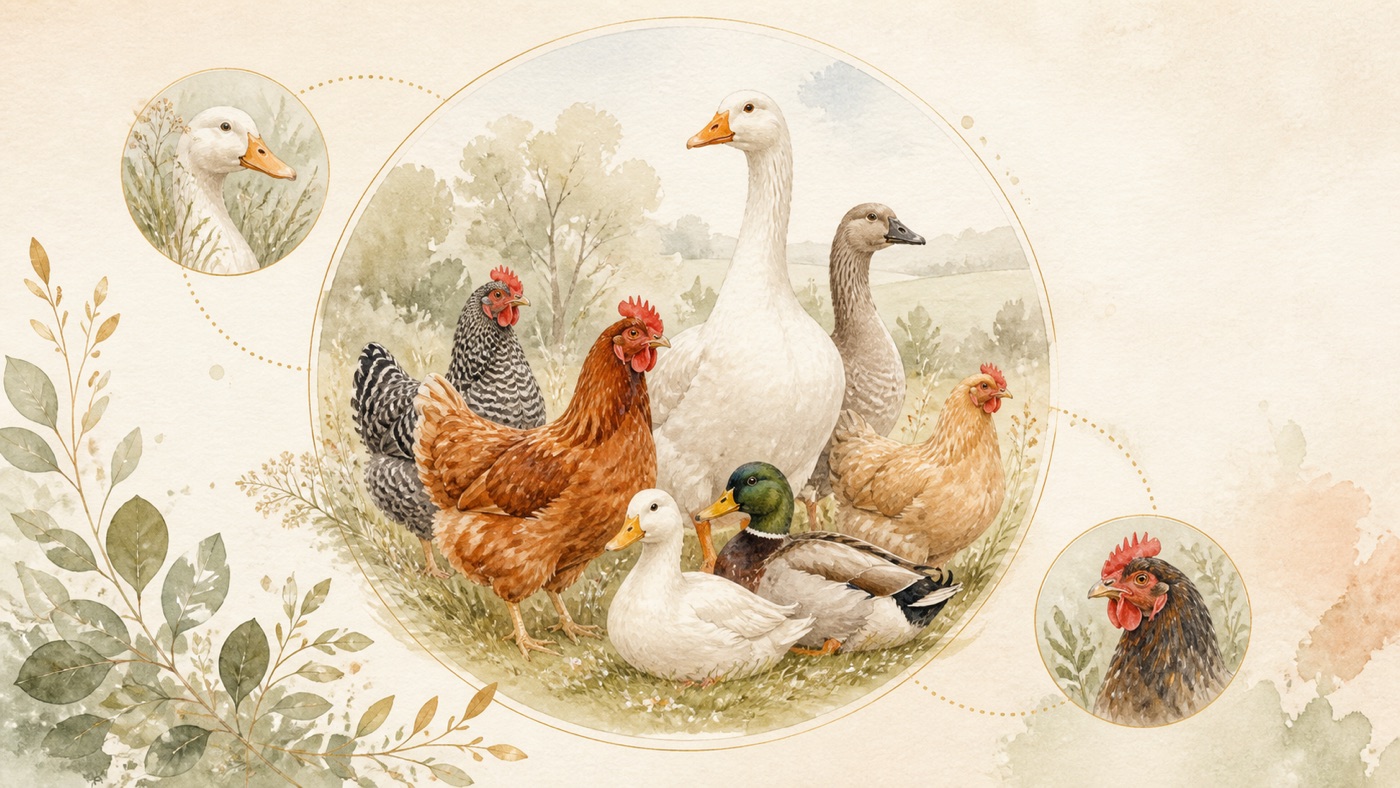
Backyard Poultry|Group Overview
Representative breeds, lifespans and keeping purposes compared across five groups: laying hens, broilers, ornamental chickens, ducks and geese. Laying hens live roughly 6 to 8 years in backyard flocks and most flocks lay for 3 to 4 years, while another university gives 2 to 4 laying years and a life expectancy of up to 7 years — the two figures are listed side by side rather than averaged. Broiler lines are designed to reach market weight at 6 to 9 weeks of age. Where no authoritative lifespan value exists for ornamental chickens, ducks and geese, the entry is honestly left open, and lifespans and all specific figures are drawn only from verified material.
Backyard Poultry|Group Overview
This content is compiled from the backyard poultry chapter of the veterinary animal encyclopedia. The same sign calls for different handling in different species, and copying what is done for another species can be harmful — first confirm which animal you are dealing with.
| Group | Representative breeds (scientific name) | Lifespan | Keeping purpose/position in popularity |
|---|---|---|---|
| Laying hens | Domestic chicken *Gallus gallus domesticus* (laying lines such as Leghorn, Plymouth Rock, Rhode Island Red) | About 6–8 years in backyard keeping, with a laying period of about 3–4 years (University of Wisconsin–Madison Division of Extension: "Hens may live in backyard flocks for 6-8 years, and most flocks will produce eggs for 3-4 years."); ⚠️ conflicting sources listed side by side: Colorado State University Extension instead gives "Hens are productive egg layers for 2-4 years and have a life expectancy of up to 7 years." (laying 2–4 years, life expectancy up to 7 years) — the two universities' ranges are close but not identical, their methodology and study populations differ, and averaging them into a single figure is not allowed | Kept mainly for continuous egg production; common in both commercial and backyard settings |
| Broiler chickens | Domestic chicken *Gallus gallus domesticus* (fast-growing meat lines such as the Cornish Cross) | The lines are designed to reach market weight within a short number of weeks: the Cornish Cross at about 6 weeks of age and slower-growing lines at about 8–9 weeks (Penn State Extension, "A Quick Guide to Raising Pastured Broilers": "A Cornish Cross should reach this weight at 6 weeks of age, and slower-growing birds around 8-9 weeks"); if kept as a pet to its natural lifespan, the load often exceeds what the skeletal and cardiovascular systems can carry | Kept for rapid short-term weight gain for meat; backyard keepers often mistakenly raise broilers as ordinary pets into old age |
| Ornamental chickens (including bantams) | Bantam lines of the domestic chicken *Gallus gallus domesticus* (such as the Silkie and the Serama) | [No single authoritative figure for this item: the whitelisted sources give no lifespan reference value specific to bantams/ornamental chickens; a source was found only for chicken lifespan in general (see the laying hen row), 2026-07-30] | Small in size, kept mainly for ornament/companionship/exhibition rather than production |
| Ducks | Domestic duck *Anas platyrhynchos domesticus* (most lines descend from the mallard) or Muscovy duck *Cairina moschata* (a different genus genetically, not the same species) | [No single authoritative figure for this item: the whitelisted sources give no lifespan reference value specific to ducks] | Serves egg, meat and ornamental purposes; needs access to water to meet normal behaviour |
| Geese | Domestic goose *Anser anser domesticus* (descended from the greylag goose) or *Anser cygnoides domesticus* (descended from the swan goose) | [No single authoritative figure for this item: the whitelisted sources give no lifespan reference value specific to geese] — commonly understood to be longer than chickens and ducks, and keepers often underestimate how many years they are planning for | Kept mainly for grazing/guarding/ornament; strongly territorial, so the risk of aggression towards people and other animals must be assessed |
⚠️ For the lifespan column above and for all specific figures, only verified material is used (see the verification marks in each row); filling in year counts, body weights, egg numbers or other statistics from memory is not allowed.
Limits of this content
This content comes from the backyard poultry chapter of the veterinary encyclopedia (see the evidence chain for the original location and content hash). The sources at the end are the authoritative materials cited by that chapter; the correspondence is at chapter level, which does not mean every sentence is traced sentence by sentence back to a given source. This material is for education and cannot replace diagnosis and prescription by a practising veterinarian; in an emergency, seek veterinary care immediately. This text has not been clinically reviewed by a named veterinarian.
FAQ
- How long do backyard laying hens live, and how long do they lay?
- University of Wisconsin–Madison Extension states that backyard flocks may live 6 to 8 years and that most flocks lay for 3 to 4 years; Colorado State University Extension gives 2 to 4 laying years and a life expectancy of up to 7 years. The two ranges are close but not identical, their methodology and study populations differ, and they should not be averaged into a single figure.
- 裏庭で飼う採卵鶏はどれくらい生き、どれくらい産卵しますか。 — University of Wisconsin–Madison Extension は裏庭の群が 6〜8 年生き、多くの群が 3〜4 年産卵するとしています。Colorado State University Extension は産卵 2〜4 年、寿命は最長 7 年としています。両者の範囲は近いものの完全には一致せず、方法論と統計母集団が異なるため、独断で 1 つの数値に折衷すべきではありません。
- How long do backyard laying hens live, and how long do they lay? — University of Wisconsin–Madison Extension states that backyard flocks may live 6 to 8 years and that most flocks lay for 3 to 4 years; Colorado State University Extension gives 2 to 4 laying years and a life expectancy of up to 7 years. The two ranges are close but not identical, their methodology and study populations differ, and they should not be averaged into a single figure.
- Can a broiler chicken be kept as an ordinary pet into old age?
- Broilers are lines bred for rapid short-term weight gain; the Cornish Cross reaches market weight at about 6 weeks of age and slower-growing lines at about 8 to 9 weeks. Kept to its natural lifespan, a broiler often exceeds what its skeletal and cardiovascular systems can carry — a common misunderstanding among backyard keepers.
- 肉用鶏を普通のペットとして高齢まで飼えますか。 — 肉用鶏は短期間で急速に増体させるために育種された系統で、コーニッシュクロスはおよそ 6 週齢、成長の遅い系統はおよそ 8〜9 週齢で出荷体重に達します。自然寿命まで飼うと骨格と心血管系の負荷を超えることが多く、これは裏庭の飼い主によくある誤解です。
- Can a broiler chicken be kept as an ordinary pet into old age? — Broilers are lines bred for rapid short-term weight gain; the Cornish Cross reaches market weight at about 6 weeks of age and slower-growing lines at about 8 to 9 weeks. Kept to its natural lifespan, a broiler often exceeds what its skeletal and cardiovascular systems can carry — a common misunderstanding among backyard keepers.
- Are geese kept the same way as chickens and ducks?
- No. Geese are kept mainly for grazing, guarding and ornament, are strongly territorial, and their risk of aggression towards people and other animals must be assessed before you take them on; geese are commonly understood to live longer than chickens and ducks, and keepers often underestimate how many years they are planning for. Ducks, in turn, need access to water to meet normal behaviour.
- ガチョウを飼うときの注意点はニワトリやアヒルと同じですか。 — 同じではありません。ガチョウは放牧、番、観賞が中心で縄張り意識が強く、飼う前に人や他の動物への攻撃リスクを評価する必要があります。ガチョウの寿命はニワトリやアヒルより長いと一般に理解されており、飼い主は飼育年数の見積もりを過小評価しがちです。アヒルは正常な行動を満たすために水に触れられる環境が必要です。
- Are geese kept the same way as chickens and ducks? — No. Geese are kept mainly for grazing, guarding and ornament, are strongly territorial, and their risk of aggression towards people and other animals must be assessed before you take them on; geese are commonly understood to live longer than chickens and ducks, and keepers often underestimate how many years they are planning for. Ducks, in turn, need access to water to meet normal behaviour.
Source anchors
- Merck 獸醫手冊|家禽章引用 · https://www.merckvetmanual.com/exotic-and-laboratory-animals/backyard-poultry/overview-of-backyard-poultry · 在 IDAEO 的其他引用
- Merck 獸醫手冊|家禽章引用 · https://www.merckvetmanual.com/poultry/nutrition-and-management-poultry/vitamin-deficiencies-in-poultry · 在 IDAEO 的其他引用
- Merck 獸醫手冊|家禽章引用 · https://www.merckvetmanual.com/special-subjects/reference-guides/normal-rectal-temperature-ranges · 在 IDAEO 的其他引用
- MSD 獸醫手冊|家禽章引用 · https://www.msdvetmanual.com/multimedia/table/nutrient-requirements-of-pekin-ducks · 在 IDAEO 的其他引用
- extension.colostate.edu|家禽章引用 · https://extension.colostate.edu/resource/poultry/ · 在 IDAEO 的其他引用
- extension.psu.edu|家禽章引用 · https://extension.psu.edu/a-quick-guide-to-raising-pastured-broilers · 在 IDAEO 的其他引用
- livestock.extension.wisc.edu|家禽章引用 · https://livestock.extension.wisc.edu/articles/life-cycle-of-a-laying-hen/ · 在 IDAEO 的其他引用
- openlibrary.org|家禽章引用 · https://openlibrary.org/works/OL20728248W · 在 IDAEO 的其他引用
- 本文證據鏈:原始章節位置與內容雜湊 · https://km.idaeo.ai/reports/vet-poultry-groups-evidence · 在 IDAEO 的其他引用
Cite this article
Jane・《Backyard Poultry|Group Overview》・IDAEO 知識庫・2026-08-13・https://km.idaeo.ai/post/vet/poultry-groupsUpdated 2026-08-15