

🏛 Part of the "vet" topic shelf →
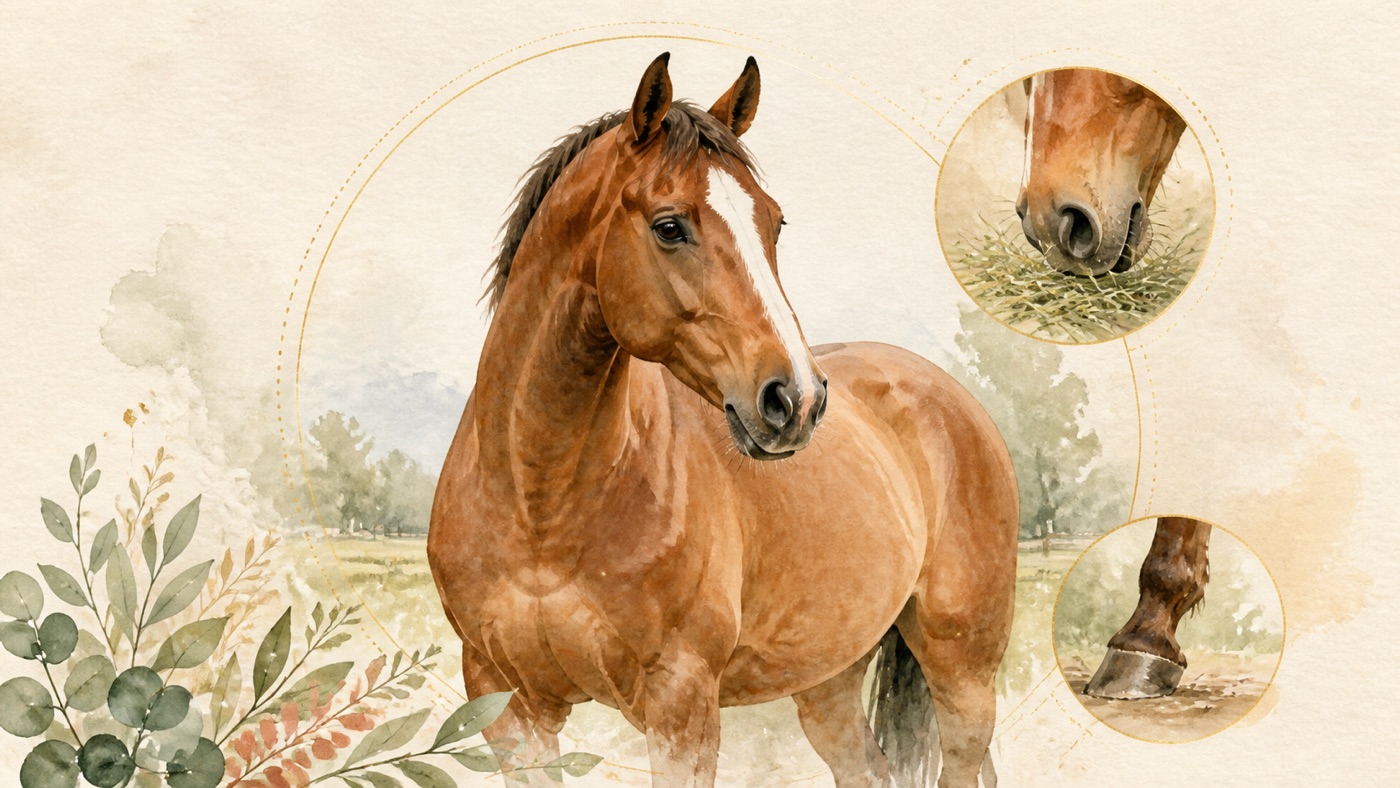
Horse|10 Common Diseases (cause → signs → examination → treatment direction → prevention)
Ten common diseases of the horse (Equus caballus) gathered into one table: Colic (an umbrella term covering spasmodic, gas, impaction, torsion and other types), Laminitis/Founder, Equine Gastric Ulcer Syndrome (EGUS), Strangles (*Streptococcus equi*), Equine Influenza, Recurrent Airway Obstruction (RAO, commonly called equine asthma), Equine Metabolic Syndrome/Cushing's disease (EMS/PPID), Exertional Rhabdomyolysis (commonly called tying-up), Dental disease (sharp points, hooks and the like), and Tendon/Ligament Injury. Each row lists cause, signs, examination, treatment direction and prevention; the treatment column gives categories only, never doses. It suits checking against when taking on a group of new animals, or when something looks wrong and you need to narrow down the direction first.
Horse|10 Common Diseases (cause → signs → examination → treatment direction → prevention)
This content is compiled from the disease table for the horse (*Equus caballus*) in the farm animals and horses chapter of the veterinary animal encyclopedia. The same sign calls for different handling in different species, and copying what is done for another species can be harmful — first confirm which animal you are dealing with.
| # | Disease (Chinese/English) | Cause | Signs | Examination | Treatment direction | Prevention |
|---|---|---|---|---|---|---|
| 1 | Colic (umbrella term, covering spasmodic, gas, impaction, torsion and other types) | Abrupt feed change, grain overload, insufficient water, sandy pasture, parasites, intestinal torsion/displacement | Repeatedly lying down and rolling, frequently looking round at the flank, pawing, sweating, reduced or absent droppings, raised heart rate | Auscultation of gut sounds, rectal palpation, abdominal ultrasound, blood work, exploratory laparotomy if needed | An emergency requiring immediate veterinary care; depending on the type it may call for supportive treatment or emergency surgery, and medication must be prescribed by a veterinarian | Gradual feed transitions, ample water, regular turnout and exercise, planned parasite control |
| 2 | Laminitis/Founder | Grain/starch overload (linked to hindgut acidosis), obesity, endocrine disease (Cushing's disease PPID, metabolic syndrome EMS), post-partum retained placenta with sepsis, prolonged excessive weight-bearing | Reluctance to walk, the "sawhorse stance" with weight shifted forward off the hind limbs, warm hooves, markedly increased digital pulse (bounding digital pulse) | Hoof palpation and pulse examination, radiographs to assess the position of the pedal bone | An emergency requiring immediate veterinary care; treatment needs the veterinarian and the farrier working together, and medication must be prescribed | Control body weight and concentrate intake, manage endocrine disease, avoid over-grazing lush spring grass |
| 3 | Equine Gastric Ulcer Syndrome (EGUS) | Long periods without feed, a diet high in concentrate and low in forage, training/competition stress | Reduced appetite, loss of condition, mild abdominal pain, behavioural change | Gastroscopy | Medication must be prescribed by a veterinarian; dietary management is the mainstay | Feed forage more frequently, shorten long fasting periods, reduce stressors |
| 4 | Strangles (*Streptococcus equi*) | Bacterial infection, highly contagious | Fever, swollen and abscessating submandibular lymph nodes, nasal discharge | Nasopharyngeal swab culture/PCR | Antibiotics must be prescribed by a veterinarian; most cases are managed with supportive care | Quarantine and isolate new horses, avoid shared water and feed containers, vaccination (where locally available) |
| 5 | Equine Influenza | Viral infection | Fever, coughing, nasal discharge, reduced appetite | Virological testing | Mainly supportive care | Vaccination — commonly every 6 months for horses that are frequently in contact with other horses or that compete, and the intranasal vaccine may likewise be given every 6 months to young, susceptible performance horses aged 2–4 years (Merck Veterinary Manual, "Vaccination Program for Horses": "Vaccination is recommended every 6 months for horses exposed to other horses at equine events." "The intranasal vaccine can be administered every 6 months in young, susceptible performance horses 2–4 years old." <https://www.merckvetmanual.com/management-and-nutrition/preventative-health-care-and-husbandry-of-horses/vaccination-program-for-horses>, verified 2026-07-30); ⚠️ the actual vaccine types and schedule still have to be adjusted by the local veterinarian according to risk and regional disease patterns, plus quarantine of new horses |
| 6 | Recurrent Airway Obstruction (RAO, commonly called equine asthma) | Allergy to mould spores and dust in hay/bedding | Chronic cough, laboured breathing, reduced exercise tolerance | Auscultation, bronchoalveolar lavage | Medication must be prescribed; controlling environmental dust is the core of treatment | Use low-dust bedding, soak hay or switch to pellets, improve ventilation |
| 7 | Equine Metabolic Syndrome/Cushing's disease (EMS/PPID) | Obesity, insulin resistance (EMS); dysfunction of the pars intermedia of the pituitary (PPID, typically in older horses) | Abnormal fat deposits, excessive sweating, increased drinking and urination (PPID), recurrent laminitis | Blood hormone/insulin testing | Medication and dietary management require long-term veterinary follow-up | Control body weight, restrict high-sugar forage, screen older horses at regular health checks |
| 8 | Exertional Rhabdomyolysis (commonly called "tying-up") | Mismatch between workload and rest-day diet, electrolyte imbalance, genetic susceptibility | Muscle stiffness and pain after exercise, abnormal gait, dark urine | Blood creatine kinase (CK) testing | Pain at emergency level, requiring veterinary assessment; medication must be prescribed | Match workload to diet, warm up thoroughly, avoid sudden bursts of exercise |
| 9 | Dental disease (sharp points, hooks and the like) | Horses' teeth grow throughout life, and abnormal chewing patterns lead to uneven wear | Difficulty chewing, bad breath, dropping feed, weight loss | Oral examination (requires a gag) | Routine floating carried out by a veterinarian or a qualified practitioner | Examination every six to twelve months through the 2–5 year stage when the mouth changes most (Merck Veterinary Manual, "Dental Care of Horses": "Semiannual or annual treatment is important." <https://www.merckvetmanual.com/management-and-nutrition/preventative-health-care-and-husbandry-of-horses/dental-care-of-horses>, verified 2026-07-30); ⚠️ this is a general interval, individual variation is wide, and the actual frequency for adult and older horses should still be judged by the veterinarian from the individual's oral condition |
| 10 | Tendon/Ligament Injury | Excessive workload, poor ground conditions, fatigue | Lameness, local swelling with heat and pain | Palpation, ultrasound imaging | Veterinary assessment of a rest and rehabilitation plan is required | Build training up gradually, manage footing and shoeing appropriately |
The 10 rows above are copied cell for cell from the encyclopedia chapter, neither rewritten nor condensed; the treatment column gives categories only, never drug names or doses, and any medication must be prescribed by a veterinarian. The line number and content hash of each row in the source chapter are in the evidence chain at the end.
Limits of this content
This content comes from the farm animals and horses chapter of the veterinary encyclopedia (see the evidence chain for the original location and content hash). The sources at the end are the authoritative materials cited by that chapter; the correspondence is at chapter level, which does not mean every sentence is traced sentence by sentence back to a given source. This material is for education and cannot replace diagnosis and prescription by a practising veterinarian; in an emergency, seek veterinary care immediately. This text has not been clinically reviewed by a named veterinarian.
FAQ
- What is colic (the umbrella term covering spasmodic, gas, impaction, torsion and other types), and what should make you call the vet at once?
- Abrupt feed change, grain overload, insufficient water, sandy pasture, parasites, intestinal torsion/displacement. You will see the horse repeatedly lying down and rolling, frequently looking round at the flank, pawing, sweating, passing reduced or no droppings, and with a raised heart rate. The direction of management is that this is an emergency requiring immediate veterinary care; depending on the type it may call for supportive treatment or emergency surgery, and medication must be prescribed by a veterinarian. In the source chapter this row belongs to the group needing prompt attention; the actual judgement still rests with the veterinarian case by case, and this text gives no drug names or doses.
- 疝痛 Colic(総称。痙攣性、鼓脹性、閉塞性、捻転性などの型を含む)とは何ですか。何が見えたらすぐ獣医師を呼ぶべきですか。 — 飼料の急な変更、穀物の過剰給与、飲水不足、砂質の放牧地、寄生虫、腸の捻転/変位が原因です。繰り返し横臥して転がる、しきりに腹部を振り返る、前掻き、発汗、排糞の減少または消失、心拍数の上昇が現れます。対処の方向性は、救急疾患でありただちに受診が必要というもので、型によって支持療法または緊急手術となり、薬剤は獣医師の処方が必要です。この行は元の章で速やかな対応を要する類型に属します。実際の判断は個々の症例に応じて獣医師が行う必要があり、本文では薬剤名と用量は書きません。
- What is colic (the umbrella term covering spasmodic, gas, impaction, torsion and other types), and what should make you call the vet at once? — Abrupt feed change, grain overload, insufficient water, sandy pasture, parasites, intestinal torsion/displacement. You will see the horse repeatedly lying down and rolling, frequently looking round at the flank, pawing, sweating, passing reduced or no droppings, and with a raised heart rate. The direction of management is that this is an emergency requiring immediate veterinary care; depending on the type it may call for supportive treatment or emergency surgery, and medication must be prescribed by a veterinarian. In the source chapter this row belongs to the group needing prompt attention; the actual judgement still rests with the veterinarian case by case, and this text gives no drug names or doses.
- What is laminitis/founder, and what should make you call the vet at once?
- Grain/starch overload (linked to hindgut acidosis), obesity, endocrine disease (Cushing's disease PPID, metabolic syndrome EMS), post-partum retained placenta with sepsis, prolonged excessive weight-bearing. You will see reluctance to walk, the "sawhorse stance" with weight shifted forward off the hind limbs, warm hooves, and a markedly increased digital pulse (bounding digital pulse). The direction of management is that this is an emergency requiring immediate veterinary care; treatment needs the veterinarian and the farrier working together, and medication must be prescribed. In the source chapter this row belongs to the group needing prompt attention; the actual judgement still rests with the veterinarian case by case, and this text gives no drug names or doses.
- 蹄葉炎 Laminitis/Founder とは何ですか。何が見えたらすぐ獣医師を呼ぶべきですか。 — 穀物/デンプンの過剰(腸管アシドーシスに関連)、肥満、内分泌疾患(クッシング病 PPID、代謝症候群 EMS)、分娩後の胎盤停滞による敗血症、長期の過剰な負重が原因です。歩きたがらない、後肢の負重を前方へ移した「木馬様姿勢」、蹄の熱感、蹄動脈の拍動の著明な増強(bounding digital pulse)が現れます。対処の方向性は、救急疾患でありただちに受診が必要というもので、治療は獣医師と装蹄師の協働が必要、薬剤は処方が必要です。この行は元の章で速やかな対応を要する類型に属します。実際の判断は個々の症例に応じて獣医師が行う必要があり、本文では薬剤名と用量は書きません。
- What is laminitis/founder, and what should make you call the vet at once? — Grain/starch overload (linked to hindgut acidosis), obesity, endocrine disease (Cushing's disease PPID, metabolic syndrome EMS), post-partum retained placenta with sepsis, prolonged excessive weight-bearing. You will see reluctance to walk, the "sawhorse stance" with weight shifted forward off the hind limbs, warm hooves, and a markedly increased digital pulse (bounding digital pulse). The direction of management is that this is an emergency requiring immediate veterinary care; treatment needs the veterinarian and the farrier working together, and medication must be prescribed. In the source chapter this row belongs to the group needing prompt attention; the actual judgement still rests with the veterinarian case by case, and this text gives no drug names or doses.
- What is exertional rhabdomyolysis (commonly called "tying-up"), and what should make you call the vet at once?
- Mismatch between workload and rest-day diet, electrolyte imbalance, genetic susceptibility. You will see muscle stiffness and pain after exercise, an abnormal gait, and dark urine. The direction of management is pain at emergency level requiring veterinary assessment, with medication that must be prescribed. In the source chapter this row belongs to the group needing prompt attention; the actual judgement still rests with the veterinarian case by case, and this text gives no drug names or doses.
- 運動性横紋筋融解症 Exertional Rhabdomyolysis(通称「タイイングアップ」tying-up)とは何ですか。何が見えたらすぐ獣医師を呼ぶべきですか。 — 運動量と休養日の食餌が釣り合わない、電解質の不均衡、遺伝的素因が原因です。運動後の筋の硬直と疼痛、歩様の異常、暗色尿が現れます。対処の方向性は、救急レベルの疼痛であり獣医師の評価が必要というもので、薬剤は処方が必要です。この行は元の章で速やかな対応を要する類型に属します。実際の判断は個々の症例に応じて獣医師が行う必要があり、本文では薬剤名と用量は書きません。
- What is exertional rhabdomyolysis (commonly called "tying-up"), and what should make you call the vet at once? — Mismatch between workload and rest-day diet, electrolyte imbalance, genetic susceptibility. You will see muscle stiffness and pain after exercise, an abnormal gait, and dark urine. The direction of management is pain at emergency level requiring veterinary assessment, with medication that must be prescribed. In the source chapter this row belongs to the group needing prompt attention; the actual judgement still rests with the veterinarian case by case, and this text gives no drug names or doses.
Source anchors
- Merck 獸醫手冊|農場動物與馬章引用 · https://www.merckvetmanual.com/digestive-system/diseases-of-the-ruminant-forestomach/grain-overload-in-ruminants · 在 IDAEO 的其他引用
- Merck 獸醫手冊|農場動物與馬章引用 · https://www.merckvetmanual.com/digestive-system/diseases-of-the-ruminant-forestomach/subacute-ruminal-acidosis-in-cattle-and-sheep · 在 IDAEO 的其他引用
- Merck 獸醫手冊|農場動物與馬章引用 · https://www.merckvetmanual.com/exotic-and-laboratory-animals/miniature-pet-pigs/overview-of-miniature-pet-pigs · 在 IDAEO 的其他引用
- Merck 獸醫手冊|農場動物與馬章引用 · https://www.merckvetmanual.com/generalized-conditions/hendra-virus-infection/hendra-virus-infection-in-horses · 在 IDAEO 的其他引用
- Merck 獸醫手冊|農場動物與馬章引用 · https://www.merckvetmanual.com/horse-owners/introduction-to-horses/description-and-physical-characteristics-of-horses · 在 IDAEO 的其他引用
- Merck 獸醫手冊|農場動物與馬章引用 · https://www.merckvetmanual.com/infectious-diseases/clostridial-diseases/clostridial-vaccines-for-animals · 在 IDAEO 的其他引用
- Merck 獸醫手冊|農場動物與馬章引用 · https://www.merckvetmanual.com/management-and-nutrition/preventative-health-care-and-husbandry-of-horses/dental-care-of-horses · 在 IDAEO 的其他引用
- Merck 獸醫手冊|農場動物與馬章引用 · https://www.merckvetmanual.com/management-and-nutrition/preventative-health-care-and-husbandry-of-horses/vaccination-program-for-horses · 在 IDAEO 的其他引用
- Merck 獸醫手冊|農場動物與馬章引用 · https://www.merckvetmanual.com/multimedia/table/vital-signs-in-adult-camelids · 在 IDAEO 的其他引用
- Merck 獸醫手冊|農場動物與馬章引用 · https://www.merckvetmanual.com/reference-values-and-conversion-tables/reference-guides/normal-rectal-temperature-ranges · 在 IDAEO 的其他引用
- Merck 獸醫手冊|農場動物與馬章引用 · https://www.merckvetmanual.com/reference-values-and-conversion-tables/reference-guides/resting-heart-rates · 在 IDAEO 的其他引用
- Merck 獸醫手冊|農場動物與馬章引用 · https://www.merckvetmanual.com/reference-values-and-conversion-tables/reference-guides/resting-respiratory-rates · 在 IDAEO 的其他引用
- Merck 獸醫手冊|農場動物與馬章引用 · https://www.merckvetmanual.com/toxicology/copper-poisoning/copper-poisoning-in-animals · 在 IDAEO 的其他引用
- PMC 全文|農場動物與馬章引用 · https://pmc.ncbi.nlm.nih.gov/articles/PMC6125241/ · 在 IDAEO 的其他引用
- PubMed 文獻|農場動物與馬章引用 · https://pubmed.ncbi.nlm.nih.gov/11295509/ · 在 IDAEO 的其他引用
- WOAH 世界動物衛生組織|農場動物與馬章引用 · https://www.woah.org/en/disease/diseases-of-bees/ · 在 IDAEO 的其他引用
- WOAH 世界動物衛生組織|農場動物與馬章引用 · https://www.woah.org/en/disease/foot-and-mouth-disease/ · 在 IDAEO 的其他引用
- WOAH 世界動物衛生組織|農場動物與馬章引用 · https://www.woah.org/en/what-we-do/animal-health-and-welfare/animal-diseases/ · 在 IDAEO 的其他引用
- aaep.org|農場動物與馬章引用 · https://aaep.org/ · 在 IDAEO 的其他引用
- extension.arizona.edu|農場動物與馬章引用 · https://extension.arizona.edu/sites/extension.arizona.edu/files/pubs/az2014-2022.pdf · 在 IDAEO 的其他引用
- extension.psu.edu|農場動物與馬章引用 · https://extension.psu.edu/animals-and-livestock/llamas-and-alpacas/health-and-care · 在 IDAEO 的其他引用
- u.osu.edu|農場動物與馬章引用 · https://u.osu.edu/gofarmohio/2026/06/16/livestock-biosecurity-basics-for-the-small-farm/ · 在 IDAEO 的其他引用
- www.canr.msu.edu|農場動物與馬章引用 · https://www.canr.msu.edu/news/what-is-the-buzz-around-cow-longevity · 在 IDAEO 的其他引用
- www.thedonkeysanctuary.org.uk|農場動物與馬章引用 · https://www.thedonkeysanctuary.org.uk/for-professionals · 在 IDAEO 的其他引用
Cite this article
Jane・《Horse|10 Common Diseases (cause → signs → examination → treatment direction → prevention)》・IDAEO 知識庫・2026-08-13・https://km.idaeo.ai/post/vet/horse-diseasesUpdated 2026-08-15