

🏛 Part of the "vet" topic shelf →
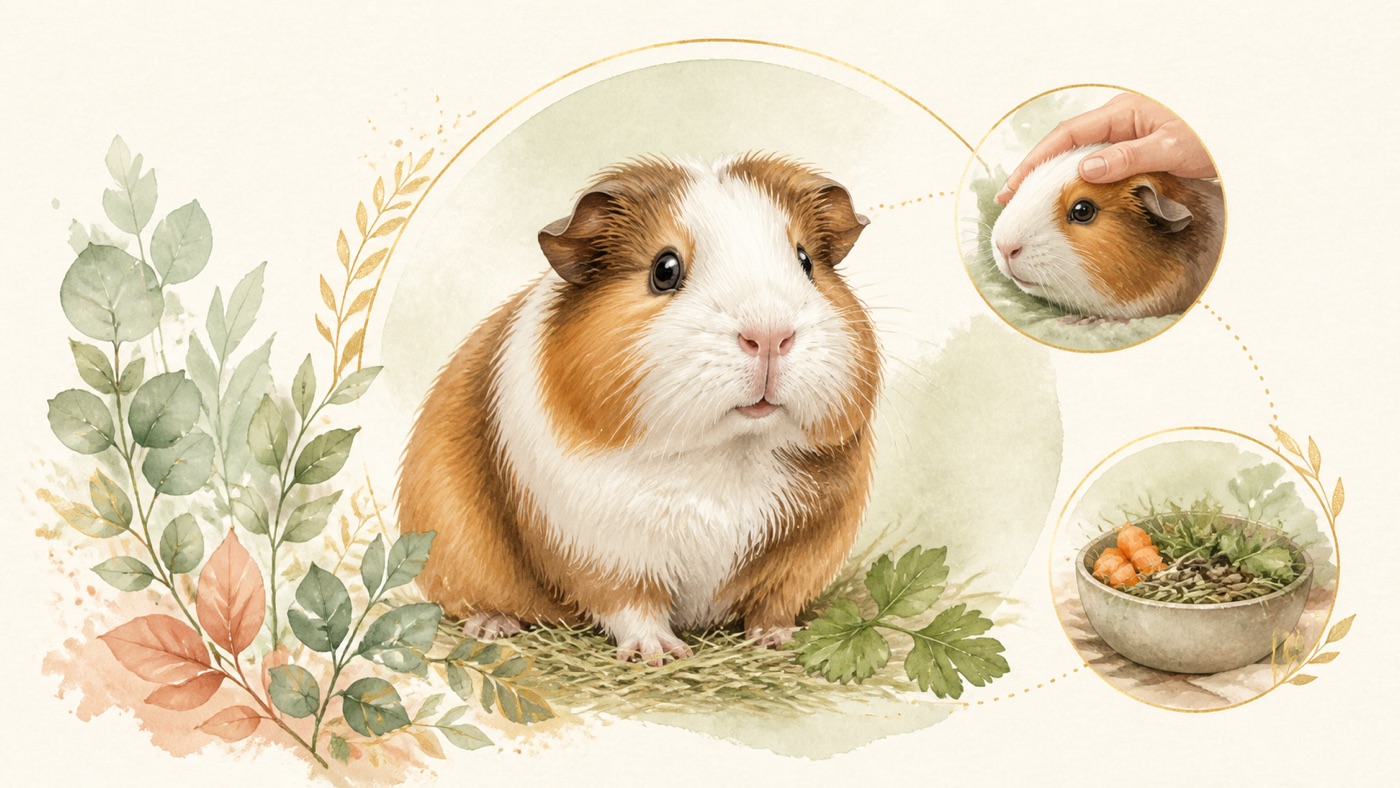
Guinea pigs | Husbandry and health: a 12-column knowledge tree
A single table covering twelve columns for the guinea pig (Cavia porcellus): species and breeds with lifespan, normal physiological parameters, housing, nutrition, behaviour and welfare, preventive medicine, common diseases, emergency red flags, zoonoses, household toxins, geriatric and end-of-life decisions, and authoritative sources. Where the source chapter could not find an authoritative figure, the field is left blank with the reason stated, and this site does not fill in a number on its behalf. It suits taking on a new animal, or working out which direction to look in when something seems wrong.
Guinea pigs | Husbandry and health: a 12-column knowledge tree (Cavia porcellus)
This article is compiled from the 12-column knowledge tree for guinea pigs in the small mammals chapter of the veterinary animal encyclopaedia. Small mammals differ enormously from one another — rabbits and guinea pigs have no vomiting reflex, chinchillas tolerate heat very poorly, and ferrets are carnivores — so doing what works for another species can do harm. Confirm which animal you have first.
| Column | Content |
|---|---|
| 1 Species/breeds and lifespan | Common varieties: short-haired, long-haired (Peruvian) and hairless (the Skinny pig). Lifespan: 5–8 years (Merck Vet Manual: 「Lifespan: 5–8 yr」<https://www.merckvetmanual.com/multimedia/table/physiological-data-for-guinea-pigs>, verified 2026-07-30; the consumer-facing page likewise gives 「Lifespan: 5–8 years」<https://www.merckvetmanual.com/all-other-pets/guinea-pigs/description-and-physical-characteristics-of-guinea-pigs>, the two agreeing). |
| 2 Normal physiological parameters | As with rabbits, there is no vomiting reflex; monitor body weight, appetite and faeces. Abnormalities: dental malocclusion causing drooling, weight loss. Figures: body temperature 38–39.5°C (100.4–103.1°F) (Merck Vet Manual: 「Body Temperature: 38–39.5°C (100.4–103.1°F)」<https://www.merckvetmanual.com/multimedia/table/physiological-data-for-guinea-pigs>, verified 2026-07-30); heart rate conflicting sources listed side by side: Merck's 「Physiological Data」 table gives 200–350 bpm while Merck's 「Resting Heart Rates」 table gives 200–300 bpm (two different tables on the same domain; both are listed and neither is chosen over the other); respiratory rate 40–100 breaths/min (same Physiological Data table); adult body weight conflicting sources listed side by side: the Merck professional exotic/laboratory animal table separates the sexes, 「Sows: 700–900 g; boars: 900–1,200 g」, while the Merck consumer page does not separate them, 「about 1.8–2.2 pounds (815–1,000 g)」 (both pages verified 2026-07-30; the methodologies differ and no compromise value is given). |
| 3 Housing | Needs generous floor area (guinea pigs are poor jumpers, so floor space matters more than height), avoidance of wire mesh flooring (which readily causes pododermatitis), dry bedding, and — as they are extremely heat-sensitive and prone to heat stroke — avoidance of sharp temperature swings. Parameters: temperature 18–26°C (65–79°F), humidity 30–60% (Merck Vet Manual: 「They tolerate a wide range of temperature and humidity levels...(18–26°C [65–79°F] and 30–60% humidity)」<https://www.merckvetmanual.com/exotic-and-laboratory-animals/guinea-pigs/housing-and-nutrition-of-guinea-pigs>, verified 2026-07-30); an explicit threshold temperature that triggers heat stroke 【No single authoritative figure for this item: the whitelisted sources do not provide a guinea-pig-specific heat-stroke threshold temperature. Heat-stroke risk arises from environmental temperature, humidity, ventilation and individual acclimatisation acting together; the rabbit column in this same file (see above) likewise found no single threshold temperature, which is a consistent cross-species finding rather than insufficient searching. Avoid hot, stuffy environments and watch for early signs of heat stroke rather than applying a fixed threshold temperature. Verified 2026-07-30】. |
| 4 Nutrition and feeding | Unlimited grass hay as the staple, with pellets and fresh vegetables as supplements, and daily supplementary vitamin C is essential — guinea pigs, like humans and a few other species, lack the enzyme needed to synthesise vitamin C and cannot make their own, so a deficient diet leads to scurvy. Recommended daily intake: roughly 10–25 mg/kg for adults, and 30 mg/kg or more for growing, pregnant, lactating or ill individuals (this is a nutritional requirement, not a drug dose; Merck Vet Manual: 「they require a regular source of vitamin C, which typically ranges between 10 and 25 mg/kg daily for adults and 30 mg/kg or more for growing, pregnant, lactating, or ill individuals.」<https://www.merckvetmanual.com/exotic-and-laboratory-animals/guinea-pigs/housing-and-nutrition-of-guinea-pigs>, verified 2026-07-30 · this is an additional safety note, not one of the original 53 flagged items). Common feeding mistakes: assuming pellets already contain enough vitamin C (vitamin C oxidises and is lost rapidly in storage) and failing to provide an additional fresh fruit and vegetable source. |
| 5 Behaviour and welfare | Normal: "popcorning" at the sight of food or a sound, and squealing for food; highly social and in need of companions. Stress signals: hiding, aggressive tooth-chattering, refusing food. The five welfare needs: a very high need for companionship (housed alone they readily become depressed), enough hiding places, and avoidance of noise stress. |
| 6 Preventive medicine | Regular health and dental checks, and neutering assessed by sex (reducing risks such as ovarian cysts). Frequency: at least once a year (Merck Vet Manual: 「Have a veterinarian experienced with guinea pigs examine your pet at least once a year for a routine checkup.」<https://www.merckvetmanual.com/all-other-pets/guinea-pigs/routine-health-care-of-guinea-pigs>, verified 2026-07-30). |
| 7 Common diseases, top 10 | 1. Vitamin C deficiency (scurvy): dietary lack of vitamin C → bleeding gums, lameness, poor wound healing, reduced immunity → history/physical examination → vitamin C supplementation (under veterinary guidance) → daily vitamin-C-rich vegetables and fruit plus a dedicated supplement.<br>2. Upper respiratory tract infection: bacterial/viral, precipitated by stress → sneezing, nasal discharge, abnormal respiratory sounds → auscultation/radiography → antibiotics (prescription, see the safety note below) → improved ventilation and hygiene.<br>3. Gastrointestinal stasis: the same mechanism as in rabbits (hindgut fermenters) → refusing food, reduced faeces → palpation/radiography → prokinetics and supportive care (prescription) → ample hay.<br>4~10. Ovarian cysts (the most common reproductive tract disorder in sows; Merck: 「Cystic ovarian disease is the most common reproductive tract disorder in guinea pig sows.」<https://www.merckvetmanual.com/exotic-and-laboratory-animals/guinea-pigs/noninfectious-diseases-of-guinea-pigs>), pododermatitis (wire mesh or coarse bedding compressing weight-bearing skin, with obesity and osteoarthritis shifting the centre of gravity also implicated; same source), mange mites (Trixacarus caviae, causing intense pruritus and even seizure-like episodes, with secondary bacterial/fungal skin infection; Merck: <https://www.merckvetmanual.com/exotic-and-laboratory-animals/guinea-pigs/infectious-diseases-of-guinea-pigs>), dental malocclusion (mostly related to nutritional/husbandry shortcomings such as vitamin C deficiency and insufficient fibre, though trauma or heredity are also possible; same noninfectious source), and cystic calculi (precipitation of calcium carbonate and other crystals in the urine, common in guinea pigs; same source) among others (verified 2026-07-30). |
| 8 🚨Emergency red flags | Reduced appetite or reduced faecal output (no guinea-pig-specific time threshold for seeking care was obtained from the whitelisted sources, so this project gives no figure; guinea pigs, like rabbits, are hindgut fermenters and likewise have no vomiting reflex, so the sooner seen the better — do not wait out any number of hours. The 4-hour threshold for rabbits comes from a rabbit-specific page at the University of Illinois which does not cover guinea pigs, so it is not extrapolated. Verified 2026-07-30), severe respiratory distress, heavy gingival bleeding, complete inability to stand. |
| 9 Zoonoses | Ringworm (dermatophytosis); Salmonella (less common, but to be noted by the immunocompromised). |
| 10 Household toxins and hazards | The same as for rabbits (toxic plants, cleaning products); chocolate, avocado, and the onion family. |
| 11 Geriatric care, palliative care and euthanasia decisions | End-stage tumours, chronic kidney disease that cannot be relieved, irreversible complications of scurvy. Euthanasia must be performed by a veterinarian. |
| 12 Authoritative sources | *Ferrets, Rabbits, and Rodents: Clinical Medicine and Surgery* (source text line 87); Merck Veterinary Manual (source text line 293). |
The 12 columns above are copied cell by cell from the encyclopaedia chapter, without rewriting or condensing; treatment directions state categories only, never drug names or doses, and medication requires a veterinary prescription. Where the source chapter could not find an authoritative figure (such as species-specific time thresholds for seeking care), it explicitly leaves the field blank and states why, and this site preserves that as it stands.
The limits of this content
This content comes from the small mammals chapter of the veterinary encyclopaedia (the original location and content hash are in the evidence chain). The sources at the end are the authoritative material cited by that section. This chapter has no row-level anchors in the project's line-level anchor file; only the chapter-level content hash can be verified — the same level as this site's existing "group overview" articles for each chapter — which does not mean every sentence traces to a particular source. Where the source text could not find an authoritative figure it leaves the field blank and states the reason; this site preserves that as it stands and does not fill in a number on its behalf. This is educational information and cannot replace diagnosis and prescription by a practising veterinarian; in an emergency, seek care immediately. This article has not been clinically reviewed by a named veterinarian.
"Source text line N" in the table is a line number in the original teaching-material inventory used when this project's database was built; it is an internal traceability marker and that inventory is not public. It is the book and journal titles outside the parentheses that are the sources you can look up for yourself.
FAQ
- What is most often fed wrongly to guinea pigs?
- Unlimited grass hay as the staple, with pellets and fresh vegetables as supplements, and daily supplementary vitamin C is essential — guinea pigs, like humans and a few other species, lack the enzyme needed to synthesise vitamin C and cannot make their own, so a deficient diet leads to scurvy. Recommended daily intake: roughly 10–25 mg/kg for adults, and 30 mg/kg or more for growing, pregnant, lactating or ill individuals (this is a nutritional requirement, not a drug dose; Merck Vet Manual: 「they require a regular source of vitamin C, which typically ranges between 10 and 25 mg/kg daily for adults and 30 mg/kg or more for growing, pregnant, lactating, or ill individuals.」<https://www.merckvetmanual.com/exotic-and-laboratory-animals/guinea-pigs/housing-and-nutrition-of-guinea-pigs>, verified 2026-07-30 · this is an additional safety note, not one of the original 53 flagged items). Common feeding mistakes: assuming pellets already contain enough vitamin C (vitamin C oxidises and is lost rapidly in storage) and failing to provide an additional fresh fruit and vegetable source.
- モルモットの給餌で最も間違えやすいのは何ですか。 — 主食は無制限の牧草、ペレットと新鮮な野菜は補助とし、毎日のビタミン C の追加補給が必須です——モルモットはヒトなど少数の種と同様にビタミン C 合成に必要な酵素を欠き、自ら合成できないため、食事が不足すると壊血病に至ります。1 日あたりの推奨摂取量:成体でおよそ 10–25 mg/kg、成長期/妊娠/授乳中/罹患個体では 30 mg/kg 以上(これは栄養要求量であり薬用量ではありません。Merck Vet Manual:「they require a regular source of vitamin C, which typically ranges between 10 and 25 mg/kg daily for adults and 30 mg/kg or more for growing, pregnant, lactating, or ill individuals.」<https://www.merckvetmanual.com/exotic-and-laboratory-animals/guinea-pigs/housing-and-nutrition-of-guinea-pigs>、確認 2026-07-30・これは安全性のための追加補足であり、元の 53 標記項目ではありません)。よくある給餌の誤り:ペレットに十分なビタミン C が含まれていると思い込む(ビタミン C は保存中に急速に酸化して失われます)、新鮮な野菜・果物という別の供給源を用意しない。
- What is most often fed wrongly to guinea pigs? — Unlimited grass hay as the staple, with pellets and fresh vegetables as supplements, and daily supplementary vitamin C is essential — guinea pigs, like humans and a few other species, lack the enzyme needed to synthesise vitamin C and cannot make their own, so a deficient diet leads to scurvy. Recommended daily intake: roughly 10–25 mg/kg for adults, and 30 mg/kg or more for growing, pregnant, lactating or ill individuals (this is a nutritional requirement, not a drug dose; Merck Vet Manual: 「they require a regular source of vitamin C, which typically ranges between 10 and 25 mg/kg daily for adults and 30 mg/kg or more for growing, pregnant, lactating, or ill individuals.」<https://www.merckvetmanual.com/exotic-and-laboratory-animals/guinea-pigs/housing-and-nutrition-of-guinea-pigs>, verified 2026-07-30 · this is an additional safety note, not one of the original 53 flagged items). Common feeding mistakes: assuming pellets already contain enough vitamin C (vitamin C oxidises and is lost rapidly in storage) and failing to provide an additional fresh fruit and vegetable source.
- What signs in a guinea pig mean going to the vet immediately?
- Reduced appetite or reduced faecal output (no guinea-pig-specific time threshold for seeking care was obtained from the whitelisted sources, so this project gives no figure; guinea pigs, like rabbits, are hindgut fermenters and likewise have no vomiting reflex, so the sooner seen the better — do not wait out any number of hours. The 4-hour threshold for rabbits comes from a rabbit-specific page at the University of Illinois which does not cover guinea pigs, so it is not extrapolated. Verified 2026-07-30), severe respiratory distress, heavy gingival bleeding, complete inability to stand.
- モルモットにどんな状態が出たらすぐ受診すべきですか。 — 食欲低下または排便減少(モルモット固有の正確な受診までの時間はホワイトリスト典拠から得られなかったため、本プロジェクトは数字を示しません。モルモットはウサギと同じく後腸発酵動物であり、同様に嘔吐反射をもたないため、受診は早いほどよく、何時間も待たないでください。ウサギの 4 時間の閾値は University of Illinois のウサギ専用ページに由来し、同ページはモルモットを扱っていないため外挿しません。確認 2026-07-30)、重度の呼吸困難、歯肉からの大量出血、まったく起立できない状態。
- What signs in a guinea pig mean going to the vet immediately? — Reduced appetite or reduced faecal output (no guinea-pig-specific time threshold for seeking care was obtained from the whitelisted sources, so this project gives no figure; guinea pigs, like rabbits, are hindgut fermenters and likewise have no vomiting reflex, so the sooner seen the better — do not wait out any number of hours. The 4-hour threshold for rabbits comes from a rabbit-specific page at the University of Illinois which does not cover guinea pigs, so it is not extrapolated. Verified 2026-07-30), severe respiratory distress, heavy gingival bleeding, complete inability to stand.
- What is the most common disease in guinea pigs?
- 1. Vitamin C deficiency (scurvy): dietary lack of vitamin C → bleeding gums, lameness, poor wound healing, reduced immunity → history/physical examination → vitamin C supplementation (under veterinary guidance) → daily vitamin-C-rich vegetables and fruit plus a dedicated supplement.
- モルモットで最もよくある疾患は何ですか。 — 1. ビタミン C 欠乏症(壊血病 Scurvy):食事中のビタミン C 不足→歯肉出血、跛行、創傷治癒不良、免疫力低下→病歴/身体検査→ビタミン C の補給(獣医師の指導のもとで)→ビタミン C を豊富に含む野菜・果物と専用サプリメントを毎日与える。
- What is the most common disease in guinea pigs? — 1. Vitamin C deficiency (scurvy): dietary lack of vitamin C → bleeding gums, lameness, poor wound healing, reduced immunity → history/physical examination → vitamin C supplementation (under veterinary guidance) → daily vitamin-C-rich vegetables and fruit plus a dedicated supplement.
Source anchors
- Merck 獸醫手冊|小型哺乳章引用 · https://www.merckvetmanual.com/multimedia/table/physiological-data-for-guinea-pigs · 在 IDAEO 的其他引用
- Merck 獸醫手冊|小型哺乳章引用 · https://www.merckvetmanual.com/all-other-pets/guinea-pigs/description-and-physical-characteristics-of-guinea-pigs · 在 IDAEO 的其他引用
- Merck 獸醫手冊|小型哺乳章引用 · https://www.merckvetmanual.com/exotic-and-laboratory-animals/guinea-pigs/housing-and-nutrition-of-guinea-pigs · 在 IDAEO 的其他引用
- Merck 獸醫手冊|小型哺乳章引用 · https://www.merckvetmanual.com/all-other-pets/guinea-pigs/routine-health-care-of-guinea-pigs · 在 IDAEO 的其他引用
- Merck 獸醫手冊|小型哺乳章引用 · https://www.merckvetmanual.com/exotic-and-laboratory-animals/guinea-pigs/noninfectious-diseases-of-guinea-pigs · 在 IDAEO 的其他引用
- Merck 獸醫手冊|小型哺乳章引用 · https://www.merckvetmanual.com/exotic-and-laboratory-animals/guinea-pigs/infectious-diseases-of-guinea-pigs · 在 IDAEO 的其他引用
Cite this article
Jane・《Guinea pigs | Husbandry and health: a 12-column knowledge tree》・IDAEO 知識庫・2026-08-13・https://km.idaeo.ai/post/vet/guinea-pig-guideUpdated 2026-08-15