

🏛 Part of the "vet" topic shelf →
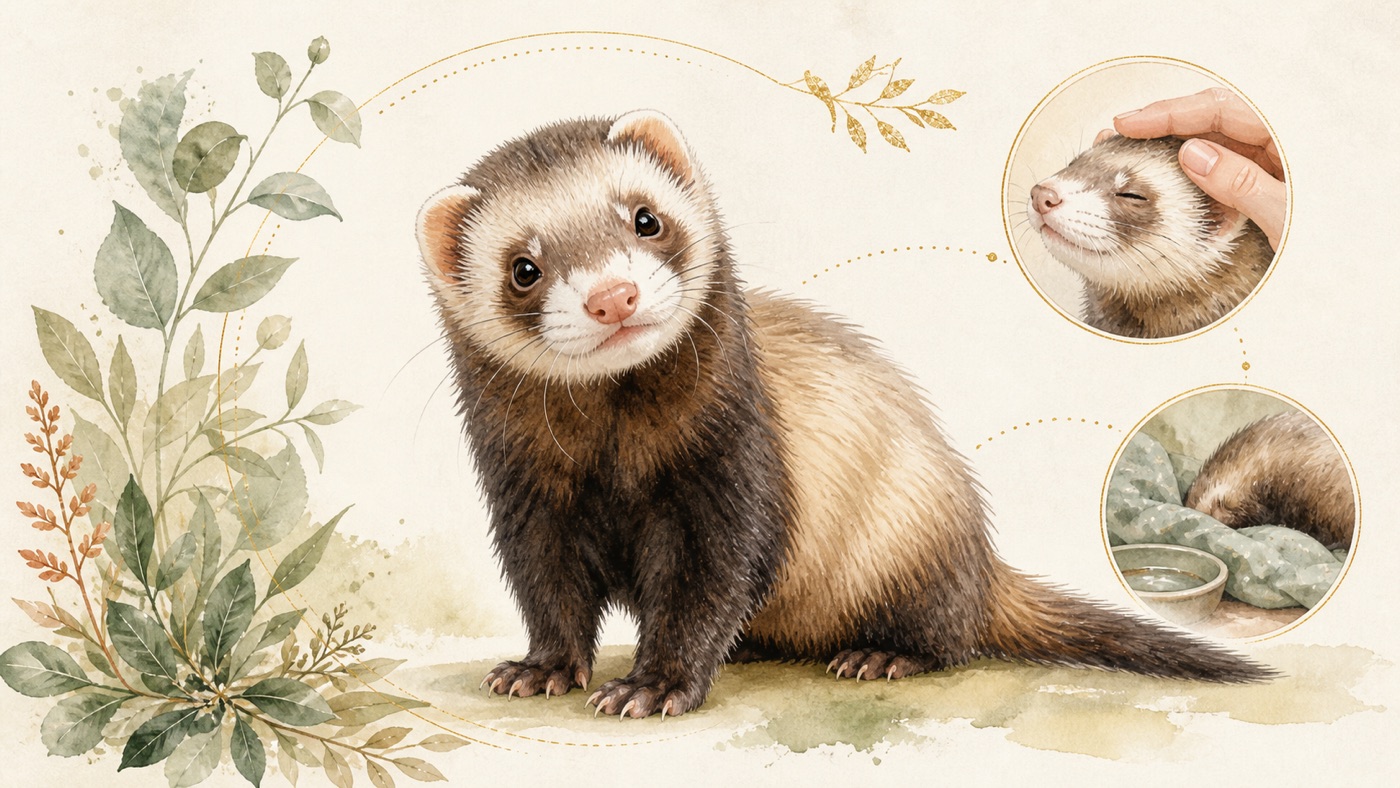
Ferret|Husbandry and health, a 12-column knowledge tree
A single table covering twelve columns for the ferret (Mustela putorius furo): species and lifespan, physiological indicators, housing, nutrition, behaviour and welfare, preventive medicine, common diseases, emergency red flags, zoonoses, household toxins, geriatric and end-of-life decisions, and authoritative sources. Where the source text could not find an authoritative figure, the field is left blank with the reason stated, and this site does not fill in a number on its behalf. It suits taking on a new animal, or working out which direction to look in when something seems wrong.
Ferret|Husbandry and health, a 12-column knowledge tree (Mustela putorius furo)
This article is compiled from the 12-column knowledge tree for the ferret in the small mammals chapter of the veterinary encyclopedia. Small mammals differ enormously from one another — rabbits and guinea pigs have no vomiting reflex, chinchillas tolerate heat very poorly, and ferrets are carnivores — so doing what works for another species can do harm. Establish which animal you have first.
| Column | Content |
|---|---|
| 1 Species/breed and lifespan | Domestic ferret; most are neutered and descented. Lifespan: 6–10 years (Merck Vet Manual: 「The typical life span is 6 to 10 years, but many life spans are shortened due to accidents or illness.」<https://www.merckvetmanual.com/all-other-pets/ferrets/description-and-physical-characteristics-of-ferrets>; the 「Ferrets at a Glance」 table likewise gives 「Life expectancy: 6 to 10 years」<https://www.merckvetmanual.com/multimedia/table/ferrets-at-a-glance>, verified 2026-07-30). |
| 2 Normal physiological indicators | Monitor body weight, activity level and the coat-moulting cycle. Abnormal: hindlimb weakness or dragging (be alert for insulinoma-related hypoglycaemia), symmetrical alopecia (be alert for adrenal disease). Figures: the two Merck tables differ slightly, so both are listed——heart rate 200–250 bpm (both tables agree); respiratory rate: the professional 「Vital Signs in Healthy Adult Ferrets」 table gives 33–36 breaths/min, the consumer 「Ferrets at a Glance」 table gives 30–40 breaths/min; rectal temperature: the professional version gives 38.8°C (37.8–40°C/100–104°F), the consumer version gives only the 100–103°F range (Merck: <https://www.merckvetmanual.com/multimedia/table/vital-signs-in-healthy-adult-ferrets> and <https://www.merckvetmanual.com/multimedia/table/ferrets-at-a-glance>, verified 2026-07-30); adult body weight: a male ferret (hob) may reach 2 kg (4 lb), a female ferret (jill) may reach 1.2 kg (2.5 lb) (both tables agree, same source). |
| 3 Housing | Needs a sturdy escape-proof enclosure (the body is supple and they are expert at squeezing through gaps), avoidance of sponge or rubber toys (high risk of intestinal obstruction from ingestion), and a cool environment (poor heat tolerance). Parameters: ideal ambient temperature 65–75°F (about 18–24°C), never above 90°F (about 32°C) (Merck 「Ferrets at a Glance」 table: 「Recommended environmental temperature: 65°F to 75°F (never over 90°F).」<https://www.merckvetmanual.com/all-other-pets/ferrets/description-and-physical-characteristics-of-ferrets>); ferrets are highly prone to heatstroke because they cannot sweat effectively, so the enclosure must not be in direct sunlight (Merck professional version: 「Ferrets are highly susceptible to heatstroke because they cannot sweat, so housing should never be placed in direct sunlight.」<https://www.merckvetmanual.com/exotic-and-laboratory-animals/ferrets/management-of-ferrets>, verified 2026-07-30). |
| 4 Nutrition and feeding | Obligate carnivore, requiring a dedicated high-protein, high-fat, low-carbohydrate ferret diet; do not feed dog food (the protein sources are in the wrong proportions). Common feeding errors: substituting cat or dog food for a dedicated ferret diet over the long term, and feeding carbohydrates such as fruit and vegetables (ferrets cannot digest plant fibre effectively). |
| 5 Behaviour and welfare | Normal: highly curious, given to rummaging and hoarding; the excited jumping "war dance"; long sleeping hours. Stress signals: worsening abnormal lethargy (hypoglycaemia must be ruled out), hair loss. The five welfare needs: ample daily time out of the cage, social interaction (most ferrets like company), and environmental management to prevent ingestion of foreign bodies. |
| 6 Preventive medicine | Canine distemper vaccination according to region (ferrets are extremely susceptible to canine distemper virus and mortality is high; a ferret-approved vaccine must be used and a canine vaccine must not be used directly), rabies vaccination (per local law), and from middle age onwards twice-yearly examinations with blood work are advised (endocrine tumours are common). Vaccine types and frequency: 【Verification result: no fixed figure should be given for this item — the ferret-approved types of distemper and rabies vaccine, their availability and the vaccination interval vary by national and regional regulation, and must follow the veterinary vaccines approved by the local competent authority together with veterinary advice; supplying a fixed number is outside the scope of this text, verified 2026-07-30】. |
| 7 Common diseases, top 10 | 1. Insulinoma: a pancreatic islet-cell tumour secreting excess insulin, common in middle-aged and older ferrets → hypoglycaemic episodes: hindlimb weakness, drooling, altered consciousness, even seizures → blood glucose testing/abdominal ultrasound → medical control or surgical excision (prescription) → not preventable; early detection through health checks is what matters.<br>2. Adrenal disease: associated with early neutering, photoperiod and other factors (mechanism: the current professional version of the Merck Vet Manual proposes that after neutering the loss of gonadal negative feedback leads to persistently raised gonadotropin (LH) concentrations, which chronically stimulate the adrenal cortex into hyperplasia; 「it is considered likely that the increased concentrations of gonadotropins, which occur after neutering because of the loss of negative feedback, persistently stimulate the adrenal cortex, which eventually results in adrenocortical growth. The time of neutering is no longer thought to play a significant role.」<https://www.merckvetmanual.com/exotic-and-laboratory-animals/ferrets/endocrine-disorders-of-ferrets>——the Merck page does not mention photoperiod, and it explicitly downplays the importance of the timing of neutering; peer-reviewed literature does, however, support early neutering combined with an artificially extended photoperiod as a possible contributing factor, the mechanism being that adrenocortical cells express LH receptors and, under persistent high LH, undergo hyperplasia or neoplasia: Schoemaker et al. 2002: 「Clear cells in hyperplastic or neoplastic adrenal glands of hyperadrenocorticoid ferrets stained positive with the LH-R antibody」<https://pubmed.ncbi.nlm.nih.gov/12431804/>; Simone-Freilicher 2008: 「Early oophorohysterectomies and neutering, combined with the artificially prolonged photoperiod experienced by indoor pet ferrets, and a possible genetic component, may be contributing factors.」<https://pubmed.ncbi.nlm.nih.gov/18165141/>——Merck and the peer-reviewed literature take different views on whether photoperiod is a key factor, and both are listed, verified 2026-07-30) → symmetrical alopecia (tail/trunk), vulvar swelling in jills, prostatic enlargement with dysuria in hobs → physical examination/hormone testing/ultrasound → medication (such as the GnRH agonist class, prescription) or surgery → not fully preventable.<br>3. Lymphoma: one of the common ferret tumours → lymph node enlargement, weight loss, reduced activity → cytology/biopsy → chemotherapy requires referral to oncology (prescription) → not preventable; early detection is key.<br>4. Gastrointestinal foreign body obstruction: from curiously chewing rubber and sponge toys → vomiting, anorexia, abdominal pain on palpation → radiography/ultrasound → surgical removal of the foreign body (prescription) → prevent access to small ingestible objects.<br>5–10. Epizootic catarrhal enteritis (ECE, a ferret enteric coronavirus causing blunting of the intestinal villi with consequent maldigestion and malabsorption, presenting as anorexia, vomiting, green or mucoid diarrhoea, melena, dehydration, lethargy and weight loss; Merck: 「the virus causes blunting of the intestinal villi and consequent maldigestion and malabsorption, leading to clinical signs such as anorexia, vomiting, green or mucoid diarrhea, melena, dehydration, lethargy, and weight loss」<https://www.merckvetmanual.com/exotic-and-laboratory-animals/ferrets/infectious-diseases-of-ferrets>), heartworm disease depending on region (the ferret is a host with a lower infection success rate but severe individual disease, because the parasite-to-host body-weight ratio is so extreme that a small worm burden can cause illness; the risk varies with the local prevalence of canine heartworm; Merck: 「the infection success rate is low (an average of 6% in cats and 40% in ferrets)...ferrets develop clinical signs with relatively small heartworm burdens」「infection rates in other companion animals, such as ferrets and cats...tend to parallel infection rates in dogs in the same geographic region」<https://www.merckvetmanual.com/circulatory-system/heartworm-disease/heartworm-disease-in-dogs-cats-and-ferrets>), and gastric Helicobacter infection (Helicobacter mustelae, commonly present in the ferret stomach and duodenum after weaning; an opportunistic pathogen that can cause chronic persistent gastritis and ulceration, with gastric lymphoma possible in chronic cases; Merck: 「It is an opportunistic pathogen and can induce chronic, persistent gastritis and ulcer formation similar to gastric ulcer disease in humans. Gastric lymphoma may occur in chronic cases.」<https://www.merckvetmanual.com/exotic-and-laboratory-animals/ferrets/infectious-diseases-of-ferrets>) among others (verified 2026-07-30). |
| 8 🚨Emergency red flags | Sudden hindlimb collapse or seizures (suspected hypoglycaemia), persistent vomiting with inability to eat, severe respiratory distress, severe abdominal distension with pain. |
| 9 Zoonoses | Influenza virus (ferrets are highly susceptible to human influenza viruses and transmission can go both ways; anyone with influenza should avoid close contact with ferrets); rabies (risk depends on region). |
| 10 Household toxins and hazards | Sponge, rubber bands and foam-material toys (foreign body obstruction can be fatal); chocolate, avocado, the onion family, caffeinated drinks; some indoor potted plants. |
| 11 Geriatric care, palliative care and euthanasia decisions | End-stage tumours (insulinoma/lymphoma/adrenal disease) with uncontrollable recurrence, end-stage cardiac or renal failure. Euthanasia must be carried out by a veterinarian. |
| 12 Authoritative sources | *Ferrets, Rabbits, and Rodents: Clinical Medicine and Surgery* (source text line 87, which explicitly lists the ferret); Journal of Exotic Pet Medicine (source text lines 117–118); Merck Veterinary Manual (source text line 293). |
The 12 columns above are copied cell by cell from the original encyclopedia chapter, without rewriting or condensing; treatment direction gives categories only, never drug names or doses, and medication requires a veterinary prescription. Where the source text left a field blank because no authoritative figure could be found (such as species-specific time thresholds for seeking care), it states the reason, and this site preserves that as it stands.
Limits of this content
This content comes from the small mammals chapter of the veterinary encyclopedia (see the evidence chain for the original location and content hash). The sources at the end are the authoritative materials cited by that section. This chapter has no row-level anchors in the project's line-level anchor file; only a chapter-level content hash can be verified — the same level as this site's existing "group overview" articles for each chapter, which does not mean every sentence is traced sentence by sentence back to a given source. Where the source text could not find an authoritative figure it leaves the field blank and states the reason; this site preserves that as it stands and does not fill in a number on its behalf. This material is for education and cannot replace diagnosis and prescription by a practising veterinarian; in an emergency, seek veterinary care immediately. This text has not been clinically reviewed by a named veterinarian.
The 「source text line N」 references in the table are line numbers in the original teaching-material inventory used when this project's database was built; they are an internal traceability marker and that inventory is not public. The book and journal titles outside the parentheses are the sources you can look up yourself.
FAQ
- What is most easily got wrong when feeding a ferret?
- An obligate carnivore, requiring a dedicated high-protein, high-fat, low-carbohydrate ferret diet; do not feed dog food (the protein sources are in the wrong proportions). Common feeding errors: substituting cat or dog food for a dedicated ferret diet over the long term, and feeding carbohydrates such as fruit and vegetables (ferrets cannot digest plant fibre effectively).
- フェレットの給餌で最も間違えやすいのは何ですか。 — 絶対的肉食動物(Obligate carnivore)であり、高タンパク・高脂肪・低炭水化物のフェレット専用フードが必要です。ドッグフードを与えてはいけません(タンパク質源の比率が適しません)。よくある給餌の誤り:専用フードの代わりにキャットフード/ドッグフードを長期間与える、果物や野菜などの炭水化物を与える(フェレットは植物繊維を有効に消化できません)。
- What is most easily got wrong when feeding a ferret? — An obligate carnivore, requiring a dedicated high-protein, high-fat, low-carbohydrate ferret diet; do not feed dog food (the protein sources are in the wrong proportions). Common feeding errors: substituting cat or dog food for a dedicated ferret diet over the long term, and feeding carbohydrates such as fruit and vegetables (ferrets cannot digest plant fibre effectively).
- What signs in a ferret mean going to a veterinarian straight away?
- Sudden hindlimb collapse or seizures (suspected hypoglycaemia), persistent vomiting with inability to eat, severe respiratory distress, severe abdominal distension with pain.
- フェレットにどんな状態が現れたらすぐに受診すべきですか。 — 突然の後肢の脱力または痙攣(低血糖の疑い)、嘔吐が続き食べられない、重度の呼吸困難、腹部の著しい膨満と痛み。
- What signs in a ferret mean going to a veterinarian straight away? — Sudden hindlimb collapse or seizures (suspected hypoglycaemia), persistent vomiting with inability to eat, severe respiratory distress, severe abdominal distension with pain.
- What is the most common disease in ferrets?
- 1. Insulinoma: a pancreatic islet-cell tumour secreting excess insulin, common in middle-aged and older ferrets → hypoglycaemic episodes: hindlimb weakness, drooling, altered consciousness, even seizures → blood glucose testing/abdominal ultrasound → medical control or surgical excision (prescription) → not preventable; early detection through health checks is what matters.
- フェレットで最もよくある疾患は何ですか。 — 1. インスリノーマ(Insulinoma):膵島細胞の腫瘍がインスリンを過剰分泌するもので、中高齢のフェレットに多い→低血糖発作:後肢の脱力、よだれ、意識混濁、さらには痙攣→血糖検査/腹部超音波→内科的な薬物コントロールまたは外科切除(処方)→予防はできず、早期の健康診断による発見が重要。
- What is the most common disease in ferrets? — 1. Insulinoma: a pancreatic islet-cell tumour secreting excess insulin, common in middle-aged and older ferrets → hypoglycaemic episodes: hindlimb weakness, drooling, altered consciousness, even seizures → blood glucose testing/abdominal ultrasound → medical control or surgical excision (prescription) → not preventable; early detection through health checks is what matters.
Source anchors
- Merck 獸醫手冊|小型哺乳章引用 · https://www.merckvetmanual.com/all-other-pets/ferrets/description-and-physical-characteristics-of-ferrets · 在 IDAEO 的其他引用
- Merck 獸醫手冊|小型哺乳章引用 · https://www.merckvetmanual.com/multimedia/table/ferrets-at-a-glance · 在 IDAEO 的其他引用
- Merck 獸醫手冊|小型哺乳章引用 · https://www.merckvetmanual.com/multimedia/table/vital-signs-in-healthy-adult-ferrets · 在 IDAEO 的其他引用
- Merck 獸醫手冊|小型哺乳章引用 · https://www.merckvetmanual.com/exotic-and-laboratory-animals/ferrets/management-of-ferrets · 在 IDAEO 的其他引用
- Merck 獸醫手冊|小型哺乳章引用 · https://www.merckvetmanual.com/exotic-and-laboratory-animals/ferrets/endocrine-disorders-of-ferrets · 在 IDAEO 的其他引用
- PubMed 文獻|小型哺乳章引用 · https://pubmed.ncbi.nlm.nih.gov/12431804/ · 在 IDAEO 的其他引用
- PubMed 文獻|小型哺乳章引用 · https://pubmed.ncbi.nlm.nih.gov/18165141/ · 在 IDAEO 的其他引用
- Merck 獸醫手冊|小型哺乳章引用 · https://www.merckvetmanual.com/exotic-and-laboratory-animals/ferrets/infectious-diseases-of-ferrets · 在 IDAEO 的其他引用
- Merck 獸醫手冊|小型哺乳章引用 · https://www.merckvetmanual.com/circulatory-system/heartworm-disease/heartworm-disease-in-dogs-cats-and-ferrets · 在 IDAEO 的其他引用
Cite this article
Jane・《Ferret|Husbandry and health, a 12-column knowledge tree》・IDAEO 知識庫・2026-08-13・https://km.idaeo.ai/post/vet/ferret-guideUpdated 2026-08-15