

🏛 Part of the "vet" topic shelf →
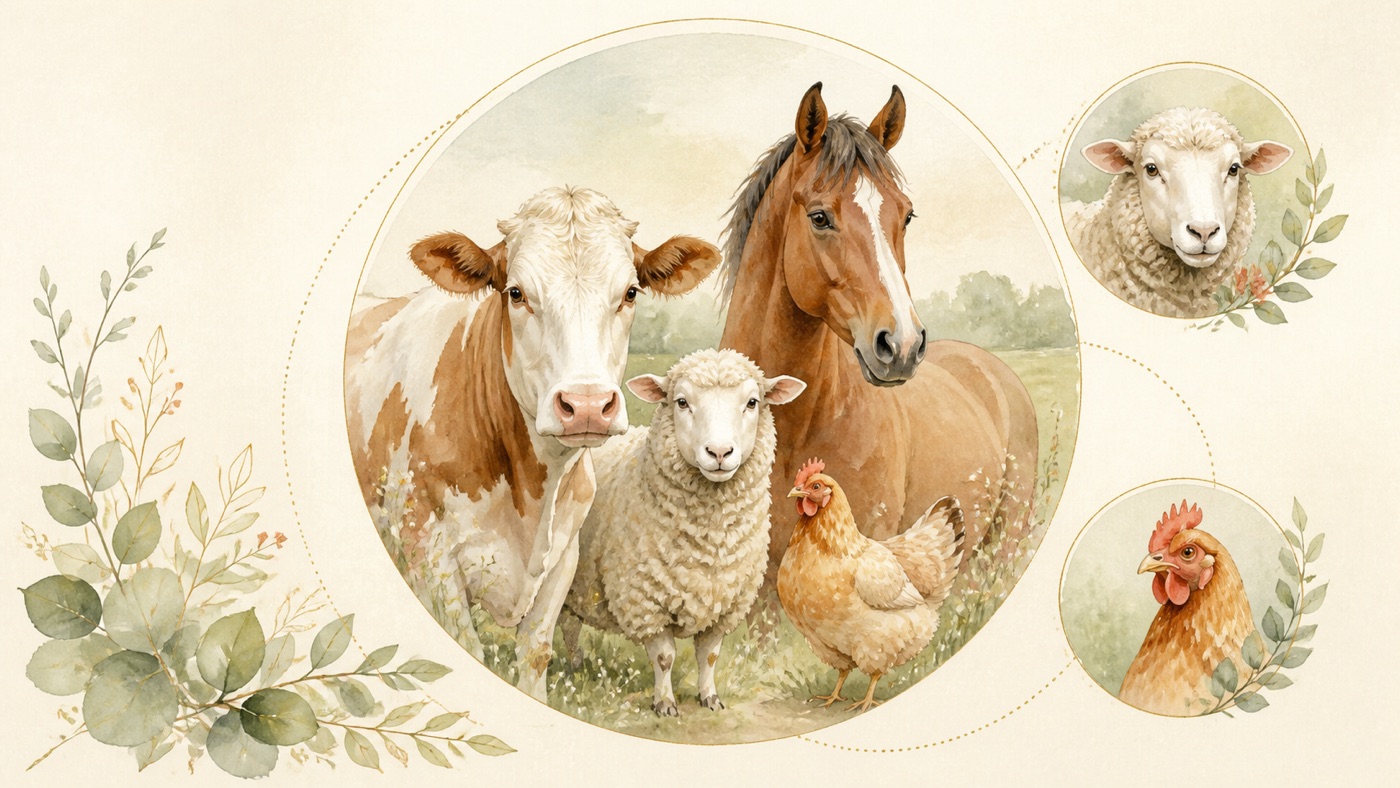
Farm Animals and Horses|Group Overview
One table sets the scientific names, lifespans and common keeper misconceptions side by side for eight groups — horses, donkeys and mules, backyard chickens, ducks and geese, cattle, sheep and goats, pigs, alpacas and honeybees — so you can confirm which animal you are dealing with before discussing handling. Wherever the whitelisted sources give no group-specific value, the lifespan entry is marked as having no single authoritative figure rather than filled in from impression; poultry is left as a pointer only, with the full knowledge tree in the dedicated poultry chapter. It suits the moment before you take on a new group of animals, or before you copy what someone else is doing, to check each group's profile and the points most often misunderstood.
Farm Animals and Horses|Group Overview
This content is compiled from the farm animals and horses chapter of the veterinary animal encyclopedia. The same sign calls for different handling in different species, and copying what is done for another species can be harmful — first confirm which animal you are dealing with.
| Group | Representative scientific name | Lifespan | Profile/common keeper misconceptions |
|---|---|---|---|
| (A) Horse | *Equus caballus* | On average 25–30 years, with miniature horses reaching 40 years or more (Merck Veterinary Manual, Horse Owners: "On average, horses live 25–30 years, but their lifespan depends on their health, care, and size." "For instance, miniature horses can live 40 years or more.") | The companion/sport animal with the highest density of individual medical care; colic and laminitis are the foremost emergencies |
| (B) Donkey/Mule | Donkey *Equus asinus*; the mule is a donkey-horse hybrid (usually infertile) | [No single authoritative figure for this item: the whitelisted sources give no lifespan reference value specific to donkeys/mules] (Directional conclusion: donkeys and mules often live longer than horses of comparable size.) | Donkeys are stoic by nature and do not readily show illness, so they are often held to equine care standards by mistake, which delays treatment |
| (C) Backyard poultry | Domestic chicken *Gallus gallus domesticus*/domestic duck *Anas platyrhynchos domesticus*/domestic goose *Anser anser domesticus* | Varies enormously by line: backyard laying hens may live 6–8 years with a laying period of 3–4 years (University of Wisconsin Extension; see row 54 of `26-T7-家禽.md` for detail); broiler lines are designed to reach market weight at 6 weeks (Cornish Cross) to 8–9 weeks of age and are not kept for their natural lifespan (Penn State Extension, same source); specific natural lifespan year counts for ornamental chickens/ducks/geese [No single authoritative figure for this item: the whitelisted sources give no reference value for a natural lifespan year count specific to ornamental chickens/ducks/geese; the full verification record and cross-sources are in the corresponding rows of `26-T7-家禽.md`] | Now a separate chapter; the full 12-column knowledge tree plus four 🔴 supplementary columns is in `26-T7-家禽.md`. Section five (C) of this file keeps only a pointer stub and is not maintained in duplicate |
| (D) Cattle | *Bos taurus*/*Bos indicus* | The natural lifespan can reach about 20 years, but commercial dairy cows are in practice culled after an average productive life of only about 2.8 lactations (roughly 5 years) (Michigan State University Extension: "The natural lifespan of a cow can be around 20 years") | Dual dairy/beef use; the largest interface with food safety (residues in milk and meat) |
| (E) Sheep/Goat | Sheep *Ovis aries*; goat *Capra hircus* | [No single authoritative figure for this item: the whitelisted sources give no lifespan reference value specific to sheep and goats] (No whitelisted source gives a specific lifespan year count.) | Small ruminants, common in gardens and on smallholdings; the vast difference in copper tolerance between them is a deadly pitfall |
| (F) Pig | *Sus scrofa domesticus* | Miniature pet pigs "about 8–20 years (original text ~8–20 years, typically ~10–15 years; the `~` is the source's own approximation sign, not a precise range)" (Merck Veterinary Manual, "Overview of Miniature Pet Pigs": "The lifespan of a miniature pig is ~8–20 years (typically ~10–15 years)."); a separate figure for the natural lifespan of production pigs [No single authoritative figure for this item: the whitelisted sources give no reference value for a natural lifespan specific to production pigs] | A dual identity as production animal and pet pig, with different care priorities in the two contexts |
| (G) Alpaca | *Vicugna pacos* | About 15–20 years, with llamas somewhat longer (Penn State Extension: "The alpaca lifespan is 15 to 20 years, while llamas tend to live a bit longer, provided that the animals get the proper care.") | Prone to heat stress when kept at high latitudes or in hot, humid climates; entirely absent from the original teaching material |
| (H) Honeybee | *Apis mellifera* | Worker bees live about 3–6 weeks during the active season (spring and summer), and overwintering workers about 4 months; queens are generally understood to reach 2–3 years, but in commercial colonies they are in practice often replaced within a year (Page RE Jr, Peng CY. "Aging and development in social insects with emphasis on the honey bee, Apis mellifera L." *Exp Gerontol* 2001, PMID 11295509: "Workers typically live 3-6 weeks during the spring and summer and can live about 4 months during the winter." "Queens are longer lived. Anecdotes of queens living 2-3 years are not unusual, though they normally live less than a year in commercial hives."); the unit of health is the "colony", not the individual bee | The only encyclopedia species where "the colony is the individual"; entirely absent from the original teaching material |
⚠️ For the lifespan column and all specific figures, only verified material is used (see the verification marks in each row: ① a figure exists/② no single authoritative value/③ no fixed figure should be given); filling them in from memory is not allowed.
Limits of this content
This content comes from the farm animals and horses chapter of the veterinary encyclopedia (see the evidence chain for the original location and content hash). The sources at the end are the authoritative materials cited by that chapter; the correspondence is at chapter level, which does not mean every sentence is traced sentence by sentence back to a given source. This material is for education and cannot replace diagnosis and prescription by a practising veterinarian; in an emergency, seek veterinary care immediately. This text has not been clinically reviewed by a named veterinarian.
FAQ
- Why confirm which species you are dealing with before discussing handling?
- Because the same sign calls for different handling in different species, and handling an animal the way another species would be handled can be harmful, so the first step in every case is to confirm which animal is in front of you.
- 対処を語る前に、なぜどの動物なのかを確認する必要があるのですか。 — 同じ症状でも動物種によって対処が異なり、別の種のやり方で扱うと害になることがあるためです。したがって第一歩は常に、目の前の動物がどの種なのかを確認することです。
- Why confirm which species you are dealing with before discussing handling? — Because the same sign calls for different handling in different species, and handling an animal the way another species would be handled can be harmful, so the first step in every case is to confirm which animal is in front of you.
- Can a donkey be cared for the way a horse is?
- Donkeys are stoic by nature and do not readily show illness, so they are often held to equine care standards by mistake, which delays treatment. Donkeys and mules often live longer than horses of comparable size — a directional conclusion, since the whitelisted sources give no lifespan figure specific to donkeys and mules.
- ロバはウマと同じやり方で世話をしてよいですか。 — ロバは生来がまん強く病気が表に出にくいため、ウマの世話の基準を当てはめられて受診が遅れることがよくあります。ロバやラバは同程度の体格のウマより長生きすることが多いのですが、これは方向性のある結論であり、ホワイトリスト出典はロバ・ラバ固有の寿命の数値を示していません。
- Can a donkey be cared for the way a horse is? — Donkeys are stoic by nature and do not readily show illness, so they are often held to equine care standards by mistake, which delays treatment. Donkeys and mules often live longer than horses of comparable size — a directional conclusion, since the whitelisted sources give no lifespan figure specific to donkeys and mules.
- Why do some entries in the lifespan column read "no single authoritative figure"?
- The lifespan column and all specific figures draw only on verified material, and filling them in from memory is not allowed; where the whitelisted sources hold no reference value specific to that group, the entry says so plainly rather than offering a figure that merely looks plausible.
- 寿命欄に「単一の権威ある数値なし」と書かれているのはなぜですか。 — 寿命欄とすべての具体的な数値は検証を完了した内容のみを用い、記憶に頼って書き込むことを禁じているためです。ホワイトリスト出典にそのグループ固有の参考値がない場合は、もっともらしく見える数字を出すのではなく、ありのままにその旨を明示します。
- Why do some entries in the lifespan column read "no single authoritative figure"? — The lifespan column and all specific figures draw only on verified material, and filling them in from memory is not allowed; where the whitelisted sources hold no reference value specific to that group, the entry says so plainly rather than offering a figure that merely looks plausible.
Source anchors
- Merck 獸醫手冊|農場動物與馬章引用 · https://www.merckvetmanual.com/digestive-system/diseases-of-the-ruminant-forestomach/grain-overload-in-ruminants · 在 IDAEO 的其他引用
- Merck 獸醫手冊|農場動物與馬章引用 · https://www.merckvetmanual.com/digestive-system/diseases-of-the-ruminant-forestomach/subacute-ruminal-acidosis-in-cattle-and-sheep · 在 IDAEO 的其他引用
- Merck 獸醫手冊|農場動物與馬章引用 · https://www.merckvetmanual.com/exotic-and-laboratory-animals/miniature-pet-pigs/overview-of-miniature-pet-pigs · 在 IDAEO 的其他引用
- Merck 獸醫手冊|農場動物與馬章引用 · https://www.merckvetmanual.com/generalized-conditions/hendra-virus-infection/hendra-virus-infection-in-horses · 在 IDAEO 的其他引用
- Merck 獸醫手冊|農場動物與馬章引用 · https://www.merckvetmanual.com/horse-owners/introduction-to-horses/description-and-physical-characteristics-of-horses · 在 IDAEO 的其他引用
- Merck 獸醫手冊|農場動物與馬章引用 · https://www.merckvetmanual.com/infectious-diseases/clostridial-diseases/clostridial-vaccines-for-animals · 在 IDAEO 的其他引用
- Merck 獸醫手冊|農場動物與馬章引用 · https://www.merckvetmanual.com/management-and-nutrition/preventative-health-care-and-husbandry-of-horses/dental-care-of-horses · 在 IDAEO 的其他引用
- Merck 獸醫手冊|農場動物與馬章引用 · https://www.merckvetmanual.com/management-and-nutrition/preventative-health-care-and-husbandry-of-horses/vaccination-program-for-horses · 在 IDAEO 的其他引用
- Merck 獸醫手冊|農場動物與馬章引用 · https://www.merckvetmanual.com/multimedia/table/vital-signs-in-adult-camelids · 在 IDAEO 的其他引用
- Merck 獸醫手冊|農場動物與馬章引用 · https://www.merckvetmanual.com/reference-values-and-conversion-tables/reference-guides/normal-rectal-temperature-ranges · 在 IDAEO 的其他引用
- Merck 獸醫手冊|農場動物與馬章引用 · https://www.merckvetmanual.com/reference-values-and-conversion-tables/reference-guides/resting-heart-rates · 在 IDAEO 的其他引用
- Merck 獸醫手冊|農場動物與馬章引用 · https://www.merckvetmanual.com/reference-values-and-conversion-tables/reference-guides/resting-respiratory-rates · 在 IDAEO 的其他引用
- Merck 獸醫手冊|農場動物與馬章引用 · https://www.merckvetmanual.com/toxicology/copper-poisoning/copper-poisoning-in-animals · 在 IDAEO 的其他引用
- PMC 全文|農場動物與馬章引用 · https://pmc.ncbi.nlm.nih.gov/articles/PMC6125241/ · 在 IDAEO 的其他引用
- PubMed 文獻|農場動物與馬章引用 · https://pubmed.ncbi.nlm.nih.gov/11295509/ · 在 IDAEO 的其他引用
- WOAH 世界動物衛生組織|農場動物與馬章引用 · https://www.woah.org/en/disease/diseases-of-bees/ · 在 IDAEO 的其他引用
- WOAH 世界動物衛生組織|農場動物與馬章引用 · https://www.woah.org/en/disease/foot-and-mouth-disease/ · 在 IDAEO 的其他引用
- WOAH 世界動物衛生組織|農場動物與馬章引用 · https://www.woah.org/en/what-we-do/animal-health-and-welfare/animal-diseases/ · 在 IDAEO 的其他引用
- aaep.org|農場動物與馬章引用 · https://aaep.org/ · 在 IDAEO 的其他引用
- extension.arizona.edu|農場動物與馬章引用 · https://extension.arizona.edu/sites/extension.arizona.edu/files/pubs/az2014-2022.pdf · 在 IDAEO 的其他引用
- extension.psu.edu|農場動物與馬章引用 · https://extension.psu.edu/animals-and-livestock/llamas-and-alpacas/health-and-care · 在 IDAEO 的其他引用
- u.osu.edu|農場動物與馬章引用 · https://u.osu.edu/gofarmohio/2026/06/16/livestock-biosecurity-basics-for-the-small-farm/ · 在 IDAEO 的其他引用
- www.canr.msu.edu|農場動物與馬章引用 · https://www.canr.msu.edu/news/what-is-the-buzz-around-cow-longevity · 在 IDAEO 的其他引用
- www.thedonkeysanctuary.org.uk|農場動物與馬章引用 · https://www.thedonkeysanctuary.org.uk/for-professionals · 在 IDAEO 的其他引用
- 本文證據鏈:原始章節位置與內容雜湊 · https://km.idaeo.ai/reports/vet-farm-animal-groups-evidence · 在 IDAEO 的其他引用
Cite this article
Jane・《Farm Animals and Horses|Group Overview》・IDAEO 知識庫・2026-08-13・https://km.idaeo.ai/post/vet/farm-animal-groupsUpdated 2026-08-15