

🏛 Part of the "vet" topic shelf →
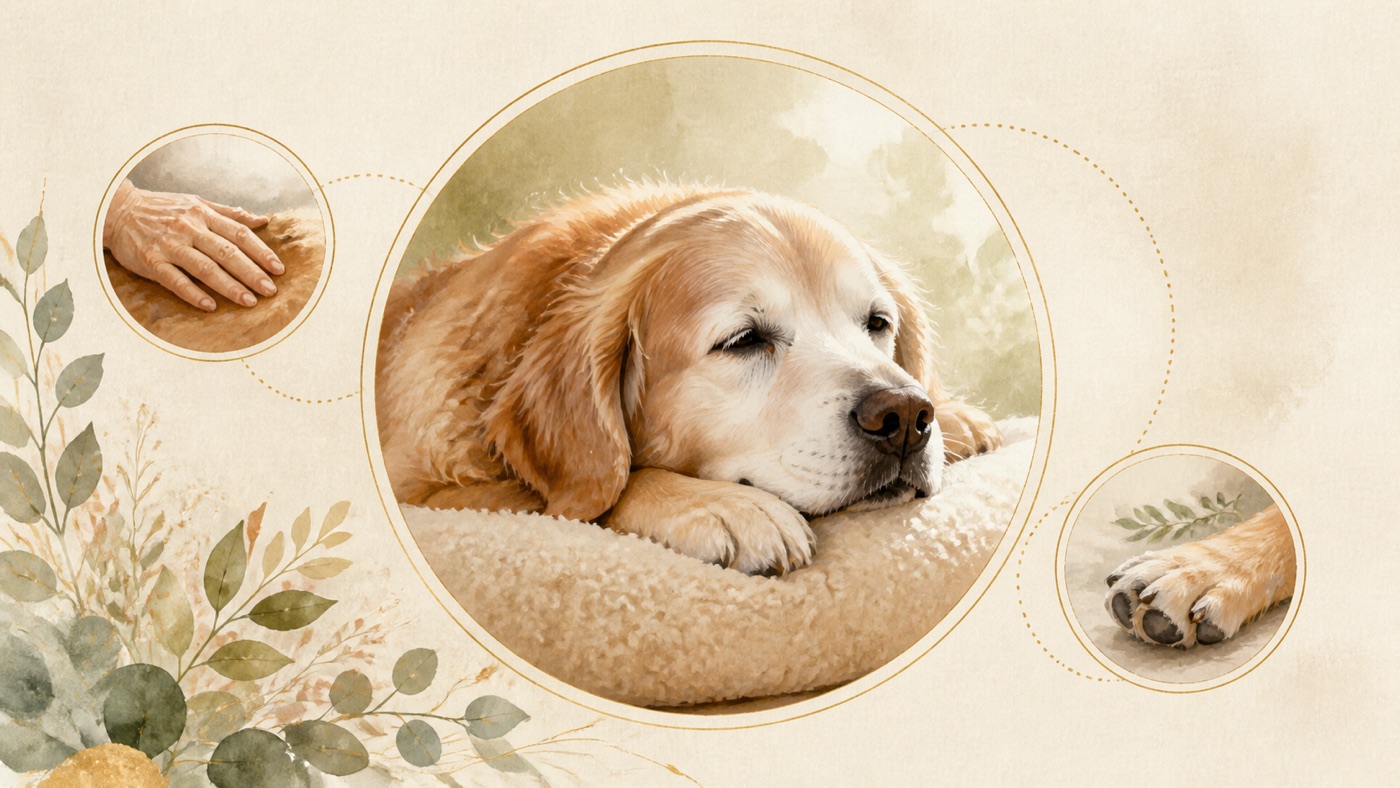
Dogs | Old Age, Hospice, and Euthanasia Decisions
When a dog counts as "old" depends on body size, not just age: the AAHA 2019 guidelines set no fixed age and instead define senior as the last 25% of estimated lifespan, so giant and large breeds reach old age far earlier than small breeds. This chapter covers common problems of old age and how to manage them at home, why "he's just gotten lazy" is the most common misreading of pain in older dogs, what hospice and palliative care involve (including the often-overlooked caregiver burden), how scales and diaries turn quality of life from a gut feeling into something you can discuss, plus what to ask about euthanasia ahead of time and when to talk to your veterinarian right away.
Dogs | Old Age, Hospice, and Euthanasia Decisions
This chapter is compiled from the dog section of the veterinary encyclopedia. The same sign is handled differently in different species, and following another species' approach can be harmful — first confirm which animal you are dealing with.
⚠️ This section does not provide legal advice (per the SPEC safety rule). For body handling, reporting, and pet registration cancellation, follow the regulations of your local authorities and ask the hospital about procedures and fees.
11.1 When does a dog count as "old"
| Item | Details |
|---|---|
| Guiding principle | By body size, not age alone: giant and large breeds reach old age far earlier than small breeds |
| Specific age cutoff | ✅ Exists · verified: the AAHA 2019 guidelines set no fixed age and use a relative definition instead: "Senior: The last 25% of estimated lifespan through end of life," i.e., starting from the last 25% of the estimated lifespan for the breed/body size. Reference: 2019 AAHA Canine Life Stage Guidelines. *Journal of the American Animal Hospital Association*, 55(6): 267–290, Nov/Dec 2019, Table 1. PMID: 31622127; DOI: 10.5326/JAAHA-MS-6999 (verified via PubMed/Crossref, 2026-07-30; the original aaha.org source returned 403 to automated retrieval, so PubMed/DOI are used as the official identifier source) |
| What to do | Once senior: increase checkup frequency (most guidelines suggest every six months), add blood pressure and urine specific gravity, start routine pain and cognitive assessments, and establish a "baseline" for later comparison |
11.2 Common problems of old age and home management
| Problem | What the owner can see | Home management | What needs the vet |
|---|---|---|---|
| Osteoarthritis pain | Slow to get up, avoids stairs, stops jumping onto the sofa, shorter walks, licking joints, irritability, restless at night | Non-slip flooring, ramps, raised food bowls, soft bedding, short frequent walks, keeping an ideal body weight | Pain must be treated (multimodal prescription plus rehabilitation) — it is not "just old age" |
| Declining vision (cataracts, retinal degeneration, glaucoma) | Bumping into things, hesitant in the dark, cannot find toys | Do not rearrange furniture, leave a night light, use voice cues, add gates at stairways | Sudden red, intensely painful eye = emergency (§8); cataracts may be linked to diabetes |
| Declining hearing | Does not come when called, sleeps deeply, startles when touched | Switch to hand signals and vibration cues; let the dog see you before touching (to avoid startle bites) | Rule out ear infection and ear canal obstruction |
| Dental disease | Bad breath, dropping food, chewing on one side, weight loss | Keep up daily tooth brushing | Weigh anesthetic risk and treatment trade-offs with the veterinarian; no anesthesia-free dental cleaning |
| Chronic kidney disease, heart disease, tumors, endocrine disorders | Drinking and urinating more, labored breathing, coughing, weight loss, lumps | Record sleeping respiratory rate, body weight, water intake | Regular staging follow-up and prescription diets |
| Cognitive dysfunction (Canine Cognitive Dysfunction, CCD) | Nighttime restlessness and pacing, staring at corners, getting stuck behind furniture, getting lost, less interaction with family, day-night reversal, house soiling | Regular routine and daylight, daytime activity and scent games, safe nighttime paths with night lights, avoid major changes to the environment, use gates to prevent getting stuck | First rule out pain, hearing and vision loss, endocrine disease, hypertension, and brain disease; prescriptions and diets can slow progression, assessed by the veterinarian |
| Muscle loss (sarcopenia) and weakness | Hind legs slipping, cannot climb into the car, thinning muscles | Gentle regular exercise, do not restrict protein without reason, support straps/harnesses | Muscle condition score (MCS) tracking; rule out neurological and endocrine disease |
| Incontinence | Wet sleeping spot, red skin | Pee pads, frequent changes, keep skin clean and dry, prevent urine scald | Urinalysis first (infection, kidney disease, diabetes, hormone-related) |
| Sleep changes | Barking at night, sleeping heavily by day | See CCD management | Rule out pain and hypertension |
11.3 Recognizing pain — the most important part of this section
Dogs do not "cry out in pain"; dogs "go quiet." "He's just gotten lazy" is the most common misreading of pain in older dogs.
| Don't say | What to think of instead |
|---|---|
| "He's old and doesn't like to move" | Arthritis, back pain, dental pain |
| "He's gotten lazy and won't play" | Pain, heart disease, thyroid, cognitive dysfunction |
| "He's been grumpy lately" | Pain (especially flinching or baring teeth when touched somewhere) |
| "He paces at night because he's old" | Pain, CCD, hypertension, hypoxia |
| "He's just eating slowly" | Dental pain, oral tumor, nausea (kidney disease) |
Action: make "pain assessment" a fixed item at every senior checkup (use a structured scale, see §2.2), and record videos at home (walking, getting up, climbing stairs) so the veterinarian can see the trend.
11.4 Hospice / palliative care
| Aspect | Details |
|---|---|
| Shift in goals | From "treating the disease" to "maintaining comfort and dignity." This is an active care plan, not giving up |
| Pain and symptom management | Pain, nausea, breathing difficulty, anxiety, appetite → set by the veterinarian and adjusted as the disease progresses (prescription, no doses given here) |
| Nutrition and hydration | Small frequent meals, warming food to boost aroma, hand feeding, discussing the pros and cons of assisted feeding when necessary |
| Elimination and skin | An accessible toileting spot, pee pads, frequent cleaning and drying, pressure sore (decubitus ulcer) prevention: soft padding plus scheduled repositioning |
| Mobility support | Support harnesses, non-slip surfaces, ramps, carts; avoid dragging that causes abrasions |
| Environment | Quiet, comfortable temperature, family nearby, familiar smells |
| Caregiver burden | Share shifts, allow yourself to be tired, discuss in advance "at what point we choose not to continue," plan finances. Caregiver burnout directly affects the animal's quality of care |
| Other animals at home | Reduce conflict, separate resources; other dogs may show appetite and behavior changes in the final stage and after the loss |
| Children | Explain in concrete, honest terms without the "went to sleep" metaphor; allow them to take part in saying goodbye |
11.5 How to assess quality of life (turning the subjective into something discussable)
| Method | How |
|---|---|
| Structured scales | For example the HHHHHMM quality-of-life scale (Hurt/Hunger/Hydration/Hygiene/Happiness/Mobility/More good days than bad) ✅ Exists · verified: the original concept comes from Villalobos AE (2004), "Quality of life scale helps make final call," *Veterinary Practice News* (a trade publication column, no DOI/PMID); formally included in the textbook Villalobos AE, Kaplan L. *Canine and Feline Geriatric Oncology: Honoring the Human-Animal Bond*, 2nd ed. Wiley-Blackwell, 2017-11-20. ISBN 9781119290391 (print) / 9781119290469 (electronic); an independent peer-reviewed validation study confirms it as a recognized scale: Testoni I et al. (2023), "Validation of the HHHHHMM Scale in the Italian Context: Assessing Pets' Quality of Life and Qualitatively Exploring Owners' Grief." *Animals*, 13(6):1049. PMID: 36978590; DOI: 10.3390/ani13061049 (verified via PubMed/Crossref, 2026-07-30); other veterinary hospice organization scales 🚫【conceptual description, not a specific publication, 2026-07-30】. Score repeatedly with the same scale at regular intervals — what matters is the trend, not any single score |
| The "5 favorite things" list | Write down now the 5 things this dog loves most (e.g., walks, snuggling with you on the sofa, meals, playing ball, greeting you at the door). When the dog can no longer do 3 of them, it is time to reassess |
| Good day / bad day diary | Mark a ✓ or ✗ on the calendar each day (was today, overall, a good day or a bad day). When bad days start to outnumber good days and the trend cannot be reversed, it is time to discuss timing with the veterinarian |
| Objective indicators | Body weight, appetite, water intake, sleeping respiratory rate, pain score, whether the dog can stand up and eliminate on its own |
| Who judges | The owner provides daily observations (the 23 hours the veterinarian does not see); the veterinarian provides the disease course and prognosis. Only both together give the full picture |
11.6 Euthanasia: the decision and the process
| Aspect | Details |
|---|---|
| The core question | Not "how much longer can the dog live" but "in the time that remains, does the suffering outweigh what the dog can still enjoy, and is that irreversible" |
| "Too early" vs. "too late" | Most owners' regret afterwards centers on too late (unable to bear the decision, leaving the dog to suffer for extra weeks). Some worry about deciding too early → this is exactly why scales and diaries exist: decide on the trend, not on the emotions of a single day |
| When to discuss immediately | Uncontrollable pain, the distress of being unable to breathe, persistent inability to eat or drink, inability to stand or eliminate unaided with pressure sores developing, persistent severe seizures or neurological signs, major bleeding, an acute deterioration expected to be irreversible |
| What to ask beforehand (ask before that day comes) | How the procedure works, how long it takes, whether it hurts (sedation is usually given first), can I stay by my dog's side, can it be done at home (availability and cost of house-call services), can it be arranged at night or on holidays, the cost, what happens to the body afterwards (per local regulations — ask the hospital about the available options and fees), can I keep a memento (paw print, fur) |
| Who takes part in the decision | The whole family (including children, in an age-appropriate way) discusses in advance and seeks consensus as far as possible; carrying the decision alone is the biggest source of psychological burden afterwards |
| Preparing for the day | Bring the favorite blanket and treats, choose a quiet time slot, decide who will be present, do not drive long distances right afterwards |
| Afterwards | Pet loss grief is a real loss; grief has no timetable; housemate animals need time to adjust; if grief interferes with daily functioning, seek professional support |
| Veterinary communication (textbook basis) | Lines 266–267: `Communication and ethics: explain risks, options, costs, and prognosis clearly; put animal welfare first at all times` plus `practice clear expression, informed consent, empathy, and honest disclosure of uncertainty`. The euthanasia conversation is the final test of this line |
Limits of this content
The content of this chapter comes from the dog section of the veterinary encyclopedia (original location and content hash in the evidence chain). The sources at the end are the authoritative references cited by that section — a chapter-level mapping, which does not mean every sentence traces line by line to a specific source. This content is for educational purposes and cannot replace diagnosis and prescriptions by a practicing veterinarian; in an emergency, seek veterinary care immediately. This text has not been clinically reviewed by a named veterinarian.
FAQ
- At what age is a dog "old"?
- The rule is body size, not age alone: giant and large breeds reach old age far earlier than small breeds. The AAHA 2019 guidelines set no fixed age and use a relative definition instead: senior is "the last 25% of estimated lifespan through end of life," projected from the estimated lifespan for the breed and body size. Once a dog is senior, checkups should become more frequent — most guidelines suggest every six months — with blood pressure and urine specific gravity added, plus routine pain and cognitive assessments.
- 犬は何歳から高齢ですか? — 判定の原則は年齢だけでなく体格で、超大型犬・大型犬は小型犬よりはるかに早く高齢期に入ります。AAHA 2019 ガイドラインは固定の年齢を設けず、「推定寿命の最後の 25% から生命の終わりまで」という相対的な定義を採用し、品種と体格ごとの推定寿命から推し量ります。高齢期に入ったら健診頻度を上げ(多くのガイドラインは半年ごとを推奨)、血圧と尿比重を追加し、痛みと認知の定期評価を始めます。
- At what age is a dog "old"? — The rule is body size, not age alone: giant and large breeds reach old age far earlier than small breeds. The AAHA 2019 guidelines set no fixed age and use a relative definition instead: senior is "the last 25% of estimated lifespan through end of life," projected from the estimated lifespan for the breed and body size. Once a dog is senior, checkups should become more frequent — most guidelines suggest every six months — with blood pressure and urine specific gravity added, plus routine pain and cognitive assessments.
- My old dog has gotten lazy and inactive — is that normal aging?
- Not necessarily; that is the most common misreading of pain in older dogs. Dogs do not cry out in pain — they go quiet. "He's old and doesn't like to move" may be arthritis, back pain, or dental pain; "grumpy lately," especially flinching or baring teeth when touched somewhere, usually means pain; "pacing at night" may be pain, cognitive dysfunction, hypertension, or hypoxia; "eating slowly" may be dental pain, an oral tumor, or nausea. Pain must be treated.
- 老犬が怠けて動かなくなったのは、正常な老化ですか? — そうとは限りません。それは高齢犬の痛みで最も多い見誤りです。犬は痛みで鳴かず、静かになります。「年で動きたがらない」は関節炎、背中の痛み、歯の痛みかもしれません。「気難しくなった」、特にある場所を触られると避けたり歯をむき出したりするのは、たいてい痛みです。「夜うろうろする」は痛み、認知機能不全、高血圧、低酸素の可能性があり、「食べるのが遅い」は歯の痛み、口腔腫瘍、吐き気の可能性があります。痛みは治療が必要です。
- My old dog has gotten lazy and inactive — is that normal aging? — Not necessarily; that is the most common misreading of pain in older dogs. Dogs do not cry out in pain — they go quiet. "He's old and doesn't like to move" may be arthritis, back pain, or dental pain; "grumpy lately," especially flinching or baring teeth when touched somewhere, usually means pain; "pacing at night" may be pain, cognitive dysfunction, hypertension, or hypoxia; "eating slowly" may be dental pain, an oral tumor, or nausea. Pain must be treated.
- How do I judge my dog's quality of life, and when should I discuss euthanasia with the veterinarian?
- Decide on the trend, not on the emotions of a single day. Score repeatedly with a structured scale and watch the trend; write down now the 5 things this dog loves most and reassess when it can no longer do 3 of them; add a good day/bad day diary, and when bad days start to outnumber good days and the trend cannot be reversed, it is time to discuss timing with the veterinarian. Uncontrollable pain, the distress of being unable to breathe, or persistent inability to eat or drink call for an immediate discussion.
- 犬の生活の質はどう判断し、いつ獣医師と安楽死を相談すべきですか? — その日の感情ではなく、傾向で決めます。構造化スケールで定期的に繰り返し採点して傾向を見る。今のうちに、この犬が一番好きな 5 つのことを書き出し、そのうち 3 つができなくなったら見直す。さらに良い日/悪い日の日誌を付け、悪い日が良い日より多くなり始めて傾向が戻らないなら、獣医師とタイミングを相談すべき時です。コントロールできない痛み、呼吸できない苦しみ、飲食が続けてできない場合は、すぐに相談してください。
- How do I judge my dog's quality of life, and when should I discuss euthanasia with the veterinarian? — Decide on the trend, not on the emotions of a single day. Score repeatedly with a structured scale and watch the trend; write down now the 5 things this dog loves most and reassess when it can no longer do 3 of them; add a good day/bad day diary, and when bad days start to outnumber good days and the trend cannot be reversed, it is time to discuss timing with the veterinarian. Uncontrollable pain, the distress of being unable to breathe, or persistent inability to eat or drink call for an immediate discussion.
Source anchors
- Merck 獸醫手冊|犬章引用 · https://www.merckvetmanual.com/management-and-nutrition/management-of-the-neonate/management-of-the-neonate-in-dogs-and-cats · 在 IDAEO 的其他引用
- Merck 獸醫手冊|犬章引用 · https://www.merckvetmanual.com/multimedia/table/parameters-to-evaluate-during-triage · 在 IDAEO 的其他引用
- Merck 獸醫手冊|犬章引用 · https://www.merckvetmanual.com/reproductive-system/reproductive-diseases-of-the-female-small-animal/dystocia-in-small-animals · 在 IDAEO 的其他引用
- PMC 全文|犬章引用 · https://pmc.ncbi.nlm.nih.gov/articles/PMC10385239/ · 在 IDAEO 的其他引用
- PMC 全文|犬章引用 · https://pmc.ncbi.nlm.nih.gov/articles/PMC10705156/ · 在 IDAEO 的其他引用
- PMC 全文|犬章引用 · https://pmc.ncbi.nlm.nih.gov/articles/PMC11096582/ · 在 IDAEO 的其他引用
- PMC 全文|犬章引用 · https://pmc.ncbi.nlm.nih.gov/articles/PMC5421102/ · 在 IDAEO 的其他引用
- PMC 全文|犬章引用 · https://pmc.ncbi.nlm.nih.gov/articles/PMC7608676/ · 在 IDAEO 的其他引用
- WSAVA|犬章引用 · https://wsava.org/wp-content/uploads/2021/04/Selecting-a-pet-food-for-your-pet-updated-2021_WSAVA-Global-Nutrition-Toolkit.pdf · 在 IDAEO 的其他引用
- AAHA|犬章引用 · https://www.aaha.org/wp-content/uploads/globalassets/02-guidelines/behavior-management/2015_aaha_canine_and_feline_behavior_management_guidelines_final.pdf · 在 IDAEO 的其他引用
- AAHA|犬章引用 · https://www.aaha.org/wp-content/uploads/globalassets/02-guidelines/canine-life-stage/canine_life_stage_guidelines.pdf · 在 IDAEO 的其他引用
- WOAH 世界動物衛生組織|犬章引用 · https://www.woah.org/en/disease/rabies/ · 在 IDAEO 的其他引用
- vetmed.illinois.edu|犬章引用 · https://vetmed.illinois.edu/pet-health-columns/never-give-medications-for-people-to-pets/ · 在 IDAEO 的其他引用
- 本文證據鏈:原始章節位置與內容雜湊 · https://km.idaeo.ai/reports/vet-dog-senior-and-end-of-life-evidence · 在 IDAEO 的其他引用
Cite this article
Jane・《Dogs | Old Age, Hospice, and Euthanasia Decisions》・IDAEO 知識庫・2026-08-13・https://km.idaeo.ai/post/vet/dog-senior-and-end-of-lifeUpdated 2026-08-15