

🏛 Part of the "vet" topic shelf →
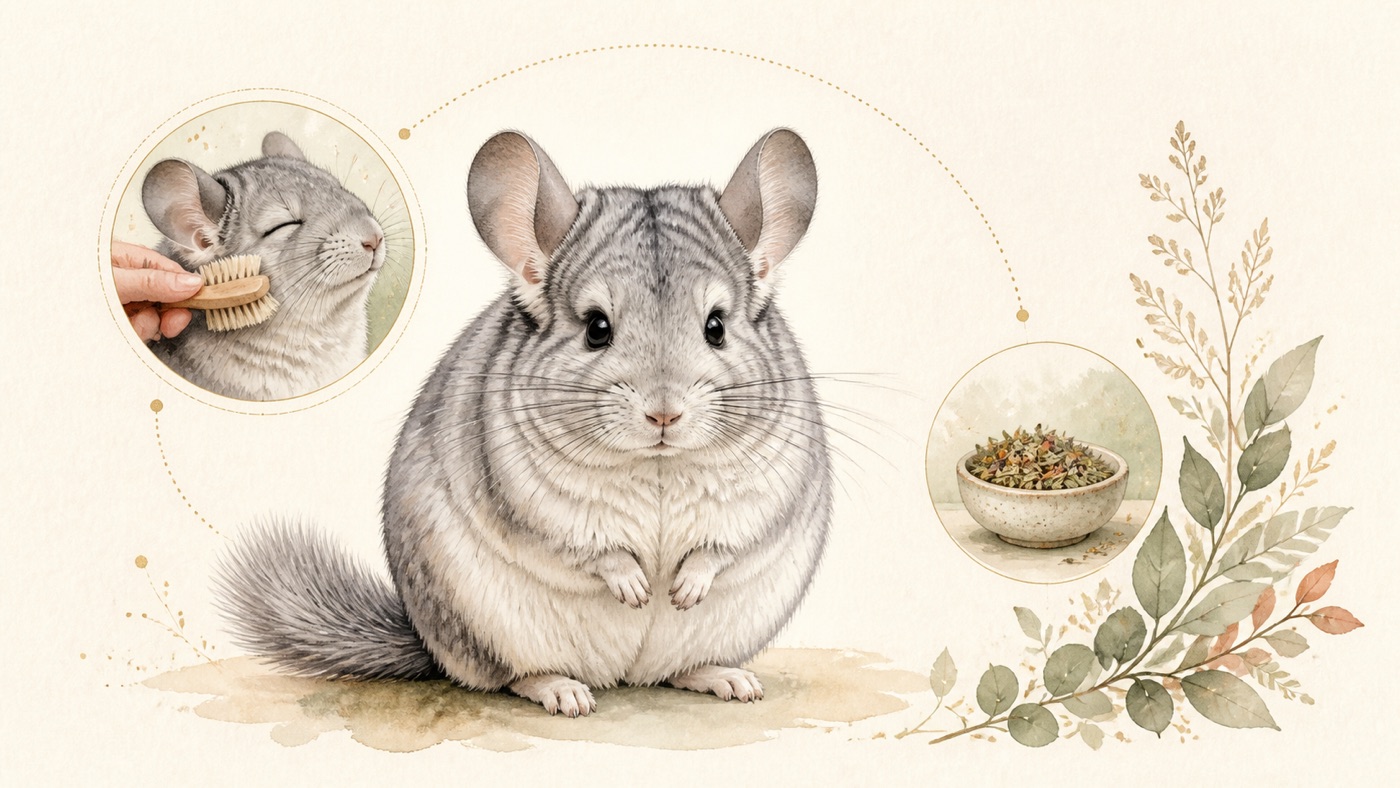
Chinchillas | Husbandry and health: a 12-column knowledge tree
A single table covering twelve columns for the chinchilla (Chinchilla lanigera): species and breeds with lifespan, normal physiological parameters, housing, nutrition, behaviour and welfare, preventive medicine, common diseases, emergency red flags, zoonoses, household toxins, geriatric and end-of-life decisions, and authoritative sources. Where the source chapter could not find an authoritative figure, the field is left blank with the reason stated, and this site does not fill in a number on its behalf. It suits taking on a new animal, or working out which direction to look in when something seems wrong.
Chinchillas | Husbandry and health: a 12-column knowledge tree (Chinchilla lanigera)
This article is compiled from the 12-column knowledge tree for chinchillas in the small mammals chapter of the veterinary animal encyclopaedia. Small mammals differ enormously from one another — rabbits and guinea pigs have no vomiting reflex, chinchillas tolerate heat very poorly, and ferrets are carnivores — so doing what works for another species can do harm. Confirm which animal you have first.
| Column | Content |
|---|---|
| 1 Species/breeds and lifespan | The long-tailed chinchilla, native to the Andes of South America. Lifespan: generally 10–15 years, with a maximum recorded age of up to 20 years (Merck Vet Manual consumer page: 「Chinchillas live about 10–15 years, on average, but some pet chinchillas have lived up to 20 years.」<https://www.merckvetmanual.com/all-other-pets/chinchillas/description-and-physical-characteristics-of-chinchillas>; the professional page likewise states 「up to 20 years」<https://www.merckvetmanual.com/exotic-and-laboratory-animals/rodents/chinchillas>, the two agreeing, verified 2026-07-30). |
| 2 Normal physiological parameters | Monitor body weight, evenness of coat density (a patch of shed fur, "fur slip", is a predator-defence mechanism and not necessarily a disease), and the size and shape of the droppings. Abnormalities: droppings becoming smaller and fewer (a gastrointestinal stasis warning sign). Figures: adult body weight 450–680 g (1–1.5 pounds) (Merck: 「Adult chinchillas weigh between 1 and 1½ pounds (450–680 grams).」<https://www.merckvetmanual.com/all-other-pets/chinchillas/description-and-physical-characteristics-of-chinchillas>, verified 2026-07-30); body temperature/heart rate/respiratory rate 【No single authoritative figure for these items: the whitelisted sources do not provide chinchilla-specific reference values for body temperature/heart rate/respiratory rate】. |
| 3 Housing | Native to a dry, cool, high-altitude climate and extremely intolerant of heat and humidity (a high heat-stroke risk requiring strict temperature control); a dust bath must be provided rather than a water bath (bathing in water leaves the dense coat unable to dry and precipitates fungal dermatitis); multiple levels for jumping are needed (they naturally like to jump and climb). Temperature and humidity limits: the ambient temperature range to which chinchillas are adapted is 18.3–26.7°C (65–80°F), and exceeding this range — especially together with high humidity — can cause heat stroke (Merck Vet Manual, professional edition: 「The ambient temperature range to which chinchillas are adapted is 18.3–26.7°C (65–80°F)...Exposure to higher ambient temperatures, especially in the presence of high humidity, can result in heatstroke.」<https://www.merckvetmanual.com/exotic-and-laboratory-animals/rodents/chinchillas>); the consumer page gives an explicit heat-stroke threshold: 「Chinchillas can get heat stroke at temperatures above 80°F (27°C).」「They prefer temperatures between 50 and 60°F (10–16°C).」<https://www.merckvetmanual.com/all-other-pets/chinchillas/routine-health-care-for-chinchillas> — conclusion: ambient temperature must not exceed roughly 26.7°C (80°F); this is the safety-critical figure in this file; Merck gives no specific upper humidity percentage, noting only that high humidity aggravates the heat-stroke risk (verified 2026-07-30). |
| 4 Nutrition and feeding | Unlimited high-fibre grass hay as the staple, with pellets as a supplement, and strict limitation of high-sugar, high-fat treats such as fruit and nuts (the digestive tract is sensitive and readily develops gastrointestinal problems and obesity). Common feeding mistakes: mistaking dried fruit for a "healthy treat" and feeding it in quantity, and overlooking the importance of hay. |
| 5 Behaviour and welfare | Normal: nocturnal activity, rolling in a dust bath, jumping. Stress signals: over-grooming to the point of bald patches, refusing food. The five welfare needs: enough space to jump, regular opportunities to dust bathe, and a cool environment. |
| 6 Preventive medicine | Regular health and dental checks (like rabbits, chinchilla teeth grow throughout life). Frequency: an annual check-up is recommended (second-round independent verification on 2026-07-30 found that the AEMV chinchilla care guide states the frequency explicitly — 「It is recommended that your chinchilla have an annual exam.」<https://aemv.org/wp-content/uploads/2024/10/aemv_trifold_chinchilla_web_.pdf> — consistent with the AEMV 「annual exam」 recommendation in the hamster/gerbil/rat columns of the same table). Merck notes only that abnormalities related to subclinical dental disease are found in about one-third of apparently healthy chinchillas presented for routine examination (「Abnormalities related to subclinical dental disease have been reported in one-third of apparently healthy chinchillas presented for routine physical examination」<https://www.merckvetmanual.com/exotic-and-laboratory-animals/rodents/chinchillas>), without giving a specific figure such as "annually" or "every six months"; AEMV has since filled that gap. Separately, the Merck professional edition gives a fur-ring examination frequency for breeding males of 「at least 4 times a year」, which is a check on a specific reproductive structure rather than a whole-body examination frequency (verified 2026-07-30). |
| 7 Common diseases, top 10 | 1. Gastrointestinal stasis: the same mechanism as in rabbits/guinea pigs (hindgut fermenters, precipitated by insufficient fibre or stress) → refusing food, reduced or absent droppings → palpation/radiography → prokinetics and supportive care (prescription) → ample hay.<br>2. Heat stroke (heat exhaustion): excessive ambient temperature (they are extremely heat-sensitive) → panting, reddened ears, collapse → physical examination (body temperature) → emergency cooling and fluids (requires immediate veterinary care) → strict temperature control and no direct exposure to heat.<br>3. Dental malocclusion: insufficient wear of continuously growing teeth → drooling, weight loss, refusing food → oral examination/radiography → burring (requires anaesthesia, prescription) → ample hay to maintain wear.<br>4~10. Fungal skin infection (dermatophytosis: clinical signs are uncommon in chinchillas but they can be subclinical carriers. 🔴 OP withdraws a misjudgement, 2026-07-30: OP had previously added a note here that "the '2–3 weeks' treatment figure in the source text had no source and was removed" — that accusation was wrong and has been withdrawn. OP's scanner flagged the "2–3 weeks" in this row, and OP assumed it lacked a source without first confirming which claim it referred to; in fact that figure belongs to the postpartum timing of bloat (see later in this row, recorded verbatim in Merck), not to the duration of dermatophytosis treatment, and the file was correct as written. What was genuinely added from Merck is that the treatment endpoint for dermatophytosis is "two negative cultures" rather than a fixed number of days (verbatim: 「continued until two negative dermatophyte culture results have been obtained」; medication and dosage are decided by the veterinarian and are not recorded in this encyclopaedia). Merck also does not link dermatophytosis to water bathing; excessive water bathing is instead linked to conjunctivitis and pulmonary epithelial hyperplasia/granuloma. Trichophyton mentagrophytes is most often isolated; the infection rate is 30% in animals with fur damage versus 5% in those with normal skin — Merck professional edition: 「fungal cultures of fur-ranched chinchillas show a 5% incidence of T mentagrophytes in animals with normal skin and a 30% incidence in animals with fur damage.」<https://www.merckvetmanual.com/exotic-and-laboratory-animals/rodents/chinchillas>; note: that Merck page does not explicitly link this to "water bathing" but rather associates it more strongly with pre-existing fur damage, so the causal statement "precipitated by water bathing" in the original file is an inference and not a direct Merck statement), bloat / gastric tympany 〔this item is a correction made after the second round of verification: the original text's "hairball obstruction" was independently re-checked and confirmed not to be a documented chinchilla disease; see the explanation below〕: multifactorial, precipitated by sudden dietary change or overeating, with case reports also in dams 2–3 weeks after lactation begins, possibly related to hypocalcaemia (Merck verbatim: 「Bloat has been reported in lactating females 2–3 weeks postpartum and might be related to hypocalcemia.」 fetched and verified by OP 2026-07-30); ⚠️ and gas accumulates extremely rapidly — Merck records that it can occur within hours (verbatim: gas accumulation occurs rapidly within 2–4 hours). ⚠️ That time figure refers to the speed at which intestinal gas accumulates, not a period you may count down and wait out; clinically it presents as dullness, respiratory difficulty, and a painful, distended abdomen. 🚩 Emergency red flag: marked abdominal distension and pain plus dullness or respiratory difficulty → contact a veterinarian experienced with exotic pets immediately; emergency management requires passage of a stomach tube or paracentesis to release the gas (Merck: 「Bloat, or tympany, can result from sudden dietary changes, especially overeating.」「lethargic and dyspneic, with a painful, distended abdomen」「passage of a stomach tube or paracentesis to relieve gas buildup」<https://www.merckvetmanual.com/exotic-and-laboratory-animals/rodents/chinchillas>, verified 2026-07-30) among others (verified 2026-07-30).<br>〔Re-check note〕 the independent re-verification of the disease name "hairball obstruction": in the second round on 2026-07-30 the 「Gastrointestinal Disorders of Chinchillas」 section of the Merck chinchilla overview page (<https://www.merckvetmanual.com/exotic-and-laboratory-animals/rodents/chinchillas>) was re-checked directly, and the gastrointestinal diseases listed there were confirmed verbatim as choking, megaesophagus, gastric ulcers, bloat/tympany, diarrhoea, constipation and hepatic lipidosis; trichobezoar or hairball is not mentioned anywhere in the page; the only fur-related entry on the page is the "fur ring" of the male chinchilla's reproductive organ (not a gastrointestinal disease). The first-round PubMed/PMC search likewise found no corresponding literature on hairball obstruction in chinchillas. Conclusion: "hairball obstruction" appears to be a mistaken transposition of a rabbit disease (rabbit trichobezoar/wool block; rabbits are also hindgut fermenters and groom and swallow fur), the whitelisted chinchilla literature does not support this disease name, and it has been removed from the chinchilla disease list and replaced by 「bloat / gastric tympany」, which Merck actually records. |
| 8 🚨Emergency red flags | Signs of heat stroke (panting, collapse), reduced appetite or reduced faecal output (no chinchilla-specific time threshold for seeking care was obtained from the whitelisted sources, so no figure is given; as another hindgut fermenter, the sooner the better), severe traumatic fur loss with bleeding. |
| 9 Zoonoses | Ringworm (dermatophytosis). |
| 10 Household toxins and hazards | A hot environment is itself the greatest household hazard; toxic plants and cleaning products as for other small herbivores. |
| 11 Geriatric care, palliative care and euthanasia decisions | End-stage dental disease preventing eating, repeatedly recurring chronic gastrointestinal problems, severe sequelae of heat stroke. Euthanasia must be performed by a veterinarian. |
| 12 Authoritative sources | *Ferrets, Rabbits, and Rodents: Clinical Medicine and Surgery* (source text line 87, covering chinchillas and other rodents); Merck Veterinary Manual (source text line 293). |
The 12 columns above are copied cell by cell from the encyclopaedia chapter, without rewriting or condensing; treatment directions state categories only, never drug names or doses, and medication requires a veterinary prescription. Where the source chapter could not find an authoritative figure (such as species-specific time thresholds for seeking care), it explicitly leaves the field blank and states why, and this site preserves that as it stands.
The limits of this content
This content comes from the small mammals chapter of the veterinary encyclopaedia (the original location and content hash are in the evidence chain). The sources at the end are the authoritative material cited by that section. This chapter has no row-level anchors in the project's line-level anchor file; only the chapter-level content hash can be verified — the same level as this site's existing "group overview" articles for each chapter — which does not mean every sentence traces to a particular source. Where the source text could not find an authoritative figure it leaves the field blank and states the reason; this site preserves that as it stands and does not fill in a number on its behalf. This is educational information and cannot replace diagnosis and prescription by a practising veterinarian; in an emergency, seek care immediately. This article has not been clinically reviewed by a named veterinarian.
"Source text line N" in the table is a line number in the original teaching-material inventory used when this project's database was built; it is an internal traceability marker and that inventory is not public. It is the book and journal titles outside the parentheses that are the sources you can look up for yourself.
FAQ
- What is most often fed wrongly to chinchillas?
- Unlimited high-fibre grass hay as the staple, with pellets as a supplement, and strict limitation of high-sugar, high-fat treats such as fruit and nuts (the digestive tract is sensitive and readily develops gastrointestinal problems and obesity). Common feeding mistakes: mistaking dried fruit for a "healthy treat" and feeding it in quantity, and overlooking the importance of hay.
- チンチラの給餌で最も間違えやすいのは何ですか。 — 主食は無制限の高繊維牧草、ペレットは補助とし、果物やナッツなど高糖・高脂のおやつは厳しく制限します(消化管が敏感で、消化器の問題と肥満を招きやすいため)。よくある給餌の誤り:ドライフルーツを「健康的なおやつ」と誤解して大量に与える、乾草の重要性を軽視する。
- What is most often fed wrongly to chinchillas? — Unlimited high-fibre grass hay as the staple, with pellets as a supplement, and strict limitation of high-sugar, high-fat treats such as fruit and nuts (the digestive tract is sensitive and readily develops gastrointestinal problems and obesity). Common feeding mistakes: mistaking dried fruit for a "healthy treat" and feeding it in quantity, and overlooking the importance of hay.
- What signs in a chinchilla mean going to the vet immediately?
- Signs of heat stroke (panting, collapse), reduced appetite or reduced faecal output (no chinchilla-specific time threshold for seeking care was obtained from the whitelisted sources, so no figure is given; as another hindgut fermenter, the sooner the better), severe traumatic fur loss with bleeding.
- チンチラにどんな状態が出たらすぐ受診すべきですか。 — 熱中症の徴候(パンティング、倒れる)、食欲低下または排便減少(チンチラ固有の受診までの時間はホワイトリスト典拠から得られなかったため数字を示しません。同じ後腸発酵動物であり、早いほどよいとされます)、出血を伴う重度の外傷性脱毛。
- What signs in a chinchilla mean going to the vet immediately? — Signs of heat stroke (panting, collapse), reduced appetite or reduced faecal output (no chinchilla-specific time threshold for seeking care was obtained from the whitelisted sources, so no figure is given; as another hindgut fermenter, the sooner the better), severe traumatic fur loss with bleeding.
- What is the most common disease in chinchillas?
- 1. Gastrointestinal stasis: the same mechanism as in rabbits/guinea pigs (hindgut fermenters, precipitated by insufficient fibre or stress) → refusing food, reduced or absent droppings → palpation/radiography → prokinetics and supportive care (prescription) → ample hay.
- チンチラで最もよくある疾患は何ですか。 — 1. 消化管うっ滞:機序はウサギ/モルモットと同じ(後腸発酵動物で、繊維不足やストレスが誘因)→拒食、糞の減少または消失→触診/X 線→消化管運動促進薬と支持療法(処方)→十分な乾草。
- What is the most common disease in chinchillas? — 1. Gastrointestinal stasis: the same mechanism as in rabbits/guinea pigs (hindgut fermenters, precipitated by insufficient fibre or stress) → refusing food, reduced or absent droppings → palpation/radiography → prokinetics and supportive care (prescription) → ample hay.
Source anchors
- Merck 獸醫手冊|小型哺乳章引用 · https://www.merckvetmanual.com/all-other-pets/chinchillas/description-and-physical-characteristics-of-chinchillas · 在 IDAEO 的其他引用
- Merck 獸醫手冊|小型哺乳章引用 · https://www.merckvetmanual.com/exotic-and-laboratory-animals/rodents/chinchillas · 在 IDAEO 的其他引用
- Merck 獸醫手冊|小型哺乳章引用 · https://www.merckvetmanual.com/all-other-pets/chinchillas/routine-health-care-for-chinchillas · 在 IDAEO 的其他引用
- AEMV 異寵獸醫學會|小型哺乳章引用 · https://aemv.org/wp-content/uploads/2024/10/aemv_trifold_chinchilla_web_.pdf · 在 IDAEO 的其他引用
- VCA 動物醫院|小型哺乳章引用 · https://vcahospitals.com/know-your-pet/chinchillas-diseases · 在 IDAEO 的其他引用
Cite this article
Jane・《Chinchillas | Husbandry and health: a 12-column knowledge tree》・IDAEO 知識庫・2026-08-13・https://km.idaeo.ai/post/vet/chinchilla-guideUpdated 2026-08-15