

🏛 Part of the "vet" topic shelf →
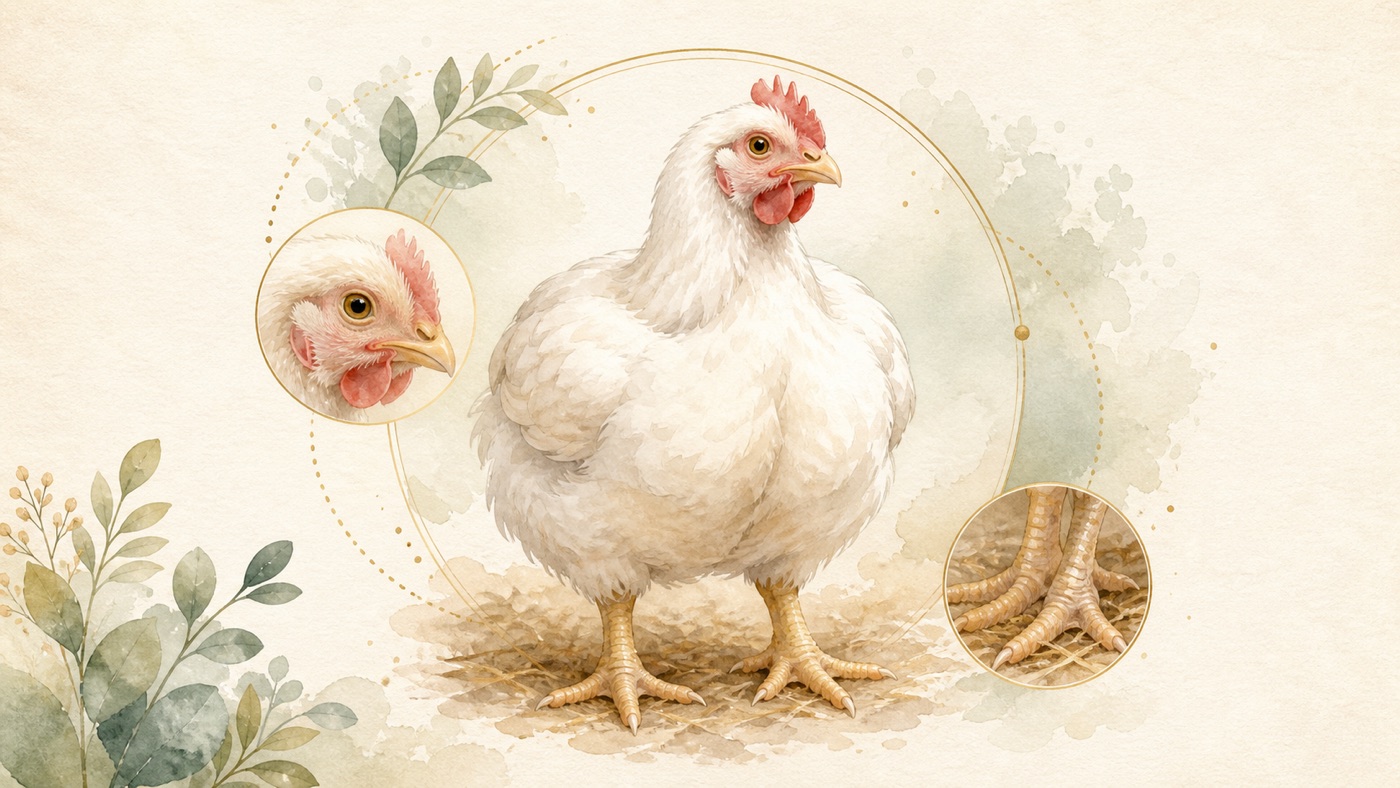
Broiler Chickens|10 Common Diseases (cause → signs → examination → treatment direction → prevention)
Ten common diseases of broiler chickens gathered into one table: ascites syndrome (pulmonary hypertension syndrome), sudden death syndrome (SDS, flip-over disease), leg disorders (valgus/varus deformity, tibial dyschondroplasia), contact dermatitis/hock burn, Newcastle disease, avian influenza, coccidiosis, colibacillosis, salmonellosis, and chronic heart failure (the non-sudden, chronic form). Each row lists cause, signs, examination, treatment direction and prevention; the treatment column gives categories only, never doses. It suits checking against when something looks wrong and you need to narrow down the direction first, or when taking on new birds.
Broiler Chickens|10 Common Diseases (cause → signs → examination → treatment direction → prevention)
This content is compiled from the disease table for broiler chickens in the backyard poultry chapter of the veterinary animal encyclopedia. The same sign calls for different handling in different species, and copying what is done for another species can be harmful — first confirm which animal you are dealing with.
| # | Disease (Chinese/English) | Cause | Signs | Examination | Treatment direction | Prevention |
|---|---|---|---|---|---|---|
| 1 | Ascites syndrome (pulmonary hypertension syndrome) | Rapid growth outpaces what the heart and lungs can carry as muscle mass increases, leading to right-sided heart failure | Distended abdomen with fluid, laboured breathing, reduced activity | History taking, palpation, imaging | Supportive care, requiring veterinary assessment; the prognosis is often poor | Managing growth rate and environment (ventilation, stocking density); not something the household alone can resolve |
| 2 | Sudden death syndrome (SDS, flip-over disease) | Sudden cardiac death, associated with fast-growing lines | An apparently healthy bird dies suddenly, often found on its back | Mostly found at post-mortem | It cannot be treated after the fact; the focus is on overall husbandry to lower the risk | Avoiding overfeeding of high-energy feed, providing adequate space to move |
| 3 | Leg disorders (valgus/varus deformity, tibial dyschondroplasia) | Growth rate outpaces skeletal development | Lameness, abnormal posture, reluctance to stand | Visual inspection, gait assessment, imaging | Veterinary assessment is required; where quality of life is severely affected, the humane measures in column 11 need to be considered | Managing diet and growth rate, avoiding prolonged overweight loading |
| 4 | Contact dermatitis / hock burn | Wet litter, heavy body weight with low activity, prolonged lying contact | Redness, swelling and broken skin over the hocks and breast | Visual inspection | Wound care needs veterinary assessment, and treating infection requires prescription medication | Keeping litter dry, lowering stocking density |
| 5 | Newcastle disease | Same as the laying hen group | Same as the laying hen group | Same as the laying hen group | Same as the laying hen group | Same as the laying hen group |
| 6 | Avian influenza | Same as the laying hen group | Same as the laying hen group | Same as the laying hen group | This falls under statutory reporting and stamping-out measures (see columns B and C) | Same as the laying hen group |
| 7 | Coccidiosis | Same as the laying hen group; young chicks are at high risk | Same as the laying hen group | Same as the laying hen group | Antiparasitic medication must be prescribed | Same as the laying hen group |
| 8 | Colibacillosis | Same as the laying hen group; in broilers, low activity and long contact with the environment make secondary infection somewhat more likely | Same as the laying hen group | Same as the laying hen group | Antibiotics must be prescribed | Environmental hygiene, reducing stressors |
| 9 | Salmonellosis | Same as the laying hen group | Same as the laying hen group | Same as the laying hen group | Antibiotics must be prescribed, and a withdrawal period comes into play (see column A; for broilers this is the meat withdrawal period) | Same as the laying hen group |
| 10 | Chronic heart failure (the non-sudden, chronic form) | Long-standing obesity and the cumulative cardiac load of fast-growing lines | Steadily falling activity, rapid breathing, ascites | Auscultation, imaging | Long-term veterinary assessment and management are required | Dietary control, avoiding prolonged overfeeding |
The 10 rows above are copied cell for cell from the encyclopedia chapter, neither rewritten nor condensed; the treatment column gives categories only, never drug names or doses, and any medication must be prescribed by a veterinarian. The line number and content hash of each row in the source chapter are in the evidence chain at the end.
Limits of this content
This content comes from the backyard poultry chapter of the veterinary encyclopedia (see the evidence chain for the original location and content hash). The sources at the end are the authoritative materials cited by that chapter; the correspondence is at chapter level, which does not mean every sentence is traced sentence by sentence back to a given source. This material is for education and cannot replace diagnosis and prescription by a practising veterinarian; in an emergency, seek veterinary care immediately. This text has not been clinically reviewed by a named veterinarian.
FAQ
- What is sudden death syndrome (SDS, flip-over disease), and what should make you call the vet at once?
- Sudden cardiac death, associated with fast-growing lines. You will see an apparently healthy bird die suddenly, often found on its back. The direction of management is that it cannot be treated after the fact; the focus is on overall husbandry to lower the risk. In the source chapter this row belongs to the group needing prompt attention; the actual judgement still rests with the veterinarian case by case, and this text gives no drug names or doses.
- 突然死症候群 Sudden death syndrome(SDS、flip-over disease)とは何ですか。何が見えたらすぐ獣医師を呼ぶべきですか。 — 心臓性の突然死であり、急速に発育する系統と関連します。外見上健康な個体が突然死し、仰向けの姿勢で見つかることが多くあります。対処の方向性は、事後の治療はできず、飼養管理全体でリスクを下げることが要点というものです。この行は元の章で速やかな対応を要する類型に属します。実際の判断は個々の症例に応じて獣医師が行う必要があり、本文では薬剤名と用量は書きません。
- What is sudden death syndrome (SDS, flip-over disease), and what should make you call the vet at once? — Sudden cardiac death, associated with fast-growing lines. You will see an apparently healthy bird die suddenly, often found on its back. The direction of management is that it cannot be treated after the fact; the focus is on overall husbandry to lower the risk. In the source chapter this row belongs to the group needing prompt attention; the actual judgement still rests with the veterinarian case by case, and this text gives no drug names or doses.
- What is avian influenza, and what should make you call the vet at once?
- Same as the laying hen group. You will see: same as the laying hen group. The direction of management is that this falls under statutory reporting and stamping-out measures (see columns B and C). In the source chapter this row belongs to the group needing prompt attention; the actual judgement still rests with the veterinarian case by case, and this text gives no drug names or doses.
- 高病原性鳥インフルエンザ Avian influenza とは何ですか。何が見えたらすぐ獣医師を呼ぶべきですか。 — 採卵鶏グループと同じです。症状も採卵鶏グループと同じです。対処の方向性は、法定の届出と殺処分の対象範囲(B・C 欄参照)というものです。この行は元の章で速やかな対応を要する類型に属します。実際の判断は個々の症例に応じて獣医師が行う必要があり、本文では薬剤名と用量は書きません。
- What is avian influenza, and what should make you call the vet at once? — Same as the laying hen group. You will see: same as the laying hen group. The direction of management is that this falls under statutory reporting and stamping-out measures (see columns B and C). In the source chapter this row belongs to the group needing prompt attention; the actual judgement still rests with the veterinarian case by case, and this text gives no drug names or doses.
- What causes ascites syndrome (pulmonary hypertension syndrome), and what matters most in preventing it?
- Rapid growth outpaces what the heart and lungs can carry as muscle mass increases, leading to right-sided heart failure. You will see a distended abdomen with fluid, laboured breathing and reduced activity. The key to prevention is managing growth rate and environment (ventilation, stocking density); it is not something the household alone can resolve. The direction of treatment rests with the veterinarian case by case, and this text gives no drug names or doses.
- 腹水症 Ascites syndrome(肺動脈高血圧症候群)の原因と予防の要点は何ですか。 — 急速な発育に心肺の能力が筋肉の増加に追いつかず、右心不全を起こすことが原因です。腹部の膨満と腹水、呼吸困難、活動性の低下が現れます。予防の要点は、発育速度と環境(換気、飼育密度)の管理であり、家庭だけで解決できるものではありません。治療の方向性は獣医師が個別に評価する必要があり、本文では薬剤名と用量は書きません。
- What causes ascites syndrome (pulmonary hypertension syndrome), and what matters most in preventing it? — Rapid growth outpaces what the heart and lungs can carry as muscle mass increases, leading to right-sided heart failure. You will see a distended abdomen with fluid, laboured breathing and reduced activity. The key to prevention is managing growth rate and environment (ventilation, stocking density); it is not something the household alone can resolve. The direction of treatment rests with the veterinarian case by case, and this text gives no drug names or doses.
Source anchors
- Merck 獸醫手冊|家禽章引用 · https://www.merckvetmanual.com/exotic-and-laboratory-animals/backyard-poultry/overview-of-backyard-poultry · 在 IDAEO 的其他引用
- Merck 獸醫手冊|家禽章引用 · https://www.merckvetmanual.com/poultry/nutrition-and-management-poultry/vitamin-deficiencies-in-poultry · 在 IDAEO 的其他引用
- Merck 獸醫手冊|家禽章引用 · https://www.merckvetmanual.com/special-subjects/reference-guides/normal-rectal-temperature-ranges · 在 IDAEO 的其他引用
- MSD 獸醫手冊|家禽章引用 · https://www.msdvetmanual.com/multimedia/table/nutrient-requirements-of-pekin-ducks · 在 IDAEO 的其他引用
- extension.colostate.edu|家禽章引用 · https://extension.colostate.edu/resource/poultry/ · 在 IDAEO 的其他引用
- extension.psu.edu|家禽章引用 · https://extension.psu.edu/a-quick-guide-to-raising-pastured-broilers · 在 IDAEO 的其他引用
- livestock.extension.wisc.edu|家禽章引用 · https://livestock.extension.wisc.edu/articles/life-cycle-of-a-laying-hen/ · 在 IDAEO 的其他引用
- openlibrary.org|家禽章引用 · https://openlibrary.org/works/OL20728248W · 在 IDAEO 的其他引用
Cite this article
Jane・《Broiler Chickens|10 Common Diseases (cause → signs → examination → treatment direction → prevention)》・IDAEO 知識庫・2026-08-13・https://km.idaeo.ai/post/vet/broiler-diseasesUpdated 2026-08-15