

🏛 Part of the "vet" topic shelf →
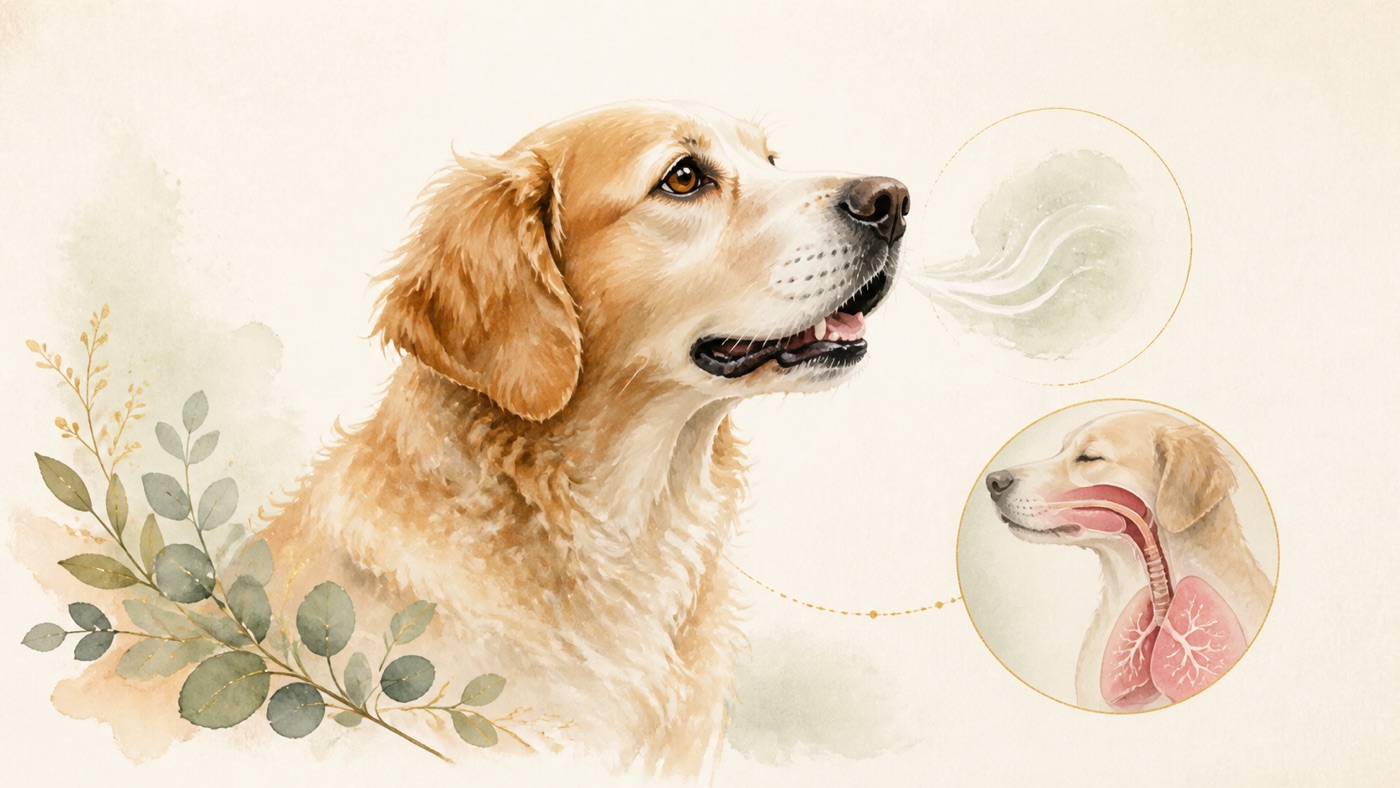
Symptom Triage|Breathing and Coughing
Four groups of breathing-related signals: rapid, laboured, open-mouth breathing; a persistent cough; sneezing with eye and nose discharge; and hoofed animals drooling and stretching the neck after eating. Each row gives the species where it is common and the severity. Open-mouth breathing in a cat is treated as an emergency in almost every case, a rising sleeping respiratory rate at home is an early signal of worsening heart disease in dogs and cats, and drooling with a stretched neck in horses, cattle and sheep after a feed change should raise choke. It also explains how to count the respiratory rate and why a cough should be filmed first, so that even at midnight you can tell whether to leave now or record and watch.
Symptom Triage|Breathing and Coughing
This section is compiled from the Symptom Triage chapter of the veterinary animal encyclopedia. The same symptom calls for different handling in different species, and copying what is done for another species can be harmful — first confirm which animal you are dealing with.
| Symptom (what the owner sees) | Species where it is common | Possible direction | What the owner can observe / record at home | Matching specialty |
|---|---|---|---|---|
| Rapid, laboured or open-mouth breathing, with the abdomen heaving | Dogs and cats (heart disease, pulmonary oedema, pleural effusion, airway obstruction in brachycephalic dogs), birds (fluffed feathers with rapid breathing), reptiles (respiratory infection), fish (several individuals gasping at the surface and crowding the air outlet) | Emergency (open-mouth breathing in a cat is treated as an emergency in almost every case; in dogs and cats a persistently rising sleeping respiratory rate at home is also an early signal of worsening heart disease) | Count chest and abdominal movements for one minute while the animal sleeps to record the respiratory rate (works for both cats and dogs); check for blue mucous membranes; note whether exercise tolerance has dropped | Cardiology (the original teaching material explicitly lists arrhythmia and congenital and acquired heart disease; in most mammals acute respiratory distress originates here) |
| Persistent cough (especially at night or worse after exercise) | Dogs (myxomatous mitral valve disease, MMVD; tracheal collapse), dogs and cats kept in groups (canine infectious respiratory disease complex, CIRDC) | Veterinary visit needed (persistent); emergency (with breathing difficulty or blue mucous membranes) | Film how the cough looks and sounds at the time (it has often stopped by the visit, so video is the most useful evidence), and record how often it happens and what triggers it (exercise, excitement, night) | Cardiology (cardiac cough is explicitly listed in the original teaching material) / Population Medicine (the infectious respiratory complex follows the group logic of the "disease prevention systems for farms, shelters and similar settings") |
| Sneezing, nasal discharge, increased eye and nose discharge | Cats (upper respiratory infection group, where stress readily reactivates herpesvirus), birds, reptiles (respiratory infection) | Mostly mild (simple sneezing with normal alertness and appetite); veterinary visit needed (discharge becomes thick or coloured, appetite drops, or the cornea is affected) | Colour and amount of discharge, whether it affects eating (an animal that cannot smell may refuse food), and whether other individuals in a multi-cat or multi-bird household fall ill at the same time | Population Medicine* (managing infectious spread in multi-pet households) |
| Ruminants and hoofed animals drooling while eating after a feed change, with the neck stretched abnormally | Horses, cattle, sheep (choke, oesophageal obstruction) | Emergency | Record when it started, whether the animal eats too fast, and whether the type of feed changed recently | Population Medicine* (prevention at the husbandry level fits this lens most closely; mechanical obstruction itself is not among the 8 specialties in the original teaching material) |
Limits of this content
This content comes from the Symptom Triage chapter of the veterinary encyclopedia (see the evidence chain for the original location and content hash). The sources at the end are the authoritative references cited by that chapter; the mapping is at chapter level, which does not mean every sentence is traced individually back to a given source. This content is for education and cannot replace the diagnosis and prescription of a practising veterinarian; in an emergency seek care immediately. This text has not been clinically reviewed by a named veterinarian.
FAQ
- What does open-mouth breathing in a cat mean?
- Open-mouth breathing in a cat is treated as an emergency in almost every case and calls for immediate care. Rapid, laboured breathing with the abdomen heaving may come from heart disease, pulmonary oedema, pleural effusion or airway obstruction in brachycephalic dogs and cats. Keep stimulation to a minimum on the way to the clinic, and you can check whether the mucous membranes look blue and whether exercise tolerance has dropped.
- 猫の開口呼吸は何を意味しますか。 — 猫の開口呼吸はほぼ例外なく急症とみなし、直ちに受診してください。呼吸が速く努力性で腹部が大きく動く状態は、心臓病、肺水腫、胸水、あるいは短頭種の犬猫の気道閉塞に由来することがあります。病院へ向かう間は刺激を減らし、粘膜が紫色になっていないか、運動耐性が落ちていないかを確認できます。
- What does open-mouth breathing in a cat mean? — Open-mouth breathing in a cat is treated as an emergency in almost every case and calls for immediate care. Rapid, laboured breathing with the abdomen heaving may come from heart disease, pulmonary oedema, pleural effusion or airway obstruction in brachycephalic dogs and cats. Keep stimulation to a minimum on the way to the clinic, and you can check whether the mucous membranes look blue and whether exercise tolerance has dropped.
- My dog coughs all night but stops once we reach the clinic. What should I do?
- Film it first. The cough has often stopped by the time of the visit, so a video of how it looks and sounds is the most useful evidence; also record how often it happens and what triggers it, such as exercise, excitement or night-time. A persistent cough calls for a veterinary visit; with breathing difficulty or blue mucous membranes it is an emergency.
- 犬が夜中ずっと咳をするのに、病院では咳が出ません。どうすればよいですか。 — まず動画を撮ってください。受診時には咳が止まっていることが多く、その場の様子と音を記録した動画が最も有用な証拠になります。起こる頻度と誘因(運動、興奮、夜間など)も記録してください。咳が続く場合は受診が必要で、呼吸困難や粘膜のチアノーゼを伴う場合は急症です。
- My dog coughs all night but stops once we reach the clinic. What should I do? — Film it first. The cough has often stopped by the time of the visit, so a video of how it looks and sounds is the most useful evidence; also record how often it happens and what triggers it, such as exercise, excitement or night-time. A persistent cough calls for a veterinary visit; with breathing difficulty or blue mucous membranes it is an emergency.
- How can I spot an early signal of worsening heart disease at home?
- Count the sleeping respiratory rate. While the animal sleeps, count chest and abdominal movements for one minute; this works for both cats and dogs, and a persistently rising sleeping respiratory rate at home is an early signal of worsening heart disease. If the figure stays high, or blue mucous membranes and reduced exercise tolerance appear at the same time, seek veterinary care.
- 自宅で心臓病悪化の早期の信号をどう見つけますか。 — 睡眠時の呼吸数を数えてください。眠っている間に胸と腹の動きを一分間数えます。猫犬とも同じ方法で、自宅での睡眠時呼吸数が上がり続けることが心臓病悪化の早期の信号です。数値が高いまま続く場合や、粘膜のチアノーゼ・運動耐性の低下を同時に認める場合は受診してください。
- How can I spot an early signal of worsening heart disease at home? — Count the sleeping respiratory rate. While the animal sleeps, count chest and abdominal movements for one minute; this works for both cats and dogs, and a persistently rising sleeping respiratory rate at home is an early signal of worsening heart disease. If the figure stays high, or blue mucous membranes and reduced exercise tolerance appear at the same time, seek veterinary care.
Source anchors
- Merck 獸醫手冊|症狀鑑別章引用 · https://www.merckvetmanual.com/toxicology/insecticide-and-acaricide-organic-toxicity/plant-derived-insecticide-toxicosis-in-animals · 在 IDAEO 的其他引用
- PMC 全文|症狀鑑別章引用 · https://pmc.ncbi.nlm.nih.gov/articles/PMC10385239/ · 在 IDAEO 的其他引用
- PMC 全文|症狀鑑別章引用 · https://pmc.ncbi.nlm.nih.gov/articles/PMC10705156/ · 在 IDAEO 的其他引用
- 本文證據鏈:原始章節位置與內容雜湊 · https://km.idaeo.ai/reports/vet-breathing-and-cough-evidence · 在 IDAEO 的其他引用
Cite this article
Jane・《Symptom Triage|Breathing and Coughing》・IDAEO 知識庫・2026-08-13・https://km.idaeo.ai/post/vet/breathing-and-coughUpdated 2026-08-15