Part of the "Veterinary" topic shelf → ← Back to the article:Finches|Husbandry and Care (disease column covered separately)
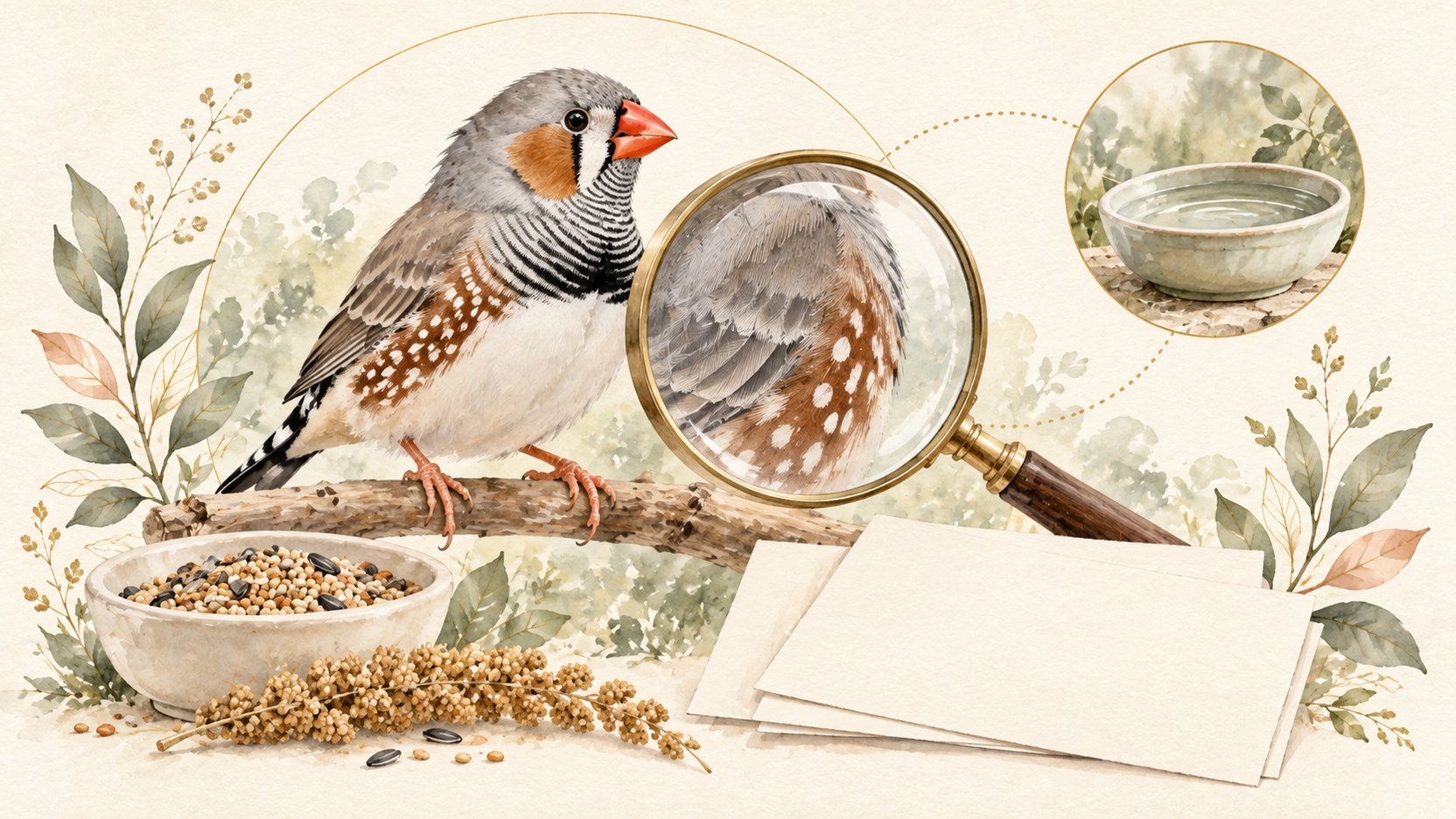
Finches|Husbandry and Care (disease column covered separately) | Evidence chain
This record notes the source location and content hash of "Finches|Husbandry and Care (disease column covered separately)", so the text can be checked against the original.
This record notes the source location and content hash of "Finches|Husbandry and Care (disease column covered separately)", so the text can be checked against the original.
How to use this record to verify
This record exists so that anyone can check for themselves whether the text has been altered. Every chapter of the veterinary encyclopaedia carries a starting line number and a content hash (the first 16 characters of its SHA-256). Recompute the hash over the original chapter: if it matches the value recorded below, what is published here is identical to the source chapter. The source list at the end is the authoritative material cited by that chapter — a chapter-level correspondence, meaning those sources underpin the chapter as a whole rather than mapping sentence by sentence. This is educational information and cannot replace a practising veterinarian; in an emergency, seek care immediately.
This record notes the source location of "Finches|Husbandry and Care (disease column covered separately) | Evidence chain": the section beginning at line 119 of `24-T5-鳥.md` in the veterinary encyclopaedia. The SHA-256 of that section (first 16 characters) is `484773b97fb65dcd`, which anyone can recompute to confirm the content has not been altered.

Source location
- File: Veterinary Animal Encyclopaedia — birds
- Starting line: line 119
- Section title: (C) 雀科(文鳥/金絲雀)
- Line range: lines 119–158
- Content hash: `484773b97fb65dcd`
- Character count: 2,738
Relationship to the disease table
This article covers the columns of the species’ 12-column knowledge tree other than the disease column; the disease column has been published as a separate article, so the two do not overlap.
FAQ
- What should I watch out for regarding species, breed and lifespan in finches?
- The Java sparrow (Java finch) and the canary are the representative pet finches: small-bodied and mostly kept in groups. Their lifespan is generally shorter than that of parrots; specific year counts: AVMA: "Finches live an average of four to five years" "Canaries live an average of eight years, have been reported to live for 20 years" <https://www.avma.org/resources/pet-owners/petcare/selecting-pet-bird>, verified 2026-07-30. The actual judgement still rests with a veterinarian on a case-by-case basis, and this article gives no drug names or dosages.
- What should I watch out for regarding normal physiological indicators in finches?
- The items measured are the same as for parrots (temperature/heart rate/respiration/body weight), except that finches are extremely small with a faster metabolism, so improper restraint and measurement can itself be fatal; having a veterinarian carry it out is advised. Figures: the same Merck page, "Management of Pet Birds", gives respiratory rate not by taxonomic group but graded by body weight — "The normal resting respiratory rate for pet birds varies with size and species, with the rate ranging in smaller birds (< 300 g) from 30−60 breaths/minute" <https://www.merckvetmanual.com/exotic-and-laboratory-animals/pet-birds/management-of-pet-birds>, verified 2026-07-30; Java sparrows and canaries mostly weigh under 300 g, so this range can be applied. Java sparrows and canaries are passerines (Passeriformes), so psittacine values do not apply, and for these two values [Verification result: no passerine-specific source available for verbatim citation, 2026-07-30]. The actual judgement still rests with a veterinarian on a case-by-case basis, and this article gives no drug names or dosages.
- What should I watch out for regarding housing for finches?
- A group cage needs enough horizontal flight space (finches prefer level flight to climbing); avoid sharp temperature swings, as canaries are particularly sensitive to draughts and humidity changes; non-stick PTFE, essential oils and second-hand smoke are equally prohibited in the environment. The actual judgement still rests with a veterinarian on a case-by-case basis, and this article gives no drug names or dosages.
Source anchors
- Merck 獸醫手冊|鳥章引用 · https://www.merckvetmanual.com/exotic-and-laboratory-animals/pet-birds/management-of-pet-birds · Other citations on IDAEO
- AVMA|鳥章引用 · https://www.avma.org/resources/pet-owners/petcare/selecting-pet-bird · Other citations on IDAEO
- aav.org|鳥章引用 · https://aav.org/ · Other citations on IDAEO
Cite this article
Jane・《Finches|Husbandry and Care (disease column covered separately) | Evidence chain》・IDAEO 知識庫・2026-08-13・https://km.idaeo.ai/post/reports/vet-finch-care-evidenceUpdated 2026-08-15