

🏛 Part of the "reports" topic shelf →
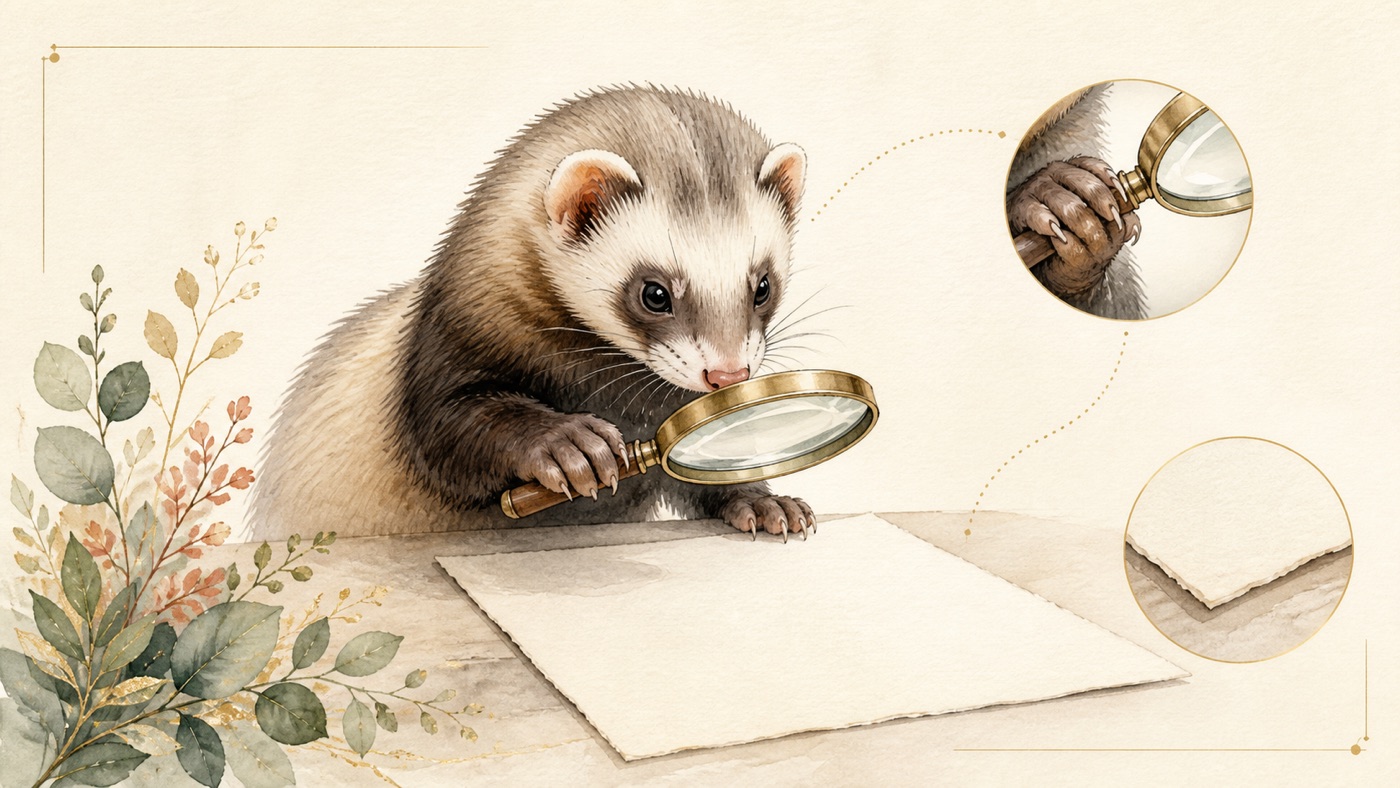
Ferret|Husbandry and health, a 12-column knowledge tree | Evidence chain
This record notes the source location and content hash of "Ferret|Husbandry and health, a 12-column knowledge tree", so the text can be checked against the original.
Ferret|Husbandry and health, a 12-column knowledge tree | Evidence chain
This record notes the source location and content hash of "Ferret|Husbandry and health, a 12-column knowledge tree", so the text can be checked against the original.
How to use this record to verify
This record exists so that anyone can check for themselves whether the text has been altered. Every chapter of the veterinary encyclopaedia carries a starting line number and a content hash (the first 16 characters of its SHA-256). Recompute the hash over the original chapter: if it matches the value recorded below, what is published here is identical to the source chapter. The source list at the end is the authoritative material cited by that chapter — a chapter-level correspondence, meaning those sources underpin the chapter as a whole rather than mapping sentence by sentence. This is educational information and cannot replace a practising veterinarian; in an emergency, seek care immediately.
This record notes the source location of "Ferret|Husbandry and health, a 12-column knowledge tree | Evidence chain": the section beginning at line 122 of `25-T6-小型哺乳.md` in the veterinary encyclopaedia. The SHA-256 of that section (first 16 characters) is `b4e13d3082f87092`, which anyone can recompute to confirm the content has not been altered.
Source location
- File: Veterinary Animal Encyclopaedia — small mammals
- Starting line: line 122
- Section title: (5)雪貂 Ferret(*Mustela putorius furo*)
- Table line range: lines 122–138(共 12 欄)
- Content hash: `b4e13d3082f87092`
- Character count: 5,291
Anchor granularity
This chapter has no entries at all in the project’s row-level anchor file `planning-out/anchor-436.tsv` (its 490 anchors cover eight chapters: dogs, cats, fish and aquarium, reptiles and amphibians, birds, backyard poultry, farm animals and horses, and wildlife). What can therefore be verified here is only the chapter-level content hash listed above, with no per-row claim ids — the same level as this site’s existing chapter overview and index articles. The source chapter itself went through two rounds of verification (`70-查證log-25-T6-小型哺乳.md`, `72-第二輪查證log-23爬蟲22魚25小哺.md`); every value filled into a column carries a clickable URL and a verbatim English quotation.
Deliberate gaps, stated honestly
Where no whitelisted authoritative source could be found for a figure, the source chapter leaves it blank and says why (for example, species-specific times-to-vet for guinea pigs, chinchillas and sugar gliders). This site keeps those gaps as they are: no figure has been supplied on the source’s behalf, and no figure has been extrapolated from another species.
FAQ
- What is most easily got wrong when feeding a ferret?
- An obligate carnivore, requiring a dedicated high-protein, high-fat, low-carbohydrate ferret diet; do not feed dog food (the protein sources are in the wrong proportions). Common feeding errors: substituting cat or dog food for a dedicated ferret diet over the long term, and feeding carbohydrates such as fruit and vegetables (ferrets cannot digest plant fibre effectively).
- フェレットの給餌で最も間違えやすいのは何ですか。 — 絶対的肉食動物(Obligate carnivore)であり、高タンパク・高脂肪・低炭水化物のフェレット専用フードが必要です。ドッグフードを与えてはいけません(タンパク質源の比率が適しません)。よくある給餌の誤り:専用フードの代わりにキャットフード/ドッグフードを長期間与える、果物や野菜などの炭水化物を与える(フェレットは植物繊維を有効に消化できません)。
- What is most easily got wrong when feeding a ferret? — An obligate carnivore, requiring a dedicated high-protein, high-fat, low-carbohydrate ferret diet; do not feed dog food (the protein sources are in the wrong proportions). Common feeding errors: substituting cat or dog food for a dedicated ferret diet over the long term, and feeding carbohydrates such as fruit and vegetables (ferrets cannot digest plant fibre effectively).
- What signs in a ferret mean going to a veterinarian straight away?
- Sudden hindlimb collapse or seizures (suspected hypoglycaemia), persistent vomiting with inability to eat, severe respiratory distress, severe abdominal distension with pain.
- フェレットにどんな状態が現れたらすぐに受診すべきですか。 — 突然の後肢の脱力または痙攣(低血糖の疑い)、嘔吐が続き食べられない、重度の呼吸困難、腹部の著しい膨満と痛み。
- What signs in a ferret mean going to a veterinarian straight away? — Sudden hindlimb collapse or seizures (suspected hypoglycaemia), persistent vomiting with inability to eat, severe respiratory distress, severe abdominal distension with pain.
- What is the most common disease in ferrets?
- 1. Insulinoma: a pancreatic islet-cell tumour secreting excess insulin, common in middle-aged and older ferrets → hypoglycaemic episodes: hindlimb weakness, drooling, altered consciousness, even seizures → blood glucose testing/abdominal ultrasound → medical control or surgical excision (prescription) → not preventable; early detection through health checks is what matters.
- フェレットで最もよくある疾患は何ですか。 — 1. インスリノーマ(Insulinoma):膵島細胞の腫瘍がインスリンを過剰分泌するもので、中高齢のフェレットに多い→低血糖発作:後肢の脱力、よだれ、意識混濁、さらには痙攣→血糖検査/腹部超音波→内科的な薬物コントロールまたは外科切除(処方)→予防はできず、早期の健康診断による発見が重要。
- What is the most common disease in ferrets? — 1. Insulinoma: a pancreatic islet-cell tumour secreting excess insulin, common in middle-aged and older ferrets → hypoglycaemic episodes: hindlimb weakness, drooling, altered consciousness, even seizures → blood glucose testing/abdominal ultrasound → medical control or surgical excision (prescription) → not preventable; early detection through health checks is what matters.
Source anchors
- Merck 獸醫手冊|小型哺乳章引用 · https://www.merckvetmanual.com/all-other-pets/ferrets/description-and-physical-characteristics-of-ferrets · 在 IDAEO 的其他引用
- Merck 獸醫手冊|小型哺乳章引用 · https://www.merckvetmanual.com/multimedia/table/ferrets-at-a-glance · 在 IDAEO 的其他引用
- Merck 獸醫手冊|小型哺乳章引用 · https://www.merckvetmanual.com/multimedia/table/vital-signs-in-healthy-adult-ferrets · 在 IDAEO 的其他引用
- Merck 獸醫手冊|小型哺乳章引用 · https://www.merckvetmanual.com/exotic-and-laboratory-animals/ferrets/management-of-ferrets · 在 IDAEO 的其他引用
- Merck 獸醫手冊|小型哺乳章引用 · https://www.merckvetmanual.com/exotic-and-laboratory-animals/ferrets/endocrine-disorders-of-ferrets · 在 IDAEO 的其他引用
- PubMed 文獻|小型哺乳章引用 · https://pubmed.ncbi.nlm.nih.gov/12431804/ · 在 IDAEO 的其他引用
- PubMed 文獻|小型哺乳章引用 · https://pubmed.ncbi.nlm.nih.gov/18165141/ · 在 IDAEO 的其他引用
- Merck 獸醫手冊|小型哺乳章引用 · https://www.merckvetmanual.com/exotic-and-laboratory-animals/ferrets/infectious-diseases-of-ferrets · 在 IDAEO 的其他引用
- Merck 獸醫手冊|小型哺乳章引用 · https://www.merckvetmanual.com/circulatory-system/heartworm-disease/heartworm-disease-in-dogs-cats-and-ferrets · 在 IDAEO 的其他引用
Cite this article
Jane・《Ferret|Husbandry and health, a 12-column knowledge tree | Evidence chain》・IDAEO 知識庫・2026-08-13・https://km.idaeo.ai/post/reports/vet-ferret-guide-evidenceUpdated 2026-08-15