Part of the "Veterinary" topic shelf → ← Back to the article:Farm Animals and Horses|Group Overview
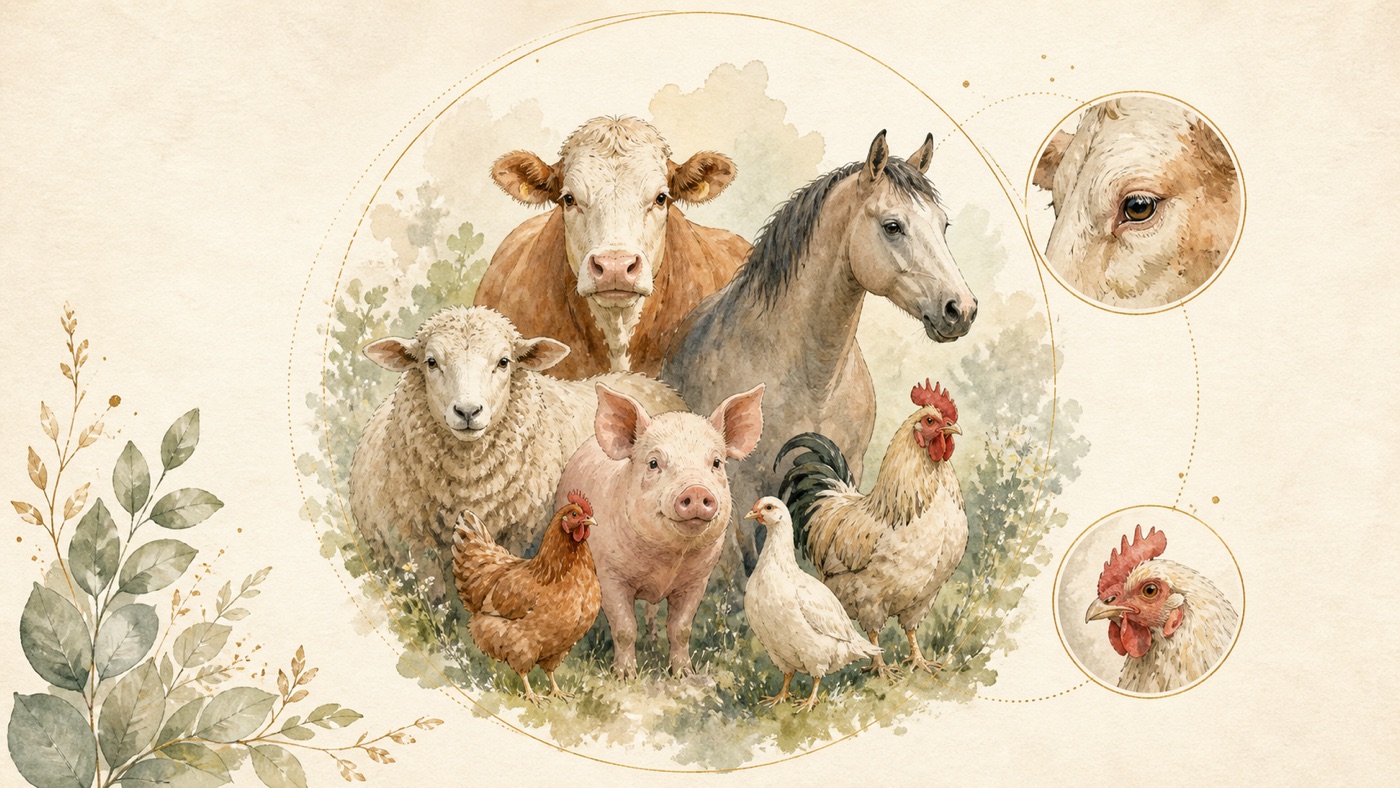
Farm Animals and Horses|Group Overview | Evidence chain
This record notes the source location and content hash of "Farm Animals and Horses|Group Overview", so the text can be checked against the original.
This record notes the source location and content hash of "Farm Animals and Horses|Group Overview", so the text can be checked against the original.
How to use this record to verify
This record exists so that anyone can check for themselves whether the text has been altered. Every chapter of the veterinary encyclopaedia carries a starting line number and a content hash (the first 16 characters of its SHA-256). Recompute the hash over the original chapter: if it matches the value recorded below, what is published here is identical to the source chapter. The source list at the end is the authoritative material cited by that chapter — a chapter-level correspondence, meaning those sources underpin the chapter as a whole rather than mapping sentence by sentence. This is educational information and cannot replace a practising veterinarian; in an emergency, seek care immediately.
This record notes the source location of "Farm Animals and Horses|Group Overview | Evidence chain": the section beginning at line 77 of `27-T8-農場與T9-馬.md` in the veterinary encyclopaedia. The SHA-256 of that section (first 16 characters) is `cd5b66a666dada98`, which anyone can recompute to confirm the content has not been altered.

Source location
- File: Veterinary Animal Encyclopaedia — farm animals and horses
- Starting line: line 77
- Chapter section title: 四、8 族群總覽
- Content hash: `cd5b66a666dada98`
- Character count: 3,036
FAQ
- Why confirm which species you are dealing with before discussing handling?
- Because the same sign calls for different handling in different species, and handling an animal the way another species would be handled can be harmful, so the first step in every case is to confirm which animal is in front of you.
- Can a donkey be cared for the way a horse is?
- Donkeys are stoic by nature and do not readily show illness, so they are often held to equine care standards by mistake, which delays treatment. Donkeys and mules often live longer than horses of comparable size — a directional conclusion, since the whitelisted sources give no lifespan figure specific to donkeys and mules.
- Why do some entries in the lifespan column read "no single authoritative figure"?
- The lifespan column and all specific figures draw only on verified material, and filling them in from memory is not allowed; where the whitelisted sources hold no reference value specific to that group, the entry says so plainly rather than offering a figure that merely looks plausible.
Source anchors
- Merck 獸醫手冊|農場動物與馬章引用 · https://www.merckvetmanual.com/digestive-system/diseases-of-the-ruminant-forestomach/grain-overload-in-ruminants · Other citations on IDAEO
- Merck 獸醫手冊|農場動物與馬章引用 · https://www.merckvetmanual.com/digestive-system/diseases-of-the-ruminant-forestomach/subacute-ruminal-acidosis-in-cattle-and-sheep · Other citations on IDAEO
- Merck 獸醫手冊|農場動物與馬章引用 · https://www.merckvetmanual.com/exotic-and-laboratory-animals/miniature-pet-pigs/overview-of-miniature-pet-pigs · Other citations on IDAEO
- Merck 獸醫手冊|農場動物與馬章引用 · https://www.merckvetmanual.com/generalized-conditions/hendra-virus-infection/hendra-virus-infection-in-horses · Other citations on IDAEO
- Merck 獸醫手冊|農場動物與馬章引用 · https://www.merckvetmanual.com/horse-owners/introduction-to-horses/description-and-physical-characteristics-of-horses · Other citations on IDAEO
- Merck 獸醫手冊|農場動物與馬章引用 · https://www.merckvetmanual.com/infectious-diseases/clostridial-diseases/clostridial-vaccines-for-animals · Other citations on IDAEO
- Merck 獸醫手冊|農場動物與馬章引用 · https://www.merckvetmanual.com/management-and-nutrition/preventative-health-care-and-husbandry-of-horses/dental-care-of-horses · Other citations on IDAEO
- Merck 獸醫手冊|農場動物與馬章引用 · https://www.merckvetmanual.com/management-and-nutrition/preventative-health-care-and-husbandry-of-horses/vaccination-program-for-horses · Other citations on IDAEO
- Merck 獸醫手冊|農場動物與馬章引用 · https://www.merckvetmanual.com/multimedia/table/vital-signs-in-adult-camelids · Other citations on IDAEO
- Merck 獸醫手冊|農場動物與馬章引用 · https://www.merckvetmanual.com/reference-values-and-conversion-tables/reference-guides/normal-rectal-temperature-ranges · Other citations on IDAEO
- Merck 獸醫手冊|農場動物與馬章引用 · https://www.merckvetmanual.com/reference-values-and-conversion-tables/reference-guides/resting-heart-rates · Other citations on IDAEO
- Merck 獸醫手冊|農場動物與馬章引用 · https://www.merckvetmanual.com/reference-values-and-conversion-tables/reference-guides/resting-respiratory-rates · Other citations on IDAEO
- Merck 獸醫手冊|農場動物與馬章引用 · https://www.merckvetmanual.com/toxicology/copper-poisoning/copper-poisoning-in-animals · Other citations on IDAEO
- PMC 全文|農場動物與馬章引用 · https://pmc.ncbi.nlm.nih.gov/articles/PMC6125241/ · Other citations on IDAEO
- PubMed 文獻|農場動物與馬章引用 · https://pubmed.ncbi.nlm.nih.gov/11295509/ · Other citations on IDAEO
- WOAH 世界動物衛生組織|農場動物與馬章引用 · https://www.woah.org/en/disease/diseases-of-bees/ · Other citations on IDAEO
- WOAH 世界動物衛生組織|農場動物與馬章引用 · https://www.woah.org/en/disease/foot-and-mouth-disease/ · Other citations on IDAEO
- WOAH 世界動物衛生組織|農場動物與馬章引用 · https://www.woah.org/en/what-we-do/animal-health-and-welfare/animal-diseases/ · Other citations on IDAEO
- aaep.org|農場動物與馬章引用 · https://aaep.org/ · Other citations on IDAEO
- extension.arizona.edu|農場動物與馬章引用 · https://extension.arizona.edu/sites/extension.arizona.edu/files/pubs/az2014-2022.pdf · Other citations on IDAEO
- extension.psu.edu|農場動物與馬章引用 · https://extension.psu.edu/animals-and-livestock/llamas-and-alpacas/health-and-care · Other citations on IDAEO
- u.osu.edu|農場動物與馬章引用 · https://u.osu.edu/gofarmohio/2026/06/16/livestock-biosecurity-basics-for-the-small-farm/ · Other citations on IDAEO
- www.canr.msu.edu|農場動物與馬章引用 · https://www.canr.msu.edu/news/what-is-the-buzz-around-cow-longevity · Other citations on IDAEO
- www.thedonkeysanctuary.org.uk|農場動物與馬章引用 · https://www.thedonkeysanctuary.org.uk/for-professionals · Other citations on IDAEO
Cite this article
Jane・《Farm Animals and Horses|Group Overview | Evidence chain》・IDAEO 知識庫・2026-08-13・https://km.idaeo.ai/post/reports/vet-farm-animal-groups-evidenceUpdated 2026-08-15