Part of the "Veterinary" topic shelf → ← Back to the article:Dogs | Behavior and welfare
Dogs | Behavior and welfare | Evidence chain
This record notes the source location and content hash of "Dogs | Behavior and welfare", so the text can be checked against the original.
This record notes the source location and content hash of "Dogs | Behavior and welfare", so the text can be checked against the original.
How to use this record to verify
This record exists so that anyone can check for themselves whether the text has been altered. Every chapter of the veterinary encyclopaedia carries a starting line number and a content hash (the first 16 characters of its SHA-256). Recompute the hash over the original chapter: if it matches the value recorded below, what is published here is identical to the source chapter. The source list at the end is the authoritative material cited by that chapter — a chapter-level correspondence, meaning those sources underpin the chapter as a whole rather than mapping sentence by sentence. This is educational information and cannot replace a practising veterinarian; in an emergency, seek care immediately.
This record notes the source location of "Dogs | Behavior and welfare | Evidence chain": the section beginning at line 366 of `20-T1-犬.md` in the veterinary encyclopaedia. The SHA-256 of that section (first 16 characters) is `0a08720bab5d3255`, which anyone can recompute to confirm the content has not been altered.

Source location
- File: Veterinary Animal Encyclopaedia — dog
- Starting line: line 366
- Chapter section title: §5 行為與福利
- Content hash: `0a08720bab5d3255`
- Character count: 4,280
FAQ
- My dog growled at me — can I scold or punish it?
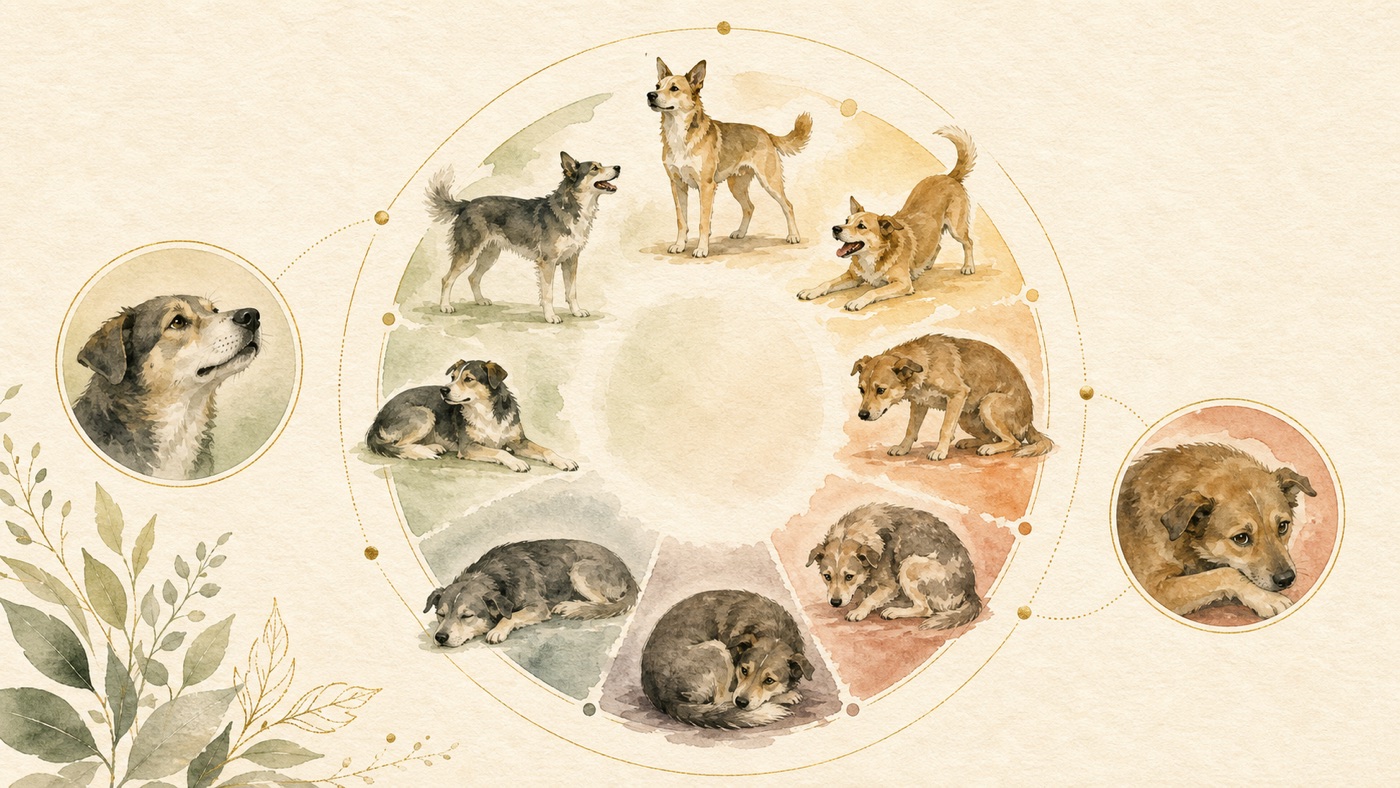
- Do not punish a growl under any circumstances. The growl is the warning stage on the ladder of stress signals, and punishing it amounts to dismantling the alarm, so the next time the dog may bite without warning. Earlier signals include lip licking, blinking, head turning, turning the body away, yawning and scratching, followed by walking away, hiding, ears back and the white of the eye showing; if the dog is already tense all over, has stopped chewing, is staring at you and breathing shallowly, that is the last peaceful warning and you should stop immediately.
- My dog has suddenly become aggressive and refuses to go upstairs — has it turned bad?
- A sudden change in behavior should be treated as a medical problem first. Sudden aggression, suddenly refusing stairs or the sofa, suddenly biting at one part of the body, suddenly toileting indoors and sudden night-time restlessness should all lead first to ruling out pain (especially osteoarthritis, teeth, ears, intervertebral disc disease), endocrine disease, neurological disease and cognitive dysfunction, and only then to a discussion of training. Inappropriate toileting indoors is the same: test the urine first.
- What should I watch for between my child and my dog?
- Bite incidents occur mostly at home, are caused by a familiar dog, and injure the child's face and hands, so the principle is that a child of any age with a dog needs an adult present to supervise. Teach the child the "three do-nots": do not hug, do not disturb the dog while it eats or sleeps, do not chase it, and establish a do-not-disturb zone for the dog. A dog in pain has the highest risk of biting, so with children at home it matters even more to treat dental, ear and joint pain actively.
Source anchors
- Merck 獸醫手冊|犬章引用 · https://www.merckvetmanual.com/management-and-nutrition/management-of-the-neonate/management-of-the-neonate-in-dogs-and-cats · Other citations on IDAEO
- Merck 獸醫手冊|犬章引用 · https://www.merckvetmanual.com/multimedia/table/parameters-to-evaluate-during-triage · Other citations on IDAEO
- Merck 獸醫手冊|犬章引用 · https://www.merckvetmanual.com/reproductive-system/reproductive-diseases-of-the-female-small-animal/dystocia-in-small-animals · Other citations on IDAEO
- PMC 全文|犬章引用 · https://pmc.ncbi.nlm.nih.gov/articles/PMC10385239/ · Other citations on IDAEO
- PMC 全文|犬章引用 · https://pmc.ncbi.nlm.nih.gov/articles/PMC10705156/ · Other citations on IDAEO
- PMC 全文|犬章引用 · https://pmc.ncbi.nlm.nih.gov/articles/PMC11096582/ · Other citations on IDAEO
- PMC 全文|犬章引用 · https://pmc.ncbi.nlm.nih.gov/articles/PMC5421102/ · Other citations on IDAEO
- PMC 全文|犬章引用 · https://pmc.ncbi.nlm.nih.gov/articles/PMC7608676/ · Other citations on IDAEO
- WSAVA|犬章引用 · https://wsava.org/wp-content/uploads/2021/04/Selecting-a-pet-food-for-your-pet-updated-2021_WSAVA-Global-Nutrition-Toolkit.pdf · Other citations on IDAEO
- AAHA|犬章引用 · https://www.aaha.org/wp-content/uploads/globalassets/02-guidelines/behavior-management/2015_aaha_canine_and_feline_behavior_management_guidelines_final.pdf · Other citations on IDAEO
- AAHA|犬章引用 · https://www.aaha.org/wp-content/uploads/globalassets/02-guidelines/canine-life-stage/canine_life_stage_guidelines.pdf · Other citations on IDAEO
- WOAH 世界動物衛生組織|犬章引用 · https://www.woah.org/en/disease/rabies/ · Other citations on IDAEO
- vetmed.illinois.edu|犬章引用 · https://vetmed.illinois.edu/pet-health-columns/never-give-medications-for-people-to-pets/ · Other citations on IDAEO
Cite this article
Jane・《Dogs | Behavior and welfare | Evidence chain》・IDAEO 知識庫・2026-08-13・https://km.idaeo.ai/post/reports/vet-dog-behaviour-welfare-evidenceUpdated 2026-08-15