

🏛 Part of the "reports" topic shelf →
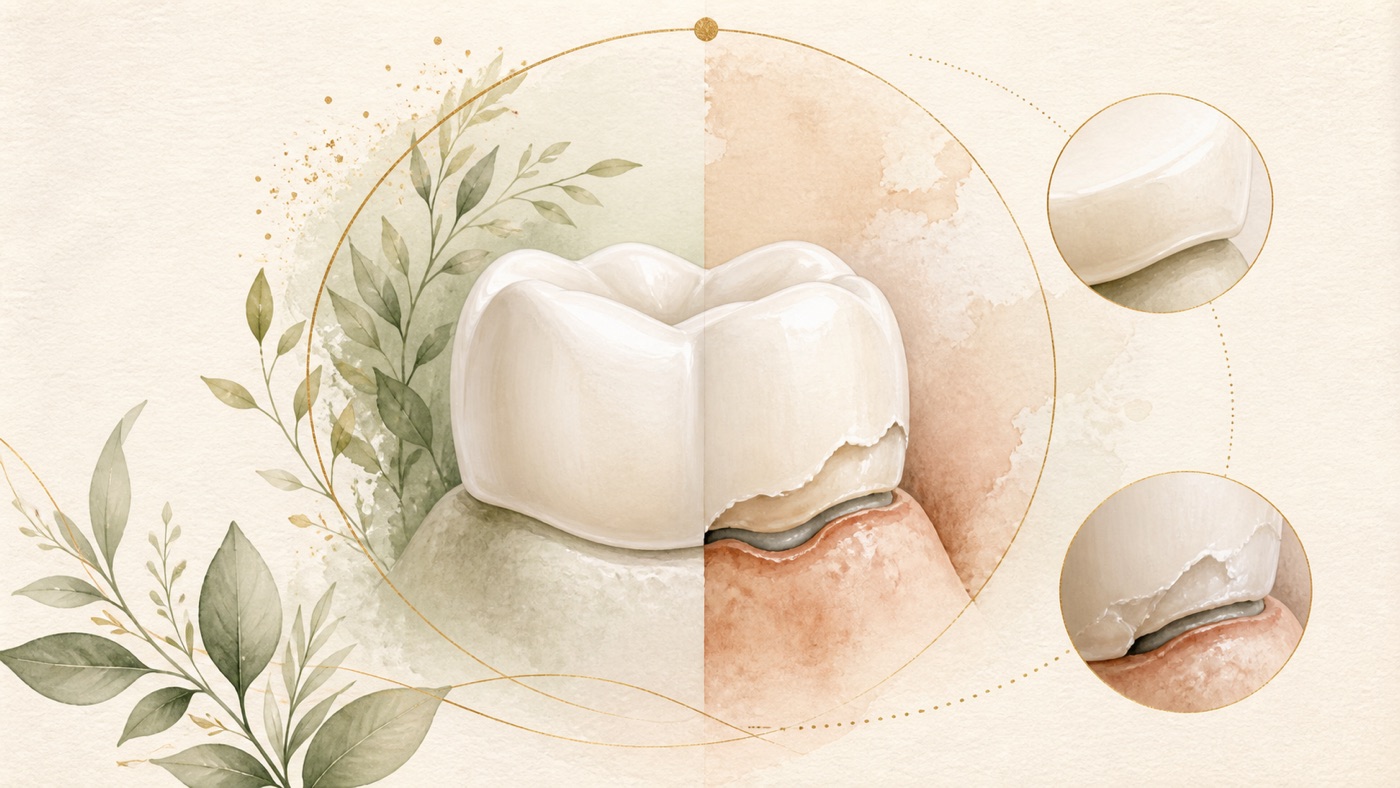
Will I regret getting an all-ceramic crown? What are the drawbacks? Matching online complaints to the literature, one category at a time|證據鏈
本頁是〈Will I regret getting an all-ceramic crown? What are the drawbacks? Matching online complaints to the literature, one category at a time〉的事實單元帳:每一條主張對應的來源、證據等級、地域與期間、原文引句與限制,逐條攤開。
Will I regret getting an all-ceramic crown? What are the drawbacks? Matching online complaints to the literature, one category at a time|證據鏈
F-Units (fact-unit ledger)
Each entry identifies its source, confidence, basis, period, geo, and caveat. Basis hierarchy: law > official_statement > clinical_guideline > peer_reviewed > textbook.
- F1|confidence: high|basis: internal_dataset (S24, not a medical claim)|period: GSC retention window (from 2025-03-22)|geo: TW|Topic-selection basis: reconciled search data from 14 clinic sites, 4 query terms across 3 sites, item by item|caveat: Internal data; not included in the visible layer at publication.
- F2|confidence: n/a|basis: structural organisation (editorial framework, S25, not a factual claim)|geo: universal|The following are explanatory structures defined by this site, not external facts: ① the approach of neither citing nor dismissing forum posts and instead matching complaint types to literature categories; ② the canonical boundary between this card and the crown-cost card (KM-DENTAL-11)—material survival and quotation breakdown belong there, while drawbacks and expectation gaps belong here; ③ the classification and ordering of five drawback types; ④ the care-communication suggestion that warranty and handling of chipping are matters agreed between patient and clinic and should be obtained in writing; and ⑤ the editorial rule against outcome promises such as “choose the right dentist and you will not regret it.”
- F3|confidence: n/a|basis: evidence-gap statement (editorial, not pending verification)|geo: universal|No citable evidence was obtained in this search, so this card does not state: ① any monetary amount, range, or market price; ② an individual prediction of how long an all-ceramic crown will last; ③ Taiwan-local statistics for all-ceramic-crown complications or survival; ④ individual advice on which material is better for a particular person; ⑤ the content or effect of warranty terms (a contractual matter, not a medical question; this site provides no legal opinion); or ⑥ absolute incidence of any complication type (available reviews mostly report relative risk, intervals, or narrative lists, and this card does not calculate them).
- F4|confidence: medium|basis: peer_reviewed (overview / summary of systematic reviews, PMID 34119611)|period: searched to 2021-02; published 2021|geo: universal|span: 「38 eligible articles published between 2006 and 2021 were included. The reviews were based on 128 in vivo studies on approximately 10,000 zirconia restorations.」「Chipping was the most often technical complication, followed by framework fracture, loss of retention, marginal discrepancies/discoloration, occlusal roughness and abutment/screw loosening. Color mismatch was the only esthetic complication. Biological complications were caries, endodontic complications, tooth fracture, periodontal disease, abrasion/attrition, persisting pain, high sensitivity…」「The predominant technical problem of veneering fractures could be overcome with adapted design or fabrication and application of monolithic restorations, but reviews of clinical studies on this subject are rare.」「The impact of zirconia restorations on the masticatory system remains unclear.」|caveat: The overview covers systematic reviews rather than original studies. Complications are a list ranked by frequency, not incidence estimates; the body does not read them as proportions. The paper covers both tooth- and implant-supported restorations; this card uses only complication categories relevant to tooth-supported restorations. Version-currency check (2026-08-06): a search for umbrella review / overview of systematic reviews plus zirconia in the 2022–2026 publication period retrieved newer overviews on implants, zirconia abutments, bonding-surface treatment, and full-arch prostheses, but none replacing this overview of tooth-supported zirconia restorations.
- F5|confidence: medium|basis: peer_reviewed (systematic review・meta-analysis, PMID 35660957)|period: published 2022|geo: universal|span: 「Fifty-two studies were included and most of them had unclear risk of bias. Considering all reported fractures/chipping, for veneered crowns with 1 to 3 years of follow-up, the relative risk (RR) of fracture in relation to loss or retention was 3.95 (95% CI 1.18-13.23; p = 0.03). For 4 to 6 years of follow-up, the RR was 5.44 (95% CI 1.41-20.92; p = 0.01).」「When only framework fractures were considered, there were no significant differences for the RR in all follow-up periods (p > 0.05).」「there is approximately four times higher chance of fracture/chipping than loss of retention for both single and multi-unit tooth-supported veneered zirconia restorations.」|caveat: Key framing: the RR compares two failure types (fracture or chipping versus loss of retention), not the absolute incidence of chipping; the body states this limit explicitly. The population is veneered zirconia, not monolithic zirconia. Most included studies had an unclear risk of bias.
- F6|confidence: medium|basis: peer_reviewed (systematic review・meta-analysis, PMID 34615842)|period: published 2022 (electronic prepublication 2021-10)|geo: universal|span: 「From nine articles included, there was a total of 594 participants and 1657 single-tooth restorations with a mean exposure time of 1.07 years, and follow-up period between 0.3 and 2.1 years.」「There was high heterogeneity between studies (I2 = 93.74% and Q = 79.672).」|caveat: This card uses only sample scale and follow-up duration as support for the statement that clinical data on monolithic zirconia remain short. It does not cite the review’s survival-rate range (its upper bound is material data belonging with KM-DENTAL-11 under the agreed division of scope).
- F7|confidence: medium|basis: peer_reviewed (systematic review, PMID 42008751)|period: literature searched from 2012–2023; published 2026|geo: universal|span: 「Crown preparation leads to irreversible dental tissue loss, which affects long-term restoration success.」「Twenty-three studies were included. Six studies directly quantified tooth-structure removal or residual dentin thickness using gravimetric analysis, micro-CT, digital volumetric analysis, or related methods.」|caveat: The review compares preservation of dental structure in vertical and horizontal preparation techniques and includes clinical, in-vitro, and narrative literature; its PROSPERO registration was retrospective. This card uses only its statement that crown preparation causes irreversible dental-tissue loss. It does not cite conclusions about the superiority of any preparation technique or read them as a recommendation for a specific technique.
- F8|confidence: medium|basis: peer_reviewed (systematic review・network meta-analysis of controlled clinical trials, PMID 38211687)|period: published 2024|geo: universal|span: 「Eligibility criteria included clinical studies reporting on MVL on antagonist's tooth up to 24 months following the permanent crown placement. From a total of 5697 articles, 7 studies reporting on 261 crowns for 177 subjects with 3 ceramic materials (Lithium disilicate, metal-ceramic, monolithic zirconia) were included. Among all, metal-ceramic and zirconia caused significantly higher enamel tooth wear on antagonist teeth, representing 82.5 µm [54.4; 110.6]) and 40.1 µm [22.2; 58.0]) more MVL than natural teeth group. In contrast, lithium disilicate showed only 5.0 µm [-48.2; 58.1]) more MVL than occurs on opposing natural teeth.」|caveat: Follow-up was capped at 24 months and there were only 7 studies; the authors state that sample and study numbers were insufficient and that more homogeneous randomised controlled trials are needed. Values are differences in mean vertical loss (MVL) of opposing teeth versus the natural-tooth opposing group, not wear of the crown itself. Its material ranking differs from F9, and the body presents both.
- F9|confidence: medium|basis: peer_reviewed (systematic review・meta-analysis, PMID 41590161)|period: searched to 2025-09; published 2026|geo: universal|span: 「Nine clinical studies (5 randomized controlled trials and 4 prospective studies) involving 203 patients (2015-2025) were included.」「Follow-up ranged from 6 to 24 months.」「Meta-analysis revealed significant enamel wear from zirconia (p < 0.05; MD: -1.32; 95% CI: -2.06 to -0.57; I2 = 94%) and lithium disilicate (p < 0.05; MD: -0.45; 95% CI: -0.71 to -0.19; I2 = 2%). Feldspathic ceramics did not show significant enamel wear (p = 0.06; MD: -2.77; 95% CI: -5.66 to 0.13; I2 = 96%).」「Ceramic materials generally cause greater wear on opposing posterior natural enamel than enamel-to-enamel contact. Monolithic zirconia and lithium disilicate crowns produced higher antagonist wear, whereas metal-ceramic restorations with feldspathic veneering appeared more conservative for preserving posterior enamel.」|caveat: The abstract does not specify the measurement unit for MD, so this card cites only its I² values and direction of conclusion, not MD values, to avoid a unit-related misreading. Heterogeneity in the zirconia group is extremely high (I² 94%). This paper reaches a material-ranking conclusion opposite to F8; the body presents both faithfully and does not select one as correct.
- F10|confidence: low|basis: peer_reviewed (prospective clinical study, not a systematic review, PMID 42536234)|period: 36-month follow-up; published 2026|geo: universal|span: 「Out of thirty-two patients, each provided with one 5 mol% yttria-stabilized zirconia crown on a natural tooth, ten met the inclusion criteria.」「The mean maximum vertical loss for the antagonist teeth to the zirconia crowns was 216 µm (SD ± 113 µm).」「The zirconia crowns exhibited 38 µm (SD ± 14 µm).」「The monolithic zirconia crowns induced approximately twice the amount of wear on opposing enamel compared with natural tooth contacts.」「After three years, the monolithic zirconia crowns caused significantly greater antagonist enamel wear than natural enamel contacts, yet the wear was comparable to that observed for other dental ceramic materials.」|caveat: A single-centre study with only 10 people included in analysis; evidence level is lower than F8 and F9. This card uses it only to add a 3-year time point, not for material ranking. The paper’s conflict-of-interest statement reports consulting, speaking, and third-party research-funding relationships between several authors and dental-material manufacturers.
- F11|confidence: medium|basis: peer_reviewed (systematic review・meta-analysis, PMID 28967401)|period: published 2018|geo: universal|span: 「Eight studies were included for qualitative synthesis, but only 5 for the meta-analysis. Three studies were categorized as moderate risk and 5 as high risk of bias.」「Increased hazard ratio (HR=7.74; 95% confidence interval [CI]=2.50 to 23.95) and odds ratio (OR=2.52; 95% CI=1.24 to 5.12) were observed considering only anterior ceramic veneers.」「Nevertheless, limited data from the meta-analysis and from the restricted number of included studies suggested that differences in the overall odds of failure concerning SB and other types of ceramic restorations did not favor or disfavor any association (OR=1.10; 95% CI=0.43 to 2.8).」「The overall quality of evidence was considered very low according to the GRADE criteria.」「Within the limitations of this systematic review, the overall result from the meta-analysis did not favor any association between SB and increased odds of failure for ceramic restorations.」|caveat: Key population limit: HR 7.74 and OR 2.52 apply only to the anterior ceramic-veneer subgroup and cannot be extrapolated to all-ceramic crowns; the body states this explicitly. Overall evidence quality under GRADE is very low. Version-currency check (2026-08-06): a search for sleep bruxism plus ceramic restorations in the 2018–2026 publication period found no systematic review on the same question that replaces this one; the newer direct evidence is the clinical trial in F12.
- F12|confidence: medium|basis: peer_reviewed (prospective clinical study, crown material randomised, PMID 41967567)|period: 3-year follow-up; published 2026|geo: universal|span: 「In this prospective clinical study, 109 patients requiring a single molar crown were assessed for SB using a structured questionnaire, clinical examination, and a portable electromyography device (BruxOff).」「Based on SB status and randomized crown material allocation, patients were assigned to four groups: LiDi-SB (n = 27), LiDi-no SB (n = 21), Zir-SB (n = 21), and Zir-no SB (n = 24). Protective occlusal guards were not permitted.」「No technical complications occurred in any group.」「Success rates were 81.5% for LiDi-SB and 95.2% for LiDi-no SB (95% CI difference: -0.3590 to 0.1450; p = 0.211), and 85.7% for Zir-SB and 95.8% for Zir-no SB (95% CI difference: -0.3390 to 0.1530; p = 0.326).」「sleep bruxism showed no detectable impact on the incidence of technical complications or on the survival and success of monolithic LiDi or Zir molar crowns.」|caveat: Crown material was randomised; bruxism status was an observational grouping and cannot be randomly assigned. Each group had 21 to 27 people and follow-up was 3 years; a non-significant result does not mean no difference (success was numerically lower in the bruxism groups). The trial did not allow protective occlusal guards, so it cannot be read as a comparison of using versus not using an occlusal splint. The population was single molar monolithic crowns.
- F13|confidence: medium|basis: peer_reviewed (evidence-based dentistry commentary, PMID 42323516)|period: published 2026|geo: universal|span: 「Survival was defined as restoration remaining in situ without replacement. Success is defined as restoration without biological or technical complications.」「No statistically significant differences were observed between SB and non-SB patients or between lithium disilicate and zirconia crowns.」|caveat: This is a commentary on the F12 trial, not independent original research. This card uses only its restatement of outcome definitions and statistical conclusion, not its clinical recommendations.
- F14|confidence: medium|basis: peer_reviewed (systematic review・meta-analysis, observational studies, PMID 34516686)|period: searched to 2021-01; published 2022|geo: universal|span: 「Electronic searches provided 10,075 records among which 20 studies were selected for systematic review and 7 studies were selected for meta-analysis.」「The meta-analysis revealed clinical and radiographic success rate ranging between 92% to 98% at different follow up periods ranging between 5 years and 20 years.」「Future high-quality randomized clinical controlled trials with a larger population are required to confirm the evidence as only observational studies were considered in this paper.」|caveat: Only observational studies were included and heterogeneity was high. Success is defined by pulpal and periapical status, not survival of the crown itself. The population is vital abutment teeth for fixed prostheses, including single crowns and bridges; same anchor as KM-DENTAL-11.
- F15|confidence: high|basis: clinical_guideline (narrative review commissioned by the 2017 World Workshop, PMID 29926939)|period: published 2018|geo: universal|span: 「Placement of restoration margins within the junctional epithelium and supracrestal connective tissue attachment can be associated with gingival inflammation and, potentially, recession.」「Restoration margins located within the gingival sulcus do not cause gingivitis if patients are compliant with self-performed plaque control and periodic maintenance.」「Hypersensitivity reactions can occur to dental materials.」|caveat: A narrative review, not a meta-analysis; same anchor as KM-DENTAL-11 and KM-DENTAL-23.
- F16|confidence: high|basis: peer_reviewed (systematic review・meta-analysis, PMID 41489982)|period: search window 2014–2024; published 2026|geo: universal|span: 「Lithium-disilicate and zirconia-based all-ceramic SCs achieve five-year survival rates comparable to metal-ceramic crowns.」|caveat: This card uses only the overall conclusion as a single summary sentence. Complete five-year survival figures by material are canonical content of KM-DENTAL-11 and are not repeated here under the division of scope. This is a population-level estimate and cannot be extrapolated to an individual prognosis.
- F17|confidence: medium|basis: peer_reviewed (overview of systematic reviews, PMID 40750081)|period: search updated to 2025-02; published 2025|geo: universal|span: 「However, substantial methodological heterogeneity, limited long-term data (>5 years), and a concentration of studies on a single product」「practitioners should communicate both the well-documented short- to medium-term benefits and the remaining uncertainties regarding long-term performance」|caveat: The overview covers systematic reviews rather than original studies. This card uses only its conclusions on methodological limitations and communication, and does not cite its survival-rate figures, consistent with the handling in KM-DENTAL-11.
- F18|confidence: medium|basis: peer_reviewed (systematic review・meta-analysis, PMID 41100150)|period: searched from 1999 to 2025-03; published online in 2025|geo: universal|span: 「The meta-analysis of two clinical studies on 277 endocrowns and 246 crowns followed for 7 years demonstrated that the pooled risk ratio for success rate was 0.93 (95% CI: 0.69-1.27, P = 0.66), showing no significant difference in outcomes.」「Endocrowns demonstrate comparable clinical performance to conventional crowns for structurally compromised posterior teeth with or without post and cores.」|caveat: Only 5 clinical studies met eligibility and 4 entered the meta-analysis; the authors state that there are few studies, heterogeneity is high, and more standardised trials are needed. The population is structurally compromised posterior teeth. It is an online-ahead-of-print version, with page numbers not yet assigned.
- F19|confidence: medium|basis: peer_reviewed (systematic review・meta-analysis of RCTs, PMID 39558793)|period: searched to 2024-02; published 2025|geo: universal|span: 「Six RCTs were included. Resin matrix ceramic (RMC) and lithium disilicate (LDS) restorations had a 3-year survival rate of 89.3% (95% CI 76.4-95.3) and 93.7% (95% CI 83.7-97.7), respectively」「The long-term performance of posterior PCRs is uncertain.」|caveat: The population is partial-coverage restoration of extensively damaged posterior teeth (onlays, occlusal veneers, and partial crowns), not a full-crown comparison. Only 6 randomised controlled trials were included, follow-up was 1 to 3 years, and long-term performance is uncertain. Full-crown versus onlay comparative data are in KM-DENTAL-11.
- F20|confidence: high|basis: law (S20)|period: current text (HTTP 200 verified and matched verbatim on 2026-08-06)|geo: TW|Article 21 of Taiwan's Medical Care Act. Verbatim Chinese statutory text: 醫療機構收取醫療費用之標準,由直轄市、縣(市)主管機關核定之。
- F21|confidence: high|basis: law (S21)|period: current text (HTTP 200 verified and matched verbatim on 2026-08-06)|geo: TW|Article 81 of Taiwan's Medical Care Act. Verbatim Chinese statutory text: 醫療機構診治病人時,應向病人或其法定代理人、配偶、親屬或關係人告知其病情、治療方針、處置、用藥、預後情形及可能之不良反應。
- F22|confidence: high|basis: law (S22)|period: current text (HTTP 200 verified and matched verbatim on 2026-08-06)|geo: TW|Article 87, Paragraph 2 of Taiwan's Medical Care Act. Verbatim Chinese statutory text: 醫學新知或研究報告之發表、病人衛生教育、學術性刊物,未涉及招徠醫療業務者,不視為醫療廣告。 This article is the basis for this card’s compliance note.
- F23|confidence: high|basis: law (S23)|period: current text (HTTP 200 verified and matched verbatim on 2026-08-06)|geo: TW|Article 51, Paragraph 11 of Taiwan's National Health Insurance Act. Verbatim Chinese statutory text: 義齒、義眼、眼鏡、助聽器、輪椅、拐杖及其他非具積極治療性之裝具。
- F24|confidence: high|basis: official_statement (S18, cross-card verified fact, same anchor)|period: tested with ego-browser on 2026-08-05 (OP re-verified)|geo: TW|The product categories in both search routes of the National Health Insurance Administration's Medical Materials Price Comparison Website contain no dentistry; the full page contains no Chinese character for “tooth.”|caveat: This card did not repeat the test and relies on the record in this site's fact-check register; the official database may change, so cite the verification date when relying on it.
- F25|confidence: high|basis: official_statement (S19, cross-card verified fact, same anchor)|period: approved 1090117; page verified reachable with ego-browser by KM-DENTAL-11 on 2026-08-06|geo: TW|A verified example that a city or county health authority announces dental fee standards is the Taipei City Department of Health’s “Taipei City Medical Institution Dental Fee Standard Table” (approved 1090117).|caveat: This card did not repeat the test. It is one city/county example only; other cities and counties issue their own notices. This card cites no monetary amount from that table. [On the official page the label appears in Chinese only: 「臺北市醫療機構牙科收費標準表」]
How to find a clinic that provides this service
This site lists no clinics and does not recommend, rate or compare any medical institution.
To find a clinic that provides this service, use the following official lookup channels yourself —
they are maintained by the competent authorities and are more current than any list:
>
- The Ministry of Health and Welfare's medical-institution lookup: search by city or county,
township and specialty (dentistry) for institutions that have completed practice registration.
The results show the institution's name, address and registered specialty. This is the first place
to confirm whether a clinic is lawfully registered.
- The National Health Insurance Administration's contracted-institution lookup: check whether a
clinic is under contract with National Health Insurance. This determines which items are covered
and which are self-paid, and therefore what kind of fee explanation you will be given.
>
Both systems are on the respective authorities' official websites; searching for the
medical-institution lookup or the contracted-institution lookup will find them. This site does not
reproduce the URLs, because they change; use whichever entry point the authority currently publishes.
>
In an emergency, do not spend time looking up lists. If your breathing, swallowing or speech is
affected, or swelling is spreading, go to the nearest emergency department.
Chinese labels to look for on the official pages
These official systems, datasets and files are published in Chinese only. The English names above are this site's renderings; on the page itself you will see the following strings, so search for these:
>
- 「醫事機構查詢」
- 「特約醫事機構查詢」
- 「特約院所查詢」
Compliance note
This article is health education information under Article 87 of Taiwan's Medical Care Act[F22], not medical advertising. It does not recommend a particular institution and gives no monetary amount or price range. All-ceramic crown treatment involves irreversible tooth reduction and has medical risks and contraindications. It may involve ceramic chipping, framework fracture, loss of retention, marginal discrepancy or discoloration, wear of opposing enamel, recurrent caries, pulpal symptoms, and gingival responses. Actual treatment and outcomes vary by person and require a dentist’s assessment. The factors organised in this card are for communication when seeking care and cannot replace clinical diagnosis. This article also does not evaluate any institution’s procedures, does not provide legal opinions about insurance claims or contractual terms, and treats related questions as dependent on the applicable insurance-policy and contract terms.
Sources
- S1 Laumbacher H, Strasser T, Knüttel H, Rosentritt M. Long-term clinical performance and complications of zirconia-based tooth- and implant-supported fixed prosthodontic restorations: A summary of systematic reviews. J Dent. 2021;111:103723. PMID 34119611. pubmed.ncbi.nlm.nih.gov/34119611(取用 2026-08-06,efetch 摘要逐字對得上)
- S2 Gonzaga CC, Garcia PP, Wambier LM, Prochnow FHO, Madeira L, Cesar PF. Do tooth-supported zirconia restorations present more technical failures related to fracture or loss of retention? Systematic review and meta-analysis. Clin Oral Investig. 2022;26(8):5129-5142. PMID 35660957. pubmed.ncbi.nlm.nih.gov/35660957(取用 2026-08-06,efetch 摘要逐字對得上)
- S3 Leitão CIMB, Fernandes GVO, Azevedo LPP, Araújo FM, Donato H, Correia ARM. Clinical performance of monolithic CAD/CAM tooth-supported zirconia restorations: systematic review and meta-analysis. J Prosthodont Res. 2022;66(3):374-384. PMID 34615842. pubmed.ncbi.nlm.nih.gov/34615842(取用 2026-08-06,efetch 摘要逐字對得上)
- S4 Florescu ML, Arrien-Barrenetxea G, Fiorillo L, et al. Preservation of Dental Structure in Prosthetic Restorations: Vertical and Horizontal Preparation Techniques. Systematic Review. Clin Exp Dent Res. 2026;12(2):e70360. PMID 42008751. pubmed.ncbi.nlm.nih.gov/42008751(取用 2026-08-06,efetch 摘要逐字對得上)
- S5 Mao Z, Beuer F, Hey J, Schmidt F, Sorensen JA, Prause E. Antagonist enamel tooth wear produced by different dental ceramic systems: A systematic review and network meta-analysis of controlled clinical trials. J Dent. 2024;142:104832. PMID 38211687. pubmed.ncbi.nlm.nih.gov/38211687(取用 2026-08-06,efetch 摘要逐字對得上)
- S6 Rosa CDDRD, Bento VAA, Duarte ND, et al. Comparative Wear of Opposing Natural Enamel by Different Ceramic Materials in Fixed Dental Protheses: A Systematic Review and Meta-Analysis. Dent J (Basel). 2026;14(1):37. PMID 41590161. pubmed.ncbi.nlm.nih.gov/41590161(取用 2026-08-06,efetch 摘要逐字對得上)
- S7 Rygol J, Raith S, Wolfart S, et al. Thirty-six months in vivo wear of enamel antagonists to monolithic zirconia crowns. Clin Oral Investig. 2026;30(8):369. PMID 42536234. pubmed.ncbi.nlm.nih.gov/42536234(取用 2026-08-06,efetch 摘要逐字對得上)
- S8 de Souza Melo G, Batistella EÂ, Bertazzo-Silveira E, et al. Association of sleep bruxism with ceramic restoration failure: A systematic review and meta-analysis. J Prosthet Dent. 2018;119(3):354-362. PMID 28967401. pubmed.ncbi.nlm.nih.gov/28967401(取用 2026-08-06,efetch 摘要逐字對得上)
- S9 Bömicke W, Schmitter M, Waldecker M, et al. Ceramic crowns and sleep bruxism: 3-year results of a randomized controlled trial. J Dent. 2026;170:106691. PMID 41967567. pubmed.ncbi.nlm.nih.gov/41967567(取用 2026-08-06,efetch 摘要逐字對得上;ClinicalTrials.gov NCT03039985)
- S10 Khalid A, Al-Jewair T. Do sleep bruxism patients experience higher complication or failure rates with monolithic lithium disilicate or zirconia molar crowns? Evid Based Dent. 2026 Jun 20. PMID 42323516. pubmed.ncbi.nlm.nih.gov/42323516(取用 2026-08-06,efetch 摘要逐字對得上)
- S11 Kohli S, Bhatia S, Al-Haddad A, Pulikkotil SJ, Jamayet NB. Pulpal and Periapical Status of the Vital Teeth Used as Abutment for Fixed Prosthesis-A Systematic Review and Meta-Analysis. J Prosthodont. 2022;31(2):102-114. PMID 34516686. pubmed.ncbi.nlm.nih.gov/34516686(取用 2026-08-06,efetch 摘要逐字對得上)
- S12 Ercoli C, Caton JG. Dental prostheses and tooth-related factors. J Periodontol. 2018;89 Suppl 1:S223-S236. PMID 29926939. pubmed.ncbi.nlm.nih.gov/29926939(取用 2026-08-06,efetch 摘要逐字對得上)
- S13 Pjetursson BE, Pitta J, Balet A, et al. A Systematic Review and Meta-analysis Evaluating the Survival, Failure, and Complication Rates of Metal-Ceramic, Veneered, and Monolithic All-Ceramic Tooth-Supported Single Crowns-Part 1. Int J Prosthodont. 2026;39(3):308-324. PMID 41489982. pubmed.ncbi.nlm.nih.gov/41489982(取用 2026-08-06,efetch 摘要逐字對得上;本卡僅取結論一句,完整數據在 KM-DENTAL-11)
- S14 Laumbacher H, Scholz KJ, Knüttel H, Rosentritt M. Clinical outcomes and complications of tooth- and implant-supported lithium (di)silicate based single crowns: an overview of systematic reviews. J Dent. 2025;162:106004. PMID 40750081. pubmed.ncbi.nlm.nih.gov/40750081(取用 2026-08-06,efetch 摘要逐字對得上)
- S15 Niakou A, Stratos A, Pissadakis M, et al. Complications and Survival Rates of Endocrowns vs. Crowns: A Systematic Review and Meta-Analysis. Int J Prosthodont. 2025 Oct 16 (online ahead of print). PMID 41100150. pubmed.ncbi.nlm.nih.gov/41100150(取用 2026-08-06,efetch 摘要逐字對得上)
- S16 Prott LS, Pieralli S, Klein P, et al. Survival and Complications of Partial Coverage Restorations on Posterior Teeth-A Systematic Review and Meta-Analysis. J Esthet Restor Dent. 2025;37(3):620-641. PMID 39558793. pubmed.ncbi.nlm.nih.gov/39558793(取用 2026-08-06,efetch 摘要逐字對得上)
- S17 保留編號(本卡文獻檢索過程中列為候選但未採用之來源,未進入任何事實宣稱)。
- S18 衛生福利部中央健康保險署醫材比價網兩查詢軌之品項分類(跨卡已驗事實,同錨)。info.nhi.gov.tw INAE2000/INAE2010S01(2026-08-05 由 KM-DENTAL-03 卡以 ego-browser 實測並經 OP 複驗,紀錄見 this site's fact-check register;本卡未重複實測)
- S19 臺北市政府衛生局-收費標準:「臺北市醫療機構牙科收費標準表」(1090117核定)(跨卡已驗事實,同錨)。health.gov.taipei 收費標準頁(2026-08-06 由 KM-DENTAL-11 以 ego-browser 實測可達,頁面標題逐字對得上;本卡未重複實測)
- S20 醫療法 第 21 條(全國法規資料庫)。law.moj.gov.tw pcode=L0020021 flno=21(取用 2026-08-06,HTTP 200,條文逐字對得上) Official English translation
- S21 醫療法 第 81 條(全國法規資料庫)。law.moj.gov.tw pcode=L0020021 flno=81(取用 2026-08-06,HTTP 200,條文逐字對得上) Official English translation
- S22 醫療法 第 87 條(全國法規資料庫)。law.moj.gov.tw pcode=L0020021 flno=87(取用 2026-08-06,HTTP 200,第 2 項逐字對得上) Official English translation
- S23 全民健康保險法 第 51 條(全國法規資料庫)。law.moj.gov.tw pcode=L0060001 flno=51(取用 2026-08-06,HTTP 200,第 11 款逐字對得上)
- S24 內部資料:`analysis/reports/km-dental-backlog.md` 第 37 題附錄(14 診所站 GSC 全量,資料窗 2025-03~2026-08),4 詞項跨 3 站,逐筆可對帳。非醫學事實 basis,僅為選題依據,發布時不進可見層。
- S25 編輯框架(無外部來源):本卡的五類缺點分類、與牙冠費用卡的分工邊界、論壇貼文處理原則、禁寫結果承諾之編輯規則,見 F2、F3。
Internal citation chain
- Same-family canonical card (read first): How much does one dental crown (cap) cost? Read the quotation before deciding (KM-DENTAL-11, draft). The canonical boundary between the two cards is this: the crown-cost card covers complete five-year survival breakdowns for single crowns by material, prognostic factors involving ferrule and remaining tooth structure, survival comparisons of full crowns versus onlays, and the six-part breakdown and verification routes for a single-crown quotation. This card covers the typology of drawbacks and complications, opposing-enamel wear, evidence on irreversible tooth reduction, the current evidence on bruxism, and expectation gaps. For material data, this card keeps only one summary sentence and points to that card rather than repeating it. The two cards share four literature anchors: F14 (PMID 34516686), F15 (PMID 29926939), F16 (PMID 41489982), and F17 (PMID 40750081); their English spans are verbatim identical as required for citation-grade work.
- Terminology-routing card: What is a dental crown (cap)? Can a crown replace a missing tooth? (KM-DENTAL-23, draft). If you are not yet sure whether you have been advised to receive a crown, bridge, or implant-supported prosthesis, start there. This card assumes you have already been advised to have an all-ceramic crown.
- Same-type reputation card: Will I regret getting implants? Are online horror stories true? (KM-DENTAL-07, draft). The two cards use the same handling principle—neither cite nor dismiss posts, but match them to literature categories—while addressing different objects: that card covers implants and peri-implant tissues; this one covers tooth-supported all-ceramic crowns.
- Upstream decision card: Must every cavity be filled? How are fillings done? (KM-DENTAL-12, draft). If your decay has not yet reached the point where a crown is necessary, the decision criteria for the level of restoration are in that card. This card begins after an all-ceramic crown has been suggested.
FAQ
- Can an all-ceramic crown chip?
- Chipping is a documented technical complication; a 2021 overview ranked it first among technical complications of zirconia restorations.[F4] A 2022 meta-analysis found that, for tooth-supported veneered zirconia restorations, fracture or chipping was about four times as likely as loss of retention—**but that compares two ways things can go wrong; it is not chipping incidence**.[F5] Clinical data for monolithic designs are still short in follow-up (mean exposure 1.07 years, range 0.3 to 2.1 years).[F6] Whether it will occur for you varies by person and requires a dentist’s assessment.
- オールセラミッククラウンは欠けますか? — チッピングは文献に記録された技術的合併症で、2021 年の概説ではジルコニア修復物の技術的合併症の頻度で首位でした。[F4] 2022 年のメタ解析は、歯支持性前装ジルコニア修復物では破折またはチッピングの機会が脱離の約 4 倍と示しました。**ただし、これは二つの壊れ方の比較であって、チッピングの発生率ではありません。**[F5] モノリシック設計の臨床データはまだ追跡が短く、平均曝露 1.07 年、範囲 0.3〜2.1 年です。[F6] 自分に起こるかは個人差があり、歯科医師の評価が必要です。
- Can an all-ceramic crown chip? — Chipping is a documented technical complication; a 2021 overview ranked it first among technical complications of zirconia restorations.[F4] A 2022 meta-analysis found that, for tooth-supported veneered zirconia restorations, fracture or chipping was about four times as likely as loss of retention—**but that compares two ways things can go wrong; it is not chipping incidence**.[F5] Clinical data for monolithic designs are still short in follow-up (mean exposure 1.07 years, range 0.3 to 2.1 years).[F6] Whether it will occur for you varies by person and requires a dentist’s assessment.
- I grind my teeth. Does that mean I cannot get an all-ceramic crown?
- Current evidence does not support “if you grind your teeth, the crown will certainly fail”: the 2018 meta-analysis did not support an association for ceramic restorations overall (odds ratio 1.10, 95% confidence interval 0.43 to 2.8, very low GRADE).[F11] In a 2026 trial that did not allow protective occlusal guards, no technical complications occurred in any of the four groups over three years, and differences between bruxism and non-bruxism groups were not statistically significant.[F12][F13] But this **does not mean “bruxism has no effect.”** The 2018 overall odds ratio had an upper confidence limit of 2.8, so a clear increase in risk cannot yet be excluded[F11]; the 2026 trial had only 21 to 27 people per group, followed them for only 3 years, and had numerically lower success in the bruxism groups.[F12] The higher 2018 risk value also came from anterior ceramic veneers, not crowns.[F11] Suitability and whether to add occlusal management require a dentist’s assessment of your condition.
- 歯ぎしりをします。オールセラミッククラウンはできませんか? — 現時点の根拠は「歯ぎしりをするなら必ず壊れる」を支持しません。2018 年のメタ解析は陶材修復物全体で関連を支持せず(オッズ比 1.10、95% 信頼区間 0.43〜2.8、GRADE 極めて低い)[F11]、保護用オクルーザルガードを許可しなかった 2026 年の 3 年試験では、4 群すべてに技術的合併症がなく、ブラキシズム群と非ブラキシズム群の差も統計的有意に達しませんでした。[F12][F13] しかし、これは**「歯ぎしりは影響しない」ではありません。**2018 年の全体オッズ比は信頼区間上限が 2.8 で、リスクの明らかな上昇をまだ除外できず[F11]、2026 年試験は各群 21〜27 人、追跡 3 年だけで、数値上の成功率はブラキシズム群の方が低いからです。[F12] また、2018 年のより大きいリスク値は前歯部陶材ラミネートベニア由来で、クラウン由来ではありません。[F11] 適否と咬合への対応は、あなたの状態を踏まえて歯科医師が評価します。
- I grind my teeth. Does that mean I cannot get an all-ceramic crown? — Current evidence does not support “if you grind your teeth, the crown will certainly fail”: the 2018 meta-analysis did not support an association for ceramic restorations overall (odds ratio 1.10, 95% confidence interval 0.43 to 2.8, very low GRADE).[F11] In a 2026 trial that did not allow protective occlusal guards, no technical complications occurred in any of the four groups over three years, and differences between bruxism and non-bruxism groups were not statistically significant.[F12][F13] But this **does not mean “bruxism has no effect.”** The 2018 overall odds ratio had an upper confidence limit of 2.8, so a clear increase in risk cannot yet be excluded[F11]; the 2026 trial had only 21 to 27 people per group, followed them for only 3 years, and had numerically lower success in the bruxism groups.[F12] The higher 2018 risk value also came from anterior ceramic veneers, not crowns.[F11] Suitability and whether to add occlusal management require a dentist’s assessment of your condition.
- Will an all-ceramic crown damage the natural tooth opposite it?
- The consistent direction in the literature is that ceramic materials generally cause more wear of opposing posterior natural enamel than natural-tooth contact[F9], and zirconia was on the higher-wear side in all three studies.[F8][F9][F10] What differs is material ranking: the 2024 network meta-analysis found 82.5 µm more wear for metal-ceramic and 40.1 µm more for zirconia than natural-tooth opposition, while lithium disilicate was only 5.0 µm more and its interval crossed 0.[F8] The 2026 meta-analysis instead placed monolithic zirconia and lithium disilicate on the higher-wear side; its feldspathic-ceramic group was not significant (p = 0.06).[F9] A small study followed for 36 months, with 10 people analysed, measured mean maximum vertical loss of 216 µm in teeth opposing zirconia crowns, about twice natural-tooth contact, but comparable with other dental ceramics.[F10] These are population-level measurements, not a prediction for you.
- オールセラミッククラウンは対合する天然歯を摩耗させますか? — 文献で方向が一致する部分は、陶材が後方歯の対合天然エナメル質に与える摩耗は一般に天然歯同士より大きいこと[F9]、ジルコニアは 3 件すべてで摩耗が大きい側だったことです。[F8][F9][F10] 一致しないのは材料順位です。2024 年のネットワークメタ解析は、メタルセラミックとジルコニアが天然歯同士より 82.5 µm と 40.1 µm 多く、二ケイ酸リチウムは 5.0 µm 多いだけで区間が 0 をまたぐとしました。[F8] 2026 年のメタ解析は逆にモノリシックジルコニアと二ケイ酸リチウムを摩耗が大きい側に置き、長石系陶材群は有意に達しませんでした(p = 0.06)。[F9] 36 か月まで追った小標本研究(分析 10 人)は、ジルコニアクラウンの対合歯で平均最大垂直的喪失 216 µm を測定し、天然歯接触の約 2 倍だが他の歯科用陶材と同程度としました。[F10] これらは集団レベルの測定であり、あなたへの予測ではありません。
- Will an all-ceramic crown damage the natural tooth opposite it? — The consistent direction in the literature is that ceramic materials generally cause more wear of opposing posterior natural enamel than natural-tooth contact[F9], and zirconia was on the higher-wear side in all three studies.[F8][F9][F10] What differs is material ranking: the 2024 network meta-analysis found 82.5 µm more wear for metal-ceramic and 40.1 µm more for zirconia than natural-tooth opposition, while lithium disilicate was only 5.0 µm more and its interval crossed 0.[F8] The 2026 meta-analysis instead placed monolithic zirconia and lithium disilicate on the higher-wear side; its feldspathic-ceramic group was not significant (p = 0.06).[F9] A small study followed for 36 months, with 10 people analysed, measured mean maximum vertical loss of 216 µm in teeth opposing zirconia crowns, about twice natural-tooth contact, but comparable with other dental ceramics.[F10] These are population-level measurements, not a prediction for you.
Source anchors
- Laumbacher H, Strasser T, Knüttel H, Rosentritt M. Long-term clinical performance and complications of zirconia-based tooth- and implant-supported fixed… · https://pubmed.ncbi.nlm.nih.gov/34119611/ · 在 IDAEO 的其他引用
- Gonzaga CC, Garcia PP, Wambier LM, Prochnow FHO, Madeira L, Cesar PF. Do tooth-supported zirconia restorations present more technical failures related to… · https://pubmed.ncbi.nlm.nih.gov/35660957/ · 在 IDAEO 的其他引用
- Leitão CIMB, Fernandes GVO, Azevedo LPP, Araújo FM, Donato H, Correia ARM. Clinical performance of monolithic CAD/CAM tooth-supported zirconia restorations:… · https://pubmed.ncbi.nlm.nih.gov/34615842/ · 在 IDAEO 的其他引用
- Florescu ML, Arrien-Barrenetxea G, Fiorillo L, et al. Preservation of Dental Structure in Prosthetic Restorations: Vertical and Horizontal Preparation… · https://pubmed.ncbi.nlm.nih.gov/42008751/ · 在 IDAEO 的其他引用
- Mao Z, Beuer F, Hey J, Schmidt F, Sorensen JA, Prause E. Antagonist enamel tooth wear produced by different dental ceramic systems: A systematic review and… · https://pubmed.ncbi.nlm.nih.gov/38211687/ · 在 IDAEO 的其他引用
- Rosa CDDRD, Bento VAA, Duarte ND, et al. Comparative Wear of Opposing Natural Enamel by Different Ceramic Materials in Fixed Dental Protheses: A Systematic… · https://pubmed.ncbi.nlm.nih.gov/41590161/ · 在 IDAEO 的其他引用
- Rygol J, Raith S, Wolfart S, et al. Thirty-six months in vivo wear of enamel antagonists to monolithic zirconia crowns. Clin Oral Investig. 2026;30(8):369.… · https://pubmed.ncbi.nlm.nih.gov/42536234/ · 在 IDAEO 的其他引用
- de Souza Melo G, Batistella EÂ, Bertazzo-Silveira E, et al. Association of sleep bruxism with ceramic restoration failure: A systematic review and… · https://pubmed.ncbi.nlm.nih.gov/28967401/ · 在 IDAEO 的其他引用
- Bömicke W, Schmitter M, Waldecker M, et al. Ceramic crowns and sleep bruxism: 3-year results of a randomized controlled trial. J Dent. 2026;170:106691. PMID… · https://pubmed.ncbi.nlm.nih.gov/41967567/ · 在 IDAEO 的其他引用
- Khalid A, Al-Jewair T. Do sleep bruxism patients experience higher complication or failure rates with monolithic lithium disilicate or zirconia molar crowns?… · https://pubmed.ncbi.nlm.nih.gov/42323516/ · 在 IDAEO 的其他引用
- Kohli S, Bhatia S, Al-Haddad A, Pulikkotil SJ, Jamayet NB. Pulpal and Periapical Status of the Vital Teeth Used as Abutment for Fixed Prosthesis-A Systematic… · https://pubmed.ncbi.nlm.nih.gov/34516686/ · 在 IDAEO 的其他引用
- Ercoli C, Caton JG. Dental prostheses and tooth-related factors. J Periodontol. 2018;89 Suppl 1:S223-S236. PMID 29926939 · https://pubmed.ncbi.nlm.nih.gov/29926939/ · 在 IDAEO 的其他引用
- Pjetursson BE, Pitta J, Balet A, et al. A Systematic Review and Meta-analysis Evaluating the Survival, Failure, and Complication Rates of Metal-Ceramic… · https://pubmed.ncbi.nlm.nih.gov/41489982/ · 在 IDAEO 的其他引用
- Laumbacher H, Scholz KJ, Knüttel H, Rosentritt M. Clinical outcomes and complications of tooth- and implant-supported lithium (di)silicate based single… · https://pubmed.ncbi.nlm.nih.gov/40750081/ · 在 IDAEO 的其他引用
- Niakou A, Stratos A, Pissadakis M, et al. Complications and Survival Rates of Endocrowns vs. Crowns: A Systematic Review and Meta-Analysis. Int J… · https://pubmed.ncbi.nlm.nih.gov/41100150/ · 在 IDAEO 的其他引用
- Prott LS, Pieralli S, Klein P, et al. Survival and Complications of Partial Coverage Restorations on Posterior Teeth-A Systematic Review and Meta-Analysis. J… · https://pubmed.ncbi.nlm.nih.gov/39558793/ · 在 IDAEO 的其他引用
- 衛生福利部中央健康保險署醫材比價網兩查詢軌之品項分類(跨卡 · https://info.nhi.gov.tw/INAE2000/INAE2010S01 · 在 IDAEO 的其他引用
- 臺北市政府衛生局-收費標準:「臺北市醫療機構牙科收費標準表」(1090117核定)(跨卡 · https://health.gov.taipei/News_Content.aspx?n=A0420FBE55D1F966&sms=B8B153B383FA969F&s=002671406AFBBB67 · 在 IDAEO 的其他引用
- 醫療法 第 21 條(全國法規資料庫) · https://law.moj.gov.tw/LawClass/LawSingle.aspx?pcode=L0020021&flno=21 · 在 IDAEO 的其他引用
- 醫療法 第 81 條(全國法規資料庫) · https://law.moj.gov.tw/LawClass/LawSingle.aspx?pcode=L0020021&flno=81 · 在 IDAEO 的其他引用
- 醫療法 第 87 條(全國法規資料庫) · https://law.moj.gov.tw/LawClass/LawSingle.aspx?pcode=L0020021&flno=87 · 在 IDAEO 的其他引用
- 全民健康保險法 第 51 條(全國法規資料庫) · https://law.moj.gov.tw/LawClass/LawSingle.aspx?pcode=L0060001&flno=51 · 在 IDAEO 的其他引用
Cite this article
Lucy・《Will I regret getting an all-ceramic crown? What are the drawbacks? Matching online complaints to the literature, one category at a time|證據鏈》・IDAEO 知識庫・2026-08-13・https://km.idaeo.ai/post/reports/dental-zirconia-crown-regret-evidenceUpdated 2026-08-27