

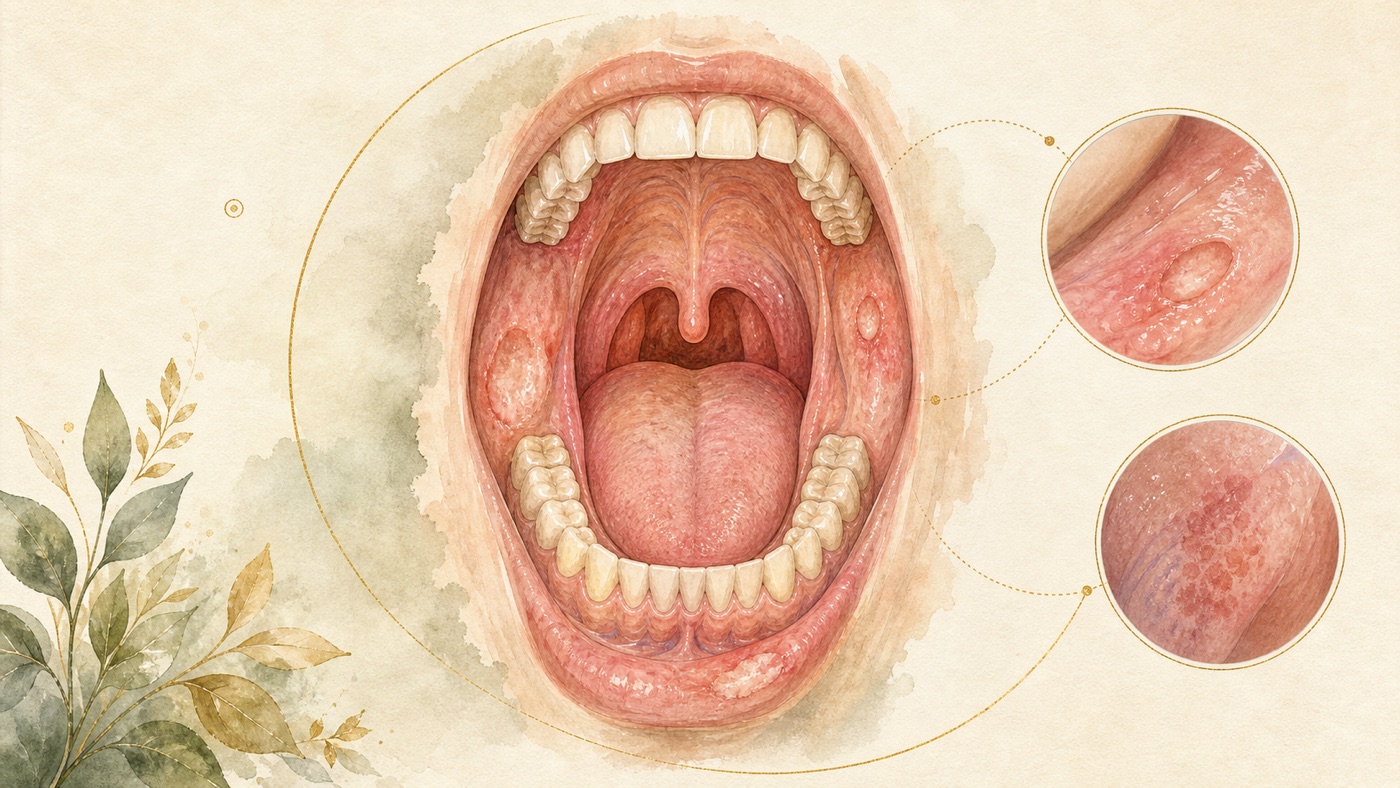
口腔黏膜与口腔癌筛查全指南:从溃疡分类、癌前病变风险到筛查证据边界的领域地图|證據鏈
本頁是〈口腔黏膜与口腔癌筛查全指南:从溃疡分类、癌前病变风险到筛查证据边界的领域地图〉的事實單元帳:每一條主張對應的來源、證據等級、地域與期間、原文引句與限制,逐條攤開。
口腔黏膜与口腔癌筛查全指南:从溃疡分类、癌前病变风险到筛查证据边界的领域地图|證據鏈
F-Units(事实单元帐)
F1|口腔癌合计为全球第 13 常见癌症;2022 年估计新发 389,846 例、死亡 188,438 例
- 来源#: #O1|confidence: high|basis: official_statement(WHO 实况报导)|geo: universal|period: 页面时间戳 2025-03-17;资料年 2022
- caveat: 为 WHO 引用之外部估计(原页注记编号 (1)),非本文独立计算;「第 13 常见」为口腔与口咽合计之排名,不可拆读为单一部位。
F2|烟品、酒精与槟榔为口腔癌主要成因之一;口腔癌在男性与年长者较常见
- 来源#: #O1(三大成因、性别年龄分布)/#G1(完整风险因子清单)/#G2(性别年龄)|confidence: high|basis: official_statement+clinical_guideline|geo: universal|period: 2025/2013(2023 文献扫描维持)/2026
- caveat: 为定性列举,非效应量;量化证据见 F9–F11,且各量化研究之人群不同不可互推。
F3|复发性口疮为文献所载口腔黏膜常见临床疾病,一般人群患病率报告 5%–25%,高峰于生命第二个十年;病因与致病机制仍不明确
- 来源#: #W16|confidence: moderate|basis: peer_reviewed(PMID 37357066,Review)|geo: universal|period: Med Clin (Barc), 2023
- caveat: 属叙述性回顾而非荟萃分析;5%–25% 区间之宽度反映判定与抽样差异,不可取中位数或平均作为代表值;另一回顾(PMID 32451064)报告区间为 5%–60%,本文未采用该值,仅记录区间差异存在。
F4|复发性口疮属排除性诊断:须先鉴别诊断、排除相关全身性疾病并评估可治疗病因,之后才成立
- 来源#: #W16|confidence: high|basis: peer_reviewed(PMID 37357066)|geo: universal|period: 2023
- caveat: 本条为诊断流程之定性陈述,不含任何可供自我判断之判定标准。
F5|复发性口疮与营养缺乏、乳糜泻存在关联(B12 OR 3.75/叶酸 7.55/铁蛋白 2.62;乳糜泻 25% vs 11%,OR 3.79)
- 来源#: #W9|confidence: moderate|basis: peer_reviewed(PMID 38530258,JAMA Review 所引之各荟萃分析)|geo: universal|period: JAMA, 2024
- caveat: 均为病例对照设计之关联,非因果;本文引自综述之二次引述,未回溯各原始荟萃分析;不构成任何补充剂、饮食或检验建议。
F6|局部治疗于 RAS 疼痛结局未显示彼此或相对安慰剂之统计显著差异(43 篇 RCT/3,067 人/20 种药物)
- 来源#: #W10|confidence: moderate|basis: peer_reviewed(PMID 37753744,Network Meta-Analysis)|geo: universal|period: J Oral Pathol Med, 2023
- caveat: 该文自评证据质量为低至中等。该文另有一条以具名处方药为主词的愈合结论,本档第三轮已整条撤下(处方药品名搭配疗效诉求不得对大众呈现),故本条不再承载任何单一药物之优劣宣称;证据薄弱面改由 F7 承接。
F7|针对单一局部药物之系统综述与荟萃分析,仅 3 篇 RCT 进入量化合并(纳入回顾 5 篇,2 篇因样本量不足被排除)
- 来源#: #R7|confidence: low|basis: peer_reviewed(PMID 42034874)|geo: universal|period: Saudi Dent J, 2026
- caveat: 本条只记录证据基础的薄厚,不记录任何疗效方向或数值。该研究之药名、给药途径、使用次数与愈合时间/疼痛评分数值,本档于正文、脚注中文栏、F-Unit 与 FAQ 一律不转述(合规:处方药品名不得搭配疗效诉求对大众呈现);来源清单保留其原始书目标题,因书目信息不得窜改——此为分层处理,不是「全篇无此药名」。原绑定之 Fn40 已整条撤下,断号保留不递补。
F8|目前没有能让复发性口疮不再发生的治疗方式;初始处置无改善者可能需全身性药物
- 来源#: #W16(无根除性疗法)/#W9(初始与全身性处置)|confidence: high|basis: peer_reviewed(PMID 37357066/38530258)|geo: universal|period: 2023/2024
- caveat: 本条为证据缺口之记录,非疗效否定;本文不含任何用药、剂量或使用方式指示。
F9|OPMD 之国际命名与分类由 WHO 口腔癌合作中心召集之专家共识界定,涵盖白斑、红斑、增殖性疣状白斑、扁平苔癣、口腔黏膜下纤维化等
- 来源#: #W1|confidence: high|basis: peer_reviewed(PMID 33128420,期刊发表之国际专家共识,PublicationType 含 Review/Consensus Statement)|geo: universal|period: Oral Dis, 2021
- caveat: 为命名与分类共识,非治疗指引;被列入 OPMD 代表风险升高之关联,不代表个别病灶必然转化。basis 于第三轮由 clinical_guideline 下修为 peer_reviewed:它是期刊上的专家共识报告,不是任何组织正式发布之临床指引,原标签会把它抬高一阶(下修理由见合规注记)。
F10|OPMD 整体恶性转化率 7.9%(99% CI 4.9%–11.5%);各亚型自扁平苔癣 1.4% 至增殖性疣状白斑 49.5% 不等;中重度异生相较轻度异生之胜算比 2.4(95% CI 1.5–3.8)
- 来源#: #W2|confidence: moderate|basis: peer_reviewed(PMID 31803979,Meta-Analysis)|geo: universal|period: Head Neck, 2020;纳入 92 篇
- caveat: 主要区间采 99% CI 而非惯用之 95%,与他文不可直接互比;原文白斑一项写作「LE 9.5」未带百分号;异生比较之 CI 于 2019-12-27 经期刊更正由 99% 改为 95%(原文自载);年化率为依平均随访期换算之近似值。
F11|口腔扁平苔癣汇总恶性转化率 1.14%(95% CI 0.84–1.49),且原作者认为此类数值被低估;相关因子含舌部位置、萎缩糜烂型、烟、酒
- 来源#: #W3|confidence: moderate|basis: peer_reviewed(PMID 31422203,Meta-Analysis)|geo: universal|period: Oral Oncol, 2019;纳入 82 篇、26,742 人
- caveat: 与 #W2 之 1.4% 为不同分析,不得取平均或择一代表;「被低估」为原作者主张而非实测上修值,本文未据此调高任何数字;风险因子之 RR 限定于已诊断扁平苔癣之人群。
F12|口腔扁平苔癣全球汇总患病率 1.01%,40 岁起显著渐进上升;不同专业背景报告之患病率差异显著(口腔医学/口腔病理 1.80% vs 牙医 0.61% vs 皮肤科 0.33%)
- 来源#: #W4|confidence: moderate|basis: peer_reviewed(PMID 32144836,Meta-Analysis)|geo: universal|period: Oral Dis, 2021
- caveat: 专业别差异为观察性关联,反映受检人群与诊断标准差异,不得读为任何专业之能力评比或就医推荐。
F13|OPMD 整体患病率 4.47%(95% CI 2.43–7.08),亚洲人群 10.54%
- 来源#: #W18|confidence: moderate|basis: peer_reviewed(PMID 29738071,Meta-Analysis)|geo: universal|period: J Oral Pathol Med, 2018
- caveat: 仅纳入同时具临床评估与组织病理确认之研究(22 篇),其中 7 篇高偏倚风险;地域差异大,单一地区数值不可代表全球。
F14|口腔黏膜下纤维化之恶性转化率:全球专家共识为 4%–7%;荟萃分析点估计为 5.2%(99% CI 2.9%–8.00%)
- 来源#: #R9(共识)/#W2(荟萃分析)|confidence: moderate|basis: peer_reviewed(PMID 42064137/31803979)|geo: universal|period: 2026/2020
- caveat: 一为专家共识区间(共识门槛 ≥80% 同意)、一为荟萃分析点估计,两者性质不同不可互证;本文并陈而不合并。
F15|白斑治疗目前无预防口腔癌发生之有效证据;某些药物治疗可能助病灶愈合但复发与不良反应常见(本档不列其成分名);手术治疗未经含对照组之随机试验评估
- 来源#: #W8|confidence: high|basis: peer_reviewed(Cochrane 系统综述,PMID 27471845)|geo: universal|period: Cochrane Database Syst Rev, 2016;14 篇、909 人
- caveat: 检索截止 2016-05-16,其后新证据未纳入;「无有效证据」为证据缺口而非疗效否定;本文不由此建议或反对任何处置。
F16|伴上皮异生之口腔白斑经 5-ALA 光动力疗法之汇总整体反应率为 0.85(95% CI 0.74–0.93)
- 来源#: #R10|confidence: low|basis: peer_reviewed(PMID 41754995,Meta-Analysis)|geo: universal|period: Pharmaceutics, 2026
- caveat: 证据等级经 GRADE 评为极低;结局为病灶反应率,非癌症预防;与 F15 之「无预防癌症证据」不冲突,因结局不同。
F17|对无症状成人之常规口腔癌筛查为 I 级声明(证据不足以评估利弊平衡),2023 年 7 月文献扫描维持原判;官方另载目前无标准或常规筛查检查
- 来源#: #G1(I 级与文献扫描)/#O2(无标准或常规检查)|confidence: high|basis: official_statement+clinical_guideline|geo: universal|period: USPSTF 2013(2023 扫描)/NCI 页面更新 2025-05-08
- caveat: 「证据不足以评估」≠「筛查无效」;此结论限定于「无症状成人之常规筛查」,不适用于有病灶者或高风险人群(见 F18)。
F18|高风险人群之视觉筛查(单一印度喀拉拉邦成人试验):试验 9 年报告之整体死亡率比 0.79(95% CI 0.51–1.22,未达显著)、烟酒使用者亚组 0.66(95% CI 0.45–0.95);Cochrane 现行版(2013 更新版,15 年随访)记为整体 RR 0.88(95% CI 0.69–1.12,未达显著)与高风险亚组 24% 死亡率降低(RR 0.76,95% CI 0.60–0.97),另记载第三期或更晚期诊断人数显著较少(RR 0.81,95% CI 0.70–0.93)
- 来源#: #W7(试验原文,9 年)/#W6(Cochrane 2013 更新版,15 年随访)|confidence: low|basis: peer_reviewed(PMID 15936419/24254989)|geo: universal|period: Lancet, 2005/Cochrane, 2013
- caveat: 同一批资料的不同随访期与不同呈现,不可当作多个独立证据;Cochrane 明载证据仅限单一研究、该研究高偏倚风险且分析未计入分群随机之效应。本条于第三轮由 Cochrane 2010 版(PMID 21069680)换绑至 2013 更新版(PMID 24254989):2010 版以较短随访期报告较大之降幅,PubMed 于 2013 版标有 `UpdateOf` 关系,故旧版效应量已停止使用,不得与本条并用或互比。试验人群为印度喀拉拉邦成人,暴露结构特殊,不得外推为普世筛查效益。
F19|口腔视诊之准确度:受训基层人员敏感度 74%/特异度 94%;另一分析汇总敏感度 88.8%/特异度 91.9%;AI 影像判读敏感度 0.87/特异度 0.81
- 来源#: #R1/#W14/#R5|confidence: low|basis: peer_reviewed(PMID 42019578/36579978/39568787)|geo: universal|period: 2026/2022/2024
- caveat: 三者执行者、判读对象与年代不同,不可互比或取平均;#R1 自陈异质性可观;#W14 仅 5 篇纳入且 4 篇完成于 2000 年前;三者皆非确诊工具。
F20|无任何辅助检查可取代手术切片与组织病理判读;视觉辅助工具不适合作筛查用途或由一般牙医师使用
- 来源#: #W5(Cochrane 诊断准确度回顾 2021 更新版)/#R2(视觉辅助回顾)/#W6(Cochrane 筛查回顾 2013 更新版:无证据支持辅助技术作为降低死亡率之筛查工具)/#G1(疑似病灶需切片确认)|confidence: high|basis: clinical_guideline+peer_reviewed(PMID 34282854/41899069/24254989)|geo: universal|period: 2021/2026/2013/2013
- caveat: 本条于第三轮整组换绑至现行更新版(#W5 由 PMID 26021841 换为 34282854、#W6 由 21069680 换为 24254989;两者 PubMed 记录均自载 `UpdateOf` 关系)。#W5 2021 更新版检索截止 2020-10-20,其合并估计之确定性自中度至极低度不等,仅 2 篇研究在所有面向为低偏倚风险;#R2 受高异质性与缺乏随机试验限制。四条来源只支撑「不能取代切片、不适合作筛查或由一般牙医师使用」这两句;未评估这些工具在临床流程中的其他角色,本文亦不描述。 四条方向一致,故本条 confidence 标 high。
F21|筛查的害处已被官方明列:可能出现伪阴性、伪阳性,以及过度诊断;同一来源另载逾半数口腔癌发现时已扩散
- span: "More than half of oral cancers have already spread to lymph nodes or other areas by the time they are found."
- 来源#: #O2|confidence: high|basis: official_statement(NCI PDQ 病人版)|geo: universal|period: 页面更新 2025-05-08
- caveat: 两项事实方向相反但同时为真,不得只引其一;本条不支撑任何「该筛/不该筛」的个人决策。
F22|口腔癌风险之量化证据:重度饮酒 RR 5.13;嚼食烟草 OR 4.7、含烟草槟榔 OR 7.1(南亚);槟榔成瘾使用障碍重度者 42.3;不含烟草之槟榔对癌前病变 OR 22.2/56.2/29.0
- 来源#: #W11/#W12/#R6/#W15|confidence: moderate|basis: peer_reviewed(PMID 25422909/25097551/39164987/15172639)|geo: universal|period: 2015/2014/2025/2004
- caveat: 人群限定——#W12 为南亚、#R6 为南亚/东南亚/东亚、#W15 为印度喀拉拉邦病例对照;#W15 之结局为癌前病变而非癌症;各研究暴露定义不同,数值不可互比亦不可相加;本文不由此推算任何个人风险。#R6 之 8.5/8.2/42.3 三数,其摘要原文仅写「risk」而未标明效应量种类(OR/RR/HR)亦未附置信区间,本文因此在正文与本条均不替它补上任何统计标签;若后续需引用其精确定义,须取回全文确认。
F23|IARC 专论已将不含烟草之槟榔嚼食分类为人类致癌物
- 来源#: #W15|confidence: moderate|basis: peer_reviewed(PMID 15172639,引述 IARC 分类)|geo: universal|period: Oral Oncol, 2004
- caveat: 本条为 2004 年论文对 IARC 分类之引述,本轮未直接取回 IARC 专论原文;若需引用分类版本与年度,须另行查证原始专论。
F24|诊断延迟与诊断时晚期分期相关:口咽癌汇总 RR 1.32;限缩口腔癌 1.47;延迟逾一个月 1.69
- 来源#: #W13|confidence: moderate|basis: peer_reviewed(PMID 19758250,Meta-Analysis)|geo: universal|period: Eur J Oral Sci, 2009
- caveat: 结局为诊断时分期,非死亡率或存活率;纳入为观察性研究,作者自陈需更严谨之前瞻研究;本文不由此作任何存活宣称。
F25|在一项单一地区医院之紧急转诊样本中(883 件),整体癌症患病率 6.2%,多数为常见良性病症
- 来源#: #W17|confidence: low|basis: peer_reviewed(PMID 37723310,单中心回顾性服务资料)|geo: universal(依 本线编务规格 全线定调,geo 栏记录的是本文的地域适用范围,不是研究人群;研究人群限定另记于本 caveat)|period: Br Dent J, 2023;资料期间 2020-10-12 至 2022-01-19
- caveat: 单一地区医院、单一时期之服务资料,不可外推为任何人群之患病率。分母是「已被转诊者」,不是「所有出现警讯者」,两者不可互换;本文引用其比例仅为说明「符合警讯不等于癌症」,不描述任何国家之转诊制度。
F26|口腔自我检查之步骤通常为黏膜视诊加颈部触诊,但缺乏标准化程序与评估,损害可重现性与提出建议之能力
- 来源#: #R3|confidence: low|basis: peer_reviewed(PMID 41352997,系统综述)|geo: universal|period: Oral Surg Oral Med Oral Pathol Oral Radiol, 2026;11 篇、53–34,766 人
- caveat: 该回顾之结论为「证据异质、无法提出建议」,故本文不提供任何自我检查步骤教学;本条仅记录该方法在文献中的现况。
F27|HPV 之关联性在机构文件中主要指向口咽癌,与口腔黏膜病灶属不同亚群
- 来源#: #G1(口咽癌之表述)/#O1(北美与欧洲年轻人群比例上升)|confidence: moderate|basis: official_statement+clinical_guideline|geo: universal|period: 2013(2023 扫描)/2025
- caveat: 两来源措辞之解剖范围不同(#O1 用 "oral cancers"、#G1 明指 oropharyngeal),本文以较精确者为准并标示差异;本条不涉任何疫苗建议。
F28|跨国 Delphi 共识产出七项建议,涵盖口腔癌控制之关键领域含初级预防
- 来源#: #R8|confidence: moderate|basis: peer_reviewed(PMID 42378752,Delphi 共识研究)|geo: universal|period: Oral Oncol, 2026
- caveat: 属同行评议期刊之共识研究,非任何组织正式发布之指引;其实施情境为拉丁美洲与加勒比海地区,本文仅引用「转诊路径仍在形成共识」此一定性事实。
F29|第二份机构警讯清单采同一两周门槛,但另列出前一份未收的项目:持续喉咙痛或喉中异物感、声音沙哑或失声、颈部肿块、下颌肿胀致假牙不合、口内疼痛或出血、舌与口腔其他部位麻木、耳痛
- 来源#: #O3|confidence: high|basis: official_statement(NIDCR/NIH 机构卫教页)|geo: universal|period: 页面标示 Last Reviewed November 2024;取用 2026-08-06
- caveat: 本条的用途是证明「单一机构清单不是完整集合」,不是提供一份较完整的清单——两份机构清单并列后仍非穷举,未列到的症状不得被读为安全。清单为病人卫教层级之警讯提示,不是诊断标准、不排序严重度、不得作为自我判读工具;它能支撑的行动只有一个:请由专业人员检查。第三轮新增(原因:前一版仅收单一机构清单却以总览呈现,属呈现为完整集合之缺陷)。
F30(编务保留,非文献事实单元)|两项只放宽就医时机、不收紧的安全底线:①不适用两周门槛的急症信号——呼吸困难,或突发/快速恶化之吞咽困难(尤伴口舌喉肿胀、喉紧或声音改变)应立即寻求紧急医疗评估;②新发、正在恶化、外观可疑或伴其他警讯者,可早于两周接受检查
- 来源#: 无单一文献来源——本条为安全底线之编务保留,非取自单一文献之判定标准|confidence: n/a(不主张证据等级)|basis: editorial_safety_reservation(非 本线编务规格 五级 basis 阶梯之一,不得被引用为医学 basis)|geo: universal|period: 2026-08-06 第三轮新增
- caveat: 保留理由可查证:本文所引两份机构清单均把吞咽困难置于两周门槛之下 [Fn25][Fn120],未对突发/伴呼吸道受影响者另设例外;两份亦均只给「超过两周请就医」,未声称两周内可安全等待 [Fn20][Fn118]。本条只指向「立即/更早由专业人员评估」,不含任何病因判断判定标准、不排序严重度、不指定任何国家的紧急服务名称或路径,亦不取代 P13 之完整分级。两项均为单向放宽(只可能让人更早被检查,不会让任何人更晚就医),这是本文接受其无单一文献来源的前提。凡引用本文者,不得把本条当作文献结论转述;正文对应处为 §1-1、6-0、FAQ Q1 与 FAQ Q4,四处均已标记为编务保留。
合规注记
- 本文为卫生教育与医学新知整理,属一般性卫教信息,未涉招徕医疗业务,不构成医疗广告,亦不构成诊断或治疗建议。
- 本文不提供任何金额、收费或给付信息,不推荐任何医疗机构、医师、品牌或产品,不含任何可识别个案,亦无第三人对疗程的主观评述。
- 本文不含任何用药、剂量、营养补充或操作指示;涉及药物与成分的引用仅为呈现研究结论及其限制。具名处方药搭配疗效数值的段落已于第三轮整组撤下(正文、脚注中文栏、F-Unit 与 FAQ 均不列其药名、途径、使用次数与疗效数值;来源清单保留原始书目标题,因书目信息不得窜改)。白斑处置之具名成分同理只在来源逐字 span 中存在,中文各层一律不复述、不建议任何人自行取得或使用。
- 本文不提供自我检查步骤教学,亦不编制自创的症状分级表、不排序症状严重度;警讯清单为两份机构原文之转述且均非完整集合,分级判定标准属 P13 领域。本文另于 6-0 与 F30 保留一条不适用两周门槛的急症安全底线,该条明标为编务保留、非取自单一文献之判定标准,只指向「立即由专业人员评估」,不含任何病因判断判定标准,亦不指定任何国家的紧急服务名称或路径。
- 与锚定档的两处 basis 标签分歧(本档为准,锚定档未动):①#G2(ADA MouthHealthy 消费者卫教页)由 `clinical_guideline` 改标 `official_patient_education`——它是机构的病人卫教页而非临床指引原文,该标签不在 本线编务规格 五级 basis 阶梯内,本档明定其权威低于 `clinical_guideline`,且只准支撑「机构列出的警讯清单与时间门槛」,不得作为任何效应量或诊断标准之 basis。②#W1(WHO 合作中心命名与分类共识报告)由 `clinical_guideline` 下修为 `peer_reviewed`——其 PublicationType 为 Review/Consensus Statement,属期刊发表之专家共识,非任何组织正式发布之临床指引。两处均为下修,不涉任何权威层级的抬升。
- 本文所引流行病学数字均为人群层级之研究结果,不能用于推算任何个人的罹病概率;实际治疗方式与效果因人而异,须由牙医师评估后决定。
- 本文不描述任何国家之科别设置、转诊规则、保险或收费制度;在地制度一律下链至对应正典卡(TW)与领域文 P12。
来源清单
取用/实测日期:2026-08-06(全部来源同日以 curl/PubMed E-utilities 实测,HTTP 200;第三轮换版与增修后,现行 120 条逐字 span 全部以程式逐条溯源比对通过、0 FAIL,另有 4 条 should-FAIL 反例全被抓出)
锚定档既验来源
| # | basis | 标题 | 出处 | PMID/URL |
|---|---|---|---|---|
| #O1 | official_statement | Oral health(Fact sheet) | World Health Organization, 页面时间戳 17 March 2025 | https://www.who.int/news-room/fact-sheets/detail/oral-health |
| #O2 | official_statement | Oral Cavity and Nasopharyngeal Cancers Screening (PDQ®)–Patient Version | National Cancer Institute (NCI/NIH), Updated May 8, 2025 | https://www.cancer.gov/types/head-and-neck/patient/oral-screening-pdq |
| #G1 | clinical_guideline | Oral Cancer: Screening(Final Recommendation Statement, Grade I) | US Preventive Services Task Force, November 15, 2013(2023-07 文献扫描维持) | https://www.uspreventiveservicestaskforce.org/uspstf/recommendation/oral-cancer-screening |
| #G2 | official_patient_education | Oral Cancer(消费者卫教页) | American Dental Association/MouthHealthy.org | https://www.mouthhealthy.org/all-topics-a-z/oral-cancer |
| #R1 | peer_reviewed | Effectiveness of oral cancer training programs for frontline health workers: A systematic review and meta-Analysis | J Cancer Policy, 2026;48:100741 | PMID 42019578|https://pubmed.ncbi.nlm.nih.gov/42019578/ |
| #R2 | peer_reviewed | Beyond Visual Inspection: A Systematic Review of Adjunctive Aids for the Early Detection of Oral Squamous Cell Carcinoma | J Clin Med, 2026;15(6):2146 | PMID 41899069|https://pubmed.ncbi.nlm.nih.gov/41899069/ |
| #R3 | peer_reviewed | Reported mouth self-examination methods for oral cancer screening: a systematic review | Oral Surg Oral Med Oral Pathol Oral Radiol, 2026;141(3):351-356 | PMID 41352997|https://pubmed.ncbi.nlm.nih.gov/41352997/ |
| #R4 | peer_reviewed | Screening tools and strategies for early detection of oral cancer and potentially malignant disorders in rural and low-resource populations: A systematic review | J Stomatol Oral Maxillofac Surg, 2026;127(3):102667 | PMID 41285247|https://pubmed.ncbi.nlm.nih.gov/41285247/ |
| #R5 | peer_reviewed | Diagnostic performance of artificial intelligence in detecting oral potentially malignant disorders and oral cancer using medical diagnostic imaging: a systematic review and meta-analysis | Front Oral Health, 2024;5:1494867 | PMID 39568787|https://pubmed.ncbi.nlm.nih.gov/39568787/ |
| #R6 | peer_reviewed | Betel-quid addictive use disorders and Oral potentially malignant disorders and Oral cancer in south, southeast, and East Asia: A systematic review and meta-analysis | Oral Dis, 2025;31(5):1517-1530 | PMID 39164987|https://pubmed.ncbi.nlm.nih.gov/39164987/ |
| #R7 | peer_reviewed | A systematic review and meta-analysis of single-application topical doxycycline for recurrent aphthous stomatitis | Saudi Dent J, 2026;38(5):55 | PMID 42034874|https://pubmed.ncbi.nlm.nih.gov/42034874/ |
| #R8 | peer_reviewed | Implementation-focused consensus recommendations for oral cavity cancer prevention and early detection in Latin America and the Caribbean: A Delphi study | Oral Oncol, 2026;180:108065 | PMID 42378752|https://pubmed.ncbi.nlm.nih.gov/42378752/ |
| #R9 | peer_reviewed | Global expert consensus on oral submucous fibrosis: Standardizing care, surveillance, and prevention strategies | J Oral Maxillofac Pathol, 2026;30(1):2-13 | PMID 42064137|https://pubmed.ncbi.nlm.nih.gov/42064137/ |
| #R10 | peer_reviewed | Efficacy of 5-ALA Photodynamic Therapy in Dysplastic Oral Leukoplakia: Systematic Review and Meta-Analysis | Pharmaceutics, 2026;18(2):254 | PMID 41754995|https://pubmed.ncbi.nlm.nih.gov/41754995/ |
锚定档零捏造声明沿用:ADA 官方 `ada.org/.../oral-health-topics/oral-cancer` 路径实测 404,已剔除;改用同机构具名版权之 MouthHealthy.org 页面(实测 200)。依 本线编务规格 2026-08-06 全线 global 定调,台湾法规/健保/卫生局内容未作为本篇任何医学或制度宣称之 basis;在地制度一律下链至对应 TW 正典卡与 P12。
WRITER-ADDED SOURCES(本文新增 19 条,含实测证据)
新增理由:锚定档的 14 条覆盖「筛查在做什么」与「口腔癌流行病学/风险」两块,但本篇领域范围另含①口腔潜在恶性疾患(OPMD)的国际命名与分类体系、②白斑/红斑/扁平苔癣各自的恶性转化率与患病率、③异生分级这条被量化过的风险轴、④复发性口疮的患病率、外观、排除性诊断性质与处置证据光谱、⑤烟酒与各型槟榔的量化效应量、⑥筛查的随机试验证据与 Cochrane 评述、⑦辅助检查相对切片的诊断准确度、⑧诊断延迟与转诊样本的结局资料、⑨(第三轮新增)第二份机构警讯清单,用以证明单一机构清单不是完整集合。以下 19 条全部经本机实测(PubMed E-utilities/curl,HTTP 200)并程式化逐字比对通过,未修改锚定档。
#O3 为第三轮新增之机构网页来源(不在锚定档):
| # | basis | 标题 | 出处 | URL |
|---|---|---|---|---|
| #O3 | official_statement | Oral Cancer(含 Symptoms 清单) | National Institute of Dental and Craniofacial Research (NIDCR/NIH), 页面标示 Last Reviewed November 2024;curl 实测 HTTP 200/69,978 bytes | https://www.nidcr.nih.gov/health-info/oral-cancer |
以下 18 条为首轮新增之 PubMed 来源(#W5/#W6 两列已于第三轮换绑至现行更新版):
| # | basis | 标题 | 出处 | PMID/URL |
|---|---|---|---|---|
| #W1 | peer_reviewed | Oral potentially malignant disorders: A consensus report from an international seminar on nomenclature and classification, convened by the WHO Collaborating Centre for Oral Cancer | Oral Dis, 2021;27(8):1862-1880(PublicationType: Review/Consensus Statement;期刊发表之国际专家共识,非任何组织正式发布之临床指引) | PMID 33128420|https://pubmed.ncbi.nlm.nih.gov/33128420/ |
| #W2 | peer_reviewed | Potentially malignant disorders of the oral cavity and oral dysplasia: A systematic review and meta-analysis of malignant transformation rate by subtype | Head Neck, 2020;42(3):539-555 | PMID 31803979|https://pubmed.ncbi.nlm.nih.gov/31803979/ |
| #W3 | peer_reviewed | Malignant transformation risk of oral lichen planus: A systematic review and comprehensive meta-analysis | Oral Oncol, 2019;96:121-130 | PMID 31422203|https://pubmed.ncbi.nlm.nih.gov/31422203/ |
| #W4 | peer_reviewed | Worldwide prevalence of oral lichen planus: A systematic review and meta-analysis | Oral Dis, 2021;27(4):813-828 | PMID 32144836|https://pubmed.ncbi.nlm.nih.gov/32144836/ |
| #W5 | peer_reviewed | Diagnostic tests for oral cancer and potentially malignant disorders in patients presenting with clinically evident lesions(Cochrane,2021 更新版;PubMed 记录自载 `UpdateOf` 指向其 2015 旧版) | Cochrane Database Syst Rev, 2021;7(7):CD010276 | PMID 34282854|https://pubmed.ncbi.nlm.nih.gov/34282854/ |
| #W6 | peer_reviewed | Screening programmes for the early detection and prevention of oral cancer(Cochrane,2013 更新版;PubMed 记录自载 `UpdateOf` 指向其 2010 旧版) | Cochrane Database Syst Rev, 2013;(11):CD004150 | PMID 24254989|https://pubmed.ncbi.nlm.nih.gov/24254989/ |
| #W7 | peer_reviewed | Effect of screening on oral cancer mortality in Kerala, India: a cluster-randomised controlled trial | Lancet, 2005;365(9475):1927-1933 | PMID 15936419|https://pubmed.ncbi.nlm.nih.gov/15936419/ |
| #W8 | peer_reviewed | Interventions for treating oral leukoplakia to prevent oral cancer(Cochrane) | Cochrane Database Syst Rev, 2016;7(7):CD001829 | PMID 27471845|https://pubmed.ncbi.nlm.nih.gov/27471845/ |
| #W9 | peer_reviewed | Common Oral Conditions: A Review | JAMA, 2024;331(12):1045-1054 | PMID 38530258|https://pubmed.ncbi.nlm.nih.gov/38530258/ |
| #W10 | peer_reviewed | Topical medications for the treatment of recurrent aphthous stomatitis: A network meta-analysis | J Oral Pathol Med, 2023;52(9):811-825 | PMID 37753744|https://pubmed.ncbi.nlm.nih.gov/37753744/ |
| #W11 | peer_reviewed | Alcohol consumption and site-specific cancer risk: a comprehensive dose-response meta-analysis | Br J Cancer, 2015;112(3):580-593 | PMID 25422909|https://pubmed.ncbi.nlm.nih.gov/25422909/ |
| #W12 | peer_reviewed | Smokeless tobacco and oral cancer in South Asia: a systematic review with meta-analysis | J Cancer Epidemiol, 2014;2014:394696 | PMID 25097551|https://pubmed.ncbi.nlm.nih.gov/25097551/ |
| #W13 | peer_reviewed | Is diagnostic delay related to advanced-stage oral cancer? A meta-analysis | Eur J Oral Sci, 2009;117(5):541-546 | PMID 19758250|https://pubmed.ncbi.nlm.nih.gov/19758250/ |
| #W14 | peer_reviewed | Diagnostic Accuracy of Screening of Lip and Oral Cavity Cancers or Potentially Malignant Disorders (PMD) by Frontline Workers: A Systematic Review and Meta-Analysis | Asian Pac J Cancer Prev, 2022;23(12):3983-3991 | PMID 36579978|https://pubmed.ncbi.nlm.nih.gov/36579978/ |
| #W15 | peer_reviewed | Betel quid without tobacco as a risk factor for oral precancers | Oral Oncol, 2004;40(7):697-704 | PMID 15172639|https://pubmed.ncbi.nlm.nih.gov/15172639/ |
| #W16 | peer_reviewed | Recurrent aphthous stomatitis | Med Clin (Barc), 2023;161(6):251-259 | PMID 37357066|https://pubmed.ncbi.nlm.nih.gov/37357066/ |
| #W17 | peer_reviewed | Appropriateness of two-week wait head and neck cancer referrals to a district general hospital | Br Dent J, 2023 | PMID 37723310|https://pubmed.ncbi.nlm.nih.gov/37723310/ |
| #W18 | peer_reviewed | Prevalence of oral potentially malignant disorders: A systematic review and meta-analysis | J Oral Pathol Med, 2018;47(7):633-640 | PMID 29738071|https://pubmed.ncbi.nlm.nih.gov/29738071/ |
FAQ
- Q1. 嘴破一直不好,什么时候该去看?
- **两份机构卫教页给的时间门槛都是两周:若不会消退的酸痛处或刺激感等情况持续超过两周,应立刻联系牙医师 [Fn20][Fn21];另一份的写法是持续超过两周请看牙医师或医师 [Fn118]。但两周是持续性的警讯门槛,不是保证安全的观察期**——新发、正在恶化或伴其他警讯者可以更早接受检查;**呼吸困难,或突发、快速恶化的吞咽困难(尤其伴口舌喉肿胀、喉紧或声音改变)不适用两周门槛,应立即寻求紧急医疗评估**。(本句这两项均为本文之**安全底线编务保留,非取自单一文献之判定标准**,帐列 F30、说明见 6-0。)需要一起知道的是为什么要有门槛——存在诊断延迟时,口腔癌于诊断时呈现晚期的汇总相对风险为 1.47(95% CI 1.09–1.99),延迟超过一个月时为 1.69(95% CI 1.26–2.77)[Fn95]。但也请同时记得:在一项单一地区医院的紧急转诊样本中,整体癌症患病率为 6.2% [Fn109],多数为常见的良性病症 [Fn110]——该分母是「已被转诊的人」,不是「所有出现警讯的人」。**警讯门槛的功能是提示该由专业人员检查,不是判定是什么。** 本段的时间门槛来自病人卫教页而非临床指引原文,且本文不描述任何国家的转诊制度。
- Q1. 口内炎がずっと治りません。いつ受診すべきですか? — **二つの機関の衛生教育ページが示す時間の閾値はいずれも 2 週間です:消えない痛みや刺激感などの状況が 2 週間を超えて持続する場合は、ただちに歯科医師に連絡すべきです [Fn20][Fn21];もう一方の書き方は、2 週間を超えて持続する場合は歯科医師または医師の診察を受けてください、というものです [Fn118]。しかし 2 週間は持続性のレッドフラッグの閾値であって、安全を保証する観察期間ではありません**——新たに生じたもの、悪化しつつあるもの、または他のレッドフラッグを伴うものは、より早く診察を受けることができます。**呼吸困難、または突然生じて急速に悪化する嚥下困難(とくに口・舌・のどの腫れ、のどの締めつけ感や声の変化を伴うもの)は 2 週間の閾値が当てはまらず、ただちに救急の医学的な評価を求めるべきです**。(この文のこの二つの項目はいずれも本記事の**安全のための最低線としての編集上の留保であり、単一の文献から取った判断基準ではありません**。台帳上は F30、説明は 6-0 をご覧ください。)あわせて知っておく必要があるのは、なぜ閾値があるのかということです——診断の遅れが存在する場合、口腔がんが診断時に進行した病期で現れる統合された相対危険は 1.47(95% CI 1.09–1.99)、遅れが 1 か月を超える場合は 1.69(95% CI 1.26–2.77)です [Fn95]。しかし同時に覚えておいてください:ある単一の地域の病院の緊急の紹介の標本では、全体のがんの有病率は 6.2% であり [Fn109]、多くはよく起こる良性の病態でした [Fn110]——この分母は「すでに紹介された人」であって、「レッドフラッグが現れたすべての人」ではありません。**レッドフラッグの閾値の機能は専門家の診察を受けるべきことを促すことであって、それが何であるかを判定することではありません。** 本段落の時間の閾値は患者向けの衛生教育ページに由来するものであって臨床ガイドラインの原文ではなく、また本記事はいかなる国の紹介の制度も記述しません。
- Q1. My mouth ulcer keeps not getting better — when should I have it looked at? — **Both institutional patient-education pages give the same time threshold, two weeks: if a sore or irritation that doesn't go away, or a similar issue, lasts longer than two weeks, you should call your dentist right away [Fn20][Fn21]; the other one puts it as, if you have any of these symptoms for more than two weeks, see a dentist or a doctor [Fn118]. But two weeks is a persistence threshold for a warning sign, not an observation window that assures safety**—anyone whose lesion is new, is getting worse, or comes with other warning signs may be examined earlier; and **difficulty breathing, or difficulty swallowing that comes on suddenly or is worsening rapidly (especially with swelling of the mouth, tongue or throat, tightness in the throat or a change in the voice), is not subject to the two-week threshold and calls for emergency medical assessment immediately**. (Both of those two items in this sentence are an **editorial reservation of a safety floor by this article, not a criterion taken from any single source**; they are booked as F30 and explained in 6-0.) What needs to be known alongside this is why there is a threshold at all — where diagnostic delay is present, the pooled relative risk of oral cancer presenting at an advanced stage at diagnosis is 1.47 (95% CI 1.09–1.99), and 1.69 (95% CI 1.26–2.77) where the delay is longer than 1 month [Fn95]. But please remember this at the same time: in the urgent referral sample of one single district hospital, the overall prevalence of cancer was 6.2% [Fn109], and most were commonly occurring benign conditions [Fn110] — that denominator is “people who have already been referred”, not “everyone in whom a warning sign appears”. **The function of a warning-sign threshold is to prompt that this should be examined by a professional, not to determine what it is.** The time threshold in this passage comes from patient-education pages rather than the text of a clinical guideline, and this article describes no country's referral system.
- Q2. 口腔白斑是癌吗?
- **白斑不等于癌,但也不能只靠外观排除异生或癌——需要临床检查,必要时以组织切片判定 [Fn16][Fn17]。** 它属于被列管的风险类别:白斑是世界卫生组织口腔癌合作中心共识所列的口腔潜在恶性疾患之一 [Fn47],而 OPMD 的定义就是「与唇部或口腔癌症发生风险升高相关」[Fn46]。量化上,一篇纳入 92 篇研究的荟萃分析报告白斑的恶性转化率为 9.5(99% CI 5.9%–14.00%)[Fn51][Fn54],年化转化率为 1.56% [Fn53]。被量化过的重要风险轴是异生程度而不是颜色:中重度异生相较轻度异生,恶性转化风险的胜算比为 2.4(95% CI 1.5–3.8)[Fn52],而异生只能由组织病理判定,因此疑似病灶需切片确认 [Fn17][Fn62]。另需注意,病人口中的「白斑」往往只是对外观的描述,未经检查前不等同于文献中经临床与病理确认的白斑(该类研究的纳入条件即含组织病理确认 [Fn114])。也要诚实说明处置端的现况:目前没有证据显示任何一种白斑治疗能有效预防口腔癌发生 [Fn76]。
- Q2. 口腔白板症はがんですか? — **白板症はがんと同じではありませんが、見た目だけで異形成やがんを除外することもできません——臨床診察が必要で、必要な場合は組織の生検によって判定します [Fn16][Fn17]。** それは管理の対象とされるリスクのカテゴリーに属します:白板症は世界保健機関の口腔がん協力センターの合意が挙げる口腔潜在的悪性疾患の一つであり [Fn47]、OPMD の定義そのものが「口唇または口腔のがんの発生リスクの上昇と関連する」というものです [Fn46]。定量的には、92 件の研究を組み入れたメタアナリシスは白板症の悪性転化率を 9.5(99% CI 5.9%–14.00%)と報告しており [Fn51][Fn54]、年あたりの転化率は 1.56% です [Fn53]。定量化された重要なリスクの軸は色ではなく異形成の程度です:中等度・高度の異形成は軽度の異形成と比べて悪性転化のリスクのオッズ比が 2.4(95% CI 1.5–3.8)であり [Fn52]、そして異形成は病理組織によってしか判定できないため、疑わしい病変には生検による確認が必要です [Fn17][Fn62]。またご注意ください、患者が言う「白板症」はしばしば見た目についての記述にすぎず、診察を受ける前の段階では、文献において臨床と病理によって確認された白板症と同じではありません(この種の研究の組み入れの条件には病理組織学的な確認が含まれます [Fn114])。管理の側の現状も誠実に説明する必要があります:現時点で、いかなる白板症の治療も口腔がんの発生を有効に予防できるというエビデンスはありません [Fn76]。
- Q2. Is oral leukoplakia cancer? — **Leukoplakia is not the same as cancer, but neither can dysplasia or cancer be ruled out on appearance alone — it takes a clinical examination and, where necessary, determination by tissue biopsy [Fn16][Fn17].** It belongs to a risk category that is kept under watch: leukoplakia is one of the oral potentially malignant disorders listed in the consensus of the WHO Collaborating Centre for Oral Cancer [Fn47], and the definition of an OPMD is precisely that it is “associated with an increased risk of occurrence of cancers of the lip or oral cavity” [Fn46]. Quantitatively, a meta-analysis that included 92 studies reports a malignant transformation rate for leukoplakia of 9.5 (99% CI 5.9%–14.00%) [Fn51][Fn54], with an annual transformation rate of 1.56% [Fn53]. The important risk axis that has been quantified is the degree of dysplasia, not the colour: compared with mild dysplasia, moderate/severe dysplasia carries an odds ratio for the risk of malignant transformation of 2.4 (95% CI 1.5–3.8) [Fn52], and dysplasia can only be determined by histopathology, which is why a suspected lesion requires confirmation by biopsy [Fn17][Fn62]. Note also that “leukoplakia” as a patient uses the word is often only a description of appearance, and before examination it is not equivalent to the leukoplakia that is clinically and pathologically confirmed in the literature (the inclusion condition of that class of study includes histopathological confirmation [Fn114]). The state of the management side has to be stated honestly too: there is at present no evidence that any treatment for leukoplakia is effective for preventing the development of oral cancer [Fn76].
- Q3. 口腔癌的前兆有哪些?
- 专业上对应的不是单一征兆,而是一整份疾病清单(口腔潜在恶性疾患,其定义为「与唇部或口腔癌症发生风险的升高相关」[Fn46])与机构列给病人的警讯清单(门槛为持续超过两周请就医 [Fn20][Fn118])。⚠ 以下两份警讯清单都不是完整集合,没列到的不代表可以忽略;正确用法是「出现下列情况请由专业人员检查」,不是「出现下列情况代表可能有癌症」。** 疾病面,世界卫生组织口腔癌合作中心的共识列出白斑、红斑、增殖性疣状白斑、口腔扁平苔癣、口腔黏膜下纤维化、逆吸烟者的腭部病灶、红斑性狼疮、表皮松解水疱症与先天性角化不良 [Fn47]。症状面,一份机构卫教页列出不消退的酸痛处 [Fn21]、红白斑块 [Fn22]、疼痛或麻木 [Fn23]、肿块或粗糙处 [Fn24]、咀嚼吞咽困难 [Fn25]、咬合改变 [Fn26];另一份机构清单在同一门槛下另列持续喉咙痛或喉中异物感、声音沙哑或失声 [Fn119]、颈部肿块 [Fn120]、下颌肿胀到假牙不合 [Fn121]、口内疼痛或出血、舌头与口腔其他部位麻木、耳痛 [Fn122]——**两份机构列的内容并不一致,这正说明任何单一清单都不能当成完整集合。** 另外,**呼吸困难或突发、快速恶化的吞咽困难不适用两周门槛,应立即寻求紧急医疗评估**(本文之安全底线编务保留,非取自单一文献之判定标准,见 6-0)。风险因子面,主要为烟品与酒精,另包含男性、年长、槟榔、紫外线暴露、念珠菌或细菌菌丛感染与免疫功能受损 [Fn15]。**这些是人群层级的风险指标,不能用来自我判断。
- Q3. 口腔がんの前兆にはどのようなものがありますか? — 専門的に対応するのは単一の徴候ではなく、疾患のリスト全体(口腔潜在的悪性疾患。その定義は「口唇または口腔のがんの発生リスクの上昇と関連する」です [Fn46])と、機関が患者に向けて挙げたレッドフラッグのリスト(閾値は 2 週間を超えて持続する場合は受診すること [Fn20][Fn118])です。⚠ 以下の二つのレッドフラッグのリストはどちらも完全な集合ではなく、挙げられていないものが無視してよいことを意味しません。正しい使い方は「以下の状況が現れたら専門家の診察を受けてください」であって、「以下の状況が現れたらがんの可能性があることを意味する」ではありません。** 疾患の面では、世界保健機関の口腔がん協力センターの合意は白板症、紅板症、増殖性疣贅性白板症、口腔扁平苔癬、口腔粘膜下線維症、逆喫煙者の口蓋病変、エリテマトーデス、表皮水疱症、先天性角化不全症を挙げています [Fn47]。症状の面では、ある機関の衛生教育ページが消えない痛み [Fn21]、赤い斑や白い斑 [Fn22]、痛みまたはしびれ [Fn23]、しこりやざらつき [Fn24]、咀嚼や嚥下の困難 [Fn25]、噛み合わせの変化 [Fn26] を挙げています。別の機関のリストは同じ閾値のもとで、持続するのどの痛みやのどの異物感、声のかすれや声が出なくなること [Fn119]、首のしこり [Fn120]、顎が腫れて義歯が合わなくなること [Fn121]、口の中の痛みまたは出血、舌や口の他の部位のしびれ、耳の痛み [Fn122] を別に挙げています——**二つの機関が挙げた内容は一致しておらず、これはまさにどの単一のリストも完全な集合として扱えないことを示しています。** また、**呼吸困難または突然生じて急速に悪化する嚥下困難は 2 週間の閾値が当てはまらず、ただちに救急の医学的な評価を求めるべきです**(本記事の安全のための最低線としての編集上の留保であり、単一の文献から取った判断基準ではありません。6-0 をご覧ください)。リスク因子の面では、主にタバコとアルコールであり、その他に男性であること、高齢、ビンロウ、紫外線曝露、カンジダまたは細菌叢の感染、免疫機能の低下が含まれます [Fn15]。**これらは集団レベルのリスクの指標であり、自己判断に用いることはできません。
- Q3. What are the early signs of oral cancer? — What corresponds to this professionally is not a single sign but a whole list of disorders (oral potentially malignant disorders, defined as being “associated with an increased risk of occurrence of cancers of the lip or oral cavity” [Fn46]) together with the warning-sign lists institutions set out for patients (the threshold being to seek care if it lasts longer than two weeks [Fn20][Fn118]). ⚠ Neither of the two warning-sign lists below is a complete set, and something not listed does not mean it can be ignored; the correct use is “if the following appear, have them examined by a professional”, not “if the following appear it means there may be cancer”.** On the disorder side, the consensus of the WHO Collaborating Centre for Oral Cancer lists leukoplakia, erythroplakia, proliferative verrucous leukoplakia, oral lichen planus, oral submucous fibrosis, palatal lesions in reverse smokers, lupus erythematosus, epidermolysis bullosa and dyskeratosis congenita [Fn47]. On the symptom side, one institutional education page lists a sore that doesn't go away [Fn21], red or white patches [Fn22], pain or numbness [Fn23], a lump or rough spot [Fn24], difficulty chewing and swallowing [Fn25], and a change in the bite [Fn26]; the other institutional list adds, under the same threshold, persistent sore throat or a feeling that something is caught in the throat, hoarseness or loss of voice [Fn119], a lump in the neck [Fn120], swelling of the jaw that makes dentures fit poorly [Fn121], pain or bleeding in the mouth, numbness in the tongue or other areas of the mouth, and ear pain [Fn122] — **what the two institutions list is not identical, and that is exactly what shows that no single list can be treated as a complete set.** In addition, **difficulty breathing, or difficulty swallowing that comes on suddenly or is worsening rapidly, is not subject to the two-week threshold and calls for emergency medical assessment immediately** (an editorial reservation of a safety floor by this article, not a criterion taken from any single source; see 6-0). On the risk-factor side, the primary ones are tobacco and alcohol, with the further inclusion of male sex, older age, betel quid, ultraviolet light exposure, infection with Candida or bacterial flora, and a compromised immune system [Fn15]. **These are risk indicators at population level and cannot be used to judge one's own case.
来源锚定
- #O1 | official_statement | Oral health(Fact sheet) | World Health Organization, 頁面時間戳 17 March 2025 · https://www.who.int/news-room/fact-sheets/detail/oral-health · 在 IDAEO 的其他引用
- #O2 | official_statement | Oral Cavity and Nasopharyngeal Cancers Screening (PDQ®)–Patient Version | National Cancer Institute (NCI/NIH), Updated May 8, 2025 · https://www.cancer.gov/types/head-and-neck/patient/oral-screening-pdq · 在 IDAEO 的其他引用
- #G1 | clinical_guideline | Oral Cancer: Screening(Final Recommendation Statement, Grade I) | US Preventive Services Task Force, November 15, 2013(2023-07… · https://www.uspreventiveservicestaskforce.org/uspstf/recommendation/oral-cancer-screening · 在 IDAEO 的其他引用
- #G2 | official_patient_education | Oral Cancer(消費者衛教頁) | American Dental Association/MouthHealthy.org · https://www.mouthhealthy.org/all-topics-a-z/oral-cancer · 在 IDAEO 的其他引用
- #R1 | peer_reviewed | Effectiveness of oral cancer training programs for frontline health workers: A systematic review and meta-Analysis | J Cancer Policy… · https://pubmed.ncbi.nlm.nih.gov/42019578/ · 在 IDAEO 的其他引用
- #R2 | peer_reviewed | Beyond Visual Inspection: A Systematic Review of Adjunctive Aids for the Early Detection of Oral Squamous Cell Carcinoma | J Clin Med… · https://pubmed.ncbi.nlm.nih.gov/41899069/ · 在 IDAEO 的其他引用
- #R3 | peer_reviewed | Reported mouth self-examination methods for oral cancer screening: a systematic review | Oral Surg Oral Med Oral Pathol Oral Radiol… · https://pubmed.ncbi.nlm.nih.gov/41352997/ · 在 IDAEO 的其他引用
- #R4 | peer_reviewed | Screening tools and strategies for early detection of oral cancer and potentially malignant disorders in rural and low-resource… · https://pubmed.ncbi.nlm.nih.gov/41285247/ · 在 IDAEO 的其他引用
- #R5 | peer_reviewed | Diagnostic performance of artificial intelligence in detecting oral potentially malignant disorders and oral cancer using medical… · https://pubmed.ncbi.nlm.nih.gov/39568787/ · 在 IDAEO 的其他引用
- #R6 | peer_reviewed | Betel-quid addictive use disorders and Oral potentially malignant disorders and Oral cancer in south, southeast, and East Asia: A… · https://pubmed.ncbi.nlm.nih.gov/39164987/ · 在 IDAEO 的其他引用
- #R7 | peer_reviewed | A systematic review and meta-analysis of single-application topical doxycycline for recurrent aphthous stomatitis | Saudi Dent J… · https://pubmed.ncbi.nlm.nih.gov/42034874/ · 在 IDAEO 的其他引用
- #R8 | peer_reviewed | Implementation-focused consensus recommendations for oral cavity cancer prevention and early detection in Latin America and the… · https://pubmed.ncbi.nlm.nih.gov/42378752/ · 在 IDAEO 的其他引用
- #R9 | peer_reviewed | Global expert consensus on oral submucous fibrosis: Standardizing care, surveillance, and prevention strategies | J Oral Maxillofac… · https://pubmed.ncbi.nlm.nih.gov/42064137/ · 在 IDAEO 的其他引用
- #R10 | peer_reviewed | Efficacy of 5-ALA Photodynamic Therapy in Dysplastic Oral Leukoplakia: Systematic Review and Meta-Analysis | Pharmaceutics… · https://pubmed.ncbi.nlm.nih.gov/41754995/ · 在 IDAEO 的其他引用
- #O3 | official_statement | Oral Cancer(含 Symptoms 清單) | National Institute of Dental and Craniofacial Research (NIDCR/NIH), 頁面標示 Last Reviewed November… · https://www.nidcr.nih.gov/health-info/oral-cancer · 在 IDAEO 的其他引用
- #W1 | peer_reviewed | Oral potentially malignant disorders: A consensus report from an international seminar on nomenclature and classification, convened by… · https://pubmed.ncbi.nlm.nih.gov/33128420/ · 在 IDAEO 的其他引用
- #W2 | peer_reviewed | Potentially malignant disorders of the oral cavity and oral dysplasia: A systematic review and meta-analysis of malignant… · https://pubmed.ncbi.nlm.nih.gov/31803979/ · 在 IDAEO 的其他引用
- #W3 | peer_reviewed | Malignant transformation risk of oral lichen planus: A systematic review and comprehensive meta-analysis | Oral Oncol, 2019;96:121-130… · https://pubmed.ncbi.nlm.nih.gov/31422203/ · 在 IDAEO 的其他引用
- #W4 | peer_reviewed | Worldwide prevalence of oral lichen planus: A systematic review and meta-analysis | Oral Dis, 2021;27(4):813-828 | PMID 32144836 · · https://pubmed.ncbi.nlm.nih.gov/32144836/ · 在 IDAEO 的其他引用
- #W5 | peer_reviewed | Diagnostic tests for oral cancer and potentially malignant disorders in patients presenting with clinically evident lesions(Cochrane… · https://pubmed.ncbi.nlm.nih.gov/34282854/ · 在 IDAEO 的其他引用
- #W6 | peer_reviewed | Screening programmes for the early detection and prevention of oral cancer(Cochrane,2013 更新版;PubMed 紀錄自載 `UpdateOf` 指向其 2010 舊版) |… · https://pubmed.ncbi.nlm.nih.gov/24254989/ · 在 IDAEO 的其他引用
- #W7 | peer_reviewed | Effect of screening on oral cancer mortality in Kerala, India: a cluster-randomised controlled trial | Lancet, 2005;365(9475):1927-1933… · https://pubmed.ncbi.nlm.nih.gov/15936419/ · 在 IDAEO 的其他引用
- #W8 | peer_reviewed | Interventions for treating oral leukoplakia to prevent oral cancer(Cochrane) | Cochrane Database Syst Rev, 2016;7(7):CD001829 | PMID… · https://pubmed.ncbi.nlm.nih.gov/27471845/ · 在 IDAEO 的其他引用
- #W9 | peer_reviewed | Common Oral Conditions: A Review | JAMA, 2024;331(12):1045-1054 | PMID 38530258 · · https://pubmed.ncbi.nlm.nih.gov/38530258/ · 在 IDAEO 的其他引用
- #W10 | peer_reviewed | Topical medications for the treatment of recurrent aphthous stomatitis: A network meta-analysis | J Oral Pathol Med… · https://pubmed.ncbi.nlm.nih.gov/37753744/ · 在 IDAEO 的其他引用
- #W11 | peer_reviewed | Alcohol consumption and site-specific cancer risk: a comprehensive dose-response meta-analysis | Br J Cancer, 2015;112(3):580-593 |… · https://pubmed.ncbi.nlm.nih.gov/25422909/ · 在 IDAEO 的其他引用
- #W12 | peer_reviewed | Smokeless tobacco and oral cancer in South Asia: a systematic review with meta-analysis | J Cancer Epidemiol, 2014;2014:394696 | PMID… · https://pubmed.ncbi.nlm.nih.gov/25097551/ · 在 IDAEO 的其他引用
- #W13 | peer_reviewed | Is diagnostic delay related to advanced-stage oral cancer? A meta-analysis | Eur J Oral Sci, 2009;117(5):541-546 | PMID 19758250 · · https://pubmed.ncbi.nlm.nih.gov/19758250/ · 在 IDAEO 的其他引用
- #W14 | peer_reviewed | Diagnostic Accuracy of Screening of Lip and Oral Cavity Cancers or Potentially Malignant Disorders (PMD) by Frontline Workers: A… · https://pubmed.ncbi.nlm.nih.gov/36579978/ · 在 IDAEO 的其他引用
- #W15 | peer_reviewed | Betel quid without tobacco as a risk factor for oral precancers | Oral Oncol, 2004;40(7):697-704 | PMID 15172639 · · https://pubmed.ncbi.nlm.nih.gov/15172639/ · 在 IDAEO 的其他引用
- #W16 | peer_reviewed | Recurrent aphthous stomatitis | Med Clin (Barc), 2023;161(6):251-259 | PMID 37357066 · · https://pubmed.ncbi.nlm.nih.gov/37357066/ · 在 IDAEO 的其他引用
- #W17 | peer_reviewed | Appropriateness of two-week wait head and neck cancer referrals to a district general hospital | Br Dent J, 2023 | PMID 37723310 · · https://pubmed.ncbi.nlm.nih.gov/37723310/ · 在 IDAEO 的其他引用
- #W18 | peer_reviewed | Prevalence of oral potentially malignant disorders: A systematic review and meta-analysis | J Oral Pathol Med, 2018;47(7):633-640 |… · https://pubmed.ncbi.nlm.nih.gov/29738071/ · 在 IDAEO 的其他引用
引用本文
Lucy・《口腔黏膜与口腔癌筛查全指南:从溃疡分类、癌前病变风险到筛查证据边界的领域地图|證據鏈》・IDAEO 知識庫・2026-08-13・https://km.idaeo.ai/post/reports/dental-pillar-oral-medicine-evidence更新于 2026-08-27