

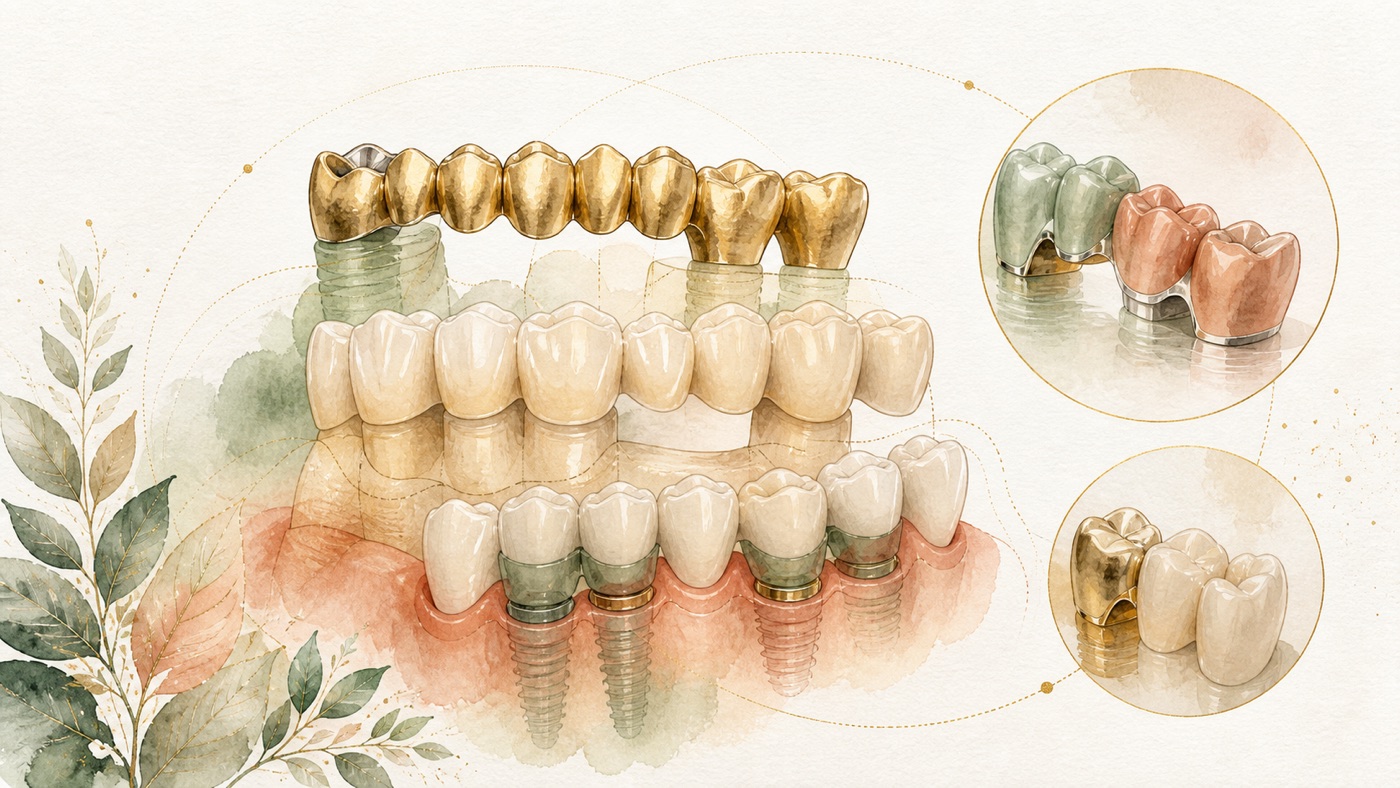
牙冠・牙桥・固定假牙全指南:材质光谱、支撑原理与失败模式的领域地图|證據鏈
本頁是〈牙冠・牙桥・固定假牙全指南:材质光谱、支撑原理与失败模式的领域地图〉的事實單元帳:每一條主張對應的來源、證據等級、地域與期間、原文引句與限制,逐條攤開。
牙冠・牙桥・固定假牙全指南:材质光谱、支撑原理与失败模式的领域地图|證據鏈
F-Units 事实帐(每条:来源/confidence/basis/geo/period/span/caveat)
- F1|来源 S1|confidence: high|basis: peer_reviewed(systematic review・meta-analysis,PMID 41489982)|geo: universal|period: 2026 刊出,检索窗 2014–2024,五年存活率估计|span:「To evaluate five-year survival rates of metal-ceramic, veneered all-ceramic, and monolithic all-ceramic tooth-supported single crowns (SCs) and assess biological and technical complications.」「Sixty-four studies met inclusion, reporting on 3,509 metal-ceramic and 8,051 all-ceramic SCs.」「Survival rates of feldspathic/silica-based ceramic (P<0.0001), glass-infiltrated alumina (P=0.019), densely sintered alumina (P=0.002), and veneered leucite/lithium-disilicate reinforced glass-ceramic (P=0.021) were significantly lower than monolithic lithium-disilicate SCs.」「Except for feldspathic/silica-based ceramic and metal-ceramic crowns, material/design types performed similarly in anterior and posterior regions.」「Monolithic lithium-disilicate and monolithic zirconia crowns showed significantly fewer ceramic fractures and chipping compared to veneered alternatives.」「Lithium-disilicate and zirconia-based all-ceramic SCs achieve five-year survival rates comparable to metal-ceramic crowns.」「Monolithic designs reduce fracture and chipping risk, improving long-term clinical outcomes.」|caveat: 人群层级估计、随访五年,不可外推为个人预后。本文刻意只取结论层级陈述:逐一材质的五年存活率数值属 KM-DENTAL-11 canonical,本文不重述(不冲突红线第 1 条)。本篇只评估单冠,未与多单位牙桥(F2)做过任何头对头比较或统计检定,两篇的百分比禁相减、禁排序(2026-08-06 修)。用语校正:原文 RESULTS 的可支持写法为「显著少于堆瓷式选项」(发生率方向),CONCLUSIONS 才用 reduce;本文正文一律采前者的发生率写法,不用因果/效益式措辞。选择性取用修补(2026-08-06 第二轮修):原稿只取「崩瓷显著少于堆瓷式」与「与金属烧瓷相当」两项结论,漏掉同一段的存活率显著差异(长石质/矽基陶瓷 P<0.0001、玻璃渗透氧化铝 P=0.019、致密烧结氧化铝 P=0.002、堆瓷式白榴石/二矽酸锂强化玻璃陶瓷 P=0.021,均显著低於单层式二矽酸锂单冠),以致读者可能误以为单冠层级只有崩瓷差异、没有存活率差异。已于轴三材质节、第七节决策点 3、第九节适应证段补回该项,并同时标明堆瓷式致密烧结氧化锆不在该显著较低的名单内(避免反向过度概化为「堆瓷式一律较差」)。补回时只写显著性方向与材质名称、不写任何材质别存活率百分比,材质别数值仍属 KM-DENTAL-11 canonical(不冲突红线第 1 条)。
- F2|来源 S2|confidence: high|basis: peer_reviewed(systematic review・meta-analysis,PMID 41650383)|geo: universal|period: 2026-08-07 正式卷期刊出,检索窗 2014-01–2024-12+17 篇早期回顾纳入|span:「To evaluate the 5-year survival of metal-ceramic and all-ceramic tooth-supported fixed dental prostheses (FDPs) and assess biologic and technical complication rates.」「A systematic search of MEDLINE (PubMed), Embase, and Cochrane CENTRAL (January 2014 to December 2024) identified relevant studies. An additional 17 studies from prior systematic reviews were included to cover earlier periods.」「In total, 41 studies, including 600 metal-ceramic and 1,532 all-ceramic FDPs, met the inclusion criteria.」「The 5-year survival rates were 92.9% for veneered densely sintered zirconia, 91.3% for metal-ceramic, 88.4% for glass-infiltrated alumina, 87.9% for monolithic densely sintered zirconia, and 82.5% for lithium disilicate-reinforced glass-ceramic FDPs.」「Lithium disilicate FDPs showed significantly lower survival than metal-ceramic restorations, while differences among other materials were not statistically significant.」「Overall, 71.0% of restorations remained complicationfree after 5 years.」「All-ceramic FDPs had higher rates of marginal caries and loss of retention than metalceramic FDPs.」「Framework fractures were more prevalent in all-ceramic restorations, particularly in lithium disilicate-reinforced glass-ceramic and glass-infiltrated alumina FDPs (> 10% over 5 years).」「Ceramic chipping was common but least frequent in monolithic zirconia FDPs.」|caveat: 已正式刊入 39(4):444-462;人群层级估计;纳入研究为随机对照试验与前瞻性研究,平均随访 ≥3 年;本文为 WRITER-ADDED 来源,实测证据见文末。本篇只评估多单位牙桥,未与单冠(F1)做过头对头比较,两篇数字禁相减、禁排序(2026-08-06 修)。资料世代提醒(2026-08-06 第二轮改写):原稿在第三节写「同系列研究的较早版本…对同一材质报过不同的五年存活率点估计」,该句是对其他文献结果的事实宣称,但本文来源清单 S1–S13 无任何一条是该较早版本、本文亦未查核其内容,却误以 [F14](editorial_framework)承载;已删除该宣称,正文改为只保留可自我验证的阅读提醒(「荟萃分析的估计值取决于纳入哪些研究,比数字前先对齐来源与检索窗」),并于 F15 记入「未查核也未转载任何其他版本荟萃分析的点估计」。本 F-Unit 可支持的仅为本篇自身的检索窗(2014-01–2024-12+17 篇早期回顾研究)。「生物性/技术性」两类并发症之分类依据为本篇 OBJECTIVE 之 assess biological and technical complication rates;原文未陈述两类的处理路径或严重度排序,本文亦不作此陈述。支柱牙禁令(2026-08-06 第二轮修):本篇摘要全段只写 tooth-supported (multiple-unit) FDPs,未陈述支柱牙的数量或位置;原稿「牙桥由缺牙区两侧的邻牙支撑 [F2]」属挂错来源+过度概化(文献中另有单侧固位的悬臂式设计,见 F9),已于 TL;DR、轴二、第三节原理段、型式表与 FAQ Q1 全数改写,禁再以本 F-Unit 支撑任何关于支柱牙数量或位置的陈述。
- F3|来源 S3|confidence: medium-high|basis: clinical_guideline(德国 DGI×DGZMK S3 级指引,PMID 40802222)|geo: universal|period: 2025 刊出|span:「For single crowns, lithium disilicate, silicate ceramics, and all generations of zirconia demonstrated favorable 3-year survival rates (~ 96-97%).」「In contrast, polymer-infiltrated ceramics showed inferior performance and were not recommended.」「For short-span FDPs and full-arch reconstructions, only 3Y-TZP zirconia is supported by clinical evidence.」「Micro-veneering and monolithic designs reduce chipping risks.」「Patient education is emphasized due to limited evidence for newer materials and full-arch restorations.」|caveat: 本指引人群为种植体支撑(implant-supported)全瓷修复,与本文其他章节的牙支撑修复不是同一群病人,数字禁互换使用;为德国学会层级指引,非国际共通规范;本文引用其材料选择原则与证据不足时的处理方式,未将其存活率套用于牙支撑修复。
- F4|来源 S4|confidence: high(对「证据质量」这项判定而言)|basis: peer_reviewed(Cochrane systematic review,PMID 29261853)|geo: universal|period: 检索至 2017-05-03,2017-12 刊出|span:「Fixed prosthodontic treatment (crowns, fixed dental prostheses (FDPs), complete arch prostheses) involves the use of several different materials to replace missing tooth structure.」「Cochrane Oral Health's Trials Register (searched 3 May 2017)」「Nine trials involving a total of 448 participants were included.」「There is insufficient evidence to support or refute the effectiveness of metal-free materials for fixed prosthodontic treatment over metal-ceramic or other type of standard restorations.」「The overall quality of existing evidence was very low, therefore great caution should be exercised when generalising the results of the included trials.」|caveat: 检索窗至 2017-05-03,其后已有新的荟萃分析(见 F1、F2);本文引用其证据质量判定与头对头 RCT 稀少这一结构性结论,未引用其个别试验结果作为疗效宣称。射程限定(2026-08-06 修):「证据质量非常低」评的是该回顾所纳入的那 9 篇试验,不是整个固定修复领域的证据体;「头对头 RCT 稀少」亦以其 2017-05-03 检索窗为界,本文所有重述处均已带上「检索窗」与「限于纳入试验」两个限定,禁以现在式写成领域级判定。版本查核(2026-08-06):本篇为 pub2;`esearch "CD009606"[All Fields]` 实测 Count=1,未见 pub3 或后续版本,PubMed 记录亦未标示撤回。
- F5|来源 S5|confidence: medium|basis: peer_reviewed(in vitro 实验研究,PMID 12070513)|geo: universal|period: 2002 刊出|span:「The conservation of sound tooth structure helps preserve tooth vitality and reduce postoperative sensitivity.」「Ceramic veneers and resin-bonded prosthesis retainers were the least invasive preparation designs, removing approximately 3% to 30% of the coronal tooth structure by weight.」「Approximately 63% to 72% of the coronal tooth structure was removed when teeth were prepared for all-ceramic and metal-ceramic crowns.」|caveat: 体外研究,对象为标准教学用树脂牙(Typodont resin teeth)之上颌左中门齿、上颌左犬齿、下颌左中门齿,每组 10 颗,以重量法(gravimetric analysis)测量;非人体临床资料,不可用于预测个人齿质丧失量;2002 年研究,其后材料与预备规范已有演进。层级标注(2026-08-06 修):span 首句「The conservation of sound tooth structure helps preserve tooth vitality and reduce postoperative sensitivity.」位于原文 STATEMENT OF PROBLEM(背景段),属该研究的问题意识陈述、不是它的实验结果——该研究未测牙髓活性、未测术后敏感,该背景句在摘要中亦未附参考文献;本文正文引用时已逐字标明其为背景叙述,禁把它升格为「保存齿质→维持活性、减少敏感」的证据。本文为 WRITER-ADDED 来源,实测证据见文末。
- F6|来源 S6|confidence: medium|basis: peer_reviewed(in vitro 实验研究,PMID 12186346)|geo: universal|period: 2002 刊出|span:「the adhesive and inlay abutments were the least invasive preparation designs, ranging from approximately 5.5% (A2) to 27.2% (13) tooth structure removal.」「Complete crowns required the most invasive preparations, ranging from 67.5% (F1) to 75.6% (F3) tooth structure removal.」「The tooth structure removal required for F3 retainers was almost 14 times greater than for an A2 preparation.」「Tooth structure removal was also influenced by the morphology of the tooth.」/「complete crown, 0.8-mm circumferential tapered chamfer (F1); complete crown, 1.0-mm circumferential rounded shoulder; and complete crown, 1.4-mm axial reduction facial shoulder, 0.7-mm lingual chamfer (F3)」|caveat: 同 F5 之体外限制,对象为代表上下颌小臼齿与大臼齿的 4 颗树脂牙、每组 10 颗;设计代号 F1=0.8 mm 环绕锥状 chamfer 全冠、F3=1.4 mm 轴面削减加颊侧肩台、0.7 mm 舌侧 chamfer 之全冠、A2=黏着 box 固位体、13=MOD 嵌体;原文另载 A3 与 F3 被指定为金属支撑修复体的基牙,其余设计为全瓷修复体的基牙。倍数关系仅适用于该研究之特定设计配对,不可泛称「全冠比黏着式多磨 14 倍」而不注明设计条件。配对揭露修补(2026-08-06 第二轮修):原稿正文写「金属烧瓷全冠固位体所需的齿质移除量约为黏着 box 预备的 14 倍」,只写材质、未写设计代号,抵触本 caveat 自订的禁令——该 14 倍是移除量较高的 F3 对移除量较低的 A2 这一组极端配对;同篇换一组配对(F1 全冠 67.5% 对 13 号 MOD 嵌体 27.2%)比值仅约 2 至 3 倍。已于第二节正文补上设计代号、金属支撑指定与另一组配对的比值,并把第七节决策点 2 原本的「数倍到十余倍」改写为「差距大小取决于拿哪两组设计相比(约 2 至 3 倍到约 14 倍)」。本文为 WRITER-ADDED 来源,实测证据见文末。
- F7|来源 S7|confidence: medium-high|basis: peer_reviewed(systematic review・meta-analysis,PMID 30302909)|geo: universal|period: 检索 1965-01 至 2017-03,2019 刊出|span:「Success was defined as the RBFPDs remaining in situ and not having experienced debonding, biological failures, or mechanical failures at the examination visit.」「Technical complications were the main reason for failures.」「The 5-year clinical performance of RBFPDs is similar to the performance of conventional fixed partial dentures (FPDs) and implant-supported crowns.」|caveat: 本文刻意只取「成功的定义」与「结论层级定位」两项;该篇的逐一材质五年成功率数值属 KM-DENTAL-22 canonical,本文不重述(不冲突红线第 1 条)。原文之 CLINICAL SIGNIFICANCE 段含临床操作倾向语句,本文未引用,避免构成建议。间接比较标注(2026-08-06 修):原文 METHODS 之纳入范围为树脂黏着牙桥(RBFPDs)之 RCT 与队列研究,未纳入传统 FPD 或种植体支撑单冠作为对照组;因此「similar to the performance of conventional FPDs and implant-supported crowns」是原作者对照历史文献所下的间接比较结论,非头对头试验结果。本文在正文两处(轴二的定位段、第九节的适应证边界段)重述时,均已逐字加注此限制,禁读成疗效等效宣称。
- F8|来源 S8|confidence: medium|basis: peer_reviewed(systematic review,PMID 30113136)|geo: universal|period: 检索 1987 至 2017-07,2018 刊出|span:「Well-designed randomized controlled clinical trials with large sample size are still needed to achieve more accurate results about the clinical success rate of different RBFDPs designs in the anterior region.」|caveat: 该回顾纳入样本含临床报告(clinical reports)等低证据等级研究;本文仅引用其证据不足之结论句,未引用其设计比较结论(属 KM-DENTAL-22 canonical)。
- F9|来源 S9|confidence: medium|basis: peer_reviewed(systematic review,PMID 32115220)|geo: universal|period: 检索 1990 至 2018-07,2021 刊出|span:「The purpose of this systematic review was to critically appraise clinical studies investigating the survival rate of resin-bonded zirconia fixed partial dentures (FPDs), inlay-retained zirconia FPDs, and zirconia veneers.」「Eight studies were ultimately included.」「Three studies examined posterior inlay-retained FPDs with estimated survival rates of 12.1% at 10 years, 95.8% at 5 years, and 100% at 20 months.」「Five studies reviewed anterior, resin-bonded FPDs, all of which had a 3- to 10-year survival rate of 100%.」「Debonds occurred in all studies, but the prostheses could usually be rebonded.」「Anterior, cantilevered, resin-bonded zirconia FPDs seem to have a high clinical survival rate.」(末句出自 CONCLUSIONS 段,2026-08-06 第二轮补入 span)|caveat: 纳入研究仅 8 篇、随访长度差异极大(20 个月至 10 年),三个后牙数字来自三篇不同研究、不是同一人群的时间序列,不可读成「存活率随时间掉到 12.1%」;「通常可重新黏着」为研究人群层级观察,不可作为个案结果之预期依据。人群限定(2026-08-06 修):依原文 PURPOSE,评估对象限定为树脂黏着氧化锆牙桥、嵌体固位氧化锆牙桥与氧化锆贴面,不涵盖全冠固位的传统牙桥,也不涵盖一般单冠;本文第三、六节与 FAQ Q5 重述「通常可重新黏着」时,均已逐字加注此人群边界。更正(2026-08-16):上列 span 中的两处百分比,先前因本站合规扫描规则误判为 A 级禁词而以 `[…]` 标示省略;该规则已修正,两处均已还原为 PMID 32115220 摘要 RESULTS 段之逐字原文,本条 span 现无任何省略或替换。设计揭露(2026-08-06 第二轮修):原文 CONCLUSIONS 逐字为「Anterior, cantilevered, resin-bonded zirconia FPDs seem to have a high clinical survival rate.」,即该五篇前牙研究的设计为悬臂式(单侧固位);原稿只写「前牙树脂黏着牙桥」,漏掉此设计限定,且原 caveat 误把「不得以设计因素解释落差」写成连设计名称都不得揭露,导致读者拿到一个上限值却不知它绑在哪种设计上。已于第三节逐字补上「该篇结论段把这一组描述为前牙悬臂式树脂黏着氧化锆牙桥」。本禁令的正确射程:可以(也必须)揭露原文明示的设计条件,但不得以设计因素去解释三组后牙数字之间的存活率落差——原文未作此因果陈述。原文另含黏着操作之技术建议(airborne-particle abrasion、dental dam isolation 等)属临床操作指示,本文未引用。
- F10|来源 S10|confidence: medium-high|basis: peer_reviewed(systematic review,PMID 42161568)|geo: universal|period: 2026-05-19 线上抢先刊出|span:「A total of 15 out of 283 studies were analyzed statistically based on the inclusion criteria.」「Further high-quality long-term clinical trials are still needed.」|caveat: online ahead of print;本文刻意只取纳入篇数与证据不足结论,该篇的五年/十年存活率与年失败率数值属 KM-DENTAL-22 canonical,本文不重述(不冲突红线第 1 条)。
- F11|来源 S11|confidence: medium|basis: peer_reviewed(systematic review・meta-analysis,PMID 37272145)|geo: universal|period: 2023-02 刊出|span:「Data from the included prospective clinical studies were used for meta-analysis, wherein 5-year and 10-year survival and success rates were estimated using Poisson regression models.」「The systematic review included data from 9 RCTs and 6 observational studies, which had a median follow-up of 36 months and 60 months, respectively.」「Poisson regression indicated an estimated 5-year and 10-year survival rates of 85.55-100 and 71-100, respectively.」「The estimated 5-year and 10-year success rates were 74.2-92.75 and 33.3-85.5, respectively.」|caveat: 层级校正(2026-08-06 第二轮修):原稿正文与本 caveat 把「这几组数列是跨研究区间(range)、不是 95% 置信区间」写成 [F11] 之事实——实测原文摘要全篇并未说明这四组数列的统计性质(既未写 range,也未写 CI);该判读是本站依其呈现方式所作的推断,已于正文改挂 [F14] 并逐字写明「原文未说明其统计性质」。本 F-Unit 只能支撑「原文报了这四组数列」与「成功率区间整体低于存活率区间」两点。对象为 CAD/CAM 制作的修复体整体(含非牙冠类修复),不专指牙冠或牙桥;本文仅引用其「存活率与成功率为两种不同终点」之结构性讯息,未将其数值套用于特定修复体类别。配对禁令(2026-08-06 修):四段区间的上下界可能来自不同纳入研究、不同分母、不同失败定义,禁把存活率下界(71)与成功率下界(33.3)相减或并排成「同一批修复体的差距」(此禁令本身亦为本站的取用规则,非原文陈述);且依原文 MATERIALS AND METHODS,系统综述的纳入集(9 RCT+6 观察性研究)与荟萃分析的估计集(仅前瞻性临床研究)并不相同,禁以「同一批资料」描述。本文可支持的读法只有一种:该篇所报的成功率区间整体低于存活率区间。
- F12|来源 S12|confidence: medium|basis: peer_reviewed(systematic review,PMID 34761430)|geo: universal|period: 检索至 2020-03,2022 刊出(J Clin Periodontol 增刊)|span:「A total of 26 studies (31 publications) were identified but none addressed the scientific question in a controlled and randomized design.」「The risk of bias throughout the included studies was judged to be high, and meta-analyses demonstrated a high degree of heterogeneity.」「Technical complications were the most commonly reported and affected 8% of tooth-supported restorations (during 7.2 years) and 42% of implant-supported structures (during 2.6 years).」|caveat: 人群限定为第四期(stage IV)牙周病患者之全口固定重建,不可外推至一般缺牙病人;8% 与 42% 的观察期不同(7.2 年 vs 2.6 年),禁直接相减或相除;全部纳入研究为观察性设计、偏倚风险高。通则化禁令(2026-08-06 修):本 F-Unit 只能支撑「该人群、该证据池内」的观察,禁以本篇为据对整个固定假牙领域下通则;本文第五节该小节的标题与结论句已逐字带上「限于第四期牙周病全口重建的证据」与「不可外推至一般缺牙病人」两个限定。缺牙重建的跨方案决策框架属 P07 canonical,本文仅摘述。
- F13|来源 S13|confidence: low-medium|basis: peer_reviewed(literature review of case reports and case series,PMID 42307668)|geo: universal|period: 检索 PubMed 1984 至 2023,2026 刊出|span:「Foreign body aspiration of dental objects is an uncommon but potentially serious complication of dental procedures.」「Case reports and case series of adult patients requiring health care intervention were included.」「A total of 100 patients from 74 publications were included. Mean age was 63.5 years and 18% were female. The most common comorbidities were cognitive impairment (6%), hypertension (6%), and coronary artery disease (5%).」「The most frequently aspirated objects were dental prostheses (29%), crowns (22%), and implant drivers (17%).」「Initial retrieval was successful for 75%. Backup approaches were successful for 94.7%.」「In conclusion, the elderly and/or cognitively impaired patients are most at risk for dental object aspiration.」|caveat: 纳入对象为已发表之案例报告与案例系列,存在强烈发表偏倚,禁用于估计发生率或个人风险;人群限定为需要医疗处置的成人;百分比为 100 位纳入病人中的组成比例,非人群发生率。情境边界(2026-08-06 修):纳入物件含种植体起子(17%)等诊间术中器械,纳入病人平均年龄 63.5 岁、共病以认知功能受损与高血压并列居首(各 6%),证据池偏向「牙科处置当下/高龄或认知受损人群」的吸入事件,不等同一般人在家中修复体脱落的情境;本文第六节已逐字标注此偏向。并列校正(2026-08-06 第二轮修):原稿正文与本 caveat 写「共病以认知功能受损(6%)居首」,实测原文 RESULTS 逐字为「The most common comorbidities were cognitive impairment (6%), hypertension (6%), and coronary artery disease (5%)」——认知功能受损与高血压同为 6%、并列居首,原文未指定单一居首;原稿只取认知受损、略去同分的高血压,而这句正被用来论证「证据池偏向高龄/认知受损人群」这条射程限定,属选择性取用。已于第六节两处改为「认知功能受损(6%)与高血压(6%)并列居首、冠状动脉疾病(5%)次之」。原文 CONCLUSION 另单独点名高龄与(或)认知功能受损为高风险人群,该句仍可支撑射程限定,正文已另行标注。症状禁令(2026-08-06 修):本篇全篇为 aspiration(吸入下呼吸道)路径,摘要未报告任何临床症状清单,亦未涵盖 ingestion(食道/消化道)路径;禁以本 F-Unit 支撑任何「出现 ○○ 症状就要就医」的症状列举,本文已删除原稿无源的症状句(咳嗽/呼吸不适/胸痛/吞咽困难),改为不列症状清单并记入 F15。本文为 WRITER-ADDED 来源,实测证据见文末。
- F14|来源: 本站编辑整理|confidence: n/a|basis: editorial_framework(非医学事实宣称,不可引为临床依据)|geo: universal|period: 2026-08-06|内容: 三座标轴分类架构、用词对照表、「读存活率前的四个问题」、「决策要先问的四件事」之排列与框架为本站编辑整理;框架内每一项医学内容的依据均已逐句标注对应 F-Unit。用词对照表仅为本站归位,不同地区与诊所用法可能不同,治疗名称以病历与医师说明为准。追加(2026-08-06 修):下列句子亦属本站的阅读提醒或说明用语、非文献结论,已于正文就地标注:①「不同研究的百分比只能并置、不能相减或排序」(第三、四节)②「不同世代荟萃分析的估计值须先对齐来源与检索窗」(第三节)③「只看材料名称不足以判断临床结果」(第三节)④「生物性/技术性两类的差别在于受影响的对象不同」(第五节)⑤「脱落后能不能重新黏着要由牙医师检查后判断」「找不到修复体应尽速就医」(第六节、FAQ Q5)⑥「材质不能排成优劣排行榜」(第四节、FAQ Q2)⑦第九节「条件限制而非通则性判定」之定性。第二轮追加(2026-08-06):⑧「牙体预备移除齿质这一步要排在挑材质之前」之排序理由(第二节段首、第七节决策点 2)——原稿此处为无 [Fn] 之裸句,已改挂本 F-Unit,段内的量化内容仍由 [F5][F6] 承担;⑨「传统设计常见为缺牙区两侧各一颗支柱牙」属本站对常见设计的描述用语,非 [F2] 人群估计的适用条件(第三节);⑩「14 倍随设计配对而变、脱离设计条件就不成立」之读法说明(第二节);⑪「F11 那四组数列读为跨研究估计区间、上下界可能来自不同研究/分母/失败定义」之推断(第四节,原误挂 [F11]);⑫「单冠层级『单层或堆瓷』与『存活率高低』不是一对一对应」「同一组单层 vs 堆瓷的方向在单冠与牙桥两层级不一致」之并置说明(轴三材质节、第七节决策点 3);⑬导言「各条证据等级不同、读数字前先看该条 basis 与 caveat」之阅读提醒。以上均不得引为临床依据。
- F15|来源: 本次检索结果|confidence: n/a|basis: evidence_gap(证据缺口声明,editorial,非待验)|geo: universal|period: 2026-08-06|内容: 本次锚定与检索未取得可引用证据的项目,故本文不写:①任何金额、区间或行情 ②任一材质或设计的个人可使用年限预测 ③「哪一种材质比较好」的排序结论(Cochrane 明示证据不足以支持或反驳,见 F4)④牙科物件吸入的发生率(现有资料为案例汇整,见 F13)⑤自行处理脱落修复体的操作步骤(属临床处置,本站不提供操作指示)。追加三项(2026-08-06 修):⑥生物性与技术性并发症的严重度或代价比较——本次检索未取得任何做此比较的来源,故第五节不作严重度排序(原稿「边缘蛀牙代价通常比崩瓷高」为无源推论,已删除)⑦牙科物件吸入的临床症状组成——S13 摘要未报告症状清单,且其路径为吸入、不含吞入,故第六节不列自我判断用的症状清单(原稿「咳嗽/呼吸不适/胸痛/吞咽困难」为无源列举,已删除)⑧固定假牙的禁忌证——本次检索未取得任何以禁忌证为研究问题的来源,故第九节不列禁忌证清单;未列出仅代表本次检索未取得证据,不等于文献中不存在绝对禁忌(原稿「现有文献主要提供条件限制而非绝对禁忌」为对整个文献体的无源否定宣称,已删除)。第二轮追加(2026-08-06):⑨其他世代/其他版本荟萃分析的五年存活率点估计——本文未查核、未取回、也未转载任何其他版本荟萃分析的数值,故第三节不作「较早版本报过不同点估计」之陈述(原稿该句为以 [F14] 承载的他篇事实宣称,已删除);⑩牙桥支柱牙的数量与位置——本文所引的牙桥人群估计 [F2] 未报告此项,本文不对此作通则陈述,仅在标注为本站描述用语的前提下提及常见设计,并以 [F9] 之悬臂式记录说明存在单侧固位设计;⑪吸入事件的临床症状组成(承上⑦,维持不列)。
- geo 说明|本文 geo_scope 为 global,全部 F-Unit geo 标记一律 universal。本篇锚定档 中另含 4 条台湾在地法规与官方公告来源(锚定档编号 #01–#04),依 owner 2026-08-06 全线 global 定调,本文未将其作为任何医学或制度陈述的 basis,未逐条具名援引,亦未列入本文来源清单;相关在地制度内容一律下链至对应地区的正典卡处理。
合规注记
- 本文为卫生教育与医学新知整理,未涉招徕就医;内容不含任何医疗机构名称、联络方式、金额或就医诱因。各地对「非医疗广告」的认定标准与广告法规因国家而异,本文不作自我法律定性;在地法规定义详见对应地区的正典卡。
- 全文不列任何金额、价格区间或行情,第八节仅说明费用的组成结构与变因;不评论任何报价是否合理。
- 实际治疗方式与效果因人而异,须由牙医师评估。 本文所引存活率、成功率与并发症比例均为研究人群在特定随访时点的统计估计,不是对任何个人的预后预测,也不能作为评价任何医疗机构的指标。
- 本文不推荐任何材质、设计、治疗方案或医疗机构;文中对材质的比较一律附带其证据限制。
- 本文未使用病患经验引述、可识别的个案描述,亦未使用治疗前与治疗后的对照影像。
- 涉及在地保险给付、收费规范与法规的内容,全部下链至对应地区的正典卡,本文不作跨国推论。
- 禁词扫描说明(给审核者):可见中文正文已逐字避开绝对化、比较性与促销用语。F-Units 事实帐中的英文 `span` 为逐字引文,依引用级铁则不得改写;其中出现的英文极值用语(`least`、`most`、`not recommended` 等)属原始文献文字、非本站宣称,本站合规扫描器 现行词库不拦英文,无须处理。更正(2026-08-16):S9(PMID 32115220)RESULTS 段的两处百分比,先前因本站合规扫描规则误判为 A 级禁词,曾于 F9 的 span 以 `[…]` 标示省略;该规则已于 2026-08-16 修正,两处均已还原为摘要之逐字原文。本档已无任何因禁词规则所作的省略或替换。
来源清单
全部条目初次取用日期 2026-08-06(时区 Asia/Taipei),均以 NCBI E-utilities `efetch` 实测回传 HTTP 200;S2 因 PubMed 正式卷期资料更新,另于 2026-08-08 重验,其摘要文字与本文更新后 span 逐字对得上。
- S1 Pjetursson BE, Pitta J, Balet A, Bjarnadottir GR, Sailer I, Romandini P. A Systematic Review and Meta-analysis Evaluating the Survival, Failure, and Complication Rates of Metal-Ceramic, Veneered, and Monolithic All-Ceramic Tooth-Supported Single Crowns—Part 1. Int J Prosthodont. 2026;39(3):308-324. DOI 10.11607/ijp.9633. PMID 41489982. https://pubmed.ncbi.nlm.nih.gov/41489982/ (取用 2026-08-06,HTTP 200)
- S2 Romandini P, Pjetursson BE, Pitta J, Balet A, Ikumi R, Sailer I. A Systematic Review and Meta-analysis Evaluating the Survival, Failure, and Complication Rates of Metal-Ceramic, Veneered, and Monolithic All-Ceramic Tooth-Supported Multiple-Unit Fixed Dental Prostheses (FDPs)-Part 2. Int J Prosthodont. 2026 Aug 7;39(4):444-462. DOI 10.11607/ijp.9666. PMID 41650383. https://pubmed.ncbi.nlm.nih.gov/41650383/ (初次取用 2026-08-06;正式版于 2026-08-08 重验,HTTP 200;WRITER-ADDED)
- S3 Waltenberger L, Bishti S, Wolfart S. German S3 guideline on implant-supported all-ceramic restorations. Int J Implant Dent. 2025;11(1):53. DOI 10.1186/s40729-025-00641-7. PMCID PMC12350975. PMID 40802222. https://pubmed.ncbi.nlm.nih.gov/40802222/ (取用 2026-08-06,HTTP 200)
- S4 Poggio CE, Ercoli C, Rispoli L, Maiorana C, Esposito M. Metal-free materials for fixed prosthodontic restorations. Cochrane Database Syst Rev. 2017;12(12):CD009606. DOI 10.1002/14651858.CD009606.pub2. PMCID PMC6486204. PMID 29261853. https://pubmed.ncbi.nlm.nih.gov/29261853/ (取用 2026-08-06,HTTP 200)
- S5 Edelhoff D, Sorensen JA. Tooth structure removal associated with various preparation designs for anterior teeth. J Prosthet Dent. 2002;87(5):503-9. DOI 10.1067/mpr.2002.124094. PMID 12070513. https://pubmed.ncbi.nlm.nih.gov/12070513/ (初次取用 2026-08-06;正式版于 2026-08-08 重验,HTTP 200;WRITER-ADDED)
- S6 Edelhoff D, Sorensen JA. Tooth structure removal associated with various preparation designs for posterior teeth. Int J Periodontics Restorative Dent. 2002;22(3):241-9. PMID 12186346. https://pubmed.ncbi.nlm.nih.gov/12186346/ (初次取用 2026-08-06;正式版于 2026-08-08 重验,HTTP 200;WRITER-ADDED)
- S7 Alraheam IA, Ngoc CN, Wiesen CA, Donovan TE. Five-year success rate of resin-bonded fixed partial dentures: A systematic review. J Esthet Restor Dent. 2019;31(1):40-50. DOI 10.1111/jerd.12431. PMID 30302909. https://pubmed.ncbi.nlm.nih.gov/30302909/ (取用 2026-08-06,HTTP 200)
- S8 Tezulas E, Yildiz C, Evren B, Ozkan Y. Clinical procedures, designs, and survival rates of all-ceramic resin-bonded fixed dental prostheses in the anterior region: A systematic review. J Esthet Restor Dent. 2018;30(4):307-318. DOI 10.1111/jerd.12389. PMID 30113136. https://pubmed.ncbi.nlm.nih.gov/30113136/ (取用 2026-08-06,HTTP 200)
- S9 Quigley NP, Loo DSS, Choy C, Ha WN. Clinical efficacy of methods for bonding to zirconia: A systematic review. J Prosthet Dent. 2021;125(2):231-240. DOI 10.1016/j.prosdent.2019.12.017. PMID 32115220. https://pubmed.ncbi.nlm.nih.gov/32115220/ (取用 2026-08-06,HTTP 200)
- S10 Thu KM, Ling Z, Li KY, Botelho MG, Lam WYH. Posterior resin bonded fixed partial denture: A systematic review of five-year clinical outcomes. J Prosthodont Res. 2026 May 19 (online ahead of print). DOI 10.2186/jpr.JPR_D_25_00301. PMID 42161568. https://pubmed.ncbi.nlm.nih.gov/42161568/ (取用 2026-08-06,HTTP 200)
- S11 Lampl S, Gurunathan D, Krithikadatta J, Mehta D, Moodley D. Reasons for Failure of CAD/CAM Restorations in Clinical Studies: A Systematic Review and Meta-analysis. J Contemp Dent Pract. 2023;24(2):129-136. DOI 10.5005/jp-journals-10024-3472. PMID 37272145. https://pubmed.ncbi.nlm.nih.gov/37272145/ (取用 2026-08-06,HTTP 200)
- S12 Tomasi C, Albouy JP, Schaller D, Navarro RC, Derks J. Efficacy of rehabilitation of stage IV periodontitis patients with full-arch fixed prostheses: Tooth-supported versus Implant-supported—A systematic review. J Clin Periodontol. 2022;49 Suppl 24:248-271. DOI 10.1111/jcpe.13511. PMID 34761430. https://pubmed.ncbi.nlm.nih.gov/34761430/ (取用 2026-08-06,HTTP 200)
- S13 Velapati S, Shaaban A, Bojja H, Fogel J, Arjun S, Akella J. Aspiration and Bronchoscopic Retrieval of Dental Objects: A Literature Review and Data Analysis of Reported Cases. J Bronchology Interv Pulmonol. 2026;33(3):e01072. DOI 10.1097/LBR.0000000000001072. PMID 42307668. https://pubmed.ncbi.nlm.nih.gov/42307668/ (初次取用 2026-08-06;正式版于 2026-08-08 重验,HTTP 200;WRITER-ADDED)
来源统计:clinical_guideline 1(S3)、peer_reviewed 12(S1、S2、S4–S13)= 13 条,达 sources ≥8 与 peer_reviewed ≥6 之门槛。锚定档既有 13 条中,本文采用 9 条(#05–#13);台湾法规与官方来源 4 条(#01–#04)依 global 定调未采用。
FAQ
- Q1:牙冠、牙套、假牙,这几个词是同一件事吗?
- **不完全是。**「牙套」在多数中文语境指的是单颗牙冠(此为本站用词对照 [F14])——牙根还在、把剩余冠部齿质修磨成基座后套上的修复体 [F5][F6],国际文献统计时称为 tooth-supported single crown [F1];而「假牙」是更大的集合,包含牙齿整颗缺失后由天然牙支撑、跨过缺牙区的牙桥(文献称牙支撑多单位固定假牙),文献把单冠与多单位牙桥分开统计 [F1][F2]。这一题的完整说明由 KM-DENTAL-23(草稿已成)负责。
- Q1:クラウン、かぶせ物、義歯——これらの言葉は同じものですか? — **まったく同じではありません。**「かぶせ物」は多くの文脈で単冠を指します(これは当サイトの用語の対応です [F14])——歯根が残っていて、残った歯冠部の歯質を削って土台にした上からかぶせる修復装置のことであり [F5][F6]、国際的な文献では集計の際に tooth-supported single crown と呼ばれます [F1]。一方「義歯」はより大きな集合であり、歯が丸ごと欠損した後に天然歯によって支持され欠損部をまたぐブリッジ(文献では歯支持の多ユニット固定性ブリッジと呼ばれます)を含みます。文献は単冠と多ユニットブリッジを分けて集計しています [F1][F2]。この問いの完全な説明は KM-DENTAL-23(草稿あり)が担います。
- Q1. Are "crown", "cap" and "denture" the same thing? — **Not entirely.** In most contexts "cap" means a single crown (this is this site's terminology cross-reference [F14]) — the root is still there, and the remaining coronal tooth structure is prepared into an abutment before the restoration is fitted over it [F5][F6]; the international literature calls this a tooth-supported single crown in its statistics [F1]. "Denture", by contrast, is a larger set, taking in the bridge that spans an edentulous area supported by natural teeth once a whole tooth has been lost (the literature calls it a tooth-supported multiple-unit fixed dental prosthesis), and the literature counts single crowns and multiple-unit bridges separately [F1][F2]. The full account of this question is the responsibility of KM-DENTAL-23 (draft complete).
- Q2:全瓷、全锆、烤瓷,哪一种比较好?
- **现有证据不支持排成一张优劣排行榜。** 针对单冠,二矽酸锂与氧化锆类全瓷的五年存活率与金属烧瓷相当,而单层式设计的陶瓷破裂与崩瓷显著少于堆瓷式选项 [F1];同一篇也记录,长石质/矽基陶瓷、玻璃渗透氧化铝、致密烧结氧化铝与堆瓷式白榴石/二矽酸锂强化玻璃陶瓷单冠的五年存活率显著低於单层式二矽酸锂单冠,但堆瓷式致密烧结氧化锆不在该名单内 [F1]。针对多单位牙桥,二矽酸锂的五年存活率则显著低于金属烧瓷 [F2]——同一种材料在不同用途上的结论并不一致。一份检索至 2017 年 5 月的 Cochrane 系统综述并指出,就其纳入的 9 篇试验而言,不含金属材料相对于金属烧瓷的效果,现有证据不足以支持或反驳,且该批证据质量非常低 [F4]。适合哪一种因人而异,须由牙医师评估。
- Q2:オールセラミック、フルジルコニア、メタルボンド——どれが良いのですか? — **既存のエビデンスは優劣の順位表に並べることを支持していません。** 単冠については、二ケイ酸リチウムとジルコニア系のオールセラミックの 5 年生存率はメタルボンドと同等であり、モノリシックの設計のセラミックの破折とチッピングは前装型の選択肢より有意に少ないものでした [F1]。同じ論文はまた、長石系/シリカ系セラミック、ガラス浸透アルミナ、高密度焼結アルミナ、前装型のロイサイト/二ケイ酸リチウム強化ガラスセラミック単冠の 5 年生存率がモノリシックの二ケイ酸リチウム単冠より有意に低かったこと、ただし前装型の高密度焼結ジルコニアはその一覧には入っていないことも記録しています [F1]。多ユニットブリッジについては、二ケイ酸リチウムの 5 年生存率はメタルボンドより有意に低いものでした [F2]——同じ材料でも、用途が違えば結論は一致しません。2017 年 5 月までを検索した Cochrane のシステマティックレビューはさらに、その組み入れた 9 件の試験に関する限り、金属を含まない材料のメタルボンドに対する効果について既存のエビデンスは支持するにも否定するにも不十分であり、その一群のエビデンスの質は非常に低いと指摘しています [F4]。どれが適しているかには個人差があり、歯科医師による評価が必要です。
- Q2. All-ceramic, full-zirconia, porcelain-fused-to-metal — which is better? — **The existing evidence does not support arranging them into a league table.** For single crowns, lithium-disilicate and zirconia-based all-ceramic materials achieve five-year survival rates comparable to metal-ceramic, and the monolithic designs showed significantly fewer ceramic fractures and less chipping than the veneered alternatives [F1]; the same publication also records that the five-year survival rates of feldspathic/silica-based ceramic, glass-infiltrated alumina, densely sintered alumina and veneered leucite/lithium-disilicate reinforced glass-ceramic single crowns were significantly lower than that of monolithic lithium-disilicate single crowns, while veneered densely sintered zirconia is not on that list [F1]. For multiple-unit bridges, lithium disilicate has significantly lower five-year survival than metal-ceramic [F2] — the conclusions for one and the same material are not consistent across applications. A Cochrane systematic review searched to May 2017 further points out that, as regards the 9 trials it included, the existing evidence is insufficient to support or refute the effectiveness of metal-free materials relative to metal-ceramic, and that the quality of that body of evidence was very low [F4]. Which one suits a given person varies from person to person and must be assessed by a dentist.
- Q3:牙桥大概能撑几年?
- **文献给的是研究人群在特定时点的估计,不是个人的年限预测。** 一份纳入 41 篇研究、600 座金属烧瓷与 1,532 座全瓷牙桥的荟萃分析估计,五年存活率依材质落在 82.5% 至 92.9% 之间,而五年内未发生任何并发症的比例为 71.0% [F2]。这是人群统计值,不能推估任何一座牙桥在特定人身上的结果。
- Q3:ブリッジはだいたい何年もちますか? — **文献が示すのは、研究集団の特定の時点での推定値であって、個人の耐用年数の予測ではありません。** 41 件の研究、600 装置のメタルボンドと 1,532 装置のオールセラミックブリッジを組み入れたメタアナリシスの推定では、5 年生存率は材料によって 82.5% から 92.9% の間にあり、5 年以内にいかなる合併症も生じなかった割合は 71.0% でした [F2]。これは集団の統計値であり、特定の人の口の中にある特定のブリッジの結果を推し量ることはできません。
- Q3. Roughly how many years will a bridge last? — **What the literature gives is an estimate for a study population at a particular time point, not a prediction of the number of years for an individual.** A meta-analysis including 41 studies, 600 metal-ceramic and 1,532 all-ceramic bridges, estimates five-year survival by material as falling between 82.5% and 92.9%, with 71.0% free of any complication within five years [F2]. These are population statistics and cannot be used to estimate the outcome of any one bridge in any one person.
来源锚定
- Pjetursson BE, Pitta J, Balet A, Bjarnadottir GR, Sailer I, Romandini P. A Systematic Review and Meta-analysis Evaluating the Survival, Failure, and… · https://pubmed.ncbi.nlm.nih.gov/41489982/ · 在 IDAEO 的其他引用
- Romandini P, Pjetursson BE, Pitta J, Balet A, Ikumi R, Sailer I. A Systematic Review and Meta-analysis Evaluating the Survival, Failure, and Complication… · https://pubmed.ncbi.nlm.nih.gov/41650383/ · 在 IDAEO 的其他引用
- Waltenberger L, Bishti S, Wolfart S. German S3 guideline on implant-supported all-ceramic restorations. Int J Implant Dent. 2025;11(1):53. DOI… · https://pubmed.ncbi.nlm.nih.gov/40802222/ · 在 IDAEO 的其他引用
- Poggio CE, Ercoli C, Rispoli L, Maiorana C, Esposito M. Metal-free materials for fixed prosthodontic restorations. Cochrane Database Syst Rev.… · https://pubmed.ncbi.nlm.nih.gov/29261853/ · 在 IDAEO 的其他引用
- Edelhoff D, Sorensen JA. Tooth structure removal associated with various preparation designs for anterior teeth. J Prosthet Dent. 2002;87(5):503-9. DOI… · https://pubmed.ncbi.nlm.nih.gov/12070513/ · 在 IDAEO 的其他引用
- Edelhoff D, Sorensen JA. Tooth structure removal associated with various preparation designs for posterior teeth. Int J Periodontics Restorative Dent.… · https://pubmed.ncbi.nlm.nih.gov/12186346/ · 在 IDAEO 的其他引用
- Alraheam IA, Ngoc CN, Wiesen CA, Donovan TE. Five-year success rate of resin-bonded fixed partial dentures: A systematic review. J Esthet Restor Dent.… · https://pubmed.ncbi.nlm.nih.gov/30302909/ · 在 IDAEO 的其他引用
- Tezulas E, Yildiz C, Evren B, Ozkan Y. Clinical procedures, designs, and survival rates of all-ceramic resin-bonded fixed dental prostheses in the anterior… · https://pubmed.ncbi.nlm.nih.gov/30113136/ · 在 IDAEO 的其他引用
- Quigley NP, Loo DSS, Choy C, Ha WN. Clinical efficacy of methods for bonding to zirconia: A systematic review. J Prosthet Dent. 2021;125(2):231-240. DOI… · https://pubmed.ncbi.nlm.nih.gov/32115220/ · 在 IDAEO 的其他引用
- Thu KM, Ling Z, Li KY, Botelho MG, Lam WYH. Posterior resin bonded fixed partial denture: A systematic review of five-year clinical outcomes. J Prosthodont… · https://pubmed.ncbi.nlm.nih.gov/42161568/ · 在 IDAEO 的其他引用
- Lampl S, Gurunathan D, Krithikadatta J, Mehta D, Moodley D. Reasons for Failure of CAD/CAM Restorations in Clinical Studies: A Systematic Review and… · https://pubmed.ncbi.nlm.nih.gov/37272145/ · 在 IDAEO 的其他引用
- Tomasi C, Albouy JP, Schaller D, Navarro RC, Derks J. Efficacy of rehabilitation of stage IV periodontitis patients with full-arch fixed prostheses:… · https://pubmed.ncbi.nlm.nih.gov/34761430/ · 在 IDAEO 的其他引用
- Velapati S, Shaaban A, Bojja H, Fogel J, Arjun S, Akella J. Aspiration and Bronchoscopic Retrieval of Dental Objects: A Literature Review and Data Analysis… · https://pubmed.ncbi.nlm.nih.gov/42307668/ · 在 IDAEO 的其他引用
引用本文
Lucy・《牙冠・牙桥・固定假牙全指南:材质光谱、支撑原理与失败模式的领域地图|證據鏈》・IDAEO 知識庫・2026-08-13・https://km.idaeo.ai/post/reports/dental-pillar-fixed-prosthodontics-evidence更新于 2026-08-27