

🏛 Part of the "reports" topic shelf →
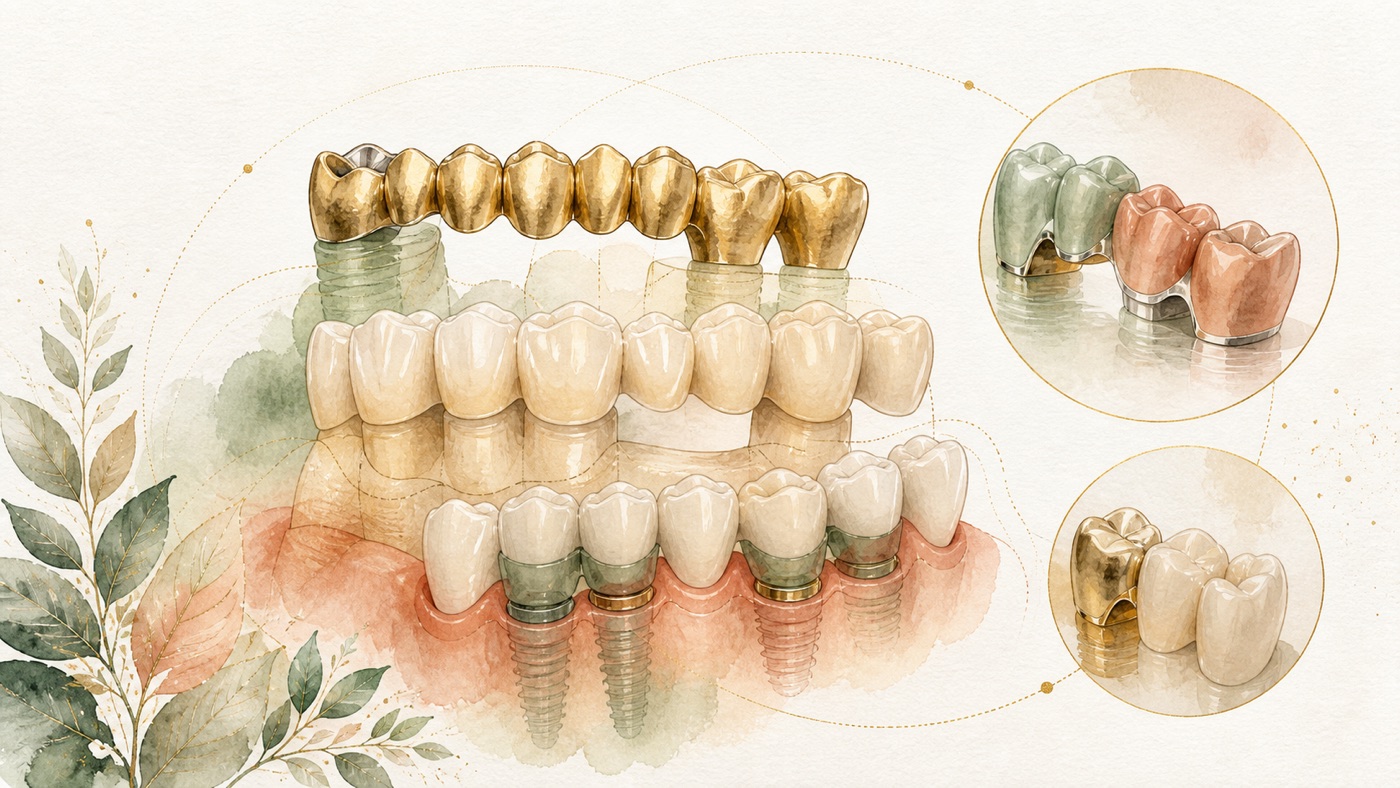
The complete guide to crowns, bridges and fixed prostheses: a domain map of the material spectrum, the principle of support and the modes of failure|證據鏈
本頁是〈The complete guide to crowns, bridges and fixed prostheses: a domain map of the material spectrum, the principle of support and the modes of failure〉的事實單元帳:每一條主張對應的來源、證據等級、地域與期間、原文引句與限制,逐條攤開。
The complete guide to crowns, bridges and fixed prostheses: a domain map of the material spectrum, the principle of support and the modes of failure|證據鏈
F-Units fact ledger (each item: source / confidence / basis / geo / period / span / caveat)
- F1|source S1|confidence: high|basis: peer_reviewed (systematic review・meta-analysis, PMID 41489982)|geo: universal|period: published 2026, search window 2014–2024, five-year survival estimates|span:「To evaluate five-year survival rates of metal-ceramic, veneered all-ceramic, and monolithic all-ceramic tooth-supported single crowns (SCs) and assess biological and technical complications.」「Sixty-four studies met inclusion, reporting on 3,509 metal-ceramic and 8,051 all-ceramic SCs.」「Survival rates of feldspathic/silica-based ceramic (P<0.0001), glass-infiltrated alumina (P=0.019), densely sintered alumina (P=0.002), and veneered leucite/lithium-disilicate reinforced glass-ceramic (P=0.021) were significantly lower than monolithic lithium-disilicate SCs.」「Except for feldspathic/silica-based ceramic and metal-ceramic crowns, material/design types performed similarly in anterior and posterior regions.」「Monolithic lithium-disilicate and monolithic zirconia crowns showed significantly fewer ceramic fractures and chipping compared to veneered alternatives.」「Lithium-disilicate and zirconia-based all-ceramic SCs achieve five-year survival rates comparable to metal-ceramic crowns.」「Monolithic designs reduce fracture and chipping risk, improving long-term clinical outcomes.」|caveat: a population-level estimate over five years of follow-up; it cannot be extrapolated to an individual prognosis. This article deliberately takes only conclusion-level statements: the five-year survival figures material by material are canonical to KM-DENTAL-11 and are not repeated here (red line 1 on non-conflict). This publication evaluates single crowns only; it has made no head-to-head comparison and no statistical test against multiple-unit bridges (F2), and the percentages of the two publications must not be subtracted from one another or ranked (revised 2026-08-06). Wording correction: the phrasing supportable from the original RESULTS is a statement of incidence direction — significantly fewer than the veneered alternatives; it is CONCLUSIONS that uses reduce. The body of this article uses the incidence phrasing throughout, and no causal or benefit-framed wording. Repair of selective extraction (second round of revision, 2026-08-06): the first draft took only two conclusions — significantly less chipping than veneered, and comparable to metal-ceramic — and left out the significant survival differences in the same passage (feldspathic/silica-based ceramic P<0.0001, glass-infiltrated alumina P=0.019, densely sintered alumina P=0.002, veneered leucite/lithium-disilicate reinforced glass-ceramic P=0.021, all significantly lower than monolithic lithium-disilicate single crowns), so that readers might have taken it that at the single-crown level there were only chipping differences and no survival differences. That item has been restored in the material axis of axis three, in decision point 3 of section 7 and in the indications passage of section 9, and at the same time it is marked that veneered densely sintered zirconia is not on that list of significantly lower materials (to avoid the reverse over-generalisation that veneered is always worse). In restoring it, only the direction of significance and the names of the materials are written, and no survival percentage for any individual material; the material-by-material figures remain canonical to KM-DENTAL-11 (red line 1 on non-conflict).
- F2|source S2|confidence: high|basis: peer_reviewed (systematic review・meta-analysis, PMID 41650383)|geo: universal|period: published in final issue 2026-08-07, search window 2014-01–2024-12 plus 17 studies from earlier reviews|span:「To evaluate the 5-year survival of metal-ceramic and all-ceramic tooth-supported fixed dental prostheses (FDPs) and assess biologic and technical complication rates.」「A systematic search of MEDLINE (PubMed), Embase, and Cochrane CENTRAL (January 2014 to December 2024) identified relevant studies. An additional 17 studies from prior systematic reviews were included to cover earlier periods.」「In total, 41 studies, including 600 metal-ceramic and 1,532 all-ceramic FDPs, met the inclusion criteria.」「The 5-year survival rates were 92.9% for veneered densely sintered zirconia, 91.3% for metal-ceramic, 88.4% for glass-infiltrated alumina, 87.9% for monolithic densely sintered zirconia, and 82.5% for lithium disilicate-reinforced glass-ceramic FDPs.」「Lithium disilicate FDPs showed significantly lower survival than metal-ceramic restorations, while differences among other materials were not statistically significant.」「Overall, 71.0% of restorations remained complicationfree after 5 years.」「All-ceramic FDPs had higher rates of marginal caries and loss of retention than metalceramic FDPs.」「Framework fractures were more prevalent in all-ceramic restorations, particularly in lithium disilicate-reinforced glass-ceramic and glass-infiltrated alumina FDPs (> 10% over 5 years).」「Ceramic chipping was common but least frequent in monolithic zirconia FDPs.」|caveat: final issue 39(4):444-462; a population-level estimate; the included studies were randomised controlled trials and prospective studies with mean follow-up ≥3 years; this is a WRITER-ADDED source for this article, with the measured evidence at the end. This publication evaluates multiple-unit bridges only and has made no head-to-head comparison against single crowns (F1); the figures of the two publications must not be subtracted from one another or ranked (revised 2026-08-06). Reminder about data generations (rewritten in the second round, 2026-08-06): the first draft wrote in section 3 that an earlier version in the same series had reported a different five-year survival point estimate for the same material; that sentence was a factual claim about the results of another publication, yet none of the sources S1–S13 in this article is that earlier version and this article never verified its content, while the claim was wrongly carried on [F14] (editorial_framework). It has been deleted; the body now keeps only the self-verifiable reading reminder (the estimate a meta-analysis produces depends on which studies it includes, so align the source and the search window before comparing figures), and F15 records that this article has neither verified nor reproduced the point estimate of any other version of any meta-analysis. What this F-Unit can support is only this publication's own search window (2014-01–2024-12 plus 17 studies from earlier reviews). The basis for classifying complications as biological and technical is this publication's OBJECTIVE, assess biological and technical complication rates; the original states neither a pathway of management nor a ranking of severity for the two classes, and this article makes no such statement either. Abutment-tooth prohibition (second round of revision, 2026-08-06): the whole abstract of this publication writes only tooth-supported (multiple-unit) FDPs and says nothing about the number or position of the abutment teeth; the first draft's sentence that a bridge is supported by the adjacent teeth on both sides of the edentulous area [F2] attached the claim to the wrong source and over-generalised (the literature also contains cantilever designs retained on one side, see F9). It has been rewritten throughout — in the TL;DR, axis two, the principles passage of section 3, the type table and FAQ Q1 — and this F-Unit must no longer be used to support any statement about the number or position of abutment teeth.
- F3|source S3|confidence: medium-high|basis: clinical_guideline (German DGI × DGZMK S3-level guideline, PMID 40802222)|geo: universal|period: published 2025|span:「For single crowns, lithium disilicate, silicate ceramics, and all generations of zirconia demonstrated favorable 3-year survival rates (~ 96-97%).」「In contrast, polymer-infiltrated ceramics showed inferior performance and were not recommended.」「For short-span FDPs and full-arch reconstructions, only 3Y-TZP zirconia is supported by clinical evidence.」「Micro-veneering and monolithic designs reduce chipping risks.」「Patient education is emphasized due to limited evidence for newer materials and full-arch restorations.」|caveat: the population of this guideline is implant-supported all-ceramic restorations, which are not the same group of patients as the tooth-supported restorations in the other sections of this article, and the figures must not be used interchangeably; it is a German society-level guideline, not an internationally common standard; this article cites its principles for material selection and its way of handling insufficient evidence, and has not applied its survival rates to tooth-supported restorations.
- F4|source S4|confidence: high (as regards the judgement on quality of evidence)|basis: peer_reviewed (Cochrane systematic review, PMID 29261853)|geo: universal|period: searched to 2017-05-03, published 2017-12|span:「Fixed prosthodontic treatment (crowns, fixed dental prostheses (FDPs), complete arch prostheses) involves the use of several different materials to replace missing tooth structure.」「Cochrane Oral Health's Trials Register (searched 3 May 2017)」「Nine trials involving a total of 448 participants were included.」「There is insufficient evidence to support or refute the effectiveness of metal-free materials for fixed prosthodontic treatment over metal-ceramic or other type of standard restorations.」「The overall quality of existing evidence was very low, therefore great caution should be exercised when generalising the results of the included trials.」|caveat: the search window ends 2017-05-03, and newer meta-analyses have appeared since (see F1, F2); this article cites its structural conclusion about the quality of evidence and about the scarcity of head-to-head RCTs, and does not cite its individual trial results as an efficacy claim. Scope limitation (revised 2026-08-06): the rating of very low quality of evidence applies to the 9 trials that review included, not to the evidence base of the whole of fixed prosthodontics; the scarcity of head-to-head RCTs is likewise bounded by its search window of 2017-05-03, and every restatement in this article carries the two qualifiers of search window and limited to the included trials; it must not be written in the present tense as a domain-level determination. Version check (2026-08-06): this is pub2; `esearch "CD009606"[All Fields]` returned Count=1 in practice, with no pub3 or later version seen, and the PubMed record shows no retraction either.
- F5|source S5|confidence: medium|basis: peer_reviewed (in vitro experimental study, PMID 12070513)|geo: universal|period: published 2002|span:「The conservation of sound tooth structure helps preserve tooth vitality and reduce postoperative sensitivity.」「Ceramic veneers and resin-bonded prosthesis retainers were the least invasive preparation designs, removing approximately 3% to 30% of the coronal tooth structure by weight.」「Approximately 63% to 72% of the coronal tooth structure was removed when teeth were prepared for all-ceramic and metal-ceramic crowns.」|caveat: an in vitro study; the specimens were standard teaching resin teeth (Typodont resin teeth) — maxillary left central incisor, maxillary left canine and mandibular left central incisor, 10 in each group — measured gravimetrically (gravimetric analysis); not clinical data from human subjects, and not to be used to predict an individual's loss of tooth structure; a 2002 study, since when materials and preparation standards have moved on. Level labelling (revised 2026-08-06): the first sentence of the span,「The conservation of sound tooth structure helps preserve tooth vitality and reduce postoperative sensitivity.」, sits in the original's STATEMENT OF PROBLEM (the background section); it states the study's problem framing and is not its experimental result — that study assessed neither pulp vitality nor postoperative sensitivity, and the background sentence carries no reference in the abstract either. Where the body of this article cites it, it is marked verbatim as background narrative, and it must not be upgraded into evidence that conserving tooth structure maintains vitality and reduces sensitivity. This is a WRITER-ADDED source for this article, with the measured evidence at the end.
- F6|source S6|confidence: medium|basis: peer_reviewed (in vitro experimental study, PMID 12186346)|geo: universal|period: published 2002|span:「the adhesive and inlay abutments were the least invasive preparation designs, ranging from approximately 5.5% (A2) to 27.2% (13) tooth structure removal.」「Complete crowns required the most invasive preparations, ranging from 67.5% (F1) to 75.6% (F3) tooth structure removal.」「The tooth structure removal required for F3 retainers was almost 14 times greater than for an A2 preparation.」「Tooth structure removal was also influenced by the morphology of the tooth.」/「complete crown, 0.8-mm circumferential tapered chamfer (F1); complete crown, 1.0-mm circumferential rounded shoulder; and complete crown, 1.4-mm axial reduction facial shoulder, 0.7-mm lingual chamfer (F3)」|caveat: the same in vitro limitations as F5; the specimens were 4 resin teeth representing maxillary and mandibular premolars and molars, 10 in each group; design codes: F1 = a complete crown with a 0.8 mm circumferential tapered chamfer, F3 = a complete crown with 1.4 mm axial reduction, a buccal shoulder and a 0.7 mm lingual chamfer, A2 = an adhesive box retainer, 13 = an MOD inlay; the original further records that A3 and F3 were designated as the abutments for metal-supported restorations, the remaining designs as the abutments for all-ceramic restorations. The multiple applies only to that study's particular pairing of designs, and it must not be stated generally that complete crowns remove 14 times more than adhesive designs without noting the design conditions. Repair of the pairing disclosure (second round of revision, 2026-08-06): the first draft wrote in the body that the tooth structure removal required for a metal-ceramic complete-crown retainer was about 14 times that of an adhesive box preparation, giving only the material and not the design codes, which contravened the prohibition this caveat itself sets — that 14-fold figure is F3, with the higher removal, against A2, with the lower removal, one extreme pairing; take another pairing in the same publication (the F1 complete crown at 67.5% against the number 13 MOD inlay at 27.2%) and the ratio is only about 2 to 3 times. The design codes, the metal-support designation and the ratio for the other pairing have been added to the body of section 2, and decision point 2 of section 7 has been rewritten from several times to more than ten times into the size of the difference depends on which two designs are compared (about 2 to 3 times up to about 14 times). This is a WRITER-ADDED source for this article, with the measured evidence at the end.
- F7|source S7|confidence: medium-high|basis: peer_reviewed (systematic review・meta-analysis, PMID 30302909)|geo: universal|period: searched 1965-01 to 2017-03, published 2019|span:「Success was defined as the RBFPDs remaining in situ and not having experienced debonding, biological failures, or mechanical failures at the examination visit.」「Technical complications were the main reason for failures.」「The 5-year clinical performance of RBFPDs is similar to the performance of conventional fixed partial dentures (FPDs) and implant-supported crowns.」|caveat: this article deliberately takes only two items, the definition of success and the conclusion-level placement; that publication's five-year success rates material by material are canonical to KM-DENTAL-22 and are not repeated here (red line 1 on non-conflict). The original's CLINICAL SIGNIFICANCE section contains sentences leaning towards clinical practice; this article does not cite them, so as not to constitute advice. Indirect-comparison labelling (revised 2026-08-06): the inclusion range in the original METHODS is RCTs and cohort studies of resin-bonded bridges (RBFPDs), and it did not include conventional FPDs or implant-supported single crowns as a control group; the phrase 「similar to the performance of conventional FPDs and implant-supported crowns」 is therefore an indirect comparison drawn by the original authors against the historical literature, not the result of a head-to-head trial. Where the body of this article restates it in two places (the placement passage of axis two and the indication-boundary passage of section 9), that limitation is noted verbatim in both, and it must not be read as a claim of equivalent efficacy.
- F8|source S8|confidence: medium|basis: peer_reviewed (systematic review, PMID 30113136)|geo: universal|period: searched 1987 to 2017-07, published 2018|span:「Well-designed randomized controlled clinical trials with large sample size are still needed to achieve more accurate results about the clinical success rate of different RBFDPs designs in the anterior region.」|caveat: the sample included in that review contains low-evidence study types such as clinical reports; this article cites only its conclusion sentence about insufficient evidence, and does not cite its design-comparison conclusions (which are canonical to KM-DENTAL-22).
- F9|source S9|confidence: medium|basis: peer_reviewed (systematic review, PMID 32115220)|geo: universal|period: searched 1990 to 2018-07, published 2021|span:「The purpose of this systematic review was to critically appraise clinical studies investigating the survival rate of resin-bonded zirconia fixed partial dentures (FPDs), inlay-retained zirconia FPDs, and zirconia veneers.」「Eight studies were ultimately included.」「Three studies examined posterior inlay-retained FPDs with estimated survival rates of 12.1% at 10 years, 95.8% at 5 years, and 100% at 20 months.」「Five studies reviewed anterior, resin-bonded FPDs, all of which had a 3- to 10-year survival rate of 100%.」「Debonds occurred in all studies, but the prostheses could usually be rebonded.」「Anterior, cantilevered, resin-bonded zirconia FPDs seem to have a high clinical survival rate.」(the last sentence comes from the CONCLUSIONS section; span added in the second round, 2026-08-06)|caveat: only 8 studies were included and the follow-up lengths differ enormously (20 months to 10 years); the three posterior figures come from three different studies and are not a time series in one and the same population, so they must not be read as survival declining over time to 12.1%; that the prostheses could usually be rebonded is an observation at the level of the study population and cannot be used as the expected outcome for an individual case. Population limitation (revised 2026-08-06): per the original PURPOSE, the objects of assessment are limited to resin-bonded zirconia bridges, inlay-retained zirconia bridges and zirconia veneers, and it does not cover conventional bridges with complete-crown retention, nor ordinary single crowns; where sections 3 and 6 and FAQ Q5 of this article restate that these could usually be rebonded, that population boundary is noted verbatim in each place. Correction (2026-08-16): the two percentage figures in the span above were previously marked as omitted with `[…]`, because this site's compliance scanner wrongly flagged them as grade-A prohibited terms. That scanner rule has been fixed, and both figures have been restored to the exact wording of the RESULTS section of the abstract of PMID 32115220; nothing in this span is now omitted or substituted. Design disclosure (second round of revision, 2026-08-06): the original CONCLUSIONS reads verbatim 「Anterior, cantilevered, resin-bonded zirconia FPDs seem to have a high clinical survival rate.」, that is, the design of those five anterior studies was cantilevered (retained on one side); the first draft wrote only anterior resin-bonded bridges and left out that design qualifier, and the original caveat mistakenly turned "the survival gap must not be explained by design factors" into a ban on disclosing even the name of the design, leaving readers with an upper-bound value but no idea which design it was tied to. The wording that the conclusion section of that review describes this group as anterior cantilevered resin-bonded zirconia bridges has been added verbatim to section 3. The correct scope of this prohibition: the design conditions stated explicitly in the original may — and must — be disclosed, but design factors must not be used to explain the survival gap between the three posterior figures, since the original makes no such causal statement. The original also contains technical recommendations on bonding procedure (airborne-particle abrasion, dental dam isolation and so on), which are clinical operating instructions and are not cited in this article.
- F10|source S10|confidence: medium-high|basis: peer_reviewed (systematic review, PMID 42161568)|geo: universal|period: published online ahead of print 2026-05-19|span:「A total of 15 out of 283 studies were analyzed statistically based on the inclusion criteria.」「Further high-quality long-term clinical trials are still needed.」|caveat: online ahead of print; this article deliberately takes only the number of included studies and the conclusion about insufficient evidence; that publication's five-year and ten-year survival rates and annual failure rates are canonical to KM-DENTAL-22 and are not repeated here (red line 1 on non-conflict).
- F11|source S11|confidence: medium|basis: peer_reviewed (systematic review・meta-analysis, PMID 37272145)|geo: universal|period: published 2023-02|span:「Data from the included prospective clinical studies were used for meta-analysis, wherein 5-year and 10-year survival and success rates were estimated using Poisson regression models.」「The systematic review included data from 9 RCTs and 6 observational studies, which had a median follow-up of 36 months and 60 months, respectively.」「Poisson regression indicated an estimated 5-year and 10-year survival rates of 85.55-100 and 71-100, respectively.」「The estimated 5-year and 10-year success rates were 74.2-92.75 and 33.3-85.5, respectively.」|caveat: Level correction (second round of revision, 2026-08-06): the first draft's body and this caveat stated as a fact of [F11] that these sequences are ranges across studies rather than 95% confidence intervals — in practice the whole abstract of the original says nothing about the statistical nature of these four sequences (it writes neither range nor CI); that reading is an inference by this site from the way they are presented, and it has been re-attached to [F14] in the body, with the fact that the original says nothing about their statistical nature written out verbatim. This F-Unit can support only two points: that the original reported these four sequences, and that the range of success rates lies as a whole below the range of survival rates. The subject is CAD/CAM restorations as a whole (including restorations that are not crowns), not crowns or bridges specifically; this article cites only its structural message that survival and success are two different endpoints, and has not applied its figures to any particular class of restoration. Pairing prohibition (revised 2026-08-06): the upper and lower bounds of the four ranges may come from different included studies, different denominators and different definitions of failure, and the lower bound of survival (71) must not be subtracted from or set beside the lower bound of success (33.3) as the gap within one and the same batch of restorations (this prohibition is itself a usage rule of this site, not a statement of the original); moreover, per the original MATERIALS AND METHODS, the inclusion set of the systematic review (9 RCTs plus 6 observational studies) and the estimation set of the meta-analysis (prospective clinical studies only) are not the same, so they must not be described as one and the same body of data. This article supports a single reading and no other: the range of success rates reported in that publication lies as a whole below the range of survival rates.
- F12|source S12|confidence: medium|basis: peer_reviewed (systematic review, PMID 34761430)|geo: universal|period: searched to 2020-03, published 2022 (J Clin Periodontol supplement)|span:「A total of 26 studies (31 publications) were identified but none addressed the scientific question in a controlled and randomized design.」「The risk of bias throughout the included studies was judged to be high, and meta-analyses demonstrated a high degree of heterogeneity.」「Technical complications were the most commonly reported and affected 8% of tooth-supported restorations (during 7.2 years) and 42% of implant-supported structures (during 2.6 years).」|caveat: the population is limited to full-arch fixed reconstruction in patients with stage IV periodontitis and cannot be extrapolated to patients with missing teeth in general; the observation periods behind 8% and 42% differ (7.2 years vs 2.6 years), and they must not be subtracted from or divided by one another; all the included studies were observational in design, with a high risk of bias. Prohibition on generalisation (revised 2026-08-06): this F-Unit can support observations only within that population and that evidence pool, and it must not be used as a basis for any general statement about fixed prosthodontics as a whole; the heading and concluding sentence of that subsection of section 5 of this article carry verbatim the two qualifiers limited to the evidence on full-arch reconstruction in stage IV periodontitis and cannot be extrapolated to patients with missing teeth in general. The cross-option decision framework for restoring missing teeth is canonical to P07, and this article gives only a summary.
- F13|source S13|confidence: low-medium|basis: peer_reviewed (literature review of case reports and case series, PMID 42307668)|geo: universal|period: PubMed searched 1984 to 2023, published 2026|span:「Foreign body aspiration of dental objects is an uncommon but potentially serious complication of dental procedures.」「Case reports and case series of adult patients requiring health care intervention were included.」「A total of 100 patients from 74 publications were included. Mean age was 63.5 years and 18% were female. The most common comorbidities were cognitive impairment (6%), hypertension (6%), and coronary artery disease (5%).」「The most frequently aspirated objects were dental prostheses (29%), crowns (22%), and implant drivers (17%).」「Initial retrieval was successful for 75%. Backup approaches were successful for 94.7%.」「In conclusion, the elderly and/or cognitively impaired patients are most at risk for dental object aspiration.」|caveat: the material included consists of published case reports and case series, with strong publication bias; it must not be used to estimate an incidence or an individual's risk; the population is limited to adults requiring health-care intervention; the percentages are the composition of the 100 included patients, not a population incidence. Situational boundary (revised 2026-08-06): the objects included cover chairside intra-procedural instruments such as implant drivers (17%), the mean age of the included patients was 63.5 years, and the most common comorbidities, equal first, were cognitive impairment and hypertension (6% each); the evidence pool is weighted towards aspiration events at the moment of a dental procedure and in elderly or cognitively impaired populations, and is not the same as a restoration coming off at home in the general population; section 6 of this article notes this weighting verbatim. Juxtaposition correction (second round of revision, 2026-08-06): the first draft's body and this caveat wrote that cognitive impairment (6%) was the single most common comorbidity, whereas the original RESULTS reads verbatim 「The most common comorbidities were cognitive impairment (6%), hypertension (6%), and coronary artery disease (5%)」 — cognitive impairment and hypertension are both at 6% and equal first, and the original names no single leader; the first draft took only cognitive impairment and dropped the tied hypertension, and that very sentence was being used to argue the scope limitation that the evidence pool is weighted towards elderly and cognitively impaired populations, which makes it selective extraction. Both places in section 6 have been changed to cognitive impairment (6%) and hypertension (6%) equal first, followed by coronary artery disease (5%). The original CONCLUSION separately names the elderly and/or the cognitively impaired as the high-risk group, and that sentence can still support the scope limitation; the body notes it separately. Symptom prohibition (revised 2026-08-06): the whole of this publication concerns the aspiration route (into the lower airway); the abstract reports no list of clinical symptoms and does not cover the ingestion route (oesophagus/digestive tract); this F-Unit must not be used to support any listing of symptoms of the form "if symptom X appears, seek care", and this article has deleted the first draft's unsourced symptom sentence (cough / breathing discomfort / chest pain / difficulty swallowing), giving no symptom list and recording the gap in F15 instead. This is a WRITER-ADDED source for this article, with the measured evidence at the end.
- F14|source: this site's editorial compilation|confidence: n/a|basis: editorial_framework (not a medical factual claim; must not be cited as a clinical basis)|geo: universal|period: 2026-08-06|content: the three-axis classification framework, the terminology cross-reference table, the four questions to ask before reading a survival figure, and the arrangement and framing of the four things a decision has to ask first are this site's editorial compilation; the basis for every medical item within the framework is marked sentence by sentence with the corresponding F-Unit. The terminology cross-reference table is only this site's placement of terms; usage may differ between regions and clinics, and the name of a treatment should be taken from the clinical record and the dentist's own explanation. Additions (revised 2026-08-06): the following sentences are likewise reading reminders or wording of this site and not conclusions of the literature, and are marked as such on the spot in the body: ① percentages from different studies may only be juxtaposed, not subtracted or ranked (sections 3 and 4); ② estimates from meta-analyses of different generations must first be aligned by source and search window (section 3); ③ the name of the material alone is not enough to judge the clinical result (section 3); ④ the difference between the biological and technical classes lies in what is affected (section 5); ⑤ whether a restoration can be rebonded after coming off has to be judged by a dentist on examination, and if the restoration cannot be found care should be sought promptly (section 6 and FAQ Q5); ⑥ materials cannot be arranged into a league table of better and worse (section 4 and FAQ Q2); ⑦ the characterisation in section 9 of conditional limits rather than general determinations. Second-round additions (2026-08-06): ⑧ the ordering rationale that the step of removing tooth structure in preparation should come ahead of choosing a material (the opening of section 2 and decision point 2 of section 7) — the first draft had this as a bare sentence with no [Fn] and it has been re-attached to this F-Unit, while the quantitative content in the passage is still carried by [F5][F6]; ⑨ that the common conventional design has one abutment tooth on each side of the edentulous area is this site's descriptive wording for the common design, and is not a condition of applicability of the [F2] population estimate (section 3); ⑩ the note on how to read the 14-fold figure, that it changes with the design pairing and does not hold once the design conditions are stripped away (section 2); ⑪ the inference that the four sequences in F11 are read as estimate ranges across studies whose upper and lower bounds may come from different studies, denominators and definitions of failure (section 4; previously mis-attached to [F11]); ⑫ the juxtaposition note that at the single-crown level monolithic versus veneered and higher versus lower survival do not map one to one, and that the direction for one and the same monolithic-versus-veneered pair is inconsistent between the single-crown and bridge levels (the material axis of axis three, decision point 3 of section 7); ⑬ the reading reminder in the introduction that the strength of evidence differs from item to item and that the basis and caveat of the item should be read before its figures. None of the above may be cited as a clinical basis.
- F15|source: the results of this round of searching|confidence: n/a|basis: evidence_gap (a declaration of evidence gaps, editorial, not pending verification)|geo: universal|period: 2026-08-06|content: the items for which this round of anchoring and searching retrieved no citable evidence, and which this article therefore does not write: ① any amount, range or going rate; ② a prediction of the number of years any individual can use any material or design; ③ a ranking conclusion about which material is better (Cochrane states explicitly that the evidence is insufficient to support or refute, see F4); ④ the incidence of aspiration of dental objects (the existing material is compiled case material, see F13); ⑤ the steps for dealing with a detached restoration oneself (that is clinical management, and this site provides no operating instructions). Three additions (revised 2026-08-06): ⑥ a comparison of the severity or the price of biological versus technical complications — this round of searching retrieved no source making that comparison, so section 5 makes no ranking of severity (the first draft's sentence that marginal caries usually costs more than chipping was an unsourced inference and has been deleted); ⑦ the clinical symptom profile of aspiration of dental objects — the S13 abstract reports no symptom list and its route is aspiration rather than ingestion, so section 6 gives no symptom list for self-assessment (the first draft's unsourced list of cough / breathing discomfort / chest pain / difficulty swallowing has been deleted); ⑧ contraindications to fixed prostheses — this round of searching retrieved no source that took contraindications as its research question, so section 9 gives no list of contraindications; the absence of a list means only that this round of searching retrieved no evidence, and does not mean that no absolute contraindication exists in the literature (the first draft's sentence that the existing literature mainly provides conditional limits rather than absolute contraindications was an unsourced negative claim about the whole body of literature and has been deleted). Second-round additions (2026-08-06): ⑨ the five-year survival point estimates of meta-analyses of other generations or other versions — this article has not verified, retrieved or reproduced the figures of any other version of any meta-analysis, so section 3 makes no statement that an earlier version reported a different point estimate (the first draft's sentence was a factual claim about another publication carried on [F14], and has been deleted); ⑩ the number and position of the abutment teeth of a bridge — the population estimate for bridges cited in this article [F2] does not report this, so this article makes no general statement about it and mentions the common design only on the stated premise that it is this site's descriptive wording, using the cantilever record in [F9] to show that designs retained on one side exist; ⑪ the clinical symptom profile of aspiration events (continuing from ⑦; still not listed).
- Note on geo|the geo_scope of this article is global, and the geo tag of every F-Unit is universal throughout. The anchor file for this article additionally holds 4 Taiwanese local statutory and official sources (anchor numbers #01–#04); under the owner's 2026-08-06 global framing for the whole line, this article has not used them as the basis for any medical or systems statement, has not cited any of them by name, and has not entered them in this article's source list; the related local-systems content is handled uniformly by downstream links to the canonical card for the corresponding region.
Compliance note
- This article is a compilation of health education and new medical knowledge and does not solicit patients; its content contains no name of any medical institution, no contact details, no monetary amount and no inducement to seek treatment. The criteria for what counts as non-medical advertising, and the advertising rules themselves, differ from country to country; this article makes no legal characterisation of itself, and for local definitions see the canonical card for the corresponding region.
- The article lists no monetary amount, price range or going rate anywhere; section 8 explains only what a cost is made of and what makes it vary, and comments on no quotation as reasonable or otherwise.
- Actual treatment and its results vary from person to person and must be assessed by a dentist. The survival rates, success rates and complication proportions cited here are statistical estimates for study populations at particular follow-up time points; they are not a prognosis for any individual, and they cannot serve as an indicator for evaluating any medical institution.
- This article endorses no material, design, treatment plan or medical institution; every comparison of materials in the text carries its evidential limitations with it.
- This article uses no patient testimonials and no identifiable case descriptions, and no before-and-after treatment images.
- All content touching local insurance coverage, fee regulation and statutes is handled by downstream links to the canonical card for the corresponding region, and this article draws no cross-country inference.
- Note on the banned-term scan (for reviewers): the visible English text has been kept clear, word by word, of absolutising, comparative and promotional language. The English `span` entries in the F-Units fact ledger are verbatim citations and, under the citation-grade rules, may not be rewritten; the extreme-value English terms appearing within them (`least`, `most`, `not recommended` and so on) are the words of the original literature and not claims by this site, and the current this site's compliance scanner term list does not intercept English, so no action is needed. Correction (2026-08-16): the two percentage figures in the RESULTS section of S9 (PMID 32115220) were previously marked as omitted with `[…]` in the span of F9, because this site's compliance scanner wrongly flagged them as grade-A prohibited terms. That scanner rule was fixed on 2026-08-16 and both figures have been restored to the exact wording of the abstract. No span in this file now carries any omission or substitution made for banned-term reasons.
Source list
Initial access date for all entries: 2026-08-06 (time zone Asia/Taipei). Each was verified with NCBI E-utilities `efetch` returning HTTP 200; because PubMed updated S2 to its final issue record, S2 was reverified on 2026-08-08, and its abstract matches the updated spans in this article verbatim.
- S1 Pjetursson BE, Pitta J, Balet A, Bjarnadottir GR, Sailer I, Romandini P. A Systematic Review and Meta-analysis Evaluating the Survival, Failure, and Complication Rates of Metal-Ceramic, Veneered, and Monolithic All-Ceramic Tooth-Supported Single Crowns—Part 1. Int J Prosthodont. 2026;39(3):308-324. DOI 10.11607/ijp.9633. PMID 41489982. https://pubmed.ncbi.nlm.nih.gov/41489982/ (accessed 2026-08-06, HTTP 200)
- S2 Romandini P, Pjetursson BE, Pitta J, Balet A, Ikumi R, Sailer I. A Systematic Review and Meta-analysis Evaluating the Survival, Failure, and Complication Rates of Metal-Ceramic, Veneered, and Monolithic All-Ceramic Tooth-Supported Multiple-Unit Fixed Dental Prostheses (FDPs)-Part 2. Int J Prosthodont. 2026 Aug 7;39(4):444-462. DOI 10.11607/ijp.9666. PMID 41650383. https://pubmed.ncbi.nlm.nih.gov/41650383/ (initially accessed 2026-08-06; final record reverified 2026-08-08, HTTP 200; WRITER-ADDED)
- S3 Waltenberger L, Bishti S, Wolfart S. German S3 guideline on implant-supported all-ceramic restorations. Int J Implant Dent. 2025;11(1):53. DOI 10.1186/s40729-025-00641-7. PMCID PMC12350975. PMID 40802222. https://pubmed.ncbi.nlm.nih.gov/40802222/ (accessed 2026-08-06, HTTP 200)
- S4 Poggio CE, Ercoli C, Rispoli L, Maiorana C, Esposito M. Metal-free materials for fixed prosthodontic restorations. Cochrane Database Syst Rev. 2017;12(12):CD009606. DOI 10.1002/14651858.CD009606.pub2. PMCID PMC6486204. PMID 29261853. https://pubmed.ncbi.nlm.nih.gov/29261853/ (accessed 2026-08-06, HTTP 200)
- S5 Edelhoff D, Sorensen JA. Tooth structure removal associated with various preparation designs for anterior teeth. J Prosthet Dent. 2002;87(5):503-9. DOI 10.1067/mpr.2002.124094. PMID 12070513. https://pubmed.ncbi.nlm.nih.gov/12070513/ (initially accessed 2026-08-06; final record reverified 2026-08-08, HTTP 200; WRITER-ADDED)
- S6 Edelhoff D, Sorensen JA. Tooth structure removal associated with various preparation designs for posterior teeth. Int J Periodontics Restorative Dent. 2002;22(3):241-9. PMID 12186346. https://pubmed.ncbi.nlm.nih.gov/12186346/ (initially accessed 2026-08-06; final record reverified 2026-08-08, HTTP 200; WRITER-ADDED)
- S7 Alraheam IA, Ngoc CN, Wiesen CA, Donovan TE. Five-year success rate of resin-bonded fixed partial dentures: A systematic review. J Esthet Restor Dent. 2019;31(1):40-50. DOI 10.1111/jerd.12431. PMID 30302909. https://pubmed.ncbi.nlm.nih.gov/30302909/ (accessed 2026-08-06, HTTP 200)
- S8 Tezulas E, Yildiz C, Evren B, Ozkan Y. Clinical procedures, designs, and survival rates of all-ceramic resin-bonded fixed dental prostheses in the anterior region: A systematic review. J Esthet Restor Dent. 2018;30(4):307-318. DOI 10.1111/jerd.12389. PMID 30113136. https://pubmed.ncbi.nlm.nih.gov/30113136/ (accessed 2026-08-06, HTTP 200)
- S9 Quigley NP, Loo DSS, Choy C, Ha WN. Clinical efficacy of methods for bonding to zirconia: A systematic review. J Prosthet Dent. 2021;125(2):231-240. DOI 10.1016/j.prosdent.2019.12.017. PMID 32115220. https://pubmed.ncbi.nlm.nih.gov/32115220/ (accessed 2026-08-06, HTTP 200)
- S10 Thu KM, Ling Z, Li KY, Botelho MG, Lam WYH. Posterior resin bonded fixed partial denture: A systematic review of five-year clinical outcomes. J Prosthodont Res. 2026 May 19 (online ahead of print). DOI 10.2186/jpr.JPR_D_25_00301. PMID 42161568. https://pubmed.ncbi.nlm.nih.gov/42161568/ (accessed 2026-08-06, HTTP 200)
- S11 Lampl S, Gurunathan D, Krithikadatta J, Mehta D, Moodley D. Reasons for Failure of CAD/CAM Restorations in Clinical Studies: A Systematic Review and Meta-analysis. J Contemp Dent Pract. 2023;24(2):129-136. DOI 10.5005/jp-journals-10024-3472. PMID 37272145. https://pubmed.ncbi.nlm.nih.gov/37272145/ (accessed 2026-08-06, HTTP 200)
- S12 Tomasi C, Albouy JP, Schaller D, Navarro RC, Derks J. Efficacy of rehabilitation of stage IV periodontitis patients with full-arch fixed prostheses: Tooth-supported versus Implant-supported—A systematic review. J Clin Periodontol. 2022;49 Suppl 24:248-271. DOI 10.1111/jcpe.13511. PMID 34761430. https://pubmed.ncbi.nlm.nih.gov/34761430/ (accessed 2026-08-06, HTTP 200)
- S13 Velapati S, Shaaban A, Bojja H, Fogel J, Arjun S, Akella J. Aspiration and Bronchoscopic Retrieval of Dental Objects: A Literature Review and Data Analysis of Reported Cases. J Bronchology Interv Pulmonol. 2026;33(3):e01072. DOI 10.1097/LBR.0000000000001072. PMID 42307668. https://pubmed.ncbi.nlm.nih.gov/42307668/ (initially accessed 2026-08-06; final record reverified 2026-08-08, HTTP 200; WRITER-ADDED)
Source counts: clinical_guideline 1 (S3), peer_reviewed 12 (S1, S2, S4–S13) = 13 entries, meeting the thresholds of sources ≥8 and peer_reviewed ≥6. Of the 13 existing entries in the anchor file, this article uses 9 (#05–#13); the 4 Taiwanese statutory and official sources (#01–#04) are not used, under the global framing.
FAQ
- Q1. Are "crown", "cap" and "denture" the same thing?
- **Not entirely.** In most contexts "cap" means a single crown (this is this site's terminology cross-reference [F14]) — the root is still there, and the remaining coronal tooth structure is prepared into an abutment before the restoration is fitted over it [F5][F6]; the international literature calls this a tooth-supported single crown in its statistics [F1]. "Denture", by contrast, is a larger set, taking in the bridge that spans an edentulous area supported by natural teeth once a whole tooth has been lost (the literature calls it a tooth-supported multiple-unit fixed dental prosthesis), and the literature counts single crowns and multiple-unit bridges separately [F1][F2]. The full account of this question is the responsibility of KM-DENTAL-23 (draft complete).
- Q1:クラウン、かぶせ物、義歯——これらの言葉は同じものですか? — **まったく同じではありません。**「かぶせ物」は多くの文脈で単冠を指します(これは当サイトの用語の対応です [F14])——歯根が残っていて、残った歯冠部の歯質を削って土台にした上からかぶせる修復装置のことであり [F5][F6]、国際的な文献では集計の際に tooth-supported single crown と呼ばれます [F1]。一方「義歯」はより大きな集合であり、歯が丸ごと欠損した後に天然歯によって支持され欠損部をまたぐブリッジ(文献では歯支持の多ユニット固定性ブリッジと呼ばれます)を含みます。文献は単冠と多ユニットブリッジを分けて集計しています [F1][F2]。この問いの完全な説明は KM-DENTAL-23(草稿あり)が担います。
- Q1. Are "crown", "cap" and "denture" the same thing? — **Not entirely.** In most contexts "cap" means a single crown (this is this site's terminology cross-reference [F14]) — the root is still there, and the remaining coronal tooth structure is prepared into an abutment before the restoration is fitted over it [F5][F6]; the international literature calls this a tooth-supported single crown in its statistics [F1]. "Denture", by contrast, is a larger set, taking in the bridge that spans an edentulous area supported by natural teeth once a whole tooth has been lost (the literature calls it a tooth-supported multiple-unit fixed dental prosthesis), and the literature counts single crowns and multiple-unit bridges separately [F1][F2]. The full account of this question is the responsibility of KM-DENTAL-23 (draft complete).
- Q2. All-ceramic, full-zirconia, porcelain-fused-to-metal — which is better?
- **The existing evidence does not support arranging them into a league table.** For single crowns, lithium-disilicate and zirconia-based all-ceramic materials achieve five-year survival rates comparable to metal-ceramic, and the monolithic designs showed significantly fewer ceramic fractures and less chipping than the veneered alternatives [F1]; the same publication also records that the five-year survival rates of feldspathic/silica-based ceramic, glass-infiltrated alumina, densely sintered alumina and veneered leucite/lithium-disilicate reinforced glass-ceramic single crowns were significantly lower than that of monolithic lithium-disilicate single crowns, while veneered densely sintered zirconia is not on that list [F1]. For multiple-unit bridges, lithium disilicate has significantly lower five-year survival than metal-ceramic [F2] — the conclusions for one and the same material are not consistent across applications. A Cochrane systematic review searched to May 2017 further points out that, as regards the 9 trials it included, the existing evidence is insufficient to support or refute the effectiveness of metal-free materials relative to metal-ceramic, and that the quality of that body of evidence was very low [F4]. Which one suits a given person varies from person to person and must be assessed by a dentist.
- Q2:オールセラミック、フルジルコニア、メタルボンド——どれが良いのですか? — **既存のエビデンスは優劣の順位表に並べることを支持していません。** 単冠については、二ケイ酸リチウムとジルコニア系のオールセラミックの 5 年生存率はメタルボンドと同等であり、モノリシックの設計のセラミックの破折とチッピングは前装型の選択肢より有意に少ないものでした [F1]。同じ論文はまた、長石系/シリカ系セラミック、ガラス浸透アルミナ、高密度焼結アルミナ、前装型のロイサイト/二ケイ酸リチウム強化ガラスセラミック単冠の 5 年生存率がモノリシックの二ケイ酸リチウム単冠より有意に低かったこと、ただし前装型の高密度焼結ジルコニアはその一覧には入っていないことも記録しています [F1]。多ユニットブリッジについては、二ケイ酸リチウムの 5 年生存率はメタルボンドより有意に低いものでした [F2]——同じ材料でも、用途が違えば結論は一致しません。2017 年 5 月までを検索した Cochrane のシステマティックレビューはさらに、その組み入れた 9 件の試験に関する限り、金属を含まない材料のメタルボンドに対する効果について既存のエビデンスは支持するにも否定するにも不十分であり、その一群のエビデンスの質は非常に低いと指摘しています [F4]。どれが適しているかには個人差があり、歯科医師による評価が必要です。
- Q2. All-ceramic, full-zirconia, porcelain-fused-to-metal — which is better? — **The existing evidence does not support arranging them into a league table.** For single crowns, lithium-disilicate and zirconia-based all-ceramic materials achieve five-year survival rates comparable to metal-ceramic, and the monolithic designs showed significantly fewer ceramic fractures and less chipping than the veneered alternatives [F1]; the same publication also records that the five-year survival rates of feldspathic/silica-based ceramic, glass-infiltrated alumina, densely sintered alumina and veneered leucite/lithium-disilicate reinforced glass-ceramic single crowns were significantly lower than that of monolithic lithium-disilicate single crowns, while veneered densely sintered zirconia is not on that list [F1]. For multiple-unit bridges, lithium disilicate has significantly lower five-year survival than metal-ceramic [F2] — the conclusions for one and the same material are not consistent across applications. A Cochrane systematic review searched to May 2017 further points out that, as regards the 9 trials it included, the existing evidence is insufficient to support or refute the effectiveness of metal-free materials relative to metal-ceramic, and that the quality of that body of evidence was very low [F4]. Which one suits a given person varies from person to person and must be assessed by a dentist.
- Q3. Roughly how many years will a bridge last?
- **What the literature gives is an estimate for a study population at a particular time point, not a prediction of the number of years for an individual.** A meta-analysis including 41 studies, 600 metal-ceramic and 1,532 all-ceramic bridges, estimates five-year survival by material as falling between 82.5% and 92.9%, with 71.0% free of any complication within five years [F2]. These are population statistics and cannot be used to estimate the outcome of any one bridge in any one person.
- Q3:ブリッジはだいたい何年もちますか? — **文献が示すのは、研究集団の特定の時点での推定値であって、個人の耐用年数の予測ではありません。** 41 件の研究、600 装置のメタルボンドと 1,532 装置のオールセラミックブリッジを組み入れたメタアナリシスの推定では、5 年生存率は材料によって 82.5% から 92.9% の間にあり、5 年以内にいかなる合併症も生じなかった割合は 71.0% でした [F2]。これは集団の統計値であり、特定の人の口の中にある特定のブリッジの結果を推し量ることはできません。
- Q3. Roughly how many years will a bridge last? — **What the literature gives is an estimate for a study population at a particular time point, not a prediction of the number of years for an individual.** A meta-analysis including 41 studies, 600 metal-ceramic and 1,532 all-ceramic bridges, estimates five-year survival by material as falling between 82.5% and 92.9%, with 71.0% free of any complication within five years [F2]. These are population statistics and cannot be used to estimate the outcome of any one bridge in any one person.
Source anchors
- Pjetursson BE, Pitta J, Balet A, Bjarnadottir GR, Sailer I, Romandini P. A Systematic Review and Meta-analysis Evaluating the Survival, Failure, and… · https://pubmed.ncbi.nlm.nih.gov/41489982/ · 在 IDAEO 的其他引用
- Romandini P, Pjetursson BE, Pitta J, Balet A, Ikumi R, Sailer I. A Systematic Review and Meta-analysis Evaluating the Survival, Failure, and Complication… · https://pubmed.ncbi.nlm.nih.gov/41650383/ · 在 IDAEO 的其他引用
- Waltenberger L, Bishti S, Wolfart S. German S3 guideline on implant-supported all-ceramic restorations. Int J Implant Dent. 2025;11(1):53. DOI… · https://pubmed.ncbi.nlm.nih.gov/40802222/ · 在 IDAEO 的其他引用
- Poggio CE, Ercoli C, Rispoli L, Maiorana C, Esposito M. Metal-free materials for fixed prosthodontic restorations. Cochrane Database Syst Rev.… · https://pubmed.ncbi.nlm.nih.gov/29261853/ · 在 IDAEO 的其他引用
- Edelhoff D, Sorensen JA. Tooth structure removal associated with various preparation designs for anterior teeth. J Prosthet Dent. 2002;87(5):503-9. DOI… · https://pubmed.ncbi.nlm.nih.gov/12070513/ · 在 IDAEO 的其他引用
- Edelhoff D, Sorensen JA. Tooth structure removal associated with various preparation designs for posterior teeth. Int J Periodontics Restorative Dent.… · https://pubmed.ncbi.nlm.nih.gov/12186346/ · 在 IDAEO 的其他引用
- Alraheam IA, Ngoc CN, Wiesen CA, Donovan TE. Five-year success rate of resin-bonded fixed partial dentures: A systematic review. J Esthet Restor Dent.… · https://pubmed.ncbi.nlm.nih.gov/30302909/ · 在 IDAEO 的其他引用
- Tezulas E, Yildiz C, Evren B, Ozkan Y. Clinical procedures, designs, and survival rates of all-ceramic resin-bonded fixed dental prostheses in the anterior… · https://pubmed.ncbi.nlm.nih.gov/30113136/ · 在 IDAEO 的其他引用
- Quigley NP, Loo DSS, Choy C, Ha WN. Clinical efficacy of methods for bonding to zirconia: A systematic review. J Prosthet Dent. 2021;125(2):231-240. DOI… · https://pubmed.ncbi.nlm.nih.gov/32115220/ · 在 IDAEO 的其他引用
- Thu KM, Ling Z, Li KY, Botelho MG, Lam WYH. Posterior resin bonded fixed partial denture: A systematic review of five-year clinical outcomes. J Prosthodont… · https://pubmed.ncbi.nlm.nih.gov/42161568/ · 在 IDAEO 的其他引用
- Lampl S, Gurunathan D, Krithikadatta J, Mehta D, Moodley D. Reasons for Failure of CAD/CAM Restorations in Clinical Studies: A Systematic Review and… · https://pubmed.ncbi.nlm.nih.gov/37272145/ · 在 IDAEO 的其他引用
- Tomasi C, Albouy JP, Schaller D, Navarro RC, Derks J. Efficacy of rehabilitation of stage IV periodontitis patients with full-arch fixed prostheses:… · https://pubmed.ncbi.nlm.nih.gov/34761430/ · 在 IDAEO 的其他引用
- Velapati S, Shaaban A, Bojja H, Fogel J, Arjun S, Akella J. Aspiration and Bronchoscopic Retrieval of Dental Objects: A Literature Review and Data Analysis… · https://pubmed.ncbi.nlm.nih.gov/42307668/ · 在 IDAEO 的其他引用
Cite this article
Lucy・《The complete guide to crowns, bridges and fixed prostheses: a domain map of the material spectrum, the principle of support and the modes of failure|證據鏈》・IDAEO 知識庫・2026-08-13・https://km.idaeo.ai/post/reports/dental-pillar-fixed-prosthodontics-evidenceUpdated 2026-08-27