

🏛 Part of the "reports" topic shelf →
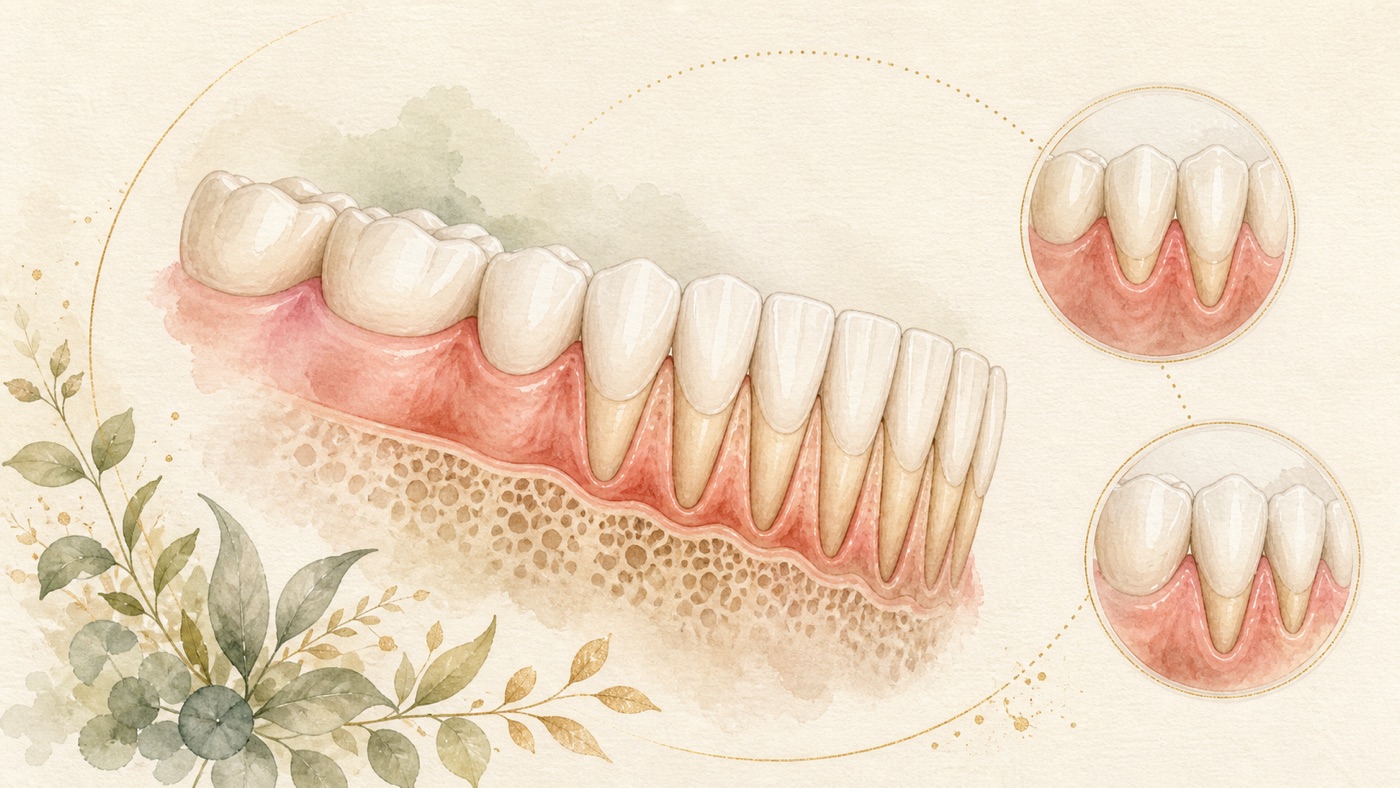
Can Receding Gums Be Treated? What Does Treatment Cost?|證據鏈
本頁是〈Can Receding Gums Be Treated? What Does Treatment Cost?〉的事實單元帳:每一條主張對應的來源、證據等級、地域與期間、原文引句與限制,逐條攤開。
Can Receding Gums Be Treated? What Does Treatment Cost?|證據鏈
F-Units (fact-unit ledger)
- F1|Topic-selection basis = full GSC reconciliation for 14 clinic sites: 7 query terms including “牙齦萎縮治療費用ptt,” “牙齦萎縮治療費用,” “牙齦萎縮恢復ptt,” “水雷射牙齦萎縮,” and “老人牙齦萎縮假牙,” totaling 121,175 impressions across 4 sites |source = internal ledger (appendix to km-dental-backlog.md #27)|confidence=high|basis=internal_dataset|period=GSC retention window (from 2025-03-22)|geo: TW|caveat: impressions are attribute-level figures, not deduplicated traffic; this is internal data, not a medical claim, and is not output in publication conversion.
- F2 [structural editorial organization]|The two-layer route “control further recession / cover exposed roots,” the instruction to ask causes and classification separately, and the division of work with KM-DENTAL-14 are this site’s editorial framework mapping patient queries to literature terminology; they are not factual claims or any institution’s classification|confidence=n/a|basis=editorial|geo: TW|caveat: must not be marked pending verification (to avoid creating fake verification work).
- F3|Mucogingival defects including gingival recession are frequent in adults, tend to increase with age, and occur in populations with high and low oral-hygiene standards; exposed root surfaces are frequently associated with impaired esthetics, dentinal hypersensitivity, and carious and non-carious cervical lesions|source #1|confidence=high|basis=clinical_guideline (narrative review of the 2017 World Workshop classification consensus)|period=2018; on 2026-08-06 no newer classification consensus replacing the 2017 World Workshop was found|geo: universal|caveat: shared anchor with KM-DENTAL-14; association and trend statements, not a prevalence claim.
- F4|When pathosis is absent, monitoring specific sites is appropriate; surgery to change biotype and/or cover roots may be indicated when risk of pathosis development or progression rises or to satisfy patient esthetic requirements|source #1|confidence=high|basis=clinical_guideline|period=2018|geo: universal|caveat: shared anchor with KM-DENTAL-14; indication principle, not a case-specific criterion; this card provides no self-diagnosis method.
- F5|Inadequate oral hygiene, orthodontic treatment, and cervical restorations might increase gingival-recession risk; thin periodontal biotypes are at greater risk; periodontal health can be maintained in most patients with optimal home care|source #1|confidence=moderate|basis=clinical_guideline (reviewed literature synthesis)|period=2018|geo: universal|caveat: risk-factor statements; relative risk not quantified.
- F6|2016 systematic review and meta-analysis of untreated buccal gingival recession: studies with follow-up ≥24 months and no root-coverage or gingival-augmentation surgery, searched through July 2015; 378 records screened; 8 reports (6 studies) included; among 1,647 defects with baseline and follow-up data, 78.1% deepened and the remainder decreased or did not change; defect number rose 79.3% among followed patients; pooled OR 2.43 by patient count (P = 0.03) and OR 2.16 by site count (P = 0.0005); authors concluded a high long-term probability of progression in untreated defects among people with good oral hygiene|source #2|confidence=high|basis=peer_reviewed (SR + MA)|period=2016; on 2026-08-06, PubMed search for post-2017 systematic reviews of the same clinical question (long-term progression of untreated recession) found no update|geo: universal|caveat: population is adults with good oral hygiene, and only 6 studies; population-level probability must not be extrapolated to an individual tooth site; the sentence “the remainder decreased or did not change” must not be omitted.
- F7|Creeping attachment = coronal migration of the gingival margin to obtain additional root coverage; it may occur after healing from various mucogingival surgeries, but coverage is not always complete or entirely predictable|source #3|confidence=moderate|basis=peer_reviewed (literature review including 82 articles)|period=2020|geo: universal|caveat: a postsurgical phenomenon, not spontaneous recovery in an untreated state; narrative review, not meta-analysis.
- F8|2015 review and meta-analysis: meta-analysis included 159 subjects and found greater recession after 12 months in manual than powered toothbrush users; 13 cross-sectional studies most often associated brushing frequency, horizontal/scrub method, bristle hardness, duration, and replacement frequency with recession; authors concluded evidence supporting or refuting association of brushing with recession and non-carious cervical lesions remains largely inconclusive|source #4|confidence=moderate|basis=peer_reviewed (review + meta-analysis, literature commissioned by the European periodontal workshop)|period=2015; on 2026-08-06 a PubMed search for post-2016 systematic reviews/meta-analyses on this topic found only source #5 (bristle-specific), with no update replacing this review|geo: universal|caveat: authors expressly say evidence is inconclusive; this card must not state “toothbrushing causes recession.”
- F9|2019 systematic review: 1,945 records screened and 13 studies included; hard-bristle toothbrushes produced more gingival lesions than medium and soft brushes; soft and extra-soft brushes tend to be safer|source #5|confidence=moderate|basis=peer_reviewed (systematic review, qualitative synthesis)|period=2019|geo: universal|caveat: only 4 studies used adverse effects as the primary outcome; this card recommends no brand.
- F10|2023 systematic review of post-orthodontic gingival-recession risk factors: searched to 2023-04-20; 48 articles included; significantly higher recession prevalence, severity, and extent in orthodontic patients in 10/15, 4/10, and 2/2 articles; 10/16 reported more recession and increased clinical crown height after orthodontic incisor proclination; thin gingival biotype, prior recession, baseline keratinized-gingiva width, and facial gingival-margin thickness were associated with higher risk in 9 articles, but pocket depth was not; authors noted high heterogeneity and often contradictory results|source #6|confidence=moderate|basis=peer_reviewed (systematic review, no meta-analysis)|period=2023 (current newest version for this topic: the earlier 2018 systematic review, PMID 29911278, included only 2 observational studies; this card uses the newer review with more included material)|geo: universal|caveat: non-randomized studies included, with moderate risk of bias; association, not causation.
- F11|2023 systematic review and meta-analysis (129 records screened, 12 included, 8 in quantitative analysis): current evidence is insufficient to conclude that clear aligners maintain periodontal health better than fixed appliances during orthodontic treatment|source #7|confidence=moderate|basis=peer_reviewed (SR + MA)|period=2023|geo: universal|caveat: extreme heterogeneity for some measures (e.g., plaque index I²=99%); this card cites only the overall conclusion, not individual pooled values.
- F12|Systematic review of occlusal stress and non-carious cervical lesions (abfraction): 69 publications included (31 clinical, 38 laboratory); 56/69 (81%) found an association; no clinical study proved the lesion was caused by stress alone|source #8|confidence=moderate|basis=peer_reviewed (systematic review)|period=2017; search on 2026-08-06 found no replacement systematic review after 2018 (newer work concerned prevalence and archaeological samples)|geo: universal|caveat: outcome is cervical lesions, not gingival recession itself; do not rewrite as “occlusion causes gingival recession.”
- F13|Systematic review of the maxillary midline frenum (206 records screened, 48 included): conclusions about frenum-caused recession are inconsistent; its contribution to recession and peri-implant disease in maxillary-incisor areas is controversial; laser surgery’s superiority to conventional surgery has not been demonstrated|source #9|confidence=low|basis=peer_reviewed (systematic review)|period=2013|geo: universal|caveat: older (2013); search on 2026-08-06 found that literature from 2014 onward was mostly technique comparisons (such as a 2026 diode-laser versus scalpel meta-analysis), not a replacement systematic review of frenum–recession causality; this card cites only the conservative “inconclusive” statement.
- F14|European Federation of Periodontology S3 clinical practice guideline for stage I–III periodontitis: a pre-established stepwise, incremental pathway covering behavioural change; supragingival biofilm, gingival inflammation, and risk-factor control; supra- and subgingival instrumentation with or without adjuncts; various periodontal surgery interventions; and supportive periodontal care needed to extend benefits|source #10|confidence=high|basis=clinical_guideline (S3 level, GRADE method, 15 commissioned systematic reviews)|period=2020; search on 2026-08-06 found no revision of the same scope (stage I–III); the 2022 stage IV guideline and 2023 peri-implant-disease guideline have different scopes|geo: universal|caveat: a guideline informs clinical decisions, not an individual prescription; the abstract lists consensus interventions in (a)–(d) without labeling a numbered step for each; this card follows the listed order and assigns no step number; Taiwan payment and workflow follow Taiwan NHI notices separately.
- F15|RT1 = no interproximal attachment loss; RT2 = interproximal attachment loss less than or equal to the buccal site; RT3 = interproximal attachment loss greater than the buccal site. The classification predicted recession reduction at 6 months (109 treated sites, p<0.0001)|source #11|confidence=moderate|basis=peer_reviewed (exploratory and reliability study, 25 patients, 116 recessions)|period=2011|geo: universal|caveat: shared anchor with KM-DENTAL-14; single-centre exploratory study; classification requires clinical measurement and this card provides no self-classification.
- F16|Cochrane systematic review (2018 update; original 2009) included 48 randomized trials; gingival recession = apical displacement of the gingival margin from the cemento-enamel junction, exposing the root surface to the oral cavity|source #12|confidence=high|basis=peer_reviewed (Cochrane systematic review)|period=searched to 2018-01-15; on 2026-08-06, a CD007161[pg] version-chain search found only the 2009 original and 2018 update; the 2018 version is current|geo: universal|caveat: technique-comparison details are canonical in KM-DENTAL-14; this card cites only the definition and trial count.
- F17|2025 systematic review and meta-analysis of multiple gingival recessions (searched to 2024-05; 32 RCTs, 1012 patients, 3589 recessions): mean root coverage 82.6% (95% CI 71.3–93.9), complete root coverage 62.7% (95% CI 57.0–68.4)|source #13|confidence=high|basis=peer_reviewed (SR + MA)|period=2025 (search on 2026-08-06 found no update)|geo: universal|caveat: population has multiple recessions; do not extrapolate to all recession or individual single-tooth defects; this card gives only one-sentence summary, with full context canonical in KM-DENTAL-14.
- F18|2018 systematic review and meta-analysis (searched to August 2017; 7 RCTs, 173 patients, 296 teeth): flap graft plus laser versus surgery alone had no statistically significant difference in recession depth (P = 0.21), recession width (P = 0.92), root esthetic score (P = 0.21), or complete root coverage (P = 0.09); statistically significant differences occurred in keratinized-tissue width (P < 0.0001), probing depth at 1 year (P = 0.03), and clinical attachment level (P < 0.00001); authors concluded laser added no root-coverage or esthetic benefit|source #14|confidence=moderate|basis=peer_reviewed (SR + MA)|period=2018; a 2026-08-06 search for “laser × root coverage × systematic review/meta-analysis × after 2019” found 9 records, all different clinical questions (de-epithelialized graft harvesting, intrabony periodontal defects, peri-implantitis, oral health during orthodontics, etc.), and no update replacing this review|geo: universal|caveat: the abstract does not list each trial’s laser type and must not be equated with Er,Cr:YSGG water laser; few trials and small samples.
- F19|Randomized controlled clinical trial (24 participants with isolated single recession defects; 3 groups: blade-harvested de-epithelialized gingival graft, water-laser harvesting plus root photobiomodulation, blade harvesting plus water-laser root photobiomodulation): no statistically significant difference in root coverage between control and test groups; laser harvesting associated with lower postoperative morbidity at the palatal donor site|source #15|confidence=low|basis=peer_reviewed (single-centre RCT, n=24, single-blind)|period=2021; a 2026-08-06 search for water laser in gingival recession also found 2025/2026 harvesting-technique RCTs, all small samples and no systematic-review-level evidence|geo: universal|caveat: small sample, single centre; authors used “improvement” in their conclusion but simultaneously reported no statistically significant difference; this card uses the lack of statistical significance; do not state laser can restore gums.
- F20|Cross-sectional observational study in 7 European countries: 3551 systemically healthy adults (mean age 44 ± 17.4); gingival recession (≥1 mm) in 87.9% of participants; recession and erosive tooth wear continued to increase after young adulthood|source #16|confidence=moderate|basis=peer_reviewed (multicountry cross-sectional observational study)|period=2024|geo: universal (7 European-country sample)|caveat: not a Taiwan population; prohibited for use as Taiwan prevalence; the study received industry (Haleon) financial support and disclosed authors employed by that company; a 2025 Erratum is recorded, and this card’s figures are from the 2024 original abstract.
- F21|2025 systematic review and meta-analysis of long-term efficacy of desensitizing agents (searched to January 2025; RCTs with follow-up ≥6 months; 22 studies in review and 15 in meta-analysis): several agents significantly reduced pain scores from sensory stimuli; glutaraldehyde and low-level laser had relatively larger effect sizes; adhesive systems and calcium-phosphate agents showed no statistically significant benefit|source #17|confidence=moderate|basis=peer_reviewed (SR + MA)|period=2025|geo: universal|caveat: low-level laser is for dentinal hypersensitivity and is not the same intervention or outcome as water laser in root-coverage surgery; this card recommends no product and gives no medication instruction.
- F22|Article 21 of Taiwan’s Medical Care Act: “The standards for medical fees charged by medical institutions shall be approved by the competent authority of the special municipality or county (city).”|source #18|confidence=high|basis=law|period=current text (2026-08-06 curl verified HTTP 200 + verbatim checked)|geo: TW|caveat: shared anchor with KM-DENTAL-03/14; statutory paraphrase, not legal advice.
- F23|Article 22 of Taiwan’s Medical Care Act: medical institutions must issue a receipt stating fee items and amounts; they must not violate fee standards by overcharging or creating unauthorized fee items|source #19|confidence=high|basis=law|period=current text (2026-08-06 curl verified HTTP 200 + both passages verbatim checked)|geo: TW|caveat: shared anchor with KM-DENTAL-03/14; statutory paraphrase, not legal advice.
- F24|Article 63 of Taiwan’s Medical Care Act: before surgery, medical institutions must explain the reason, success rate or possible complications and dangers to the patient or relevant listed person, obtain consent, and obtain signed surgical and anaesthesia consent forms|source #20|confidence=high|basis=law|period=current text (2026-08-06 curl verified HTTP 200 + verbatim checked)|geo: TW|caveat: shared anchor with KM-DENTAL-14/17; the statutory proviso “except in emergency circumstances” is not cited in the body.
- F25|Article 51 of Taiwan’s National Health Insurance Act lists items outside benefit scope; item 3 includes cosmetic surgery and item 11 includes dentures, artificial eyes, eyeglasses, hearing aids, wheelchairs, crutches, and other devices without an active therapeutic purpose|source #22|confidence=high|basis=law|period=current text (2026-08-06 curl verified HTTP 200 + item 3 and item 11 verbatim checked)|geo: TW|caveat: shared anchor with KM-DENTAL-09/14/17; statutory enumeration is not a conclusion for an individual case, and this card makes no subsumption judgment.
- F26|Article 87 of Taiwan’s Medical Care Act: advertising that implies or alludes to medical business is medical advertising; publication of medical knowledge or research reports, patient health education, and academic publications that do not involve soliciting medical business are not medical advertising|source #21|confidence=high|basis=law|period=current text (2026-08-06 curl verified HTTP 200 + both passages verbatim checked)|geo: TW|caveat: basis for this card’s positioning.
- F27|Self-pay fee items are handled under fee standards approved by local health authorities; verified example = Taipei City Department of Health’s “Taipei City Dental Fee Standards for Medical Institutions” (approved 1090117) and government open-data dataset 121913 “Taipei City Medical Fee Standards”|source #23 and #24|confidence=high|basis=official_statement|period=approved 1090117; on 2026-08-06 the health-bureau page was loaded in ego-browser and its title verbatim checked; the dataset title was returned and verbatim checked through the open API|geo: TW|caveat: shared anchor with KM-DENTAL-03/11/14/26; one-city example only; other counties/cities announce separately; this card cites no amount from it. [On the official page the label appears in Chinese only: 「臺北市醫療機構牙科收費標準表」、「臺北市醫療收費標準」]
- F28|Taiwan NHI payment-side verification entry points = the National Health Insurance Administration notice page “National Health Insurance Medical Service Payment Items and Payment Standards” and government open-data dataset 174450 “Medical Service Payment Items and Payment Standards (csv)”|source #25 and #26|confidence=high|basis=official_statement|period=2026-08-06: notice page loaded in ego-browser (title and 4-file list read verbatim); dataset title and description returned and verbatim checked through open API|geo: TW|caveat: this card records only the existence and accessibility of the verification entry points; it did not download and compare each procedure’s payment status (payment determination remains pending in F30). [On the official page the label appears in Chinese only: 「全民健康保險醫療服務給付項目及支付標準」、「醫療服務給付項目及支付標準(csv檔)」]
- F29|Taiwan NHI’s “Medical Materials Price Comparison Platform” contained no dental items in either of two search routes, so dental self-pay items cannot be verified through it|source = this site's cross-card fact-check register (OP browser-tested and read each category on 2026-08-05)|confidence=high|basis=official_statement (test record)|period=2026-08-05|geo: TW|caveat: this card reuses a cross-card verified anchor and did not repeat the test; if a dental category is later added, this fact needs re-verification. [On the official page the label appears in Chinese only: 「醫材比價網」]
- F30 [pending verification]|Payment status under Taiwan NHI payment standards for procedures in this topic (periodontal treatment, desensitizing treatment, cervical-lesion restoration, root-coverage surgery)|source type: Taiwan NHI “Medical Service Payment Items and Payment Standards” notice files (entry point verified in F28; contents not compared item by item)|confidence=low|basis=pending|geo: TW|caveat: until verified, this card makes no “covered / not covered” assertion. [On the official page the label appears in Chinese only: 「醫療服務給付項目及支付標準」]
- F31 [pending verification]|Whether commercial insurance pays a claim for the procedures in this topic depends on the policy terms|source type: policy terms (no publicly citable policy specimen obtained)|confidence=low|basis=pending|geo: TW|caveat: this site provides no claims opinion (editorial policy) and states only “depends on the policy terms.”
- F32 [structural editorial organization]|The six-part breakdown “diagnosis and examination / cause management / symptom management / surgery / adjunct-device charge items / follow-up and re-treatment,” and the estimate-reconciliation advice, are this site’s editorial reading framework, not factual claims or any institution’s fee classification|confidence=n/a|basis=editorial|geo: TW|caveat: must not be marked pending verification.
Sources
- S1 Cortellini P, Bissada NF. Mucogingival conditions in the natural dentition: Narrative review, case definitions, and diagnostic considerations. J Periodontol. 2018;89 Suppl 1:S204-S213. PMID 29926948. https://pubmed.ncbi.nlm.nih.gov/29926948/ (accessed 2026-08-06; abstract retrieved by efetch). Verbatim spans: “Mucogingival defects including gingival recession occur frequently in adults, have a tendency to increase with age, and occur in populations with both high and low standards of oral hygiene” “The root surface exposure is frequently associated with impaired esthetics, dentinal hypersensitivity and carious and non-carious cervical lesions” “periodontal health can be maintained in most patients with optimal home care” “inadequate oral hygiene, orthodontic treatment, and cervical restorations might increase the risk for the development of gingival recession” “thin periodontal biotypes are at greater risk for developing gingival recession” “in the absence of pathosis, monitoring specific sites seems to be the proper approach” “surgical intervention, either to change the biotype and/or to cover roots, might be indicated when the risk for the development or progression of pathosis and associated root damages is increased and to satisfy the esthetic requirements of the patients”|span:「Mucogingival defects including gingival recession occur frequently in adults, have a tendency to increase with age, and occur in populations with both high and low standards of oral hygiene」「The root surface exposure is frequently associated with impaired esthetics, dentinal hypersensitivity and carious and non-carious cervical lesions」「periodontal health can be maintained in most patients with optimal home care」「inadequate oral hygiene, orthodontic treatment, and cervical restorations might increase the risk for the development of gingival recession」「thin periodontal biotypes are at greater risk for developing gingival recession」「in the absence of pathosis, monitoring specific sites seems to be the proper approach」「surgical intervention, either to change the biotype and/or to cover roots, might be indicated when the risk for the development or progression of pathosis and associated root damages is increased and to satisfy the esthetic requirements of the patients」
- S2 Chambrone L, Tatakis DN. Long-Term Outcomes of Untreated Buccal Gingival Recessions: A Systematic Review and Meta-Analysis. J Periodontol. 2016;87(7):796-808. PMID 26878749. https://pubmed.ncbi.nlm.nih.gov/26878749/ (accessed 2026-08-06; abstract retrieved by efetch). Verbatim spans: “Interventional and observational studies with duration of ≥24 months reporting outcomes from adult patients with localized or multiple GR defects not treated by root coverage or gingival augmentation procedures were considered eligible for inclusion” “MEDLINE and EMBASE databases were searched for articles published through July 2015” “Of 378 potentially eligible articles, eight (reporting six studies) met inclusion criteria” “Of 1,647 GR defects with baseline and follow-up information, 78.1% experienced GR depth increase during the follow-up period, whereas the remaining experienced decrease or no change” “there was a 79.3% increase in the number of GR defects among the patients followed” “Pooled estimates (data from four studies) showed significantly increased odds of recession development long term, regarding either number of patients (odds ratio 2.43; P = 0.03) or number of sites with GR (odds ratio 2.16; P = 0.0005)” “Untreated recession defects in individuals with good oral hygiene have a high probability of progressing during long-term follow-up”|span:「Interventional and observational studies with duration of ≥24 months reporting outcomes from adult patients with localized or multiple GR defects not treated by root coverage or gingival augmentation procedures were considered eligible for inclusion」「MEDLINE and EMBASE databases were searched for articles published through July 2015」「Of 378 potentially eligible articles, eight (reporting six studies) met inclusion criteria」「Of 1,647 GR defects with baseline and follow-up information, 78.1% experienced GR depth increase during the follow-up period, whereas the remaining experienced decrease or no change」「there was a 79.3% increase in the number of GR defects among the patients followed」「Pooled estimates (data from four studies) showed significantly increased odds of recession development long term, regarding either number of patients (odds ratio 2.43; P = 0.03) or number of sites with GR (odds ratio 2.16; P = 0.0005)」「Untreated recession defects in individuals with good oral hygiene have a high probability of progressing during long-term follow-up」
- S3 Wan W, Zhong H, Wang J. Creeping attachment: A literature review. J Esthet Restor Dent. 2020;32(8):776-782. PMID 32896991. https://pubmed.ncbi.nlm.nih.gov/32896991/ (accessed 2026-08-06; abstract retrieved by efetch). Verbatim spans: “An interesting phenomenon after mucogingival surgery is the coronal migration of gingival margin” “A total of 82 relevant articles were included in the literature review” “Creeping attachment may occur to obtain additional root coverage after the healing of various mucogingival surgeries. However, this coverage is not always complete nor entirely predictable.”|span:「An interesting phenomenon after mucogingival surgery is the coronal migration of gingival margin」「A total of 82 relevant articles were included in the literature review」「Creeping attachment may occur to obtain additional root coverage after the healing of various mucogingival surgeries. However, this coverage is not always complete nor entirely predictable.」
- S4 Heasman PA, Holliday R, Bryant A, Preshaw PM. Evidence for the occurrence of gingival recession and non-carious cervical lesions as a consequence of traumatic toothbrushing. J Clin Periodontol. 2015;42 Suppl 16:S237-S255. PMID 25495508. https://pubmed.ncbi.nlm.nih.gov/25495508/ (accessed 2026-08-06; abstract retrieved by efetch). Verbatim spans: “A meta-analysis included 159 subjects and showed that subjects who used MTBs (manual toothbrush) had greater gingival recession after 12 months when compared with those using PTBs (powered toothbrush)” “Thirteen cross-sectional studies identified the most frequent toothbrushing factors associated with gingival recession as being toothbrushing frequency, a horizontal or scrub toothbrushing method, bristle hardness, toothbrushing duration and the frequency of changing a toothbrush” “The data to support or refute the association between toothbrushing and gingival recession and NCCLs remain largely inconclusive”|span:「A meta-analysis included 159 subjects and showed that subjects who used MTBs (manual toothbrush) had greater gingival recession after 12 months when compared with those using PTBs (powered toothbrush)」「Thirteen cross-sectional studies identified the most frequent toothbrushing factors associated with gingival recession as being toothbrushing frequency, a horizontal or scrub toothbrushing method, bristle hardness, toothbrushing duration and the frequency of changing a toothbrush」「The data to support or refute the association between toothbrushing and gingival recession and NCCLs remain largely inconclusive」
- S5 Ranzan N, Muniz FWMG, Rösing CK. Are bristle stiffness and bristle end-shape related to adverse effects on soft tissues during toothbrushing? A systematic review. Int Dent J. 2019;69(3):171-182. PMID 30152076. https://pubmed.ncbi.nlm.nih.gov/30152076/ (accessed 2026-08-06; abstract retrieved by efetch). Verbatim spans: “Thirteen studies were included from the 1,945 initially retrieved” “Hard-bristle toothbrushes produced more gingival lesions than medium- and soft-bristle brushes” “Soft and extra-soft toothbrushes tend to be safer” “Only four studies presented adverse effects as the primary outcome”|span:「Thirteen studies were included from the 1,945 initially retrieved」「Hard-bristle toothbrushes produced more gingival lesions than medium- and soft-bristle brushes」「Soft and extra-soft toothbrushes tend to be safer」「Only four studies presented adverse effects as the primary outcome」
- S6 Cadenas de Llano-Pérula M, Castro AB, Danneels M, Schelfhout A, Teughels W, Willems G. Risk factors for gingival recessions after orthodontic treatment: a systematic review. Eur J Orthod. 2023;45(5):528-544. PMID 37432131. https://pubmed.ncbi.nlm.nih.gov/37432131/ (accessed 2026-08-06; abstract retrieved by efetch). Verbatim spans: “systematically searching 3 data bases: Pubmed, EMBASE, and Web of Science until 20 April 2023” “Forty-eight articles were included” “Significantly higher prevalence, severity and extent of GR were found in orthodontic patients by 10/15, 4/10, and 2/2 articles respectively” “10/16 articles reported significantly more GR and increased CCH in patients where orthodontic incisor proclination was performed” “A thin gingival biotype, presence of previous GR, baseline width of keratinized gingiva and facial gingival margin thickness were correlated with increased risk of GR after OT by nine articles, while pocket depth was not” “they are very heterogeneous concerning design, studied factors, methodology and reporting, which often leads to contradictory results”|span:「systematically searching 3 data bases: Pubmed, EMBASE, and Web of Science until 20 April 2023」「Forty-eight articles were included」「Significantly higher prevalence, severity and extent of GR were found in orthodontic patients by 10/15, 4/10, and 2/2 articles respectively」「10/16 articles reported significantly more GR and increased CCH in patients where orthodontic incisor proclination was performed」「A thin gingival biotype, presence of previous GR, baseline width of keratinized gingiva and facial gingival margin thickness were correlated with increased risk of GR after OT by nine articles, while pocket depth was not」「they are very heterogeneous concerning design, studied factors, methodology and reporting, which often leads to contradictory results」
- S7 Crego-Ruiz M, Jorba-García A. Assessment of the periodontal health status and gingival recession during orthodontic treatment with clear aligners and fixed appliances: A systematic review and meta-analysis. Med Oral Patol Oral Cir Bucal. 2023;28(4):e330-e340. PMID 36641738. https://pubmed.ncbi.nlm.nih.gov/36641738/ (accessed 2026-08-06; abstract retrieved by efetch). Verbatim spans: “From the 129 potential studies, finally 12 studies were included. Only 8 could be included in the quantitative analysis” “Up to the date there is not enough evidence to conclude that CA maintains better periodontal health during an orthodontic treatment than FA”|span:「From the 129 potential studies, finally 12 studies were included. Only 8 could be included in the quantitative analysis」「Up to the date there is not enough evidence to conclude that CA maintains better periodontal health during an orthodontic treatment than FA」
- S8 Duangthip D, Man A, Poon PH, Lo ECM, Chu CH. Occlusal stress is involved in the formation of non-carious cervical lesions. A systematic review of abfraction. Am J Dent. 2017;30(4):212-220. PMID 29178704. https://pubmed.ncbi.nlm.nih.gov/29178704/ (accessed 2026-08-06; abstract retrieved by efetch). Verbatim spans: “69 publications (31 clinical studies and 38 laboratory studies) were included in this review and the majority (56/69, 81%) found an association between occlusal stress and NCCLs” “no clinical study demonstrated that NCCL was caused by stress alone”|span:「69 publications (31 clinical studies and 38 laboratory studies) were included in this review and the majority (56/69, 81%) found an association between occlusal stress and NCCLs」「no clinical study demonstrated that NCCL was caused by stress alone」
- S9 Delli K, Livas C, Sculean A, Katsaros C, Bornstein MM. Facts and myths regarding the maxillary midline frenum and its treatment: a systematic review of the literature. Quintessence Int. 2013;44(2):177-187. PMID 23444184. https://pubmed.ncbi.nlm.nih.gov/23444184/ (accessed 2026-08-06; abstract retrieved by efetch). Verbatim spans: “Of the 206 initially identified articles, 48 met the inclusion criteria” “Studies on the cause of gingival recession due to the maxillary frenum are inconclusive” “the contribution to gingival recession and peri-implant diseases in the region of the maxillary incisors is rather controversial” “The superiority of laser treatment in relation to conventional surgical methods has not yet been demonstrated in the literature”|span:「Of the 206 initially identified articles, 48 met the inclusion criteria」「Studies on the cause of gingival recession due to the maxillary frenum are inconclusive」「the contribution to gingival recession and peri-implant diseases in the region of the maxillary incisors is rather controversial」「The superiority of laser treatment in relation to conventional surgical methods has not yet been demonstrated in the literature」
- S10 Sanz M, Herrera D, Kebschull M, Chapple I, Jepsen S, Berglundh T, Sculean A, Tonetti MS; EFP Workshop Participants and Methodological Consultants. Treatment of stage I-III periodontitis—The EFP S3 level clinical practice guideline. J Clin Periodontol. 2020;47 Suppl 22:4-60. PMID 32383274. https://pubmed.ncbi.nlm.nih.gov/32383274/ (accessed 2026-08-06; abstract retrieved by efetch). Verbatim spans: “The S3 CPG approaches the treatment of periodontitis (stages I, II and III) using a pre-established stepwise approach to therapy that, depending on the disease stage, should be incremental, each including different interventions” “behavioural changes, supragingival biofilm, gingival inflammation and risk factor control” “the necessary supportive periodontal care to extend benefits over time”|span:「The S3 CPG approaches the treatment of periodontitis (stages I, II and III) using a pre-established stepwise approach to therapy that, depending on the disease stage, should be incremental, each including different interventions」「behavioural changes, supragingival biofilm, gingival inflammation and risk factor control」「the necessary supportive periodontal care to extend benefits over time」
- S11 Cairo F, Nieri M, Cincinelli S, Mervelt J, Pagliaro U. The interproximal clinical attachment level to classify gingival recessions and predict root coverage outcomes: an explorative and reliability study. J Clin Periodontol. 2011;38(7):661-666. PMID 21507033. https://pubmed.ncbi.nlm.nih.gov/21507033/ (accessed 2026-08-06; abstract retrieved by efetch). Verbatim spans: “class RT1 included gingival recession with no loss of interproximal attachment, class RT2 recession was associated with interproximal attachment loss less than or equal to the buccal site and class RT3 showed higher interproximal attachment loss than the buccal site” “The RT classification was predictive of the final Rec Red (p<0.0001) at the 6-month follow-up in 109 treated gingival recessions”|span:「class RT1 included gingival recession with no loss of interproximal attachment, class RT2 recession was associated with interproximal attachment loss less than or equal to the buccal site and class RT3 showed higher interproximal attachment loss than the buccal site」「The RT classification was predictive of the final Rec Red (p<0.0001) at the 6-month follow-up in 109 treated gingival recessions」
- S12 Chambrone L, Salinas Ortega MA, Sukekava F, Rotundo R, Kalemaj Z, Buti J, Pini Prato GP. Root coverage procedures for treating localised and multiple recession-type defects. Cochrane Database Syst Rev. 2018;10(10):CD007161. PMID 30277568. https://pubmed.ncbi.nlm.nih.gov/30277568/ (accessed 2026-08-06; abstract retrieved by efetch). Verbatim spans: “Gingival recession is defined as the oral exposure of the root surface due to a displacement of the gingival margin apical to the cemento-enamel junction” “This review is an update of the original version that was published in 2009” “We included 48 RCTs in the review”|span:「Gingival recession is defined as the oral exposure of the root surface due to a displacement of the gingival margin apical to the cemento-enamel junction」「This review is an update of the original version that was published in 2009」「We included 48 RCTs in the review」
- S13 Stefanini M, Mounssif I, Figuero E, Zucchelli G, Sculean A, Cosgarea R. Esthetical and patient-reported outcomes after root coverage procedures for multiple gingival recessions: A systematic review and meta-analysis. Periodontol 2000. 2025;99(1):21-41. PMID 42130372. https://pubmed.ncbi.nlm.nih.gov/42130372/ (accessed 2026-08-06; abstract retrieved by efetch). Verbatim spans: “up to May 2024” “A total of 32 randomized controlled trials involving 1012 patients and 3589 multiple gingival recessions were included” “Mean root coverage (MRC) reached 82.6% (95% CI: 71.3-93.9), and complete root coverage (CRC) was 62.7% (95% CI: 57.0-68.4)”|span:「up to May 2024」「A total of 32 randomized controlled trials involving 1012 patients and 3589 multiple gingival recessions were included」「Mean root coverage (MRC) reached 82.6% (95% CI: 71.3-93.9), and complete root coverage (CRC) was 62.7% (95% CI: 57.0-68.4)」
- S14 Yan J, Zhang J, Zhang Q, Zhang X, Ji K. Effectiveness of laser adjunctive therapy for surgical treatment of gingival recession with flap graft techniques: a systematic review and meta-analysis. Lasers Med Sci. 2018;33(4):899-908. PMID 29374364. https://pubmed.ncbi.nlm.nih.gov/29374364/ (accessed 2026-08-06; abstract retrieved by efetch). Verbatim spans: “The studies were searched from PubMed, Embase, Web of science, and the Cochrane Central Register of Controlled Trials by two reviewers up to August 2017” “Seven RCTs with 173 patients and 296 teeth were included in the meta-analysis” “We found no statistically significant differences between two groups in GRD (gingival recession depth) (P = 0.21), GRW (gingival recession width) (P = 0.92), RES (root esthetic score) (P = 0.21), and CRC (complete root coverage) (P = 0.09)” “Statistically significant differences were found between two groups in the WKT (width of keratinized tissue) (P < 0.0001) and 1-year follow-up of PD (probing depth) (P = 0.03) and CAL (clinical attachment level) (P < 0.00001)” “flap graft associated with laser did not offer additional benefit to root coverage and esthetics in treating gingival recession”|span:「The studies were searched from PubMed, Embase, Web of science, and the Cochrane Central Register of Controlled Trials by two reviewers up to August 2017」「Seven RCTs with 173 patients and 296 teeth were included in the meta-analysis」「We found no statistically significant differences between two groups in GRD (gingival recession depth) (P = 0.21), GRW (gingival recession width) (P = 0.92), RES (root esthetic score) (P = 0.21), and CRC (complete root coverage) (P = 0.09)」「Statistically significant differences were found between two groups in the WKT (width of keratinized tissue) (P < 0.0001) and 1-year follow-up of PD (probing depth) (P = 0.03) and CAL (clinical attachment level) (P < 0.00001)」「flap graft associated with laser did not offer additional benefit to root coverage and esthetics in treating gingival recession」
- S15 Eltayeb TM, Ghali RM, Elashiry SG Jr, Eldemerdash FH, Shaker IS, Gamal AY, Romanos GE. Erbium, Chromium:Yttrium-Scandium-Gallium-Garnet Laser for Root Conditioning and Reduction of Postoperative Morbidity in the Treatment of Gingival Recession Defects: A Randomized Controlled Clinical Trial. Photobiomodul Photomed Laser Surg. 2021;39(10):665-673. PMID 34115953. https://pubmed.ncbi.nlm.nih.gov/34115953/ (accessed 2026-08-06; abstract retrieved by efetch). Verbatim spans: “This study is a randomized, single-blinded controlled trial, including 24 volunteers with isolated GR defects” “Root coverage did not show a statistically significant difference between control and test groups” “the L-DGG technique was associated with decreased postoperative morbidity in the palatal donor site”|span:「This study is a randomized, single-blinded controlled trial, including 24 volunteers with isolated GR defects」「Root coverage did not show a statistically significant difference between control and test groups」「the L-DGG technique was associated with decreased postoperative morbidity in the palatal donor site」
- S16 West NX, Davies M, Sculean A, Jepsen S, Faria-Almeida R, Harding M, Graziani F, Newcombe RG, Creeth JE, Herrera D. Prevalence of dentine hypersensitivity, erosive tooth wear, gingival recession and periodontal health in seven European countries. J Dent. 2024;150:105364. PMID 39317300. https://pubmed.ncbi.nlm.nih.gov/39317300/ (accessed 2026-08-06; abstract retrieved by efetch). Verbatim spans: “3551 participants completed the study, mean age 44 ± 17.4” “GR (≥1 mm) in 87.9 %” “Thereafter, GR and ETW continued to increase”|span:「3551 participants completed the study, mean age 44 ± 17.4」「GR (≥1 mm) in 87.9 %」「Thereafter, GR and ETW continued to increase」
- S17 Corrêa THR, da Rosa WLO, Lund RG. Long-term clinical efficacy of dentin desensitizing agents: A systematic review and meta-analysis. J Dent. 2025;163:106186. PMID 41139001. https://pubmed.ncbi.nlm.nih.gov/41139001/ (accessed 2026-08-06; abstract retrieved by efetch). Verbatim spans: “last search date: January, 2025” “a total of 22 studies included in the systematic review, 15 of which were also included in the meta-analysis” “randomized clinical trials with a minimum follow-up of 6 months” “Meta-analyses of sensory stimuli demonstrated significant reductions in pain scores with several desensitizing agents. Glutaraldehyde and low-level laser therapies achieved the largest effect sizes. In contrast, adhesive systems and calcium phosphate-based agents did not show statistically significant benefits.”|span:「last search date: January, 2025」「a total of 22 studies included in the systematic review, 15 of which were also included in the meta-analysis」「randomized clinical trials with a minimum follow-up of 6 months」「Meta-analyses of sensory stimuli demonstrated significant reductions in pain scores with several desensitizing agents. Glutaraldehyde and low-level laser therapies achieved the largest effect sizes. In contrast, adhesive systems and calcium phosphate-based agents did not show statistically significant benefits.」
- S18 Taiwan Medical Care Act, Article 21, Laws & Regulations Database of the Republic of China (Taiwan). Official English translation (accessed 2026-08-06; curl verified HTTP 200; statutory text verbatim checked).
- S19 Taiwan Medical Care Act, Article 22, Laws & Regulations Database of the Republic of China (Taiwan). Official English translation (accessed 2026-08-06; curl verified HTTP 200; both passages verbatim checked).
- S20 Taiwan Medical Care Act, Article 63, Laws & Regulations Database of the Republic of China (Taiwan). Official English translation (accessed 2026-08-06; curl verified HTTP 200; statutory text verbatim checked).
- S21 Taiwan Medical Care Act, Article 87, Laws & Regulations Database of the Republic of China (Taiwan). Official English translation (accessed 2026-08-06; curl verified HTTP 200; both passages verbatim checked).
- S22 Taiwan National Health Insurance Act, Article 51, Laws & Regulations Database of the Republic of China (Taiwan). https://law.moj.gov.tw/LawClass/LawSingle.aspx?pcode=L0060001&flno=51 (accessed 2026-08-06; curl verified HTTP 200; items 3 and 11 verbatim checked).
- S23 Taipei City Department of Health—fee standards: “Taipei City Dental Fee Standards for Medical Institutions” (approved 1090117). health.gov.taipei fee-standards page (accessed 2026-08-06; page loaded in ego-browser and title verbatim checked; this card cites no amount). [On the official page the label appears in Chinese only: 「臺北市醫療機構牙科收費標準表」]
- S24 Government Open Data Platform dataset 121913, “Taipei City Medical Fee Standards,” supplied by Taipei City Department of Health. https://data.gov.tw/dataset/121913 (accessed 2026-08-06; HTTP 200; open API returned the title “Taipei City Medical Fee Standards,” verbatim checked). [On the official page the label appears in Chinese only: 「臺北市醫療收費標準」]
- S25 Taiwan National Health Insurance Administration, “National Health Insurance Medical Service Payment Items and Payment Standards” notice page. https://www.nhi.gov.tw/ch/lp-3778-1.html (accessed 2026-08-06; page loaded in ego-browser; title and 4-file list read verbatim; this card did not download and compare individual files). [On the official page the label appears in Chinese only: 「全民健康保險醫療服務給付項目及支付標準」]
- S26 Government Open Data Platform dataset 174450, “Medical Service Payment Items and Payment Standards (csv),” supplied by Taiwan National Health Insurance Administration. https://data.gov.tw/dataset/174450 (accessed 2026-08-06; HTTP 200; open API returned the title and description “current payment items of National Health Insurance Medical Service Payment Items and Payment Standards (csv),” verbatim checked). [On the official page the label appears in Chinese only: 「醫療服務給付項目及支付標準(csv檔)」、「全民健康保險醫療服務給付項目及支付標準現行給付項目(csv檔)」]
- For the test record that Taiwan NHI’s “Medical Materials Price Comparison Platform” excludes dentistry, see this site's fact-check register (OP browser test on 2026-08-05; not re-tested in this card).
Internal citation chain
- Canonical coverage of techniques, root-coverage rates, recovery, and donor-site complications: Gum Graft Surgery: Costs, Insurance, and Recovery Explained (; shared anchors: PMID 29926948/21507033/30277568/42130372; this card does not repeat its procedure and coverage-rate sections).
- A related periodontal-surgery card for comparison of consent and cost framing: What Is Crown Lengthening? Cost, Insurance, and Pain (; shared anchors: Taiwan Medical Care Act Article 63; Taiwan National Health Insurance Act Article 51).
- A general guide to breaking down fees and reconciling estimates: How Much Does One Fixed Denture Cost? (; shared anchors: Taiwan Medical Care Act Articles 21/22; Taipei dental fee standards).
- The hard-tissue line (whether alveolar bone can regenerate naturally): Can Lost Alveolar Bone Regenerate Naturally? (item 39 in km-production-queue.html; retain this link pending production).
FAQ
- Will receding gums grow back by themselves?
- That is not an expected outcome in the literature. Creeping attachment—coronal migration of the gingival margin—is described as a possible phenomenon after healing from various mucogingival surgeries, and coverage is not always complete or entirely predictable.[F7·S3] Among recession defects without surgery, one meta-analysis recorded depth increase during follow-up in 78.1% of 1,647 defects; the remainder decreased or did not change.[F6·S2]
- 歯肉退縮は自然に戻りますか。 — 文献上、予測できる結果ではありません。歯肉縁が歯冠側へ移動するクリーピング・アタッチメントは、各種粘膜歯肉手術の治癒後に起こりうる現象で、被覆は常に完全でも完全に予測可能でもありません。[F7·S3] 手術を受けていない退縮欠損では、メタ解析は 1,647 箇所の 78.1% で追跡中に深さが増し、残りは減少または変化なしと記録しました。[F6·S2]
- Will receding gums grow back by themselves? — That is not an expected outcome in the literature. Creeping attachment—coronal migration of the gingival margin—is described as a possible phenomenon after healing from various mucogingival surgeries, and coverage is not always complete or entirely predictable.[F7·S3] Among recession defects without surgery, one meta-analysis recorded depth increase during follow-up in 78.1% of 1,647 defects; the remainder decreased or did not change.[F6·S2]
- What happens if I do not address it?
- The same review concluded that untreated recession defects in people with good oral hygiene have a high probability of progressing over long-term follow-up. It also recorded a 79.3% increase in the number of recession defects among followed patients and pooled odds ratios of 2.43 by patient count and 2.16 by site count.[F6·S2] Those are population-level probabilities, not individual predictions; need for treatment and follow-up interval require a dentist’s assessment.[F4·S1]
- 処置しないとどうなりますか。 — 同じ論文の著者は、口腔衛生が良好な人の未治療退縮欠損は長期追跡で進行する確率が高いと結論しました。同論文は、追跡患者の退縮欠損数が 79.3% 増え、統合推定オッズ比が患者数で 2.43、部位数で 2.16 であったことも記録しています。[F6·S2] これは集団水準の確率であり、個人の予測ではありません。処置の必要性と追跡間隔は歯科医師が評価します。[F4·S1]
- What happens if I do not address it? — The same review concluded that untreated recession defects in people with good oral hygiene have a high probability of progressing over long-term follow-up. It also recorded a 79.3% increase in the number of recession defects among followed patients and pooled odds ratios of 2.43 by patient count and 2.16 by site count.[F6·S2] Those are population-level probabilities, not individual predictions; need for treatment and follow-up interval require a dentist’s assessment.[F4·S1]
- Can water laser treat gingival recession?
- Existing studies place laser as a surgical adjunct. A meta-analysis of 7 randomized trials concluded that flap graft with laser did not provide additional root-coverage or esthetic benefit;[F18·S14] a 24-person Er,Cr:YSGG water-laser randomized trial also recorded no statistically significant between-group difference in root coverage, although laser harvesting was associated with lower postoperative morbidity at the palatal donor site.[F19·S15] Whether to use it requires assessment of individual conditions by a dentist.
- 水レーザーで歯肉退縮を治療できますか。 — 現在の研究ではレーザーは手術の補助です。無作為化試験 7 件を含むメタ解析は、フラップ移植+レーザーに根面被覆・審美性の追加利益がないと結論しました。[F18·S14] 水レーザー(Er,Cr:YSGG)の 24 人の無作為化比較試験も、両群の根面被覆に統計学的有意差がなく、レーザー採取群の口蓋側供給部位の術後不快感が低いことを記録しました。[F19·S15] 採用するかは個別条件に応じ歯科医師が評価します。
- Can water laser treat gingival recession? — Existing studies place laser as a surgical adjunct. A meta-analysis of 7 randomized trials concluded that flap graft with laser did not provide additional root-coverage or esthetic benefit;[F18·S14] a 24-person Er,Cr:YSGG water-laser randomized trial also recorded no statistically significant between-group difference in root coverage, although laser harvesting was associated with lower postoperative morbidity at the palatal donor site.[F19·S15] Whether to use it requires assessment of individual conditions by a dentist.
Source anchors
- Cortellini P, Bissada NF. Mucogingival conditions in the natural dentition: Narrative review, case definitions, and diagnostic considerations. J Periodontol.… · https://pubmed.ncbi.nlm.nih.gov/29926948/ · 在 IDAEO 的其他引用
- Chambrone L, Tatakis DN. Long-Term Outcomes of Untreated Buccal Gingival Recessions: A Systematic Review and Meta-Analysis. J Periodontol.… · https://pubmed.ncbi.nlm.nih.gov/26878749/ · 在 IDAEO 的其他引用
- Wan W, Zhong H, Wang J. Creeping attachment: A literature review. J Esthet Restor Dent. 2020;32(8):776-782. PMID 32896991 · https://pubmed.ncbi.nlm.nih.gov/32896991/ · 在 IDAEO 的其他引用
- Heasman PA, Holliday R, Bryant A, Preshaw PM. Evidence for the occurrence of gingival recession and non-carious cervical lesions as a consequence of… · https://pubmed.ncbi.nlm.nih.gov/25495508/ · 在 IDAEO 的其他引用
- Ranzan N, Muniz FWMG, Rösing CK. Are bristle stiffness and bristle end-shape related to adverse effects on soft tissues during toothbrushing? A systematic… · https://pubmed.ncbi.nlm.nih.gov/30152076/ · 在 IDAEO 的其他引用
- Cadenas de Llano-Pérula M, Castro AB, Danneels M, Schelfhout A, Teughels W, Willems G. Risk factors for gingival recessions after orthodontic treatment: a… · https://pubmed.ncbi.nlm.nih.gov/37432131/ · 在 IDAEO 的其他引用
- Crego-Ruiz M, Jorba-García A. Assessment of the periodontal health status and gingival recession during orthodontic treatment with clear aligners and fixed… · https://pubmed.ncbi.nlm.nih.gov/36641738/ · 在 IDAEO 的其他引用
- Duangthip D, Man A, Poon PH, Lo ECM, Chu CH. Occlusal stress is involved in the formation of non-carious cervical lesions. A systematic review of abfraction.… · https://pubmed.ncbi.nlm.nih.gov/29178704/ · 在 IDAEO 的其他引用
- Delli K, Livas C, Sculean A, Katsaros C, Bornstein MM. Facts and myths regarding the maxillary midline frenum and its treatment: a systematic review of the… · https://pubmed.ncbi.nlm.nih.gov/23444184/ · 在 IDAEO 的其他引用
- Sanz M, Herrera D, Kebschull M, Chapple I, Jepsen S, Berglundh T, Sculean A, Tonetti MS; EFP Workshop Participants and Methodological Consultants. Treatment… · https://pubmed.ncbi.nlm.nih.gov/32383274/ · 在 IDAEO 的其他引用
- Cairo F, Nieri M, Cincinelli S, Mervelt J, Pagliaro U. The interproximal clinical attachment level to classify gingival recessions and predict root coverage… · https://pubmed.ncbi.nlm.nih.gov/21507033/ · 在 IDAEO 的其他引用
- Chambrone L, Salinas Ortega MA, Sukekava F, Rotundo R, Kalemaj Z, Buti J, Pini Prato GP. Root coverage procedures for treating localised and multiple… · https://pubmed.ncbi.nlm.nih.gov/30277568/ · 在 IDAEO 的其他引用
- Stefanini M, Mounssif I, Figuero E, Zucchelli G, Sculean A, Cosgarea R. Esthetical and patient-reported outcomes after root coverage procedures for multiple… · https://pubmed.ncbi.nlm.nih.gov/42130372/ · 在 IDAEO 的其他引用
- Yan J, Zhang J, Zhang Q, Zhang X, Ji K. Effectiveness of laser adjunctive therapy for surgical treatment of gingival recession with flap graft techniques: a… · https://pubmed.ncbi.nlm.nih.gov/29374364/ · 在 IDAEO 的其他引用
- Eltayeb TM, Ghali RM, Elashiry SG Jr, Eldemerdash FH, Shaker IS, Gamal AY, Romanos GE. Erbium, Chromium:Yttrium-Scandium-Gallium-Garnet Laser for Root… · https://pubmed.ncbi.nlm.nih.gov/34115953/ · 在 IDAEO 的其他引用
- West NX, Davies M, Sculean A, Jepsen S, Faria-Almeida R, Harding M, Graziani F, Newcombe RG, Creeth JE, Herrera D. Prevalence of dentine hypersensitivity… · https://pubmed.ncbi.nlm.nih.gov/39317300/ · 在 IDAEO 的其他引用
- Corrêa THR, da Rosa WLO, Lund RG. Long-term clinical efficacy of dentin desensitizing agents: A systematic review and meta-analysis. J Dent. 2025;163:106186.… · https://pubmed.ncbi.nlm.nih.gov/41139001/ · 在 IDAEO 的其他引用
- 醫療法第 21 條,全國法規資料庫 · https://law.moj.gov.tw/LawClass/LawSingle.aspx?pcode=L0020021&flno=21 · 在 IDAEO 的其他引用
- 醫療法第 22 條,全國法規資料庫 · https://law.moj.gov.tw/LawClass/LawSingle.aspx?pcode=L0020021&flno=22 · 在 IDAEO 的其他引用
- 醫療法第 63 條,全國法規資料庫 · https://law.moj.gov.tw/LawClass/LawSingle.aspx?pcode=L0020021&flno=63 · 在 IDAEO 的其他引用
- 醫療法第 87 條,全國法規資料庫 · https://law.moj.gov.tw/LawClass/LawSingle.aspx?pcode=L0020021&flno=87 · 在 IDAEO 的其他引用
- 全民健康保險法第 51 條,全國法規資料庫 · https://law.moj.gov.tw/LawClass/LawSingle.aspx?pcode=L0060001&flno=51 · 在 IDAEO 的其他引用
- 臺北市政府衛生局-收費標準:「臺北市醫療機構牙科收費標準表」(1090117核定) · https://health.gov.taipei/News_Content.aspx?n=A0420FBE55D1F966&sms=B8B153B383FA969F&s=002671406AFBBB67 · 在 IDAEO 的其他引用
- 政府資料開放平臺 資料集 121913「臺北市醫療收費標準」,提供機關臺北市政府衛生局 · https://data.gov.tw/dataset/121913 · 在 IDAEO 的其他引用
- 衛生福利部中央健康保險署「全民健康保險醫療服務給付項目及支付標準」公告頁 · https://www.nhi.gov.tw/ch/lp-3778-1.html · 在 IDAEO 的其他引用
- 政府資料開放平臺 資料集 174450「醫療服務給付項目及支付標準(csv檔)」,提供機關衛生福利部中央健康保險署 · https://data.gov.tw/dataset/174450 · 在 IDAEO 的其他引用
Cite this article
Lucy・《Can Receding Gums Be Treated? What Does Treatment Cost?|證據鏈》・IDAEO 知識庫・2026-08-13・https://km.idaeo.ai/post/reports/dental-gum-recession-evidenceUpdated 2026-08-27