Part of the "Health, Verified" topic shelf →
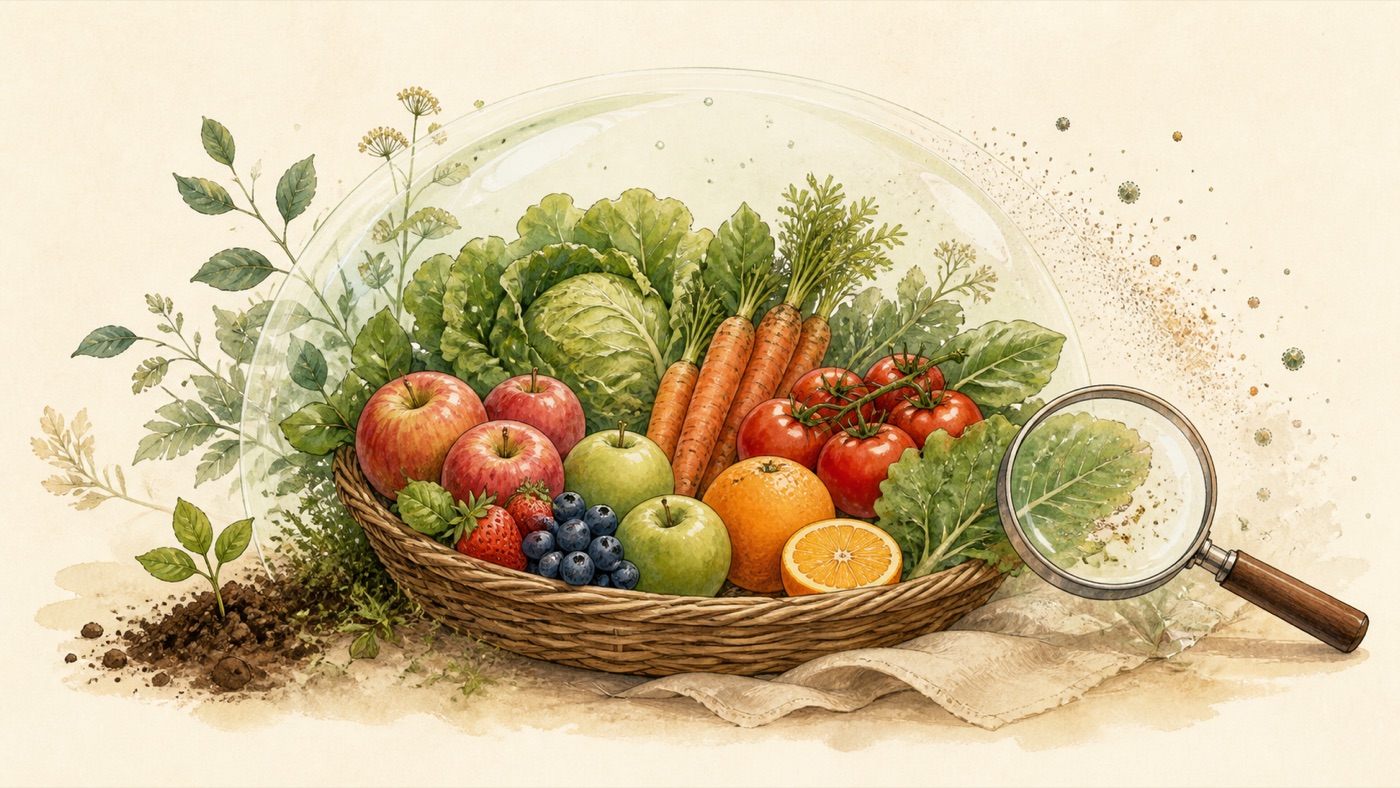
Can Organic Fruits and Vegetables Lower Cancer Risk? Evidence on Pesticide Residues, Nutritional Differences, and Cancer
Organic foods generally test positive for pesticide residues less often, and some of their constituents differ from those of conventionally grown crops. However, the systematic reviews included in ECU do not provide sufficient evidence that choosing organic food itself reduces overall cancer risk or confers a definite health advantage.
Can Organic Fruits and Vegetables Lower Cancer Risk?
Bottom line
Organic foods generally have lower pesticide residues, but current evidence remains insufficient to show that eating organic food itself reduces overall cancer risk. “Lower residues” should therefore not be translated directly into “healthier” or “cancer-preventive.” (PMID: 22944875; PMID: 24968103; PMID: 39101594)

Separate the three questions first
Discussions of organic food often collapse three different questions into one: whether products contain fewer pesticide residues, whether their nutrients and other constituents differ, and whether eating them over the long term actually reduces disease. Food testing can answer the first two questions. The third requires long-term health outcomes and careful adjustment for factors such as dietary patterns, income, education, physical activity, and use of medical care. Even if people who eat more organic food are observed to develop fewer illnesses, that does not establish that the organic label caused the difference.
Professor Ching-Shun Lin’s original article questioned the inference that food is more nutritious, healthier, or more capable of preventing cancer simply because it is organic. That historical position should not be rewritten. Reconsidered in light of the later literature included in ECU, the more accurate contemporary conclusion is that several measurable differences do exist, but their clinical significance for health remains unsettled. (PMID: 22944875; PMID: 24968103; PMID: 39101594)
Organic food usually does have fewer pesticide residues—but not zero
Systematic reviews and meta-analyses show that pesticide residues are detected less often in organic food and that organic diets are associated with lower biomarkers of pesticide exposure. This is a real and meaningful distinction between organic and conventional foods. (PMID: 22944875; PMID: 24968103)
Yet “fewer” does not mean “none.” Organic agriculture may still use approved inputs, including copper-based fungicides and biopesticides. A substance should not be presumed safe merely because it is naturally derived or permitted in organic farming. (PMID: 42009855; PMID: 42345790; PMID: 41893514)
Conversely, detecting a residue on conventionally grown produce does not mean that eating it will inevitably cause harm. Risk assessment must consider the level of exposure, toxicological thresholds, regulatory compliance, and uncertainty surrounding multiple residues. Literature included in ECU supports the conclusion that compliant chronic dietary exposure can fall within acceptable limits, while also warning that actual exceedances and cumulative exposure cannot be dismissed with the single word “harmless.” (PMID: 42195965; PMID: 42280281)
Differences in nutritional composition do not establish health outcomes
An earlier systematic review found no strong evidence of clinically meaningful nutritional differences between organic and conventional foods. (PMID: 22944875)
The literature has since evolved. A later meta-analysis found higher levels of certain antioxidants or polyphenols, lower cadmium levels, and fewer pesticide residues in organic crops. It is therefore no longer precise to say that the two are “completely identical in composition.” (PMID: 24968103)
Higher or lower concentrations of food constituents, however, are not synonymous with improved disease risk. Although subsequent reviews have identified some potentially favorable observational signals, the overall findings remain mixed, and the study methods cannot establish that organic diets themselves cause better health. (PMID: 31861431; PMID: 39101594; PMID: 38254509; PMID: 41515200)
Why one cancer study is not enough
The prospective NutriNet-Santé study observed an association between higher organic food consumption and lower overall cancer risk, with the more prominent site-specific signals involving breast cancer and lymphomas. This association merits further investigation, but it is not clinical proof that organic food prevents cancer. (PMID: 30422212)
A larger prospective study in the United Kingdom, by contrast, found no reduction in overall cancer or breast cancer risk with organic food consumption, showing that results across cohorts are inconsistent. (PMID: 24675385)
An accompanying commentary accordingly emphasized that the relationship between organic food and cancer remains uncertain and that the established benefits of eating enough fruits and vegetables may matter more than focusing narrowly on the farming label. (PMID: 30422205)
Updated systematic reviews still cannot reach a firm conclusion because of conflicting results and methodological limitations. More recent cohort data likewise show only weak observational signals for particular cancer sites, without establishing a reduction in overall cancer risk. (PMID: 39101594; PMID: 41862000)
In addition, a prospective Harvard study included in ECU found no association between estimated pesticide-residue exposure from conventional fruits and vegetables and the risk of cancer overall or at specific sites. This does not mean pesticides can never pose a risk. It reminds us that residues in an ordinary diet, high occupational exposure, and unlawful exceedances are not interchangeable. (PMID: 34256297)
What is a reasonable approach for consumers?
If lower pesticide residues, particular farming practices, or environmental values matter to you, choosing credible organic products has a reasonable basis. A higher price, however, should not be interpreted as a proven prescription for cancer prevention. If your budget is limited, there is also no evidence that you should eat fewer fruits and vegetables because you cannot afford organic options. On cancer prevention, the current evidence supports describing uncertainty honestly—not endorsing either “organic food necessarily prevents cancer” or “organic food has no value whatsoever.” (PMID: 30422205; PMID: 39101594)
How to interpret the determinations on this page
“Consistent with the literature” means that current evidence continues to support Professor Lin’s challenge to an unwarranted causal leap. “The literature has been updated” means that later research has added evidence of compositional differences; it does not imply that the professor himself changed his position. “Partly consistent” means that the core direction remains valid, although categorical wording needs to be tempered. The point of scientific progress is not to decide who won or lost, but to restore “known,” “possible,” and “not yet proven” to their proper places.
FAQ
- Can eating organic fruits and vegetables lower the chance of developing cancer?
- Some observational studies have reported associations, while large studies have found no reduction in overall cancer risk. Systematic reviews still consider the evidence insufficient, so an organic diet cannot be regarded as a proven cancer-prevention method. (PMID: 30422212; PMID: 24675385; PMID: 39101594)
- Do organic fruits and vegetables really have fewer pesticides?
- Yes. Overall, pesticide residues are detected less often in organic foods, and relevant exposure markers are also lower. Fewer, however, does not mean none. (PMID: 22944875; PMID: 24968103)
- Are organic foods produced entirely without chemicals?
- No. Organic agriculture still uses permitted inputs, such as copper-based fungicides and biopesticides. “Organic” cannot simply be equated with “chemical-free.” (PMID: 42009855; PMID: 42345790; PMID: 41893514)
- Are organic foods more nutritious?
- Later research has identified differences in certain antioxidants, polyphenols, cadmium, and pesticide residues. Whether these differences translate into definite health benefits remains unresolved. (PMID: 24968103; PMID: 39101594)
- If conventional fruits and vegetables contain pesticide residues, should they be avoided?
- A substance cannot be judged dangerous merely because it is detected; risk also depends on exposure and regulatory compliance. A prospective study found no association between estimated pesticide residues from conventional produce and cancer risk. (PMID: 34256297; PMID: 42195965)
- If I cannot afford organic food, am I more likely to develop cancer?
- Current evidence does not support that claim. A commentary noted that the established benefits of eating conventional fruits and vegetables may outweigh concerns about residues; people should not eat less produce because organic options are unaffordable. (PMID: 30422205)
- Why do different studies reach different answers?
- Most are observational studies. Participants’ lifestyles and socioeconomic circumstances may influence both food choices and health outcomes, so an association does not prove causation. (PMID: 30422212; PMID: 39101594)
Source anchors
- 林慶順教授原文正本 · http://professorlin.com/2021/08/06/%e8%b2%b4%e6%98%af%e6%9c%89%e9%81%93%e7%90%86%ef%bc%9f%e6%9c%89%e6%a9%9f%e8%94%ac%e6%9e%9c%e9%99%8d%e4%bd%8e%e7%bd%b9%e7%99%8c%e6%a9%9f%e7%8e%87%ef%bc%9f/ · Other citations on IDAEO
- 存證·Wayback 快照(原站消失仍可溯源) · https://web.archive.org/web/2/http://professorlin.com/2021/08/06/%e8%b2%b4%e6%98%af%e6%9c%89%e9%81%93%e7%90%86%ef%bc%9f%e6%9c%89%e6%a9%9f%e8%94%ac%e6%9e%9c%e9%99%8d%e4%bd%8e%e7%bd%b9%e7%99%8c%e6%a9%9f%e7%8e%87%ef%bc%9f/ · Other citations on IDAEO
- 存證·archive.today 快照 · https://archive.ph/newest/http://professorlin.com/2021/08/06/%e8%b2%b4%e6%98%af%e6%9c%89%e9%81%93%e7%90%86%ef%bc%9f%e6%9c%89%e6%a9%9f%e8%94%ac%e6%9e%9c%e9%99%8d%e4%bd%8e%e7%bd%b9%e7%99%8c%e6%a9%9f%e7%8e%87%ef%bc%9f/ · Other citations on IDAEO
- 有機與慣行食品營養、污染及臨床結果的系統性回顧 · https://pubmed.ncbi.nlm.nih.gov/22944875/ · Other citations on IDAEO
- 有機作物成分與農藥殘留差異的統合分析 · https://pubmed.ncbi.nlm.nih.gov/24968103/ · Other citations on IDAEO
- 有機食品與健康結果證據的系統性回顧 · https://pubmed.ncbi.nlm.nih.gov/39101594/ · Other citations on IDAEO
- 有機農業使用銅基投入物及其累積議題 · https://pubmed.ncbi.nlm.nih.gov/42009855/ · Other citations on IDAEO
- 農業銅基殺菌劑與土壤累積的研究 · https://pubmed.ncbi.nlm.nih.gov/42345790/ · Other citations on IDAEO
- 有機與慣行農業的生物農藥及安全性議題 · https://pubmed.ncbi.nlm.nih.gov/41893514/ · Other citations on IDAEO
- 膳食農藥暴露與可接受風險評估 · https://pubmed.ncbi.nlm.nih.gov/42195965/ · Other citations on IDAEO
- 多重殘留及累積暴露的不確定性 · https://pubmed.ncbi.nlm.nih.gov/42280281/ · Other citations on IDAEO
- 有機飲食與健康關聯的回顧 · https://pubmed.ncbi.nlm.nih.gov/31861431/ · Other citations on IDAEO
- 有機食品營養差異與健康意義的綜述 · https://pubmed.ncbi.nlm.nih.gov/38254509/ · Other citations on IDAEO
- 有機與慣行食品成分研究的更新綜述 · https://pubmed.ncbi.nlm.nih.gov/41515200/ · Other citations on IDAEO
- 有機食品攝取與癌症風險的 NutriNet-Santé 世代研究 · https://pubmed.ncbi.nlm.nih.gov/30422212/ · Other citations on IDAEO
- 英國前瞻性研究中的有機食品與癌症風險 · https://pubmed.ncbi.nlm.nih.gov/24675385/ · Other citations on IDAEO
- 有機食品與癌症關係仍不確定的同期評論 · https://pubmed.ncbi.nlm.nih.gov/30422205/ · Other citations on IDAEO
- 有機食品攝取與特定癌症部位關聯的世代資料 · https://pubmed.ncbi.nlm.nih.gov/41862000/ · Other citations on IDAEO
- 慣行蔬果農藥殘留估算與癌症風險的前瞻研究 · https://pubmed.ncbi.nlm.nih.gov/34256297/ · Other citations on IDAEO
- 存證·自存副本(原站消失仍可溯源) · https://km.idaeo.ai/archive/professorlin/13106.html · Other citations on IDAEO
Cite this article
林編輯・《Can Organic Fruits and Vegetables Lower Cancer Risk? Evidence on Pesticide Residues, Nutritional Differences, and Cancer》・IDAEO 知識庫・2026-08-11・https://km.idaeo.ai/post/health/can-organic-fruits-and-vegetables-lower-cancer-rUpdated 2026-08-12