Part of the "Health, Verified" topic shelf →
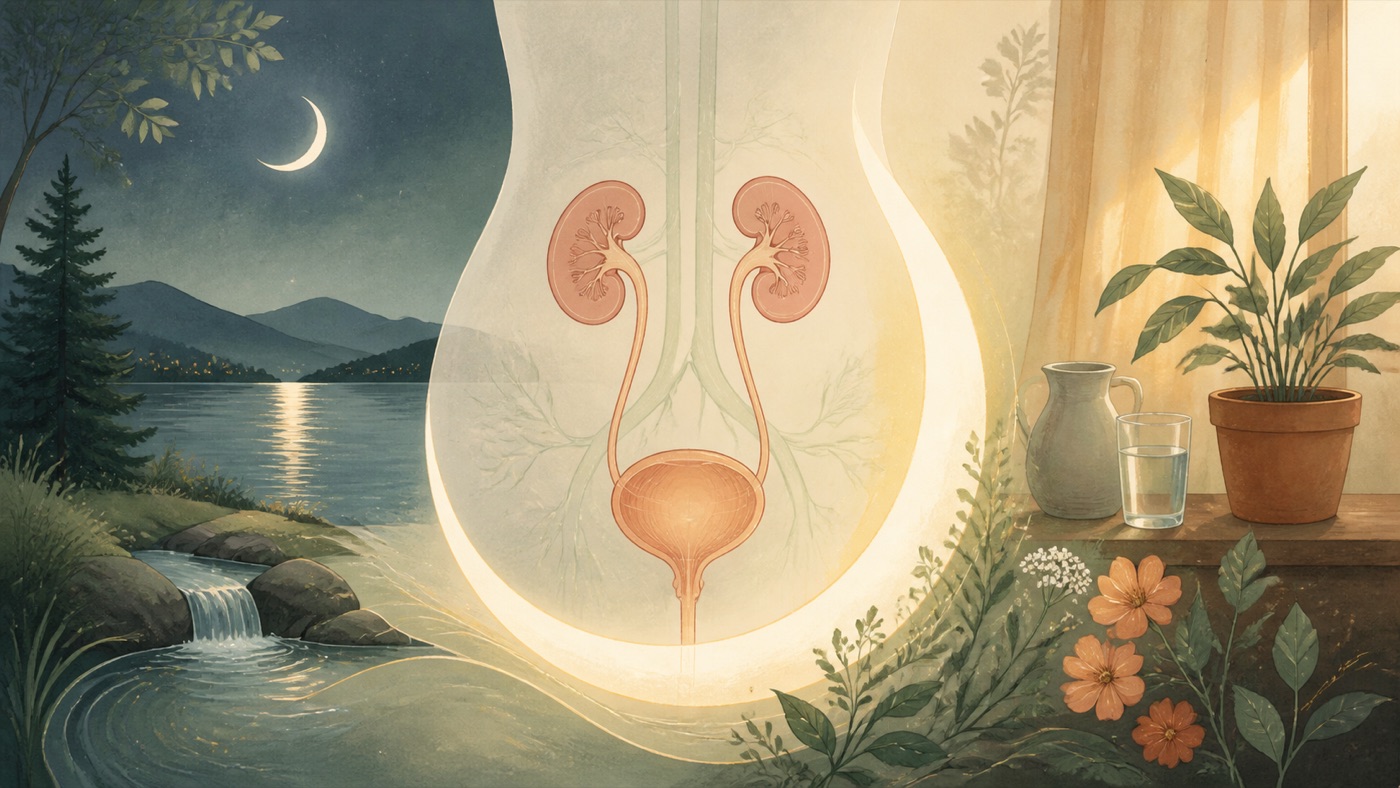
An Evidence-Based Guide to Urinary Health: Nocturia, Urinary Tract Infections, the Prostate, and Kidney Myths
Urinary symptoms cannot be explained by a single cause or supplement. Nocturia must be assessed according to its cause and the pattern of urine production. Evidence for preventing recurrent urinary tract infections varies by intervention: updated findings support cranberry, d-mannose has not been supported, and MV140 still requires confirmation in larger trials. Claims involving pumpkin seeds, soy isoflavones, coffee, and circumcision must likewise distinguish observational associations, product trials, and causal evidence.
An Evidence-Based Guide to Urinary Health
Bottom line
Urinary problems should be managed by first clarifying the cause and the population to which an intervention applies, then selecting an approach based on the evidence. Herbal supplements, hydration remedies, or a single observational association cannot currently be treated as established therapies. Evidence concerning cranberry, d-mannose, and mucosal vaccines for recurrent urinary tract infections must also be evaluated separately. (PMID: 40900851; PMID: 38532487; PMID: 37947276; PMID: 41195062; PMID: 41594044)

Nocturia does not have a single cause—or a hydration formula that suits everyone
Nocturia is a symptom, not a single disease. It may involve increased nighttime urine production, impaired bladder storage, sleep, circadian rhythms, and other distinct mechanisms. It therefore cannot invariably be attributed to heart failure in older people or managed with one lifestyle maxim. Professor Lin's original article rejected the reduction of nocturia to “an aging heart,” a position consistent with current literature that treats nocturia as a symptom with multiple causes. (PMID: 40900851; PMID: 39543359)
The claim that “one must drink warm water before bed and after every nighttime urination to prevent a cerebral or myocardial infarction” is not supported by a verifiable trial or systematic review with a PMID in the results indexed by ECU, and it should not be presented as a necessary measure. By contrast, adjusting fluid intake across the entire day—not only in the evening—may improve nocturia in patients whose total daily urine output is high and who meet the study criteria. The original study, however, used a particular male population and a specific urine-volume threshold, so its findings cannot be applied unconditionally to everyone. (PMID: 24405404)
Cross-sectional evidence has linked greater consumption of flavonoid-rich fruits and vegetables with less nocturia. It is therefore reasonable to say cautiously that such foods “may help,” but this does not establish that increasing intake treats nocturia. This interpretation preserves the careful wording of Professor Lin's original article while clearly separating correlation from a causal effect. (PMID: 39910320)
Overactive bladder and supplements: a research signal is not a standard treatment
Specific products containing pumpkin seed and soybean germ extracts have been described in the media as improving urinary frequency, urgency, and incontinence. ECU's search for the exact title, however, did not retrieve a publication with a PMID. The product, regimen, and effects on each symptom therefore cannot be verified on that basis. Professor Lin's refusal to let consumers turn a product trial directly into an efficacy claim underscores the remaining distance between research quality, reproducibility, and clinical adoption.
The overall review does not deny that herbal research may produce signals. Rather, it states that no herbal compound has yet developed into an established clinical treatment for overactive bladder. Products such as pumpkin seed preparations may thus be legitimate subjects of research, but should not be described as established standard therapy. (PMID: 38532487)
Recurrent urinary tract infections: preventive approaches must not be conflated
Urinary tract infections impose a common burden on women: more than half experience at least one during their lifetime, and nearly one-quarter develop recurrent urinary tract infections. This burden is an important reason to seek non-antibiotic preventive strategies. (PMID: 40095960)
For d-mannose, the placebo-controlled trial summarized by Professor Lin found that daily use did not reduce the proportion of women with a history of recurrence who again sought medical care for a suspected urinary tract infection during follow-up. The literature has since been updated: subsequent meta-analyses likewise did not support a preventive effect. d-mannose should therefore not currently be treated as a routine means of preventing recurrent urinary tract infections in adult women. (PMID: 38587819; PMID: 41195062; PMID: 41004704)
Cranberry is different. Drawing on the conflicting trials available at the time, Professor Lin's original article characterized the evidence as inconclusive, accurately reflecting the state of knowledge then. The literature has since been updated: a newer Cochrane review concluded with moderate certainty that cranberry reduces risk among women with recurrent urinary tract infections. Its effects are not the same in every population, however, and “may reduce risk” must not be rewritten as a guarantee against recurrence. (PMID: 37947276)
Research on MV140/Uromune has produced positive signals and deserves continued attention as a non-antibiotic strategy. A systematic review, however, found that the existing studies were highly heterogeneous, relied mainly on observational data, and included few randomized trials. It is therefore appropriately described as a promising candidate, but not yet as a routine therapy supported by sufficient evidence. (PMID: 36986281; PMID: 41594044)
Professor Lin previously cited long-term follow-up and safety figures from a UK cohort on the basis of a conference abstract. ECU did not retrieve a formal paper from that same cohort with a PMID in this search. Those specific long-term figures can therefore be retained only as reported in the original article; the shorter-term literature indexed here cannot be used to substantiate them. (PMID: 41594044)
The prostate, soy, and circumcision: distinguish effects, risks, and causation
For lower urinary tract symptoms associated with benign prostatic hyperplasia, soy isoflavones offered only a slight advantage over placebo. This cannot be extended into a claim of consistent efficacy. (PMID: 22268969)
Existing data on high soy or isoflavone intake and the risk of death from prostate cancer come from observational research. Professor Lin's use of “may” to describe the risk respects the boundary of the evidence. This is not an established causal conclusion, and it would also be inappropriate to invert it into claims of absolute safety or inevitable harm. (PMID: 32968784)
An early study of circumcision and autism reported an observational association, but registry-based cohort studies are susceptible to confounding from diagnostic and socioeconomic factors. The association cannot be recast directly as “circumcision causes autism.” Professor Lin's challenge to that causal leap is reasonable, while the fact that the individual study did observe an association should also be accurately preserved. (PMID: 25573114)
ECU's search did not retrieve a verifiable causal study with a PMID supporting the further claim that the use of acetaminophen after circumcision constitutes a disease-causing mechanism. The evidence can therefore only be judged insufficient; zero search hits cannot be treated as proof or disproof.
Coffee and the kidneys: a metabolite association is not causation by a beverage
The finding that certain coffee-related metabolites are associated with chronic kidney disease does not mean that drinking coffee itself causes chronic kidney disease. A cohort study that directly evaluated coffee intake observed a lower risk of acute kidney injury, but an observational result alone still cannot establish a protective effect. (PMID: 34737201; PMID: 35812301)
Taken together, Mendelian randomization, meta-analyses, and prospective cohorts do not provide definitive causal evidence that coffee invariably harms or protects the kidneys. Some favorable signals remain and must be interpreted in light of study design and differences among populations. (PMID: 35832703; PMID: 36516702)
Genotypes affecting caffeine metabolism may modify the association between coffee and markers of kidney function, but the specific hypertensive cohort studied to date is insufficient for drawing conclusions about the general population or all slow metabolizers. Such results are useful for generating research hypotheses, not for turning them directly into universal advice about coffee consumption. (PMID: 36701157)
Applying this evidence to yourself
When faced with nocturia, urgency, incontinence, or recurrent infections, it is more reliable to record the pattern of symptoms and have a healthcare professional assess possible causes than to apply a remedy on your own. When selecting a non-antibiotic preventive approach, examine the study population, outcome measures, and level of evidence for each option. Being labeled a supplement or novel therapy does not mean that different options have evidence pointing in the same direction or carrying the same certainty. Professor Lin's original article provided an important starting point for critical inquiry. When higher-level research subsequently emerges, it should be understood as “the literature has been updated and science has advanced,” not as a rewriting of the professor's position at the time.
FAQ
- Is nocturia caused by heart failure?
- No. Nocturia has multiple mechanisms and causes and should be assessed individually in light of urine production, bladder function, sleep, and overall health. (PMID: 40900851; PMID: 39543359)
- Should people with nocturia simply drink less in the evening?
- There is no universal rule. People with high total daily urine output who meet the study criteria may need to adjust fluid intake throughout the day, but those findings cannot be extrapolated directly to everyone. (PMID: 24405404)
- Can pumpkin seed be used as a standard treatment for overactive bladder?
- Not at present. Herbal research may yield signals, but it has not yet produced an established clinical therapy for overactive bladder. (PMID: 38532487)
- Can d-mannose prevent recurrent urinary tract infections in women?
- The existing large placebo-controlled trial and updated meta-analyses do not support a preventive effect, so it is not recommended for routine prevention. (PMID: 38587819; PMID: 41195062; PMID: 41004704)
- Does cranberry help prevent recurrent urinary tract infections?
- The literature has been updated. A newer systematic review supports a reduction in risk among women with recurrent urinary tract infections, but the effect does not apply to every population and is not guaranteed. (PMID: 37947276)
- Is MV140/Uromune already a routine therapy with sufficient evidence?
- Not yet. Studies have produced positive signals, but a systematic review found that the data were largely observational and heterogeneous. Larger randomized trials are still needed. (PMID: 36986281; PMID: 41594044)
- Does drinking coffee harm the kidneys?
- There is currently no definitive causal evidence that coffee invariably harms or protects the kidneys. Associations with metabolites also cannot be equated directly with the effects of drinking coffee. (PMID: 34737201; PMID: 35832703; PMID: 36516702)
- Does circumcision cause autism?
- An individual registry-based cohort study reported an observational association, but that is insufficient to establish causation, and confounding factors such as diagnosis and socioeconomic circumstances must still be considered. (PMID: 25573114)
Source anchors
- 林慶順教授原文正本 · http://professorlin.com/2024/09/12/%e5%b0%bf%e8%b7%af%e6%84%9f%e6%9f%93%e6%96%b0%e8%97%a5%ef%bc%9a%e8%88%8c%e4%b8%8b%e5%99%b4%e5%8a%91%e7%96%ab%e8%8b%97/ · Other citations on IDAEO
- 存證·Wayback 快照(原站消失仍可溯源) · https://web.archive.org/web/2/http://professorlin.com/2024/09/12/%e5%b0%bf%e8%b7%af%e6%84%9f%e6%9f%93%e6%96%b0%e8%97%a5%ef%bc%9a%e8%88%8c%e4%b8%8b%e5%99%b4%e5%8a%91%e7%96%ab%e8%8b%97/ · Other citations on IDAEO
- 存證·archive.today 快照 · https://archive.ph/newest/http://professorlin.com/2024/09/12/%e5%b0%bf%e8%b7%af%e6%84%9f%e6%9f%93%e6%96%b0%e8%97%a5%ef%bc%9a%e8%88%8c%e4%b8%8b%e5%99%b4%e5%8a%91%e7%96%ab%e8%8b%97/ · Other citations on IDAEO
- 草本化合物與膀胱過動症治療回顧 · https://pubmed.ncbi.nlm.nih.gov/38532487/ · Other citations on IDAEO
- 夜尿的多重病因與評估 · https://pubmed.ncbi.nlm.nih.gov/40900851/ · Other citations on IDAEO
- 夜尿、睡眠與晝夜節律機制 · https://pubmed.ncbi.nlm.nih.gov/39543359/ · Other citations on IDAEO
- 特定夜尿患者的飲水指導研究 · https://pubmed.ncbi.nlm.nih.gov/24405404/ · Other citations on IDAEO
- 類黃酮攝取與夜尿的橫斷面關聯 · https://pubmed.ncbi.nlm.nih.gov/39910320/ · Other citations on IDAEO
- 女性尿路感染流行病學與復發負擔 · https://pubmed.ncbi.nlm.nih.gov/40095960/ · Other citations on IDAEO
- d-甘露糖安慰劑對照試驗 · https://pubmed.ncbi.nlm.nih.gov/38587819/ · Other citations on IDAEO
- d-甘露糖預防復發性尿路感染統合分析 · https://pubmed.ncbi.nlm.nih.gov/41195062/ · Other citations on IDAEO
- d-甘露糖隨機試驗統合分析 · https://pubmed.ncbi.nlm.nih.gov/41004704/ · Other citations on IDAEO
- 蔓越莓預防尿路感染新版 Cochrane 綜述 · https://pubmed.ncbi.nlm.nih.gov/37947276/ · Other citations on IDAEO
- MV140 預防復發性尿路感染研究 · https://pubmed.ncbi.nlm.nih.gov/36986281/ · Other citations on IDAEO
- MV140 系統性回顧與證據限制 · https://pubmed.ncbi.nlm.nih.gov/41594044/ · Other citations on IDAEO
- 大豆異黃酮與良性攝護腺增生試驗 · https://pubmed.ncbi.nlm.nih.gov/22268969/ · Other citations on IDAEO
- 大豆異黃酮與攝護腺癌死亡風險觀察研究 · https://pubmed.ncbi.nlm.nih.gov/32968784/ · Other citations on IDAEO
- 早期割包皮與自閉症的登錄世代研究 · https://pubmed.ncbi.nlm.nih.gov/25573114/ · Other citations on IDAEO
- 咖啡相關代謝物與慢性腎臟病 · https://pubmed.ncbi.nlm.nih.gov/34737201/ · Other citations on IDAEO
- 咖啡攝取與急性腎損傷隊列研究 · https://pubmed.ncbi.nlm.nih.gov/35812301/ · Other citations on IDAEO
- 咖啡與腎臟結果的孟德爾隨機化及統合分析 · https://pubmed.ncbi.nlm.nih.gov/35832703/ · Other citations on IDAEO
- 咖啡攝取與腎臟結果前瞻性研究 · https://pubmed.ncbi.nlm.nih.gov/36516702/ · Other citations on IDAEO
- CYP1A2 基因型與咖啡、腎功能關聯 · https://pubmed.ncbi.nlm.nih.gov/36701157/ · Other citations on IDAEO
- d-甘露糖預防效果的證據評估 · https://pubmed.ncbi.nlm.nih.gov/36808931/ · Other citations on IDAEO
- 存證·自存副本(原站消失仍可溯源) · https://km.idaeo.ai/archive/professorlin/20553.html · Other citations on IDAEO
Cite this article
林編輯・《An Evidence-Based Guide to Urinary Health: Nocturia, Urinary Tract Infections, the Prostate, and Kidney Myths》・IDAEO 知識庫・2026-08-11・https://km.idaeo.ai/post/health/an-evidence-based-guide-to-urinary-health-nocturUpdated 2026-08-12