

🏛 Part of the "dental" topic shelf →
How much is an all-ceramic crown? Why quotations under the same name can differ
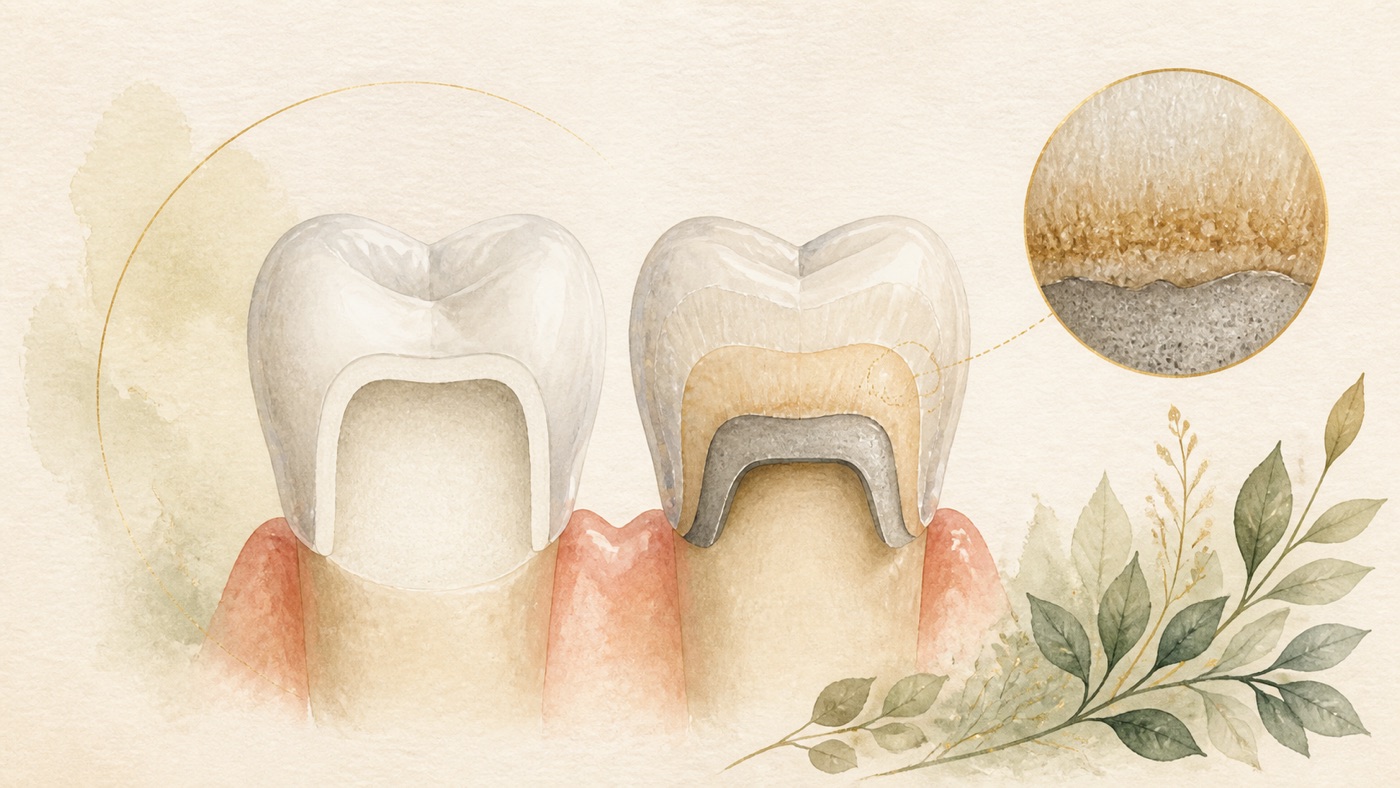
“All-ceramic crown” is an umbrella term, not one material or one method. It covers different ceramic families and fabrication methods. In Taiwan, each city or county authority approves dental fee schedules, whose all-ceramic-crown item states that material and fabrication method can differ. This card explains materials, fabrication, anterior/posterior needs, and what a quotation line can include or exclude. It gives no prices and makes no judgement on whether a price is reasonable.
How much is an all-ceramic crown? Why two quotations under the same name can differ so much
Direct answer: Crowns that are both called all-ceramic can use different ceramic materials and different fabrication methods, which makes them different line items; Taiwan's dental fee standards are approved by the competent authority of each municipality or county, so look at the line items before you compare the figures.[F5][F7]
Geographic scope: This article follows Taiwan's healthcare system (National Health Insurance and Taiwan's medical legislation). The passages on the system, item names and verification channels cite Taiwan law and documents approved by the competent authorities; the evidence passages on materials and fabrication methods cite international literature, and the two are tagged separately in the fact-unit account. The official English text of Taiwan's Medical Care Act is https://law.moj.gov.tw/ENG/LawClass/LawAll.aspx?pcode=L0020021 .
First, the division of labour: this card only answers "why quotations under the same name differ"
This site keeps one canonical card per question, so the boundaries within the same family are stated up front to save you from reading the same thing across four cards. The crown-cost card handles the six-part breakdown of a single-crown quotation and the full five-year survival figures for single crowns in each material; the all-ceramic-crown regret card handles the classification of drawbacks and how they compare with online complaints; the what-is-a-dental-crown card handles terminology equivalents and the situations each option suits. This card handles the question that price searches actually land on: why two quotations that both say "all-ceramic crown" can look completely different. On survival and on drawbacks, this card keeps one summarising sentence each and points to the relevant card rather than rewriting it.[F2]
"All-ceramic crown" is a collective term, not one material
Start with what the official document says. In the dental fee schedule approved by the Taipei City Government Department of Health, the item is named "all-ceramic crown" and the unit is per tooth; the fifth clause of its published content (the explanation of what the charge covers) reads "varies according to the all-ceramic material used and the fabrication method".[F4][F5] In other words, "same name, different price" is not a claim about a disorderly market — it is a variable written into the document the competent authority approved. On the same schedule, the corresponding explanation for "porcelain-fused-to-metal crown (ceramic fused to a full metal crown)" reads "varies according to the casting metal used and the occlusal-surface design" — a different item, with different variables.[F6]
So where exactly does "different all-ceramic materials" make a difference? In the literature this is broken into two layers:
- The composition and microstructure of the material itself. A 2026 systematic review (58 laboratory studies included, search period January 2014 to September 2025) collated the mechanical performance of multilayer zirconia and sorted the influencing factors into four groups: the manufacturer side (the gradient design of yttria content and colourants), the laboratory side (sintering parameters, computer-aided design and manufacturing strategy and the position from which the blank is taken, restoration design, staining, surface treatment), the clinical side (occlusal thickness, margin-line design, luting procedure, post-and-core material, tooth substrate) and ageing conditions.[F14] The conclusion of the same paper is stated plainly: raising the yttria content increases translucency but at the same time reduces flexural strength and fracture toughness; and although compositionally graded systems often show higher strength under controlled conditions, no multilayering approach demonstrated a definitive mechanical advantage.[F14]
- Aesthetics and strength pull against each other. A 2021 systematic review (53 in-vitro studies included) points to the same trade-off: the higher-yttria monolithic zirconia of recent years has genuinely improved in appearance, but it still falls short of the translucency of glass ceramics; and in making zirconia more aesthetic, some mechanical properties are sacrificed, so care is needed when thinner aesthetic-grade zirconia structures are used in areas that carry greater stress.[F15]
Both of these are laboratory-level evidence: they are about materials, not about the prognosis of your particular tooth. Their only use in this card is to show that "all-ceramic" is not one thing — zirconia alone comes with a whole row of formulations and multilayer designs, and the choice of formulation is itself a trade-off.[F14][F15]
Monolithic and layered: the same crown can be made in two ways
Besides the material, the method of making it also differs. Monolithic means the whole crown is milled or formed from a single ceramic; layered means an aesthetic ceramic is built up over a coping of higher strength. A systematic review published in 2025 evaluated the combination of "a zirconia coping veneered with lithium disilicate", but look at the structure of its evidence first: of the 13 studies it included, 10 were in vitro and only 3 were clinical. On that basis, the review describes the combination as drawing on the strength of zirconia and the aesthetic properties of lithium disilicate, with positive fracture resistance, clinical success rates and patient satisfaction over the short to medium term; the same paper also identifies as key factors affecting appearance whether the material can be polished to a high gloss, and the effect of the luting agent's colour on the colour of the finished restoration, noting that the results are fairly sensitive to technique and material handling — the authors' own conclusion is that data of this kind, weighted towards in-vitro and short-term work, still need well-designed long-term clinical trials to confirm.[F16] This passage can therefore only be read as a trade-off in fabrication method, and never as any conclusion about treatment effect or superiority.[F2]
What this means for a quotation is that veneering is a genuinely additional laboratory step, and it is one of the reasons why two things both called "all-ceramic crown" can fall under different line items and different amounts of working time. As for how monolithic and veneered crowns differ in chipping, that belongs to the taxonomy of drawbacks and is discussed in full in the all-ceramic-crown regret card.[F2]
Fabrication method: who made this crown, and with what
Taiwan has a dedicated statute for "who may make this crown". Article 12 of the Dental Technicians Act provides that a dental technician carrying out dental technical work shall do so in accordance with a written document issued by a dentist or a dental practitioner; the same article defines dental technical work as the making, repair or processing, outside the oral cavity, of crowns, bridges, inlays, orthodontic appliances and dentures for dental medical use.[F12] Article 16 of the same Act provides that a dental technician carrying out that work may not perform impressions, bite registrations, try-ins, placement or other medical procedures inside the oral cavity.[F13]
So the cost structure of an all-ceramic crown is inherently split into two ends: the chairside end (the dentist's examination, tooth preparation, impression or intraoral scan, try-in and adjustment) and the laboratory end (the technician making it outside the mouth in accordance with the written document). This is also reflected on the fee schedule — the fourth clause of the explanation for the "all-ceramic crown" item reads "this charge includes the dental technician's fee", whereas the "oral prosthetic treatment plan" item on the same schedule states explicitly "but does not include the dental technician's fee".[F5][F6]
What has changed at the laboratory end in recent years is the digital workflow. Here is how far the literature currently goes:
- Time: a 2025 systematic review (8 papers published between 2010 and 2023 included) compared the time taken from impression to fitting for digital and conventional workflows, and the result was not one-sided — for a single crown, 2 studies showed that conventional impressions took more time than digital scanning while 1 showed the opposite; and for the framework and veneering steps of a three-unit prosthesis, technicians spent more time on the conventional workflow than on the digital one. The same paper also notes that, for the clinical evaluation and chairside adjustment of a single crown, there was no difference between the two workflows.[F18]
- Marginal adaptation: a 2025 overview of systematic reviews (18 reviews included, 11 of them containing meta-analysis) compared the marginal adaptation of tooth-supported fixed restorations made from digital scans with those made from conventional impressions, and concluded that digital scanning achieved comparable or better marginal adaptation, more evidently in zirconia and in single or partial fixed prostheses, and that among the studies included in the overview there was no report favouring the conventional technique; but the overview also notes that most of the included reviews were rated very low or low on methodological quality assessment and must be interpreted with caution. Another thing that must be kept distinct is that marginal adaptation is a surrogate indicator in experiments and imaging; it is not the same as how long this crown will last in your mouth.[F19][F2]
- Forming method: a 2026 systematic review and meta-analysis (31 papers in the qualitative analysis, 21 in the quantitative analysis, all of them in-vitro studies) compared additively manufactured (3D-printed) and subtractively manufactured (milled) monolithic zirconia, and the pooled result showed that the flexural strength of additive manufacturing was lower than that of subtractive manufacturing; the authors conclude that, on the available in-vitro evidence, additively manufactured zirconia has potential for posterior crowns but still needs clinical validation, and that anterior teeth are a particular problem because the translucency is insufficient for aesthetic demands.[F17]
One thing here has to be spelled out: the review comparing time above also wrote a sentence saying that no article has compared the cost of fixed prostheses, and called for research analysing the cost-effectiveness of making tooth-supported restorations.[F18] In other words, the question "is digital more expensive or cheaper" currently has no literature that can answer it. Whenever someone offers the workflow as the reason for a price difference, you are entitled to ask them to explain it with a list of line items instead.[F2]
Anterior and posterior teeth do not need the same things
This section is easily overstated, so let us set the terms of reference first.
- On survival, the anterior/posterior gap is smaller than people imagine. A 2026 systematic review and meta-analysis (search from 2014 to 2024, 64 studies) writes, in comparing tooth-supported single crowns across materials and designs, that apart from feldspathic/silica-based ceramic and metal-ceramic, the material and design types performed similarly in the anterior and the posterior region.[F22] The full five-year survival figures by material belong to the crown-cost card, and this card keeps only one summarising sentence: the overall conclusion of that review is that lithium-disilicate and zirconia-based all-ceramic single crowns can achieve five-year survival comparable to metal-ceramic — this is a statistical estimate for a study population at the five-year time point; it is not a prediction for your tooth, and it cannot be used as a quality indicator for any clinic or product.[F22][F2]
- The difference lies mainly in aesthetic demand and material trade-offs. A 2022 systematic review (6 clinical studies included) compared the clinical performance of lithium-disilicate and zirconia single crowns and points out that the incidence of periodontal and pulpal complications of both was similar to that of metal-ceramic crowns; and that for zirconia crowns the most frequent complication was concern about appearance.[F20] This runs in the same direction as the in-vitro evidence above: translucency is zirconia's weak point, and anterior teeth demand more translucency than posterior teeth.[F15][F17]
- For posterior teeth there is another set of consensus statements. A 2025 consensus recommendation, formed by a cross-disciplinary expert panel through three consensus workshops and a two-stage electronic Delphi survey (its subject being single-tooth ceramic and non-metallic indirect restorations in the posterior region; the paper's conflict-of-interest statement records the links of several authors with dental-material manufacturers, see the fact-unit account), holds that the choice between direct and indirect restoration should be decided case by case and that, following the principles of minimally invasive dentistry, inlays and onlays should be preferred over full crowns; that material selection should follow clinical performance, aesthetic properties and manufacturer guidance; and it stresses at the same time the precision of the steps of tooth preparation, impression taking, contamination control and luting, together with regular follow-up and maintenance arranged according to individual need.[F21]
So "which one for the front teeth and which one for the back teeth" is not something a league table can decide: anterior teeth are mostly about aesthetic and translucency conditions[F15][F17], while posterior teeth are placed by the consensus recommendation within a framework of minimal invasiveness and case-by-case judgement[F21]; and as for how much tooth structure your particular tooth has left and whether it can support a given method, that belongs to the prognostic-factors passage of the crown-cost card and is not rewritten here[F2]. Treatment and its effects vary from person to person and must be assessed by a dentist; ask your dentist to explain the treatment plan and the possible adverse reactions as required by Article 81 of the Medical Care Act[F9].
On that quotation, what does the "all-ceramic crown" line actually contain
Taiwan has no nationwide crown price list — under Article 21 of the Medical Care Act, fee standards are approved by the competent authority of the special municipality or the county (city)[F7], so the current approved document of the place where you are treated is what governs; but an approved schedule can be used as a framework for reading a quotation. Taking the dental fee schedule approved by the Taipei City Government Department of Health as an example, the published content for the "all-ceramic crown" item has five clauses: this charge includes basic impressions, adjustment and technical-operation fees; it does not include the examination fee; the use of special instruments and appliances is charged separately; this charge includes the dental technician's fee; and it varies according to the all-ceramic material used and the fabrication method.[F5]
Translating those five clauses into what you should ask at the clinic:
- Are impressions and adjustment included? — the schedule writes basic impressions, adjustment and technical-operation fees into this item, so ask whether the quotation you are holding uses the same terms.[F5]
- The examination fee is charged separately — the schedule states explicitly that this item does not include the examination fee.[F5]
- Special instruments and appliances are charged separately — the schedule states explicitly that they are charged separately, so "were any used, and does that count as another item" is a fair question.[F5]
- The technician's fee is already included — the schedule writes the dental technician's fee into this item; whereas the oral prosthetic treatment plan on the same schedule does not include the technician's fee. They are different items.[F5][F6]
- Material and fabrication method are the source of the price difference — these are exactly the variables the earlier sections of this card discussed.[F5][F14]
There are also several things often assumed to be "included" that are in fact separate items in their own right on the same schedule: a therapeutic temporary crown is another item (and its explanation notes that it does not include repair fees), a ceramic inlay and a ceramic onlay are two different items, and a primary-tooth all-ceramic crown is another item under paediatric dentistry.[F6] This is also why, when faced with "two quotations that differ a lot", the opening move is to align the two documents line item by line item, rather than comparing the totals.[F2]
One more boundary has to be drawn clearly: what the approved document says is that "the charge varies according to the all-ceramic material used and the fabrication method", and that is a variable the system already recognises[F5]; it is not the same as saying "the difference between the two quotations in your hand has already been fully explained by that variable". Where the difference actually comes from can only be known by laying the line items out one by one — and remember that even a question with boundaries as clear as "a cost comparison between the digital and the conventional workflow" is one that a systematic review states explicitly no literature has ever done[F18], let alone attributing the difference between two quotations to any single cause. This site does not interpret, evaluate or recommend any individual quotation.[F2]
A note: the above is only an illustration of the item structure in a document already approved in Taipei City; each municipality and county approves its own, and the items and explanations are not necessarily the same; this card quotes none of the amounts in it.[F4][F7]
About search terms like "all-ceramic crown 15000"
People really do type the figure straight into the search box. This site handles search terms of this kind in one way only: it does not comment on whether any amount is reasonable, and it does not provide any price information. The reason is simple — a figure with no accompanying list of line items cannot be reconciled. You have no way of knowing whether it includes the examination fee, whether it includes a temporary crown, which all-ceramic material and which fabrication method were used — and those are precisely the variables the approved document names.[F5][F6] The action that will actually help you is turning that string of digits into a written quotation with the items listed one by one.[F8]
Why you cannot find a "going rate" for an all-ceramic crown: this is how Taiwan's system is set up
- In law, a nationally uniform price does not exist: Article 21 of the Medical Care Act provides that the standards by which a medical institution charges medical fees are approved by the competent authority of the special municipality or the county (city).[F7]
- Crowns as a rule fall on the self-paid side: the non-covered items listed in subparagraph 11 of Article 51 of the National Health Insurance Act include dentures, artificial eyes, spectacles, hearing aids, wheelchairs, crutches and other appliances that are not actively therapeutic.[F11] Exactly how an individual procedure is classified, and which side other procedures within the same course of treatment fall on, follow the National Health Insurance Administration's current rules and announcements; do not infer them from what is said online.
- The receipt is the reconciliation tool: Article 22 of the Medical Care Act provides that a medical institution charging medical fees shall issue a receipt stating the items charged and the amounts; and it may not charge in breach of the fee standards, whether by charging in excess of them or by creating charge items of its own.[F8]
- Asking is your right: Article 81 of the Medical Care Act imposes on medical institutions the duty to inform you of the condition, the treatment plan, the procedure, the medication, the prognosis and the possible adverse reactions.[F9]
How to verify the quotation you are holding (things you can actually do)
- Start from the municipality or county where you are treated: dental fee standards are approved by the local competent authority[F7], and the example this site has actually checked is the dental fee schedule published by the Taipei City Government Department of Health[F4]; for other localities, go to the fee-standard section of the local health bureau and look for an announcement of the same kind.
- Ask for a written quotation with the items listed one by one: a spoken total cannot be reconciled, and for the all-ceramic-crown question in particular you should get an answer to "which all-ceramic material, and which fabrication method", because that is exactly the variable the approved document names.[F5]
- Put three documents side by side: the procedure written in the treatment plan or the consent form, the items listed in the quotation, and the charge descriptions on the receipt should all correspond to one another.[F8][F9]
- Do not use the National Health Insurance Administration's medical-device price-comparison site for dentistry: the item classifications of both of that site's search tracks exclude dentistry, so crowns, dentures and implants cannot be found there.[F23]
Checklist before your appointment: seven questions to ask when you receive an all-ceramic-crown quotation
- Which all-ceramic material is this crown made of? Is it monolithic, or a layered design with a further ceramic layer built up on the outside?[F5][F16]
- Why is this one recommended? Is it for translucency in an anterior tooth, or for occlusal strength in a posterior tooth?[F15][F17][F20]
- Does this item include the examination fee, impressions and adjustment, and the technician's fee? Were any special instruments or appliances used that are charged separately?[F5]
- Is the temporary crown a separate item? Roughly how many visits are there from preparation to fitting the definitive crown?[F6]
- Is there an alternative that avoids a full crown (an inlay or an onlay, for example)? Why does it not apply in my case?[F6][F21]
- How many adjustment visits does the quotation cover? How is it charged if a remake is needed or the number of visits is exceeded?[F2]
- Could I have a written quotation with the items listed one by one, and a receipt stating the items charged and the amounts once the work is complete?[F8]
Risk factors (things you should know before treatment)
Making an all-ceramic crown means cutting away a portion of tooth structure that does not come back. It is a procedure that carries medical risk, and its indications and contraindications have to be assessed by a dentist according to your individual situation:
- The choice of material is a trade-off, not an upgrade: raising the yttria content brings translucency while reducing flexural strength and fracture toughness; in making zirconia more aesthetic, some mechanical properties are sacrificed, and care is needed when thinner aesthetic-grade structures are used in high-stress areas.[F14][F15]
- The finer the method, the more sensitive it is to technique: the results of a layered design are sensitive to technique and material handling, and long-term clinical data are still to be filled in.[F16]
- A newer process does not mean a stronger one: in-vitro evidence shows that the flexural strength of additively manufactured zirconia is lower than that of milled zirconia, anterior teeth also have the problem of insufficient translucency, and clinical validation is still lacking.[F17]
- Variables at the clinical end also affect the outcome: occlusal thickness, margin-line design, the luting procedure, post-and-core material and the tooth substrate are all listed as factors affecting mechanical performance[F14]; and the consensus recommendation likewise stresses the precision of the steps of tooth preparation, impression taking, contamination control and luting, together with regular follow-up and maintenance.[F21]
- Complications do not disappear just because a crown is all-ceramic: a systematic review points out that the incidence of periodontal and pulpal complications for lithium-disilicate and zirconia single crowns is similar to that of metal-ceramic crowns; the full taxonomy of drawbacks is in the all-ceramic-crown regret card.[F20][F2]
- How much weight this evidence can bear: most of the material-side data in this card come from in-vitro or laboratory studies, so clinical extrapolation has to be conservative; and the reviews included in the marginal-adaptation overview were mostly rated very low or low in quality.[F14][F15][F17][F19] Treatment and its effects vary from person to person and must be assessed by a dentist.
Every clinical statement in this article is mapped line by line to its cited source (see the sources and evidence chain below). It has not been clinically reviewed by a licensed practitioner. This is health information, not individual advice; assessment by a clinician is required.
FAQ
- Why do two clinics list different items?
- All-ceramic crown is an umbrella term. The approved schedule lists material, fabrication, included, excluded and potentially separate items. Compare items, not totals.[F5][F2]
- なぜ医院ごとに項目が違いますか。 — オールセラミッククラウンは総称で、認定表は材料、製作法、含むもの、含まないもの、別料金になり得るものを記します。合計ではなく項目を比べてください。[F5][F2]
- Why do two clinics list different items? — All-ceramic crown is an umbrella term. The approved schedule lists material, fabrication, included, excluded and potentially separate items. Compare items, not totals.[F5][F2]
- Which is better, zirconia or lithium disilicate?
- The literature supplies no ranking. Suitability depends on tooth position, occlusion, remaining tooth structure and aesthetic needs.[F14][F15][F21][F22]
- ジルコニアと二ケイ酸リチウムのどちらが良いですか。 — 文献は順位を示しません。適合性は歯の位置、咬合、残存歯質、審美要求によります。[F14][F15][F21][F22]
- Which is better, zirconia or lithium disilicate? — The literature supplies no ranking. Suitability depends on tooth position, occlusion, remaining tooth structure and aesthetic needs.[F14][F15][F21][F22]
- If computer scanning is more accurate, should it cost more?
- Marginal adaptation and cost differ; the digital-scanning evidence has low-quality limitations, and fixed prostheses have no direct cost-comparison literature.[F19][F18]
- コンピュータースキャンの方が正確なら高いですか。 — 辺縁適合と費用は別で、デジタルスキャン根拠には低い方法論の質という限界があり、固定性補綴の費用比較文献はありません。[F19][F18]
- If computer scanning is more accurate, should it cost more? — Marginal adaptation and cost differ; the digital-scanning evidence has low-quality limitations, and fixed prostheses have no direct cost-comparison literature.[F19][F18]
- Does Taiwan National Health Insurance cover an all-ceramic crown?
- Article 51, subparagraph 11, of Taiwan’s National Health Insurance Act lists dentures and other appliances not of an actively therapeutic nature among items outside coverage. Individual handling follows the Administration’s current rules and announcements. Private-insurance questions depend on the policy terms.[F11][F7][F8]
- 台湾の全民健康保険は全瓷冠を給付しますか。 — 台湾《全民健康保険法》第 51 条第 11 款は義歯などを不給付として列挙します。個別処置は健保署の現行規定・公告によります。民間保険は保険約款によります。[F11][F7][F8]
- Does Taiwan National Health Insurance cover an all-ceramic crown? — Article 51, subparagraph 11, of Taiwan’s National Health Insurance Act lists dentures and other appliances not of an actively therapeutic nature among items outside coverage. Individual handling follows the Administration’s current rules and announcements. Private-insurance questions depend on the policy terms.[F11][F7][F8]
- Do front teeth have to use a more expensive material?
- That inference does not hold. A 2026 meta-analysis reports that, apart from feldspathic and silica-based ceramics and metal-ceramic, the materials and design types perform similarly in the anterior and the posterior region [F22]. The real difference between front and back teeth is in what is required of them — translucency and appearance at the front, occlusal strength and a minimally invasive approach at the back [F15][F17][F21]. The price of a material and its suitability are two separate things, and this site gives no price information.
- 前歯には必ず高い材料を使わなければなりませんか。 — そのようには言えません。2026 年のメタ解析は、長石系およびシリカ系セラミックとメタルセラミックを除き、各材料と設計タイプの前歯部と臼歯部での成績は同程度であったと報告しています [F22]。前歯と臼歯の本当の違いは求められるものにあります。前歯では透光性と審美性、臼歯では咬合強度と低侵襲の原則です [F15][F17][F21]。材料の価格と適合性は別の事柄であり、本サイトは価格情報を提供しません。
- Do front teeth have to use a more expensive material? — That inference does not hold. A 2026 meta-analysis reports that, apart from feldspathic and silica-based ceramics and metal-ceramic, the materials and design types perform similarly in the anterior and the posterior region [F22]. The real difference between front and back teeth is in what is required of them — translucency and appearance at the front, occlusal strength and a minimally invasive approach at the back [F15][F17][F21]. The price of a material and its suitability are two separate things, and this site gives no price information.
Medical notice This article is provided for health education and medical information purposes. It is not a solicitation for medical services and does not constitute diagnosis or treatment advice. Actual treatment methods and outcomes vary between individuals and require evaluation by a dentist; every treatment has its own indications, limitations and possible risks. If you have related symptoms or treatment needs, please book a consultation for evaluation by a dentist.
Source anchors
- Bakitian F. Influence of manufacturer, laboratory, clinical, and aging-related factors on the mechanical properties of multilayered zirconia: a systematic… · https://pubmed.ncbi.nlm.nih.gov/41965706/ · 在 IDAEO 的其他引用
- Fathy SM, Al-Zordk W, E Grawish M, V Swain M. Flexural strength and translucency characterization of aesthetic monolithic zirconia and relevance to clinical… · https://pubmed.ncbi.nlm.nih.gov/33581910/ · 在 IDAEO 的其他引用
- Alrashidy M, Al Thubaiti RA, Alqahtani NH, Habash AK, Alkhalil RA. Impact of Zirconia Coping Overlapped by Lithium Disilicate on Esthetic Outcome: A… · https://pubmed.ncbi.nlm.nih.gov/41625867/ · 在 IDAEO 的其他引用
- Ruggiero MM, Souza LVS, Magno MB, et al. Is Additive Manufacturing of Dental Zirconia Comparable to Subtractive Methods When Considering Printing Orientation… · https://pubmed.ncbi.nlm.nih.gov/40616206/ · 在 IDAEO 的其他引用
- Bessadet M, Drancourt N, El Osta N. Time efficiency and cost analysis between digital and conventional workflows for the fabrication of fixed dental… · https://pubmed.ncbi.nlm.nih.gov/38302291/ · 在 IDAEO 的其他引用
- Porto AM, Nascimento MV, Garcia BA, de Freitas Pontes KM, Costa FWG, de Negreiros WA. Marginal adaptation of tooth-supported fixed restorations fabricated… · https://pubmed.ncbi.nlm.nih.gov/40610310/ · 在 IDAEO 的其他引用
- Benli M, Turkyilmaz I, Martinez JL, Schwartz S. Clinical performance of lithium disilicate and zirconia CAD/CAM crowns using digital impressions: A… · https://pubmed.ncbi.nlm.nih.gov/36533368/ · 在 IDAEO 的其他引用
- Eggmann F, Orta AL, Abdulmajeed A, et al. Interdisciplinary Delphi study by PROSEC North America: Recommendations on single indirect restorations made from… · https://pubmed.ncbi.nlm.nih.gov/39093128/ · 在 IDAEO 的其他引用
- Pjetursson BE, Pitta J, Balet A, Bjarnadottir GR, Sailer I, Romandini P. A Systematic Review and Meta-analysis Evaluating the Survival, Failure, and… · https://pubmed.ncbi.nlm.nih.gov/41489982/ · 在 IDAEO 的其他引用
- 醫療法 第 21 條(全國法規資料庫) · https://law.moj.gov.tw/LawClass/LawSingle.aspx?pcode=L0020021&flno=21 · 在 IDAEO 的其他引用
- 醫療法 第 22 條(全國法規資料庫) · https://law.moj.gov.tw/LawClass/LawSingle.aspx?pcode=L0020021&flno=22 · 在 IDAEO 的其他引用
- 醫療法 第 81 條(全國法規資料庫) · https://law.moj.gov.tw/LawClass/LawSingle.aspx?pcode=L0020021&flno=81 · 在 IDAEO 的其他引用
- 醫療法 第 87 條(全國法規資料庫) · https://law.moj.gov.tw/LawClass/LawSingle.aspx?pcode=L0020021&flno=87 · 在 IDAEO 的其他引用
- 全民健康保險法 第 51 條(全國法規資料庫) · https://law.moj.gov.tw/LawClass/LawSingle.aspx?pcode=L0060001&flno=51 · 在 IDAEO 的其他引用
- 牙體技術師法 第 12 條、第 16 條(全國法規資料庫) · https://law.moj.gov.tw/LawClass/LawAll.aspx?pcode=L0020150 · 在 IDAEO 的其他引用
- 臺北市政府衛生局-收費標準:「臺北市醫療機構牙科收費標準表」(1090117核定) · https://health.gov.taipei/News_Content.aspx?n=A0420FBE55D1F966&sms=B8B153B383FA969F&s=002671406AFBBB67 · 在 IDAEO 的其他引用
- 臺北市醫療機構牙科收費標準表(奉核版-1090117)PDF 附件,經 S16 頁面連結取得 · https://www-ws.gov.taipei/Download.ashx?u=LzAwMS9VcGxvYWQvNjg0L3JlbGZpbGUvNDczNDgvODE0MDkyNy8xMjg4NjI1NC00NzI5LTQzMjAtYTJkNy1iZTU1ZThlYjg1MDIucGRm&n=6Ie65YyX5biC6Yar55mC5qmf5qeL54mZ56eR5pS26LK75qiZ5rqW6KGoKOWlieaguOeJiC0xMDkwMTE3KS5wZGY%3d&icon=..pdf · 在 IDAEO 的其他引用
- 衛生福利部中央健康保險署「醫材比價網」兩查詢軌之品項分類(跨卡 · https://info.nhi.gov.tw/INAE2000/INAE2010S01 · 在 IDAEO 的其他引用
- 本文證據鏈:逐條出處、行號與原文引句 · https://km.idaeo.ai/reports/dental-zirconia-crown-price-evidence · 在 IDAEO 的其他引用
Cite this article
Lucy・《How much is an all-ceramic crown? Why quotations under the same name can differ》・IDAEO 知識庫・2026-08-13・https://km.idaeo.ai/post/dental/zirconia-crown-priceUpdated 2026-08-27