Part of the "Dental" topic shelf → Evidence chain for this article →
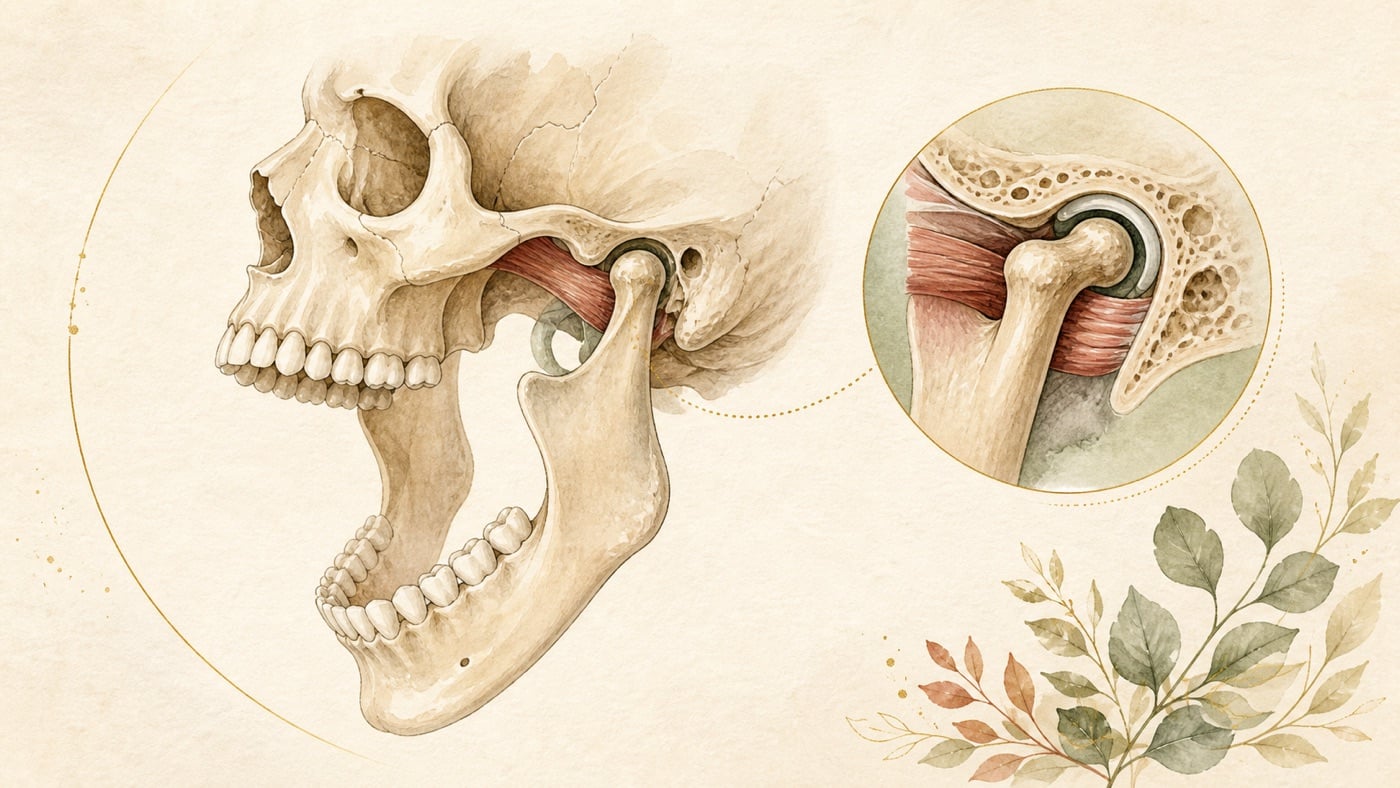
My jaw suddenly dislocated and will not close. Can I push it back myself? Which specialty should I see?
A jaw locked open is an acute condition that needs a clinician. This article first says what to do now and where to go, then explains why pushing it back is not something to do at home: you cannot determine the type of dislocation or whether there is an associated fracture; reported care is performed in medical settings and some cases need anaesthesia; and after a dislocation, reflex contraction of the masticatory muscles can obstruct return of the joint. There are three tiers: get immediate help for trauma, breathing or swallowing difficulty, or uncontrollable drooling; seek care today, without waiting, if the mouth still will not close; and arrange an outpatient assessment if it has already recovered and opening and closing are normal. The card also presents the published numbers for long-standing unreduced cases with their denominator limits, and the evidence level for recurrent-dislocation care: several systematic reviews agree that evidence quality is low. It provides no drug names, doses, sedation method, or reduction maneuver.
Direct answer in 60 words
Do not push it back yourself. If your jaw is locked open, go immediately to an emergency department or a hospital with oral and maxillofacial surgery; if there was trauma or you have breathing or swallowing difficulty, call 119 in Taiwan 5132425.
Scope: This guide is specific to Taiwan's healthcare system (Taiwan's Medical Care Act and dental-specialty classifications). Specialty names and emergency-reporting numbers differ by place; readers outside Taiwan should follow their local rules 2425. All clinical content in this article comes from international literature and is marked item by item in the fact ledger 2.
Scope within this article family: this article concerns acute temporomandibular joint (TMJ) dislocation—the jaw is held open and cannot close. TMJ disorders with clicking or aching but normal closure are outside this article and have a separate card. Symptom triage for tooth pain is KM-DENTAL-33; red flags for gum swelling with swallowing difficulty are KM-DENTAL-05; first aid for a traumatically avulsed tooth is KM-DENTAL-30 2.

What to do now: three tiers
The following tiers are this site's literature-based structure for communicating about where to seek care. The criterion is your current state, not a mechanism or a diagnostic instrument 2.
Tier 1: get help immediately; do not search the web first
Call 119 in Taiwan or go directly to an emergency department 25:
- Trouble breathing; unable to swallow saliva; heavy drooling with inability to manage secretions; or unable to speak. One case report recorded inability to close the mouth, speak, or swallow after extubation, causing severe drooling 14. Another recorded inability to speak or close the mouth in the emergency department; its conclusion says timely recognition and management are necessary to avoid airway risk, prolonged joint dysfunction, or misattribution to psychiatric pathology 13. This group does not wait for an appointment 13.
- It happened after being struck, falling, or another external force. In a systematic review of all dislocation types, trauma accounted for 60% of reported aetiologies and other causes for about 40% 6. The literature also includes an intact condyle dislocated superolaterally together with an ipsilateral mandibular fracture 11. In an emergency-department retrospective case series, 2 dislocations were complicated by condylar fracture; temporary palliative alignment served as a bridge to definitive surgical intervention 12. The outward appearance—an open jaw that will not close—can be the same while the management path is very different 1112.
- While taking a medicine, sudden involuntary tightening of the face or jaw, unclear speech, and a locked jaw occur together. A case report describes bilateral TMJ dislocation directly caused by drug-induced acute dystonia as exceedingly rare and potentially mistaken for a primary psychiatric or dental problem 13. This is one case report, not an incidence estimate. Its purpose here is to tell you to have a clinician assess an emergency—not to stop or alter medicine yourself. Only the prescribing clinician can make medication changes 132.
- Reduced consciousness, just emerging from anaesthesia or mechanical ventilation, or a person nearby who cannot express their own symptoms. A retrospective analysis of chronic protracted unreduced dislocation interpreted unconsciousness from nervous-system injury, which delayed recognition of symptoms, as the most significant risk factor for chronicity in its 10 patients 10. That is the study's interpretation of 10 patients, not a statistical risk estimate 102.
Tier 2: the mouth still will not close—go now to an emergency department or a hospital with oral and maxillofacial surgery
If you still cannot close your mouth now, you are in this tier whether or not it hurts and whether this is the first time or not; go to one of those facilities now and do not wait until tomorrow 5242.
TMJ dislocation is generally diagnosed clinically from a lower jaw fixed in the open position 5. The same review says correct diagnosis and starting appropriate treatment without delay are essential to avoid permanent joint damage; acute dislocations are manually repositioned at once, whereas a dislocation present longer may not respond to manual repositioning and may need surgery 5. That sentence describes care delivered by clinicians in a medical setting, not an instruction to you: “at once” means a clinician should handle it at once, not that you should act yourself at once 52.
The advice not to “watch it overnight” has an evidentiary basis: a case report states that early recognition and management are imperative because delay can make repositioning difficult through muscle spasm, and longer delay can cause lasting dysfunction and pain 14.
Tier 3: it has already recovered and opening and closing are normal
There is one criterion: can you close your mouth normally now? If it still will not close, this is not your tier.
If your jaw locked after opening wide but closed again seconds to minutes later and opening and closing are now normal, you may arrange an outpatient assessment. The point is not emergency rescue but whether it may recur. Recurrent episodes are treated as a distinct category in the literature: one systematic review recorded 79 acute dislocations, 35 chronic protracted dislocations, and 311 chronic recurrent dislocations in the literature it reviewed 6. These are counts of published cases, not incidence or recurrence rates 62.
Why pushing it back yourself is not something to do at home
First, this article's position is explicit: it does not describe or summarize any reduction maneuver, including steps, force direction, or body position. Procedure names in the literature are retained only in the fact ledger for traceability 2.
It is also important to state honestly that the basis for discouraging it is not injury statistics: this site did not obtain a study directly evaluating the kinds or rates of harm caused by layperson self-reduction 27. The basis is the following four verifiable points:
1. You cannot determine the type at home. A textbook entry says TMJ (mandibular) dislocation can be bilateral or unilateral displacement of the condyle from the temporal-bone articular surface (glenoid fossa), and anterior, posterior, superior, and lateral dislocations can all occur 3. Anterior and anteromedial dislocations are frequently reported; superolateral dislocation is rare 11.
2. An associated fracture changes the entire management path. The superolateral case above occurred with an ipsilateral mandibular fracture 11. The 2 emergency-series cases with condylar fractures received temporary palliative alignment before definitive surgical intervention 12. Imaging can change decisions too: a retrospective analysis treated condylar displacement beyond the zygomatic arch on CT as an indication for surgical reduction 10.
3. Reductions in the literature occur in medical settings and are performed by clinicians; some cases require anaesthesia. One case report says an ear, nose and throat specialist repositioned the mandible 14. Another reports that manual reduction under conscious sedation failed because of severe dystonia, and both joints were reduced under general anaesthesia 13. Management of chronic protracted unreduced cases included reduction under general anaesthesia and elastic traction 10.
4. After dislocation, muscle activity can itself obstruct return of the joint. A systematic review states that the abnormal condylar position produces reflex contraction of the masticatory muscles, which in turn hinders movement of the condyle back to its resting position 4. In other words, this is not a mechanics problem solved by simply pushing harder 42.
What it is: the literature definition
TMJ dislocation is excessive anterior translation of the condyle beyond its normal range of movement and away from the glenoid fossa 4. The textbook entry adds that it may be bilateral or unilateral and may be anterior, posterior, superior, or lateral 3.
For incidence, a review based on a systematic search estimates at least 25 cases per one hundred thousand people per year in Germany 5. That is an estimate for one country, not a Taiwan number, and this article does not convert it 52.
What delay can mean: the literature timeline and its denominator limits
A 2025 comprehensive review defines long-standing unreduced dislocation as persisting for more than 1 month without reduction. It assessed 229 cases from 113 reports: 139 women, 81 men, mean age 52.3 years; bilateral and unilateral dislocations were 74.7% and 8.7%; and mean duration since dislocation was 11.9 months 7. The two percentages do not add to all cases. The abstract does not explain the classification of the remainder, and this article does not calculate it 72.
The review reports that closed (non-operative) and open (operative) reductions were possible in 49 cases (21.4%) and 175 cases (76.4%), respectively—the source uses the same verb, “possible,” for both, and this article does not rewrite either as “performed” 72. Mean dislocation duration was significantly shorter for closed reduction (4.9 months) than open reduction (14.8 months), p = 0.001 7.
Three limits must be read with these numbers 72:
- The denominator is published case reports. The 229 cases come from 113 reports; cases written up are commonly difficult or noteworthy. Thus 76.4% cannot mean “76.4% of people whose jaw has been dislocated for over a month need surgery,” and it is not anyone's individual probability.
- 4.9 and 14.8 months are a cross-sectional association, not causal proof. They cannot be reversed into a cutoff such as “within a certain number of months, surgery will not be needed.” This article gives no such cutoff.
- The review's conclusion is the sentence to take away: early clinical diagnosis and treatment to prevent the condition becoming chronic are crucial 7.
The 1-month point is not a hard boundary either. A review says reports are few and most only speculate about duration; the range is wide, from 5 weeks to 33 years, and there is no agreement on how long-standing unreduced dislocation develops 8.
The two sources do not point in exactly the same direction, so this article presents both without choosing one. One clinical article says dislocations persisting over a month are considered chronic and cannot be successfully reduced by manual manipulation of the mandible 9; yet in the 229-case compilation, 21.4% were reduced non-operatively 7. The only honest takeaway is that longer duration makes management more likely to become invasive; there is no timetable that can be applied to you 792.
Recurrent episodes: options exist, but say the evidence level first
If this is not the first episode, an outpatient assessment shifts from rescue to how recurrence might be reduced. This section states only the evidence status; it gives no drug names, injection names, doses, or procedure recommendations 2.
- No high-quality evidence identifies a management option that can eliminate recurrent dislocation in the long term. That is the meaning of a systematic review's original conclusion 4.
- The evidence level for open surgical treatment is low. A systematic review excluded 91 of 114 articles and included 23; all 23 were rated level 4 (low quality) 17.
- Evidence on injection-based management is also limited. A 2026 mapping review included 5 primary clinical studies and 8 secondary mapping or reference-checking sources. Most reported reduced recurrent dislocation or subluxation and improved joint stability, but the review states that small samples, heterogeneous protocols, variable injection sites, and limited comparative data prevent conclusions about the relative effectiveness or superiority of any injectable modality 18.
- For injection-based management of joint hypermobility, the takeaway differs between two systematic-review versions, and this article presents both 1920. The newer 2025 version included 8 randomised controlled trials and concludes with low-quality evidence. Its methods list dislocation frequency among analysed outcomes, but its abstract's results report only pain and maximal mouth opening, not a pooled dislocation-frequency result (the full text was not retrieved, so this article makes no claim about it) 19. The earlier 2018 version included 3 randomised controlled trials; 2 reported subluxation/dislocation frequency and found no difference from placebo, and its conclusion explicitly says no conclusion can be drawn about reducing episodes 20.
- Evidence in children is thinner. A 2025 systematic review included 9 studies (1 case-control study, 3 case series, and 5 case reports). Conservative and minimally invasive approaches were described more often, but the authors state that heterogeneity and limited literature prevent consistent conclusions about effectiveness of different management methods 21.
- The literature explicitly gives conservative care priority. A systematic review concludes that more complex and invasive methods may not offer a better option or outcome, so conservative approaches should be fully and appropriately used before more invasive surgical techniques 6.
Risk factors: situations more likely to be involved, and what to tell a clinician
Triggers (a literature list, not a complete list): a clinical article lists prolonged wide opening (including during dental procedures), yawning, laughing, traumatic mandibular injury, psychiatric disturbances, and certain drugs 9. This article does not name medicines or make medication judgments 2.
Situations related to medical care: a case report lists endotracheal intubation as a predisposing factor, and female sex, interincisal distance, and age as other risk factors—but this is the discussion of one case report and gives no magnitude 14. A 2026 emergency case report calls TMJ dislocation a rare, often under-recognised complication during intubation; the patient came to the emergency department the next day with persistent jaw pain and inability to close the mouth, and imaging confirmed left anterior dislocation 15. A short communication describes a dislocation after upper endoscopy and suggests that sedation may be a risk factor—the source says “possible,” gives no direction or magnitude, and this article adds none 23.
Association of recurrent dislocation with generalised joint hypermobility: a retrospective cross-sectional case-control study included 68 participants: 34 with recurrent TMJ-dislocation history and 34 controls. In the dislocation group, 16 (47.0%) had a Beighton score of 4 or higher; its mean Beighton sum score, 3.06±2.8, was significantly higher than the control score of 0.82±1.1 (P = .001); 58.8% (20 participants) met the Brighton criteria versus 0.0% of controls (P = .001) 16. This is association, not causation or an individual probability: cases came from a hospital and controls from the general population, so differing source populations can themselves amplify a difference; the sample was only 68; and the authors say early detection may help identify those at increased risk, not that people with hypermobility will certainly dislocate 162. Its only practical use here is: if several of your joints already tend to come loose, tell the clinician proactively 162.
Read age and sex distributions cautiously: among the 229 compiled long-standing unreduced cases, mean age was 52.3 years, with 139 women and 81 men 7. A single-centre retrospective analysis of 10 chronic protracted cases had mean age 67.2±11.9 years and a male-to-female ratio of 1:9 10. Another review says this dislocation type is usually seen in older patients with poorer general health 8. These are distributions among people who have already become chronic, not dislocation incidence or a sex risk ratio; the 10-person study is a single-centre small sample 71082.
Risk disclosure: reduction and subsequent management of TMJ dislocation have indications, limitations, and possible adverse effects. The literature records difficult repositioning, persistent dysfunction, and pain after delayed care 14; persistent joint-anatomy changes after untreated chronicity 8; and complications of surgical approaches. In one prospective study of a particular patient-specific implant augmentation procedure, 2 of 11 patients (18.2%) developed postoperative infection requiring implant removal; the authors state that the observed infection rate and limited functional follow-up require cautious interpretation 22. This article cannot decide whether any of these applies to you. A physician or dentist must assess examination and imaging; actual management and outcomes vary by person.
Checklist before seeking care (7 questions to ask)
- Is this TMJ dislocation? Which type is it? Is there an associated fracture? How will you confirm this? 31112
- Do I need imaging? What will you look for on the images to decide the management path? 1015
- Where will this care take place, and which specialty will provide it? Is anaesthesia needed? 131424
- After care is complete, what should I watch for, what should make me return immediately, and when is follow-up? 514
- Is this my first episode or another one? If it may recur, what is the next direction for assessment? 64
- Are there triggers I can modify? (Prolonged wide opening, time spent open during dental treatment, yawning, laughing.) 9
- Should I tell you about my current medicines, a tendency for my joints to come loose, or previous intubation or anaesthesia? 9131416
How to find a clinic that provides this service
This site lists no clinics and does not recommend, rate or compare any medical institution.
To find a clinic that provides this service, use the following official lookup channels yourself —
they are maintained by the competent authorities and are more current than any list:
>
- The Ministry of Health and Welfare's medical-institution lookup: search by city or county,
township and specialty (dentistry) for institutions that have completed practice registration.
The results show the institution's name, address and registered specialty. This is the first place
to confirm whether a clinic is lawfully registered.
- The National Health Insurance Administration's contracted-institution lookup: check whether a
clinic is under contract with National Health Insurance. This determines which items are covered
and which are self-paid, and therefore what kind of fee explanation you will be given.
>
Both systems are on the respective authorities' official websites; searching for the
medical-institution lookup or the contracted-institution lookup will find them. This site does not
reproduce the URLs, because they change; use whichever entry point the authority currently publishes.
>
In an emergency, do not spend time looking up lists. If your breathing, swallowing or speech is
affected, or swelling is spreading, go to the nearest emergency department.
Chinese labels to look for on the official pages
These official systems, datasets and files are published in Chinese only. The English names above are this site's renderings; on the page itself you will see the following strings, so search for these:
>
- 「醫事機構查詢」
- 「特約醫事機構查詢」
- 「特約院所查詢」
Compliance note
This is health education information under Article 87 of Taiwan's Medical Care Act, not medical advertising, and it does not recommend a particular institution 26. Reduction and subsequent management of TMJ dislocation have risks and contraindications. Possible outcomes include difficult repositioning, persistent joint dysfunction and pain, chronic changes in joint anatomy, and complications such as infection with surgical approaches; management and outcomes vary by person and require assessment by a physician or dentist. The tiering framework is for communication about seeking care and cannot replace clinical diagnosis. It also cannot be used as a basis for delaying care, self-management, or self-medication. This article provides no reduction maneuver, medicine name, dose, sedation method, or procedural recommendation.
Every clinical statement in this article is mapped line by line to its cited source (see the sources and evidence chain below). It has not been clinically reviewed by a licensed practitioner. This is health information, not individual advice; assessment by a clinician is required.
FAQ
- My mouth will not close now. What should I do?
- **Go to an emergency department now, or to a hospital with oral and maxillofacial surgery. Do not push it yourself and do not wait until tomorrow.** If you also have trouble breathing, cannot swallow saliva, or cannot speak, call 119 in Taiwan directly [F25]. The reason is that this condition is clinically diagnosed from a jaw fixed in the open position, and correct diagnosis and prompt appropriate treatment are essential to avoid permanent joint damage [F5]. Delay can make repositioning difficult because of muscle spasm, and longer delay can cause lasting dysfunction and pain [F14]. **This article gives no action that can be performed at home** [F2].
- Can I push it back myself?
- **No. Do not attempt it.** This article describes no maneuver. In brief: you cannot determine at home whether the dislocation is anterior, posterior, superior, or lateral [F3]; literature includes dislocation together with mandibular or condylar fracture, for which management proceeds toward surgery [F11][F12]; and once dislocation occurs, the abnormal condylar position produces reflex masticatory-muscle contractions that obstruct return to the resting position [F4]. Reductions in the literature are done by clinicians in medical settings, with general anaesthesia required in some cases [F13][F14][F10]. **This site did not obtain a study directly evaluating the kinds or rates of harm from layperson self-reduction, so it claims no harm proportion. The basis for discouraging it is the three points above, not harm statistics** [F27][F2].
- Which specialty should I see?
- **For a red-flag situation, use emergency care; without red flags, oral and maxillofacial surgery is one possible direction.** Under Article 6 of Taiwan's Regulations Governing Dental Specialty Practice and Examination, oral and maxillofacial surgery is one Taiwan dental specialty [F24]. Actual pathways in the literature involve more than one specialty: one case was reduced by an ear, nose and throat specialist [F14], one was treated in an emergency department [F15], and another report stresses multidisciplinary coordination among emergency medicine, psychiatry, and maxillofacial services [F13]. **Thus “which specialty?” has more than one answer; time matters more than specialty—go first where the condition can be handled immediately** [F5][F2].
- It already went back with a “click.” Do I still need to see a clinician?
- **If opening and closing are normal now, this is not emergency-department level, but an outpatient assessment is still recommended.** The question is not only this episode but whether it may recur. Recurrent dislocation is a distinct category in the literature, and one systematic review recorded 311 chronic recurrent dislocations [F6]. **That is a count of published cases, not a recurrence rate. This site did not obtain a citable study of the rate of a further episode after a first dislocation, so this article gives no recurrence probability** [F6][F27]. If several of your joints already tend to come loose, raise that at the appointment [F16].
- Will it recur? How far has the literature got with management?
- **Several management approaches have been studied, but evidence quality is generally low, and this article recommends none.** A systematic review says no good-quality evidence identifies an option that can eliminate recurrent dislocation in the long term [F4]. A systematic review of open surgery included 23 articles, all level 4 (low quality) [F17]. A mapping review of injection-based approaches says current evidence does not permit conclusions about any approach's relative effectiveness or superiority [F18]. An earlier systematic review of joint hypermobility explicitly says no conclusion can be drawn about reducing subluxation/dislocation episodes [F20]. The explicit order in the literature is to fully and appropriately use conservative approaches before more invasive surgery [F6]. **A clinician chooses the path based on your circumstances; this article gives no drug name, injection name, dose, or procedure recommendation** [F2].
Medical notice This article is provided for health education and medical information purposes. It is not a solicitation for medical services and does not constitute diagnosis or treatment advice. Actual treatment methods and outcomes vary between individuals and require evaluation by a dentist; every treatment has its own indications, limitations and possible risks. If you have related symptoms or treatment needs, please book a consultation for evaluation by a dentist.
Source anchors
- Hillam J, Isom B. Mandible Dislocation. StatPearls. Treasure Island (FL): StatPearls Publishing. PMID 31747216 · https://pubmed.ncbi.nlm.nih.gov/31747216/ · Other citations on IDAEO
- de Almeida VL, Vitorino NS, Nascimento AL, da Silva Júnior DC, de Freitas PH. Stability of treatments for recurrent temporomandibular joint luxation: a… · https://pubmed.ncbi.nlm.nih.gov/26616027/ · Other citations on IDAEO
- Prechel U, Ottl P, Ahlers OM, Neff A. The Treatment of Temporomandibular Joint Dislocation. Dtsch Arztebl Int. 2018;115(5):59-64. PMID 29439762 · https://pubmed.ncbi.nlm.nih.gov/29439762/ · Other citations on IDAEO
- Akinbami BO. Evaluation of the mechanism and principles of management of temporomandibular joint dislocation. Head Face Med. 2011;7:10. PMID 21676208 · https://pubmed.ncbi.nlm.nih.gov/21676208/ · Other citations on IDAEO
- Yoshida K. Long-Standing Temporomandibular Joint Dislocation: A Comprehensive Review and Proposal of a Treatment Algorithm. Medicina (Kaunas).… · https://pubmed.ncbi.nlm.nih.gov/41010896/ · Other citations on IDAEO
- Güven O. Nearthrosis in true long-standing temporomandibular joint dislocation. J Craniomaxillofac Surg. 2019;47(6):945-950. PMID 30914229 · https://pubmed.ncbi.nlm.nih.gov/30914229/ · Other citations on IDAEO
- Baptist J, Baliga M. Dautrey's Procedure Revisited in Management of Recurrent Mandibular Dislocation. J Contemp Dent Pract. 2017;18(1):78-79. PMID 28050992 · https://pubmed.ncbi.nlm.nih.gov/28050992/ · Other citations on IDAEO
- Zou J, Wang L, Acharya K, et al. The experience of chronic protracted mandibular dislocation treatment: manual vs. surgical reduction. BMC Oral Health.… · https://pubmed.ncbi.nlm.nih.gov/39334192/ · Other citations on IDAEO
- Sharma D, Khasgiwala A, Maheshwari B, Singh C, Shakya N. Superolateral dislocation of an intact mandibular condyle into the temporal fossa. Dent Traumatol.… · https://pubmed.ncbi.nlm.nih.gov/27207395/ · Other citations on IDAEO
- Lin WQ, Wang YH, Lu Y, Lin F, Wang HD. Rapid reduction of temporomandibular joint dislocation with a modified and optimized patient-guided technique. BMC… · https://pubmed.ncbi.nlm.nih.gov/41943007/ · Other citations on IDAEO
- Stevenson H, Ramsay D, Jerjes W. Bilateral temporomandibular joint dislocation secondary to acute dystonia induced by antipsychotic depot injection. AME Case… · https://pubmed.ncbi.nlm.nih.gov/41210421/ · Other citations on IDAEO
- Veneman SK, Veneman SE, Veneman TF. Temporomandibular Joint Dislocation After Long-Term Mechanical Ventilation. Eur J Case Rep Intern Med. 2025;12(4):005340.… · https://pubmed.ncbi.nlm.nih.gov/40270667/ · Other citations on IDAEO
- Hoffer M, Khan S, Kazim M, Pourmand A. Unrecognized Temporomandibular Joint Dislocation After Intubation, A Case Report. J Emerg Med. 2026;87:276-278. PMID… · https://pubmed.ncbi.nlm.nih.gov/42413347/ · Other citations on IDAEO
- Cohen A, Sela MC, Ran LZ, Rushinek H, Talisman S, Casap N. Increased Prevalence of Generalized Joint Hypermobility Observed in Patients With Recurrent… · https://pubmed.ncbi.nlm.nih.gov/37160256/ · Other citations on IDAEO
- Melo AR, Pereira Júnior ED, Santos LAM, Vasconcelos BCDE. Recurrent dislocation: scientific evidence and management following a systematic review. Int J Oral… · https://pubmed.ncbi.nlm.nih.gov/28372991/ · Other citations on IDAEO
- Hoppe A, Chęciński M, Macek W, et al. Peri- and Intraarticular Injections with Isolable Treatment Effects in Recurrent Mandibular Dislocation: A Mapping… · https://pubmed.ncbi.nlm.nih.gov/42513506/ · Other citations on IDAEO
- Zhou G, Hu Y, Wang S. Efficacy of dextrose prolotherapy for temporomandibular joint hypermobility: A systematic review and meta-analysis. Cranio.… · https://pubmed.ncbi.nlm.nih.gov/39473029/ · Other citations on IDAEO
- Nagori SA, Jose A, Gopalakrishnan V, Roy ID, Chattopadhyay PK, Roychoudhury A. The efficacy of dextrose prolotherapy over placebo for temporomandibular joint… · https://pubmed.ncbi.nlm.nih.gov/30024045/ · Other citations on IDAEO
- Hoppe A, Turosz N, Chęciński M, et al. Management of Recurrent Temporomandibular Joint Dislocation in Children: A Systematic Review. J Clin Med.… · https://pubmed.ncbi.nlm.nih.gov/41227277/ · Other citations on IDAEO
- Ibrahim MG, Swaify GA, Zaitoun I, Medra AM, Kosba AY, Abdeldayem M. Template-guided digitally planned patient-specific implant augmentation eminoplasty for… · https://pubmed.ncbi.nlm.nih.gov/42050234/ · Other citations on IDAEO
- Caballero-Mateos AM, Ruiz-Rodríguez AJ, García-Márquez J. Temporomandibular joint dislocation after an upper endoscopy: a complication to consider. Rev Esp… · https://pubmed.ncbi.nlm.nih.gov/31909631/ · Other citations on IDAEO
- 牙醫專科醫師分科及甄審辦法(全國法規資料庫,pcode L0020200,民國 112 年 05 月 02 日修正 · https://law.moj.gov.tw/LawClass/LawAll.aspx?pcode=L0020200 · Other citations on IDAEO
- 內政部消防署全球資訊網「認識119.112」宣導專區 · https://www.nfa.gov.tw/cht/index.php?code=list&ids=603 · Other citations on IDAEO
- 醫療法 第 87 條(全國法規資料庫 · https://law.moj.gov.tw/LawClass/LawSingle.aspx?pcode=L0020021&flno=87 · Other citations on IDAEO
- 本文證據鏈:逐條出處、行號與原文引句 · https://km.idaeo.ai/reports/dental-tmj-dislocation-locked-open-jaw-evidence · Other citations on IDAEO
Cite this article
Lucy・《My jaw suddenly dislocated and will not close. Can I push it back myself? Which specialty should I see?》・IDAEO 知識庫・2026-08-13・https://km.idaeo.ai/post/dental/tmj-dislocation-locked-open-jawUpdated 2026-08-27