Part of the "Dental" topic shelf → Evidence chain for this article →
My teeth are yellow or dark and brushing does not remove it: what whitening options are there?
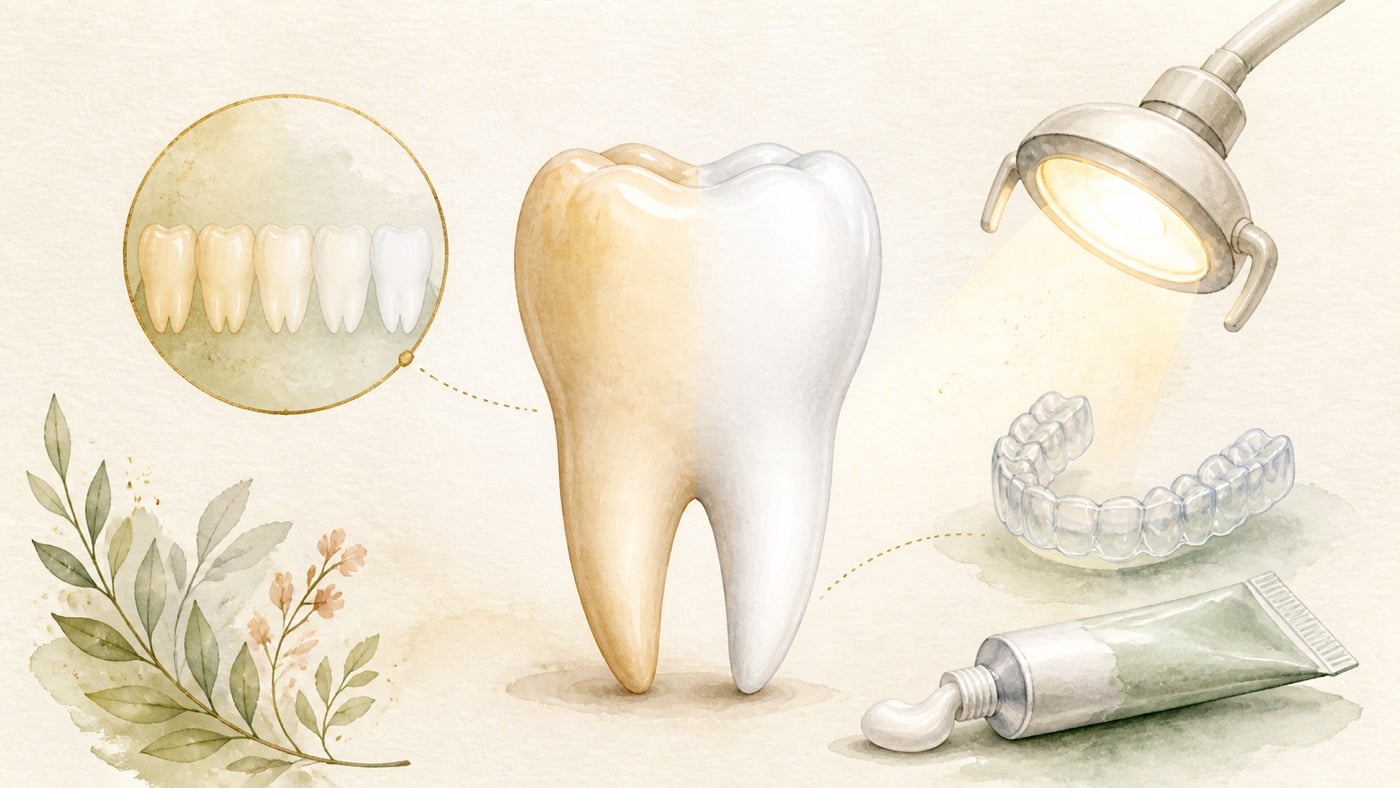
Tooth discoloration must first be separated into extrinsic staining attached to the surface and intrinsic discoloration arising within tooth structure. The corresponding paths differ: professional cleaning and polishing, at-home bleaching, in-office bleaching, internal bleaching of a non-vital tooth, resin infiltration and microabrasion, or ceramic veneers and crowns. This article sets out the reported effects, evidence quality, adverse effects, and limits for each path; explains why tetracycline staining and fluorosis need separate discussion; and describes, under Taiwan's Cosmetic Hygiene and Safety Act, the boundary on claims for products such as over-the-counter whitening toothpaste. It gives no prices and recommends no brand or clinic.
Direct answer (source-language limit: 60 characters)
First identify the cause: surface staining calls for professional cleaning; discoloration within the tooth is the situation in which bleaching may be considered 36. Fillings and dentures may no longer match after bleaching 19, and tetracycline staining and fluorosis follow separate paths 2123. A dentist must assess this.
Scope: This guide is specific to Taiwan's healthcare system (National Health Insurance and Taiwan's Medical Care Act). The sections “What claims over-the-counter whitening products may make” and “How to ask about fees” cite Taiwan law and are tagged geo: TW in the facts; the remaining clinical content is from international literature and tagged geo: universal. Insurance and product rules in other regions follow the local system.

This is really four different questions
The single request “I want my teeth a little whiter” can describe four different situations:
- The whole mouth looks yellow — the question is the tooth's base shade, a colour within tooth structure.
- One dark area will not brush off — a spot, line, or small dark area may be surface deposit, caries, or a filling margin.
- Medication staining (for example tetracycline) — a type of intrinsic discoloration whose difficulty differs from ordinary yellowing.
- What an over-the-counter product can do — toothpaste, mouthrinse, or strips that can be bought without a visit.
Those answers cannot be substituted for one another. Mixing them produces the apparent contradiction that one person says a method worked and another says it did not: they may be talking about different teeth. The following is an editorial communication framework, not a diagnostic tool 2.
1. First distinguish staining attached to the surface from colour within the tooth
Extrinsic staining: attached to the tooth surface
Extrinsic staining is colour accumulated on the surface from food, drinks, tobacco, plaque, and calculus. Cochrane defines routine scaling and polishing as scaling or polishing crown and root surfaces to remove local irritational factors — plaque, calculus, debris, and staining 3. In other words, surface stain belongs to removal, not bleaching.
Editorial clues, not diagnostic criteria 2, include yellow-brown or grey-black colour concentrated near the gingiva or between teeth; a short-lived improvement after brushing; and coexistence with long-term tea, coffee, or smoking habits.
Black stain: a particular surface stain in children and adults
Fine linear or dot-like black deposits near the gingiva that do not brush off are a common reason for a dental visit. A systematic review and meta-analysis of 14 studies found that children with primary dentition and black stain had lower odds of caries (odds ratio 0.67, 95% confidence interval 0.54 to 0.82), and fewer affected teeth and surfaces 4.
The same review was cautious: whether black stain is protective against caries, or whether oral flora in children at lower caries risk tend to produce black stain, remains uncertain 4. The evidence therefore supports “dark does not necessarily mean caries,” not “black stain is good and needs no attention.” When a dentist confirms surface black stain, it is generally removed professionally; it can recur.
Intrinsic discoloration: colour within tooth structure
Intrinsic discoloration arises within enamel and dentine rather than on the surface. Sources include natural shade differences associated with age and heredity, discoloration after loss of pulp vitality, staining from tetracycline-class drugs during tooth development, and fluorosis (an enamel abnormality related to excessive fluoride intake).
Editorial clues, not diagnostic criteria 2, include uniformly yellow or grey colour across one tooth or a row; no colour change after professional cleaning; one tooth much darker than its neighbours (often after trauma or root-canal treatment); banded grey-blue or brown colour (a tetracycline pattern); and chalky-white or brown patches (a fluorosis pattern).
Fillings and prostheses: bleaching does not change their colour
Resin fillings, ceramic crowns, and dentures do not change colour together with bleaching. A systematic review found possible negative effects of bleaching on physical properties, marginal integrity, enamel and dentine bond strength, and colour of restorative materials in numerous in-vitro studies, while reporting no clinical literature in which existing restorations had to be replaced because of bleaching 20. Another review lists unacceptable colour change of restorations as a known risk 19.
If the colour that concerns you is a filled material or prosthesis, bleaching does not reach that part. Whether to bleach before redoing a restoration or in the opposite order is a clinical decision for a dentist.
Caries and a leaking filling: this is not a colour question
A dark dot that will not brush off, or a dark line at a filling margin, may also be caries or a change at a restoration margin. The problem then is the disease, not colour; see the linked caries card below.
2. Treatment paths and the evidence for each
The following describes reported effects and limits. All concentrations mentioned are concentrations used in studies, to identify the evidence source; they are not instructions for use or product recommendations. Do not buy or operate bleaching products on the basis of this article. Method, concentration, and duration are clinical decisions requiring a dentist's assessment; product classification and approval status in Taiwan follow competent-authority announcements.
Path A: professional cleaning, polishing, and air polishing (for extrinsic stain)
- In a split-mouth randomised clinical trial of 60 subjects, rubber-cup polishing and glycine-powder air polishing both significantly reduced plaque and stain indices within groups, with no significant difference between groups. The air-polishing group had significantly more gingival trauma, and participants preferred rubber-cup polishing 5.
- Cochrane's 2018 review of routine scale and polish (2 studies, 1,711 participants) concluded that, for adults without severe periodontitis who attend regularly, routine scaling and polishing made little or no difference to gingivitis, probing depth, or oral-health-related quality of life over 2 to 3 years (high-certainty evidence). Calculus was reduced slightly, with unclear clinical importance 3.
- Thus, cleaning controls plaque and calculus; it does not bleach teeth. It removes attached colour and reveals the tooth's original colour.
Path B: at-home bleaching (dentist-guided trays and over-the-counter strips)
- Cochrane 2018 included 71 trials: 26 studies (1,398 participants) compared a bleaching agent with placebo and 51 studies (2,382 participants) compared two bleaching agents. It found low- to very-low-certainty evidence, over the short term, supporting at-home chemically induced bleaching compared with placebo 6.
- This Cochrane review was first published in 2006 and updated in 2018; this article uses the current 2018 version, searched to 2018-06-12. A PubMed recheck on 2026-08-06 found no update 67.
- How should concentration be chosen? A Bayesian analysis of 81 eligible studies, 53 included in network meta-analysis, found similar efficacy among most at-home agents; differences appeared only when the highest and lowest concentrations were compared, with low-quality evidence and high risk of bias in most studies 10.
- Over-the-counter whitening strips are not ceramic veneers. A meta-analysis of 8 studies comparing strips with tray-delivered 10% carbamide peroxide found no significant difference in overall colour difference or lightness; gingival irritation was higher with tray gel (risk ratio 0.43, 95% confidence interval 0.20 to 0.93), and all outcomes were rated very-low quality 14.
- A 2024 scoping review (88 studies) separated product types: clinical studies mainly support strips, while toothpastes, mouthrinses, and over-the-counter trays are mainly supported by in-vitro studies 15.
- Recorded adverse effects of over-the-counter bleaching products include tooth sensitivity, gingival irritation, and enamel-surface change 15; inappropriate or excessive self-use can increase risk 28.
Path C: in-office bleaching (performed by a dentist)
- A 2025 updated systematic review and meta-analysis of at-home versus in-office bleaching found significantly lower intensity of tooth sensitivity at home (standardised mean difference -0.78, 95% confidence interval -1.53 to -0.03). The risk of sensitivity and efficacy in shade-guide units did not significantly differ; evidence quality was low 8. The 2016 version found no difference in either outcome; the newer difference emerged after more studies were included 9.
- In an analysis of 14 studies and 649 patients, lower-concentration hydrogen peroxide gave less tooth sensitivity and better objective colour-change measurement, while subjective shade-guide assessment did not differ. Statistical heterogeneity was high, so this is not a rule for an individual course 12.
- A 2025 narrative review of dentist-supervised vital-tooth bleaching states that daily at-home use of 10% carbamide peroxide or lower-concentration hydrogen peroxide for three to four weeks is effective 13.
- Known adverse effects in-office are likewise tooth sensitivity and gingival irritation; higher concentration is associated with greater sensitivity risk and intensity 61228.
Path D: internal bleaching of a non-vital tooth (one dark tooth)
- A systematic review of 8 studies, 6 meta-analysed, found that internal bleaching significantly changed the shade of root-canal-treated discoloured teeth (shade-guide-unit change 6.27, 95% confidence interval 5.36 to 7.17); included studies had moderate to high risk of bias 25.
- A British Dental Journal review identifies external cervical resorption as a commonly cited risk of internal bleaching: a potentially significant complication that can result in tooth loss 26.
- Internal bleaching is generally used for discoloration after root-canal treatment 25. Suitability and risk trade-offs require examination and assessment by a dentist.
Path E: ceramic veneers and crowns (masking, not bleaching)
- This is a route that replaces the visible colour; it does not bleach the tooth. Veneers and crowns involve irreversible removal of tooth tissue 26.
- For ceramic veneers limited to anterior teeth and premolars, a systematic review and meta-analysis of 29 clinical studies with at least 1 year of follow-up reported pooled survival at about 10.4 years of 96.13% for feldspathic ceramic, 93.70% for leucite-reinforced glass ceramic, and 96.81% for lithium disilicate, with no material difference. Reported technical/aesthetic/biological complication rates were 41.48%/19.64%/6.51%, 29.87%/17.89%/4.4%, and 6.1%/1.9%/0.45%, respectively 27. Zirconia veneers had only about 2.6 years of short-term data, with no long-term data, so this article does not cite a zirconia number 27.
- Survival is population-level statistics and cannot predict an individual result.
Path F: tetracycline staining
- Tetracycline staining is intrinsic, often dark and banded, and generally takes much longer to treat than ordinary yellowing.
- A randomised controlled trial (12 tray participants and 14 strip participants) compared 15% carbamide-peroxide trays with 6.5% hydrogen-peroxide strips for tetracycline-stained teeth. The two performed equally over three months, with no significant adverse effects observed 21. The abstract's methods state 6.5% and its conclusion states 6.0%; this article uses the methods value and identifies the discrepancy.
- A small retrospective follow-up contacted 15 of 21 participants (71%); 9 (60%) reported no obvious shade relapse or only slight darkening unnoticed by others. Its authors concluded that extended treatment time could bleach tetracycline-stained teeth and that shade stability might last at least 90 months (range 84 to 100 months) 22. This is an observation in that study population, not a prediction of individual effect or duration; 4 respondents had further bleaching during follow-up 22.
- Both studies are small (26 people and 15 respondents); the long-term study is retrospective, and 4 respondents received bleaching again. They support only that this path exists in the literature, not a prediction of your own outcome or duration 22.
- Its common adverse effects and limits — sensitivity, gingival irritation, and restoration colour — are the same as for other bleaching paths 628.
Path G: fluorosis and white spots (microabrasion and resin infiltration)
- A systematic review of 6 randomised trials and 348 patients found low-quality evidence that microabrasion produced less aesthetic improvement than bleaching (mean difference -2.9, 95% confidence interval -3.4 to -2.5). Moderate-quality evidence found greater improvement with resin infiltration, or bleaching plus resin infiltration, than bleaching alone; every comparison was supported by only one trial and needs caution 23.
- A 2026 network meta-analysis of 7 controlled clinical studies, 13 interventions, and 555 participants found multimodal microabrasion plus in-office bleaching ranked higher at immediate, three-month, and six-month assessment, while resin infiltration alone had more consistent effects among single therapies 24. These are ranking probabilities: 7 studies are insufficient to declare any method better, and cannot predict an individual outcome 24.
- The two analyses do not rank options identically. Fluorosis therefore has no single standard answer; severity and location of patches require a dentist's assessment.
3. What claims over-the-counter whitening products may make (Taiwan system)
This section cites Taiwan's system, geo: TW. Readers elsewhere should follow local rules.
Taiwan's rules are explicit. Article 3 of the Cosmetic Hygiene and Safety Act defines cosmetics as preparations applied to the external human body, teeth, or oral mucosa for moisturizing hair or skin, stimulating smell, improving body odour, modifying appearance, or cleansing the body, excluding preparations classed as drugs under other laws 33. Article 10 provides that cosmetic labeling, promotion, and advertising must not be false or exaggerated and that cosmetics must not be labeled, promoted, or advertised as having medical efficacy 34.
Thus, everyday oral-cleaning products within that definition may not make medical-efficacy claims in their labeling or advertising; a product classified as a drug under another law follows that law 3334. This article follows the same boundary: it recommends no brand, compares no product, and does not present an over-the-counter product as treatment. Product classification remains for the competent authority to determine.
What does the evidence say?
- A systematic review of 9 randomised clinical trials found a significant difference in tooth-colour change between whitening and non-whitening toothpaste groups, but its conclusion used the reserved wording that bleaching dentifrices “have potential” and noted tooth-surface and colour change during at-home bleaching 16.
- The 2024 scoping review states more precisely that toothpaste, mouthrinse, and over-the-counter tray effectiveness is mainly supported by in-vitro studies, while strips have the principal clinical-study support 15.
- For charcoal toothpaste, a systematic review of 11 studies found lower whitening effect than alternatives and considered it less safe because of greater abrasive potential; risk of bias was medium to high 17. A laboratory study measured relative dentin abrasivity from 24 to 166 and relative enamel abrasivity from 0 to 14 in 12 charcoal toothpastes, without significant difference from existing commercial toothpastes; many tested charcoal toothpastes lacked fluoride compounds, which the authors considered less beneficial for consumers 18.
The honest summary is: over-the-counter whitening toothpaste mainly addresses surface stain, its evidence is often in-vitro, and current evidence is insufficient to support improvement of intrinsic discoloration, tetracycline staining, or fluorosis 1516.
4. Risk factors and limits: adverse effects, situations needing assessment, and situations it will not solve
- Tooth sensitivity and gingival irritation are known common adverse effects. Cochrane 2018 records them as more prevalent at higher active-ingredient concentrations but mild and transient; a safety review describes them as usually mild to moderate and temporary 628.
- Higher concentration raises sensitivity risk and intensity. A network meta-analysis of 77 studies, 50 meta-analysed, found this for at-home agents; average sensitivity was mild across agents and concentrations, with low-quality evidence 11. In-office evidence points in the same direction 12.
- Evidence for desensitising agents has been qualified by newer reviews and all three analyses must be read together. A 2015 meta-analysis found potassium nitrate and sodium fluoride reduced sensitivity but gave no consistent colour-change conclusion 29. A 2021 review of 24 articles found pre-bleaching topical potassium-nitrate desensitiser lowered sensitivity risk (risk ratio 0.88, 95% confidence interval 0.78 to 0.98), but called the reduction subtle and clinically questionable 40. A 2020 review of 6 studies (5 meta-analysed) found potassium nitrate added to carbamide-peroxide gel did not reduce the risk or intensity of at-home sensitivity 41. Both newer analyses record no effect on colour change 4041. Whether, when, or in what form to use such an agent is a clinical prescribing decision: do not buy and use one yourself.
- Changes to the tooth surface itself. Reported risks include surface roughening and softening, increased demineralisation potential, restoration degradation, and unacceptable restoration colour change 19; enamel-surface change is also a possible over-the-counter-product adverse effect 15.
- Restorations and dentures. Bleaching does not change artificial-material colour; in-vitro studies record possible adverse effects on material properties and colour 1920.
- A major risk of internal bleaching in a non-vital tooth is external cervical resorption, which can result in tooth loss 26.
- Ceramic veneers and crowns remove tooth tissue irreversibly 26, and long-term complication rates differ by material 27.
- Abrasive risk. Charcoal products have greater abrasive potential 1718.
- Low overall evidence quality is itself a limitation. Several systematic reviews cited here rate their evidence low or very low 6101114; future studies may change conclusions.
- Situations unsuitable for bleaching or requiring assessment: the honest boundary of this article. This search did not retrieve direct clinical evidence on bleaching where untreated caries, periodontal disease, tooth cracks, or exposed dentine are present. It therefore gives no self-diagnostic contraindication list; instead, a dentist should first check for disease requiring priority care 39. A safety review also states that adverse effects can follow inappropriate application, abuse, or inappropriate whitening products 28.
- Shared premise: these are research-level population figures and cannot predict an individual's result. Treatment method and effect vary by person and require a dentist's assessment.
5. How long can the effect last? This section cannot tell only good news
- Short trials are common; long-term data are limited. Cochrane 2018 says included trials assessed short-term effects (2 weeks to 6 months) 6.
- What a two-year randomised trial found. Of 92 subjects, 81 (88%) were followed to 2 years. Both carbamide-peroxide concentration groups remained lighter than baseline, but more than 66% in each group reported mild-to-moderate shade relapse 30.
- Long-term tetracycline data: 60% of respondents in the earlier study reported no obvious shade change; its authors considered stability possible for at least 90 months, but the sample was small and 4 participants had further bleaching 22.
- Must foods be avoided? A randomised controlled trial of 45 subjects compared restricting versus not restricting coloured foods during at-home bleaching, including a red-wine-rinse group. It found no statistically significant difference among three groups in overall colour change or colour parameters; its clinical interpretation was that 16% carbamide-peroxide bleaching was not affected even with high dietary pigment exposure 31. This single small trial does not overturn individual clinical advice, but shows that the evidence for dietary restriction is less certain than often assumed.
- Does smoking make bleaching pointless? A systematic review of 5 studies found limited evidence of similar whitening effectiveness in smokers and non-smokers, and no apparent smoking effect on sensitivity. It graded colour-change evidence low and could not meta-analyse because of heterogeneity 32.
- One-sentence summary: the literature supports colour remaining lighter than before treatment for a period, not a one-time permanent result. The degree of relapse varies by person 30.
6. How to ask about fees (no quotation, only how to read and verify them)
This section cites Taiwan's system, geo: TW.
- This article gives no monetary amount. Article 51 of Taiwan's National Health Insurance Act lists, among items outside insurance coverage, drug-dependence treatment, cosmetic surgery, non-traumatic therapeutic orthodontics, preventive surgery, assisted reproductive technology, sex reassignment surgery, and dentures, artificial eyes, glasses, hearing aids, wheelchairs, crutches, and other devices not of active therapeutic character 35. Whether an individual procedure is within coverage depends on indication, claim item, and current National Health Insurance Administration rules; this article makes no coverage determination.
- The useful fee question is “what does this number include?” Examination and assessment, impressions and tray fabrication, agent, number of sessions, follow-up and additional sessions, and other possibly necessary procedures (such as cleaning or replacing a restoration) are covered differently by different treatment plans. “How much is whitening?” is not the same thing across plans.
- Verification channel: medical fee standards published by municipal or county health authorities — for example the Government Open Data Platform dataset “Taipei City Medical Fee Standards,” supplied by the Taipei City Department of Health 38. For self-pay items, ask the institution for an itemised written fee statement.
- You may ask for an explanation. Article 81 of Taiwan's Medical Care Act requires a medical care institution treating a patient to inform the patient or specified related persons about the condition, treatment direction, procedure, medication, prognosis, and possible adverse reactions 36.
7. Checklist before the appointment (7 questions)
- Which teeth and which colour concern me: a generally yellow row, one darker tooth, or a local dark spot?
- After examination, is my discoloration considered extrinsic stain, intrinsic discoloration, or the colour of a restoration itself?
- Is there anything to treat first (caries, periodontal condition, tooth crack, sensitivity)? Does it affect whether or when bleaching can be done?
- What treatment paths are possible in my situation, and what are each path's expected effects and limits?
- How will existing fillings, crowns, or dentures be handled, and in what sequence?
- Which adverse effects (sensitivity, gingival irritation) are possible, and how should I decide whether to return if they occur?
- Which items are included in this plan's fee? Are additional sessions, follow-up, or later replacement charged separately? Can I have a written statement? (Under Article 81 of Taiwan's Medical Care Act, the institution must explain treatment direction and procedure.) 36
How to find a clinic that provides this service
This site lists no clinics and does not recommend, rate or compare any medical institution.
To find a clinic that provides this service, use the following official lookup channels yourself —
they are maintained by the competent authorities and are more current than any list:
>
- The Ministry of Health and Welfare's medical-institution lookup: search by city or county,
township and specialty (dentistry) for institutions that have completed practice registration.
The results show the institution's name, address and registered specialty. This is the first place
to confirm whether a clinic is lawfully registered.
- The National Health Insurance Administration's contracted-institution lookup: check whether a
clinic is under contract with National Health Insurance. This determines which items are covered
and which are self-paid, and therefore what kind of fee explanation you will be given.
>
Both systems are on the respective authorities' official websites; searching for the
medical-institution lookup or the contracted-institution lookup will find them. This site does not
reproduce the URLs, because they change; use whichever entry point the authority currently publishes.
>
In an emergency, do not spend time looking up lists. If your breathing, swallowing or speech is
affected, or swelling is spreading, go to the nearest emergency department.
Chinese labels to look for on the official pages
These official systems, datasets and files are published in Chinese only. The English names above are this site's renderings; on the page itself you will see the following strings, so search for these:
>
- 「醫事機構查詢」
- 「特約醫事機構查詢」
- 「特約院所查詢」
Compliance notice
This is health education information under Article 87 of Taiwan's Medical Care Act 37, not medical advertising, and it recommends no particular clinic. Tooth-whitening-related procedures — including professional cleaning and polishing, at-home bleaching, in-office bleaching, internal bleaching of a non-vital tooth, microabrasion and resin infiltration, and ceramic veneers and crowns — have risks and contraindications. Treatment and effect vary by person and require a dentist's assessment. Reported effects, survival, and adverse-effect proportions are research-level population figures; they cannot predict an individual outcome or replace clinical diagnosis. Concentrations and treatment durations stated here are study parameters, not instructions: do not buy or operate bleaching products on this basis. Taiwan product classification and approval status follow competent-authority announcements. This article recommends no brand or product and gives no monetary amount.
Every clinical statement in this article is mapped line by line to its cited source (see the sources and evidence chain below). It has not been clinically reviewed by a licensed practitioner. This is health information, not individual advice; assessment by a clinician is required.
FAQ
- Does whitening toothpaste really work?
- **It addresses surface stain, and evidence for these products is mostly in-vitro.** A systematic review of 9 randomised clinical trials did find a difference in colour change between whitening and non-whitening toothpaste, but used the reserved wording “have potential” [F16]. The 2024 scoping review says toothpaste, mouthrinse, and over-the-counter trays are mainly supported by in-vitro studies, whereas strips have the principal clinical support [F15]. Charcoal toothpastes also raise abrasive concerns [F17][F18]. Under Article 10 of Taiwan's Cosmetic Hygiene and Safety Act, such products may not be labeled, promoted, or advertised as having medical efficacy [F34].
- My teeth are dark and nothing brushes it off. Is it caries?
- **It may be surface black stain, or caries or a filling-margin change; examination is needed to distinguish them.** Surface staining is among the local irritational factors removed by professional cleaning [F3]. A meta-analysis reports lower odds of caries in children with primary dentition and black stain (odds ratio 0.67) [F4], but its authors remain reserved about whether the stain is protective [F4]. This cannot be turned into “black needs no examination”: a dentist should identify the source of dark material that will not brush off.
- Can tetracycline staining be treated?
- **This path exists in the literature, but it needs extended treatment and rests on small studies.** The trial of 12 tray and 14 strip participants found comparable three-month performance for 15% carbamide peroxide trays and 6.5% hydrogen peroxide strips [F21]. A long-term follow-up says tetracycline-stained teeth can be bleached with extended treatment time and that stability may last at least 90 months; 60% of respondents reported no obvious shade change [F22]. Both studies are small (26 people and 15 respondents); the long-term study is retrospective, and 4 respondents received further bleaching [F22]. Those figures **cannot predict your own result or duration**. A dentist must assess feasibility and expected improvement for your staining pattern.
- Will a filling or denture turn white too after bleaching?
- **No; the colour mismatch can become more noticeable after bleaching.** One review lists unacceptable restoration colour change as a known risk [F19]. Another systematic review records in-vitro negative effects on restoration properties, marginal integrity, bond strength, and colour, but no clinical reports requiring replacement of an existing restoration because of bleaching [F20]. Whether to redo a restoration and in what order is a clinical decision requiring a dentist's assessment.
- What is different about in-office versus at-home bleaching?
- **Most statistical outcomes differ little; the clearer difference is sensitivity intensity.** A 2025 updated systematic review and meta-analysis found significantly lower sensitivity intensity at home (standardised mean difference -0.78), but no significant difference in sensitivity risk or shade-guide-unit efficacy, with low-quality evidence [F8]. Higher concentration is not simply better at home: network meta-analysis found similar efficacy among most agents [F10], while higher concentrations raise sensitivity risk and intensity [F11]. The suitable path depends on the cause of discoloration, oral condition, and the time a person can commit, and needs a dentist's assessment.
Medical notice This article is provided for health education and medical information purposes. It is not a solicitation for medical services and does not constitute diagnosis or treatment advice. Actual treatment methods and outcomes vary between individuals and require evaluation by a dentist; every treatment has its own indications, limitations and possible risks. If you have related symptoms or treatment needs, please book a consultation for evaluation by a dentist.
Source anchors
- Eachempati P, et al. Home-based chemically-induced whitening (bleaching) of teeth in adults. Cochrane Database Syst Rev. 2018. PMID 30562408 · https://pubmed.ncbi.nlm.nih.gov/30562408/ · Other citations on IDAEO
- Hasson H, et al. Home-based chemically-induced whitening of teeth in adults. Cochrane Database Syst Rev. 2006(已由 2018 版更新). PMID 17054282 · https://pubmed.ncbi.nlm.nih.gov/17054282/ · Other citations on IDAEO
- de Geus JL, et al. At-home vs In-office Bleaching: An Updated Systematic Review and Meta-analysis. Oper Dent. 2025. PMID 40485133 · https://pubmed.ncbi.nlm.nih.gov/40485133/ · Other citations on IDAEO
- de Geus JL, et al. At-home vs In-office Bleaching: A Systematic Review and Meta-analysis. Oper Dent. 2016(已由 2025 版更新). PMID 27045285 · https://pubmed.ncbi.nlm.nih.gov/27045285/ · Other citations on IDAEO
- Terra RMO, et al. Effect of at-home agents and concentrations on bleaching efficacy: A systematic review and network meta-analysis. J Dent. 2025. PMID… · https://pubmed.ncbi.nlm.nih.gov/40460969/ · Other citations on IDAEO
- Terra RMO, et al. Effect of at-home bleaching agents and concentrations on tooth sensitivity: A systematic review and network meta-analysis. J Dent. 2025.… · https://pubmed.ncbi.nlm.nih.gov/40484311/ · Other citations on IDAEO
- Pontes M, et al. Effect of Bleaching Gel Concentration on Tooth Color and Sensitivity: A Systematic Review and Meta-analysis. Oper Dent. 2020. PMID 32396502 · https://pubmed.ncbi.nlm.nih.gov/32396502/ · Other citations on IDAEO
- Serraglio CR, et al. Efficacy and safety of over-the-counter whitening strips as compared to home-whitening with 10% carbamide peroxide gel. Clin Oral… · https://pubmed.ncbi.nlm.nih.gov/26245272/ · Other citations on IDAEO
- Barbosa LMM, et al. Over-the-counter products in tooth bleaching: A scoping review. J Dent. 2024. PMID 38582435 · https://pubmed.ncbi.nlm.nih.gov/38582435/ · Other citations on IDAEO
- Casado BGS, et al. Efficacy of Dental Bleaching with Whitening Dentifrices: A Systematic Review. Int J Dent. 2018. PMID 30510576 · https://pubmed.ncbi.nlm.nih.gov/30510576/ · Other citations on IDAEO
- Tomás DBM, et al. Effectiveness and abrasiveness of activated charcoal as a whitening agent: A systematic review of in vitro studies. Ann Anat. 2023. PMID… · https://pubmed.ncbi.nlm.nih.gov/36183933/ · Other citations on IDAEO
- Zoller MJ, et al. Relative dentin and enamel abrasivity of charcoal toothpastes. Int J Dent Hyg. 2023. PMID 36303293 · https://pubmed.ncbi.nlm.nih.gov/36303293/ · Other citations on IDAEO
- Carey CM. Tooth whitening: what we now know. J Evid Based Dent Pract. 2014. PMID 24929591 · https://pubmed.ncbi.nlm.nih.gov/24929591/ · Other citations on IDAEO
- Attin T, et al. Effect of bleaching on restorative materials and restorations — a systematic review. Dent Mater. 2004. PMID 15451241 · https://pubmed.ncbi.nlm.nih.gov/15451241/ · Other citations on IDAEO
- Botelho MG, et al. A randomized controlled trial of home bleaching of tetracycline-stained teeth. J Dent. 2017. PMID 28478214 · https://pubmed.ncbi.nlm.nih.gov/28478214/ · Other citations on IDAEO
- Leonard RH Jr, et al. Nightguard vital bleaching of tetracycline-stained teeth: 90 months post treatment. J Esthet Restor Dent. 2003. PMID 12859112 · https://pubmed.ncbi.nlm.nih.gov/12859112/ · Other citations on IDAEO
- Di Giovanni T, et al. Interventions for dental fluorosis: A systematic review. J Esthet Restor Dent. 2018. PMID 30194793 · https://pubmed.ncbi.nlm.nih.gov/30194793/ · Other citations on IDAEO
- Chaple Gil AM, et al. Minimally Invasive Treatments for Dental Fluorosis: A Network Meta-Analysis of Esthetic Masking Efficacy. J Esthet Restor Dent. 2026.… · https://pubmed.ncbi.nlm.nih.gov/41623091/ · Other citations on IDAEO
- Frank AC, et al. Comparison of the Bleaching Efficacy of Different Agents Used for Internal Bleaching: A Systematic Review and Meta-Analysis. J Endod. 2022.… · https://pubmed.ncbi.nlm.nih.gov/34762968/ · Other citations on IDAEO
- Newton R, Hayes J. The association of external cervical resorption with modern internal bleaching protocols. Br Dent J. 2020. PMID 32170243 · https://pubmed.ncbi.nlm.nih.gov/32170243/ · Other citations on IDAEO
- Klein P, et al. Survival and Complication Rates of Feldspathic, Leucite-Reinforced, Lithium Disilicate and Zirconia Ceramic Laminate Veneers. J Esthet Restor… · https://pubmed.ncbi.nlm.nih.gov/39523553/ · Other citations on IDAEO
- Li Y, Greenwall L. Safety issues of tooth whitening using peroxide-based materials. Br Dent J. 2013. PMID 23846062 · https://pubmed.ncbi.nlm.nih.gov/23846062/ · Other citations on IDAEO
- Wang Y, et al. Evaluation of the efficacy of potassium nitrate and sodium fluoride as desensitizing agents during tooth bleaching treatment. J Dent. 2015.… · https://pubmed.ncbi.nlm.nih.gov/25913140/ · Other citations on IDAEO
- Kury M, et al. Clinical decision-making in tooth bleaching based on current evidence: A narrative review. Dent Mater. 2025. PMID 40082147 · https://pubmed.ncbi.nlm.nih.gov/40082147/ · Other citations on IDAEO
- Meireles SS, et al. A double-blind randomized clinical trial of two carbamide peroxide tooth bleaching agents: 2-year follow-up. J Dent. 2010. PMID 20709137 · https://pubmed.ncbi.nlm.nih.gov/20709137/ · Other citations on IDAEO
- Souza JM, et al. Influence of diet and red wine exposure on the velocity of at home bleaching: A randomized controlled clinical trial. Am J Dent. 2022. PMID… · https://pubmed.ncbi.nlm.nih.gov/35986934/ · Other citations on IDAEO
- Takeuchi EV, et al. Influence of smoking on the effectiveness of tooth whitening: a systematic review. Clin Oral Investig. 2023. PMID 36512116 · https://pubmed.ncbi.nlm.nih.gov/36512116/ · Other citations on IDAEO
- Mousa HRF, et al. The association between black stain and lower risk of dental caries in children: a systematic review and meta-analysis. J Egypt Public… · https://pubmed.ncbi.nlm.nih.gov/35906494/ · Other citations on IDAEO
- Lamont T, et al. Routine scale and polish for periodontal health in adults. Cochrane Database Syst Rev. 2018. PMID 30590875 · https://pubmed.ncbi.nlm.nih.gov/30590875/ · Other citations on IDAEO
- Kaur A, et al. Efficacy evaluation of rubber cup and air polishing techniques using glycine in plaque and stain removal — A clinical trial. J Family Med Prim… · https://pubmed.ncbi.nlm.nih.gov/34041053/ · Other citations on IDAEO
- Martini EC, et al. Topical application of a desensitizing agent containing potassium nitrate before dental bleaching: a systematic review and meta-analysis.… · https://pubmed.ncbi.nlm.nih.gov/34075489/ · Other citations on IDAEO
- Costacurta AO, et al. Does the addition of potassium nitrate to carbamide peroxide gel reduce sensitivity during at-home bleaching? Aust Dent J. 2020. PMID… · https://pubmed.ncbi.nlm.nih.gov/31765021/ · Other citations on IDAEO
- 化粧品衛生安全管理法 第 3 條(全國法規資料庫 · https://law.moj.gov.tw/LawClass/LawSingle.aspx?pcode=L0030013&flno=3 · Other citations on IDAEO
- 化粧品衛生安全管理法 第 10 條(全國法規資料庫 · https://law.moj.gov.tw/LawClass/LawSingle.aspx?pcode=L0030013&flno=10 · Other citations on IDAEO
- 全民健康保險法 第 51 條(全國法規資料庫 · https://law.moj.gov.tw/LawClass/LawSingle.aspx?pcode=L0060001&flno=51 · Other citations on IDAEO
- 醫療法 第 81 條(全國法規資料庫 · https://law.moj.gov.tw/LawClass/LawSingle.aspx?pcode=L0020021&flno=81 · Other citations on IDAEO
- 醫療法 第 87 條(全國法規資料庫 · https://law.moj.gov.tw/LawClass/LawSingle.aspx?pcode=L0020021&flno=87 · Other citations on IDAEO
- 政府資料開放平臺:臺北市醫療收費標準(提供機關:臺北市政府衛生局 · https://data.gov.tw/dataset/121913 · Other citations on IDAEO
- 本文證據鏈:逐條出處、行號與原文引句 · https://km.idaeo.ai/reports/dental-teeth-whitening-evidence · Other citations on IDAEO
Cite this article
Lucy・《My teeth are yellow or dark and brushing does not remove it: what whitening options are there?》・IDAEO 知識庫・2026-08-13・https://km.idaeo.ai/post/dental/teeth-whiteningUpdated 2026-08-27