

🏛 Part of the "dental" topic shelf →
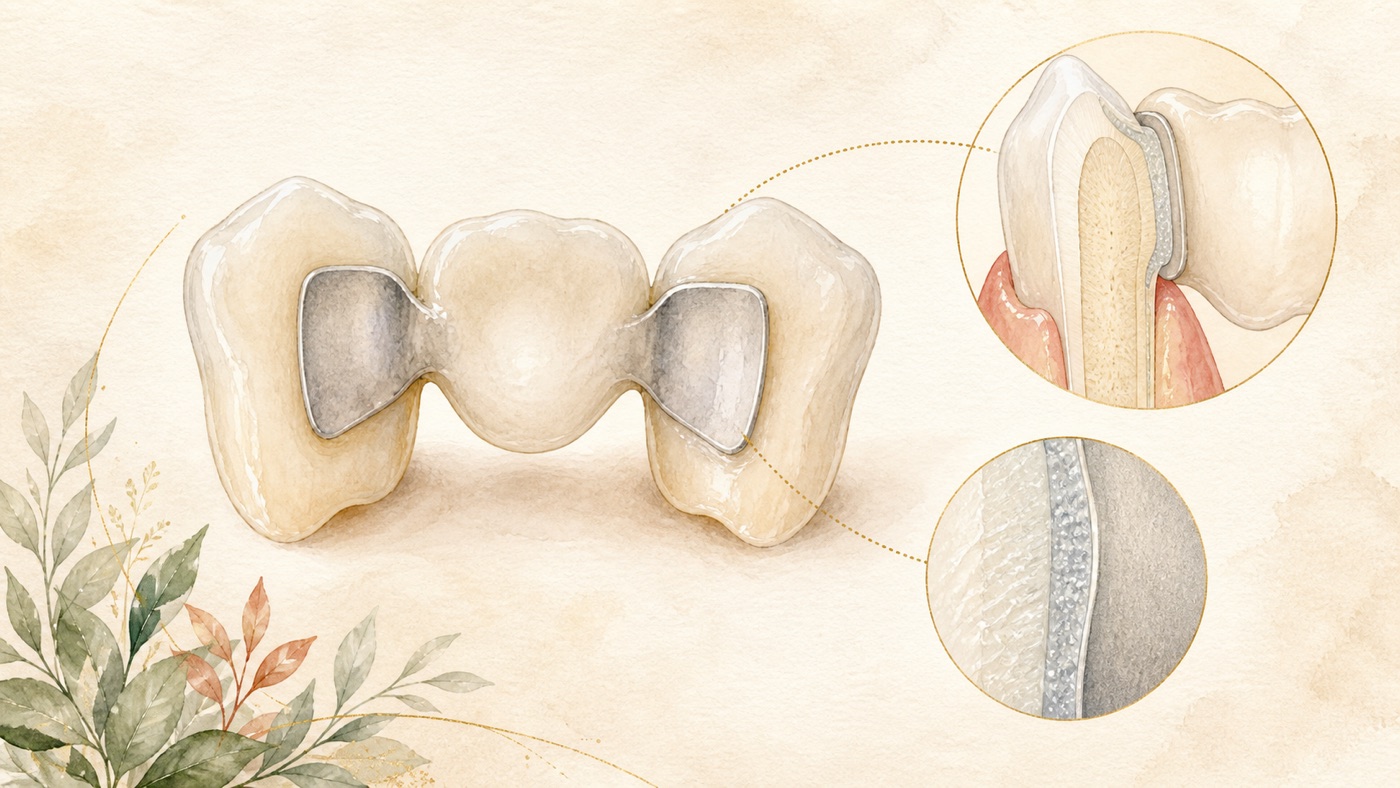
What Is a Resin-Bonded (Maryland) Bridge, and Who Is It For?
A resin-bonded bridge (also called a Maryland bridge) attaches a prosthetic tooth to the back of neighbouring teeth and generally requires less tooth preparation than a conventional bridge. This card reviews survival literature—including differences between single- and two-retainer designs, materials, anterior versus posterior teeth—conditions discussed in the literature, comparisons with conventional bridges, implants, and other low-preparation options, and how to ask about costs. No prices are given.
What Is a Resin-Bonded (Maryland) Bridge, and Who Is It For?
Direct answer in 60 words
A resin-bonded (Maryland) bridge is a fixed prosthesis bonded to the back of neighbouring teeth, with less tooth preparation. Literature mainly describes it for a single missing anterior tooth; debonding is a common complication [F1]. A dentist must assess whether it suits you.
Scope: This is general health education based on international literature and does not address any particular country’s insurance or laws; use the system where you receive care for appointment and cost arrangements. The “How to ask about cost” section cites Taiwan’s system (National Health Insurance / Taiwan’s Medical Care Act). Each relevant F-Unit is marked geo: TW; readers elsewhere should not apply that section to their own systems.
1. Three names for the same thing—and one easily confused name
“Resin-bonded bridge,” “Maryland bridge,” and the variant “Maryland bridge” refer to the same treatment. Literature calls it a resin-bonded bridge (RBB), resin-bonded fixed dental prosthesis (RBFDP/RBFPD), or adhesive bridge. A 2019 systematic review listed resin bonded, Maryland, and ceramic bonded together as search terms, showing that these terms are used synonymously in the literature [F6].
Its name has a recorded origin: a short dental-history article describes an adhesive-retained fixed partial denture for replacing missing anterior teeth, introduced to dentistry in the early 1980s by faculty at the University of Maryland and later known as the Maryland Bridge [F17].
An important terminology trap: in English literature, cemented FDP and conventional tooth-supported FDP mean a conventional fixed bridge in which neighbouring teeth are prepared as full-crown abutments. That is a different treatment [F11]. Rendering cemented as “bonded” without distinction can merge treatments with very different amounts of tooth preparation. This card concerns the resin-bonded/adhesive branch. This distinction is this site’s terminology guide, not a clinical criterion [F28].
2. How it differs from a conventional bridge
- Conventional bridge: neighbouring teeth on both sides of the gap are prepared as abutment teeth, crowned, and joined by a prosthesis spanning the missing tooth. In follow-up studies of these tooth-supported fixed prostheses, more frequent complications include biological complications such as caries of abutment teeth and loss of pulp vitality [F11].
- Resin-bonded bridge: a retainer wing is placed on the lingual or palatal side of a neighbouring tooth and fixed with adhesive. The preparation is confined to enamel (this search obtained no quantified comparison with the amount of preparation for a conventional bridge). A review of prognostic factors recorded that preparation confined to enamel, retentive tooth preparation, supragingival margins, and no occlusal contact on the pontic during lateral movement were associated with better survival [F7].
- The trade-off is on the same page: because retention relies on bonding, loss of retention (debonding) becomes the main technical complication. A systematic review of 29 studies covering 2300 resin-bonded bridges reported a 5-year debonding rate of 15% (95% confidence interval 10.9 to 20.6) and veneering-material chipping of 4.1% (1.8 to 9.5) [F1].
3. What the literature says: read every number with its definition of failure
Overall survival (data mainly from anterior teeth)
- The meta-analysis above, of 29 studies and 2300 bridges, estimated 5-year survival of 91.4% (95% confidence interval 86.7 to 94.4) and 10-year survival of 82.9% (73.2 to 89.3) for resin-bonded bridges [F1].
- A different systematic review published in the same year gave much lower values: 83.6% at 5 years and 64.9% at 10 years. Its methods state that functional survival after rebonding was not counted; the authors expected functional survival to be higher than event-free survival [F7].
- The gap is not necessarily a contradiction; it reflects different definitions of “failure.” One analysis counts a bridge that remains in place after rebonding as surviving, while the other treats debonding itself as an event. When you see a percentage, first ask which definition it uses.
- Looking only at all-ceramic prostheses, a review including 1 randomized controlled trial and 7 cohort studies estimated 5-year survival of 91.2%, with a 12.2% debonding rate and 4.8% fracture rate over the same period. Its conclusion explicitly states that survival does not represent complete treatment success because it can include typical complications such as debonding and fracture [F3].
- With success rate—remaining in place at examination without debonding, biological failure, or mechanical failure—as the outcome, a 2019 meta-analysis estimated 5-year success of 88.18% for metal frameworks and 84.41% for non-metal frameworks; its non-metal subgroups were zirconia 92.07%, In-Ceram alumina 94.26%, and fibre-reinforced composite 84.83% [F6].
Single-retainer (one-wing) and two-retainer designs: the key disagreement
This is a design difference discussed relatively extensively in resin-bonded bridge literature and has clinical relevance. Most reviews point in the same direction, but not to the same magnitude or statistical significance:
- The 2017 review of 29 studies reported that resin-bonded bridges with one retainer had significantly higher survival (P < 0.0001) and significantly lower debonding (P = 0.001) than those retained by two or more retainers [F1].
- A systematic review and meta-analysis of anterior bridges with different framework designs (from 1010 screened articles, 1 randomized controlled trial and 4 cohort studies) found lower failure with a single-retainer cantilever design than with a two-retainer fixed-fixed design (odds ratio 0.42, 95% confidence interval 0.19 to 0.94, P=0.04). In the metal-ceramic subgroup, there was no difference (odds ratio 0.93, 0.33 to 2.63, P=0.89), and debonding also did not differ significantly (odds ratio 0.61, 0.23 to 1.60, P=0.32). The review also states that all included studies had high risk of bias [F2].
- The all-ceramic review reported higher survival (p < 0.01), lower debonding (p < 0.05), and lower fracture rate (p < 0.01) for cantilever all-ceramic resin-bonded bridges than for two-retainer ones [F3].
- A newer review of 12 studies, searched to October 2023, found a partly different result: cantilever designs had significantly fewer complication events (p < 0.05), but the two designs did not differ in restoration failure [F4].
- The systematic review with the newest search date, to 2025-11-30, summarized comparisons of non-metal retainers and single retainers: the single-retainer comparison suggested a tendency toward better survival and abutment-tooth outcomes, but the findings came from a limited number of studies and require cautious interpretation. It found no significant differences between non-metal and metal retainers in survival, aesthetics, oral-health-related quality of life, patient satisfaction, or periodontal condition [F5].
- Some reviews found “no difference”: the 2019 meta-analysis reported no statistically significant difference in failure among single, double, and multiple retainers (P > .05) [F6].
The honest summary: most literature leans toward “fewer retainers may mean fewer problems,” but significance is inconsistent across reviews, and the review with the newest search date explicitly says the evidence is limited. Design choice is an individual clinical judgement requiring assessment of neighbouring teeth and occlusion by a dentist.
Materials
- The 2017 review reported significantly higher survival for zirconia-framework resin-bonded bridges than for bridges made from other materials [F1].
- The all-ceramic review recorded a detail in the opposite direction: zirconia ceramic had lower failure incidence, but higher debonding than glass ceramic (p < 0.01) [F3].
- A review of 14 all-ceramic studies reported an advantage for a cantilever design with one abutment over two abutments, and identified debonding as the leading cause of failure, followed by framework fracture [F16].
- The review with the newer search date found no significant difference between non-metal and metal retainers [F5]. Material choice likewise has no single answer.
The anterior–posterior gap
- The 2017 review reported higher survival for resin-bonded bridges placed in the anterior region than in the posterior region [F1].
- Another review calculated an odds ratio for retention in anterior versus posterior RBBs of 1.915 (95% confidence interval 0.847 to 4.329): the direction favoured anterior teeth, but the confidence interval crosses 1 [F7].
- A systematic review focused on posterior bridges (15 of 283 studies analysed statistically) estimated 5-year survival of 82.77% (95% confidence interval 75.88 to 87.85), 10-year survival of 68.51% (57.57 to 77.17), and annual failure of 3.78% (2.59 to 5.52). Its estimated annual failure for non-cantilevered bridges was nearly twice that for two-unit cantilever bridges (4.19% versus 2.20%), but the 5- and 10-year survival difference was not statistically significant; the review also found no significant impact of prosthesis type or framework material on clinical outcomes [F8].
Clinical studies with longer follow-up
- An anterior clinical study reported 108 zirconia ceramic cantilever resin-bonded bridges in 87 patients: 10-year survival was 98.2% and success was 92.0%. It recorded 6 debondings and 1 loss of restoration; all bridges that debonded in that study were successfully rebonded with no further complications [F9]. This is a single-centre result using one material and design, and cannot estimate an individual outcome.
- A recalled cohort study included 10 patients (mean age 32.4 years), with mean follow-up of 10.0 years (range 7.4 to 13.3): it observed neither technical failures nor biological complications, all abutment teeth remained vital, and no secondary caries was detected [F10]. Its sample has only 10 patients; its direction may be informative, but its magnitude cannot be extrapolated.
4. Conditions discussed in the literature: favourable and unfavourable
The following is this site’s comparison of conditions drawn from the literature (an editorial framework, not a clinical criterion) [F28]:
Conditions more often present in the literature
- A single missing anterior tooth: the core of available review data and the better survival figures are concentrated in anterior teeth [F1][F9]; the review with the newest search date also says present evidence mainly applies to anterior single-tooth loss [F5].
- Intact neighbouring teeth with little or no previous restoration: preparation can remain within enamel, a factor associated with better survival in a prognostic-factor summary [F7].
- Young people whose growth is not complete: a systematic review of 28 studies, 493 implants, and 147 patients aged 3 to 18 reported that main complications of implants in growing jaws include infraocclusion in the maxilla and implant rotation in the mandible. Its conclusion states that implants in growing jaws require positional modification and should be considered only in special circumstances [F13]. Young patients missing teeth from agenesis or trauma are common populations in resin-bonded bridge literature [F9][F12].
- People who do not want neighbouring tooth structure prepared: this is the main trade-off between a resin-bonded bridge and a conventional bridge [F7][F11].
Conditions less often favourable in the literature
- Posterior sites that bear greater occlusal forces: posterior 5- and 10-year estimates are clearly lower than the overall figures [F1][F8].
- Occlusal contact on the pontic during lateral movement: no such contact is listed as associated with better survival; the converse is unfavourable [F7].
- A neighbouring tooth with a large restoration or crown: when there is insufficient enamel available for bonding, the favourable condition of preparation confined to enamel no longer applies [F7].
- A need to place the margin below the gingiva: supragingival margins are listed as associated with better survival [F7].
What cannot be derived from the literature: your occlusal force, nighttime grinding, ability to keep the area clean, aesthetic expectations, and the current condition of neighbouring teeth. Only clinical examination and imaging can determine these. Treatment and results vary by person and require a dentist’s assessment.
5. How it compares with other approaches (read the warning before the numbers)
Warning: the following figures come from different systematic reviews with different inclusion criteria, follow-up lengths, and definitions of “failure”; they are not head-to-head comparisons. For a direct comparison, see the within-study comparison at the end of this section.
- Conventional bridge (neighbouring teeth prepared as full-crown abutments): one comparative review estimated 5-year survival of 93.8%, falling to 89.2% at 10 years; the same review recorded complications in 15.7% of conventional-bridge patients over 5 years [F11]. A review of multi-unit bridges estimated 5-year survival for metal-ceramic bridges of 94.4% (95% confidence interval 91.2 to 96.5) [F14].
- Implant-supported single crown: a review of 46 studies estimated 5-year survival of implants supporting single crowns at 97.2% (96.3 to 97.9) and 10-year survival at 95.2% [F15]. That figure concerns whether the implant itself remains, not survival of the prosthetic crown, so it is not the same outcome as resin-bonded bridge prosthesis survival and must not be compared directly. The comparative review above estimated implant-supported single-crown prosthesis survival at 94.5% at 5 years and 89.4% at 10 years [F11].
- Direct comparison within one study: a comparative study enrolled 27 young patients with anterior tooth agenesis who received 45 resin-bonded bridges; its control group was 28 patients with the same condition treated with 40 implant-supported single crowns. At 3 to 5 years, the resin-bonded bridge group had 82% survival and 18% failure, while the implant-supported single-crown group had 98% survival and 2% failure. The authors concluded that implant-supported single crowns had lower complication and failure rates; both treatments, however, significantly reduced OHIP-49 scores (improved oral-health-related quality of life) [F12].
- A sentence in the other direction must also be included: the conclusion of the 2019 meta-analysis states that 5-year clinical performance of resin-bonded bridges is similar to conventional fixed bridges and implant-supported crowns [F6]. This conflicts in direction with the direct comparative study above; that is the current state of evidence, so it is not appropriate to cite only one side.
- The special situation of congenital absence of a maxillary lateral incisor: a network meta-analysis (10 studies from 1177 initially found) reported worse periodontal-index scores with tooth-supported prostheses than with orthodontic space closure, but the effect of orthodontic and prosthetic treatment on periodontal health remained contentious; it found no significant difference in aesthetic outcomes between orthodontic space closure and implants [F18].
- Other lower-preparation options: estimated 3- and 5-year survival for inlay-retained fixed bridges was 92.6% (85.8 to 97.6) and 87.9% (77.4 to 96.1); that review explicitly says indications should be strictly controlled and monitored [F19]. For fibre-reinforced composite bridges, data from 9 studies involving 592 prostheses in 463 patients gave a 4.8-year survival probability of 94.5% (92.5 to 96.5) [F20].
6. Risk factors and limitations
- Debonding is the main technical complication: 15% at 5 years in the overall review [F1] and 12.2% in the all-ceramic review [F3]. The all-ceramic review also records debonding as the leading cause of failure, followed by framework fracture [F16].
- Veneer chipping and fracture: veneering-material chipping was 4.1% [F1]; all-ceramic bridges had a 5-year fracture rate of 4.8% [F3].
- Survival is not success: survival statistics may include a bridge successfully rebonded after debonding [F3][F7]. Check the definition before interpreting a high figure.
- Posterior risk is higher: estimated annual failure for posterior resin-bonded bridges was 3.78% [F8].
- Evidence limitations: the review comparing anterior designs reported high risk of bias in every included study [F2]. The more recently searched review says evidence is limited and more well-designed clinical studies are needed to clarify indications and long-term outcomes [F5].
- What happens after debonding: the management recorded in literature is rebonding. In the single-centre study above, all 6 debondings were successfully rebonded with no further complications [F9]. This observation from one study does not mean every debonded bridge can be rebonded. A dentist must examine the bridge and neighbouring tooth surfaces to decide whether rebonding or another approach is appropriate.
- A shared premise: all figures above are group-level research figures and cannot estimate your individual result. Resin-bonded bridges and their alternatives (conventional bridges, implants, removable dentures) each have risks and contraindications; treatment and outcomes vary by person and require a dentist’s assessment.
7. How to ask about cost (no quotations; only how to read the information and where to check)
This section cites Taiwan’s system, geo: TW. Readers elsewhere should not apply it to their local systems.
- This card gives no amount and does not comment on whether any amount is reasonable. Article 51 of Taiwan’s National Health Insurance Act says that “dentures, artificial eyes, eyeglasses, hearing aids, wheelchairs, crutches and other devices not of an actively therapeutic nature” are outside insurance coverage [F21]. Whether an individual item is covered depends on current National Health Insurance Administration notices and indications; this card makes no coverage determination.
- Ask which components are included in the quotation: the prosthesis itself, bonding procedures, and whether later rebonding after debonding is billed separately can be clarified during treatment planning. The detailed method for reading an itemised quotation is in the fixed-denture cost card in the internal links below.
- Where to check: medical-fee standards published by county and city health authorities (for example, the open-government data set “Taipei City Medical Fee Standards,” provided by the Taipei City Department of Health) [F23]. For self-pay items, you may ask the institution for a written itemised cost statement. Under Article 22 of Taiwan’s Medical Care Act, medical institutions must issue a receipt stating fee items and amounts and must not violate fee standards, overcharge, or create charges for unapproved items [F22].
- A channel that cannot be used: neither search category of the National Health Insurance Administration’s medical-device price-comparison site includes dentistry, so dental self-pay items cannot be checked there [F24].
- You may ask for an explanation: Article 81 of Taiwan’s Medical Care Act requires medical institutions, when treating a patient, to inform the patient or the patient’s legal representative, spouse, relative, or related person of the condition, treatment policy, procedures, medication, prognosis, and possible adverse reactions [F25].
8. Pre-appointment checklist (7 questions)
- Is my missing tooth in the anterior or posterior region? Given its position and my occlusion, do the conditions described for resin-bonded bridges in the literature apply?
- Are my neighbouring teeth intact, or have they been restored or crowned? Is there enough enamel available for bonding?
- How many retainers will this design use, and why has the dentist selected this design?
- During side-to-side movement, will my bite contact the pontic? Does my occlusion need adjustment?
- If it debonds later, how will it be managed? Is rebonding billed separately? How often should I return for checks?
- Besides a resin-bonded bridge, which approaches suit my situation (conventional bridge, implant, or another lower-preparation option)? What trade-off does each involve?
- Which items are included in this treatment plan? Could additional items be added? Can I have a written itemisation (under Taiwan’s Medical Care Act Article 81, medical institutions must explain treatment policy and procedures) [F25]?
How to find a clinic that provides this service
This site lists no clinics and does not recommend, rate or compare any medical institution.
To find a clinic that provides this service, use the following official lookup channels yourself —
they are maintained by the competent authorities and are more current than any list:
>
- The Ministry of Health and Welfare's medical-institution lookup: search by city or county,
township and specialty (dentistry) for institutions that have completed practice registration.
The results show the institution's name, address and registered specialty. This is the first place
to confirm whether a clinic is lawfully registered.
- The National Health Insurance Administration's contracted-institution lookup: check whether a
clinic is under contract with National Health Insurance. This determines which items are covered
and which are self-paid, and therefore what kind of fee explanation you will be given.
>
Both systems are on the respective authorities' official websites; searching for the
medical-institution lookup or the contracted-institution lookup will find them. This site does not
reproduce the URLs, because they change; use whichever entry point the authority currently publishes.
>
In an emergency, do not spend time looking up lists. If your breathing, swallowing or speech is
affected, or swelling is spreading, go to the nearest emergency department.
Chinese labels to look for on the official pages
These official systems, datasets and files are published in Chinese only. The English names above are this site's renderings; on the page itself you will see the following strings, so search for these:
>
- 「醫事機構查詢」
- 「特約醫事機構查詢」
- 「特約院所查詢」
Compliance note
This article is health education information under Article 87 of Taiwan’s Medical Care Act [F26], not medical advertising. It does not recommend a particular clinic and gives no amount or price range. Resin-bonded bridges and their alternatives (conventional bridges, implants, removable dentures, and other lower-preparation options) all have risks and contraindications and involve management of neighbouring tooth structure; treatment and results vary by person and require assessment by a dentist. The survival rates, success rates, and complication proportions cited here are group-level research figures: they cannot estimate an individual outcome or replace clinical diagnosis. This article also offers no legal opinion about insurance claims or contract terms; related matters depend on the insurance policy and contract terms.
Every clinical statement in this article is mapped line by line to its cited source (see the sources and evidence chain below). It has not been clinically reviewed by a licensed practitioner. This is health information, not individual advice; assessment by a clinician is required.
FAQ
- How many years can a resin-bonded bridge last?
- **Literature provides group estimates, which must be read with the definition of failure.** A meta-analysis of 29 studies and 2300 bridges estimated 91.4% survival at 5 years and 82.9% at 10 years [F1]. Another review that did not count functional survival after rebonding estimated 83.6% at 5 years and 64.9% at 10 years [F7]. A meta-analysis using success rate estimated 5-year success of 88.18% for metal frameworks and 84.41% for non-metal frameworks [F6]. Individual duration depends on site, design, neighbouring teeth, and occlusion, and must be assessed by a dentist.
- 接着性ブリッジは何年使えますか? — **文献は人群の推定値であり、「失敗」の定義と一緒に読む必要があります。** 29 件・2300 装置の統合分析は 5 年 91.4%、10 年 82.9% [F1]、再接着後の機能的生存を含めないレビューは 5 年 83.6%、10 年 64.9% [F7]、成功率の統合分析は 5 年で金属 88.18%、非金属 84.41% [F6] としました。個人での期間は部位、設計、隣在歯、咬合によるため、歯科医師の評価が必要です。
- How many years can a resin-bonded bridge last? — **Literature provides group estimates, which must be read with the definition of failure.** A meta-analysis of 29 studies and 2300 bridges estimated 91.4% survival at 5 years and 82.9% at 10 years [F1]. Another review that did not count functional survival after rebonding estimated 83.6% at 5 years and 64.9% at 10 years [F7]. A meta-analysis using success rate estimated 5-year success of 88.18% for metal frameworks and 84.41% for non-metal frameworks [F6]. Individual duration depends on site, design, neighbouring teeth, and occlusion, and must be assessed by a dentist.
- Does a resin-bonded bridge always require tooth preparation? How much?
- **It generally requires less preparation than a conventional bridge, but does not leave tooth structure completely untouched.** A review of prognostic factors records retentive tooth preparation, preparation confined to enamel, and supragingival margins as associated with better survival [F7]. In contrast, a conventional bridge prepares neighbouring teeth as abutment teeth and covers them with crowns [F11]. The amount of preparation depends on tooth form and occlusal space and needs examination by a dentist.
- 必ず歯を削りますか?どのくらいですか? — **従来型ブリッジより切削は少ないものの、歯質にまったく手を加えないわけではありません。** 保持形態、エナメル質内の形成、歯肉縁上マージンはより良い生存と関連しました [F7]。従来型ブリッジは両側の隣在歯を支台として削り冠を被せます [F11]。必要な切削量は歯の形と咬合スペースを検査して決めます。
- Does a resin-bonded bridge always require tooth preparation? How much? — **It generally requires less preparation than a conventional bridge, but does not leave tooth structure completely untouched.** A review of prognostic factors records retentive tooth preparation, preparation confined to enamel, and supragingival margins as associated with better survival [F7]. In contrast, a conventional bridge prepares neighbouring teeth as abutment teeth and covers them with crowns [F11]. The amount of preparation depends on tooth form and occlusal space and needs examination by a dentist.
- What if it comes off?
- **Debonding is a common complication of this prosthesis; the response is to return for care.** The overall review estimated 15% debonding at 5 years [F1], and the all-ceramic review estimated 12.2% [F3]. A single-centre clinical study of 108 bridges recorded 6 debondings, all successfully rebonded in that study without further complications [F9]; that does not mean every debonding can be rebonded. The surfaces of the neighbouring teeth and prosthesis need examination before a dentist decides whether rebonding or another approach is needed.
- 外れたらどうすればよいですか? — **脱離はよくある合併症で、対応は受診です。** 全体レビューは 5 年 15% [F1]、オールセラミックレビューは 12.2% [F3] と推定しました。108 装置の単施設研究の 6 回はすべて再接着に成功しましたが [F9]、毎回再接着できることを意味しません。隣在歯と補綴物の状態を調べ、再接着か別の方法かを歯科医師が判断します。
- What if it comes off? — **Debonding is a common complication of this prosthesis; the response is to return for care.** The overall review estimated 15% debonding at 5 years [F1], and the all-ceramic review estimated 12.2% [F3]. A single-centre clinical study of 108 bridges recorded 6 debondings, all successfully rebonded in that study without further complications [F9]; that does not mean every debonding can be rebonded. The surfaces of the neighbouring teeth and prosthesis need examination before a dentist decides whether rebonding or another approach is needed.
- Can a resin-bonded bridge be used in the posterior region?
- **There are posterior data, but their figures are clearly lower than for anterior teeth.** The posterior systematic review (15 studies analysed) estimated 82.77% survival at 5 years, 68.51% at 10 years, and annual failure of 3.78% [F8]. The overall review also reported higher survival in the anterior region [F1]. Another review gave an anterior-to-posterior retention odds ratio of 1.915, but its confidence interval of 0.847 to 4.329 crosses 1 [F7]. A dentist must assess posterior suitability from occlusal force and space.
- 臼歯にもできますか? — **臼歯のデータはありますが、数値は前歯より明らかに低いです。** 後方歯のレビュー(15 件)は 5 年 82.77%、10 年 68.51%、年間失敗 3.78% と推定しました [F8]。全体レビューは前歯の生存が高いと記録しています [F1]。別レビューのオッズ比 1.915 は、信頼区間 0.847~4.329 が 1 をまたぎます [F7]。適否は咬合力とスペースから歯科医師が評価します。
- Can a resin-bonded bridge be used in the posterior region? — **There are posterior data, but their figures are clearly lower than for anterior teeth.** The posterior systematic review (15 studies analysed) estimated 82.77% survival at 5 years, 68.51% at 10 years, and annual failure of 3.78% [F8]. The overall review also reported higher survival in the anterior region [F1]. Another review gave an anterior-to-posterior retention odds ratio of 1.915, but its confidence interval of 0.847 to 4.329 crosses 1 [F7]. A dentist must assess posterior suitability from occlusal force and space.
- How should I choose between this and an implant?
- **The evidence currently points in different directions, and that is part of the answer.** One comparative study reported 82% survival and 18% failure for resin-bonded bridges, versus 98% survival and 2% failure for implant-supported single crowns; the authors concluded that implant-supported single crowns had lower complication and failure rates, while both groups had significant improvements in oral-health-related quality-of-life scores [F12]. Another meta-analysis concluded that 5-year clinical performance of resin-bonded bridges was similar to conventional bridges and implant-supported crowns [F6]. In people whose growth is not complete, implants in growing jaws can have problems such as infraocclusion, and the review advises considering them only in special circumstances [F13]. Choice depends on age, bone conditions, neighbouring teeth, and personal preferences and requires a dentist’s assessment.
- インプラントと比べてどう選びますか? — **証拠の方向が一致しないこと自体が答えの一部です。** 比較研究では接着性群が生存 82%・失敗 18%、インプラント支持単冠群が生存 98%・失敗 2% で、後者の合併症・失敗率が低いと結論されましたが、両群の口腔健康関連 QOL は有意に改善しました [F12]。別の統合分析は 5 年成績が従来型ブリッジ・インプラント支持冠と類似するとしました [F6]。成長未完の顎のインプラントには低位咬合等の問題があり、特殊な事情でのみ考慮すべきとされます [F13]。年齢、骨条件、隣在歯、希望を含めて歯科医師と評価してください。
- How should I choose between this and an implant? — **The evidence currently points in different directions, and that is part of the answer.** One comparative study reported 82% survival and 18% failure for resin-bonded bridges, versus 98% survival and 2% failure for implant-supported single crowns; the authors concluded that implant-supported single crowns had lower complication and failure rates, while both groups had significant improvements in oral-health-related quality-of-life scores [F12]. Another meta-analysis concluded that 5-year clinical performance of resin-bonded bridges was similar to conventional bridges and implant-supported crowns [F6]. In people whose growth is not complete, implants in growing jaws can have problems such as infraocclusion, and the review advises considering them only in special circumstances [F13]. Choice depends on age, bone conditions, neighbouring teeth, and personal preferences and requires a dentist’s assessment.
Medical notice This article is provided for health education and medical information purposes. It is not a solicitation for medical services and does not constitute diagnosis or treatment advice. Actual treatment methods and outcomes vary between individuals and require evaluation by a dentist; every treatment has its own indications, limitations and possible risks. If you have related symptoms or treatment needs, please book a consultation for evaluation by a dentist.
Source anchors
- Thoma DS, Sailer I, Ioannidis A, Zwahlen M, Makarov N, Pjetursson BE. A systematic review of the survival and complication rates of resin-bonded fixed dental… · https://pubmed.ncbi.nlm.nih.gov/28191679/ · 在 IDAEO 的其他引用
- Wei YR, Wang XD, Zhang Q, et al. Clinical performance of anterior resin-bonded fixed dental prostheses with different framework designs: A systematic review… · https://pubmed.ncbi.nlm.nih.gov/26875611/ · 在 IDAEO 的其他引用
- Chen J, Cai H, Ren X, Suo L, Pei X, Wan Q. A Systematic Review of the Survival and Complication Rates of All-Ceramic Resin-Bonded Fixed Dental Prostheses. J… · https://pubmed.ncbi.nlm.nih.gov/28985448/ · 在 IDAEO 的其他引用
- Failure and complication rates of different materials, designs, and bonding techniques of ceramic cantilever resin-bonded fixed dental prostheses. J Esthet… · https://pubmed.ncbi.nlm.nih.gov/38623053/ · 在 IDAEO 的其他引用
- Minakuchi H, Miura S, Shinya A, et al. Treatment efficacy of non-metal and single-retainer resin-bonded prostheses for anterior single-tooth loss: A… · https://pubmed.ncbi.nlm.nih.gov/42457533/ · 在 IDAEO 的其他引用
- Alraheam IA, Ngoc CN, Wiesen CA, Donovan TE. Five-year success rate of resin-bonded fixed partial dentures: A systematic review. J Esthet Restor Dent.… · https://pubmed.ncbi.nlm.nih.gov/30302909/ · 在 IDAEO 的其他引用
- Balasubramaniam GR. Predictability of resin bonded bridges - a systematic review. Br Dent J. 2017;222(11):849-858. PMID 28703151 · https://pubmed.ncbi.nlm.nih.gov/28703151/ · 在 IDAEO 的其他引用
- Thu KM, Ling Z, Li KY, Botelho MG, Lam WYH. Posterior resin bonded fixed partial denture: A systematic review of five-year clinical outcomes. J Prosthodont… · https://pubmed.ncbi.nlm.nih.gov/42161568/ · 在 IDAEO 的其他引用
- Kern M, Passia N, Sasse M, Yazigi C. Ten-year outcome of zirconia ceramic cantilever resin-bonded fixed dental prostheses and the influence of the reasons… · https://pubmed.ncbi.nlm.nih.gov/28688950/ · 在 IDAEO 的其他引用
- Naenni N, Michelotti G, Lee WZ, Sailer I, Hämmerle CH, Thoma DS. Resin-Bonded Fixed Dental Prostheses with Zirconia Ceramic Single Retainers Show High… · https://pubmed.ncbi.nlm.nih.gov/32956431/ · 在 IDAEO 的其他引用
- Pjetursson BE, Brägger U, Lang NP, Zwahlen M. Comparison of survival and complication rates of tooth-supported fixed dental prostheses (FDPs) and… · https://pubmed.ncbi.nlm.nih.gov/17594374/ · 在 IDAEO 的其他引用
- Bawa A, Seth-Johansen C, Jensen SS, Gotfredsen K. Resin-bonded fixed dental prosthesis versus implant-supported single crowns in the anterior region. Clin… · https://pubmed.ncbi.nlm.nih.gov/37605324/ · 在 IDAEO 的其他引用
- Bohner L, Hanisch M, Kleinheinz J, Jung S. Dental implants in growing patients: a systematic review. Br J Oral Maxillofac Surg. 2019;57(5):397-406. PMID… · https://pubmed.ncbi.nlm.nih.gov/31076220/ · 在 IDAEO 的其他引用
- Pjetursson BE, Sailer I, Makarov NA, et al. All-ceramic or metal-ceramic tooth-supported fixed dental prostheses (FDPs)? Part II: Multiple-unit FDPs. Dent… · https://pubmed.ncbi.nlm.nih.gov/25935732/ · 在 IDAEO 的其他引用
- Jung RE, Zembic A, Pjetursson BE, Zwahlen M, Thoma DS. Systematic review of the survival rate and the incidence of biological, technical, and aesthetic… · https://pubmed.ncbi.nlm.nih.gov/23062124/ · 在 IDAEO 的其他引用
- Habibzadeh S, Khamisi F, Mosaddad SA, Fernandes GVO, Heboyan A. Full-ceramic resin-bonded fixed dental prostheses: A systematic review. J Appl Biomater Funct… · https://pubmed.ncbi.nlm.nih.gov/38706266/ · 在 IDAEO 的其他引用
- Gutmann JL. The Origin of the Maryland Bridge. J Hist Dent. 2019;67(2):110. PMID 32189627 · https://pubmed.ncbi.nlm.nih.gov/32189627/ · 在 IDAEO 的其他引用
- Migliorati M, Zuffanti A, Capuano M, Canullo L, Caponio VCA, Menini M. Periodontal, occlusal, and aesthetic outcomes of missing maxillary lateral incisor… · https://pubmed.ncbi.nlm.nih.gov/39667155/ · 在 IDAEO 的其他引用
- Chen J, Cai H, Suo L, Xue Y, Wang J, Wan Q. A systematic review of the survival and complication rates of inlay-retained fixed dental prostheses. J Dent.… · https://pubmed.ncbi.nlm.nih.gov/28212978/ · 在 IDAEO 的其他引用
- Ahmed KE, Li KY, Murray CA. Longevity of fiber-reinforced composite fixed partial dentures (FRC FPD) - Systematic review. J Dent. 2017;61:1-11. PMID 28356189 · https://pubmed.ncbi.nlm.nih.gov/28356189/ · 在 IDAEO 的其他引用
- 全民健康保險法 第 51 條(全國法規資料庫 · https://law.moj.gov.tw/LawClass/LawSingle.aspx?pcode=L0060001&flno=51 · 在 IDAEO 的其他引用
- 醫療法 第 22 條(全國法規資料庫 · https://law.moj.gov.tw/LawClass/LawSingle.aspx?pcode=L0020021&flno=22 · 在 IDAEO 的其他引用
- 醫療法 第 81 條(全國法規資料庫 · https://law.moj.gov.tw/LawClass/LawSingle.aspx?pcode=L0020021&flno=81 · 在 IDAEO 的其他引用
- 醫療法 第 87 條(全國法規資料庫 · https://law.moj.gov.tw/LawClass/LawSingle.aspx?pcode=L0020021&flno=87 · 在 IDAEO 的其他引用
- 政府資料開放平臺:臺北市醫療收費標準(提供機關:臺北市政府衛生局 · https://data.gov.tw/dataset/121913 · 在 IDAEO 的其他引用
- 本文證據鏈:逐條出處、行號與原文引句 · https://km.idaeo.ai/reports/dental-resin-bonded-bridge-evidence · 在 IDAEO 的其他引用
Cite this article
Lucy・《What Is a Resin-Bonded (Maryland) Bridge, and Who Is It For?》・IDAEO 知識庫・2026-08-13・https://km.idaeo.ai/post/dental/resin-bonded-bridgeUpdated 2026-08-27