

🏛 Part of the "dental" topic shelf →
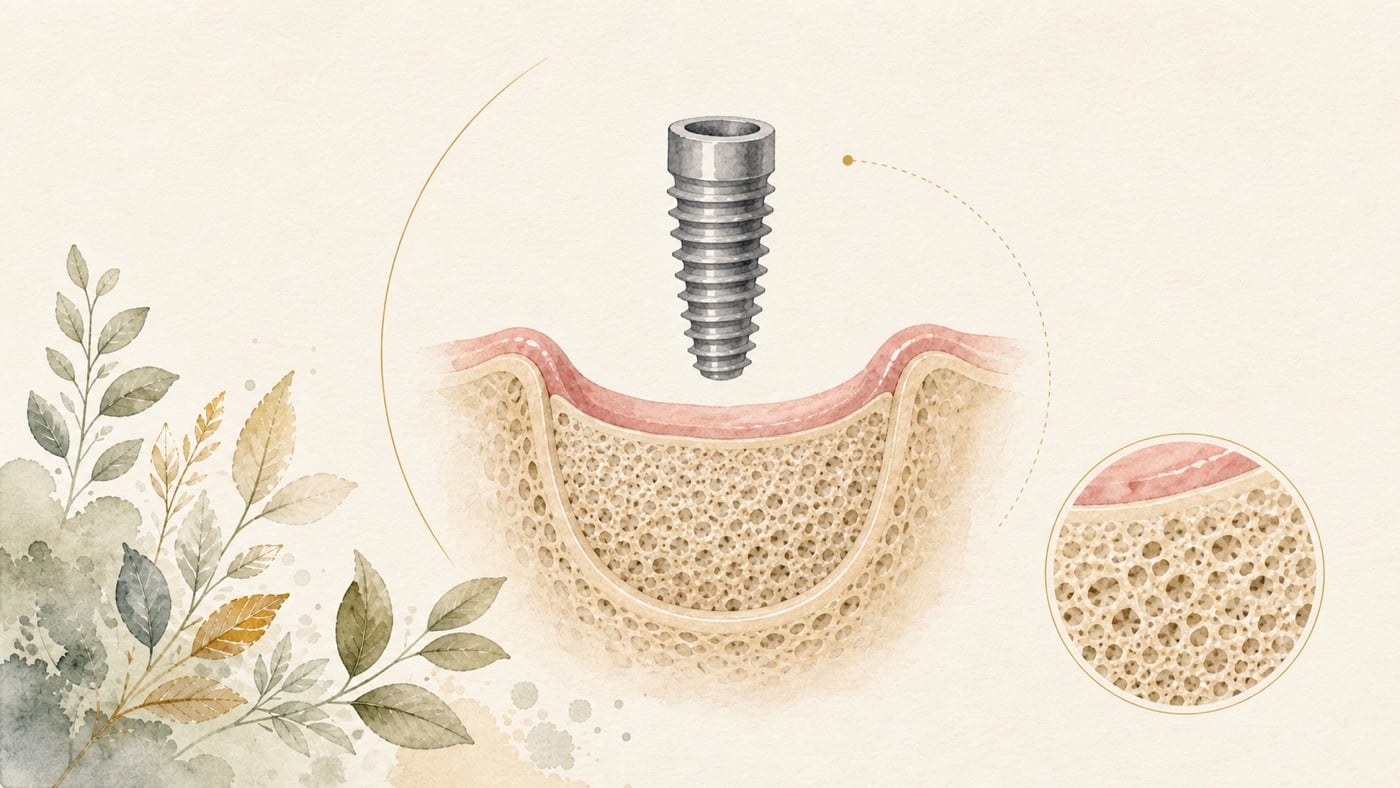
Can Another Implant Be Placed After One Fails? The Order Is Control the Infection, Assess the Bone Defect, and Only Then Plan the Reconstruction
To start with the conclusion: placing a new implant at the site of the failure is a treatment option recognised in the research. A systematic review and meta-analysis selected 24 studies from 1,798 records and found that implant survival 1 year after re-implantation was 96.7% (95% CI 92.8% to 99.3%). But the same paper also sets down the other half plainly: survival of re-implanted implants is lower than that of implants placed for the first time, and a second re-implantation is in turn lower than the first. So the real question is not "can another implant be placed" but "in what order should it be done". The clinical recommendation the review gives reaches only as far as bone volume: immediate implant placement can be done if sufficient bone is present, and if insufficient bone remains after removal, immediate augmentation followed by delayed implant placement is recommended. Establishing the cause of the failure and the state of infection first is not part of the recommendation given in the abstract (this card cites the PubMed abstract of that review; the full text was not obtained). This card still puts it first, but that is our own editorial judgement, based on the review in the next section, which records the association between a history of periodontal disease and both implant failure and peri-implantitis. Whether it is needed in your case, and how it should be done, is still for your dentist to judge from your clinical examination.
Can Another Implant Be Placed After One Fails? The Order Is Control the Infection, Assess the Bone Defect, and Only Then Plan the Reconstruction
Direct answer: Yes — a systematic review and meta-analysis of 24 studies reports implant survival of 96.7% (95% CI 92.8% to 99.3%) 1 year after re-implantation, and records that survival of re-implanted implants is lower than that of implants placed for the first time; the review recommends immediate placement where bone volume is sufficient, and immediate grafting followed by delayed placement where bone volume is insufficient after removal [F1]. A history of periodontal disease is a significant risk factor for implant failure and peri-implantitis, on evidence of low certainty under GRADE [F2].
Geographic scope: This is general health education based on international literature. It does not cover any particular country's insurance scheme or regulations; for how care and fees are organised, follow the rules where you are. Every source cited in this card is international peer-reviewed literature; no national legislation or insurance-benefit rule is cited.
TL;DR — Re-implantation is possible, but "when to place it" depends on how much bone is left after removal
To start with the conclusion: placing a new implant at the site of the failure is a treatment option recognised in the research. A systematic review and meta-analysis selected 24 studies from 1,798 records and found that implant survival 1 year after re-implantation was 96.7% (95% CI 92.8% to 99.3%) [F1].
But the same paper also sets down the other half plainly: survival of re-implanted implants is lower than that of implants placed for the first time, and a second re-implantation is in turn lower than the first [F1].
So the real question is not "can another implant be placed" but "in what order should it be done". The clinical recommendation the review gives reaches only as far as bone volume: immediate implant placement can be done if sufficient bone is present, and if insufficient bone remains after removal, immediate augmentation followed by delayed implant placement is recommended [F1].
Establishing the cause of the failure and the state of infection first is not part of the recommendation given in the [F1] abstract (this card cites the PubMed abstract of that review; the full text was not obtained). This card still puts it first, but that is our own editorial judgement, based on the review in the next section, which records the association between a history of periodontal disease and both implant failure and peri-implantitis [F2]. Whether it is needed in your case, and how it should be done, is still for your dentist to judge from your clinical examination.
Step one: first establish why it failed
A history of periodontal disease is the item most easily overlooked
If the cause of the first failure is not identified and addressed, the second attempt will meet the same environment. One item on which the evidence is relatively clear is a history of periodontal disease.
A systematic review, meta-analysis and trial sequential analysis that included prospective cohort studies only (14 reports covering 12 prospective cohort studies) assessed outcomes at least 1 year after the implants were loaded [F2]:
- The risk ratio for implant failure in people with a history of periodontal disease was 1.62 at follow-up of ≤ 5 years (95% CI 1.71 to 2.37; P = 0.013) [F2]
- At follow-up of > 5 years it was 2.26 (95% CI 1.12 to 4.53; P = 0.023) [F2]
- The risk ratio for developing peri-implantitis was 4.09 (95% CI 1.93 to 8.58; P < 0.001) [F2]
- The weighted mean difference in marginal bone loss was 0.75 mm (95% CI 0.18 to 1.31; P < 0.05) [F2]
⚠️ Read that figure together with its inconsistency: the ≤ 5 year row above transcribes the value exactly as the source reports it, but the point estimate of 1.62 falls outside the 95% confidence interval of 1.71 to 2.37 that the source itself reports. A point estimate cannot lie outside its own confidence interval, so this is an internal numerical inconsistency in the source (possibly a typesetting or transcription error). This card does not correct the source's figures and does not derive any risk multiple from that row; the > 5 year row (2.26, 95% CI 1.12 to 4.53) does not have this problem. If you want to cite the ≤ 5 year estimate, check it against the original paper.
The review also notes that, because randomised controlled trials are lacking, the certainty/quality of the evidence assessed under GRADE is low [F2]. And for peri-implant probing depth, there was no significant difference between the groups [F2].
The practical meaning of these figures is this: if you have a history of periodontal disease, "getting the periodontal condition under control before re-implantation" is not an extra recommendation — it is part of the same course of treatment.
Controlling risk factors is the first step of the reconstruction, not preliminary work
The paper above also recorded the association between a history of periodontal disease and both peri-implantitis and marginal bone loss [F2]. This shows that infection control affects not only "whether an implant can go in" but also "how long it lasts once it is in".
Step two: assess how much bone is left after removal
A grafted site is itself a factor
A second placement often requires bone grafting, and a grafted site is not exactly the same as native bone — a point the research states very directly.
A systematic review and meta-analysis including clinical studies with at least 5 years of follow-up (11 sources, 10 studies) compared marginal bone loss for implants placed in grafted sites and in native bone [F3]:
- Native bone sites: mean marginal bone loss 5 years after loading was 0.79 mm (95% CI 0.32 to 1.26) [F3]
- Grafted sites: mean marginal bone loss was 1.90 mm (95% CI 1.73 to 2.07) [F3]
The review notes that heterogeneity between the included studies was high and stresses that "pre-operative bone grafting appears to be one risk factor for marginal bone loss, but not the only one", adding that future studies should describe patient factors (such as compliance and history of periodontal disease) and local factors (such as the cleansability of the prosthesis and the attached mucosa) in detail [F3].
Another systematic review and meta-analysis comes at it from a different angle, assessing the association between bone grafting and early implant failure (defined as failure to achieve osseointegration before functional loading). From 231 full-text records it selected 10 studies and found an odds ratio of 1.50 (95% CI 1.06 to 2.13) between grafting surgery and early implant failure [F4]. The authors conclude that the possible negative effect of grafting on osseointegration should be taken into account when planning implant treatment [F4].
A careful way to read this: none of it means "do not graft". Grafting where bone is insufficient is what makes placement possible. What the research is saying is that grafted sites call for more careful long-term follow-up and maintenance planning.
Step three: decide the order — immediate placement, or graft first and place later?
This is the central decision in planning the reconstruction, and the answer the research gives depends on bone volume.
The systematic review and meta-analysis of 24 studies mentioned above carried out subgroup analyses [F1]:
- There was no significant difference in survival between immediate and delayed placement (P = 0.31) [F1]
- Nor was there a significant difference between immediate and delayed grafting (P = 0.85) [F1]
- Overall implant survival was 97.6% with immediate grafting (95% CI 93.4% to 99.9%) and 91.7% with delayed grafting (95% CI 83.4% to 97.5%), but the difference did not reach statistical significance (P = 0.26) [F1]
- Across the subgroups, peri-implant health outcomes, including marginal bone loss, were similar [F1]
The clinical recommendation the review finally gives is specific: where bone volume is sufficient, immediate placement can be carried out; where bone volume is insufficient after removal of the failed implant, immediate grafting followed by delayed placement is recommended [F1].
The same registered review (PROSPERO registration number CRD42024548610) was also published in summary form in an evidence-based dentistry journal, reporting the same core figures: 24 studies, 1 year survival 96.7% (95% CI 92.8% to 99.3%), and immediate grafting 97.6% against delayed grafting 91.7% [F5]. That summary likewise cautions that survival of re-implanted implants is generally lower than that of implants placed for the first time, and that immediate placement remains a viable option where bone volume is sufficient [F5].
This should be stated honestly: these two records report the same registered review, not two independent pieces of evidence. They are cited together so that you can trace both the original report and the evidence summary, not to make the evidence look more extensive than it is.
Putting the order together
Arranging the evidence above into a practical sequence:
- Establish the cause of failure and control the infection (our own editorial judgement, not part of the recommendation in the [F1] abstract) — the basis is that for anyone with a history of periodontal disease, that factor is associated with implant failure, peri-implantitis and marginal bone loss alike [F2].
- Remove the failed implant and assess the remaining bone defect — deciding whether grafting is needed, and how much.
- Decide the order according to bone volume — immediate placement can be considered where bone volume is sufficient; where it is insufficient, graft immediately and place later [F1].
- Build it into a long-term maintenance plan — marginal bone loss at 5 years is greater in grafted sites than in native bone [F3], and grafting is also associated with early failure [F4]; both point to a need for closer follow-up.
This sequence is not a procedural chart handed down by anyone, nor is it a pathway set out word for word by any single source: deciding between immediate placement and grafting with delayed placement according to bone volume is the clinical recommendation stated in [F1]; putting "establish the cause of failure and control the infection" first is this card's own editorial judgement, worked back from the risk-factor evidence in [F2]. How each step should be carried out is still for your dentist to judge from your actual imaging and clinical examination.
Data anchors — the verifiable figures behind the re-implantation decision
| Question | Data anchor | How to read it safely | Source |
|---|---|---|---|
| Survival after re-implantation | 24 studies; survival 1 year after re-implantation 96.7% (95% CI 92.8–99.3%) [F1] | A 1 year outcome, and survival after re-implantation is lower than after first placement | [F1] |
| Choosing between immediate and delayed | Immediate vs delayed placement P = 0.31; immediate vs delayed grafting P = 0.85; immediate grafting 97.6% vs delayed grafting 91.7% (P = 0.26) [F1] | The differences did not reach statistical significance; the choice rests on bone volume, not on a ranking of survival | [F1] |
| The evidence summary of the same review | The same 24 studies, 96.7%, 97.6% vs 91.7% [F5] | The same registered review as the row above (CRD42024548610), not independent evidence | [F5] |
| The effect of a history of periodontal disease | Risk ratio for failure 1.62 at ≤5 years and 2.26 at >5 years; risk ratio for peri-implantitis 4.09; weighted mean difference in marginal bone loss 0.75 mm [F2] | Low-certainty evidence under GRADE (no randomised controlled trials); no significant difference in probing depth; the 1.62 point estimate at ≤5 years falls outside the confidence interval the source itself reports — see the inconsistency note in the main text | [F2] |
| Long-term bone loss at grafted sites | Mean marginal bone loss at 5 years: native bone 0.79 mm vs grafted site 1.90 mm [F3] | Heterogeneity between included studies is high; grafting is one risk factor, not the only one | [F3] |
| Grafting and early failure | 10 studies; odds ratio between grafting and early implant failure 1.50 (95% CI 1.06–2.13) [F4] | An odds ratio is the strength of an association, not your personal probability of failure, and not a reason to avoid grafting | [F4] |
Conclusion — Whether another implant can be placed is one question; in what order it is done is another
The research supports re-implantation at a failed site as a reasonable option, with 1 year survival of 96.7% [F1]; it also honestly records the fact that this is lower than for first placement [F1][F5].
The order is where the difference lies: deciding from the bone defect after removal between immediate placement and grafting with delayed placement is the clinical recommendation the review states explicitly [F1]; putting the cause of the failure and the state of infection first is this card's own editorial judgement, based on the association between a history of periodontal disease and implant failure and peri-implantitis [F2]; and finally the greater long-term bone loss at grafted sites is built into the maintenance plan [F3][F4].
If your implant has already failed, do not rush to decide "when to place the next one". Take your original imaging records and treatment notes and discuss the cause of the failure and your current bone condition with your own dentist — once the order is right, every step that follows has meaning.
Risk factors (what to know before treatment)
- The indication and its limits have to be read together: re-implantation is a treatment option recognised in the research, with implant survival 1 year after re-implantation of 96.7% (95% CI 92.8% to 99.3%); but the same paper also records that survival of re-implanted implants is lower than that of implants placed for the first time, and that a second re-implantation is lower again than the first [F1].
- The order depends on bone volume, not on how long you wait: there was no significant difference in survival between immediate and delayed placement (P = 0.31), nor between immediate and delayed grafting (P = 0.85); the clinical recommendation of the review is that immediate placement can be carried out where bone volume is sufficient, and that where bone volume is insufficient after removal of the failed implant, immediate grafting should be followed by delayed placement [F1].
- A history of periodontal disease is a clear risk factor: the risk ratio for implant failure in people with a history of periodontal disease was 1.62 at follow-up of ≤ 5 years and 2.26 at > 5 years; the risk ratio for developing peri-implantitis was 4.09; and the weighted mean difference in marginal bone loss was 0.75 mm. The review also notes that, because randomised controlled trials are lacking, the certainty/quality of the evidence assessed under GRADE is low, and that there was no significant difference between the groups for peri-implant probing depth [F2]. Note also that the 1.62 point estimate at ≤ 5 years falls outside the 95% confidence interval the source itself reports — an internal numerical inconsistency in the source (see the note in the main text) — so no risk multiple should be derived from it.
- Long-term bone loss is greater at grafted sites: mean marginal bone loss 5 years after loading was 0.79 mm at native bone sites and 1.90 mm at grafted sites, with high heterogeneity in the marginal bone loss reported by the included studies; the review concludes that pre-operative bone grafting appears to be one risk factor for marginal bone loss, but not the only one [F3].
- Grafting is statistically associated with early failure: the odds ratio between grafting surgery and early implant failure (defined as failure to achieve osseointegration before functional loading) was 1.50 (95% CI 1.06 to 2.13), and the authors of that study conclude that the possible negative effect of grafting on osseointegration should be taken into account when planning implant treatment [F4]. An odds ratio is the strength of an association, not your personal probability of failure, and not a reason to avoid grafting.
- This card does not compile a list of contraindications: no separate literature search on contraindications was run for this card; whether another implant can be placed, when it should be placed, and whether grafting is needed, has to be judged by a dentist from your actual imaging and clinical examination.
Every clinical statement in this article is mapped line by line to its cited source (see the sources and evidence chain below). It has not been clinically reviewed by a licensed practitioner. This is health information, not individual advice; assessment by a clinician is required.
FAQ
- Can an implant really be placed at the same site again?
- Yes — it is a treatment option recognised in the research. A systematic review reports survival 1 year after re-implantation of 96.7% (95% CI 92.8% to 99.3%) [F1]. But the same paper also points out that survival after re-implantation is lower than after first placement, and that a second re-implantation is lower again than the first [F1].
- 同じ部位に本当にもう一度埋入できるのですか — できます。これは研究のなかで認められている治療の選択肢です。システマティックレビューは再埋入後 1 年の生存率を 96.7%(95% CI 92.8% から 99.3%)と報告しています [F1]。ただし同じ論文は、再埋入の生存率が初回埋入より低いこと、そして二度目の再埋入は一度目よりさらに低いことも指摘しています [F1]。
- Can an implant really be placed at the same site again? — Yes — it is a treatment option recognised in the research. A systematic review reports survival 1 year after re-implantation of 96.7% (95% CI 92.8% to 99.3%) [F1]. But the same paper also points out that survival after re-implantation is lower than after first placement, and that a second re-implantation is lower again than the first [F1].
- How long do I have to wait before another implant can be placed?
- There is no single answer in days, because the deciding factor is bone volume rather than time. The review's recommendation is that immediate placement is possible where bone volume is sufficient, and that where bone volume is insufficient after removal, grafting should be done immediately and placement delayed [F1]. There was no significant difference in survival between immediate and delayed placement (P = 0.31) [F1].
- どれくらい待てば再び埋入できますか — 統一された日数の答えはありません。決め手になるのは時間ではなく骨量だからです。このレビューの助言は、骨量が十分であれば即時埋入ができ、除去後に骨量が不足している場合はまず即時骨造成を行い、その後に遅延埋入とする、というものです [F1]。即時と遅延の間に生存率の有意差はありませんでした(P = 0.31)[F1]。
- How long do I have to wait before another implant can be placed? — There is no single answer in days, because the deciding factor is bone volume rather than time. The review's recommendation is that immediate placement is possible where bone volume is sufficient, and that where bone volume is insufficient after removal, grafting should be done immediately and placement delayed [F1]. There was no significant difference in survival between immediate and delayed placement (P = 0.31) [F1].
- If I need a graft, does that mean the outcome will be worse?
- It cannot be simplified that way. Grafting is what makes placement possible. The research shows that mean marginal bone loss at 5 years was greater at grafted sites (1.90 mm) than at native bone sites (0.79 mm) [F3], and that grafting was also associated with early failure (odds ratio 1.50) [F4]. What these indicate is a need for more careful follow-up, not that grafting should be avoided.
- 骨造成が必要ということは、結果が悪くなるということですか — そのように単純化することはできません。骨造成は埋入を可能にするために行うものです。研究では骨造成部位の 5 年時点の平均辺縁骨吸収(1.90 mm)が既存骨の部位(0.79 mm)より大きく [F3]、骨造成は早期失敗とも関連していました(オッズ比 1.50)[F4]。これらが示しているのはより慎重な追跡の必要性であって、骨造成をすべきでないということではありません。
- If I need a graft, does that mean the outcome will be worse? — It cannot be simplified that way. Grafting is what makes placement possible. The research shows that mean marginal bone loss at 5 years was greater at grafted sites (1.90 mm) than at native bone sites (0.79 mm) [F3], and that grafting was also associated with early failure (odds ratio 1.50) [F4]. What these indicate is a need for more careful follow-up, not that grafting should be avoided.
- I have a history of periodontal disease — is another implant still suitable for me?
- That needs your dentist's assessment. What is certain is that a history of periodontal disease is associated with implant failure (risk ratio 1.62 at ≤5 years and 2.26 at >5 years), with peri-implantitis (risk ratio 4.09) and with greater marginal bone loss, although that evidence is of low certainty under GRADE, and the 1.62 figure at ≤5 years contradicts its own confidence interval in the source (see the note in the main text) [F2]. The practical meaning is that periodontal control should be scheduled into the treatment, not skipped.
- 歯周病の既往がありますが、もう一度埋入してもよいのでしょうか — これは歯科医師の評価が必要です。確かなのは、歯周病の既往がインプラントの失敗(リスク比は 5 年以下で 1.62、5 年超で 2.26)、インプラント周囲炎(リスク比 4.09)、そしてより大きな辺縁骨吸収と関連していること、ただしそのエビデンスは GRADE では低い確実性であり、さらに 5 年以下の 1.62 は出典の中で自らの信頼区間と矛盾していることです(本文の注記を参照)[F2]。実務上の意味は、歯周の管理は治療の工程に組み込まれるべきものであって、飛ばしてよいものではない、ということです。
- I have a history of periodontal disease — is another implant still suitable for me? — That needs your dentist's assessment. What is certain is that a history of periodontal disease is associated with implant failure (risk ratio 1.62 at ≤5 years and 2.26 at >5 years), with peri-implantitis (risk ratio 4.09) and with greater marginal bone loss, although that evidence is of low certainty under GRADE, and the 1.62 figure at ≤5 years contradicts its own confidence interval in the source (see the note in the main text) [F2]. The practical meaning is that periodontal control should be scheduled into the treatment, not skipped.
- How often should I attend for review after re-implantation?
- This article does not give a fixed interval. But the reasoning can be seen in the evidence: bone loss at 5 years is greater at grafted sites [F3], and the risk of peri-implantitis is higher in people with a history of periodontal disease [F2]. Both of these factors affect how closely your dentist will arrange to follow you up. The recall interval should be decided by your dentist according to your risk factors.
- 再埋入の後、どのくらいの頻度で受診すればよいですか — 本記事は決まった間隔の数字を示しません。ただしエビデンスからその理由は見えてきます。骨造成部位の 5 年の骨吸収は大きく [F3]、歯周病の既往がある人ではインプラント周囲炎のリスクが高いという結果です [F2]。これらの要因はいずれも、歯科医師があなたのために組む追跡の密度に影響します。再診の間隔は、リスク因子に応じて歯科医師が決めます。
- How often should I attend for review after re-implantation? — This article does not give a fixed interval. But the reasoning can be seen in the evidence: bone loss at 5 years is greater at grafted sites [F3], and the risk of peri-implantitis is higher in people with a history of periodontal disease [F2]. Both of these factors affect how closely your dentist will arrange to follow you up. The recall interval should be decided by your dentist according to your risk factors.
Medical notice This article is provided for health education and medical information purposes. It is not a solicitation for medical services and does not constitute diagnosis or treatment advice. Actual treatment methods and outcomes vary between individuals and require evaluation by a dentist; every treatment has its own indications, limitations and possible risks. If you have related symptoms or treatment needs, please book a consultation for evaluation by a dentist.
Source anchors
- Outcomes of implants placed in sites of previously failed implants: a systematic review and meta-analysis. [PMID:39490354] · https://pubmed.ncbi.nlm.nih.gov/39490354/ · 在 IDAEO 的其他引用
- History of periodontitis as a risk factor for implant failure and incidence of peri-implantitis: A systematic review, meta-analysis, and trial sequential analysis of prospective cohort studies. [PMID:38720611] · https://pubmed.ncbi.nlm.nih.gov/38720611/ · 在 IDAEO 的其他引用
- Systematic review and meta-analysis on marginal bone loss of dental implants placed in augmented or pristine bone sites: Findings from clinical long-term studies. [PMID:40339894] · https://pubmed.ncbi.nlm.nih.gov/40339894/ · 在 IDAEO 的其他引用
- Risk of early implant failure in grafted and non-grafted sites: A systematic review and meta-analysis. [PMID:35266666] · https://pubmed.ncbi.nlm.nih.gov/35266666/ · 在 IDAEO 的其他引用
- Second chances for smiles: a systematic review of implants in failed sites. [PMID:39910220] · https://pubmed.ncbi.nlm.nih.gov/39910220/ · 在 IDAEO 的其他引用
Cite this article
Lucy・《Can Another Implant Be Placed After One Fails? The Order Is Control the Infection, Assess the Bone Defect, and Only Then Plan the Reconstruction》・IDAEO 知識庫・2026-07-20・https://km.idaeo.ai/post/dental/reimplant-after-failureUpdated 2026-08-26