

🏛 Part of the "dental" topic shelf →
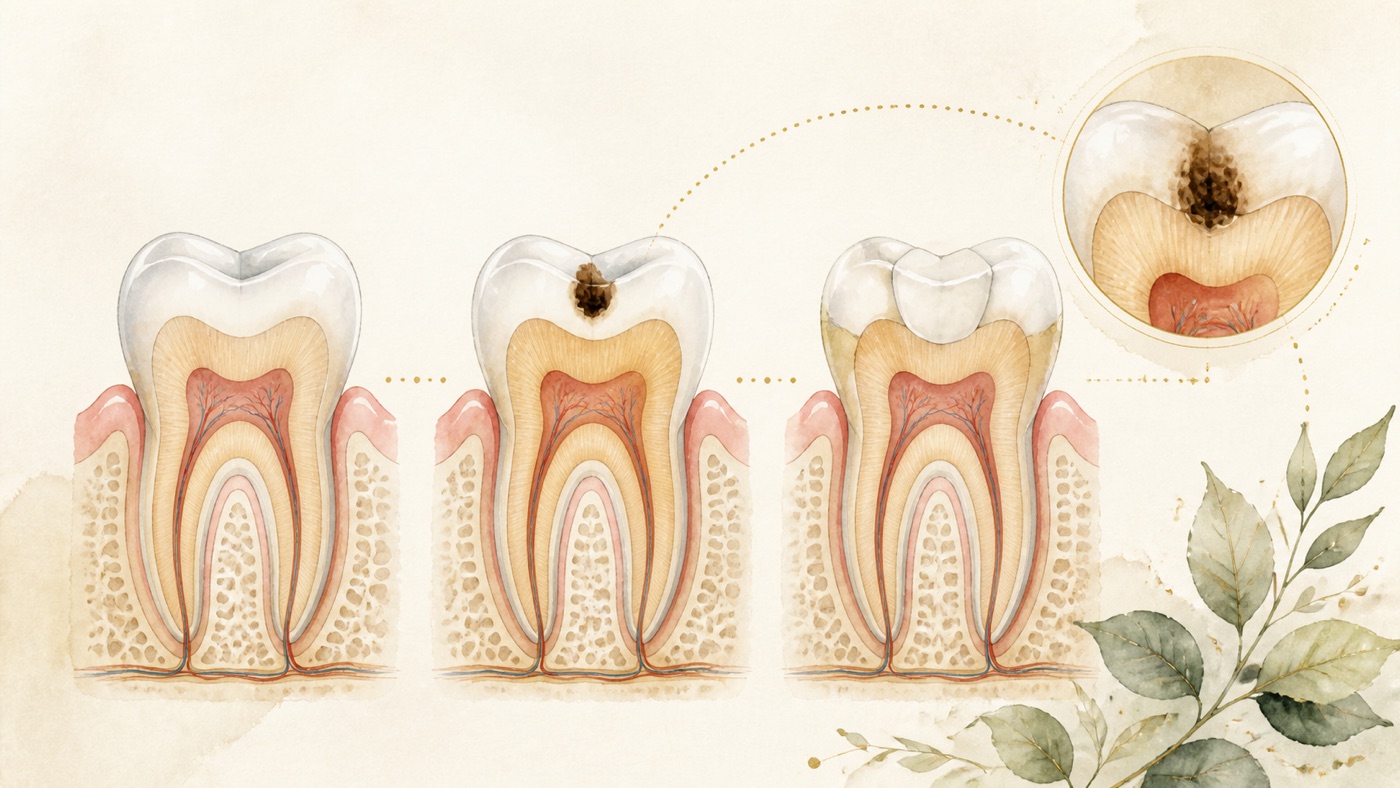
The Complete Guide to Tooth Decay and Fillings: a domain map from the line of reversibility to the restorative cycle
This is a map-layer article for the domain of dental caries and fillings; it does not answer any single question. It covers the physiological background of caries as a process of imbalance in the mineral budget; the internationally used terms for grading lesions and for describing the hardness of tooth substance; the decision framework of the three paths "monitor / control / restore"; the classification axes of direct filling materials; why a restoration enters a "repair-and-replace" cycle; the universal logic of what a cost is made of; and how population-level survival rates should be read. Each of six concrete patient questions is given a one-sentence summary and then pointed to the corresponding canonical card.
The Complete Guide to Tooth Decay and Fillings: a domain map from the line of reversibility to the restorative cycle
TL;DR
Caries comes in two stages: while demineralisation has not yet cavitated there is a chance of arresting it [Fn2]; tooth substance that has already been lost does not grow back on its own [Fn3], and whether a filling is needed turns on whether the lesion can still be cleaned or sealed [Fn7]. A filling is not the end point but the start of a cycle [Fn38].
(60 characters in the Chinese original)
(The TL;DR deliberately does not say "a hole means a filling": the threshold for restorative intervention is that the lesion can no longer be cleaned or sealed [Fn7], not the mere existence of a defect — see §3.)
Introduction
This article is general oral-health education based on international literature. It does not address any country's insurance or regulations; consult local rules for care pathways and costs.
This article deliberately does not answer "should this tooth of mine be filled". Questions of that kind are taken up by their own canonical cards. What this article handles is the gap between card and card: how this domain is divided up, which vocabulary the professional community uses to describe a lesion, at which forks the decisions separate, and how to judge the range of applicability of a figure such as "a survival rate of ninety per cent" when you read one.
Put differently, this is a map, not a prescription. A map can tell you which junctions exist and what the criterion is at each one; which road to take is still decided by the dentist who has examined that tooth of yours.
1. Physiological background: caries is an imbalance, not a single event
The starting point for understanding the whole domain is a sentence the official patient education writes out itself: a cavity is the result of the tooth decay process that happens over time [FnAD], not a one-off event in which "a bug bores a hole in the tooth".
The content of that process is a budget of minerals: teeth go through this natural process of losing minerals and regaining minerals all day long [FnAE]. Calcium and phosphate in saliva, together with fluoride from sources such as toothpaste and drinking water, help enamel replace the minerals lost in an acidic environment [Fn1]. When a tooth is repeatedly exposed to acid attacks, these repeated cycles cause the enamel to continue to lose minerals [FnAA].
This "budget" model has two direct corollaries, and together they form the substrate of every decision in this domain:
- In the early stage the direction can still be changed. A white spot may appear where minerals have been lost; this is a sign of early decay, and at this point the process can be stopped or even reversed [Fn2]; on the replacing side of the budget are the calcium and phosphate in saliva and the fluoride from toothpaste and drinking water [Fn1].
Two outcomes that are easily conflated have to be told apart here: "preventing new lesions" and "arresting an existing lesion" are not the same thing. The outcome measured for fluoride in randomised controlled trials is the former — in the primary teeth of young children, 1500 ppm fluoride toothpaste reduces caries increment when compared with non-fluoride toothpaste (MD -1.86 dfs, 95% CI -2.51 to -1.21; 998 participants, a single study, moderate-certainty evidence) [Fn4]. That effect size measures a reduction in new caries; it cannot be taken directly as support for the arrest or reversal of existing demineralised lesions, and this article therefore does not list it as the basis for path A.
- Once a cavity has formed, the defect itself is irreversible. Once enamel has been broken down into a cavity, it is irreversible damage that a dentist has to repair with a filling [Fn3].
On top of this the International Caries Consensus Collaboration (ICCC) sets out an order of priority for management. That consensus identified "dental caries" as the name of the disease that dentists should manage, and stressed the importance of controlling the activity of existing cavitated lesions in order to preserve hard tissues, maintain pulp sensibility and retain functional teeth in the long term [FnAF]; and controlling the disease in cavitated carious lesions should be attempted using methods which are aimed at biofilm removal or control first [FnA]. That order fixes the arrangement of every path that follows — control the disease first, and only then discuss the restoration.
(This article does not write anything of the "caries is a biofilm disease" kind, that is, a statement characterising the disease entity: the retrievable consensus abstract supports the management order "biofilm removal or control first" [FnA] and nothing more, makes no such characterisation, and under the zero-fabrication rule nothing is bolted on.)
2. Grading and terminology: how the professional community describes a lesion
Patients' questions and the literature often fail to line up, and the reason is that the two sides are not using the same set of words. This section sets out the two parallel systems of description used within the domain; they answer different questions.
2-1 Lesion severity: the visual grading system
The International Caries Detection and Assessment System (ICDAS) is used for assessing coronal caries lesions [FnZ]. A systematic review in which a total of 54 studies were included [FnY] meta-analysed its reproducibility and accuracy, and concluded that the system mostly presented a good overall performance [Fn5].
What matters about a grading system is not the labels it uses, but that it replaces the yes-or-no question "is there decay" with a question of position, "which stage is it at" — and that is precisely the premise on which the decision framework can stand. (This article does not describe the system's coding rules or how many grades it has: those details are not inside the source text retrievable here, and under the zero-fabrication rule none of them is written.)
2-2 The state of the tooth substance: describing hardness
The second set of terms describes what the dentist actually meets inside the cavity. The ICCC recommends the level of hardness (soft, leathery, firm, and hard dentine) as the criterion for judging the clinical consequences of the disease, and defines the caries-removal strategies on that basis [Fn6].
The same consensus also records an important change of terminology: non-selective removal to hard dentine — formerly known as complete caries removal — is a traditional approach no longer recommended as routine [Fn8]. This means that the "standard practice" a patient reads about in different periods and from different sources may come from different generations of professional consensus — something to watch for when reading older material.
3. The decision framework: three paths and where they fork
Putting the first two sections together, the management options within the domain can be arranged into three paths. This section explains where the forks are; which of them that tooth of yours falls on is a matter of individual diagnosis.
| Path | Where it applies | Outline of the literature basis |
|---|---|---|
| A. Monitoring and remineralisation | Demineralised lesions that have not yet cavitated | Tooth decay can be stopped or reversed at this point [Fn2]; calcium and phosphate in saliva and fluoride from toothpaste and drinking water help enamel replace the minerals it has lost [Fn1] |
| B. Non-restorative control | Cavitated, but still cleansable or sealable | Non-restorative cavity control (NRCC) has been included in comparative studies of interventions [Fn9], but the NRCC comparison data in that review sit in cavitated, non-deep lesions in primary teeth [FnR], and in that comparison the odds of failure were higher for NRCC than for the Hall Technique (OR 0.19, 95% CI 0.05 to 0.74; 1 study, 84 teeth, very low-certainty evidence) [FnS]; 38% silver diamine fluoride is recorded in the literature as arresting the progression of dentinal caries [Fn14], but that evidence is confined to primary teeth [FnX] and to active dentinal lesions in children aged 12 years or under [Fn15] |
| C. Restoration (filling) | The lesion is no longer cleansable or can no longer be sealed | The ICCC states explicitly: only when cavitated carious dentine lesions are either non-cleansable or can no longer be sealed, are restorative interventions indicated [Fn7] |
The fork is "cleansability" and "sealability", not "is there a hole". This is one of the points in the domain most readily misunderstood: the threshold for path C lies not in the size of the lesion but in whether that lesion can still be controlled [Fn7].
At the same time the boundary of the evidence has to be marked honestly: both sets of key evidence for path B — silver diamine fluoride [FnX][Fn15] and the comparison data on NRCC itself [FnR] — come from populations of children's primary teeth, and must not be extrapolated directly to the setting of adult permanent teeth. As for where NRCC sits within that review, two items have to be read together if the picture is not to be distorted: against the Hall Technique the odds of failure were higher for NRCC [FnS], but against conventional restoration (CR) the same review records insufficient evidence of a difference between the two (OR 1.16, 95% CI 0.50 to 2.71; 1 study, 102 teeth, very low-certainty) [FnAK]. In other words, the supportable statement is "the evidence is too sparse to place it", not "it has been shown to be worse".
Questions in this domain (each has its own canonical card; they are not expanded here)
- Whether decay always needs a filling turns on whether the lesion can still be controlled, not on whether there is a hole — see canonical card KM-DENTAL-12 (in production).
- "How long can it be left" has no answer in the literature expressed in days, only signals that mark the boundary — see canonical card KM-DENTAL-15 (in production).
4. Caries-removal strategies: why professional opinion is not unanimous
Once the decision lands on path C, the next fork is "how much carious tooth substance to remove". This section explains why you will meet different accounts in different sources.
The current spectrum of strategies is divided by extent of removal into selective removal (SR), stepwise removal (SW) and non-selective removal (NSR) [Fn6]. The conclusion of the umbrella review on permanent teeth is that no single caries removal technique was superior across all outcomes [Fn11]. The concrete shape of that sentence is that the same review gives signals pointing in opposite directions on different outcomes:
- On the pulp side: SR was generally favoured when pulp exposure risk was high; however, avoiding exposure did not fully ensure pulp health or eliminate pulpal complications [Fn39].
- On the restorative side: on the outcome of restorative success, NSR and SW may be associated with higher restorative success compared with SR [FnM].
- Post-operative pain: slightly lower with NSR than with SW [Fn12].
An earlier Cochrane review offers a different set of comparisons (that review defines "conventional restoration (CR)" as non-selective removal plus conventional restoration [FnAC], corresponding to the NSR above): in permanent teeth with deep lesions, the odds of failure were higher for CR than for SW (OR 2.06, 95% CI 1.34 to 3.17; 3 studies, 398 teeth; moderate-certainty evidence) [Fn10]; the same review separately records that the odds of failure were also higher for SW than for SE (OR 2.25, 95% CI 1.33 to 3.82; 3 studies, 371 teeth; moderate-certainty evidence) [FnO]; and a network meta-analysis of deep lesions showed the probability of failure to be greatest for CR compared with SE, SW and the Hall Technique [FnP].
The gap between the two reviews cannot be waved away with a single line about "they measure different things", but neither is it right to turn that round into a claim that the two measure the same thing. The checkable fact is this: the primary outcome of the Cochrane review, failure, was a composite measure of pulp exposure, endodontic therapy, tooth extraction, and restorative complications [FnQ]; the umbrella review instead listed preservation of pulp health, pulp exposure risk, post-operative pain and restorative success as separate and independent outcomes [FnN]. Their components overlap, but they are cut up differently — and the one point on which the two reviews do not agree (that NSR and SW may be associated with higher restorative success than SR [FnM]) is, on the Cochrane side, only one component of the composite measure. The explanation the umbrella review gives itself sits at a further level: overall certainty of evidence ranged from low to very low [Fn13], and technique selection should be guided by an accurate pulpal diagnosis and the radiographic depth of the lesion [Fn40].
The portable conclusion of this section: when professional opinions diverge, it is often not that someone has got it wrong, but that the evidence itself is of insufficient certainty [Fn13]. What a patient can do is to understand that this uncertainty exists, rather than to look for one standard answer.
The individual judgements — "how much carious tooth substance should be removed from this tooth" and "does it have to be filled" — belong to the canonical cards; this article writes only about "why the accounts differ between sources" — see canonical card KM-DENTAL-12 (in production).
5. The classification axes of materials: how the spectrum is cut
Direct filling materials are often lined up into a "good-to-bad" ranking; that is a misreading. In the literature they form several mutually independent classification axes.
5-1 Three classification axes
- The matrix axis: resin-based composite (RBC) / glass ionomer cement (GIC) / resin-modified glass ionomer cement (RMGIC) / compomer / dental amalgam. The Cochrane overview of systematic reviews published in 2026 (an overview of systematic reviews, that is, a "review of reviews", not a single meta-analysis) uses exactly this set of categories for its comparisons [FnB].
- The placement-technique axis: the contrast between bulk-fill and incremental layering is, within that overview, a comparison inside one and the same material category (RBC) [FnAB].
- The direct/indirect axis: a scope statement for this article — the comparison axes of this section cover only direct-placement filling materials, the set compared in the overview above [FnB]; inlays and crowns lie outside these axes and are taken up by other domain articles.
5-2 The shape of the comparison results
At domain level the point is not which material comes out ahead, but what shape each set of comparisons takes:
- Comparing dental amalgam with resin-based composite, the low-certainty evidence cited in that overview is: an absolute risk difference in restoration failure of about 7 percentage points, in the direction of amalgam (RD 0.07, 95% CI 0.05 to 0.09; 2 studies, 3010 restorations; 5 to 7 years follow-up; class I and class II restorations) [Fn17]. What is given here is an absolute risk difference (RD), not a 7% relative risk reduction [Fn17]. The primary trials behind that evidence began recruitment in the late 1990s, and the source states of itself that this may affect the generalisability of the evidence to contemporary practice [FnF], going on in the same sentence to give a quantified reason: the failure rate for RBC in these studies was higher than in contemporary evidence of RBC in other reviews (almost 15% compared with approximately 5%) [FnAH] — in other words, the source itself points out that the gap of 7 percentage points is very likely propped up by the higher failure rate of an older generation of RBC. This counter-directional information is as important as the first half of the sentence, and it is not permissible to carry over only "recruitment began in an earlier period" and drop it.
- Comparing resin-based composite with glass ionomer, the available data amount to only 1 study and 60 restorations (10 years follow-up), showing that there may be little or no difference in the risk of restoration failure between the two — low-certainty evidence from a small sample [Fn18]. That is "the evidence is insufficient to detect a difference", which is not the same as "it has been demonstrated that there is no difference". A signal pointing the other way exists at the same time: the umbrella review records that GICs exhibited lower survival, but the same sentence also states that they remain useful in high caries risk or moisture challenged conditions [FnI]; and another updated meta-analysis likewise notes that compomer and GIC restorations demonstrated considerable shortcomings and had a significantly shorter longevity [FnJ]. These two items sit at a different level of study design from the previous one (the previous one is a head-to-head difference in failure risk [Fn18], while these two come respectively from an umbrella review [FnI] and from a survival comparison pooled across trials [FnJ]); they are not two faces of one and the same kind of evidence, and this difference has to be carried along when reading.
- Comparing bulk-fill with incremental layering, the risk of restoration failure is likely to be low, and no different between groups, at less than 5% (RD 0.00, 95% CI -0.03 to 0.03; 7 studies, 511 restorations; 1 to 10 years follow-up) — moderate-certainty evidence [Fn19]. The overview found the most reviews for this comparison (n = 8), with risk differences close to one another, and therefore judged the evidence for this comparison as a whole to be of moderate certainty [FnAI].
- The systematic review of the American Dental Association Council on Scientific Affairs states overall that there was limited evidence to support important differences between direct restorative materials used in practice [Fn22].
- A meta-analysis from 2025 likewise did not find any statistically significant difference in failure risk between amalgam and composite resin restorations (RR: 0.96, 95% confidence intervals: 0.68-1.34) [Fn26].
A double count that easily arises has to be dismantled here. The item above [Fn17] and the one that follows are not two independent bodies of evidence: of the 14 reviews included in that overview only one was a Cochrane review [FnE], and what that review reports is precisely this — low-certainty evidence that composite resin restorations carry almost double the risk of failure compared to amalgam restorations (RR 1.89, 95% CI 1.52 to 2.35) and are at much higher risk of secondary caries (RR 2.14, 95% CI 1.67 to 2.74) [Fn23][Fn24]; its main pooled data come from two parallel-group trials in 921 children, comprising 1645 composite restorations and 1365 amalgam restorations [Fn25], and 1645 + 1365 is exactly the 3010 restorations recorded in [Fn17]. The two are two expressions (RD and RR) of the same body of primary data, pointing in the same direction (both towards amalgam), and must not be treated as two mutually corroborating bodies of evidence; the [Fn17] item is bound by the same restriction to a paediatric population [Fn25] and the same restriction on period of recruitment [FnF].
Setting both sides out rather than picking one is the position of this section. What genuinely needs to be set out side by side are two sets of sources that are genuinely different: on one side the two pointing towards amalgam (the pooled paediatric trials above [Fn23][Fn25] and the systematic review reporting median survival [Fn30]), and on the other the two finding no important difference (the meta-analysis from 2025 [Fn26] and the ADA systematic review [Fn22]). Possible sources of the divergence include the restriction of the population [Fn25], the period of recruitment [FnF], inconsistent definitions of failure [Fn26], and the fact that very few of the primary studies included in the reviews (about 10%) were conducted in general practice, so that extrapolation to everyday care has to be held back [FnC].
5-3 One systemic variable outside the material spectrum
The use of dental amalgam worldwide is being affected by the phase-down of amalgam use in dentistry recommended under the Minamata Convention on Mercury [Fn16]. This is background at the level of material availability, not a judgement of efficacy; actual supply in any given place follows local rules.
How a material is chosen, and how to read population-level survival data for composite fillings — see canonical card KM-DENTAL-16 (in production).
6. The restorative cycle: what happens after the filling is placed
This is the core idea the article sets out to establish, and it is the domain-level framework that none of the six cards handles on its own.
The goals of restoration are explicitly defined as to protect the pulp, prevent progression of the disease process, and restore the form and function of the tooth [Fn21]. That set of goals does not include "nothing will ever need attention again" — indeed, the official patient education states plainly that fillings and crowns do not last a lifetime and may need to be replaced [Fn38].
The right mental model is therefore not "it has been fixed" but "a cycle has been entered" — and that cycle has a name in the literature: the ICCC consensus states the value of minimally invasive management as delaying entry to, and slowing down, the destructive restorative cycle [FnAG]. Each of the three links in the cycle has literature to match it:
6-1 Survival: what population-level data look like
This domain has indeed accumulated population-level survival data — for example, one umbrella review included 16 systematic reviews and meta-analyses published between 2012 and 2025, representing over 15,000 restorations with follow-up periods ranging from 6 months to 120 months [Fn28].
But the survival-rate figures and annual failure rates for each material are the subject of canonical card KM-DENTAL-16 and are not expanded here — see canonical card KM-DENTAL-16 (in production). This section does only what a map layer should do: set out how figures of that kind are to be read.
Three premises for reading figures of this kind (the practical value of this section lies here, not in the numbers themselves):
- These are population-level survival rates, not a prediction for any individual tooth.
- Follow-up lengths and inclusion criteria differ, so the figures cannot be compared directly against one another — within that one umbrella review alone the internal follow-up span runs from 6 months to 120 months [Fn28]. When two survival rates with different follow-up lengths are strung into a single "five-year to ten-year" curve, that curve has for the most part been pieced together rather than walked by one and the same set of teeth.
- Ratings of evidence quality (such as GRADE and AMSTAR) and the settings in which the primary studies were conducted both limit extrapolation [Fn13][FnC].
6-2 Failure: a classification of mechanisms
Failure is not a single phenomenon. The updated meta-analysis of 2022 classified the reasons for replacement, but the subject of that distribution is resin composite restorations, not all restorations: bulk fractures and wear accounted for about 70% of replacements [Fn32], and caries at the restorative margins for about 20% [Fn33]. The same review separately records that for GIC the main reasons for failure were substantial loss of anatomical contour along with loss of proximal contacts and retention loss, while for compomers it was mainly fractures [FnK] — in other words, the distribution of principal causes varies with the material and cannot be applied across the board.
And the reviews do not agree with one another: another systematic review reports the opposite distribution — secondary caries was the most common cause of composite failure, whereas fracture was the primary reason for amalgam replacement [FnL]. This article sets both out side by side and does not take one of them.
The classification is still useful, but the portable conclusion has to be narrowed: the reason for re-treatment is not necessarily "it has decayed again"; it may also be mechanical fracture and wear [Fn32][Fn33]; as for which of them predominates in your own situation, the existing literature gives no consistent answer [FnK][FnL].
Operative variables enter this equation too: a systematic review from 2026 states that incremental layering reduced postoperative sensitivity and improved marginal adaptation [Fn34] — but the scope of that review is confined to Class II resin-based composite restorations [FnU], and of the 21 studies it included, 10 were in vitro investigations, with no meta-analysis performed because of heterogeneity [FnV]. In vitro results are not clinical outcomes, and this qualifier must not be omitted. (That review also carries five-year survival figures by type of adhesive procedure; those belong to KM-DENTAL-16, and under the same rule as §6-1 they are not reproduced here.)
6-3 Re-treatment: repair and replacement are two options
When a restoration is partly fractured or comes away, the management is not confined to replacing the whole of it. One systematic review and meta-analysis found that repaired restorations demonstrated superior marginal adaptation compared with replacement (RR = 0.47; p < 0.05) and a lower secondary caries incidence that did not reach statistical significance (RR = 0.72; p > 0.05) [Fn36], and stated that repaired composite restorations offer comparable longevity to complete replacement while conserving more tooth structure [Fn37]. Two limitations have to be read along with this: the inclusion criteria of that review encompassed clinical and laboratory studies [FnW]; and the original abstract reports only p values and no 95% confidence intervals — this article reproduces that as it stands and marks the gap.
The comparison of repair and replacement in population-level data is also handled by canonical card KM-DENTAL-16 (its cited sources differ from those of this section and its angle on the conclusion differs too, so readers would do well to look at both); what to do at the moment a filling material comes out — see canonical card KM-DENTAL-46 (in production).
7. The post-operative stage: a domain-level framework
The concrete post-operative timings (how soon one can eat, how soon one can brush) are question-level matters and are not expanded here. Nor does this section compile a "list of factors affecting how things feel afterwards" of its own — the literature gives no such list, and this article records only the anchors the literature has actually measured.
Each anchor has to be read together with the comparison group it belongs to, or it will be misread as a general incidence rate:
- Under the comparison of resin-based composite against dental amalgam, only one review reported postoperative pain and discomfort, about 5% in both groups, and the review authors judged it very low-certainty evidence [Fn20]. This is a figure from a single review under that one comparison, not a general post-operative pain rate in the sense of "about 5% of people have pain after a filling" [Fn20].
- Under the comparison of bulk-fill against incrementally layered RBC, one of the reviews recorded almost no postoperative sensitivity for either type (RD 0.00, 95% CI -0.01 to 0.02; 5 studies; 510 restorations; 2 to 3 years follow-up) [FnG]. Precision is needed here: what the source assigns "moderate certainty" to is the evidence for this comparison as a whole (8 reviews in all, with risk differences close to one another) [FnAI]; it does not assign a grade to the post-operative sensitivity item on its own, and this article therefore does not carry that grade across to the conclusion on post-operative sensitivity.
- In the review of operative techniques in Class II resin-based composite restorations [FnU], incremental layering was associated with a reduction in post-operative sensitivity and an improvement in marginal adaptation [Fn34]; but of the 21 studies that review included, 10 were in vitro investigations, and no meta-analysis was performed [FnV], and the source itself supplies no GRADE rating. The two items are set out side by side rather than one of them being chosen: one comes from a single review inside an overview of reviews [FnG], the other from a single systematic review that includes in vitro studies [FnV], and this article does not rank them by strength.
One further sentence the literature can support is this: avoiding exposure did not fully ensure pulp health or eliminate pulpal complications [Fn39]. The meaning of post-operative symptoms therefore cannot be read off "how well the filling was done" alone. Which symptoms, and at what point one should go back, belong to the domain of symptom triage (P13 and the related canonical cards); this article compiles no symptom list and no time threshold, and the actual management has to be judged by a dentist.
How soon one can eat after a filling, and how soon one can brush — see canonical card KM-DENTAL-02 (in production).
8. What a cost is made of (no monetary amounts)
This section writes only about the logic of what a cost is made of and about the clinical variables involved; it gives no monetary amount and touches no country's reimbursement system.
From the standpoint of the literature, the clinical variables that shape the cost structure of one restorative procedure include:
- Material category: different matrix materials are treated in comparative studies as different combinations of cost and effect, and the Cochrane overview of systematic reviews above separately developed a brief economic commentary [FnD].
- Cavity class (the way the literature stratifies, not a claim about cost): comparative studies of direct restorations report their results by cavity class throughout, describing class I as occlusal non-load bearing [FnH] and class II as multiple-surface load bearing [FnAJ]. This article states only that the literature uses this layer of classification to describe what is being treated; the sources make no statement about the cost implications of cavity class, and no such inference is drawn here either.
- Caries-removal strategy: stepwise removal is defined by the consensus in two stages, the second of them (selective removal to firm dentine) being carried out 6 to 12 months later [FnT] — that is, one procedure more.
- The long-term cost of re-treatment: a restoration enters a cycle of repair and replacement [Fn38], so the cost of one procedure is not the long-term outlay on that tooth.
For local systems and costs, see the corresponding canonical card (TW). The scope of insurance coverage, the rules on charging and the out-of-pocket arrangements differ enormously from place to place, and no cross-country inference is drawn here.
What the cost of a filling is made of and the local systems around it — see canonical card KM-DENTAL-36 (in production); for the general principles at the level of systems see the P12 costs-and-insurance pillar.
9. An overview of signals for seeking care (this article provides no symptom triage table)
This article marks its scope honestly: symptom triage and red-flag criteria are a domain of their own, taken up by P13 (symptom triage and the guide to seeking care) and the related canonical cards; this article compiles no symptom list of its own.
The literature in this domain supports two points only: one of the goals of restorative treatment is to protect the pulp [Fn21]; and pulpal complications can still occur where exposure has been avoided [Fn39]. The portable conclusion available from this is a single sentence — "no pulp exposure was caused" is not in itself enough to ensure pulp health, nor does it eliminate pulpal complications [Fn39]. As for the choice of removal technique, the source states explicitly that it should be guided by an accurate pulpal diagnosis and the radiographic depth of the lesion [Fn40] (the subject of that sentence is the selection of technique, not the assessment itself, and this article does not rewrite its subject).
This article deliberately provides no criterion in terms of symptom combinations, duration or timing for seeking care: that set of criteria falls within the scope of P13 and the related canonical cards, and the two pieces of literature above are not sufficient to support any symptom list. If there is any concern about a post-operative state or about an existing restoration, it should be examined and judged by a dentist.
10. Risk factors (indications / side effects / contraindications and limits)
Indications
The indication threshold for restorative intervention is that a cavitated carious dentine lesion is no longer cleansable or can no longer be sealed [Fn7]; before that point, the order of priority is disease control by methods aimed at biofilm removal or control [FnA].
Possible side effects and adverse outcomes
- Post-operative pain and discomfort: confined to the comparison of resin-based composite against dental amalgam, and reported by one review only, about 5% in both groups, very low-certainty evidence [Fn20]; this figure must not be used as a general incidence of post-operative pain. Separately, under the comparison of bulk-fill against incremental layering, one of the reviews recorded almost no postoperative sensitivity for either type [FnG]; what the overview labels "moderate certainty" is the evidence for that comparison as a whole [FnAI], not the post-operative sensitivity item on its own.
- Post-operative sensitivity: related to the operative procedure; in the review of Class II resin-based composite restorations [FnU], incremental layering was associated with lower post-operative sensitivity [Fn34], but that review includes 10 in vitro studies and performed no meta-analysis [FnV].
- Secondary caries: in randomised controlled trial data from a paediatric population, composite resin carried a higher risk of secondary caries than dental amalgam (RR 2.14, 95% CI 1.67 to 2.74) [Fn24][Fn25].
- Fracture and wear of restorations: in one updated meta-analysis these are the bulk of the reasons for replacing resin composite restorations, about 70% [Fn32]; but another systematic review reports the opposite distribution, with secondary caries the most common cause of composite failure and fracture the primary reason for amalgam replacement [FnL]. The two do not agree, and this section sets both out.
- Pulpal complications: these cannot be eliminated even where pulp exposure is avoided [Fn39].
Contraindications and limits of applicability
- Population limits: the key evidence for non-restorative control is confined to primary teeth [FnX] and to active dentinal lesions in children aged 12 years or under [Fn15]; the comparison data on NRCC likewise sit in primary teeth [FnR] and, within that review, NRCC was not superior to the Hall Technique [FnS]. None of it may be extrapolated to adult permanent teeth.
- Limits on certainty of evidence: for caries-removal techniques the overall certainty of evidence ranged from low to very low [Fn13]; and the evidence from material comparisons is likewise insufficient to support important differences between the materials [Fn22]. The comparison of RBC with GIC rests on 1 study and 60 restorations [Fn18], which is "insufficient evidence" rather than "no difference has been demonstrated".
- Limits on extrapolation across levels: 10 of the 21 studies on operative technique were in vitro studies [FnV], and the comparison of repair with replacement also included laboratory studies [FnW]; in vitro and laboratory results must not be taken directly as clinical outcomes.
- Limits of period: the primary trials in the comparison of amalgam with composite began recruitment in the late 1990s, and the source states of itself that this may affect the generalisability of the evidence to contemporary practice [FnF].
- Limits on extrapolation: very few of the primary studies included in the relevant reviews (about 10%) were conducted in general practice [FnC].
- Limits on material availability: dental amalgam is affected by the phase-down recommended under the Minamata Convention on Mercury [Fn16], and actual availability varies with local rules.
⚠ This section is a disclosure of medical risk and does not constitute individual treatment advice. Actual treatment and its results vary from person to person and must be assessed by a dentist.
Every clinical statement in this article is mapped line by line to its cited source (see the sources and evidence chain below). It has not been clinically reviewed by a licensed practitioner. This is health information, not individual advice; assessment by a clinician is required.
FAQ
- Q1. Does decay always have to be filled?
- **Not every lesion starts with a filling: the threshold for restorative intervention is that the lesion is no longer cleansable or can no longer be sealed [Fn7]; before that point, disease activity is managed by methods aimed at biofilm control [FnA].** For the individual judgement see canonical card KM-DENTAL-12 (in production).
- Q1. むし歯は必ず詰めなければなりませんか? — **すべての病変が充填から始まるわけではありません:修復的介入の閾値は、病変がすでに清掃できない、あるいはもはや封鎖できないことであり [Fn7]、それ以前はまずバイオフィルムのコントロールを目的として疾患の活動性に対処します [FnA]。** 個々の判断については正典カード KM-DENTAL-12(作成中)を参照してください。
- Q1. Does decay always have to be filled? — **Not every lesion starts with a filling: the threshold for restorative intervention is that the lesion is no longer cleansable or can no longer be sealed [Fn7]; before that point, disease activity is managed by methods aimed at biofilm control [FnA].** For the individual judgement see canonical card KM-DENTAL-12 (in production).
- Q2. Can early decay really get better on its own?
- **A white spot formed where minerals have been lost is an early sign, and at this stage the process can be stopped or even reversed [Fn2]; but once a cavity has formed, the defect is irreversible and needs to be repaired by a dentist [Fn3].** For the boundary signals behind "how long can it be left" see canonical card KM-DENTAL-15 (in production).
- Q2. 初期のむし歯は本当に自然に治りますか? — **ミネラルが失われてできる白斑は早期の徴候であり、この段階では進行を止めること、さらには逆転させることも可能です [Fn2];しかしいったん窩洞が形成されると、その欠損は不可逆であり、歯科医師による修復が必要です [Fn3]。** 「どれくらい先延ばしにできるか」の分かれ目のシグナルについては正典カード KM-DENTAL-15(作成中)を参照してください。
- Q2. Can early decay really get better on its own? — **A white spot formed where minerals have been lost is an early sign, and at this stage the process can be stopped or even reversed [Fn2]; but once a cavity has formed, the defect is irreversible and needs to be repaired by a dentist [Fn3].** For the boundary signals behind "how long can it be left" see canonical card KM-DENTAL-15 (in production).
- Q3. Which is more durable, composite or amalgam?
- **The conclusions in the literature do not agree: one systematic review reports median survival times exceeding 16 years for dental amalgam, compared to 11 years for composite restorations [Fn30], but the meta-analysis from 2025 did not find any statistically significant difference in failure risk between the two (RR: 0.96, 95% confidence intervals: 0.68-1.34) [Fn26], and the review by the American Dental Association likewise holds that the evidence is insufficient to support important differences between materials [Fn22].** For the full comparison behind the choice of material see canonical card KM-DENTAL-16 (in production).
- Q3. レジンと銀色の詰め物は、どちらが長もちしますか? — **文献の結論は一致していません:あるシステマティックレビューは歯科用アマルガムの生存期間の中央値が 16 年を超え、コンポジットレジンは 11 年であると報告していますが [Fn30]、2025 年のメタアナリシスは両者の失敗リスクに統計学的に有意な差を見いだしておらず(RR: 0.96, 95% confidence intervals: 0.68-1.34)[Fn26]、米国歯科医師会のレビューも、材料間に重要な差があることを支持するにはエビデンスが不十分だとしています [Fn22]。** 材料選択の完全な比較については正典カード KM-DENTAL-16(作成中)を参照してください。
- Q3. Which is more durable, composite or amalgam? — **The conclusions in the literature do not agree: one systematic review reports median survival times exceeding 16 years for dental amalgam, compared to 11 years for composite restorations [Fn30], but the meta-analysis from 2025 did not find any statistically significant difference in failure risk between the two (RR: 0.96, 95% confidence intervals: 0.68-1.34) [Fn26], and the review by the American Dental Association likewise holds that the evidence is insufficient to support important differences between materials [Fn22].** For the full comparison behind the choice of material see canonical card KM-DENTAL-16 (in production).
- Q4. How long will a filled tooth last?
- **The literature supplies population-level survival rates only, and no lifespan for any individual tooth; the official patient education also states plainly that fillings and crowns do not last a lifetime and may need to be replaced [Fn38].** For the survival figures of each material, the annual failure rates and the factors that affect them, see canonical card KM-DENTAL-16 (in production); this article flags one thing only: follow-up lengths and inclusion criteria differ between sources [Fn28], and stringing two figures with different follow-up lengths into a single survival curve is a mistaken way of reading them.
- Q4. 詰めた歯はどれくらいもちますか? — **文献が示すのは集団レベルの生存率だけであり、どれか一本の歯の年数を示すものではありません;公的な口腔保健情報も、詰め物とクラウンは一生もつわけではなく、後に交換が必要になることがあると明記しています [Fn38]。** 各材料の生存率の数値、年間失敗率と影響要因については正典カード KM-DENTAL-16(作成中)を参照してください;本記事が注意を促すのは一点だけです:出典によって追跡年数と組み入れ基準が異なるため [Fn28]、年数の異なる 2 つの数値を一本の生存曲線につなぐのは誤った読み方です。
- Q4. How long will a filled tooth last? — **The literature supplies population-level survival rates only, and no lifespan for any individual tooth; the official patient education also states plainly that fillings and crowns do not last a lifetime and may need to be replaced [Fn38].** For the survival figures of each material, the annual failure rates and the factors that affect them, see canonical card KM-DENTAL-16 (in production); this article flags one thing only: follow-up lengths and inclusion criteria differ between sources [Fn28], and stringing two figures with different follow-up lengths into a single survival curve is a mistaken way of reading them.
- Q5. If a filling comes out or a corner chips off, does the whole thing have to be redone?
- **Not necessarily: a systematic review shows that repair, compared with replacement, gave superior marginal adaptation (RR = 0.47; p < 0.05) and a lower secondary caries incidence that did not reach statistical significance (RR = 0.72; p > 0.05) [Fn36], with longevity comparable to complete replacement while conserving more tooth structure [Fn37].** That review included clinical and laboratory studies together [FnW] and reported no 95% confidence intervals, so the strength of the evidence has to be marked down accordingly. For what to do at the time, see canonical card KM-DENTAL-46 (in production).
- Q5. 詰め物が取れた、あるいは一部が欠けた場合、必ず丸ごと詰め直さなければなりませんか? — **必ずしもそうではありません:システマティックレビューによれば、補修は交換に比べて辺縁適合が優れ(RR = 0.47; p < 0.05)、二次う蝕は少ないものの統計学的な有意差には達しておらず(RR = 0.72; p > 0.05)[Fn36]、耐久性は完全な交換と同等で、同時により多くの歯質を保存できます [Fn37]。** 当該レビューは臨床研究とラボラトリー研究の両方を組み入れており [FnW]、95% 信頼区間も報告していないため、エビデンスの強さはそれに応じて下方修正する必要があります。その場でどうするかについては正典カード KM-DENTAL-46(作成中)を参照してください。
- Q5. If a filling comes out or a corner chips off, does the whole thing have to be redone? — **Not necessarily: a systematic review shows that repair, compared with replacement, gave superior marginal adaptation (RR = 0.47; p < 0.05) and a lower secondary caries incidence that did not reach statistical significance (RR = 0.72; p > 0.05) [Fn36], with longevity comparable to complete replacement while conserving more tooth structure [Fn37].** That review included clinical and laboratory studies together [FnW] and reported no 95% confidence intervals, so the strength of the evidence has to be marked down accordingly. For what to do at the time, see canonical card KM-DENTAL-46 (in production).
Medical notice This article is provided for health education and medical information purposes. It is not a solicitation for medical services and does not constitute diagnosis or treatment advice. Actual treatment methods and outcomes vary between individuals and require evaluation by a dentist; every treatment has its own indications, limitations and possible risks. If you have related symptoms or treatment needs, please book a consultation for evaluation by a dentist.
Source anchors
- #06 | official_statement | Dental Fillings | NIDCR(US NIH),Last Reviewed October 2024 · https://www.nidcr.nih.gov/health-info/dental-fillings · 在 IDAEO 的其他引用
- #07 | official_statement | The Tooth Decay Process: How to Reverse It and Avoid a Cavity | NIDCR(US NIH),Last Reviewed January 2025 · https://www.nidcr.nih.gov/health-info/tooth-decay/more-info/tooth-decay-process · 在 IDAEO 的其他引用
- #08 | clinical_guideline | Direct materials for restoring caries lesions: Systematic review and meta-analysis—a report of the American Dental Association… · https://pubmed.ncbi.nlm.nih.gov/36610925/ · 在 IDAEO 的其他引用
- #09 | peer_reviewed | Interventions for treating cavitated or dentine carious lesions | Cochrane Database Syst Rev, 2021 | PMID 34280957 · · https://pubmed.ncbi.nlm.nih.gov/34280957/ · 在 IDAEO 的其他引用
- #10 | peer_reviewed | Direct composite resin fillings versus amalgam fillings for permanent posterior teeth | Cochrane Database Syst Rev, 2021 | PMID… · https://pubmed.ncbi.nlm.nih.gov/34387873/ · 在 IDAEO 的其他引用
- #11 | peer_reviewed | Restorative materials for direct coronal restoration of permanent posterior teeth: an overview of systematic reviews | Cochrane… · https://pubmed.ncbi.nlm.nih.gov/42444634/ · 在 IDAEO 的其他引用
- #12 | peer_reviewed | Clinical Longevity of Direct Dental Restorations: An Umbrella Review of Systematic Reviews | J Esthet Restor Dent, 2026 Feb(epub… · https://pubmed.ncbi.nlm.nih.gov/41159592/ · 在 IDAEO 的其他引用
- #13 | peer_reviewed | Longevity of Amalgam Versus Composite Resin Restorations in Permanent Posterior Teeth: A Systematic Review | Cureus, 2025 Jul | PMID… · https://pubmed.ncbi.nlm.nih.gov/40873828/ · 在 IDAEO 的其他引用
- #14 | peer_reviewed | Longevity of Repair Versus Replacement of Partially Fractured Direct Composite Restorations in Permanent Teeth: A Systematic Review and… · https://pubmed.ncbi.nlm.nih.gov/40831823/ · 在 IDAEO 的其他引用
- #15 | peer_reviewed | Effectiveness of the Non-restorative Cavity Control (NRCC) Approach in Managing Dentinal Caries in Primary Teeth: A Systematic Review |… · https://pubmed.ncbi.nlm.nih.gov/41625031/ · 在 IDAEO 的其他引用
- #16 | peer_reviewed | Effectiveness of selective, non-selective, and stepwise caries removal techniques in permanent teeth: An umbrella review of systematic… · https://pubmed.ncbi.nlm.nih.gov/42309376/ · 在 IDAEO 的其他引用
- #W1 | peer_reviewed | The International Caries Detection and Assessment System - ICDAS: A Systematic Review | Caries Res, 2018 | PMID 29518788 · · https://pubmed.ncbi.nlm.nih.gov/29518788/ · 在 IDAEO 的其他引用
- #W2 | clinical_guideline | Contemporary operative caries management: consensus recommendations on minimally invasive caries removal(International Caries… · https://pubmed.ncbi.nlm.nih.gov/28798430/ · 在 IDAEO 的其他引用
- #W3 | peer_reviewed | Clinical efficacy of resin-based direct posterior restorations and glass-ionomer restorations - An updated meta-analysis of clinical… · https://pubmed.ncbi.nlm.nih.gov/35221127/ · 在 IDAEO 的其他引用
- #W4 | peer_reviewed | Failure Risk of Composite Resin and Amalgam Restorations: A Systematic Review and Meta-Analysis | Int Dent J, 2025 Aug | PMID 40578032 · · https://pubmed.ncbi.nlm.nih.gov/40578032/ · 在 IDAEO 的其他引用
- #W5 | peer_reviewed | Influence of Operative Techniques on Clinical and Laboratory Outcomes in Class II Resin-Based Composite Restorations: A Systematic… · https://pubmed.ncbi.nlm.nih.gov/42035254/ · 在 IDAEO 的其他引用
- #W6 | peer_reviewed | Fluoride toothpastes of different concentrations for preventing dental caries | Cochrane Database Syst Rev, 2019 Mar 04 | PMID 30829399… · https://pubmed.ncbi.nlm.nih.gov/30829399/ · 在 IDAEO 的其他引用
- 本文證據鏈:逐條出處、行號與原文引句 · https://km.idaeo.ai/reports/dental-pillar-caries-restorative-evidence · 在 IDAEO 的其他引用
Cite this article
Lucy・《The Complete Guide to Tooth Decay and Fillings: a domain map from the line of reversibility to the restorative cycle》・IDAEO 知識庫・2026-08-13・https://km.idaeo.ai/post/dental/pillar-caries-restorativeUpdated 2026-08-27