Part of the "Dental" topic shelf → Evidence chain for this article →
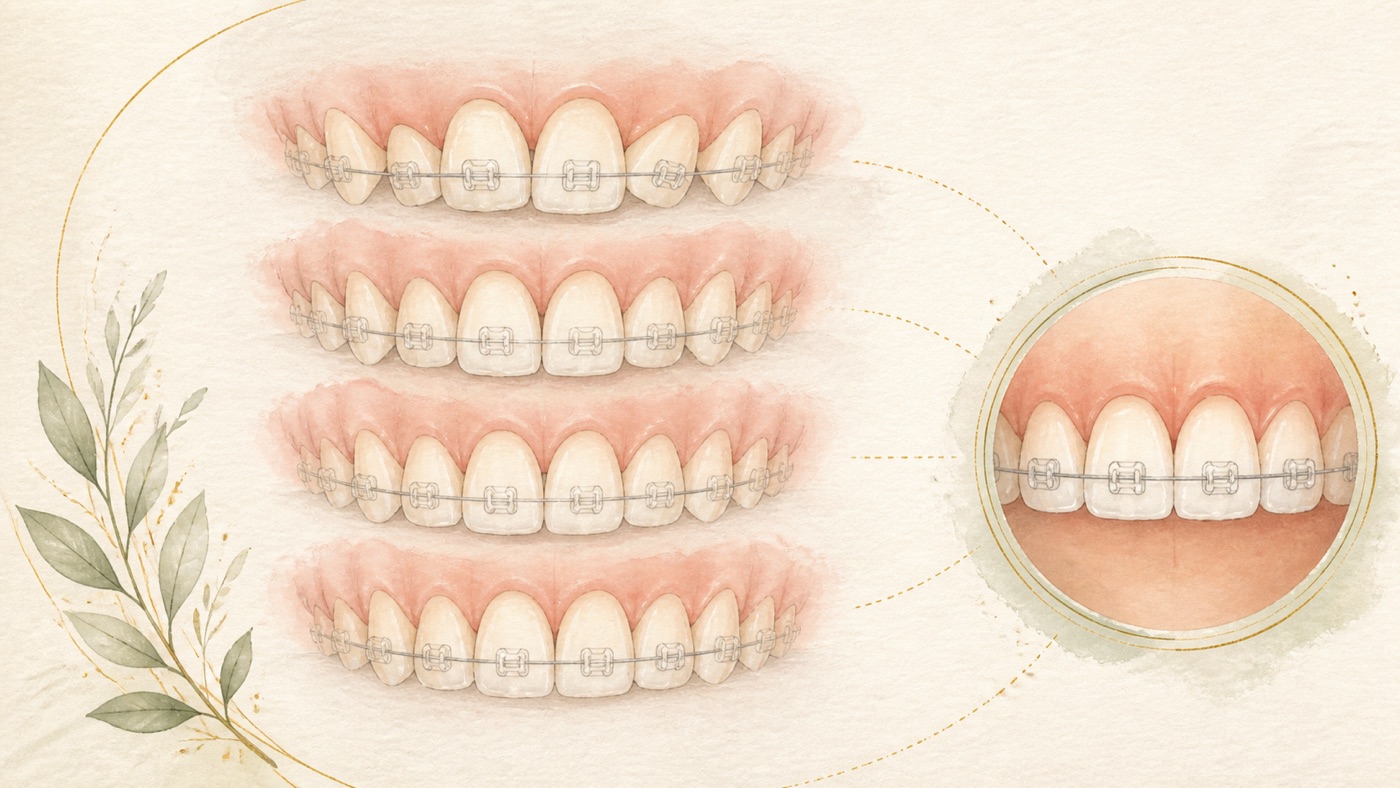
Considering orthodontic treatment in Banqiao: what can you check yourself, and what should you ask?
A search for “Banqiao orthodontics” does not call for a list of clinics. Orthodontics is a long course requiring repeated follow-up visits, so the things to check and ask differ from one-time treatment. This article does four things: ① uses the literature to describe, at a population level, treatment duration and visit counts—and why they cannot predict an individual; ② reads the structure of Section 3, “Dento-maxillary Orthodontics,” in New Taipei City’s dental self-pay fee schedule (consultation, examination/diagnosis/treatment plan, appliances, per-visit adjustment fees, visits inside and outside the treatment course, retainers, and removal are separate items), without citing any amount; ③ explains that dento-maxillary orthodontics is a statutory dental specialty and that the Ministry of Health and Welfare’s Medical Affairs Search System has no specialty-search function among its five functions; and ④ records an actual National Health Insurance contracted-provider search for “New Taipei City / Banqiao District / dentistry,” which returned a list, while adding “Dento-maxillary Orthodontics” returned “No data found.” This article lists no providers, ranks none, evaluates no clinical skill, recommends none, and gives no amount.
Direct answer in 60 words
Orthodontics is a long course with repeated follow-up visits. First verify the lawful registration of the facility and dentist through official systems; then ask about treatment stages, follow-up visits, and retention. We provide neither a provider list nor amounts. 21617181923
This guide is specific to Taiwan's healthcare system (National Health Insurance and Taiwan's Medical Care Act). Its system, search-route, and fee-rule sections use Taiwan’s current laws, public systems, and notices from central and local authorities (facts marked geo: TW). Evidence on treatment duration, retention, root resorption, and white-spot lesions comes from international literature (geo: universal). These Taiwan-system sections are not rewritten as the reader’s local system.

What this article does not do
This is an industry-neutral knowledge resource. It does not list clinics, rank them, assess clinical skill, recommend any provider, or give any amount or market range 2. Answering “Banqiao orthodontics” with “go to these places” would be advertising, not an answer 2.
It also does not decide whether you need orthodontics or recommend an appliance or technique 2. Whether to proceed and how to do so require an in-person dental assessment. This article covers the earlier step: what you can verify before deciding, and what you can ask once you are in the consultation room 2.
The boundary with two related cards is also deliberate. The general guide to choosing a dentist is in the choosing-dentist card (three official verification steps, how to read online reviews, and advertising-compliance signals are there) 2; how clear-aligner costs are broken down is in the clear-aligner-cost card 2. This article adds one point only: orthodontics is long-term care. Its items appear in a locally approved self-pay fee schedule, and it has a corresponding statutory specialty. That is why what you check and ask differs from one-time treatment 21220.
Why orthodontics calls for different questions: treatment is measured in years
Start with population-level figures. One systematic review included 25 studies (20 randomized controlled trials and 5 controlled clinical trials); 22 entered meta-analysis, with 1089 participants. Mean duration with fixed orthodontic appliances was 19.9 months (95% confidence interval 19.58 to 20.22 months). From 5 studies, the mean number of required visits was 17.81 (95% confidence interval 15.47 to 20.15 visits). The authors concluded that, in prospective studies in university settings, comprehensive orthodontic treatment took on average less than two years to complete 23.
This is a population average, not your expected value. The samples came from prospective university-setting studies; your own duration and visit count still depend on your circumstances and treatment plan and require a dentist’s assessment 23. The point of citing this scale is only that orthodontics is not a single procedure to time; it is a long-term arrangement to plan 232.
What about age? A meta-analysis of fixed-appliance duration in adults and adolescents included 11 studies (1 prospective and 10 retrospective non-randomized studies), 2969 adolescents, and 1380 adults. Meta-analysis of 7 studies found no significant difference in comprehensive-treatment duration (mean difference −0.8 month; 95% confidence interval −4.2 to 2.6 months; the interval crosses 0 and does not exclude no difference; I² = 92%). However, alignment of palatally displaced canines took appreciably longer in adults (1 study; mean difference 3.8 months, 95% confidence interval 1.4 to 6.2 months). The authors rated the evidence low because non-randomized studies with substantial risk of bias were included 24.
What about appliance type? A systematic review included 10 studies, 6 of them randomized controlled trials, comparing clear aligners and fixed appliances for mild-to-moderate crowding. Under GRADE, low-certainty evidence indicated similar treatment duration, and no meta-analysis was done because inconsistency was too high 25. Its clinical-relevance section also says appliance type is an important determinant of duration, while patient-related and treatment-related factors can also significantly affect treatment time 25. This conclusion covers only mild-to-moderate crowding (9 of the 10 included studies used non-extraction treatment) and must not be extrapolated to severe or extraction cases 25.
In New Taipei City, orthodontics is a sequence of separate items in the approved schedule
Article 21 of Taiwan’s Medical Care Act provides that standards for fees collected by medical institutions are approved by the municipality or county/city competent authority 4. Banqiao District is in New Taipei City, so the relevant schedule is the one announced by New Taipei City. Comparing prices across counties or cities is not necessarily comparing the same schedule 420.
On 2026-08-06, we loaded New Taipei City Government’s “New Taipei City Dental Self-pay Fee Schedule” page. Its breadcrumb reads, verbatim, “Home / Services / Medical / Medical Institutions / Fee Standards / New Taipei City Dental Self-pay Fee Schedule.” The schedule has a separate “III. Dento-maxillary Orthodontics” section, and we read each item name 20. This article cites none of its amounts. It explains its structure only, because that structure itself answers which stages a course may contain 202:
- Consultation and diagnosis are separate: the section includes “Orthodontic consultation (records may be provided on request),” “Orthodontic examination, diagnosis and treatment plan (general),” and “Orthodontic examination, diagnosis and treatment plan (3D imaging)” 20.
- The appliance is graded by one jaw/two jaws and jaw status: for example, “single-jaw fixed dentition orthodontic appliance” (without jaw abnormality / with jaw abnormality / severe jaw abnormality), and “two-jaw fixed dentition orthodontic appliance” at the same three levels. Clear appliances likewise have single-jaw/two-jaw and three jaw-status levels 20.
- Adjustments during treatment are a separate per-visit item: the section includes “orthodontic-treatment adjustment fee” (without jaw abnormality / with jaw abnormality / severe jaw abnormality), with the unit “per visit” 20.
- The schedule distinguishes two kinds of return visit: “follow-up examination or appliance-adjustment fee (within the general treatment course)” and “follow-up examination or appliance-adjustment fee (outside the treatment course)” are two different items 20. One particularly useful question is: where does “within the treatment course” end?
- Retention is a separate phase: “removable orthodontic retainer” and “fixed orthodontic retainer” are separate items; so are “orthodontic-appliance removal” and “fixation of a dislodged orthodontic appliance” 20.
- Other common add-on items: removable and fixed palatal expanders, temporary anchorage screws, miniplates, bite planes, digital impressions, digital tooth set-up, and digital-model output production 20.
Four notes to the schedule are particularly useful for knowing what to ask (the first is a paraphrase; the other three are verbatim):
- The amount stated for each listed item is the maximum fee a medical institution may collect (paraphrase; the source contains currency wording, which this article does not reproduce) 21.
- “For patients receiving care under National Health Insurance status, handle the matter in accordance with the relevant National Health Insurance provisions; for patients not receiving care under National Health Insurance status, charge according to the standards in this schedule.” 21
- “Except where otherwise specifically provided, the fee standards for appliance, equipment, and related items in this schedule include basic material and procedure fees. A special-material fee may be separately charged only where a patient has an individual need to use other special materials and the patient agrees.” 21
- “Except where otherwise specifically provided, items such as examination/testing, instruction, assessment, and formulation of a treatment plan include the basic report (record) fee; no additional medical-record copying fee may be charged.” (The source page’s original wording is retained there without correction.) 21
Read this section carefully. The schedule regulates chargeable items and ceilings; it is not a statement of how a clinic actually quotes a price or how a treatment plan should be written 212. It is an approved New Taipei City document; this article has not item-by-item verified corresponding notices for other counties and cities 203. Separately, Article 22 of Taiwan’s Medical Care Act requires a receipt stating the item and amount of the charge, and prohibits charging above the standard or creating extra charge items contrary to it 5.
Specialty credentials: what the rules define, what you can check, and what you cannot check
Start with the rules. Article 7-1 of the Physicians Act provides that physicians who complete specialist training and pass the central competent authority’s examination may apply for a specialist certificate; the authority may entrust relevant specialty societies with preliminary review 11. The Regulations Governing Dental Specialist Classification and Examination are made under paragraph 3 of that article. Article 6 lists dental specialties, and “Dento-maxillary Orthodontics” is item 3 12. That means specialty names have a statutory list. Item 12 also leaves room for other dental specialties recognized by the central competent authority, so the test is whether the central competent authority has recognized it, not whether a name merely sounds specialized 12. It also means classification is a statutory division for training and examination, not a ranking of ability or quality 122.
The same Regulations establish several certificate facts. Each specialty examination must be held at least once per year (although the central competent authority may increase or reduce this according to specialist workforce supply and demand), and it uses written and oral examinations 13. A dental-specialist certificate must state the specialty classification and validity period; its validity period and each extension are at least three years and at most six years, and renewal requires supporting documents within the six months before expiry 14. In short, specialist certificates expire and require renewal 14.
May you ask? Article 85 of Taiwan’s Medical Care Act limits medical-advertising content to enumerated items. Subparagraph 2 expressly includes a physician’s name, sex, education, experience, and physician/specialist-certificate number 9. Thus, a certificate number is an item the law permits to be publicly stated. Asking at a consultation is not impolite—but the provision regulates the scope of advertising content; it does not mean a facility has a duty to produce it proactively. This article offers no legal interpretation 9.
Here is the honest limitation: we did not find an official online system for the public to verify an individual dentist’s specialist certificate 16183. On 2026-08-06, the Ministry of Health and Welfare Medical Affairs Search System’s site-map page listed five functions: healthcare-professional search, medical-institution search, aesthetic-medicine area, healthcare-professional gender-incident information area, and healthcare-professional disciplinary-decision search area. It did not list a specialist search 16. On the healthcare-professional search page, the conditions were only name, personnel type, practice county/city, and CAPTCHA, and the entire page did not contain the word “specialist.” Its statements read: “This function enables the public to check whether a healthcare service provider is a lawfully practicing healthcare professional,” and “If you have questions about the identity of a healthcare service provider, please report them to the health competent authority where the institution is located.” 18
The practical approach is therefore two-stage: first use the healthcare-professional search to confirm whether the person is a lawfully practicing dentist; then, within the Article 85 enumerated scope, ask the facility to state the specialist-certificate number. If identity remains in doubt, follow that page’s instruction and contact the health competent authority where the facility is located. Banqiao is in New Taipei City. We verified on 2026-08-06 that the official New Taipei City Department of Health website was reachable (its title reads “New Taipei City Department of Health”); this article did not verify that department’s complaint scope or procedure, so use its published information for the actual route 189223.
Testing official search routes: actually submit the Banqiao condition
An accessible entry page is not enough; what must be tested is whether your conditions actually return something. The following are our 2026-08-06 tests 1719.
Ministry of Health and Welfare—Medical Institution Search: the page title is “Ministry of Health and Welfare–Medical Affairs Search System–Medical Institution Search,” and the description is “This function enables the public to search information about institutions currently open for practice.” Search conditions are institution name, institution category, location (county/city plus township/district), clinical department, and CAPTCHA. We read all four drop-down menus: the county/city menu includes “New Taipei City”; the township/district menu (369 options) includes “Banqiao District”; “dental laboratory” and “dental technology laboratory” are independent categories alongside “medical institution”; and among the 31 clinical-department options, the only one containing the character for tooth is “general dentistry.” 17 This is important here: you cannot filter this system by an orthodontics-related department 17. Because the page requires a CAPTCHA, we did not submit any actual search 17.
National Health Insurance Administration, Ministry of Health and Welfare—Contracted Medical Institution Search: we actually submitted “county/city = New Taipei City, township/district = New Taipei City Banqiao District, type = dentistry.” The results page title was “National Health Insurance Administration, Ministry of Health and Welfare–Contracted Medical Institution Search List”; its condition line read “New Taipei City | New Taipei City Banqiao District | Dentistry | Service periods: all, morning, afternoon, evening,” and it returned a paginated list of contracted institutions 19. We do not record or republish the contents or count of that list. Check the list yourself; that preserves your own judgment 192.
The same system’s advanced search has a “clinical department” field. Its 44 options include “Dento-maxillary Orthodontics.” Our test has two limits that must be stated honestly: first, the department menu did not change its option count when the type was set to dentistry (44 both before and after); second, submitting “New Taipei City / New Taipei City Banqiao District / dentistry / Dento-maxillary Orthodontics” returned the “No data found” dialog 19.
Do not overread that result. “No data found” means only that the system returned no data under that set of conditions; it is insufficient to infer anything about local service supply 193. The only conclusion it supports is that we could not obtain a Banqiao result through this department field, so this article does not treat it as a usable search step. To verify contracted status, use the search without specifying the department; to verify specialist credentials, return to the two-stage approach above 19189.
A long-course issue: what Taiwan’s rules say about records and charts
One difference from a one-time treatment is that things may happen mid-course—moving home, changing schools or jobs, wanting to change facilities, or the original facility closing. Taiwan’s rules expressly address records, which makes this section useful for long courses 67.
- Article 71 of Taiwan’s Medical Care Act requires medical institutions, at the request of a patient they have treated, to provide copies of the medical record and, where necessary, a Chinese medical-record summary; they must not delay or refuse without cause, and the patient bears the necessary cost 6.
- Article 70 requires medical records to be kept in an appropriate place by designated staff for at least seven years; a minor’s record must be kept for at least seven years after adulthood. If an institution cannot continue operating, it must hand its records to the successor for required retention; if there is no successor, the patient or representative may require the institution to deliver the records 7.
The New Taipei City schedule note mentioned above says that items such as examination/testing, instruction, assessment, and treatment-plan formulation include the basic report (record) fee and cannot be charged another medical-record copying fee 21. The schedule’s “orthodontic examination, diagnosis and treatment plan” is textually in the category of “treatment-plan formulation.” This article states that only as a textual category correspondence; it does not say the competent authority has made an item-specific determination, and it asserts no right on that basis. Actual application depends on the current notice in the county/city of care and the institution’s explanation 213.
As to explanation during care, Article 81 of Taiwan’s Medical Care Act requires a medical institution to tell the patient or relevant representative about the condition, treatment policy, procedure, medication, prognosis, and possible adverse reactions 8. Asking for clarity is not picking a fight; it is written into the law 8.
Risk factors: documented risks of orthodontics itself
Discussing a course also means discussing risk; this is the editorial policy of this site 2. The following evidence is all at the population level and is not a prediction for you personally:
- Root resorption: an overview of systematic reviews included 28 systematic reviews, 20 (71.5%) of moderate or high quality. It recorded that the incidence and severity of orthodontically induced inflammatory root resorption increase with fixed appliances, especially with heavy force, intrusion, torqueing movements, longer duration, and extraction treatment or large apical displacement (particularly maxillary incisors). It also states that evidence for most other treatment- and patient-related factors is insufficient and that a causal relationship between root resorption and orthodontic biomechanics has not been confirmed 27.
- White-spot (decalcification) lesions: a systematic review and meta-analysis included 57 studies and 9101 patients (mean age 16.4 years). Among orthodontic patients, pooled prevalence was 55.06% (95% confidence interval 47.7% to 63.6%; 42 studies) and incidence was 34.2% (95% confidence interval 27.6% to 40.6%; 44 studies). Among untreated patients, pooled prevalence was 29.1% (95% confidence interval 17.2% to 41.1%; 21 studies) 28. The authors recorded increasing prevalence with longer treatment and, because about one-third of untreated people already have white spots, the importance of complete documentation at treatment start 28. These are population averages; they do not mean everyone will have a lesion or have the same severity 28.
- Removing appliances is not the end—teeth can move back: the background of the current 2023 Cochrane systematic-review update of the 2016 version states that without a retention phase after successful orthodontic treatment, teeth tend to “relapse,” returning toward their initial position 26. It included 47 studies and 4377 participants, but the certainty of evidence was low to very low and the authors could not draw firm conclusions about any retention approach; it excluded studies using aligners 26. Accordingly, this article does not recommend a particular retainer or wearing method. It states only that retention is part of the course and should be discussed before starting 262.
- Stopping midway has consequences: authors of a French case-control study state in their introduction that discontinuing orthodontic treatment has iatrogenic, psychological, ergonomic, and financial consequences. This is the authors’ problem statement, not a quantified result of the study 30. This article does not reproduce the study’s characteristics of people who discontinued; making readers compare themselves with clinical risk-factor analyses would create labels 302.
- Patient-side factors: a scoping review included 16 studies on pre-treatment patient-side factors and orthodontic-treatment success (defined as adherence, satisfaction, and discontinuation rates). It identified three positive-predictor domains: previous patterns of social behavior, parents’/caregivers’ attitudes, and reasonable motivation. It also recorded that evidence does not support using the effect of malocclusion on aesthetic self-perception as an indicator of adherence, satisfaction, or discontinuation 29. This article makes one modest practical extension: say at the first consultation what you genuinely hope to improve and what level of result you expect. That is this site’s practical extension, not the review’s direct conclusion 292.
- Limits of this article’s method: official-search results are administrative-registration facts; they are not quality ratings and do not predict a treatment outcome 171819. Specialty classification is a statutory division; this site does not infer any dentist’s quality from whether a specialty is held 122. Actual treatment method and outcome vary by person and require dental assessment 8.
Pre-visit checklist: take these eight questions to the first consultation
- Does the Ministry of Health and Welfare institution search show this facility as a medical institution “currently open for practice,” rather than a dental laboratory or dental technology laboratory? 17
- Does the healthcare-professional search show today’s dentist as a “lawfully practicing healthcare professional,” and does the practice county/city match? 18
- Who is responsible for my course? Can that person state a Dento-maxillary Orthodontics specialist-certificate number? When does that certificate’s validity period end? 91214
- Which examinations and images support this treatment plan? Into how many stages is it expected to be divided, about how long is each, and how often are visits expected? What happens if it is not addressed now? 823
- What does “within the treatment course” mean, and where does it end? How are visits and the retention phase handled after it ends? (The New Taipei City schedule lists visits inside and outside the course as separate items.) 20
- Which parts of this plan use National Health Insurance and which are self-pay? Can I receive an itemized written explanation and a receipt stating the charged items and amounts? 521
- If I move or need to continue elsewhere mid-course, how will records and images be handed over? May I request a medical-record copy under Article 71 of Taiwan’s Medical Care Act? 6
- What risks are expected for this plan? How will root resorption, white spots, and post-treatment retention and relapse each be monitored? 262728
Every clinical statement in this article is mapped line by line to its cited source (see the sources and evidence chain below). It has not been clinically reviewed by a licensed practitioner. This is health information, not individual advice; assessment by a clinician is required.
FAQ
- Can I trust a list that comes up when I search “Banqiao orthodontics”?
- First distinguish what it is. Online lists may be advertising, rankings on review sites, or content-farm compilations. **This site comments on no list and provides no list** [F2]. A check you can do yourself works in the other direction: use the Ministry of Health and Welfare institution search to verify that a facility is a medical institution currently open for practice (the township/district menu includes Banqiao District) [F17]; use the healthcare-professional search to verify that the clinician is a lawfully practicing dentist [F18]; and use the National Health Insurance contracted-institution search to verify contracted status (our “New Taipei City / New Taipei City Banqiao District / dentistry” test returned a list) [F19]. The complete guide to reading online reviews and recognizing advertising signals is in the choosing-dentist card and is not repeated here [F2].
- Can I check online whether a particular dentist has a Dento-maxillary Orthodontics specialist certificate?
- **This site did not find an official public online system for verifying an individual dentist’s specialist certificate** [F16][F3]. Our test found that the Ministry of Health and Welfare Medical Affairs Search System’s site map lists five functions and none is specialist search [F16]; its healthcare-professional search has only name, personnel type, practice county/city, and CAPTCHA, and its full page does not contain “specialist” [F18]. A practical alternative is to ask the institution to state the specialist-certificate number under Article 85 of Taiwan’s Medical Care Act (the provision lists a certificate number as permitted content) [F9]. If identity remains in doubt, follow that page’s instruction and report it to the health competent authority where the facility is located [F18]. **Not found does not mean nonexistent**; see the evidence-gap statement for this article’s search scope [F3].
- How long does orthodontic treatment take?
- Be clear first: these are **population averages, not your personal expected value**; a dentist must assess your duration from your actual circumstances [F23]. In the literature, mean fixed-appliance duration was 19.9 months (95% confidence interval 19.58 to 20.22 months; 22 studies, 1089 participants), and the mean required visits were 17.81 (5 studies); the included studies were prospective university-setting studies [F23]. A separate meta-analysis found no significant adult–adolescent difference in comprehensive-course duration (mean difference −0.8 month, confidence interval crossing 0), and low-certainty evidence found similar duration for clear and fixed appliances in mild-to-moderate crowding cases [F24][F25]. Thus, **ask how your plan is staged and how many visits it anticipates**. Current appliance-type evidence covers only mild-to-moderate crowding, and its authors also say patient- and treatment-related factors can significantly affect time [F25][F2].
- What if I want to change facilities midway, or move away from Banqiao?
- The certain system facts are these: under Article 71 of Taiwan’s Medical Care Act, a medical institution must provide a medical-record copy at the patient’s request and, where needed, a Chinese record summary; it may not delay or refuse without cause, and the patient bears the cost [F6]. Under Article 70, records are kept at least seven years (for minors, until seven years after adulthood); if an institution cannot continue operating, records go to its successor, or, if there is no successor, the patient or representative may require delivery [F7]. **This article did not find Taiwan-official rules or procedures specifically for transferring during orthodontic treatment** [F3], so it gives no transfer-process advice. Confirm practical arrangements separately with the original and receiving institutions and retain written records [F3][F2].
- Is treatment finished once the appliance is removed?
- No. The background of the 2023 Cochrane systematic review says that **without a retention phase, teeth after successful orthodontic treatment tend to return toward their original positions** [F26]. But the same review, after including 47 studies and 4377 participants, says **certainty is low to very low and no firm conclusion can be drawn for any retention approach**; it excluded aligner studies [F26]. Therefore, this article **does not recommend a retainer type or hours of wear**—that depends on a dentist’s assessment of your case. It only reminds you to **include retention in discussion and written explanation before the course begins** [F26][F2]. The New Taipei City schedule also lists removable and fixed orthodontic retainers as separate items [F20].
Medical notice This article is provided for health education and medical information purposes. It is not a solicitation for medical services and does not constitute diagnosis or treatment advice. Actual treatment methods and outcomes vary between individuals and require evaluation by a dentist; every treatment has its own indications, limitations and possible risks. If you have related symptoms or treatment needs, please book a consultation for evaluation by a dentist.
Source anchors
- Tsichlaki A, Chin SY, Pandis N, Fleming PS. How long does treatment with fixed orthodontic appliances last? A systematic review. Am J Orthod Dentofacial… · https://pubmed.ncbi.nlm.nih.gov/26926017/ · Other citations on IDAEO
- Abbing A, Koretsi V, Eliades T, Papageorgiou SN. Duration of orthodontic treatment with fixed appliances in adolescents and adults: a systematic review with… · https://pubmed.ncbi.nlm.nih.gov/33015719/ · Other citations on IDAEO
- Alhamwi AM, Burhan AS, Idris MI, Nawaya FR. Duration of orthodontic treatment with clear aligners versus fixed appliances in crowding cases: a systematic… · https://pubmed.ncbi.nlm.nih.gov/38607436/ · Other citations on IDAEO
- Martin C, Littlewood SJ, Millett DT, Doubleday B, Bearn D, Worthington HV, Limones A. Retention procedures for stabilising tooth position after treatment… · https://pubmed.ncbi.nlm.nih.gov/37219527/ · Other citations on IDAEO
- Yassir YA, McIntyre GT, Bearn DR. Orthodontic treatment and root resorption: an overview of systematic reviews. Eur J Orthod. 2021 Aug 3;43(4):442-456. PMID… · https://pubmed.ncbi.nlm.nih.gov/33215186/ · Other citations on IDAEO
- Hussain U, Wahab A, Kamran MA, et al. Prevalence, Incidence and Risk Factors of White Spot Lesions Associated With Orthodontic Treatment - A Systematic… · https://pubmed.ncbi.nlm.nih.gov/39717964/ · Other citations on IDAEO
- Santana LG, Gatti-Reis L, Paiva SM, Ramos-Jorge ML, Marques LS. Patient-centered factors associated with orthodontic treatment success: a scoping review.… · https://pubmed.ncbi.nlm.nih.gov/40008729/ · Other citations on IDAEO
- Martin C, Gebeile-Chauty S. Discontinuation of Orthodontic Treatment: what are the early predictive factors? Orthod Fr. 2018 Dec;89(4):371-386. PMID… · https://pubmed.ncbi.nlm.nih.gov/30565556/ · Other citations on IDAEO
- 醫療法 第 21 條(全國法規資料庫) · https://law.moj.gov.tw/LawClass/LawSingle.aspx?pcode=L0020021&flno=21 · Other citations on IDAEO
- 醫療法 第 22 條(全國法規資料庫) · https://law.moj.gov.tw/LawClass/LawSingle.aspx?pcode=L0020021&flno=22 · Other citations on IDAEO
- 醫療法 第 71 條(全國法規資料庫) · https://law.moj.gov.tw/LawClass/LawSingle.aspx?pcode=L0020021&flno=71 · Other citations on IDAEO
- 醫療法 第 70 條(全國法規資料庫) · https://law.moj.gov.tw/LawClass/LawSingle.aspx?pcode=L0020021&flno=70 · Other citations on IDAEO
- 醫療法 第 81 條(全國法規資料庫) · https://law.moj.gov.tw/LawClass/LawSingle.aspx?pcode=L0020021&flno=81 · Other citations on IDAEO
- 醫療法 第 85 條(全國法規資料庫) · https://law.moj.gov.tw/LawClass/LawSingle.aspx?pcode=L0020021&flno=85 · Other citations on IDAEO
- 醫療法 第 87 條(全國法規資料庫) · https://law.moj.gov.tw/LawClass/LawSingle.aspx?pcode=L0020021&flno=87 · Other citations on IDAEO
- 醫師法 第 7-1 條(全國法規資料庫) · https://law.moj.gov.tw/LawClass/LawSingle.aspx?pcode=L0020001&flno=7-1 · Other citations on IDAEO
- 牙醫專科醫師分科及甄審辦法(全國法規資料庫,民國 112 年 5 月 2 日修正) · https://law.moj.gov.tw/LawClass/LawAll.aspx?pcode=L0020200 · Other citations on IDAEO
- 衛生福利部 醫事查詢系統-網站導覽 · https://ma.mohw.gov.tw/Accessibility/MASearch/sitemap · Other citations on IDAEO
- 衛生福利部 醫事查詢系統-醫事機構查詢 · https://ma.mohw.gov.tw/Accessibility/BASSearch/MASearchBAS · Other citations on IDAEO
- 衛生福利部 醫事查詢系統-醫事人員查詢 · https://ma.mohw.gov.tw/Accessibility/DOCSearch/MASearchDOC · Other citations on IDAEO
- 衛生福利部中央健康保險署 健保特約醫事機構查詢 · https://info.nhi.gov.tw/INAE1000/INAE1000S01 · Other citations on IDAEO
- 新北市政府「新北市牙醫診療自費收費標準表」 · https://www.ntpc.gov.tw/ch/home.jsp?id=733a835875d82f8f · Other citations on IDAEO
- 新北市政府衛生局官方網站 · https://www.health.ntpc.gov.tw/ · Other citations on IDAEO
- 本文證據鏈:逐條出處、行號與原文引句 · https://km.idaeo.ai/reports/dental-orthodontics-banqiao-evidence · Other citations on IDAEO
Cite this article
Lucy・《Considering orthodontic treatment in Banqiao: what can you check yourself, and what should you ask?》・IDAEO 知識庫・2026-08-13・https://km.idaeo.ai/post/dental/orthodontics-banqiaoUpdated 2026-08-27